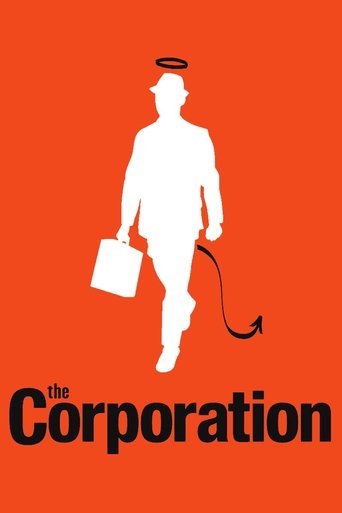
The Corporation
2003 · Film · documentary · 145 min
Directed by Mark Achbar, Jennifer Abbott
Since the late 18th century American legal decision that the business corporation organizational model is legally a person, it has become a dominant economic, political and social force around the globe. This film takes an in-depth psychological examination of the organization model through various case studies. What the study illustrates is that in the its behaviour, this type of "person" typically acts like a dangerously destructive psychopath without conscience. Furthermore, we see the profound threat this psychopath has for our world and our future, but also how the people with courage, intelligence and determination can do to stop it.
50 positive11 neutralfrom 61 commenters
Where to watch
No streaming data for this title.
77 comments on Hacker News
There is a movie which does this, trying to align to WHO ICD list:
The Corporation / 2003
https://en.wikipedia.org/wiki/The_Corporation_(2003_film)
Free to watch on YT, IIRC
Chomsky called corporations legal psychopaths in the documentary "The Corporation". He was right.
If companies can engage in terrible illegal behavior and then only pay 10% of profit as a fine, so can I.
If that means I cancel all streaming services, help friends also cancel streaming services, set up a Jellyfin/Navidrome box and grab everything, I do not give one fuck. Hell, the AI companies grabbed Annas Archive and Libgen. Why not me?
So, yeah. I wouldnt steal from fellow humans. I value humans. But companies and corporate "property"? <SPIT>
A company is a ship of Theses. Someone can die, and theyre replaced within 3 days. A new hire takes their place within a month (or used to). And legally, the comapny's sole responsibility is "make money for shareholders".
An analysis of 'what a company is', is fair to compare it to the most laser-focused sociopath.
But your false point is trying to say 'Since humans run a company, its human ethics and just humans'. And what we have is demonstrably not human-like.
The 2003 documentary film 'The Corporation' does a deep dive as why you are wrong, in regards to falsely equivocating humans to a corporation. The worst of the worst behaviors of sociopathic humans get selected more and more, all in the name of money.
https://m.youtube.com/watch?v=6v8e7dUwq_Q
Now I understand your point. I narrowed my thinking process to the music industry. You're right that companies usually never "go to jail" just "kindly" pay the fee eventually. I remember there's movie "Corporation" which tries to prove that if company is a person (legal person), this person has a personality disorder
I think there are two key imperatives that lead to company "psychopathy".
The first imperative is a company must survive past its employees. A company is an explicit legal structure designed to survive past the initial people in the company. A company is _not_ the employees, it is what survives past the employees' employment.
The second imperative is the diffusion of responsibility. A company becomes the responsible party for actions taken, not individual employees. This is part of the reason we allow companies to survive past employees, because their obligations survive as well.
This leads to individual employees taking actions for the company against their own moral code for the good of the company.
See also The Corporation (2003 film) and Meditations On Moloch (2014)[0].
[0] https://slatestarcodex.com/2014/07/30/meditations-on-moloch/
Anti-corporate attitudes were completely normalized in the 2000s and arguably only really lulled during the mid-2010s. There were several films from that period that featured countercultural messaging:
Disney’s Incredibles had allusions to Kafka
Monster’s Inc. is a commentary on corporate vampirism.
Kingdom of Heaven was if not a commentary on the Global War on Terror at least a bold film to have released 4 years after 9/11.
The second Pirates of the Caribbean film was a (childish) commentary on global empire and rationalization eliminating places for the human person to live freely.
The Corporation, Capitalism: A Love Story, and Supersize Me were all released post-9/11. They screened Supersize Me in elementary and high schools when it was released.
Anti-globalization as a movement completely collapsed during the Occupy Wall Street protests. These movements had attitudes towards international mobility rights that completely undermined organized labor. Most of them recognized what impacts illegals were having on these industries but took the position that labor solidarity would somehow make everyone better off. This could have worked in theory except that they had no operational plan to enact this solidarity and the illegals were never interested in it to begin with.
Once the bankers realized that they could just pay off the OWS leadership with fake email jobs, you started to see the conventional partisan divide on globalism that we observe today, with liberals being in favor of it and conservatives opposed to it.
I think (haven't actually watched it, but on my watchlist) this is exactly what the movie "The Corporation" (2003) [1] lays out.
[1] https://m.imdb.com/title/tt0379225
Thank you. Well expressed. I very much agree with this and have been saying so to friends for years.
The way I look at it is that it's analogous to the way we ourselves function: we're made up of billions of cells which individually just follow simple programs mediated by local interactions with their neighbours as well as some global state mediated by hormones and signals from the nervous system. However collectively they produce what we call intelligence (and even consciousness) which we wouldn't ascribe to any of the component cells and those components aren't aware of the collective organisms goal. Moreover the overall organism can achieve goals and solve problems beyond the scale of the components.
Similarly our institutions, be they corporations, governments, etc... are collective intelligences with us as the parts. These institutions have goals and problems solving capabilities that far surpass our own - no individual could keep all Walmart stores perfectly stocked every day, or design a modern microchip or end-to-end AI platform, etc... . These really are the goals of the organisations, and not the individuals. Take for example the US government, every four years you swap out the individuals in the executive branch yet overall US policy remains largely unchained. Sure, sometimes there is a major shift in direction, but it takes time for that to be translated into shifts in policy and actions as different parts of the system react at different speeds. The bigger point is that the individuals executing the actions get swapped out over time (at different speeds for different parts like cells being replaced at different speeds in our bodies) but the organisation continues to pursue its own goal which only changes slowly over time. Political and financial analysts implicitly acknowledge this when they talk about US or Chinese policy but this often gets personified into the leader.
I think we really need to acknowledge more the existence and reality of organisational goals as independent of the goals of the individuals in those organisations. I was struck by how in the movie The Corporation they point out that corporations often take actions that are contrary to the beliefs of the individuals in them, including the CEO because the CEO is bound by his fiduciary duty to the shareholders. Corporations are legal persons and if you analyse them as persons they are psychopaths, without any human feelings or regard for human cost or externalities unless those are enforced through some legal or pricing mechanism. Yet when corporations or organisations transgress we often hold the individuals accountable. Sometimes the individuals are to blame but often its how the game has been set up that is at fault. For example, in a globally heterogenous tax regime, a multinational corporation will naturally minimise its tax burden, it can't really do otherwise and the executives of the company have a fiduciary duty to shareholders to carry that out.
Therefore we have revise and keep evolving the rules of the game in order to stay compatible with human values and survival.
There's a movie "Corporation" (2003) that makes an argument that the corporations behave like psychopaths (in a medical sense i.e. the diagnostic criteria).
See the movie "The Corporation", which compares corporations to psychopaths; they're very similar in that corporations don't have a conscience.
Corporations, IMO, should not be involved in politics at all - only real people. Rich people would still have more influence over political decisions, but not to the extent that rich corporations do now.
Yawn. Isn't that exactly what https://en.wikipedia.org/wiki/The_Corporation_(2003_film) & https://thecorporation.com/film/ was about twentyone years ago? (Time flies!)
As bottom line at least? Can't have the one without the other, just different aspects of the same shit.
Everything and Nothing: the Amazing Science of Empty Space: https://www.imdb.com/title/tt2071460/
The Corporation: https://www.imdb.com/title/tt0379225/
See the documentary "The Corporation" (2003)
It looks at what sort of 'people' Corporations are:
The documentary attempts to compare the way corporations are systematically compelled to behave with what it claims are the DSM-IV's symptoms of psychopathy, e.g., the callous disregard for the feelings of other people, the incapacity to maintain human relationships, the reckless disregard for the safety of others, the deceitfulness (continual lying to deceive for profit), the incapacity to experience guilt, and the failure to conform to social norms and respect the law.
https://en.wikipedia.org/wiki/The_Corporation_(2003_film)
The failure mode of governments is to become “exploitative and corrupt,” Runciman notes. The failure mode of corporations, as extensions of an independent civil society, is that “their independence undoes social stability by allowing those making the money to make their own rules.” There is only a “narrow corridor”—a term Runciman borrows from the economists Daron Acemoglu and James A. Robinson—in which the artificial agents balance each other out, and citizens get to enjoy the sense of control that emerges from an atmosphere of freedom and security. The ideal scenario is, in other words, a kludgy equilibrium.
This is really interesting; to draw parallels between AI and the emergence of States and Corporations, which are two other inventions that we have lost control of. You could argue that Climate Change is an X-risk bought about by Corporations, which lumber around our civil landscape like single minded giants pursuing profit above all else and using regulatory capture to push externalities onto the populace.
I'm a big fan of The Corporation (2003), a documentary that explores how Corporations came to have legal rights, and asks, if Corporations are legal people, what sort of people are they? They exhibit reckless disregard for the safety of others, deceitfulness, the incapacity to experience guilt, and the failure to conform to social norms and respect the law, which matches the DSM-IV's symptoms of psychopathy.
The art documentary https://en.wikipedia.org/wiki/The_Corporation_(2003_film) (available on YouTube...) is basically about how the distant separation of employees from the consequences of their decisions naturally leads nice, regular people to behave effectively like psychopaths and not realize it. Highly recommended.
> What the fuck are you even saying?
They were saying the truth: as a corporation, their primary fiduciary responsiblity is to return value to their shareholders.
Definitely worth watching: https://archive.org/details/The_Corporation_
You can watch "The Corporation" free on the Internet Archive: https://archive.org/details/The_Corporation_/TheCorporation-Movie-Part1.avi
More about it: https://en.wikipedia.org/wiki/The_Corporation_(2003_film)
Oh if only I could upvote this x1000.
Watch the documentary "The Corporation". It explains perfectly what is going on.
Interesting bit in "The Corporation" iirc about a phony research on how to make kids nag more efficiently which was presented as neutral research for parents about raising kids.
https://www.imdb.com/title/tt0379225/
yes, i think we agree that, at least in theory, companies with bad reps could find it more difficult to find people, find the best people, find people for as low a salaries as they would like, etc.
otoh, i think you could just as easily argue that these companies are attracting the absolute best talent, paying them the highest salaries, and being happy to do so -- because their business model enjoys insane profits.
employees might have to leave a bit more of their conscience at the door, but there are all sorts of ways to justify that to oneself.
what is the 'absolute best talent' for a company with a less-than-stellar reputation?
really, it's probably the same employee as for most companies -- someone whose beliefs/behaviors most closely model the expected and ideal behavior of corporations -- sociopaths. serial killers, even -- as long as they didn't kill their fellow employees. it's expensive to find talent in this market!
it reminds me of the lady, Lucy Hughes, of marketing firm, Initiative -- in the movie, The Corporation, she's tells how a friend asked her, "Lucy, is (manipulating children with your advertising) ethical?"
She says, basically, "Well I don't know if it's ethical or not, but at Initiative our job is to move product."
:-D
https://www.youtube.com/watch?v=zpQYsk-8dWg&t=4090s
I agree wholesale with you but would like to point out that in "capitalism" prices for raw materials are often so cheap as to be called free not only in lawless shithole countries (see the films "Tapped" or "Gasland" concerning shale and bottled waterwater industry), even fines for polluting are often a slap on the wrist for hugely rich corporations (who are too big to fail ...) Swiss billionaire Stephen Schmidheiny is a rare example of someone being held accountable... But more to the point "The Corporation" makes the case that it's because a change in the law during the civil war let businesses have the same rights as citizens that such oversight occurs..they have more resources than individuals and often cause speculative havoc (ie buying up properties to make a Airbnb empire)
I understand your emotion and living in Romania I see the abandoned conglomerates and am glad that period is over...however if you discount the risk of chernobilian disaster (sea of Azov etc) that the lack of media and public accountability made possible I'd wager that capitalistic societies is powers of magnitude more polluting simply because people live behind paid layers (producer->wholesalers->distributors->retailers->consumer) paying for it by living in cities, working for buisnesses serving other buisness etc) Manufactured boredom (from living in cities) ->Advertising->fashion/fads->brands-> excess packaging is also a thing and part of the problem... Then there is the fact that businesses once created to solve a problem in the most efficient way often self perpetuate and bloat with govt closing their eyes to monopolistic behaviour in the name of customer pricing
In the city I live in, you can buy food from people from the countryside, rent/property is still cheap , so if you live simply you hardly have expenses and can avoid wasting your life working away while hardly seeing your kids grow up... I understand you lived in a failed system but you shouldn't throw away the baby with the bathwater, authenticity counts, real food counts, generosity and food that is less processed or sprayed (because cost) counts
I feel having grown up in a WIERD (acronym) people there forget that the apparent sophistication is just a sheen and like the 300ml plastic bottles they constantly consume they are choking the rest of us on their garbage (ie the developed world using x times more than the rest)
I think you can see where I'm going with this...the problem with capitalism atm or the way government treats it is that it inherently needs growth, whereas the planet needs "decroissance" a french word for "ungrowth" a french politician, (Yves Cochet )I think, said something like our economy has to "ungrow" 10% per year , it's possible even without covid, but it certainly needs a whole new mindset or a drastic realisation that droughts are going to get much much worse...
This is the gist of the 2003 documentary "The Corporation" - if corporations have the rights of legal 'persons', what sort of the 'persons' are they?
The film attempts to compare the way corporations are systematically compelled to behave with what it claims are the DSM-IV's symptoms of psychopathy, e.g., the callous disregard for the feelings of other people, the incapacity to maintain human relationships, the reckless disregard for the safety of others, the deceitfulness (continual lying to deceive for profit), the incapacity to experience guilt, and the failure to conform to social norms and respect the law.
edit: surprisingly positive review of the film in The Economist - https://www.economist.com/business/2004/05/06/the-lunatic-you-work-for
There's a good documentary about this called "The Corporation". It compares a corporation to a psychopath or sociopath. Corporations don't have ethics and morals - people do.
But people in groups also don't have morals or ethics because being in the group allows them to not take responsibility for their actions, ie, "the group decided", not "I decided".
Engineers have bosses, and they generally do what their bosses tell them to do.
So the responsibility should lie, as usual, with the people at the top, who set the direction for the company, not for low-level peons like engineers, who might be highly compensated, but the engineers don't set the direction for the company nor make the ultimate decisions regarding these algorithms.
But part of the tragedy of organizations is that responsibility tends to be diffused, so it's really hard to ultimately blame any one person.
There was a documentary (maybe called "The Corporation" or something) which showed some protestors outside some CEO's home, and the CEO's wife went out with some tea and cookies or something and invited the protestors inside their home to have a chat, and the CEO talked to the protestors and told them how helpless he himself was, as he was just part of the system with relatively limited ability to change it.
I'm not sure I buy that, and not sure the protestors did either, as the CEO still has enormous power. At the very least the CEO has the ear of the board of directors, and quite a lot of leeway as to how to run the business. They might not be able to change it all, but they can change a lot. Still, there's no denying that especially in a large organization no one person knows everything that's going on and can be accountable for absolutely everything, but leadership still exists and still is ultimately responsible.
Obligatory plug for The Corporation (book & film)
https://thecorporation.com/
The similarity I see between AI and corporations is single-mindedness. They ignore anything outside the scope of their interest, "externalities" in the parlance of The Coporation. Those externalities can have very real consequences.
See the documentary "The Corporation". The basic premise of this doc is that corporations are sociopaths / psychopaths. Corporations do not "care" about anything - only people can do that.
Companies do not have ethics, morals, etc. Only individual people have those. The film also talks about how any group of people tend to lose their humanity because in any group, it is easy to fall back on "someone else made the decision", "it's someone else's problem", "I didn't have the final say-so on this", etc.
IMO we too often have given companies attributes and rights of individuals that they don't deserve because they don't behave like individuals, and are incapable of having things like morals.
It's a nice statement but as long as shareholders can sue corporations for not maximizing value regardless of externalities, the purpose of a corporation is defined de facto rather than de jure.
Joel Bakan's book The Corporation (and the documentary of the same name) lay out this case well.
Imho it isn't relevant. The implication of OP is that the fact that they are female paints Google in a bad light, not that they were protest leaders.
Corporations do not care about gender, it's all about power and control, and they do not care about the gender of those who they have to dismantle to keep it.
The Canadian Documentary "The Corporation" is a good example of how corporations behave: https://www.youtube.com/watch?v=Y888wVY5hzw
Dividing Media narratives help to keep people from realizing who's their common enemy.
Uncanny. I watched the documentary "The Corporation" the other day (https://www.rottentomatoes.com/m/corporation) and it opened my mind to this issue completely.
It is well worth the watch.
Because corporations are publicly owned. They're treated like humans in many ways, yet when it comes to responsibility they're protected by a facade of faceless leaders and shareholders.
The 2003 documentary "The Corporation" covers this subject in detail: "Documentary that looks at the concept of the corporation throughout recent history up to its present-day dominance." [1]
[1] https://www.imdb.com/title/tt0379225/
The Venus Project: Future By Design - By Jacque Fresco. Introduced Jacque Fresco's philosophy, R.I.P., and also the empathy we must have in designing something that is good for the planet and for the future. I highly recommend.
Mike Maloney's "Hidden Secrets of Money" is a beautiful set of YouTube documentaries financed by Mike himself. It educated me and millions out there how money really worked in the real world, and how the Federal Reserve and banking manipulates currency. https://goldsilver.com/hidden-secrets/
The Corporation - When Corporations started to get the same rights and treatment as regular citizens, we have created a monster that have changed our world for the worst.
The Cove and Blackfish. Really sad and made me stay away from Sea World and circuses and places that held animals in captivity for entertainment.
The Fog of War: Eleven Lessons from the Life of Robert S. McNamara - The 11 lessons are worth learning: https://en.wikipedia.org/wiki/The_Fog_of_War
Enron: The Smartest Guys In The Room/Inside Job - When corporations are run by sociopaths.
An Inconvenient Truth - Global warming.
Diana Vreeland: The Eye Has to Travel/Bill Cunningham New York - Learned so much about creativity and just being true to your unique self regardless of what the world thinks.
Zeitgeist - Esoteric knowledge.
The Venus Project: Future by Design
The Corporation
Inside Job
HBO's documentary on Warren Buffet
Who Killed The Electric Car?
All documentaries by: Scott Noble (available free at his site http://metanoia-films.org/), Patricio Guzman, Werner Herzog, Adam Curtis, The Yes Men.
Other great documentaries: Man with a Movie Camera, Sherman's March, Burden of Dreams, Bus 174, My Winnipeg, How to Start a Revolution, Merchants of Doubt, Silenced (2014), the Corporation (2003), Man on Wire, The Parking Lot Movie, Land of Look Behind, Intangible Asset No. 82, Brasileirinho, Jodorowsky's Dune, Revolution OS, Facebookistan, The King of Kong, Kumaré, McLibel, Harlan County USA
Why? Because they're amazing, important, will change your life etc. Sorry I don't have hours to go into detail. Enjoy!
ps I found a lot of these by googling best documentaries lists, IMDb lists etc. I judge whether to watch movies/docos by reading 2 or 3 pages of user reviews on IMDb, occasionally Ebert or Urban Cinefile etc also.
> Mine managers wield enormous power under law and in practice.
You know who else holds enormous power? The mine managers employer, as well as the collective will of all the subordinates of the mine manager who depend on high paying mining jobs. The mine manager may also be close friends with many of these people, and many of them may have spouses who are friends of the mine managers spouse.
Then, there's the letter of the law, and there's de facto (in practice) law. Sometimes these are closely aligned, sometimes they are not.
Also, there is huge variance in individual companies' ethics and compliance with local laws and customs, as well as variance in compliance in different operational locations around the world - you likely wouldn't get away with very much in advanced 1st world countries very often, but I wonder if the same can be said in smaller, less fortunate countries.
> The idea that globalisation is responsible is a bit tenuous.
Agreed. A more plausible culprit is the corporation as a legal structure, with multi-national corporations being even worse. I'm pretty far right fiscally, but one documentary that had a big effect on my opinion is The Corporation.
https://en.wikipedia.org/wiki/The_Corporation_(2003_film)
This seems to be the entire documentary:
https://www.youtube.com/watch?v=Y888wVY5hzw
As it was produced 15 years ago I imagine it's a bit dated (I watched it over 10 years ago so can't recall much detail), but it's well worth the 2hr24min investment of your time.
As for the article itself....
> Global population and the world’s interconnections are increasing at an unprecedented rate; internet access, tourism, migration, and increased trade, among other phenomena, are transforming the planet. While the world gross domestic product has grown by 250 percent since 1980, world trade has grown by 600 percent; the ports of Shanghai and Singapore alone more than doubled their turnover of goods between 2003 and 2014. Cities like Mogadishu, Somalia, have seen growth rates of 1,000 percent in a generation, expanding from a couple hundred thousand inhabitants in the 1980s to a couple of million. The faster the rate of change, the harder it is for people to adapt.
I wonder if some important truths are hiding within or near these statistics. GDP up 250% while world trade is up 600%. Not stated is the extra layer of complexity around in what way the flows of money changed during this transition. Has great good come out of this for millions of people, raising them out of hellish poverty? Undoubtedly, and it makes me happy.
However, I often encounter a related opinion (that I'm often told disagreeing with in the slightest proves various things) that things have improved for everyone. Everyone is better off under globalization, full stop. I often find myself wondering whether this claim is actually true, and I also wonder how everyone is so certain about this fact when I've never encountered any evidence-based analysis that does a good job of substantiating it, without also leaving a large number of unanswered questions in my mind. I suppose it could be that I am really just as dumb as I'm told, but I can't find much else that corroborates that theory.
> There are alternatives to the current situation of powerlessness. One way to counter globalized power is to globalize the response by forging alliances between local community groups and transnational organizations that are capable of putting pressure on governments, public opinion, and corporations. This has been a successful strategy among feminists, trade unionists, and environmentalists in the recent past. Another option—an opposite yet complementary strategy—is to resist the forces that threaten to overrun and disempower local communities. One of the most striking examples of this strategy is the burgeoning support for locally grown food.
Another example is cooperative nationalism - sovereign nation states who trade with each other in a self-beneficial way, as well as assist those less fortunate nations (due to unfortunate geographical locations, plain bad luck, etc) for self-interested reasons of pragmatism as well as general humanity. How difficult it would be to pull this in real life I do not know, but neither does anyone else despite what they might say. But another side benefit this approach offers is that it enables true diversity. As globalization normalizes behaviors and conventions around the world (yes, often good, but there's more than one way to achieve goodness), diversity is actually decreasing in many ways (and if you think a variety of skin colors equals diversity, I happen to mostly disagree, and I actually think it's a tad racist). An independent nation state approach allows different countries to try different approaches to the full spectrum of life over long periods of time, and as optimal individual strategies arise, individual countries can choose to adopt them, or not.
It seems to me it would make sense to get some solid evidence and large-scale enthusiastic agreement that we've "got it all figured out" before we start merging the entire planet into a mono-culture, and rapidly rising populist sentiment in many nations would seem to suggest there might be some truth to this idea.
""brutal capitalism" is both more efficient and more compassionate in the long run"
I'm not sure about that. I've watched a lot of scuffles in capitalist markets eliminate most of the competition to turn into lock-in via strong brands, control of territory, copyrights, or patents. The lock-in typically lands on a few companies that become an oligopoly of sorts. These are most noticeable in telecoms, operating systems, big chains of any kind, and so on. Once they form, they barely compete with each other. They mostly screw customers and employees over in common ways to maintain high margins. Internally, they usually form rigid hierarchies that push control more than innovation with the evidence showing they're driven by politics more than performance. If they pay a lot of advertising money, the media will also misrepresent their incompetence taking about how they're in a competitive market, struggling, or so on. Quite a few years on my resume was in one of those companies on Fortune 100 with general public none the wiser.
That doesn't even get into all the horrors of capitalism which stim from its incentives and operating environment. These companies systematically mislead people to get talent in the door, demand as much from them as possible, do as little for them as possible, do as much as possible for their controllers, discard them whenever opportune regardless of promises made, externalize as many bad things as possible, and pay bribes to lawmakers to make their evils legal. I don't have to imagine whether that was more compassionate in the long run: we're well into more messed up stuff than I can count that comes directly from financial incentives and moral apathy.
If you want to see some of that, the documentary The Corporation has a nice collection of anecdotes. I'd especially cite the examples of media suppression, taking water from Bolivians, and sweatshops. Author uploaded it in pieces on YouTube for free. I'll post first one followed by those clips.
https://www.youtube.com/watch?v=Pin8fbdGV9Y
https://www.youtube.com/watch?v=eZkDikRLQrw
https://www.youtube.com/watch?v=xw5Fon_EjGw
https://www.youtube.com/watch?v=H3m5lq9FHDo
Hell, let's add one for parents everywhere who suffer to this day due to the invention of marketing aimed at making kids nag them.
https://www.youtube.com/watch?v=Hi63rXnuWbw
There's a related idea in a movie made in 2003, called "The Corporation". The movie is pretty strongly anti-corporate, and the main point of it is that, in their role as actors in the legal system, "legal persons", corporations are deeply sociopathic, and perhaps ought not to be tolerated, or at least should be more regulated.
It's been a while since I saw it, but I think a few AI-like features are mentioned, even if the corporations-as-AIs idea is not spelled out. Their lifespan, in particular, I recall coming up.
[1] https://en.wikipedia.org/wiki/The_Corporation_(film)
Edit: Removed markdown formatting.
His discussion of corporations being actual, literal AIs in the mould of the Chinese Room [0] I found fascinating.
He jokes in the Q&A that he wants an app that finds the 3% of the sociopaths out there. I like the connection to the Book / film The Corporation [1], that labels all corporations as psychopaths. So you don't need an app to find them.
[0]: https://en.wikipedia.org/wiki/Chinese_room
[1]: http://thecorporation.com/
The only reason Cook would be vocal about being a freedom fighter is when its in his interests as CEO of Apple. Cook is a servant of the shareholders; not the US public or Chinese public. Their goal is to increase Apple's profit margins & volume ("profit"), not to increase liberty among the US, or spread liberty across the world. He's CEO of Apple, not chairman of Amnesty International.
I don't understand why people keep confusing the two as if CEOs are some kind of philanthropists. They're not. They're egocentric maniacs who represent their big business. That's what they're trained for, and what they're good at. See also the documentary The Corporation. IMDB's summary [1]: "Documentary that looks at the concept of the corporation throughout recent history up to its present-day dominance." or Metacritic's summary [2] "This feature documentary analyzes the very nature of the corporate institution, its impacts on our planet, and what people are doing in response."
Also interesting is the correlation between CEOs and psychopaths [3].
[1] http://www.imdb.com/title/tt0379225/
[2] http://www.metacritic.com/movie/the-corporation
[3] http://time.com/32647/which-professions-have-the-most-psychopaths-the-fewest/
Regardless, my point is that it's entirely possible that without this current legal structure the alternatives will only increase low-level employees legal exposure, while having a marginal impact on the behaviour of wealthy top level executives (which is what people really care about, isn't it?), and while simultaneously flooding the courts with massive inefficient cases, consuming finite resources which could be better spent elsewhere.
Just because you can point out the current system's flaws doesn't automatically mean a comparable better one exists.
Plenty of systems in our economy and legal system are a matter of lesser-of-evils. It's easy to complain but unless you can propose a better alternative, an alternative that won't end up being worse for the poor/middle class average person, then you aren't really helping the situation.
This disconnect from the on-the-ground reality is one of the big reasons I don't support many of these populist activist causes... and yes I've seen "The Corporation" film many times.
Its not the outcome which matters. The outcome is what it is, you move on. Its the way the outcome is communicated which is a complete disregard of social norms. Its considered impolite to flat out ignore someone. You only do that if you seriously dislike that person, and want to burn your bridges to them, or if you lack communication skills. Consider you might have an appointment with a possible customer on Thursday at 2 PM at Starbucks, but you'd verify it because you are also busy. You never follow up on it. They phone you at 1 PM, but you don't pick up. You don't reply to the missed call either. Now, consider how your potential customer felt at Wednesday evening and Thursday morning. They wonder what's up. They'd like to plan their time as well.
I know, I know, corporations are psychopaths [1], but a hint of humanity or compassion would've at least kept the façade somewhat up. Actions like these can harm your faith in corporations and humanity, and that might very well be the goal. It can be extremely demotivating, and if Google doesn't buy the startup its generally in Google's interest the VC doesn't get bought by the competitor. So from that PoV it makes sense.
But we are talking about real humans here, with startups, with limited resources, and a lot of stress. Is it too much to ask for a response you've been declined preferably also with a honest mention of "because of reason X or Y"?
[1] https://en.wikipedia.org/wiki/The_Corporation_(film)
The movie 'the corporation' actually has shots of the sheets they got from the garbage of a factory (Nike or H&M iirc).
I think the US is really feeling the effects of having its anti-trust laws gutted a few decades ago. I wouldnt despair though, in the late 19th century you had a similar situation with so called robber-barons and through consistent grassroots action anti-trust laws and other socal reforms were enacted.
Making a fairer society takes a lot of hard work over a long time (and constant vigilance) but its been shown to be possible many times even against seemingly insurmountable odds.
ps. I'd recommend that documentary film 'the corporation' from 2003.
He is simply right.
The global trend is, that governments in all nations loose more and more of their former power and (partially) dump it to international corporations which hold the real power in their hands.
There is an older documentary, that is still valid with the name "The Corporation" which shows, how corporations have used the US constitution and decades of lobbying and court cases to gain more and more power. So today, the corporations are difficult to held liable for things they do (in many cases they come away with small fees that don't even cover the harm they caused), but enjoy many of the rights which where meant for real citizen.
This documentary comes to the conclusion, that many corporations behave like psychopaths, because when a corporation has to decide, (for example) to keep the environment clean or make more profits, the corporation rule is, to go for the money and forget about the rest.
Anybody should watch this. Either on DVD, or I also spotted it on worlds favorite video site.
With international treaties like TTP and others, the power of international corporations is hardened and it gets more and more difficult to reverse this global trend. With all their lawyers and lobbyists, the corporations are bound to win over the democracies -- what dictators did not manage to.
This trend is undermining democracies and human rights, because corporations are not democratic and have only one rule to obey: The profit rule.
So finally, we are all governed by money and nothing else.
A pretty good documentary that explores this idea further: https://archive.org/details/The_Corporation_
Just like chomsky said it in the corporation documentary, some institutions do a much effective job if they operate at a loss. For the simple reason that those insitution makes sure the whole country benefits from them. Often profit will bring more destruction.
Profit driven economy is important for competition, it applies for many market, like luxury, automobile, housing, furniture, etc, and it's also important when the government need to make expenses: they will buy from the company who offer a good service at a fair price.
That's where capitalism fails. Capitalism doesn't directly make the poor wealthier, but if you make programs that help the poor, it will always have benefits to the rich. That's what I don't understand when the wealthy wants the poor to not be given aid: it might increase the wealthy's relative wealth, but not their absolute wealth.
I think the wealthy don't like socialism not because it doesn't reward their effort or their wealth, but because it gives them less decision power in general. Which is stupid, since wealthy people have a career in business, not in politics. I guess it boils down to an inferiority complex.
Also don't forget france's budget is mostly financed by the valude added tax, which doesn't exist in the US.
The scary thing is just how commonplace, and how well-thumbed the playbook is.
Look up the stories behind the disinformation and smear wars waged on behalf of tobacco, leaded paint, MLK, labor organizers, environmental activists, global warming (especially), and others, and you'll find the same story again and again. It's very useful to read these stories, because the tricks simply don't change.
In a recent posting on documentaries, "The Corporation" was listed, and I took the opportunity to watch it again. Yes it's long and repetitive, but it's good: https://www.youtube.com/watch?v=s6zQO7JytzQ
A friend of mine lost his father as a child in an industrial accident which turned out to be the manufacturer's fault. That process involved years of litigation, much of it lead by his mother and a young attorney (the other families were less active) against a major corporate titan. They attempted to smear her character and play all sorts of other dirty tricks, but did eventually lose. The whole affair did form the basis of an excellent education in corporate cynicism, however.
It's real.
Looking at their other stories/posts, I find it - I dunno what I find it, actually. It does strike me as a fight and struggle with everything. A war on life.
Personally, I'm not into the military at all, never have been. I do find that Google's connection with the military (more than just Boston Dynamics) unfortunate. I'm sure they have a reason why they are doing what they do with them, as do all the companies that work with that part of the government. It would be nice (a pipe dream I suppose) if tech companies shunned the military. Singling out this this guy - I'm not sure what good it will do.
Which ultimately leads me to think about you have to be the change you want to see. Harassing people like this is probably not going to get them to change their mind. At all. Reminds me of some documentary I watched (The Corporation maybe?) where some protestors were at an ex-Shell Oil ceo's house, doing their thing. The guy came out, offered them team and biscuits and engaged in a sit down discussion with them on his lawn. Granted, no one changed anyone's minds, but the fact they could engage in a civil conversation - both sides! - was a good thing.
As someone who's lived in SF since the early 90's and seen it go thru good and bad and ho hum times, I think all this tech worker/bus hype is misplaced. I've also lived in NYC and dated someone who completed their masters at Columbia in urban planning. While I'm not claiming to be an expert, I know a thing or two about the real reasons for skyrocketing rents and 'gentrification'. For anyone looking for a great history of NYC, check out Ken Burns 'New York'. Awesome in it's scope and presentation. It get's really interesting and relevant to today when it hits the 20th century and Robert Moses appears. (SF's version of Moses is Justin Herman)
So would I prefer the manhattanization of SF over the detroitization of SF? Absolutely. Is it that simple? Probably not. But for anyone that's been around for more than few years, you remember what the corner of 10th & Market was like before it went thru it's Twitter and redevelopment phase? This is one example and I do feel like it was a dick move on Twitter's part to cry about the tax break. But, if it means the area is cleaning up, then I figure that's better than the way it was.
Anyway, I don't feel like any of these tech protests are worth much or will amount to anything. I feel like the protesters are targeting the wrong thing and need to refocus their efforts on their local government.
The documentary "The Corporation" actually illustrates this point quite well. The psychological profile of a corporation is one of a sociopath, hell bent on making profit, at the disregard of all else.
Don't be loyal to a corporation, don't buy into propaganda about the well-being of the corporation == your well-being.
Incidentally the article references a Book and Documentary both called "The Corporation" by Joel Bakan. The book[1] is an excellent read and the documentary[2] is also worth a watch, free on archive.org.
[1] - http://www.amazon.co.uk/Corporation-Pathological-Pursuit-Profit-Power/dp/1845291743/ref=sr_1_1?s=books&ie=UTF8&qid=1361117603&sr=1-1
[2] - http://archive.org/details/The_Corporation_
It's become popular recently to talk of corporations as psychopathic. I have to say I that I find this diagnosis quite compelling. There's a great documentary about this sort of thing: http://en.wikipedia.org/wiki/The_Corporation_(film)
> When a bank reposses a house do they send in councelors and break the news over a hot beverage, no they do it in a letter and with that are about as cold as any psycopath could ever come up with.
interesting that you mention this, because a "bank", or in general, a corporation can be considered a psychopath. If you watch the documentary "The Corporation" (freely available on thepiratebay), it shows you the criterias that they used to measure a corporation that leads to this conclusion. But number 1 cause is the requirement of a corporation to make as much money for its shareholder as possible, and the CEO/chair/president/etc is legally bound to do this.
It's because the company has the leverage. If they terminate an interview early, they leave one person with a bad impression. If you terminate the interview early, you leave however many people are participating in the interview with a bad impression.
Relatedly, the 2003 documentary "The Corporation" (http://en.wikipedia.org/wiki/The_Corporation_(film)) makes the case that if corporations are "people", they fit the psychopath personality type. Non-psychopathic people have a sense of empathy, a personality trait that corporations lack.
"The question at issue is whether they are morally upstanding to make this decision or not."
A business does not operate in a "moral" way, unlike a human would. No matter how much you personify a business. They would want the public to perceieve them as being moral, but they are doing that for only one reason - PR, which to some coroprations, are intimately tied to their bottom line.
I have no doubt moral behaviour is a consequence of it being a good way to increase the bottomline, and is not a goal in of itself. The free documentary film "The Corporation" outlines this quite well, and worth watching.
And I wonder, is this sort of moral decay necessarily part of the current corporate world?
by construction:
The documentary is critical of the modern-day corporation, considering its legal status as a class of person and evaluating its behaviour towards society and the world at large as a psychiatrist might evaluate an ordinary person. [...] corporations are systematically compelled to behave with the DSM-IV's symptoms of psychopathy
http://en.wikipedia.org/wiki/The_Corporation_%28film%29
The idea that "nagging works" is widely used to craft advertising for children's television (source: The Corporation (film)). Is the march toward such advertising in this nascent children's entertainment medium inexorable?
they aren't synonymous - its just that 'Companies' have the money, where as the 'People' doesn't.
Have a watch of the movie at http://www.thecorporation.com/ (its free but donate if you have spare money!). They pointed out that clever people managed to give corporation the rights as a person with strokes of the pen, those very same rights that many have shed blood and lives to grant. And yet, a corporation has none of the checks and balances that a person has - e.g., they can only be punished financially because the concept of freedom doesn't exist for a corporation (you can't improson a corporation!). A corporation doesn't have to be accountable for crimes they commit (ala, limited liability).
I think a corp should not be granted the same rights as a person, unless it is also held to the same regard as a person.
What a marvelous discussion because it encourages the inherently self-absorbed to reveal their belief systems which nearly always include the worship of self, money, and power as their only true gods.
I highly recommend they all watch the Canadian Documentary 'The Corporation' which clearly illustrates why corporations ARE like psychopaths - and generally run by people who also meet the definition. The movie is available free online.
Corporations as they currently exist are inherently unethical and unsustainable because by focusing on short term gain and stock values they are destroying the real value they once had.
Either social responsibility and long term goals must be injected back into corporations or they need to be boycotted by everyone with a conscience or ideally have their corporate charters revoked.
Some would argue that 'capitalist corporation'='evil'. Having the same rights as an individual (and in some cases more) corporations often exhibit traits that, if observed in an individual, would result in that individual being diagnosed as a psychopath. http://en.wikipedia.org/wiki/The_Corporation_(film)
The documentary shows the development of the contemporary business corporation, from a legal entity that originated as a government-chartered institution meant to effect specific public functions, to the rise of the modern commercial institution entitled to most of the legal rights of a person. One theme is its assessment as a "personality", as a result of an 1886 case in the United States Supreme Court in which a statement by Chief Justice Morrison R. Waite[nb 1] led to corporations as "persons" having the same rights as human beings, based on the Fourteenth Amendment to the United States Constitution. The film's assessment is effected via the diagnostic criteria in the DSM-IV; Robert Hare, a University of British Columbia psychology professor and a consultant to the FBI, compares the profile of the contemporary profitable business corporation to that of a clinically-diagnosed psychopath. The documentary concentrates mostly upon North American corporations, especially those of the United States.
The film is in vignettes examining and criticizing corporate business practices. It establishes parallels between the way corporations are systematically compelled to behave and the DSM-IV's symptoms of psychopathy, i.e. callous disregard for the feelings of other people, the incapacity to maintain human relationships, reckless disregard for the safety of others, deceitfulness (continual lying to deceive for profit), the incapacity to experience guilt, and the failure to conform to social norms and respect for the law.
https://secure.wikimedia.org/wikipedia/en/wiki/The_Corporation
I think this is a lone spark in what is always interesting corporate actions. For instance, in the film the Corporation, it is posited that the only way to really combat the problems of corporations (like environmental issues, health effects of fast food, etc) is to in fact create a great number of corporations that can find motive and the means to defend against those interests. That way the market figures out the problem.
So, in theory, issues that you may have with the Apple way of doing business, should, at least in a healthy market, be figured out in much the way this article seems to discuss.
I think it is good that this opinion is out there, and that Reuters felt the need to publish it. However, I want to propose an antithesis to simply more public transparency, but rather that transparency can be achieved through some of the means posited in the film The Corporation. Specifically, we should have more corporations involved in nuclear energy information, research, safety, etc. We should hold the industry (which arguably already has most of the resources needed) to greater transparency through existing means, like for instance, threatening to revoke their charter if they can't push forward in resolving these issues. I know that isn't profit oriented as a company should be, but ultimately the public allows them to operate for profit, and the knowledge marketplace needs profit as well, and also having more competing corporations I would think would allow for a healthier market.
Note, that corps. can claim a tax break for fines, as being a 'business expense'. Much more depth on all of this in the documentary 'The Corporation'.
Corporations have nothing to do with morals. It is business, not personal.
The film's assessment is effected via the diagnostic criteria in the DSM-IV; Robert Hare, a University of British Columbia psychology professor and a consultant to the FBI, compares the profile of the contemporary profitable business corporation to that of a clinically-diagnosed psychopath. The documentary concentrates mostly upon North American corporations, especially those of the United States.
https://secure.wikimedia.org/wikipedia/en/wiki/The_Corporation
Having seen the film and read the book I can say it's definitely worth a watch.
It's a documentary that asks, "If a corporation were a person, what type of person would it be?"
It then follows through on the history of corporate personhood, has interviews with capitalists and anticapitalists and concludes that if a corporation were a person it would be a psychopath, concerned only with the acquisition of power and money.
It's a good film, it's worth a watch especially if you're not familiar with the concepts of corporate personhood.
If you want to see the arguments in black text on white paper, you could do worse than buy the book, The Corporation - by Joel Bakan.
It's a great read. I thought the film was very good.
it's a well reasoned look at framing the observable results of corporate behavior in the context of allowable human behavior; this is an important issue in light of the the law's assertion that corporations are legal entities in as much as humans are.
watching the corporation is an excellent way to better understand the way our world works, whether or not you agree with the sentiment that corps have a moral obligation to anything.
it's a bit of an intro-level look at the issue. for more of the same i can't recommend adam curtis's series of bbc documentaries.
The movie is very popular in some circles, enough so that I can understand why the OP did not add more of a description. (I assume he wanted to just tell people that it now exists for viewing on hulu.)
The movie is an indictment of the corporation as a "legal person." In my opinion, it conflated a lot of general adverse phenomenon associated with collective action and the consequences of corporate personhood.
This sort of proves the point of the documentary film "The Corporation." Even if the owners, managers, shareholders, etc. of a corporation don't want to do slimy things, the system imposes a fiduciary responsibility on them to be slimy if doing so will make next quarter better.
Watch "The Corporation" if you get the chance (although it's 4 hours long). Essentially, corporations have the legal rights of a person, but none of the incentives to "be good". Their sole imperative is to maximise value for shareholders, leading to behaviour -- as characterised in the documentary -- that would be classified as sociopathic in an actual person.
Some of the rights corporations have are actually 'more' than individuals.
A corporation for instance is immortal.
There is a movie out called 'The Corporation', depending on your political views you'll probably see it as attack piece or a documentary.
But whichever way you perceive it the facts in the movie are real and because of that alone it is worth seeing.
http://www.thecorporation.com/
edit: why is it that polls with quite a few votes for the poll itself always have very few votes for the article?
You'd think that if it was worth voting in the poll that it would be worth voting for the article too.
Actually, the corporation would technically be classified as a "psychopathic person"
http://video.google.com/videoplay?docid=-684415688278839051&ei=kxhbS5_rMoP8qAOxq9DvAg&q=the+corporation#
Documentary is standard movie length, but highly recommended. The readable bytes, if no time to watch:
http://www.usatoday.com/money/books/reviews/2004-03-28-corp_x.htm
I think Aaron misses the point about sociopaths. Individual behavior has nothing to do with corporate behavior. Larry and Sergey's personal niceness or lack thereof is irrelevant.
Most people who work for giant tech corporations aren't sociopaths -- far from it. The top American tech firms are filled with people that are almost painfully conscientious, in an upper-middle-class way. Don't even think about cancelling the recycling program or face a general uprising at the next assembly. This is true whether you work for Microsoft, Yahoo, Google, Apple, Oracle, or whatever. I don't know the telecom or media industry, but I bet it's about the same there.
The sociopath angle makes sense to describe the behavior of the corporation itself. (viz. "The Corporation" film). Even if there's an opportunity you have qualms about (subprime mortgages, expanding into China), the shareholders will insist you get into that market as long as competitors are making money.
Google's corporate behavior is pretty "evil". To their competitors. And sometimes even their partners. Consider how they are bootstrapping off TeleAtlas' mapping data product to basically make that entire industry obsolete, once people are carrying around iPhones that constantly map everything.
But as long as they are "evil" to competitors in the service of making a better product, they are "good" for everyone else.
The traditional media monopolies stopped really competing a generation ago, and after the consolidation of the 80s and 90s it's all been about denying entry to competitors, and controlling access to markets. That's what makes them "evil".
Google isn't in any position where they can do that yet, except maybe online advertising (sort of). So for the most part Google is focused on breaking open markets. That might change if they ever start "owning" a consumer, like say with a Chrome-powered netbook. Just you wait.
That people have the same legal rights as people is known as the "doctrine of corporate personhood." An indie film from a few years ago explored what _kind_ of person a corporation would be is here:
http://www.thecorporation.com/
(spoiler: a sociopath)
"Corporation" and "moral" are two words that don't work in one sentence.
There is a good movie about this issue: http://www.thecorporation.com/
Finance has its very own 'genes', in the sense of certain business practices, and it boasts a potential for spontaneous mutation thanks to technological innovation. There is competition between firms for resources; a mechanism for natural selection, with weaker practices, firms and individuals wiped out; scope for speciation, with the creation of wholly new species of financial institutions a key feature of the past few years; and scope for extinction, with species dying out altogether.
Reminded me of this documentary I've seen once before but can't remember the title. The film's hook was to approach the modern American corporation as a person then psychoanalyze it accordingly. As you may have guessed, by the third act of the film you want most of these companies under question to be sent off to the loony bin.
Oh, there may yet be.
Melodramatic mea culpas can attract traffic too. Getting a story wrong can thus provide a two-fer: one batch of attention for the sloppy, inflammatory first piece, then another for the contrite (or alternatively, defiantly unapologetic) correction.
Ever see the movie 'The Corporation', which diagnosed the 'person' of a corporation as being psychopathic? Well, the DSM-IV diagnosis for an ad-supported blogging site will tend toward Histrionic Personality Disorder†. Clickonomics almost demands as much.
† http://en.wikipedia.org/wiki/Histrionic_personality_disorder
'... Microsoft is not dead, because (come on get real) it's a company, and companies aren't living, and they don't die ...' [0]
It's always good to read a collory argument. In this case Dave Winer.
Can't help think that Dave misses the point. MS is dead in the sense they are no longer the dominant force in software technology. Especially true in the eyes of the young consumer. Remember when MS was a consumer OS company instead of just another supplier to (Big) Business.
I do like the idea of cycle of tech companies and appeals to the empiricist in me.
Reference
[0] The Corporation, a film by Mark Achbar, Jennifer Abbot, Joel Baken, 2003, "'... Corporation lawyers gained rights through the US Supreme Court using the 14th Amendment (set up to protect slaves) that gives them the rights of a person ...' As for corporations not living, they do have the the rights of a living person, distastefully garnered from rights assigned to liberate slaves. PDF 34Kb"
http://www.thecorporation.com/media/DVD_Chapters.pdf