 Hacker Cinema
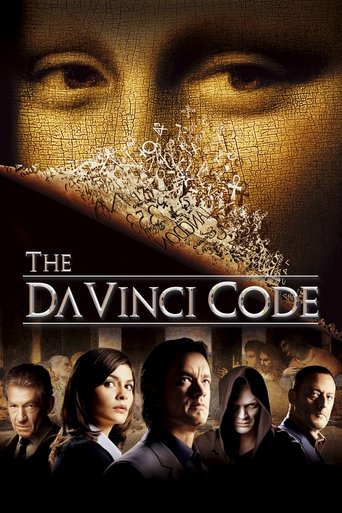
The Da Vinci Code
2006 · Film · 149 min
Part of Robert Langdon Collection
Directed by Ron Howard
A murder in Paris’ Louvre Museum and cryptic clues in some of Leonardo da Vinci’s most famous paintings lead to the discovery of a religious mystery. For 2,000 years a secret society closely guards information that — should it come to light — could rock the very foundations of Christianity.
2 positive6 negative1 mixed12 neutralfrom 21 commenters
Where to watch
No streaming data for this title.
22 comments on Hacker News
And yet, it's not unusual that a poorly written book gets a decent movie adaptation. Sometimes it's not even a good plot OR well written, sometimes a book is just popular and the execs cash in on its popularity.
I'm thinking things like Da Vinci Code, 50 shades, Twilight, neither of which (the books) are particularly good or tasteful or whatever, but they were very popular, appealing to people who normally don't read books.
Surely this would require the observation that the public is actually using LLMs as a substitute for purchasing the book, ie they sit down and type "Generate me the first/second/third chapter of The Da Vinci Code" and then read if from there. Because it was easy to observe in the cassette tape era that people copied the store bought music and films and shared it among each other. I doubt that this is or will be a serious use case of LLMs.
I read the Da Vinci Code very quickly and I enjoyed it. But a different kind of enjoyment, I realized afterwards I basically just read a movie. Very little internal monologue, or some other kind of description that other novels would have, something like that, was a long time ago.
Heaven forbid anyone read the Hackernews darling, Snow Crash in a similar light.
I sometimes get put in a position where i state my favourite book. Snow Crash. What's it about they ask?
Well there's a guy who delivers pizza, 'a deliverator' they call him but his name is Hiro Protagonist (yes seriously that's the main characters name folks). It's set in the dystopian future where you have to deliver pizza in under 30minutes or face public execution for the entertainment of the people who didn't get their pizza in time. He uses a skateboard and grappling hooks to get around and has samurai swords because he studies the way of the blade. He logs into the metaverse where he's a hardcore hacker by night. He ends up meeting a biker who has a nuclear bomb in a sidecar with a tattoo on his forehead that reads POOR IMPULSE CONTROL... (i could ramble on for a while like this trying to explain what it's about but you probably get a sense for it).
I actually think Neil Stephenson was intentionally trying to write the most ridiculous book possible but the truth is the book is FUN. I don't care about clever plots or prose. I want FUN. Da Vinci code is similar. It's an Indiana Jones movie in book form.
I know some tech people who are capable of absorbing difficult material, but who never read for pleasure (and that means especially fiction). I think dyslexia may play a part in it.
If reading is really a chore for you, try looking for movies with more literate scripts. Many good writers have written for film, and in most genres.
If reading itself is not the problem and you are just easily bored, don't try to start with "serious" literature, but look for anything that grabs your attention. Not all of these are to my taste, but they have been broadly popular: The Hitchhiker's Guide to the Galaxy (1979), The Da Vinci Code (2003), The Big Sleep (1939), The Color out of Space (1927) (short), The Hunt for Red October (1984), Hondo (1953), Get Shorty (1990).
I saw the film adaptation of Umberto Eco's Name of the Rose, https://en.wikipedia.org/wiki/The_Name_of_the_Rose_(film)
That led me to read Foucault's Pendulum.
So reading Dan Brown's Da Vinci Code and watching Ron Howard's film version of Brown's book gave me a sense of deja vu.
It's a profoundly idiotic book. But the pacing achieves its goals. You're not bored while you're reading it.
What people get out of reading The Da Vinci Code, or other books in that style, is the same thing they get out of watching thriller movies. So I think it makes sense to call the book a thriller.
> Brown's style is cinematic, or at least cinematic-aspirant.
This is an interesting comment. I didn't get that vibe from Dan Brown. But Brandon Sanderson's Steelheart struck me, while I was reading it, as an effort to put a movie into book form. I was completely unsurprised to later learn he'd shopped out the movie rights.
The Da Vinci Code actually has car chases in it.
You can practically see the action movie that was playing in Dan Brown's head.
It's a profoundly idiotic movie, and if anything Hollywood probably improved on it, but still. Brown's style is cinematic, or at least cinematic-aspirant.
> As Eddie Izzard once memorably pointed out, you get a lot of car chases in movies; very few car chases in books though.
> So in movies we see ‘action’ emerge as a distinct genre, with ‘thriller’ left for more Hitchcockian psychological excitement
I would say that e.g. The Da Vinci Code is written with pacing that would make me characterize it as a "thriller". There's no psychological excitement going on there.
I don't think it's true that you don't see car chases, or their equivalent, in books.
There are no profits. The Louvre is owned by the French government and heavily subsidized by the French taxpayer.
https://en.wikipedia.org/wiki/Louvre#Management,_administration,_partnerships
> The Louvre is owned by the French government. Since the 1990s, its management and governnace have been made more independent.[91][92][93][94] Since 2003, the museum has been required to generate funds for projects.[93] By 2006, government funds had dipped from 75 percent of the total budget to 62 percent. Every year, the Louvre now raises as much as it gets from the state, about €122 million. The government pays for operating costs (salaries, safety, and maintenance), while the rest – new wings, refurbishments, acquisitions – is up to the museum to finance.[95] A further €3 million to €5 million a year is raised by the Louvre from exhibitions that it curates for other museums, while the host museum keeps the ticket money.[95] As the Louvre became a point of interest in the book The Da Vinci Code and the 2006 film based on the book, the museum earned $2.5 million by allowing filming in its galleries.[96][97] In 2008, the French government provided $180 million of the Louvre's yearly $350 million budget; the remainder came from private contributions and ticket sales.[92]
COVID bailout:
https://news.artnet.com/art-world/france-museums-rescue-package-1906760
I read Foucault's Pendulum and finished it, but it was heavy going. I then read "The Illuminatus! Trilogy" [0] which I enjoyed much more, because it was more intentionally cranky and funny. It is to conspiracy novels as "Airplane!" was to disaster movies, and then some.
[Edit] Both of them make Dan Brown look really, really unimpressive. If "The Da Vinci Code" is a vaguely thought-through concept aimed at general readers, "The Illuminatus! Trilogy" is an explosion in a conspiracy theory factory.
[0] https://en.wikipedia.org/wiki/The_Illuminatus!_Trilogy
Well, you could either go the route of a Nobel laureate in literature that you've never heard of, or for a guy with commercial success.
From Wikipedia: His books have been translated into 57 languages and, as of 2012, have sold over 200 million copies. Three of them, Angels & Demons, The Da Vinci Code, and Inferno, have been adapted into films.
It all depends on what your goals are. No-one is forced to take any of the offered classes.
If I recall correctly, the Mona Lisa and its room at the Louvre feature prominently in The Da Vinci Code, a hugely popular book and movie.
“It is so badly written.” The author tries Doubleday instead and his little book makes an impression. The Da Vinci Code sells 80 million.
Absolutely true. It is awfully written. And indeed, is just awful in so many ways. Not just the writing. But it sells, like cheap chocolate and Avengers movies.
I read the Da Vinci Code when it came out, and just didn't find the narrative to hold together. The logic was bad, there were gaping plot holes, unbelievable story lines, etc. It has been too many years to recall the details, but I do recall my overall impression being that he just wasn't a very intelligent author, and I couldn't muster up enough suspension of disbelief to enjoy it.
That being said, I do know intelligent people who enjoy his work, and his books and movies have been successes, so I don't take my own bad impressions of his work too seriously - I'm clearly in the minority. So if other people enjoy his work, I'm not going to come down on him or them because of it all. To each their own.
First, I appreciate the thoughtful discussion. Good points, and it's nice to have avoided Godwin's law in a thread this deep.
> Skype
I fundamentally agree with you. Skype does support way more platforms than just about any service I can think of, especially when you consider Skype for Web beta (http://blogs.skype.com/2014/11/14/please-welcome-skype-for-web-beta/). But I agree that nobody can support every platform.
> Chrome
Kind of true, but not all platforms can or will support arbitrary browsers. Worse, as a user I should never have to run multiple browsers just to use a web app. Extra chagrin here because holy cow this is the web we're talking about, and Google's established a pretty clear pattern over the past year of Chrome-only dev that should be pretty worrying to anyone that cares about web standards.
>shadenfreude
In my case, I decided that I was irritated enough at Google's actions that I'd rather not have Google apps on my phone apps than support their ecosystem. Plus, I genuinely prefer Windows Phone as a platform.
>OOXML
That was 2006, the same year jQuery was first released. Cars and Da Vinci Code were big movies that year. That was before Windows Vista shipped. It was a long time ago. If that's your reference on Microsoft's standards support, it's not the full picture.
>Blame all of them or none of them
I'll blame them all then, but I definitely feel like Microsoft's by far the least bad in this area. I'm disappointed, when I first got excited about the Android platform, I had high hopes that it would be something else. I ran early releases in VM's before phones were available. I was excited about an open source phone platform, and Google's general trend (at that time) of doing cool stuff on open source, open services, open API's. Things turned out differently.
http://arstechnica.com/gadgets/2013/10/googles-iron-grip-on-android-controlling-open-source-by-any-means-necessary/
Netflix has already killed the old distribution model. For the price of about 8 full-price DVDs per year, you can watch any video in the Netflix catalog with the assurance of consistent quality and convenience. You can even watch multiple video streams at once, if you have a network pipe that's fat enough and a few extra screens.
I have a decently-sized collection of DVDs. But my indexing and search system sucks, in that it heavily relies on physical discs being replaced in exactly the right spot, which is often hard to reach. Now, a decent HTPC with networked storage would solve that problem handily. But I would still have to read the video files off all the discs and put them into a media catalog.
Netflix has already done all that work for the videos they are licensed to distribute. So if I know that a movie I want to watch is buried behind two rows of DVD cases, certainly no longer in the genre+alphabetical order that I try in vain to enforce, and possibly not even in its case, I'll definitely check to see if it's on Netflix before I get off the couch.
And if I know I don't own the DVD, and it's not on Netflix, I'm certainly not going to go check a dozen walled gardens that will probably still want me to pay $2.99 to view each TV episode one time, or $4.99 to see one movie one time, and maybe they also want me to log in using credentials from a cable or satellite provider.
It only takes a few instances of being annoyed and frustrated like that, and a few instances of finding exactly what you desire from friendly pirates, before skipping the former. I have already demonstrated my willingness to pay for content that I like. But that willingness has limits.
I bought the Ghostbusters DVD, because I knew that I'd want to see it again, at multiple times of my choosing in the future. And I also know how to use certain programs to take the video off the physical medium and transcode it to a file viewable on my kids' Android tablets. That's still not as convenient as Netflix, because I have to do that extra work, and there's still no central entertainment nexus, where I can search in just one place for the video I want to watch.
That's the thing that will kill the walled gardens. People don't want to have to flip through 57 channels and still not find anything they want to watch. They want to open up the program guide, maybe search, maybe look at recommendations and reviews, and then press play. If consuming your entertainment becomes too much like work, your audience shrinks. As long as Netflix has the infrastructure to make consuming entertainment convenient it doesn't need to carry exactly the content people want. All they need is a reasonable alternative.
For example, if people search for "Indiana Jones" on Netflix, they might see a "not found" result. Instead, Netflix could have said "not found, but..." and made suggestions.
Features like "Indiana Jones and the Raiders of the Lost Ark": "The Librarian and the Spear of Destiny", "Allan Quatermain and the Kingdom of Skulls", "The Da Vinci Code", "The Mummy", (>> more >>) ...
Features starring Harrison Ford: "Star Wars", "The Frisco Kid", "Witness", "Cowboys and Aliens", (>> more >>) ...
Features directed by Steven Spielberg: etc ...
Features set between 1917 and 1945: etc ...
Something like that would kick those distributors who refused to license content at a reasonable price right in the wallet, because Netflix would be forcing them into direct competition with all the other features that include the same old tropes and plots. Likewise, anyone who could seize the initiative from Netflix as the first place that people check for the features they want to watch could kill them, too.
All it would take is a better search engine, with support for alternative recommendations.
After the Da Vinci Code book & film, people think there's some sort of secret early Christian books that are being hidden and if the world knew about them, Christianity/Catholic church would fall.
But there are loads of early Christian books / "gospels" that survive or rediscovered which are quite different from what's in the bible, and no-one really cares.
For example in 1945, a pile of early books were discovered in Nag Hammadi, Egypt[1], including a Gospel of Thomas[2]. There is a Infancy Gospel of Thomas[3] from ~145CE which claims to talk about Jesus as a child, in which child Jesus uses his supernatural powers to kill children who bully him.
Have the revelations of all this "brought down the Catholic Chruch"?
[1] https://en.wikipedia.org/wiki/Nag_Hammadi_library [2] https://en.wikipedia.org/wiki/Gospel_of_thomas [3] https://en.wikipedia.org/wiki/Infancy_Gospel_of_Thomas
The Council of Nicea didn't deal with bible canon - that was made up for "The Da Vinci Code". Various religious sites debunked that one during the books and movie introductions.
Inventory: a mix between bestsellers (e.g. Da Vinci Code, Harry Potter) and the long tail, with very specific titles tailored to smaller audiences. Amazon excels at the long tail and traditional stores can't compete with that, as they're restricted to high street real estate with limited capacity. Another problem for small stores is that they don't have the knowledge and expertise to give advice to their customers on what titles to buy for niche markets (or buy the right stock to begin with beyond using the besteller lists), which Amazon does very well through user generated reviews and the recommendation system. This is a major concern for brick and mortars, because people value a trustworthy authority they can go to that will tell them what to read next (as the erudite bookseller of the past would do in nostalgic stories).
Medium: Moving towards digital, but physical books will remain relevant. Eventually digital might become so superior from a practical perspective that physical books will become collectors items in the sense that people will want to have some of them around for nostalgic reasons (e.g. religious texts, favorite authors). But people are programmed to hoard physical objects, so even when digital becomes superior they'll still want some books. In the mid-term you will see printing on demand in a reasonable quality distributed through and printed by local stores[1], allowing them to participate in the long tail segment instead of just stocking bestsellers.
Shopping experience: It's fun to go to a bookshop and browse, even if you're going to order the books you like from Amazon in the end. This will become something you do on a free afternoon as a form of leisure (as many of us do already). Successful shops will figure out a business model around this, focussing on the experience instead of the practicalities. For more practical purchases (e.g. "I need a book on Haskell, pronto") people will use Amazon instead.
Small players will remain active in niche markets, like selling collectible antiquarian books, where focus and specialization gives them an edge over big players like Borders or Amazon. This will mostly happen over the internet, which is a change that is already happening. A good friend of mine runs a high street antiquarian bookshop and has days where he sells for less than $20 in his brick and mortar store, but makes up for this by selling online. The main reasons for keeping the brick and mortar shop are nostalgic, as a warehouse for this inventory and as an avenue for people to come in and sell him new stock.
[1] That is if copyright holders will go along with this approach, because the publishing, movie and music industries are rackets that don't necessarily have the best interest of their customers in mind (customers as in consumers as well as resellers like bookshops and record stores).
Off topic but I had a very interesting experience reading Dan Brown. I read 'The da Vinci Code' without knowing anything about it or Brown, and I really enjoyed reading it. Then I saw the movie and I immediately recognized the massive holes in the plot, holes that I never saw while reading it. It surprised me.
Yeh, definitely fiction is not to be considered factually conclusive or anything. But The Tudors was great for light information about Tudor life, The Da Vinci code was insightful in terms of classical history.
The idea is that if stuff sparks your interest you can always go read into it in more depth. Otherwise you have at least a baseline; I have absolutely no interest in the Tudors, really, but the TV series means I could at least try to have a worthwhile conversation with a Tudor history buff :)