 Hacker Cinema
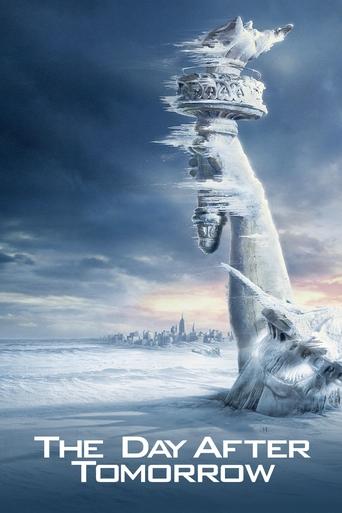
The Day After Tomorrow
2004 · Film · 124 min
Directed by Roland Emmerich
Science FictionThrillerAdventure
After paleoclimatologist Jack Hall is largely ignored by UN officials when presenting his environmental concerns about the beginning of a new Ice Age, his research proves true when a superstorm develops, setting off catastrophic natural disasters throughout the world. Trying to get to his son, Sam, who is trapped in New York City with his friend Laura and others, Jack and his crew must travel to get to Sam before it's too late.
6 positive20 negative26 neutralfrom 52 commenters
Where to watch
No streaming data for this title.
53 comments on Hacker News
Domingo Gonsales is flown to the moon by tying himself to wild swans, and meets Lunar Christians - The Man in the Moone by Francis Godwin (1601)
Manned mission to the Moon by giant gun - Jules Verne (1865 ish).
Manned trip around Saturn by comet - Jules Verne (1877).
Time traveller sets off to the future - H.G. Wells (1894)
Martian invasion of Earth - War of the Worlds by H.G. Wells (1905)
Global telephone network reaches as many connections as a human brain and wakes up - Dial 'F' for Frankenstein, Arthur C Clarke (December 1, 1975)
Birth of Dr Susan Calvin, founding of US Robotics & Mechanical Men, development of 'Positronic Brain' - Asimov's robot stories (1982 and after)
British space station under construction - The Outward Urge by John Wyndham (1994)
Portal to parallel universes - Sliders (1994)
Doctor Samuel Beckett steps into the Quantum Leap Accelerator and vanishes - Quantum Leap (1995)
Skynet becomes self-aware - Terminator 2 Judgement Day (August 29, 1997. at 02:14 am Eastern Time)
HAL 9000 AI computer operational (1997), first human voyage to Jupiter system (2001), first landing on Europa and alien life discovered (2010) - Arthur C. Clarke's 2001 A Space Odyssey
Moon leaves Earth Orbit after nuclear waste explosion, taking human-occupied Lunar colony with it - Space:1999 (13 September 1999)
Efficient international flight, using Zeppelins and blimps - Rudyard Kipling (2000)
Global climate disaster - The Day After Tomorrow (2004)
Replicants - Bladerunner (2016)
Keanu Reeves smuggles digital information in his brain - Johnny Mnemonic (2021)
Arnold Schwarzenegger kills to survive in a typical American TV show - The Running Man (2025)
Woman relifed into robot, rich people discover workers' rights - Fritz Lang's Metropolis (2026)
First colony mission to Mars, 100 colonists on the largest spaceship ever built - Kim Stanley Robinson's Red Mars (2026)
Tibetan monks finish listing all the names of God, stars start going out - The Nine Billion Names of God, Arthur C. Clarke (when computers were rentable and could print 1000 names per second)
and many more: https://scifi.fandom.com/wiki/Timeline_of_fictional_future_events
To borrow a comment from YouTube
> The Day After Tomorrow was a documentary.
https://www.moviemixup.com
A wordle-like game based on a road trip game my friends and I used to play. It serves you up a mashup of two different movie plots, and you have to guess the combined movie title. There's always some sort of shared word or wordplay between the two movie titles.
An example from the tutorial: the day after tomorrow never dies.
A couple "Groundhog Day" responses, so I'll add "Day After Tomorrow" for the action version of the time-loop device.
Terminator 2 is also a nearly perfect movie.
This is misguided, naive, and likely to end in multiple potential failure outcomes that may be unacceptable, both from a profit standpoint; as well as a societal standpoint.
Education is a part of what gets adopted into each and every student's self concept (identity). There is an uncanny valley in communication where any inconsistent distortion of reflected appraisal can lead students down a path of irrational madness, in a way that they themselves cannot perceive. This is well known in certain circles.
AI always has the biases which are programmed into it by the creators of the AI, whether this is explicit or implicit, the fact remains, there are biases.
AI in education will be proven to be harmful because there is no possible way that AI can remain consistent in its interactions at all times. We already know this from hallucinations where experts went and fact checked it and found it had lied, where lawyers were disbarred or censured.
Put plainly, this is a safety critical system involving our children.
Given the level of care to date that's occurred with AI in industry, there is no room for discussion or adoption of these tools, unless the actual unspoken intention is to drive your children crazy; where they self eliminate later as a result.
Rationally, good people don't create a world of intolerable suffering and then magically expect that somehow, someone, will figure out a way to fix everything you've broken but were too blind to see; at the time when knowing would save lives.
For those who enjoy cinema, a perfect analogy of this might be the Day After Tomorrow, where the main scientist turns out to be correct, but was ultimately ignored until devastating losses and risks were nearly insurmountable.
Leadership didn't want to hear the facts when knowing would have saved lives, and so they had to take a triage on the battlefield approach (abandoning half the country). While it is a fictional story, it sufficiently demonstrates what lack of scientific or rational foresight can lead to for those that can't imagine it themselves (people who are blinded like that should never be in positions of influence or power).
Throwback to the scene in The Day After Tomorrow where the cargo ship comes to an almost instant halt after impacting a bus wreck under water. For some reason it managed to stand out as ridiculous even in that movie.
That movie The Day After Tomorrow had a really cool visualisation for all that. The movie was released exactly 20 years ago...
Sigh, considering how bad journalists are at nuance - especially those that don't consider themselves as journalists but still wield the 4th Power of Broadcast - I can't wait (/s) until we have to "explain ourselves" about how it "contradicts" our previous meme about excess freshwater from melt being expected to at least slow down the thermohaline circulation in the North Atlantic, leading to a weaker Gulf Stream, and therefore a colder Europe (as emphasized to the point of ridiculousness in The Day After Tomorrow apocalyptic movie)... by "forgetting" the emphasis on summers.
Will at least be an opportunity to explain how Science actually works, and about chaotic systems I guess...
----
Still, one immediate question is how this impacts the rest of the year, since there's an (on the surface) obvious feedback loop here... (an answer to which might or might not be forthcoming...)
I find the more recent ones more fun because a) it's a shifting target, so you can find something new and b) you get to make people feel old!
Let's see... the release of the film The Day After Tomorrow is closer to 'We begin bombing in five minutes' than it is to today.
> Durìng the 1990s scientists predicted that NYC would be underwater due to rising temperatures and melting ice caps.
I think you watch too many movies: https://en.wikipedia.org/wiki/The_Day_After_Tomorrow
Wasn't there a film on this topic called The Day After Tomorrow?
It certainly couldn't be any worse or more idiotic than the scripts for probably every Hollywood natural disaster movie: The Day After Tomorrow, The Core, Deep Impact, Armageddon, etc.
The worst example I can remember was in the movie The day after tomorrow, where cold air from the statosphere dropped down to ground level and instantly freeze dried people.
Now, granted the stratosphere is cold. But it’s also at very low pressure, and what happens to air when you compress it, say by moving it from the stratosphere to the ground? That’s right, it heats up. If you were to bring a packet of air down from the stratosphere, letting it heat adiabatically as it compresses to one atmosphere, I’d expect it to be hot enough to burn people rather than freezing them.
I rather enjoyed seeing Los Angeles being torn to pieces by multiple simultaneous super-tornadoes, though.
The Day after Tomorrow was one of my favorite movies growing up!
Yes. We have lots of models, some of the biggest super computers crunching them.
But models are still estimates. There can still be un-knowns. Scientist have been writing about un-known, or difficult to model feedback loops for awhile. That is the movie-style doomsday, where we hit some un-foreseen tipping point and climate change takes off.
Instead view climate as a large dynamic system, you hit it hard enough, maybe it moves to a different stability point. Even with small systems this can be hard to estimate with a model.
Of course, this is the plot to the movie "Day After Tomorrow".
But just because it was the plot to a movie doesn't mean it can't be a real risk.
Nuclear weapons are humanities biggest extensional threat, moreso than climate change, but it rarely seems to be discussed in public forums. Films like Threads and Day After Tomorrow should be a requirement in civics classes for states that possess nuclear weapons.
I’m not sure what case can be made for mutually assured destruction bringing peace to the world. Is it causal to how there are relatively fewer people who die in wars during our modern times? Is it correlated with the global improvement in standard or living? or is it merely a statistical blip that will be “evened out” when a nuclear war takes place?
I do think it’s a pipe dream to eliminate nukes; however I do wish there was some way to increase the amount of time required between intending to use them and actually using them. The 1979 incident at NORAD (https://en.wikipedia.org/wiki/List_of_nuclear_close_calls#9_November_1979) is a great example of why the latency shouldn’t be minutes between intent and implementation. Increasing this latency to days, then weeks, in a verifiable manner could give time for cooler heads to prevail.
The depressing thing is that so long as these weapons exist, it’s not a matter of “if” they will be used, it’s a matter or “when”.
Well, 'Day after tomorrow' and 'Snow Priecers' are perhaps distorting science a bit too much ;).
'Don't look up' is a bit more on topic, but it's a comedy about our handling of a prediction of a catastrophe, not our handling of the catastrophe itself.
> Isn't it amazing how mankind is always forced into a state of existential angst by the people in power. Nuclear winter to globalcooling to ozone to hiv to global terrorism to global warming.
Well, it depends on "which people" in power of "what".
The exact opposite arguments pops up regularly, where some indefinite "They" is accused of "hidding" a very dangerous thing that is going to destroy us all.
We have almost as much evidence of governements, corporations, interest groups downplaying risks (nuclear winter, global warming, AI, etc..), than of governments, news outlets, activits overblowing risks (global cooling, terrorism, etc...)
It's usually just fun when the risks are completely imaginary, but in practice someone _is_ affected.
In the end, we have survivor bias for "mostly past" risks (nuclear war, covid, ozone layer, terrorism, hiv, etc... are not things of the past per se, they're just less acutely present), and Cassandra syndrom for the future ones - with the benefit of our capacity for fiction.
At some point, the proverbial shit hits the proverbial fan, and we do our best, and we 've historically survived as a species - but I'd rather not be too close to the feces, and I wish more people would "see the movie" before it happens.
> That being said, I think climate activists need to have their "The Day After" moment, but the problem is that they have to distort science just enough to have a movie where they show _westerners_ taking the blunt of the damage.
We've had so many already. Day after tomorrow, snow piercer, don't look up, etc and that's not including all the 'documentaries'.
Isn't it amazing how mankind is always forced into a state of existential angst by the people in power. Nuclear winter to globalcooling to ozone to hiv to global terrorism to global warming. Will an asteroid end life on earth? Who cares? Life goes on.
There are several doomsday movies that predate The Road, were better at the time, and hold up far better today, IMO. Children of Men (2005) would be my top suggestion. The rare movie I've gone back and watched multiple times. You know why it's good? Because the central premise didn't come true (humanity is infertile), but we live in that dystopia now anyway. It's like Black Mirror but for the police state. It didn't go into hyperbole like The Road or The Day After Tomorrow. It was a realistic, slow-motion apocalypse. Going out with a whimper instead of a bang.
However, Children of Men is admittedly not as bleak as The Road, so not a fair comparison. If you really want a film that produces bottomless despair in the viewer, I recommend Threads (1984) instead. It was produced by the BBC on a shoestring budget, and yet it's still a better film. I can't say I recommend it, but if you do watch it, the ending is on par with Requiem for a Dream for being memorable and filled with doom and horror.
The Road just wasn't very good IMO. No Country for Old Men, on the other hand? Same writer, different genre, but excellent.
There's already a documentary on it: "The Day After Tomorrow"
I have a facination with disaster movies. 2012 and The Day after tomorrow are other faves of mine. The holy grail of those movies for me though is Children of Men.
Trash disaster movies have their place, 2012, Day After Tomorrow, The Core, Deep Impact, Armageddon, Moonfall, etc. They are all entertaining in their own right, and are usually very self-aware of how stupid they are. Ben Affleck's commentary on Armageddon is gold. Though, I think that film was a higher tier than most of the list here, the Aerosmith song made for that film dominated the summer radio that year and the soundtrack flew off the shelves. I wish things like that still happened, you'll get a bump on Spotify but its cultural impact is much less.
> So Luntz suggested shifting from calling it “global warming,” which sounds scary, to calling it “climate change,” which at the time at least sounded much less intimidating. It was apparently luck that it ended up being the more accurate term anyway.
This doesn’t check out, it was a more accurate term so it stuck due to no opposition to it. By then it was clear climate can change not just by warming as a result of man made activities. The movie “The day after tomorrow” came out on 2004 (so production started a bunch earlier) using a popular perception that things can freeze from good old CO2. (They do explain it in the movie, since this was during the transition of terms)
heh that episode of South Park is seared into my brain
> Two days before the day after tomorrow
> Bah gawd... that's today
> in a movie, that wouldn’t feel real no matter how good the special effects are, it’s too out there
This entire thing just reminds me of Day After Tomorrow (2004). Although the movie had a lot of bad science, way too many people called the premise and social outcomes of the movie ridiculous. Hell, the South Park criticism of it alone significantly pushed this current batch of climate deniers.
I feel like we need movies/media that helps things feel more real, personal, negative, close to home.
Not movies that _focus_ and sensationalize climate disasters like The Day After Tomorrow. But movies that exist in the near future where really visceral elements of how climate change played out 10-20 years exist as a backdrop to whatever story is being told (but feel grounded in reality).
e.g. water rationing, abandoned towns/cities, authoritarian responses to increased immigration/migration, food shortages, etc...
I believe this, because of how successful TT was w infinite scroll, auto-play.
RE: Vanilla Sky
There are interesting moments to that film, (like the holographic jazz player at the fancy party) but it isn't worth sitting for to see Cruise if you haven’t already seen Top Gun, Mission Impossible, Day After Tomorrow and Minority Report.
There is movie about this. Watched few days back, surreal to see the headline on Reuters.
The Day After Tomorrow (2004) https://www.imdb.com/title/tt0319262/
2 minutes summary - trailer https://www.youtube.com/watch?v=Ku_IseK3xTc
Several warnings have come true: rising sea levels, disappearance of bees, extinction of several animal species, melting of glaciers, disappearance of coral reefs, loss of soil surface due to deforestation.
Armageddon for me is thus not a one-day event like in movies such as The Day after Tomorrow, but a gradual and accelerating destruction all around. This is a “boil the ocean” project that humans have inadvertently initiated and it is taking the required time to complete.
The movie The Day After Tomorrow is quite good, and revolves around this happening.
So "Day after tomorrow" is the SF film that came true?
That is nightmare fuel. If they made a movie about this, it wouldn't even be enjoyable to watch because it would be too sad and scary.
Like The Day After Tomorrow but without the comforting thought reminding you that couldn't actually happen.
Maybe I'll give it a shot. For me the premise occupies a sort of uncanny valley of realism: there's no space wizards or wormholes or FTL or aliens, but it's also not realistic enough to be something that could happen. It's kind of like that movie The Day After Tomorrow. It felt like there should have been some kind of mystical or supernatural force behind it all because it could never happen as presented, but they want it to come across as plausible.
Been hearing about the possibility of this since 1999 or there about when it was covered at a university lecture. Then there was the movie: https://en.wikipedia.org/wiki/The_Day_After_Tomorrow Like global warming, it is regularly predicted and in some ways we become immune to the predictions because it is on such a long time scale compared to our attention.
Humans do not do well with long-term threats in which we have to make everyday sacrifices. We do better with long-term threats that are clear economic opportunities, such as buying better airport scanners and the like, something the sales guys can really sink their teeth into.
Note to readers, land speed not equal to air speed. As the article discusses it doesn't break the sound barrier.
That said, the news here is that the jet stream is carrying more energy than it has in the past (air mass is moving faster, kinetic energy content is 1/2mv^2). I read a paper a long time ago which talked about the impact of thermal 'tubes' where denser cold air travelling at speed would "punch holes" in high pressure systems leading to more complex weather patterns. Sadly I cannot find it! The question I think about when reading this is the impact on the duration and temperature swings of the winter months in the north east of the continent. In particular, atmosphere so cold as to support hurricane formation over land. Most famously exploited in a fairly mundane movie "the day after tomorrow" but the modelling works if the temperatures meet certain conditions.
I don't know if winter "super storms" are possible due to other moderating influences but if they are, having the jet stream behave in a new way is a prerequisite (feeding very cold air into the system).
I just watched Day After Tomorrow again. All of a sudden, it's science doesn't seem nearly as far-fetched.
Anybody here have thoughts re why more isn't done about this? I'm thinking a combination between: 1) The general population doesn't want to hear about it so the media doesn't care so it does not create movies/books/shows about it 2) Selfish individualism over societal interests 3) Too much money invested in destroying the earth through the major resource industries.
Of all of the disaster movies with terrible physics, The Day After Tomorrow is truly their king. Supercooled air depositing ice crystals on warm surfaces, oh yeah.
Yeah, the movie The Day After Tomorrow explored this. I'm not looking forward to having to literally outrun waves of freezing ice.
Late to this game...
Galaxy Quest
V, but the original miniseries from the 80's
Close Encounters
Dune, this is controversial I'm sure!
Starship Troopers
The Day After Tomorrow
The Fifth Element
Terminator I
Alien
Aliens
Tron, oh god I nearly forgot this one from the 80's!
There's a linked Washington Post article at the bottom, that links to an updated Washington Post article that says:
I also quoted two prominent researchers who think this pattern reflects a much feared slowdown in Atlantic ocean circulation, a scenario made famous by the film The Day After Tomorrow. Granted, even if they’re right, what’s happening here will be nothing like the movie. At most, the circulation may be slowing, not stopping abruptly. And with a warming globe overall, there will definitely be no new ice age.
can you blame them with all the media alarmism about global warming? The Day After Tomorrow type movies and such too.
Not that it's not a problem - it obviously is - but it's not like the earth is going to be barbecue'd in our lifetime.
this article pretty closely expounds the setup to the movie , day after tomorrow starring dennis quaid and jake gyllenhaal
You are aware that "The Day After Tomorrow" was a fictional movie, right? It's a dramatisation set in the real world. Fantasy Mexico can do all manner of things.
And that is a really good question. The interesting thing about this paper is it points out that prior to a glacial period there is a rise in temperature. The onset of ice ages appears to be much more rapid than the onset of warming.
This was one of the ideas used in the "Day After Tomorrow" movie, although soundly criticized for presenting a very short time frame change into an ice age, that an overly warm earth can trigger a transition into an ice age is not unheard of. Lots of time questions about time frame and mechanism.
I lost the paper I read that was suggesting the mechanism was water vapor (a pretty important green house gas) which as the planet warmed the air carried more vapor which hits critical mass, turns into a nearly permanent covering layer of clouds in the upper atmosphere, which then causes water at lower altitudes to precipitate out as snow. Sort of a self induced nuclear winter type scenario.
The key conclusion of the paper is that the system responds in a non-linear way. That makes predicting its behavior with models like the one IPCC uses very challenging.
Where are the people who said that the sea level would raise 1 foot to 1 meter per year?
You didn't answer that question. Everything you wrote is a distraction, which ends up increasing the confusion you describe and complain about.
You pointed to some artists and movies. So what? I can point to movies who have depicted meteors crashing into modern day Earth, and volcanoes erupting in Los Angeles, and even have the core of the Earth stop spinning. Artists have different goals. They are not required to only depict what science predicts +/- 1 sigma.
You point to a scientist who liked that "The Day After Tomorrow" used climate change as a plot device, even if the science was awful. So what? I'm sure some Spacewatch people like "Armageddon" and that some geologists like "The Core", even though the science is awful in both. Are you equally disdainful towards those scientists? Or do only climate scientists draw your ire? (BTW, "Water World" used global warming as a plot device, was almost 9 years before TDAT, and portrayed an equally scientifically absurd future.)
You mentioned "An Inconvenient Truth". Does Gore make a prediction that there will be 30cm or higher water rise per year? Does he even predict that the Atlantic will have reached the base of the Empire State Building by now?
How is the IPCC 2001 report not an attempt at a thorough rebuttal? What level of rebuttal would you require before you say it was sufficient? Do we all need to be like Neil deGrasse Tyson and pinpoint every single scientific flaw in a movie? Or go even further and reject every movie with a flaw?
In other words, I'm not going to get into a goalpost argument with you before you even say what the goalposts are.
Your argument of the structure of the argument is useless. It's so easily inverted. Watch: You have set up your own Motte and Bailey about what's going on in this HN thread, so nothing I say can dissuade you. You have inserted irrelevant commentary from your bailey to defend your views. Now you can ignore me because you think I'm using irrational arguments, because you have placed me in a spot where you think I can be ignored. Now you can enjoy your motte.
I argued that the OP presented a straw man argument that misrepresents what the large majority of climatologists and policymakers like Gore were making 15 years ago. Do you agree or disagree with me?
I presented the IPCC report to supports my argument. Gore's "An Inconvenient Truth" also supports my argument. If you disagree, do you have an actual examples of people who predicted 30+cm/year sea rise, or even that much of Manhattan would be underwater by now?
There's a lot of motte/bailey'ing[1] going on in the climate change debate.
There is tons of histrionics and scare mongering out there. I particular remember during the COP15 meeting in Copenhagen, art installations illustrating how the city would be under water if sea level rose 7 meters, which is the estimated rise if all of the ice on Greenland melts. The Day After Tomorrow, not to mention An Inconvenient Truth.
While there certainly are and were voices critical of these things and their dubious relationship with the science (whether settled or consensus or not), their usefulness in advancing the agenda appears to be appreciated more than their role in misrepresenting the science. This is an actual quote from a scientist listed in the "criticism" section of the "The Day After Tomorrow" Wikipedia page[2]: "I'm heartened that there's a movie addressing real climate issues. But as for the science of the movie, I'd give it a D minus or an F. And I'd be concerned if the movie was made to advance a political agenda.". This is an actual scientist on the record believing that TDAT is "addressing real climate issues". That is like applauding Swordfish[3] for addressing cyber security issues. That is the Bailey.
Then, years after, when these things perhaps look a bit more absurd (and some very specific predictions turned out not to come through, at least not as unambiguously as expected), we get "The IPCC's 2001 report was for <1 meter rise over the entire century ... Do you have evidence that it wasn't just kooks saying what you suggested?"
That's the Motte.
You can't have your cake and eat it, too. If it was only kooks saying it, certainly none of the non-kooks bothered throughly rebutting them at the time.
1:http://blog.practicalethics.ox.ac.uk/2014/09/motte-and-bailey-doctrines/
2: https://en.wikipedia.org/wiki/The_Day_After_Tomorrow#Criticism
3: https://en.wikipedia.org/wiki/Swordfish_(film)
Global warming will not happen because The Day After Tomorrow is a movie. 12 Monkeys is a movie therefore weaponized biotechnology is without risk. "Hollywood made a movie vaguely like this" isn't much of an argument against anything.
True, but I suspect that doesn't massively prolong most movies, only big ones that people are passionate about (Star Wars, The Godfather Trilogy, etc).
Just randomly picking... 2004. Top 10 movies from that year, and pulling future media sales predictions out of my ass:
Shrek 2 kids movie, profitable regardless. Spider-Man 2 probably poor The Passion of the Christ probably poor Meet the Fockers nobody cares. The Incredibles kids movie, profitable regardless. Harry Potter and the Prisoner of Azkaban great. The Day After Tomorrow nobody cares. The Bourne Supremacy possibly good. National Treasure nobody cares. The Polar Express nobody cares.
I mean, I am sure all of these will have future releases on new media. There is no reason not to re-release movies, it is essentially printing money), but will many of them see dramatic sales that will really change how we view the profitability of those movies? Meet the Fockers was a good movie, but nobody is going to give a shit if you re-release it in 3D, 4K resolution, "hyperdisk". Only a few have that potential I think, and it gets more bleak if you stop looking at the top 10.
After the initial burst of home media sales, I just don't see most movies getting anything more than a trickle of revenue. For every movie like Office Space, there are dozens that aren't.
The first episode of The Walking Dead comes to mind. I'd also volunteer Waterworld and The Day After Tomorrow, but those are a bit too obvious and not worth the money.
The weather effects in The Day After Tomorrow were ripped off from the 1979 novel The Sixth Winter by Douglas Orgill and John Gribbin. Specifically, the super-cold storm centers were an "expanded for video" version of the "Ice Dancer" storms from the novel; they are unique enough in my rather extensive reading that I noticed the similarity immediately. (For that matter, the same director's later movie, 2012, borrowed rather strongly from Don Pendleton's 1969 novel Cataclysm, though from the credits that may have been indirectly.)
There was even a reasonably high budget movie made about it, The Day After Tomorrow, not that it showed anything approaching a realistic depiction of the results of that shutdown.
I loved Avatar, but I've noticed a strong theme from Hollywood for over a decade now of environmentalism. It's either the subtext, subplot in the 90's movies, and now it's become the main context and plot of major movies in the 00's and I'm getting the strong feeling I'm going to be beaten to death with it in the 10's.
I think one of the reasons I've gone from liking the Harry Potter film series to outright loving it is because environmentalism isn't even a sub-subtext in the story. The plot is that humans are doing incredible damage to humans, not that humanities inactions are inevitably going to hurt us by some bullshit catastrophe like 2012 or the day after tomorrow.
This bullshit enviro-paganism has driven me to the point of not giving the slightest damn anymore. If you tell me we've got a program error from monday to friday, but you offer no solution to fix it except to spell check the code (recycling) then I'll tell you to fuck off by the next monday. If you offered a major rewrite I'd buy in. Double-down on Fusion research, go all nuclear with new power plants (it's the only practical and realistic way, if you deny it you're ignorant of the massive wastes inherent in solar and wind systems and the fact that many of these systems rely on the existing coal and gas infrastructure to support it in low-wind or cloudy periods).
We're being told we've changed the world disastrously through our inactions, then we should be showing the world we can change it through our actions. Sequester carbon, go nucelar, build a frigging IR reflector in space, build cloud machines.
I find it more disturbing that environmentalists are flat out ignoring the disastrous effects caused by wind turbines, killing bird and especially bat populations and promoting demineralization of farm land (note this is the preliminary step in desertification). Not to mention that there's already been noticeable wind-speed decreases in areas of heavy wind turbine usage. I think interfering with the wind patterns is going to fuck up the planet far more than a little CO2 as you'll actually be creating high and low pressure regions permanently.
There is some, most of it that I've seen is related to vulcanology.
There was also an article in Discover magazine in the late 90's (which formed the basis for "The Day After Tomorrow" even though it was blindingly obvious that the writers didn't understand any of the article's science) that described some simulations that the author's had developed. They found that the runaway greenhouse effect lead to an ice age, but not from global cooling.
Instead, it lead to an ice age because the melting ice submerged the North Atlantic Gyre, preventing it from transferring heat to New England and Europe, leading to a drastic drop in their temperatures. So while the arctic and sub-arctic zones experience plunging temperatures, the equatorial waters end up getting warmer since the currents that normally convey their heat elsewhere aren't flowing... so the hurricanes get stronger and more frequent.
The buffoons that wrote the movie script somehow got the impression that it was possible for a hurricane to form in the arctic. They should have consulted a 4th-grader about how things tend to move downhill rather than uphill.