 Hacker Cinema
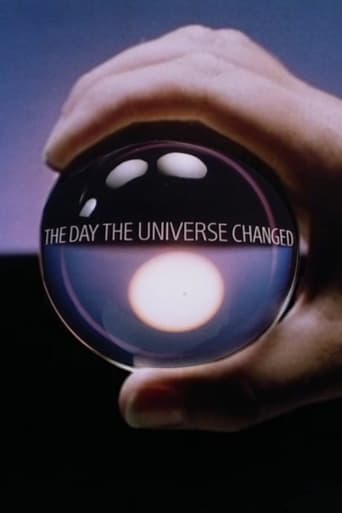
The Day the Universe Changed
1985 · TV series · documentary · 55 min episodes · 1 season
Documentary series about the effect of advances in science and technology on western society in its philosophical aspects.
17 positive2 neutralfrom 19 commenters
Where to watch
No streaming data for this title.
33 comments on Hacker News
Wow, I messed up there!
You were talking about Connections. I watched The Day The Universe Changed.
Just realized my mistake now, and watched Connections episode 1.
Yeah, totally about technology traps.
I just watched the first episode. The simulated nuclear attack did terrify me.
That said, his commentary about telecommuting is spot-on. At 39:49 of https://archive.org/details/the-day-the-universe-changed-s01e01-the-way-we-are .
"The point about all this technological pizazz isn't the gee-whiz high-tech stuff. It's the secondary effects of using it. Take say what this chip could do to change the pattern of work. With this you could have telecommuting, that's where you work at home from a screen and you never go into the office.
Great! No more rush hour. But what does that do to the public transportation system and the taxes it uses. Or to the car manufacturers and their workers' jobs, and the rest of the economy that depends on their output?
Or to the concept of the city itself, with its support systems and businesses. Or to the downtown properties where maybe your pension fund's invested.
Not to speak of working at home day in and day out and what that might do to a marriage. And what do you get out of work when it's only you? What would be the effect of isolating and fragmenting the community like that?
From just one application of this microchip."
The Day the Universe Changed is amazing. It combines history, science and philosophy.
Do yourself a favor, and search for the episodes.
Agreed that Connections 2 and (especially) 3 were pale shadows of the original series.
However the related The Day the Universe Changed, which took a slightly different conceit (the episodes aren't necessarily linear in time) and focus (science and philosophy rather than technology), is excellent, and I'd put it right next to the original Connections series.
(There is, it turns out, a fourth season of Connections, "Connections 4", released in 2023 on Curiosity Stream according to Wikipedia. I've net seen any of it. It consists of only 6 episodes. <https://en.wikipedia.org/wiki/Connections_(British_TV_series)#Series_4_(2023)>.
Second the comment re the day the universe changed, and found the episode on how Islamic Spain influenced the world quite surprising. Think it was the 2nd one, starting with two competing views of the world from African Roman scholars/clerics.
Many of these older docu’s wanted you to stop and think.
I personally feel like _The Day The Universe Changed_ (his second documentary) is better. I love Connections but the basic thesis (there are hidden connections between disparate developments in science and technology) ends up pretty scattershot, spreading out like Brownian Motion. _tDtUC_ is much more focused. Largely based on Kuhn's _Structure of Scientific Revolutions_ for individual stories, it traces how the understanding of time in Europe changed from the middle ages to the 1980's- the idea of time as a marker of descent from a previous golden age (1), or at best a repeating cycle, evolves into our modern conception of time as endlessly improving into a better future. And the supporting book was amazing too.
I also want to speak up for the BBC history documentary team that worked with Michael Wood: _In Search of the Trojan War_, _In Search of the Dark Ages_, _The Story of England_, _The Story of India_ they were also a staple of American PBS and informed my understanding of the world.
1: My go to example for this is imagine you walk into the Pantheon in 1000 AD: no one on your entire continent has known how to build a dome like that in 500 years, and won't again for another 500 years. The fundamental way you understand the world has to be completely different from the "newer is better" baseline that we have understood the world by for the past 150 years.
Also from Burke, The Day the Universe Changed. He also has a recent new Connections miniseries.
The Day the Universe Changed (also by Burke) was also exceptionally good.
Similar premise, but focusing more on philosophy and understanding, and not tracking linearly through time.
There were another two Connections mini-series, though they were IMO not up to the mark of the first. Good, but not truly excellent.
Connections was savvy in finding faires, working museaums, and access to the BBC's film vaults for providing much (though not all) such footage. Burke describes going to reenactment festivals to film many of the medieval life scenes.
And his journalist background and connections enabled him to have the access necessary to shoot single-take sequences such as this:
https://youtube.com/watch?v=2WoDQBhJCVQ
(Hardly the only impressive on-location scene in his work.)
Agreed with your comments on the primary importance of writing and research. I'd argue that Chris & Evan Hadfield's "Rare Earth" is getting close, Tom Scott is doing quite well, and Derrek Muller's "Veritasium" and Destin Sandlin's "Smarter Every Day" have promise.
Several YouTubers have been picked up by traditional broadcasters/production organisations, notably Hank Green ("Crash Course"), with PBS, and Emily Graslie ("Prehistoric Road Trip"), with the Chicago Field Museum. YouTube as a training and recruiting ground has merits.
One reason Connections is so hard to compare to is that it's pretty incomparable: forty years on we're still discussing it in glowing terms. It was produced by someone well-established and experienced at least within the BBC, and backed by the organisation. Notably, little from either national/public broadcasting or commercial production has even approached it. My short list includes Sagan's Cosmos, Burke's own The Day the Universe Changed, Ken Burns. Daniel Yergin's The Prize. And of course Kenneth Clarke's Civilisation and Jacob Bronowski's The Ascent of Man, which had paved the way for Burke himself. I might include Adam Curtis's works.
The role of the author or creative voice --- a Burke, Sagan, Burns, Bronowski, Clark, Curtis --- cannot be overstated. That talent seems rare, perhaps also the ability to simply get out of its way. Also realising when it's circled too hard back in on itself --- Burke had 2--3 good series in him, but he hasn't matched himself in at least three decades.
Related HN thread with additional recommendations: https://news.ycombinator.com/item?id=2698026
Part of that is a more crowded field: there's more produced, it's harder to get noticed. Part my own near-total avoidance of broadcast television. But I don't think that's all of it.
And yes my HN history shows I'm quite the fan of Burke: https://hn.algolia.com/?dateRange=all&page=0&prefix=true&query=by%3Adredmorbius%20connections%20burke%20&sort=byPopularity&type=comment
The first Connections series (and the book), and The Day the Universe Changed, are both excellent.
Connections2 and Connections3 flag somewhat. Both were produced for TLC, at a point before its Honey Boo Boo slide, though off its peak. One ran shorter (~25 minute) episodes, which is unfortunate, and there was an excessive fascination with early-1990s CGI effects. Still a net positive.
The series is often findable on YouTube.
A notable omission from all four series is much reference to Chinese science and technology, or any reference to Burke's compatriot Joseph Needham, who compiled the definitive study of these topics, Science and Civilisation in China, a monumental work I've only learned of in the past five years or so.
https://en.wikipedia.org/wiki/Science_and_Civilisation_in_China
Connections[0], The Day the Universe Changed [1], and Industrial Revelations [2] are other very good choices in this area. These series are very old (1978, 1985, and 2002 respectively) but their age gives them a level of quality that modern, dumbed-down, documentaries do not have.
They're probably more readily available through forms of through non-monetary cultural exchange rather than by paying streaming service danegeld, however.
[0] https://en.wikipedia.org/wiki/Connections_(TV_series) [1] https://en.wikipedia.org/wiki/The_Day_the_Universe_Changed [2] https://en.wikipedia.org/wiki/Industrial_Revelations
James Burke's The Day the Universe Changed (both the TV series and accompanying book) have more to say about Fibonacci, specifically in the chapter Point of View.
For those who are interested in The Day the Universe Changed, you can find copies of the episodes at the internet archive or on Dailymotion. It really is well worth watching.
I’d like to recommend James Burke’s series “Connections”[1] and “The Day the Universe Changed”[2] from the late 70s early 80s.
He was a bbc journalist covering NASA and doing science communication and one of his particular fascinations (and mine, having grown up with his work) is the cumulative effect of ideas and technology shape not only how we interact with the modern world, but how we perceive it.
[1] https://m.imdb.com/title/tt0078588/ [2] https://m.imdb.com/title/tt0199208/?ref_=m_nm_knf_wr_t3
Again, views and theories vary greatly.
The Renaissance, printing, the Reformation, the Enlightenment, and the breaking of uniform Catholic control over thought and science. That's an area I've been exploring (I'm exploring a lot of areas, progress is slow), and it's fascinating.
The Bacons (Francis and Roger, no relation), free-thought movements especially in the north (Amsterdam and Copenhagen), and relative political freedom of inquiry in England all seem to have helped. It's interesting that the Enlightenment itself played heavily in Scotland, otherwise a hinterland (Adam Smith travelled to London for an education he didn't think much of, taking six weeks to make the journey by coach or on horseback, in the 1740s or 50s).
James Burke's television series Connections and The Day the Universe Changed cover much of this development (as well as earlier and later periods), and have been useful, though I'm starting to find holes in Burke's treatments (he wholly ignores Joseph Needham's work and Chinese invention, as examples).
Gregory Clark, mentioned above, has a generally excellent treatment of the question, one of the best I've read yet, though there's much I've yet to read.
Another excellent resource is the History of Information website. It's a useful place to explore questions such as this.
http://www.historyofinformation.com/index.php
James Burke, better known for his Connections series, also produced on called "The Day the Universe Changed". In it he explores how the changing understanding, and sometimes simply views of the world, humans' place in it, and what is right and wrong, change the Universe (or at least our perception of it) itself.
One segment from the final episode featured on HN a few weeks ago. It references the burning of witches, in Scotland, from earlier in the same episode. Burke's point was that a set of beliefs which had once carried legal force no longer does. That route can run in reverse, and it's quite possible for beliefs, or actions, previously legally sanctioned (or at least not criminalised) to become otherwise. Prohibitions against ex post facto laws limit this in many jurisdictions, but changes in social mores are less forgiving. I've lived long enough to see some remarkable changes along several such lines, and have witnessed social and political upheavals elsewhere that are even more pronounced.
There's the question of whether or not it's the fact of a durable record, or the abuse of power through that record, that is the real root of the problem. As Aesop noted, any excuse will do for a tyrant. But the persistent record does seem to pose certain problems. Particularly against a shifting set of judgements.
I love James Burke. The first "Connections" is available on Kanopy if you have a library card. Lots of episodes on Youtube too.
"The Day the Universe Changed" was my intro to Burke; I loved it as a child an still as an adult.
James Burke's "The Day the Universe Changed" series. A history of inventions, how one led to another, often in stupid tiny ways brought about by pure luck - or the right person working on the smallest thing at the right time. Fantastic series if you're into old british documentaries that you can put on in the background while tinkering btw.
Then you'd probably enjoy watching two TV series by James Burke: Connections and The Day the Universe Changed. They explore the driving forces behind many of the major technical inventions in the past 800 years -- how the status quo created a void that invention arose to fill.
The videos may look a bit dated now, but the content is amazing and Burke is terriffic.
https://en.wikipedia.org/wiki/James_Burke_(science_historian)
Pretty much everything by James Burke, including the Connections series and The Day the Universe Changed.
Both were turned into TV miniseries by the BBC (plus a successor to Connections that I haven't seen).
I'll chime in here to add The Day the Universe Changed, on PBS. Less "invention" specific and broader, about how certain concepts shifted us. It has also aged better, in my opinion. Connections, especially its last episode, seems rooted in a certain place and time.
From a recent HN comment, a list, some authors, and some guidelines, largely based on books which radically changed my thinking.
Currently: Vaclav Smil, Energy in World History (1994), and Manfred Weissenbacher, Sources of Power (2009). Both detail the role and impact of energy through world history. The latter draws strongly on the first, both are exceedingly well documented. TL;DR: coal changed much, oil changed everything.
http://www.worldcat.org/title/energy-in-world-history/oclc/30398523&referer=brief_results
http://www.worldcat.org/title/before-oil-the-ages-of-foraging-agriculture-and-coal/oclc/837625798&referer=brief_results
http://www.worldcat.org/title/oil-age-and-beyond/oclc/837625970&referer=brief_results
James Burke's books Connections and The Day the Universe Changed, and their accompanying television series, were a profound introduction to the history of technology, science, ideas, and philosophy. Though 30+ years old, they remain highly current and relevant.
https://www.worldcat.org/title/connections/oclc/4494136
https://www.worldcat.org/title/day-the-universe-changed/oclc/12049817
Jeremy Campbell's Grammatical Man (1984) introduced the concepts of information theory and their deep, deep, deep interconnections to a tremendous number of interconnected systems, many not explored within his book. Darwin's The Origin of Species, James Gleick's Chaos, and many of the works of Santa Fe Institute members, including John C. Holland, J. Doyne Farmer, Geoffrey West, W. Brian Arthur, David Krakauer, and Sander van der Leeuw, continue these themes.
https://www.worldcat.org/title/grammatical-man-information-entropy-language-and-life/oclc/8306673
https://www.worldcat.org/title/chaos-making-a-new-science/oclc/15366709
William Ophuls' Ecology and the Politics of Scarcity (1977) is perhaps the best, most comprehensive, shortest, and most readable exposition of the fact, reality, dynamics, and interactions of limits on the present phase of fossil-fuel fed economic growth I've found. This is a book I recommend not only for the message, but the author's clarity of thought and exposition, his meticulous research, exquisite bibliographical notes, and, given the nearly 30 years elapsed, testability numerous of his predictions, some failed, yes, others uncannily accurate. Rather more the latter. In a similar vein, William R. Catton's Overshoot looks at the ecological dynamics in more depth, with much wisdom, the writings of Richard Heinberg cover the ground of limits fairly accessibly and more recently. Vaclav Smil in numerous books addresses technical factors of the profound nature of the past 250 years, and implications for the future. Meadows, et al, in Limits to Growth set off much of the post-1970 discussion (though they're hardly the first to raise the question -- it dates to Seneca the Elder),
https://www.worldcat.org/title/ecology-and-the-politics-of-scarcity-prologue-to-a-political-theory-of-the-steady-state/oclc/2524932
https://www.worldcat.org/title/overshoot-the-ecological-basis-of-revolutionary-change/oclc/6195764
https://www.worldcat.org/search?q=au%3Aheinberg%2C+richard&qt=owc_search
https://www.worldcat.org/search?q=au%3Asmil%2C+vaclav&qt=results_page
Though hardly pessimistic, Daniel Yergin's book The Prize (and TV series) impressed upon me more than any other just how much petroleum specifically changed and transformed the modern world. Though intended largely as laudetory and championing the oil industry by the author, my read of it was exceptionally cautionary. The impacts on business, everyday life, politics, wars, industry, and transport, and the rate at which they occurred, are simply staggering. You can continue this exploration in Vaclav Smil's Energy in World History (1994) (I've recommended Smil independently elsewhere), and a rare but profound two-volume set I'm currently reading, Manfred Weissenbacher's Sources of Power: How energy forges human history (2009). The shear physicality of this book speaks to the message -- it's divided into five parts: 1) Foraging Age (6 pages), 2) Agricultural Age (156 pp), 3) Coal Age (160 pp), 4) Oil Age (296 pp), and 5) Beyond the Oil Age (142 pp). That is, the ~2 million years of pre-agricultural existence are little more than a footnote, the 8,000 years of agriculture roughly equal to the 150 years of coal, and the 100 years of petroleum use roughly twice either. The oil and post-oil ages comprise their own volume. Yergin followed up with The Quest, continuing the search for oil, though I've been less impressed by it.
https://www.worldcat.org/title/prize-the-epic-quest-for-oil-money-and-power/oclc/22381448
https://www.worldcat.org/title/energy-in-world-history/oclc/30398523
https://www.worldcat.org/title/before-oil-the-ages-of-foraging-agriculture-and-coal/oclc/837625798
https://www.worldcat.org/title/oil-age-and-beyond/oclc/837625970
Adam Smith's An Inquiry into the Nature and Causes of the Wealth of Nations is among the most-cited (and most incorrectly cited), least-read books of high influence I'm aware of, outside religious texts (and perhaps it is a religious text to some…). The author's message has been exceptionally shaped and manipulated by a powerful set of forces, quite often utterly misrepresenting Smith's original intent. Reading him in his own words, yourself, is strongly recommended. I'd also recommend scholarship particularly by Emma Rothschild and Gavin Kennedy, though also others, on Smith. Contrast with the portrayal by the propaganda disinformation front of the Mont Pelerin Society / Atlas Network / so-called Foundation for Economic Education, and much of the modern American Libertarian movement (von Mises, Hayek, Friedman, Hazlett, Rothbard, and more recently, Norberg). Contrast The Invisible Hand (1964), a compilation of essays published by Libertarian house Regnery Press in 1966, at the beginning of the rise in public use of Smith's metaphor to indictate mechanism rather than an expression of the unknown.
There are numerous editions of Smith, I believe the Glasgow is frequently cited by Smith scholars: https://www.worldcat.org/title/glasgow-edition-of-the-works-and-correspondence-of-adam-smith-2-an-inquiry-into-the-nature-and-causes-of-the-wealth-of-nations-vol-1/oclc/832488566
https://www.worldcat.org/title/economic-sentiments-adam-smith-condorcet-and-the-enlightenment/oclc/45282974
https://www.worldcat.org/title/adam-smith-and-the-invisible-hand/oclc/820387997
https://www.worldcat.org/title/adam-smiths-lost-legacy/oclc/56598640
https://www.worldcat.org/title/invisible-hand-a-collection-of-essays-on-the-economic-philosophy-of-free-enterprise/oclc/326622
I'd like to put in recommendations on technology specifically, but am still searching for a good general text. The material's covered somewhat in the chaos and complexity recommendations above (Campbell et al), though I'd add Joseph Tainter's The Collapse of Complex Societies. Charle's Perrow has several excellent books including Normal Accidents and Organizing America. I'd like to reference something concerning Unix, Linux, and programming, perhaps Kernighan and Pike's The Unix Programming Environment, Linus Torvalds' Just for Fun, Richard Stallman's The GNU Manifesto, and Steve McConnel's Code Complete. The O'Reilly book Unix Power Tools also encapsulates much the strength of the Unix toolset. All these are somewhat dated.
https://www.worldcat.org/title/collapse-of-complex-societies/oclc/15083222
https://www.worldcat.org/title/normal-accidents-living-with-high-risk-technologies/oclc/10229932
https://www.worldcat.org/title/organizing-america-wealth-power-and-the-origins-of-corporate-capitalism/oclc/939707157
https://www.worldcat.org/title/unix-programming-environment/oclc/10269821
https://www.worldcat.org/title/unix-power-tools/oclc/52381684
He's not produced another TV series so far as I know.
He has been pursuing his knowledge-web concept for the past couple of decades, though I also get the feeling his game's slipped a bit. The first Connections and The Day the Universe Changed are really his best work. Both remain quite relevant to this day.
The Knowledge Web concept is ... interesting, but of itself I don't find it quite so fundamental or useful as the concepts of Connections & TDTUC.
On the other hand, you remind me that sinks and unintended consequences seem to be particularly potent late-stage factors in technological revolutions.
That is a fantastic programme, and other than the leisure suits, has aged phenomenally well. The opening sequence of the first episode, in and above lower Manhattan, gives me the chills.
I'd also strongly recommend the subsequent programme, The Day the Universe Changed, which follows a similar, though temporally arbitrary, connect-the-dots motif.
The two sequels to Connections aren't as good, though C3 is the better of the two.
Also: if you're interested in the background of technology, look up the story of Joseph Needham and his extended exploration, Science and Civilisation in China. Begun in 1954, it remains in process, with 27 volumes. Needham himself died in 1995. Simon Winchester's written an excellent (and much shorter) biography of Needham.
I've been forever scarred - in a good way - by the James Burke series "the day the universe changed". In I think the penultimate episode he explains as we watch a dramatization of a witch being tried and burned at the stake that the people perpetrating the horrible act truly believed that they were doing a good thing. That their reality included witches and Devils and gods and that they were doing this woman a favor for her immortal soul.
It sounds rediculous to us today but sending someone to be medicated because they don't adhere to your particular belief system seems right in line with that kind of thinking. (To say nothing of religions that practice exorcism, Rebirthing and eschewing gluten. )
Personally I wonder what beliefs we hold today will be absolutely appalling to our descendants 400 years from now. Probably eating meat (and I say this as someone that is in now way pro-veg, and I eat meat all the time - I just suspect we will find that our current working theories of animal behavior will prove that we are morally responsible for great pain in other sentient beings.) because our society keeps it acceptable in our perceived (or imposed) reality.
This is an important point which I think many miss. I'm not remotely religious, and I see the errors in the so called truths of each religion. I used to consider people of faith to be either stupid or brainwashed, but then I watched The Day The Universe Changed[1], a beautifully written BBC documentary by James Burke from 1985. It's much easier to watch it[2] than me try to replicate everything said on there. But the essence is the point that dropit_sphere made, and that is both religion and science are trying to figure out the truth. But use different methods to acquire it.
The difference is that the scientific truth is always changing. The scientific truth today is different from the truth 300 years ago. And will be different again in 300 years time. So how true is that 'truth'? If the things we believe to be true today are untrue tomorrow, then how can people of science be so hostile to the 'truths' of religion? And what's the end-game? When will we finally know the truth?
People of faith get their absolute unchanging truths from their religion, not that the religions themselves are truth seeking in the same way as science.
Anyway, it's definitely worth a watch and very thought provoking. He also predicts the potential totalitarian use of the internet, along with the ideas of global communities sharing knowledge and ultimately each person's own truths.
I have since stopped being quite so brutal in my opinions about people of faith.
[1] http://en.wikipedia.org/wiki/The_Day_the_Universe_Changed
[2] https://www.youtube.com/watch?v=6QgNpYg0IOU
it's also shown in James Burke's "The Day the Universe Changed", episode 5 from what I can gather.
Many people here are writing about various techniques/books that talk about science, i.e., for distinguishing scientific truths from non-scientific falsehoods, but as a scientist myself (well ok, computer "scientist"), I think in some sense we give "science" too much credit. There are things we consider "truths" in science which are actually only a veneer on "beliefs as of today" -- i.e., not that far removed from even such non-scientific things as e.g. "religion".
This is very abstract, but more concretely, what I mean is that it helps to read about the philosophy/history of science. The canonical recommendation here is Thomas Kuhn's The Structure of Scientific Revolutions [1], but I also strongly recommend watching James Burke's Connections tv series [2] and then watching or reading his The Day the Universe Changed [3] to understand how our entire conception of "reality" or "truth" is so strongly determined by the technology of the time.
Finally, there are lots of "truths" in fields where this is no scientific basis to fall-back on -- politics, art, etc. For these, you have to seek out and find the best elucidators of each field (usually, but not always, books).
[1] http://en.wikipedia.org/wiki/The_Structure_of_Scientific_Revolutions
[2] http://en.wikipedia.org/wiki/Connections_%28TV_series%29
[3]
It makes solid sense for a company to choose a leader, the person who sets the tone and communicates to the public, partners, and stakeholders for it, who reflects the values of the organization and its stakeholders.
Mozilla stands, among other things, for freedom both online and off.
Eich certainly has technical chops, and has contributed, technically, to both Mozilla and the Web. There's no doubt about that.
His personal values, as reflected through his public political actions, were an extremely poor fit. In his prior role as CTO this wasn't as significant an issue (though it could likely have emerged eventually). As CEO there's simply no question that they were polarizing and distracting to the extreme. Especially in light of how he addressed the controversy once it emerged.
Quite bluntly: he wasn't up for the job.
I'm not saying this as a GLTBQ individual, or someone with an unblemished record myself on this (attitudes have changed tremendously over the several decades I've been aware that alternative sexual orientation is a thing) or other issues. It's a reflection of contemporary moral values -- and I absolutely believe that there's a large room for movement in such values.
If you want to reflect on that for a while, I'd recommend James Burke's The Day the Universe Changed, which addresses beliefs. The first and last programmes in the series address this particularly episodes 1 and 10, which reflect specifically on how beliefs have changed over time.
http://en.wikipedia.org/wiki/The_Day_the_Universe_Changed
If nothing else, this is a mark of just how far we've gone from beating up faggots for lols (not that this doesn't still happen) -- even under cover of law (Stonewall and similar events), if not without sanction or consequence for those so engaged.
For those who are suggesting that Eich was singled out where others more deserving haven't been: Mozilla proved itself to be more susceptible and responsive to moral suasion and pressure. There are plenty of companies (and other organizations) exhibiting poor moral character: Dropbox's appointment of someone widely regarded as a war criminal to its board, ongoing boycotts against Chick-fil-A, growing actions against the Koch brothers and the industrial and political network they control, campaigns I recall against Nestle, Carl's Jr., grape growers, and other causes.
The fact is that moral and market pressures can work, and in a world in which enterprises far too often disclaim all but the smallest shreds of moral responsibility, they're often one of the few effective tools available.
So while I do feel a slight bit of sympathy toward Eich (he was caught up in changing times), I applaud the action and result.
People learn through stories and pictures. The documentary is a powerful teaching tool. Not perfect, and it can mislead, but powerful.
I've spent more hours than I care to admit over the past year going through a range of material from slick and well-prepared documentaries (including several on this list: "Inside Job", "The Four Horsemen", "Capitalism in Crisis", How Many People Can Live on Planet Earth", "The Fog of War", "The Ascent of Money" (well, I read the book). "Collapse" with Michael Ruppert.
And a few which aren't on the list: "The Prize", on the story of petroleum, based on Daniel Yergin's book of the same name. James Burke's "Connections" and "The Day the Universe Changed". And numerous conference presentations, interviews, and various other presentations.
What's particularly useful is watching these not online through a crappy video player, but by downloading the videos, where I can stop and start playback, and by checking up on points (did that really happen? is there documentation of that fact?), and taking notes. Sometimes I'll breeze through a light topic at 140% realtime, in others it may take me most of a week to get through a 90 minute lecture.
Yes, books have their place, but a well-made documentary or series which mixes spoken word, visual imagery, demonstration, and other effects, hits on the keys your mind uses to form memories. I'd watched "Connections" decades ago as a child, but bits stuck with me, and it was interesting to watch myself anticipating Burke reciting "Hardwick Hall, more glass than wall", which I'd last heard some 30 years earlier.
Yes, there's material that tends toward the bogus, but sometimes watching good bogosity is decent training, or you can simply skip over that part of the list. I tackled an instance of this a few weeks back with an RT interview that was posted to HN: https://news.ycombinator.com/item?id=6905655 Dissecting the elements of conspiracy (or finding out that the conspiracists were right -- reading up on COINTELPRO and Operation HOODWINK (an attempt to set the Communist Party of the US and La Cosa Nostra against one another) from the FBI's own website a couple of days ago was sobering in context of Snowden and related allegations: http://vault.fbi.gov/cointel-pro/hoodwink).
Ruppert's a case of one of the shakier videos. His history's pretty solid, his near-term future somewhat bleaker than I suspect is strictly accurate. If you read on background, the director notes that the story is as much about a man unmade by his own pursuit of an idea: "What I hoped to reveal was ... that his obsession with the collapse of industrial civilization has led to the collapse of his life. In the end, it is a character study about his obsession." (Ruppert's since continued to have a pretty hard time).
Still, anyone not planning to be dead within fifteen years had better consider what happens on the energy, resources, population, and sustainability fronts to be the biggest factors in their lifetime.
Dismissing the documentary format out-of-hand as some have done here, is simply uncalled for. Actually, it's pretty much straight out of the old FBI playbook. Perhaps even the current one.
Having been on a bit of a Burke kick for the past few months (re-watching Connections, hitting The Day the Universe Changed (excellent) and Connections2 (a bit too commercial and rushed) for the first time, I agree that some of his connections ... are a bit tenuous. But he's making a point (forget now if this was in Connections or TDTUC) that progress isn't linear and doesn't happen within given categories. Things draw from all over the place, some people make it huge, many don't (the number of people in Burke's stories who either toil on in obscurity or die penniless is ... sobering).
I'd say that while he occasionally does reach a bit far, most of his junctures are at least defensible.
C2 is where this starts to run a bit thin. The episodes are 22 minutes long, rather than 54, much of the material is covered in his earlier programs (and feels a bit like a go-over / phoning-it-in), and it feels a bit more commercial overall (not nearly as bad as the crap that shows up on most modern TV, but decidedly moreso than the first series and TDTUC). I'll see how C3 turned out, at least it returns to the 52 minute format.
As for Curtis: I found his opening a bit weak and vague, but it built a bit like a Neal Stephenson novel: there's foundation being laid and an atmosphere being created which pulls together if you stick with it. No, not a fast read, but a damned good one.
you can call someone wrong without calling them names
There's ... a lot of history behind that term. As my follow-up indicates, there's a lot of ground to cover in addressing my criticisms, something that would probably take up a good chapter or two of a book (if not more). Which I may well write.
My experiences in both dealing with present-day defenders of Libertarianism and in going to its roots, foundations, and the considerable machinations behind it have lead me to conclude that most of those who defend the tradition 1) fail to understand it and/or know its roots, 2) lack the ability to do so, 3) are paid for their opinions, and/or 4) fully understand the inherent contradictions but find it convenient and in their interest to promulgate a false philosophy for their own benefit. The upshot is that the debate simply isn't an honest one. At which point the respect I show rapidly dwindles.
David Brin's one of the more eloquent critics I've run across of late (he's written a number of pieces on G+ and his blog in recent months). James Burke's The Day the Universe Changed goes into foundations of Libertarian philosophy with Sumner and Spencer. Episode 8, "Fit to Rule", I'd recommend the whole episode, but you can skip forward around 30 minutes to pick up the meat. Studying the evolution of economic thought reveals that laissez-faire was considered all but discredited by the early 20th century (ironically, it was Keynes whose book on the subject seemed to most revive interest, judging by the Google Books Ngram viewer). RationalWiki's page on Austrian school economics is another good starting point.
http://fixyt.com/watch?v=0wqS7FXrEUQ (TDTUC - Episode 8)
http://rationalwiki.org/wiki/Austrian_school
That's James Burke, in the years before he created his excellent "Connections" and "The Day The Universe Changed" series. Highly recommended - I watched every episode when they came out starting in the late 1970s.