 Hacker Cinema
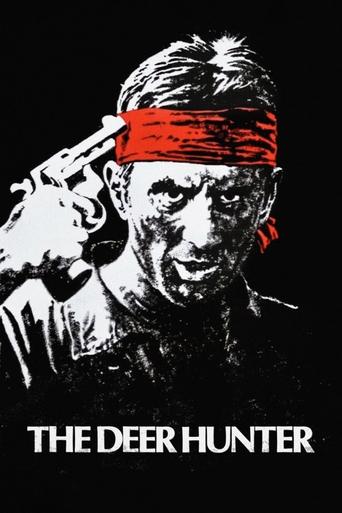
The Deer Hunter
1978 · Film · 183 min
Directed by Michael Cimino
Three steelworkers enlist in the army and are sent to Vietnam, one leaving behind a rushed marriage, the others a shared love. What they encounter during the war changes their lives forever.
11 positive1 negative2 mixed15 neutralfrom 29 commenters
Where to watch
No streaming data for this title.
30 comments on Hacker News
Here is the full list of the 551 movies and TV shows being removed: https://www.playstation.com/en-us/legal/psvideocontent/
Top movies include Apocalypse Now, The Deer Hunter, The Graduate, Moonlight, Manchester by the Sea, Room, Silver Linings Playbook, Terminator 2: Judgment Day and Pan's Labyrinth.
Hard disagree about declarative "X is Y". It's a failure of weakening attention span. There are plenty of excellent long movies:
- Once Upon a Time in America (1984) 3:49
- Lawrence of Arabia (1962) 3:47
- The Irishman (2019) 3:29
- Malcolm X (1992) 3:22
- The Godfather Part II (1974) 3:22
- The Lord of the Rings: The Return of the King (2003) 3:21
- Schindler's List (1992) 3:15
- Gandhi (1982) 3:11
- The Green Mile (1999) 3:09
- The Deer Hunter (1978) 3:03
- The Lord of the Rings: The Two Towers (2002) 2:59
- The Lord of the Rings: The Fellowship of the Ring (2001) 2:58
- Casino (1995) 2:58
- Braveheart (1995) 2:58
- The Godfather (1972) 2:55
- Django Unchained (2012) 2:45
What I most object to is lazy storytelling for lazy, second-screen audiences lacking in style and subtlety having a robotic, spoon-fed, infantile, unnatural, expository narration quality in every character like it's a commercial for an antacid.
I read about a screen test of The Deer Hunter, in which people said the movie was amazing but the beginning (the hunt, the wedding, etc.) was too long. The producers cut a bunch of scenes and tried again. This time the feedback was, "the movie sucks."
Let’s be real, the overwhelming majority of those 500 are straight up terrible. Netflix alone has produced well over 100 movies, and IMO at best some of them are worth finishing not that I can think of any off the top of my head.
Now I’m sure you’ve looked forward to many movies but off the top of your head list stuff you’ve either seen more than once and or actually recommend to someone that came our in the last 10 years vs…
(78) The Deer Hunter, Superman, National Lampoon's Animal House, Invasion of the Body Snatchers (79) Apocalypse Now, Alien, Life of Brian, Mad Max, Escape from Alcatraz (80) The Shining, Star Wars: Episode V, Airplane!, The Blues Brothers, Caddyshack, The Elephant Man (81) Raiders of the Lost Ark, Das Boot, The Evil Dead, Mad Max 2, Escape from New York, Time Bandits (82) Blade Runner, The Thing, E.T. the Extra-Terrestrial, Poltergeist, Conan the Barbarian, Fast Times at Ridgemont High, Tron (83) Scarface, WarGames, Star Wars: Episode VI, Trading Places, The Evil Dead
Obviously not all great movies but that’s ~30 classic movies in just 6 years and I’m sure I’ve missed a few as kids movies are largely missing from that list.
I'd disagree. There are a few (or more?) actors, directors and producers that make movies solely for receiving the Oscar nomination/win. One example is "The Deer Hunter".
Note, on looking into provide specifics, this came up: https://en.wikipedia.org/wiki/Oscar_bait
I seem to recall the guidelines here being against list-articles, but this is the NY Times so I guess it's a reputable source.
Anyhow, the items from his acting career are:
- Early headshot (picture) and type-written résumé
- A fedora (hat) from "Mean Streets"
- An actual taxi driver's license from preparing for "Taxi Driver"
- Dog tags from "Deer Hunter"
- "Raging Bull" annoted script
Cool items, and I guess a really nice move by him to donate personal stuff like that for future generations of film buffs to admire. :)
I object to your tone, and I don't understand why you're taking it with me, or wrongly assuming that I didn't see 'The Deer Hunter'; I did see it. I had heard rave reviews about 'The Deer Hunter' but as things happen, I only got around to seeing it ~15yrs after it was released. It was decent, De Niro and Cazale are standouts, but not as great as the accolades it had been showered with. I like most De Niro (Scorsese, Cimino, or other director), but for a slow-boiler character study of a man's descent into insanity, 'Taxi Driver' (or the little-known but superb Danish film trilogy 'Pusher' (1996-2004-2005)) are IMO far superior. Or maybe even Takeshi Kitano. As far as TDH goes, I think the last chapter suffers a break in coherence, and it doesn't advance the narrative to see De Niro unravel in slow-motion at the end. As far as anti-Vietnam war films go, Bogdanovich's 'Saint Jack' made the point more deftly; we don't necessarily need to see people literally blowing their brains out to get the point that they've been systematically dehumanized. Perhaps it's the Oscar hype machine rather than Cimino's directing that's responsible for the perpetual hype around 'The Deer Hunter', and the lack of hype around Nicolas Winding Refn. In any fair universe, foreign directors like Refn would have won an Oscar for his early work, regardless that it was in Danish; which is a Hollywood attitude that persisted until 'Parasite' (2019).
Be assured I've "watched old films" aplenty. (I referenced 'Alphaville' above, earlier; and the David Lynch 'Dune'. I was even gong to reference Tarkovsky). My comment wondering if Godard was ever considered to direct 'Dune' is obviously praise for his work.
Have you seen Pusher Trilogy? or Bogdanovich's 'Saint Jack'? How do you think they compare?
(Also, 'The Deer Hunter' running time is 3h3m, so the "you can't spend an hour just watching someone else's creation" misassumption is offbase for multiple reasons. Ask questions, rather than make wrong assumptions.)
It isn't that movies like The Deer Hunter are slow, necessarily. It's that the scenes are doing things other than advancing "the plot". Things like revealing a hidden character trait or depicting the quality of the protagonist's world. I remember someone telling me that The Zero Effect (1997) was "too slow", when I thought it was moving along at a fast clip; I finally realized it was the difference in what we were getting out of (or looking to get out of) the movie that accounted for our differing perceptions.
Not that that can't be done poorly, either. But The Deer Hunter never struck me as slow, and I'm a kid who grew up with Star Wars as my template. But I got really into what we might call (erroneously) "character-driven" movies in the '80s.
(Dammit, I liked Chariots of Fire, but there was no way it should have taken Best Picture over Reds. Same with Ordinary People and Raging Bull.)
I think The Deer Hunter hits a lot harder for folks that lived through the Vietnam war. My dad (a boomer who was in his 20s during the war) connected deeply with the film because it portrayed what was really happening to people in that time. The movie wouldn't have been nearly as powerful or impacting if it just cut straight to the Vietnam and capture scenes, you need the first act to establish the deep and real friendship of the folks going to war. You see their life before the war and how amazing and perfect it is--how it could be your life. And then you see the horror of the war and how it completely fractures and destroys this group of friends. A lot of people that lived through the war experienced the same kind of shock and the film is quite cathartic for them.
If you just want a Vietnam war movie that cuts right to the gory chase about the horror of conflict, watch Platoon. If you want to experience what life was like for a young adult in their 20s and 30s being drafted or going to fight in the war and its impact on their life, watch The Deer Hunter.
The Deer Hunter is also a great example of how movies have changed. I enjoyed the movie but it's just sooooooooo.... daamn.... slooooooooow. Nothing happens for the first hour. That doesn't make it bad, but it goes to show - audiences in 1978 must have had very long attention spans. I can't imagine such a glacially slow movie being a hit if it came out today, when the average person can't pay attention to anything longer than a TikTok video (and even that needs to be played on double speed.)
People's brains have changed.
The Deer Hunter. A great movie I will never watch a second time. Too much reality.
It is hard to overstate how much Godard changed cinema, even in America. If you don’t believe me check for yourself. Open the best picture nominees between 55’-65’ and watch their trailers. Films like Marty/On the waterfront/12 angry men/To kill a mockingbird/The Caine Mutiny/Sweet smell of success is what movies were like in the late 50s.
The acting/writing was pompous, actors talked like reciting Shakespear. The movies were about heros of impeccable character doing heroic things and there always was a happy ending. Movie shots followed strict guidelines and the creative head of the movie was the producer while the director was akin to a contractor, someone hired to film the scenes.
Starting in the mid 60s there was a radical shift, topping the nominations we have films like Five Easy Pieces, The French Connection, The Godfather, One Flew Over the Cuckoo’s Nest, The Deer Hunter, Dog Day Afternoon, Taxi Driver etc. Actors would act and behave like normal everyday people facing everyday problems. The new Archetype is the Anti-Hero, someone with flaws/vices in their character, someone that viewers can relate to. We see the rise of the director as the auteur, the creative master of a film. Every known filmaking rule is being tested to it’s limits and broken by young experimenting directors.
The catalyst for this change was the French New Wave, a group of young filmmakers tired of the old style of cinema wanting to do films about their own life and experiences. The poster boy for the New Wave was Jean-Luc Godard starting this revolution with his 1960 film Breathless.
As an actor, John Cazale. Made 5 movies in his life. All of them nominated for best picture (with three winning.)
The Godfather
The Conversation
The Godfather II
Dog Day Afternoon
The Deer Hunter
I just watched The Deer Hunter (1978) for the first time, which Walken described as kicking off his fame.
If you haven't seen it before, it's long but worth a watch. Left me longing for more older films, like the original Rambo, Empire of the Sun, or The Razor's Edge. They don't make movies like that anymore.
Those are all pre-modern people before the invention of vaccines and antibiotics and who had terrible health and suffered by now preventable childhood diseases. Their 35 is not our 35. Shakespeare, I believe, wrote about joint pain, aging, and losing his memory and mind at 35, which is not typical of a modern 35 year old. Substance abuse and artistry go hand in hand and a lot of these artists were addicts and drunks who badly damaged their brains. Many of them had mercury poisoning from medical treatments of their day and other edge cases not common today.
Not to mention these people were elite global competitors, so if they felt less sharp at 35, that means they were merely just the top 1% instead of being the top .1%. They still were amazing thinkers and producers after 35.
Just off the top of my head, Stanley Kubrick's career peaked with his decade plus long Lolita, Strangelove, 2001, and Clockwork Orange period in the 1960-70s, which was around his 30-40s. Then nearly 20 years after Lolita, well into his 50's he made The Shining, which is considered an important American film, perhaps not as groundbreaking as the others, but something miles ahead of his younger competitors. So even as these people supposedly age out of their peak years, these super high performers are still amazing. The Oscar winner that year? Kramer vs Kramer, a largely forgotten piece of art and "safe pick" that played to social issues of the time. The best screenplay? Breaking Away, a completely forgotten movie. The Shining is still a beloved classic, cultural icon, horror master-class, an iconic actor's defining role, and a movie studied in film school religiously today and for the foreseeable future.
Then almost a decade later in 1987 at age 59, he directed Full Metal Jacket, a lesser work, but considered one of the best anti-war films, arguably stealing or matching the crown from beloved critic favorites like Apocalypse Now and The Deer Hunter, long after the 60s and 70s fad of anti-war movies faded away and Vietnam a now faded memory and during the right-wing, pro-military, pro-interventionist foreign policy Reagan administration. This was a bold and provocative move you'd associate with a younger director trying to get attention and not a man close to retirement. So even "old" Kubrick was competing on a world class level and doing interesting and challenging things.
A genre horror film from a famous director who hasn't delivered a great film in a decade? An anti-war film in the late 80s on the tail of Top Gun? Both of these genres were fads once and decidedly uncool at the time of their release. This on paper sounds almost foolish, but in practice, an artist of his calibre pulled off something very special in both cases.
For modern people, career peaks are mid-30s. The "wisdom" of two hundred old plus composers and poets is a nice toilet read but isn't scientific at all. Science has its own ideas about aging:
The journals Psychological Science, Science Direct, and Harvard claims various mental peaks come later in life. New vocabulary peaks at 67, learning new information at 50, concentrating at 43, learning new faces 32, etc.
https://nextluxury.com/mens-lifestyle-advice/what-age-do-men-peak/
So yes 35 is not only a good age, its the start of a peak, and a 35 year old modern worker has still another two decades of high performance waiting for them.
I have seen Iron Man 2, both Guardians of the Galaxy, the fist Captain America and the second Avengers movie. So it's actually five movies (one more than I thought).I might have seen part of the first Hulk on TV but I'm not entirely sure, could have been any of the other ones. I stand by my opinion.
When you consider that Hollywood produced movies like The Deer Hunter, Chinatown or even the first Jurassic Park if you want to talk about blockbusters (not the new ones they could be Marvel movies), it makes me a bit sad.
I mean, don't get me wrong. I enjoy going from McDonald's from time to time. Nothing like a bunch nuggets when you had too much to drink. I just don't go around pretending it's good food.
Showing these kind of things has always been against the ethical standards of journalism and exceptions to it used to be discussed intensively by editors - excluding the tabloid yellow press who make their living from this trash, of course. I guess some of the more recent American TV channels realized at some point, after they had gained fame for showing everything, that quotas are not everything and that relatives usually don't want the death of their beloved ones displayed all across the Internet without their consent.
Sites like Liveleaks are very hypocritical, they pretend to show videos for "freedom of speech" while instead their main purpose is simply to satisfy their viewers' voyeurism. Cheap thrills are the main reason for viewing this kind of material - and don't pretend to be someone better, you've looked up that kind of stuff yourself for precisely that reason just like I have. People who watch this material only want to satisfy their curiosity and get the thrills from it.
That's also why Truffault once said "There’s no such thing as an anti-war film." (There are exceptions, like "Taxi Driver", and perhaps also "Deer Hunter" and "Killing Fields", but these are rare.)
U.S. Steel is such a horrible company. Their coke plant in Clairton, PA (the setting of Deer Hunter if you haven't seen it, great movie...) continues to pump out pollution in violation of governmental environmental standards, including massive amounts of SO2, contributing to an astronomical asthma rate among children in Allegheny County (home of Pittsburgh). Unfortunately the city of Pittsburgh, the county, and Pennsylvania seem completely unwilling to take any action.
The last paragraph of the piece kinda struck me:
"And perhaps if others saw more realistic portrayals of poverty in the movies, they might be more receptive to programs that would help them instead of demeaning and punishing them."
I would love an example where 'realistic portrayals' of a given subject in movies led to changes in public policy / public perception.
If anything, I would argue that popular films, just like other art forms, are more likely to serve as a barometer of society's perception/reception of a given subject than as something that ignites the change.
Take the war in Vietnam in the 60's and 70's - I'm not sure you could make 'The Deer Hunter' in '68, or 'The Green Berets' in '78.
Or the war on drugs - movies like Trainspotting, Requiem for a Dream, or Traffic certainly showed a realistic side of drugs and addiction... and yet the war on drugs has only intensified since their popular releases.
As a movie buff this doesn't surprise me at all. I'm still waiting for THE movie about the US intervention in Iraq, the same kind of movies that Apocalypse Now, "The Deer Hunter" and even Rambo I were for the Vietnam war. I think my wait will be in vain.
This is one of those movies I used to watch every now and then with my dad when I was a teenager (although it's way too long to watch in one sitting). It's one of my father's favorites, along with Rio Bravo, The Deer Hunter, Apocalypse Now, and Deliverance (I wholeheartedly recommend all of them, the last one is some heavy shit). Such a shame that most people get to experience it in the butchered version. And to think we were getting the real thing on Polish cable TV and didn't even appreciate it...
I would like to do that too, and had thought of something like it when in my teens. I spent a lot of time in forests then.
Around that time I had read this novel (a Western) called The Deer Hunter (not related to the famous movie of the same name, which is about Vietnam, etc.), and it was about a guy who does that work - a forest ranger in the Grand Canyon (of the US). Great story.
It's not aesthetics for me as much as sufficiently older movies are a lot closer to stage plays in how they're filmed and storyboarded, and I generally dislike plays and musicals whatever the content is (case in point: I don't have any interest in Hamilton nor Disney movies). Then comes a lot of older movies having pacing that doesn't fit the time and mental energy commitment I am capable of making.
I can appreciate classics like Lawrence of Arabia, Dr. Zhivago, and the Deer Hunter, but I generally don't have 3+ contiguous hours to do anything anymore let alone watch a movie and I feel ashamed I can't honor such works with a proper, conscious viewing either. For "pop" arthouse movies closer to something like Begotten or Valhalla Rising, the effort to get value is even worse because I am not understanding what the symbols are and it becomes more of an exercise in "let's analyze scenes!" than "let's watch a movie to stimulate our minds." Some people don't like video games for similar reasons I feel - they want passive, decision-free entertainment.
Warning: spoilers ahead
Homeland was pretty subversive in its first season, I mean, up until Brody decided not to blow himself and the rest of the high-ranking officials up in that bunker it was a pretty bleak affair: a decorated US marine, now a politician, who decides to kill the VP of the United States and a couple of other generals, you don't usually get that in block-busters. Afterwards, and especially starting with season 2, it did indeed become a propaganda thingie.
Otherwise you're completely spot on. As a film junkie it really bothers me that our generation doesn't have its "Apocalypse Now", "The Deer Hunter" or "Rambo I - First Blood" (whose director has just been interviewed in the latest Cahiers du Cinema issue), it's all white-washed, depressing propaganda. There are a few exceptions here and there (De Palma's "Redacted", Bigelow's "The Hurt Locker", partially), but otherwise we're treated not as adults, but as kids who need to be told "nice" stories about what's really happening around us.
Full Metal Jacket.
• Three Kings.
• In The Valley of Elah.
Good Morning Vietnam.
A Few Good Men.
Platoon.
• Jarhead.
Casualties Of War.
• The Men Who Stare At Goats.
The Deer Hunter.
The Thin Red Line.
• Syriana.
• The Green Zone.
• Stop Loss.
Also, • HBO's "Generation Kill".
(•'d relatively recent movies)
I don't think "The Hurt Locker" was particularly critical of the military and didn't count it. Also not counting documentaries like "Restrepo".
I hereby dispute the idea that the DOD has made it impossible for big-budget Hollywood movies to criticize the US military, and suggest instead that the bias Hollywood in favor of the military is responding to customer preferences and not leading it. Given what I presume to be America's default position of "supporting our troops", I'm struck by how many films Hollywood produce that challenge that default.
Remember also that Hollywood confronts at least two vectors of consumer preference in marketing films: first, Americans (in the large) have a (typical) diffuse nationalistic home-team support for our overseas adventures, and, more importantly, there's a less-political less-issue-oriented reverence expected for the sacrifices made by the young people we send into combat which is especially intense during times when large numbers of people are serving in combat zones. In other words, it's especially tricky to criticize the military during active conflicts.
Also, Three Kings is a fantastic movie.
OT: John Cazale had the most astonishing career of any actor ever. Six years, five movies, five nominees for Best Picture (The Godfather, The Godfather Part II, The Conversation, Dog Day Afternoon, Deer Hunter), three winners. And then he died. Just a remarkable life.
I am currently trying to get my speaking chops together in anticipation of launching our game changing, earth moving start up by following the course that Conor Neil has put together. http://www.conorneill.com/ Conor has also offered our budding Barcelona Internet Startup Community a series of workshops that have served a couple of purposes 1. to make us better speakers and 2. to unite us as a community. He's terrific. So far so good.
In my life as director of commercials I have often been required to speak to groups of people. Whether it's a conference call or the "pre pro" meeting since I be "the man" I have to deliver the goods and coming from the formerly reticent Portland, Oregon I was not exactly hard wired to be a good speaker. I also occasionally have to speak at conferences which is an entirely different experience.
One of my tricks for a small group is to try to get everybody to sit as closely together as possible and I often try sit between "the client" and whoever is my big buddy at the agency. Usually it's the producer or the creative director or the writer. I'm trying to keep this as warm, cozy and informal as possible. We're all one big happy family. Usually it works. Production wise we always have our act together. Mood books. Animatics. Examples from other better, films. Really good casting and the performances to back them up. And by nature I use a lot of goofy asides (thankfully I'm a comedy director) and I keep it moving at a good clip. My thinking is that if I talk fast nobody will actually notice that I have completely taken over the concept and returned it to the great idea the 22 year intern had in the shower 18 months ago before it was reduce to meaningless drivel by the focus group/committee/in law review paradigm. We'll shoot both ways is swell way to get around a conflict. Mostly it works... they usually rub out any creativity in the editing process but at least we try. So small is beautiful. I'm your buddy. "See you in Buenos Aires!" Works. And to tell you the truth... it's not an act. It's me. I'm a natural cub scout activities director. Mostly I like people. And oddly over the years I have actually become a real chatter box... which is quite a feat for a Northwestern guy where old schoolers are prone maybe uttering a guttural groan every six months or so.
The bigger shows are different. I write them. I use marital... sorry visual aids and make it as tight as possible. I always like to have a dry side and a wet side. The dry side is the scripted part which I practice a lot and is hopefully as tight as a drum... ok with lots of incongruous hopefully funny asides... and the wet side is where I make some poor schlub from the audience come up and bite creamed corn or something.
I went to Conor's first meet up and was impressed but... it seemed to me that he was in many ways pretty much just working the room. He was selling. There was a predictable rhythm to it. Ice breaker. Intrigue, involve, challenge. Repeat. Good night. We discussed this over emails and for the next session he completely changed his focus... which was commendable and interesting and much more honest and compelling.
So my take away from this current focus on public speaking is that I really don't like the super pros. The folks that could hold an audience in rapt attention reading a phone book. It's an act and when you actually see through the smoke and mirrors... there is usually not much there. It's like the "The Deer Hunter." I left the theater in a daze... and then about 4 minutes later I decided I had no idea what the film was about.
I watch the TED talks all the time. Here's a favorite. http://www.ted.com/talks/ken_robinson_says_schools_kill_creativity.html Sir Ken is funny. Informal. Self effacing and emotionally and intellectually compelling... absolutely spot on and I will follow him to hell.
The passionate, inspirational, self important, arm waving salesmen... forgetdaboutit.
The Deer Hunter is a very strong movie that still stands on its study of how relationships change under stress of war. It's not really about Vietnam specifically, or its time. Perhaps you were too young when you saw it? (Born in 79 FWIW.)
Deer Hunter is an incredibly good movie and I have no connection to Vietnam. I was born in 1977.
both to you and jobu:
That's probably it. I remember watching Deer Hunter...maybe in '99 and I just couldn't believe how bad a movie it was. Obviously, to people still in touch with Vietnam (in 78), the impact was...greater.