 Hacker Cinema
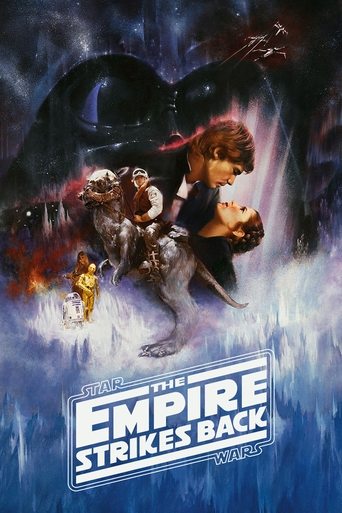
The Empire Strikes Back
1980 · Film · 124 min
Part of Star Wars Collection
Directed by Irvin Kershner
AdventureActionScience Fiction
The epic saga continues as Luke Skywalker, in hopes of defeating the evil Galactic Empire, learns the ways of the Jedi from aging master Yoda. But Darth Vader is more determined than ever to capture Luke. Meanwhile, rebel leader Princess Leia, cocky Han Solo, Chewbacca, and droids C-3PO and R2-D2 are thrown into various stages of capture, betrayal and despair.
20 positive4 negative44 neutralfrom 68 commenters
Where to watch
No streaming data for this title.
71 comments on Hacker News
A non-percentage-based one would be more interesting. The whole MCU phenomenon would likely increase the absolute number, but I doubt that it would be as dramatic. What the chart as-is fails to show is the specific loss of other types of movies that have moved to other media.
Ever since made-for-cable TV series went mainstream with HBO in the late-90s, a huge chunk of yesterday's non-blockbuster movies have become today's TV series. And there are massively more TV series than ever before.
That "25%" in the 80s shows you that there were already tons of those, and it's easy to remember them (Jaws 2, Empire Strikes Back, Temple of Doom, Aliens, Godfather Pt 2, etc etc etc).
Videogames rely on gameplay more than storytelling or teaching history. It's not a novel or encyclopedia entry. It's not unserious to expect a videogame to be fun over having a deep exploration over the possible interpretations of one word in its title.
Plus, some films are like Casablanca. Some are like History of the World Part 1. Additionally, if someone relies on media like Age of Empires, The Empire Strikes Back, or the novel Empire by Gore Vidal to gain an understanding of what an empire is, just because the word empire is in the title of these works, there are bigger issues at hand...
The Mandalorian TV series wasn't bad but the Star Wars franchise has been in reset/turnaround for ~7 YEARS (since the last movie). It's incomprehensible that Disney bet their relaunch on a spin-off streaming series based on a tertiary character miraculously swimming back upstream from online to cinema.
The two leads are a guy you never see and a small puppet (with the big reveal new character being a CGI alien). As great as they were, C3PO, Yoda and Chewbacca couldn't have carried Empire Strikes Back as the leads. What was Disney thinking?
Anthropic, both in the name, and in their model cards, agressively anthropomorphize their models.
You probably should start doing it. Ghost in the Shell is about super intelligent AI creating a "ghost" (scientifically understood version of the soul) out of thin air. I believe such a thing is possible. The same movie literally predicted model merging (the end of the film the AI model merges with the major) to a tee.
Further, the appearance of sentience/cognition/consciousness might as well be identical to actual sentience/cognition/consciousness. That is to say, we can't know if you're a P-zombie or not. Bladerunner and most other cyberpunk stuff is coming and gonna hit you and every other AI-denialist in the face. The Von-Kampf test is absurd and pretty bad (inaccurate) in their universe for a reason.
I tell my LLM it's a good bot and thank it, because even a tiny risk of subjective qualia experienced by a model (and again, Anthropic themselves believe in this exact risk) means I should treat it like a quasi-ethical actor.
This is also a reason why the robot torture scene in empire strikes back could be a real dynamic in the future.
Episode 8 was a retread of Empire Strikes Back (ships chase through empty space while the main character trains with the old master on a wild planet). It seemed subversive just because ESB was subversive relative to ANH.
It's much, much more collaborative than that. The role of a producer can be limited to managing the financial side of the production. Or they can be involved with coordinating the production itself. The director has the most say over what is shot, how it's edited, what the score should be like. A good producer can help make a film excellent, but if you have a bad director, or the "wrong" director, then nothing the producer does will fix that issue.
Of course there are also Executive producers who are far far up the financial food chain of a movie, and sometimes these titles are also just vanity plates for the production.
As an example of the value of a good/great producer, look at Gary Kurtz. He was essential for both Star Wars and The Empire Strikes Back, but wasn't part of the team for Return of the Jedi. In my opinion, that's one of the reasons that ROTJ is the worst of the three films. Lucas didn't have someone pushing back against his worse tendencies.
For an example of the wrong director, look no further than Rogue One. While it's very difficult to sus out what was wrong with Gareth Edwards directing, Tony Gilroy was brought in to fix the film. Both are appropriately quiet about what the changes were, what was re-shot (simple professional courtesy), but the result is a film that (while I love it) is just slightly off.
While you can't dismiss New Hope as it was just breathtaking at the time of its release, Empire Strikes Back was arguably peak, and you needed to wrap it up with the third movie, there's a good argument that Rogue One was the second best film after Empire. And probably Andor as a series after that. Unlike a lot of people I don't mind series wrapping up after a season or two. Even in the best cases I'm starting to lose interest by season five in a lot of cases.
(I think the prequels were worse than the sequels but they're collectively pretty unmemorable.)
Not sure why they included a hallucination as one of their first examples:
"Please recommend me three famous movies"
"The Empire Strikes Back (1980) - Directed by George Lucas"
If one looks at the YODA puppet in The Empire Strikes back, of course, moves like a puppet, but the motion is real. Jerky, emotional, human-like.
One move to The Clone Wars and the CGI moves are mechanic. Maybe the way to go about animation is not on the eye of the beholder but on careful comparison of analog vs digital renderings: Film a human running on analog and pair it pixel by pixel with the digital cgi counterpart.
The very first Star Wars ("A new hope") is fairly basic in plot, but with very good moments and no mistake.
The next two, especially the empire strikes back, are really good in their own right in terms of film-making artistry. They have the right tone, rhythm, imagery, scenography.
The rest, though, is catastrophically bad.
I am not a Star Wars superfan, but have enjoyed some of the films, particularly the original Star Wars, Empire Strikes Back, and Rogue One.
When I first saw Lucas' revisionist scenes in Mos Eisley back in the 90s or early 2000s, such as the CGI creatures outside the cantina and the Greedo/Han Solo incident inside, it was disillusioning.
Lucas didn't fix flaws in the original film. He jazzed up some scenes that didn't need it. He neutered one of the great flawed heroes of science fiction film. It would be akin to Francis Ford Coppola remaking the scene in The Godfather where Michael Corleone coldly shuts the door on his wife by adding an audio or video edit in which the wife spits on Michael, thereby "justifying" the cold treatment.
Kudos to the teams restoring the original 35mm films, although I fear this article may trigger a heavy-handed response from Disney's legal thugs.
Wow, I think the Empire Strikes Back is the best movie in the Star Wars saga. Darker. The movie was directed by Irvin Kershner instead of Lucas.
It would be great if someone puts an OCRed version of it to quickly search. I tried with ChatGPT but it "said" that is took many resources and need to cancel. Google Gemini couldn't do that and only suggest external resources to do that. Can someone try with Acrobat Reader or something similar?
Edit: OCRed via [1] and available here: https://drive.google.com/file/d/1_CPDjo-TDzXZDOSIXPuhOcrv8lc6HFgf/view?usp=sharing
[1] https://tools.pdf24.org/en/ocr-pdf
A bit of context: Leigh Brackett was a sci-fi author and screenwriter that George Lucas hired to write the first draft of The Empire Strikes Back in 1977. She wrote it based on a story conference the two had but unfortunately passed away from cancer a month after submitting it in 1978. Lucas then wrote a few drafts himself but wasn't satisfied. Eventually, he brought on Lawrence Kasdan, who would also write Raiders of the Lost Ark and Return of the Jedi. This draft is a lot different from the movie that would eventually get made but you can still see hints of it in the final film. Both Kasdan and Brackett got a screenwriting credit for the film.
Much of what you actually see in Empire is written by entirely different people.
> George Lucas initially hired Leigh Brackett, the sci-fi novelist who also wrote screenplays for Howard Hawks—including The Big Sleep (1946)—to write the sequel to Star Wars (1977). Brackett died in March 1978 while the film was still in pre-production, though, and Lucas wasn't satisfied with her script. Lucas wrote the next draft himself, which established structure and twists close to the final film, but suffered from dialogue. When Kasdan delivered his script for Raiders, Lucas asked him to rewrite The Empire Strikes Back. Kasdan suggested he read Raiders first, but Lucas reportedly said: "If I hate Raiders, I'll call you up tomorrow and cancel this offer, but basically I get a feeling about people."[9]
Brackett was a sci-fi author, Kasdan was a screenwriter by trade.
Despite seeming like similar tasks, screenwriting and book-writing actually have pretty distinct skillsets in some ways.
That's partly why the [spoiler] of The Empire Strikes Back is effective, but that movie also has a different tone right from the start (even before that, with the title), and doesn't really tell a complete story but sets up the next sequel to provide resolution and the inevitable heroic victory.
Silent Running is a dystopian setting, so the ending is unsurprising, and American Graffiti is a of genre that often has bad outcomes for some characters as cautionary tales.
Also, people criticize George Lucas for the star wars prequels but he captured lighting in a bottle again with those movies. He created a believable CGI character in jar jar, as much as everyone hates him nobody complained about the CGI. He created the green screen movie that even these dumb new wrap around things are simply emulating but for the actors sake since they complained so much. He remade what cinema was again. None of the prequels were a critical masterpiece like empire strikes back. But they did change the way movies were made.
While I'm no big fan - mostly the nostalgia effect - I used to work with someone who never watched Star Wars. I found it hard to imagine.
A few weeks ago I watched "A new hope" with my 13yo daughter, we both loved it. Of course the effects didn't age well, but the story and acting is as strong as it used to be. I'm going to watch "The empire strikes back" with her soon and have to be careful not to spoil the "I am your father" reveal. Though I admit she's not very typical - we're both Whovians ("number one fans", so to speak;-)), so she's accustomed to story, writing and acting being way more important than SFX (which is IMHO the correct attitude, at least most of the time).
I really hope that she'll find some fellow geeks soon.
Also, in my current team at work I used to be the only one who watched (and read) "The Princess Bride". Now one coworker also watched it, and one day we're going to watch it together with the whole team. I think many people nowadays know it only from memes, which is sad - it's a great movie.
You have to take into account that Star Wars is not an attempt to simulate realistic space battle strategy and tactics, it's pew-pew space battles and laser swords and pulp adventure. It was never realistic. The Death Star is a patently ridiculous, extremely inefficient weapon, since there's no need to entirely explode a planet to destroy it, as is it needing to wait until the moon of Yavin is out of the way when it could easily destroy Yavin from any axis, as is the trench run, which only exists at all because George Lucas ripped off a World War 2 movie, scene for scene, as is the plot twist of the exhaust port. Yes, it's been retconned (like the parsecs thing) but it's still goofy as hell that two torpedos could cause a chain reaction big enough to blow up an entire moon-sized ship even if it hit the reactor dead on. People accept it because it's the OT and they have nostalgia glasses on but it really is kind of bullshit.
The Empire was just that arrogant and self-confident that they never noticed such an obvious flaw until it was too late? Still bullshit.
Sabotage? Better, and it got us Rogue One, which was a great movie. But even then it stretches credibility.
The walkers in Empire Strikes Back are ridiculous, no one would actually build those, with their obvious (and easily exploited) weakness. And in a universe with blasters, no one would ever be using lightsabers. Hell, if you can force choke someone, which even Luke did with that Gammorean guard, why not just force pinch an artery in your enemy's brain or heart? Why bother with all the spinny flips and shit? Just force heart attack from a concealed location, done.
Realistically, you wouldn't even have dogfights in space at all, much less with plane-shaped ships that bank through turns, you would have fully automated, spherical droids attacking from hundreds of thousands of kilometers away or just, as you mentioned, toss a big FU asteroid through hyperspace into the orbit of a planet. And yes, the elephant in the room is that any FTL drive is by definition a weapon of mass destruction.
None of it makes much sense. It never has, because it has always been more important that things look cool than make sense. But the point is, ramming a ship with another ship while going into hyperspace makes no less sense than anything else. The transition to hyperspace isn't instantaneous, you can see the ships zooming in and out of hyperspace and see the starfield warp. So logically there must be a point at which it works. Maybe the margin of error for that is so razor thin that it's not worth trying most of the time. Maybe the particular shape of the ships involved made it an optimal strategy that one time. I don't know, but one can come up with excuses a lot less goofy and contrived that the "maze of black holes" that justifies the parsec line about the Millennium Falcon to justify it.
People are just being particularly nitpicky about this one element while they're willing to forgive the decades of patent ridiculousness that came before.
What are these midichorians you speak of? I saw all three Star Wars movies, A New Hope, Empire Strikes Back, and concluding with Return of the Jedi and there was never any mention of these mudichorians!
Yeah, he mentions his orchestrator in this documentary on Empire Strikes Back: https://www.youtube.com/watch?v=NT4_ERNVx3Q
Given the time constraints on getting the film scored it makes a ton of sense to have help in that department.
> Much like Star Wars fans have learned to put up with Disney's attempts to wring every last dollar out of the franchise.
They're just continuing in George Lucas' footsteps. IMHO, either you accept the money grabs, or your acknowledge only the two films, Star Wars and the Empire Strikes Back; even Return was money grubbing.
It is fascinating when someone does a deep dive into movies and flesh out potentially deeper meaning. For example this YouTube video (https://www.youtube.com/watch?v=MALVhzMcJ1k) does something similar for the Vader-Luke duel in "The Empire Strikes Back" albeit on more emotional interpersonal level than philosophical.
> It amazes me how being competent is enough to make you the best thing in Star Wars.
Really, Andor is the best sw thing since The Empire Strikes Back. The first episode of Mando was OK, but then it continued in the style of 1960s TV western which isn't my thing.
In general star wars is meh. It's like The Who: all energy, little musical talent (which was great at the time but doesn't age well). Except most SW movies don't even have energy.
Yeah, I agree. Limiting to one is tricky, when years like 1982 are famous for having multiple amazing films (in this example all released in the summer)
You're right that "Greatest Hit of that year" is going to wildly swing in quality, and you could miss other films that are arguably the better film.
Take that 1982 example again, the writer chose E.T. .. an amazing film by all accounts, but ignored Bladerunner, Empire Strikes Back, The Thing, Tron, Conan the Barbarian, Wrath of Kahn etc etc...
Sure not all these films are equal, but the metric of highest grossing film might work fine in the older years.. but I'm going to say that lately, that metric doesn't work anymore. And it doesn't work because honestly, was Spiderman the best film from last year?
The biggest-budget indie movie ever is The Empire Strikes Back. Lucas didn't want to be beholden to the studios so he didn't take their money.
Yes I did... Revell's Visible V8 Engine model kit is very well known among a special group of nerds: Those who build their own replicas of props from the original Star Wars movies. (I am one of those nerds ...)
Parts in the kit had been used as "greeblies", glued onto lots of different props in The Empire Strikes Back and The Return of the Jedi. This includes droids, helmets, rank badges and other applications on clothing, and "blasters" (guns): most popularly, the pistols used by the popular characters Han Solo, Luke Skywalker and Boba Fett.
Here's a list of parts and what they were used for, but I think it is far from complete: <http://partsofsw.com/v8parts.htm>
Not only are original model kit parts used, but prop replica enthusiasts also trade casts of them.
>It was pretty crazy though when movies were like $99 on VHS.
Yes! They touched on this in the Netflix documentary The Last Blockbuster[1], where an old exec claims that any video copy displaced a huge number of movie viewings, so they came up with a high price to charge for them.
It showed a picture of The Empire Strikes Back with a $99 price tag, which, if you assume it was 1982, would be like $290 today.[2]
According to the documentary, that only changed after someone bought the (expensive) videos and started renting them out, which led to a court case that affirmed the First Sale Doctrine and said you had the right to do that. Then eventually, the video rental stores got the studios to agree to "have all the copies you want, as long as we get a cut of the rental revenues".
[1] About the history of Blockbuster, framed around the last surviving location, a franchisee (in Bend, Oregon) that pays a fee to keep using the brand.
[2] https://www.usinflationcalculator.com/
Some years ago, I was at my cousin's house watching some movies on his HDTV. The first movie was "Star Trek II: The Wrath of Khan," which I recall seeing in movie theaters when it was released in 1982 (as I date myself here). I think STII is the best of the Star Trek movies and still holds up to this day, but watching on that HDTV was painful! I could see the costumes. I could see the cheapness of the set. It just looked cheap, and not at all like the incredible spectacle I remember from the movie theater (or on repeated rewatchings on TV).
The next movie was "Ronin" (1998). Great movie, but on HDTV, it looked like a cheap TV soap opera. Again, it was painful to watch. On the movie screen? Or a normal TV? Incredible. HDTV presents a level of fidelity that older movies can't properly deal with, which you may be picking up on (as someone who not only saw "Empire Strikes Back" in theaters, but still think the puppet looks much better than the CGI version).
> The mandalorian throws in droids that have machine like precision and just wipe the floor killing dozens of people in a firefight, taking no cover, and missing no shots, 360 no scope dual wielding. It broke a lot of unspoken rules about how the world worked.
The first IG assassin droid appeared in Empire Strikes Back the movie and was a boss on the train level of the N64 game. In canon, most of the IG series are unique one offs so they're not exactly mass produced droids found all over the galaxy like maintenance drones (with the exception of the IG-86?). They're very high value items that get reprogrammed and passed from organization to organization.
Thor Ragnarok is one of the few capeshit movies I have seen and it was pretty bad. The entire dialogue is written around forced oneliners from a minute into the opening scene. Guardians of the Galaxy was OK but nothing to write home about or even make me remember to watch the sequel(s?).
All of them are a steep drop in quality from The Dark Knight and there certainly isn't enough material there for twenty something 3hr films and half a dozen TV shows. Just like The Empire Strikes Back is a legitimately great movie while everything else Star Wars themed asymptotically approaches zero.
The whole idea of world building with dozens of movies is a scourge on story telling and a complete dead end imho.
Yeah, that intro to Dark City was a crime against the audience. And honestly I think it was really shortsighted/cowardly of the studio. If you look at two movies that came just a year later, The Matrix and Sixth Sense, a big surprise reveal was central to both of their appeal. And this shouldn't have been a surprise to the studios... the twist in The Usual Suspects came half a decade earlier, not to mention Empire Strikes Back.
My second least favorite thing studios do is cut the trailer in a way that makes the movie seem totally different or even a totally different genre.
Aside: a friend gave me the Sixth Sense dvd as a birthday gift one year, which I had yet to see, and my idiot roommate at that time was in the room couldn't restrain himself from trying to cleverly address my friend in a way that communicated he knew the twist. Except he'd never touched on clever in his life and gave it away instantly. Nice one Paul. Nice one.
> Then there's "it's all remakes now"—but 1) it's not,
It really is, if by "remake" you mean all ways of leveraging existing IP. Here are the top ten box office films of 2020:
* Bad Boys for Life (sequel) * Sonic the Hedgehog (videogame) * Birds of Prey (comic book) * Dolittle (book) * The Invisible Man (book) * The Call of the Wild (book) * Onward (original) * The Croods: A New Age (sequel) * Tenet (original) * Wonder Woman 1984 (sequal, comic book)
Two originals. Now go back 20 years:
* Mission: Impossible 2 (sequel) * Gladiator (book) * Cast Away (original) * What Women Want (original) * Dinosaur (original) * How the Grinch Stole Christmas (book) * Meet the Parents (remake) * The Perfect Storm (book) * X-Men (comic book) * What Lies Beneath (original)
Four originals. Go back another 10 years:
* Ghost (original) * Home Alone (original) * Pretty Woman (original) * Dances with Wolves (book) * Total Recall (short story) * Back to the Future Part III (sequel) * Die Hard 2 (sequel) * Presumed Innocent (book) * Teenage Mutant Ninja Turtles (comic book) * Kindergarten Cop (original)
Five originals. Another ten years to 1980:
* The Empire Strikes Back (sequel) * 9 to 5 (original) * Stir Crazy (original) * Airplane! (original) * Any Which Way You Can (sequel) * Private Benjamin (original) * Coal Miner's Daughter (original) * Smokey and the Bandit II (sequel) * The Blue Lagoon (book) * The Blues Brothers (SNL sketch)
Five originals again. I'm going by top box-office gross here because I think that's a good proxy for what is successful. You can look at other years, but there is a very clear (but not overwhelming) trend towards movies based on familiar content. It's not clear whether studios are leading audiences or vice versa. Probably some iterative process of both.
There's also a clear trend away from dramas. I think that's because drama (and non-slapstick comedies) tend to rely heavily on specific cultural norms for their effect which makes them translate poorly. There is a very clear trend especially in the last decade or so of Hollywood focusing on movies that will also do well in China in particular.
See also the mini-story on film novelizations from 99% Invisible: https://99percentinvisible.org/episode/mini-stories-volume-9/
A funny part of these is that the author often doesn't get to see the movie they're adapting!
> The novelization of “Alien,” for example, does not have a description of the alien, because 20th Century Fox wouldn’t let the writer look at the puppet while it was being designed. And in “The Empire Strikes Back,” the famously green character Yoda is described as having blue skin.
> Author Hank Searls went off the rails during his adaptation of “Jaws: The Revenge,” adding a plot about the shark being controlled by a “voodoo curse.”
For those who actually understand it, it's a transcendent masterpiece of cinema.
Or maybe it's just the sort of popcorn-crunching entertainment that summer blockbusters should be made of.
In any case, it's the perfect midpoint of Harrison Ford's astonishing trilogy of The Empire Strikes Back, Raiders of the Lost Ark, and Blade Runner.
I haven't examined it but there's apparently a Usenet archive independent of Google at https://www.usenetarchives.com/
I assume things are also on the IA in some form.
Probably my earliest memory of Usenet (and really the Internet) is that after The Empire Strikes Back, there were endless posts on, I think, rec.arts.sflovers about whether [SPOILER :-)] Darth Vader was Luke's father. Someone at the AI Lab printed out the whole thread on the Lab's doubtless very expensive laser printer, bound it, and brought it into the movie committee office where I was hanging out a fair bit that summer
Hey, guys, you ever see that really old movie, Empire Strikes Back?
> Star Wars: A New Hope?
What is this? ;)
Star Wars, and the later Empire Strikes Back were good films, well worth seeing. I still have the "making of" souvenir from the 1977 UK premiere. Then he started the endless pissing about reinventing everything. Last time I tried to watch one, some asshole had ruined it, and my memory of it, and that dog eared magazine souvenir looks quaintly inaccurate.
Now I essentially hate the whole franchise, and actively avoid anything George Lucas. I think I've seen 5 of the 7. Or is it 8 now? Don't care or notice any more. :)
Stargate, Star Trek and those 50's B movie sci-fi and countless others like "classic" low budget Dr Who have managed to last the decades far better... I actually still like those, and still watch new productions!
As for cats, far better to accept they got entirely the worst spot on the anthropomorphising spectrum so even stills look weirdly off and the story telling failed, so it's a dud. Try again in ten years with a new approach and team...
Or Empire Strikes Back, Godfather Part II, and plenty of other movies.
I suppose, and you may be right. But I meant that the Half-Life series is a very cinematic (among the first games to embrace this, if I recall correctly), right from the intro. Playing just HL: Alyx would be like watching Return of the Jedi while skipping A New Hope and Empire Strikes Back -- I mean, you definitely can and still enjoy the movie, but you're missing something important.
Which means there's another entire generation of people who might not yet have enjoyed a sci-fi classic.
Not long ago, I witnessed someone totally spoil the big reveal in The Empire Strikes Back right next to a family whose kids, at it turned out moments later, were obviously watching the movies for the first time and didn't know. Now they're never going to have this moment [with spoiler, obviously]:
https://www.youtube.com/watch?v=ZbV5hn_ET0U
Well, we tend to review what's new, not something from decades ago. Different process. It's unsurprising that there are more software-countable reviews of contemporary movies.
Black Panther, to use the example some are protesting here, is a perfect storm of recent (max accessible reviews), critically acclaimed, and wildly successful commercially.
I think it's more telling that recent Star Wars movies like The Last Jedi are on the list, but A New Hope and The Empire Strikes Back (which are more important imho) are not.
This is one reason I like the standard set by the Cocaine and Rhinestones country music podcast. He won't talk about 21st century music because we don't have enough distance to tell what's truly great from what's merely popular at this point. A couple of decades of reflection really separates the great from the trendy.
Tarkovsky's my favorite director, but I really did not like Solaris. For me, Tarkovsky's Stalker is the infinitely better film.
The Man Who Fell to Earth, Primer, Videodrome, Blade Runner, Brazil, A Clockwork Orange, Open Your Eyes (aka Abre Los Ojos), and Empire Strikes Back would be others I'd put on my favorite scifi movie list.
People go to a Star Wars movie to see the hero destroy the Death Star!
I'm reminded of that scene in the Empire Strikes Back where they destroyed a Death Star. Oh wait! They didn't. Because in the middle movie of most trilogies, bad things happen to the heroes. They fail. They reach rock bottom, and the third movie is their final struggle.
You can't take any story with any characters and any plot elements and place it in the Star War Universe and magically have a Star Wars movie.
That's exactly what they did with Rogue One. Worked very well. In contrast, Solo was done in the style of the traditional SW movies and is generally acknowledged as a failure.
It's the same reason the Mad Max remake was good...You have to have some respect for the tone, themes, and plots of what came before. TLJ disrespects it's audience's desires by disrespecting the draw of the source material.
Mad Max Fury Road was completely inconsistent, tonally and other wise, with the original Mad Max, and is a direct descendant of the campiness of Beyond Thunderdome. Batman v Superman, on the other hand, ws made with the same tones, themes, and plots as the other DC Synderverse movies, and was still quite terrible. Aliens and Alien are both considered terrific, genre-defining films. Yet Aliens has very little in common with Alien other than Ripley and the xenomorph. The same can be said of Terminator and T2. Harry Potter 3 and on have little tonally in common with the first two films, yet the third is considered one of the best in the series. Etc...
The most recent Disney episode was basically Empire Strikes Back but more poorly done. All the major plot points are there, although some out of order and some new ones just to make sure it makes even less sense.
Jedi student training with an old, grouchy master on a far away planet? Check. Betrayal by a new character introduced during that episode? Check. Rebels trapped in their base, about to get attacked by AT-ATs? Check. Jedi student abandons training to rescue friends? Check.
It's interesting to wonder how crowds would receive Empire Strikes Back if it came out today. I wager it would get roughly the same praise about special effects in action and criticism about bizarre story as the most recent Disney episode
There are a number of places where the movie felt like the plot turned away from where it was heading.
Rey and Kylo unite? Nah. Leia dies? Nah. Luke overcomes pain and returns as a master? Nah. Finn does something impactful and important? Nah. Poe is a hero? Nah.
Like, imagine if instead of Admiral Holdo it were all Leia. It sure as hell felt like it was supposed to be Leia. Imagine Leia never went into a coma, but she was clearly terrified by her near death and experience with the Force and upset over the loss of the command staff. (I mean, Admiral Ackbar is dead!) What if it were Leia's sacrifice at the end? I can't help but feel it should have been, and not because of Carrie Fisher's loss.
The problems inherent to the narrative, like Luke Skywalker being completely without hope when he literally is the New Hope are just... weird, and it goes on a bit too long. Yoda should've shown up sooner. I get that Jedi masters are old and crusty and don't want to teach the ways of the Force anymore. I get that the Jedi were wrong to ignore all emotion. Qui Gon was wrong to take Anakin away from his mother and leave her behind. Obi Wan was wrong to hide Vader's identity from Luke. Yoda was wrong in Empire Strikes Back to tell Luke to let his friends die. Luke is wrong to tell Rey to leave. Luke was right about Vader in Return of the Jedi. Rey was right to go to Kylo (surprisingly, somewhat). What does Obi-Wan tell Luke in A New Hope? "Trust your feelings. Let go." It seems that Jedi only gain enlightenment in death.
What the Jedi have done out of fear of the Dark Side is eliminate all emotions and therefore all virtue. The Jedi are not good. They're neutral. They're safe.
But safety doesn't make heroes. Safety doesn't protect your friends. Safety doesn't overcome tyranny.
In the end, again, Luke does overcome his despair. Again he follows his feelings and helps his friends, even at the cost of his own life.
Say what you will about the end of TLJ, but Luke still died a hero.
Empire Strikes Back for me. Amazing.
> Despite an increase in 3-D releases, the box-office market for that particular upcharge is falling as 3-D has gone from being a special experience to a perfunctory feature for every blockbuster.
The problem is the directors using 3D just couldn't resist the overused trope of having an arrow (or spears, in the case of Star Trek: Out of Darkness) fly out of the screen at the audience. I dunno, maybe it was intended as an homage to the old Anaglyph 3-D movies, but it fell flat.
By this "logic" you should watch everything on 14' CRT for the rest of your life, because thats how TV/movies looked when you were young. Enjoy that VHS Empire Strikes Back.
No, rest of the world didnt suffer thru RF modulated Never The Same Color. What you remember is not reality, just your crappy version of it.
Serialized fiction has a fundamentally different structure from feature films. Even in film series, you don't typically have the sort of multi-layered narrative with cliffhangers that keeps people going from one to the next. Star Wars ends with the good guys winning and the death star blowing up. There's no reason to straight to Empire Strikes Back.
There was extreme media censorship (GUKPPiW 1946-1990), but directed almost exclusively towards dissident political statements and praise of western prosperity. You were still allowed to show foreign wealth as long as you showed for example how easily Polish creativity fleeced westerners out of it. Labelling everything as a comedy also helped, still for example 'Alternatywy 4'(same director as the clips below) spend 3 years being edited/censored. Those were prime time TV shows broadcast couple of years before fall of the Iron Curtain, maybe even slightly contributing to the growing unrest and eventual Polish exit from the Eastern Bloc.
https://www.youtube.com/watch?v=j5MXX_n0pfQ
https://www.youtube.com/watch?v=ThD7AmKQkjg
https://youtu.be/_nmGi757fyo?t=5m1s
TV was not allowed to show anything celebrating western lifestyle. We didnt get Miami Vice, Wonder Years, MacGyver, A Team or Dynasty until ~5 years after kicking Russians out of our country. Instead foreign tv shows we had were 'Escrava Isaura' and some old chestnuts from the fifties like Zorro. Cinema was a lot better, scifi movies had little trouble with censorship, we got 'New Hope' in 1979, 'Empire Strikes Back' in 1982, 'Terminator' in 1985. Toho Kaiju movies came out same year as in the west. Of course you could get censored for something entirely not in the movie. 1984 'NeverEnding Story' was delayed into 1987 because of directors earlier work 'Das Boot'.
Not GoPro, but Norwegian broadcaster NRK have filmed several train journeys as part of their "slow tv" offering. Original HD video files (200++ GB) are available [0], and there are multiple versions on Youtube, like a 10 hour trip with Nordlandsbanen from Trondheim to Bodø [1] and a 7 hour trip from Bergen to Oslo [2], including a 10 minute stretch from Finse where the scenes from Hoth in Star Wars Episode V: The Empire Strikes Back were filmed [3].
[0] https://nrkbeta.no/2009/12/18/bergensbanen-eng/
[1] https://www.youtube.com/watch?v=831Drz4YQdQ
[2] https://www.youtube.com/watch?v=aR15x_ujuPA
[3] https://www.youtube.com/watch?v=Ql2qXpNVTjw
I enjoyed it quite a lot.
It obviously mirrored the original quite strongly. Had I been alive when that movie was released, I might have been upset about this. However, A New Hope is just one of the most solid coming of age stories there is, and I can't fault Disney for wanting to do a soft reboot for a new generation.
The film added little new lore since it is mostly a recreation of the original, but I at least do not watch Star Wars movies as a lore hunter. I watch them to be entertained, and TFA delivered in spades. I don't feel like Star Wars has ever been particularly strong on lore, so not much is lost in my opinion. In fact, my main disappointment with the prequel films is that they focused more on providing new lore and less on being solidly fun to watch. They provided a lot of great material for Star Wars wikis, but not much else.
I feel like it improved on the original in a lot of ways that matter to me personally, but may not matter to others. It might have regressed in ways that matter to others, but not to me.
The acting in general was very good, and I liked Rey more than I liked Luke. This is a big deal for me. The actors carried this movie extremely well.
I enjoyed the older Harrison Ford more than the younger -- he's grandfatherly now on top of all the traits he already had when he was younger.
Kylo Ren was a more interesting villain to me than Darth Vader. Not necessarily better, but more interesting. Vader only became interesting retrospectively with the information gained from The Empire Strikes Back and ROTJ. Given only what was known in A New Hope, he was incredibly one-dimensional.
Starkiller Base was obviously highly derivative of the Death Star, but it was so visually stunning that I don't mind. The film excelled at showing its sheer scale. It was a sight to behold on the big screen in 3D. Any Star Wars movie needs an incredible spectacle, and I think Starkiller Base delivered.
This film is probably the first Star Wars installment where none of the humor annoyed me. That's a big deal for me as well. I'm glad that C3PO was featured very minimally here.
I could go on, but I'll leave it at this. Bottom line: I was very satisfied with it, but I don't regard it as a perfect film. It worked for me, and I suspect it will work for most viewers, but certainly not all viewers.
The filmmaker behind TAB is Peter Kuran. He was a visual effects specialist for some pretty cool movies (e.g. Empire Strikes Back). Restoring old atomic test footage is a special interest of his and he's also done several more in-depth documentaries about atomic weapons:
Nuclear Rescue 911: Broken Arrows & Incidents
Atomic Filmmakers: Behind the Scenes
Atomic Journeys: Welcome to Ground Zero
Nukes in Space
Atomic Filmmakers is my favorite--it's sort of a "making of" for the historical footage used in the other movies and it talks about the secret Lookout Mountain film studio the Air Force set up outside LA to develop special technology to document and instrument above-ground nuclear tests.
You can make exceptions to all those rules though. Empire Strikes Back is probably the most obvious example of a sequel that was far and beyond the first and changed cinema.
If you're talking about money-making sequels than Toy Story 2 and 3 were memorable and interesting.
The early 80's were a truly special time for action cinema, and sequels in particular. There were several sequels that stand out for both putting a completely different spin on the movies that preceded them while offering relentless and tight pacing.
Aliens is just one example. Consider also, "The Road Warrior" (a.k.a. Mad Max 2). It took the faded and failing civilization of the original and pushed that out to every extreme possible. Total collapse. Anarchy. Barbarism. Post-apocalyptic wasteland. It also featured some of the tightest editing, most impressive stunts, and most relentless action of any film ever made. However, it was far from alone.
"The Empire Strikes Back" took the light, fun, and somewhat corny adventure of "Star Wars" and turned that into a dark, brooding character driven film that was a non-stop roller coaster of tension. Empire is the film that makes people take Star Wars seriously no matter how much zany Ewok slapstick and standup-droid-comedy Lucas put into ROTJ and the prequels (I refuse to even type the full J-J word). The 2001-derivative "Star Trek: The Motion Picture" was followed by the "The Wrath of Khan", which itself focused on character development and featured a climactic battle between both leaders and star ships. This film, despite being made on a shoestring budget when compared to the first Trek film, defined Trek movies for all time. Arguably, the franchise has suffered as Trek film after Trek film tried to recapture the magic of "The Wrath of Khan" instead of blazing their own paths.
When you watch these films and compare them to today's action flicks, one thing that stands out is that the action is anything but non-stop. All of these films feature extended sequences of slow, careful character development that are punctuated by action scenes. Compare the most recent Superman film to Aliens for example. Aliens may have felt relentless and draining in its last hour, but the first hour is relatively slow. That slow, building action sets everything up. It made us care so much about the characters and appreciate how utterly alone and vulnerable they were that it was tough watching them go through the meat grinder of the second half.
"Man of Steel" on the other hand, begins with action, continues with action, and ends with action, taking only brief breaks to string along a flimsy plot and barely flesh out stereotypical characters. Halfway through the city-wrecking final action sequence one finds oneself wishing the film would just get to the point! Both the magnitude of destruction and sheer volume of film expended in "Man of Steel" dwarfs that of Aliens, but there is only a fraction of the tension. You could take your time going to the bathroom at any point in "Man of Steel" and, odds are, all you'd miss is some CG mayhem that has no lasting effect on the plot. Does it really matter how many buildings Superman and his foes level without resolving anything?
Today's film makers are too often afraid of boring their audience and too frequently sacrifice developing what makes the action matter for the sake of giving their audience non-stop action. Non-stop meaningless action is like eating nothing but ice-cream for dinner. Sure, ice cream is great, but it simply isn't satisfying on its own. Today's film makers should look to the early 80's as an example of what can be accomplished when you don't underestimate your audience's attention span.
>How Lucas, Spielberg and Kasdan Created 'Raiders of the Lost Ark'...
...without CGI, thankfully.
It's been more than a decade since Hollywood released a movie with a realistic patina.
For an example, compare the centerpiece truck chase in Crystal Skull with the propeller-dodging fistfight in Raiders. Where's the fullers earth, where's the blood, where's the sweat? Contemporary CGI effects contaminate films with a phony "sheen" which future film historians will no doubt condemn as glaringly phoney.
Likewise, CGI seems to encourage special effects artists to "overload" movie frames, the clutter devolving into little more than a figurative close-up of a child smashing toys together. Was the Tarzan reference really necessary in Crystal Skull's truck chase? Did a kitchen sink really need to float by in Revenge of the Sith?
Further, CGI characters are forgettable. Can filmgoers still see the details of the spheroid attack vehicles from Attack of the Clones in their minds eye? Contrast this with the AT-AT's from Empire Strikes Back. The former CGI props do not ring true to the mind and are thus only imperfectly recalled. The latter physical models are unforgettable. Also see ED209, the stop motion owl from clash of the titans, the terminator skeleton from Terminator 1, etc. Physical models are crude but effective. CGI is nuanced but phoney at a deeper and much more damning level.
The widespread adoption of CGI circa Phantom Menace will likely mark the beginning of a protracted dark age in filmmaking. Who knows when or if there will be a renaissance.
Wrong movie -- you're thinking of The Empire Strikes Back.
I managed to get my girls to watch Empire Strikes Back at just old enough to appreciate the films, and fortunately before they had heard that Vader was Luke's father. More than most spoilers, for some reason for this one it was really important to me that they experience the revelation in the film.
And since 2007, many people too young then to read the books have become older and started them. Many people who were old enough but did not get around to it are now getting around to it. New people are being born every day who might someday wish to read and enjoy the books. A quick check at Amazon shows that the books continue to sell well--and I think it is a good bet that most of those are for people who have not yet read them.
As far as the movie goes, it has just recently made it to non-premium pay TV. Many many people who get their movies via cable or satellite and do not have HBO but do have more than basic cable/satellite are getting around to seeing it.
So yes, it is a spoiler to many people.
I've seen the first 6 movies, and am currently about 1/4 of the way through book 6. I happened to have already known about the death of that particular character, so your post didn't spoil anything for me, but I bet it did spoil it for some people here.
Some spoilers have become memes and catch phrases. Those new to Star Wars, for example, probably have no realistic chance of being surprised by what was the big shock to those of us who saw "The Empire Strikes Back" in the theater in 1980. For those spoilers that have not become embedded in pop culture, though, I see no reason we need to go around blurting them out.
My first reaction to this news was: "there is one screenwriter who was involved in writing Raiders of the Lost Ark, Empire Strikes Back, and Return of the Jedi?"...and he's still alive? what the hell has he been doing all this time and how badly did he piss off George Lucas to not be involved in the most recent Star Wars and Indiana Jones movies? Both Raiders and ESB have such wild adventure and such respect for the audience's intelligence that watching them today is still a revelation, even after seeing them dozens of times. I recently watched Avengers for the first time and was shocked at just how such a dull movie could make so much money...are our standards just lower? Are special effects too relied on to gloss over poor imagination? Or am I just getting really old, even though the original Star Wars movies were before my time? I felt the same way during Avatar...I couldn't believe that the same guy who wrote the sparse but brilliantly quotable dialogue of "Aliens" was behind Avatar's groanworthy one liners.
I hope Kasdan brings back the magic and that the reason why we don't see movies like ESB and Raiders anymore is because their screenwriter simply stopped writing them.
His name is Mads Nipper and I wrote to him and Jorgen Knudstorp (the CEO) over email the day after I saw the film. Sadly despite a day's research I couldn't find an email address for either of them that wouldn't bounce so I left it. I could have killed a tree, but in the end something came up and I moved on.
I just dug it out again. I was really angry. I'm almost glad it didn't get through. Here is a short excerpt:
What in Thor's name were you idiots thinking? Did you seriously believe that you'd engender goodwill in the audience by spoiling the film as it was starting? It's EXACTLY as if you'd shown an advert before a 1980 screening of The Empire Strikes Back featuring Yoda, a handless Luke and Han Solo in a block of carbonite.
For great shame, Jorgen. May your bare feet always find bricks.
I want a remake of the first three episodes.
They were a shame for fans. The best one was "the empire strikes back" and it was not directed by George Lucas.
It's also part of crazy Hollywood acounting. The more you can charge against the film the better, that's why flops like Titanic and Empire strikes back still haven't made a profit
You don't want the film company to actually own anything because then the people owed money might have something to go after
That's just wrong. Overcraking (running the film through the camera faster than normal) slows motion down. Undercranking speeds it up.
Stop-motion doesn't slow things down; it's a technique where you expose one frame of film, move something (usually a model) slightly, and expose the next frame.
http://en.wikipedia.org/wiki/Stop_motion
Stop-motion animation examples include the original King Kong, Sinbad and all those other Ray Harryhausen films, the AT-ATs in Empire Strikes Back. (And there was also a technique called "Go motion" animation where the puppet was moved during the frame exposure, thus causing motion blur, and making for a much more realistic animation, which was used for the dragon in DragonSlayer and I think some of Return of the Jedi.)
If you want to get really pedantic, probably the best term for this jellybean video is "pixilation". I know we use that word differently nowadays, but before computer graphics were common, "pixilation" was the term for stop-motion animated real-world objects.
http://en.wikipedia.org/wiki/Pixilation
Thank you for letting my nearly pointless film degree not go entirely to waste.
+1 for AirVideo.
Unless I am watching a movie with the kids, I now prefer my iPad 1 to my TV for watching video at home. Curling up with an episode of "The Prisoner" or even "The Empire Strikes Back feels like curling up with a book, and I can watch anything on my network serve without all that synchronization nonsense.
Synchronizing movies is SneakerNet by another name. It may make sense for an airplane flight or a long subway ride, but why on Earth would anyone ever want to do it at home?
But the best film of the trilogy was Empire Strikes Back - at $25M.
The Making of Star Wars: The Empire Strikes Back by J.W. Rinzler. Between reading this and The Making of Star Wars I now understand Lucas' attitude of "fuck sets and live props, we'll film everything in front of a green screen and fix it in post."
I remember watching Empire Strikes Back in a theater and being very disappointed -- I thought they should have flashed To Be Continued at the end -- I had to wait 3 years for the next episode.
I'm still waiting for an explanation why Lando was wearing Han's clothes at the end of Empire Strikes Back. I love the original movies, not the newer 'enhanced' versions. I thought the fact that they used miniature models gave it a more vivid textural look that the CGI can't match.
I also love burping the Chewbacca call. Chewie is just Han's sub-altern. Although, I thought they did have meaningful cooperation though, the way Han could understand him and you could sense their familiarity with one another.
They won't stop. Warm-cool color combos (orange/yellow vs blue, teal vs orange, cyan vs red, steel vs red etc.) provide the most color contrast, so the picture always looks "bright" and "vivid" to a casual viewer.
BTW, the trick is far from new. Some examples that come to mind are Aliens and Terminator 2 (blue/gray vs red/orange, done via lighting) and Empire Strikes Back (again, blues vs reds/oranges -- very well nuanced across the entire movie except the Yoda swamp scenes).
See also: "Superstimulus": http://wiki.lesswrong.com/wiki/Superstimulus
IMDB reports that 2322 movies were released in 1939 alone, is it really surprising that there were a handful of good movies among them?
1980 for comparision, IMDB lists 6007 movies (8000+ if you include TV movies), and contains modern (popular) classics such as Stir Crazy, Superman II, Empire Strikes Back, Airplane!, The Blue Lagoon, Ordinary People, Urban Cowboy. The Shining, Caddyshack, Raging Bull, Friday The 13th, The Fog, The Blues Brothers.
Hmm, looks like 1980 was a much more 'classic' era than the 40s for hollywood, but you wouldn't have heard that from film buffs in the 80s.
Hollywood has always been a great abuser of the 'sling lots of shit at the wall and see what sticks' approach to 'greatness', they're just slinging a lot more shit these days.
Even if we take a really contemporary year and do the same study, we see a pattern of greats no matter what year, take 2005 at random:
Batman Begins, Sin City, V for Vendetta, Revenge of the Sith, King Kong, Brokeback Mountain, Harry Potter/Goblet of Fire, Serenity, Charlie and the Chocolate Factory, Mr & Mrs Smith, Wedding Crashers, Munich, Saw 2, Hostel, Hitchhiker's Guide to the Galaxy, Madagascar, Pride & Prejudice, Land of the Dead.
Ah, but the movie buff will point out that they're not established classics like Gone with the Wind, or Wizard of Oz. Not yet, anyway.
Edit: Btw, for 2005, the number of movies was 28,000+. Is it any wonder that there is a lot of formulaic stuff in there as well?