 Hacker Cinema
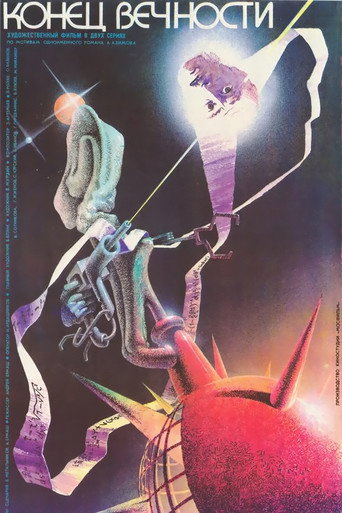
The End of Eternity
Конец вечности
1987 · Film · 137 min
Directed by Andrei Yermash
Directed by Andrei Yermash, and written by Isaac Asimov, Budimir Metalnikov, and Andrei Yermash, «Konets vechnosti» is a 1987 Science Fiction film, starring Oleg Vavilov, Vera Sotnikova, Georgi Zhzhyonov, Sergei Yursky, Gediminas Girdvainis and Boris Ivanov.
2 neutralfrom 2 commenters
Where to watch
No streaming data for this title.


2 comments on Hacker News
Most 'time loops' in science fiction might better be described as time knots.
I think of https://en.wikipedia.org/wiki/Predestination_(film) which is much more complicated than the usual time travel scenario; presumably the protagonist leaves but doesn't really enter since the protagonist is their own mother and father (the matter that makes them up does enter since they eat and breathe the way everybody else does; thinking the story through I'd think if I was going to have such a miraculous and singular existence I'd rather be a fantastic creature of some kind [dragon?] as opposed to a relatively boring intersex person capable of both reproductive roles)
Also https://en.wikipedia.org/wiki/The_End_of_Eternity which tames the complexity of time travel by presupposing 'eternity' has a second time dimension, making large-scale engineering of history practical. 'Eternity' itself owes it's existence to a time loop which is ultimately broken by the protagonist.
This is from someone who is woefully under-read, and only remembered my teenage love of sci-fi in the last couple of years. I thought similarly for several years, that fiction was a waste of time. But then I realized I was scrolling through Twitter every day, and that felt like eating french fries as a meal: lacking substance.
Reading long form prose increases your attention span and the shape of your thoughts.
Reading fiction stimulates the imagination, which opens up the space of ideas that the mind can generate.
Fiction is a compressed simulation of life. By reading good fiction one lives more life.
Fiction is a cultural touchstone. New relationships open up when there are shared understandings of stories.
Good, hard science fiction is a record of what some of the most imaginative scientific thinkers (not necessarily scientists) have pondered. Again, mind expanding.
Science fiction stimulates curiosity by asking "what if"?
We all have to engage in lower energy activities and "waste time". Watching documentaries is a "waste of time" for someone not engaged in professional research on the relevant subject. Do you use Reddit? That's a waste of time. Having a science fiction book next to the toilet will leave you feeling more nourished after you've done your business (I look forward to using the bathroom when I know there's a delicious book waiting for me that I only read there).
Dead tree books are better for someone who has a hard time reading. Studies show there's a big difference in retention between words on a screen and words in print. Dead tree books also benefit from being "things" that can be left in the intended reading location, and give a sense of progress and of conquering when completed.
The tactile nature of flipping pages and of breaking in a paperback is lovely. The cover art attracts the eyes to the book.
Reading a book is a different action than looking at your phone or computer, and it has a different set of feelings, emotions, thought patterns. There's the smell of a printed book.
I love Asimov. I, Robot is easy because it's a collection of very short stories, but it risks being seen as shallow. The End of Eternity is considered Asimov's best novel, and it's not too long. I hear good things about The Last Question. Foundation is lovely.
Be right back, going to buy more Asimov.