 Hacker Cinema
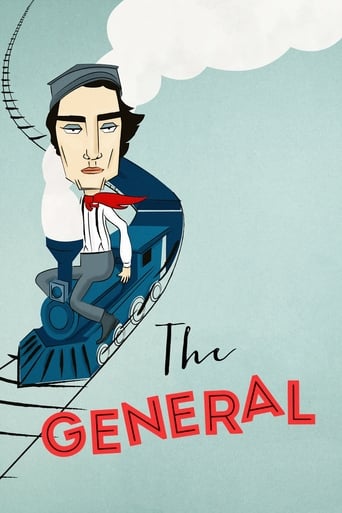
The General
1926 · Film · 79 min
Directed by Clyde Bruckman, Buster Keaton
During America’s Civil War, Union spies steal engineer Johnnie Gray's beloved locomotive, 'The General'—with Johnnie's lady love aboard an attached boxcar—and he single-handedly must do all in his power to both get The General back and to rescue Annabelle.
13 positive3 neutralfrom 16 commenters
Where to watch
No streaming data for this title.
21 comments on Hacker News
Note that the orchestral score on that YouTube video was composed in 2016 by Robert Israel. The original film had no recorded sound; it would have been accompanied on the piano (or, if lucky, pipe organ).
If you get a chance to see a silent film in the theater with live music, don't pass up that chance! I recently went to see "The General" (1926) with semi-improvised music by pianist Ben Model,[1] and (obviously) recommend the experience.
[1] - https://www.moma.org/magazine/articles/23
I recommend listening to the episode of the Blank Check podcast about The General (and Battling Butler), if you can sanction some buffoonery. It's a mix of a comedy podcast and deep movie analysis, which is not for everybody. For that episode they brought in writer Jamelle Bouie who is both a huge movie buff and a student of American history who brings in some great perspective on the Lost Cause.
https://podcasts.apple.com/ca/podcast/battling-butler-the-general-with-jamelle-bouie/id981330533?i=1000614733661
I'm not an American either so I've not a patriotic fervor over the outcome of the Civil War to the extent as that most Americans have.
That the movie showed the Confederates in better light than the Yankees wasn't appreciated much when it was released. Back then, there were Civil War veterans who were still alive who criticized the film which contributed to its poor ratings. Also, keep in mind the film was based on the story The Great Locomotive Chase, changing it to having the Yankees as the main subject just wouldn't have been feasible.
Nevertheless, the film's stature has grown over the years and has developed a bit of a cult status:
https://www.oregonencyclopedia.org/articles/the_general_film/
https://en.m.wikipedia.org/wiki/The_General_(1926_film) (read 'Legacy')
Oh, and I just noticed on the Wiki page there's even an image of Keaton riding the cowcatcher.
I'm not a film buff so I'll let those comments/reviews stand on their own merits.
Those reasons seem to make sense but I'd say just as much has to do with Buster Keaton himself, he had nerves of steel.
During the filming of the Civil War movie The General there are images of Keaton doing things that even the bravest of stuntmen wouldn't do these days and we'd now rely on film animation and tricks to make the scenes work.
For instance, Keaton—who obviously was very fit and agile—is filmed sitting on a cowcatcher of a moving locomotive whilst removing rail ties that were placed on the line to impede the train's progress and then tossing them aside.
I read somewhere that Clyde Bruckman the film's director gave instructions to the cameraman "to keep filming the scene until finished or until Keaton is killed" or words to that effect.
I can't remember whether Bruckman was referring to this scene or another such as when he's running across the locomotive's tender (the comment could equally have applied to many other scenes I reckon). Others who are more knowledgeable could perhaps fill in the details.
I like this movie, Keaton was a great performer and his movies are a testament to that.
D.W. Griffith - The Birth of a Nation (1915) The film led to the revival of the KKK
Abel Gance - Napoleon (1927) 562 Minute epos
Buster Keaton - The General (1926) as many have already pointed out
Robert Siodmak - People on Sunday (1930) Captivating images of Berlin pre war
The Brilliant Biograph: Earliest Moving Images of Europe (1897-1902) - Collection of Mutograph (68mm non perforated) films https://player.eyefilm.nl/nl/films/the-brilliant-biograph
Must watch “The General” (1926) by Buster Keaton. Silent acting class act and fun, I find myself rewatching it over the years.
I'd actually never heard of benshi.
The General is a silent film that you can show to any modern audience, and they'll love it. I actually did this once in a movie Meetup.
Perhaps so, and I think that's a good thing. Nevertheless, I can see cases where there will be arguments over where clean-up and restoration end and new original art begins.
For instance, say a film's master negative has been affected by patches of mold and detail lost. As the original information has been actually lost at these points, any reconstruction 'originates' with the reconstruction 'artist'. In some instances the reconstruction involves no art as it's obvious what's missing—say a quarter coin with a section missing out of it, whereas reconstructing the missing expression on a person's face may require interpretation and thus deemed new original art. Given the longstanding and heated debate over copyright, it seems to me these gray areas will be hotly contested.
Obviously, where new material is added there is no contest, new copyright is invoked. For example, some years back someone posted a medium resolution (720px) copy of Kino's rework of Buster Keaton's The General to the Internet Archive and it was eventually withdrawn.
I'm not conversant with any special copyright arrangements surrounding Keaton's works but presumably the takedown wasn't based on the cleaned up footage (given Bridgeman Art Library v. Corel Corp) but rather on the new soundtrack which accompanies the original silent footage.
Collaborative evidence of this is that other versions of The General weren't subject of the takedown. I vaguely recall that Keaton lost copyright over financial problems, if he'd been the copyright holder then we'd expect all copies to have been taken down (Keaton died in 1966 so if he'd still held the copyright at the time of his death then it would have been valid until 2056).
Metropolis is a remarkable film whether it's a frontrunner or not. And I agree with the general consensus that the film is of great historical importance.
Rather than dwell on that I think it important that we consider the future of early silent movies and how we can revitalize them for modern audiences who have become accustomed to—even jaded by—the visual 'pyrotechnics' of modern high definition video technology. By comparison, silent movies are deficient on multiple fronts, they're not only missing sound but also their visuals are in B&W and generally of low quality (low resolution).
These technological limitations present a high barrier for modern audiences to jump over, so they're often dismissed (many of today's audience have never seen classics from the silent era). How we should go about overcoming the barrier is an important and huge topic and cannot be covered in depth here but I'll mention a few ideas that I think are relevant.
1. Much of the footage that's currently in circulation from the silent era is of terrible quality, it consists of copies that are multiple generations away from the original camera stock. So often what we see today is footage with crushed blacks and washed out highlights to the extent that most of the detail in those areas of the image is lost.
This is unfortunate as the quality of the original camera negatives/masters are often surprising good—much, much better than one would expect. So why aren't modern copies made from the original negatives? Is it because they no longer exist, or if they do then they've deteriorated, or is it that for some reason the originals remain inaccessible?
I've limited knowledge of the reasons but all three are implicated—depending on the film of course. This came to my attention several decades ago when the actor James Mason presented a multi-part TV series on Chaplin's films wherein he compared some original film stock with the more widely circulated poor copies and the difference in quality was dramatic—the original stock being quite excellent.
2. Mason pointed out that accessibility was often a problem as Chaplin usually immediately destroyed footage he wasn't happy with, and second, he kept extremely tight control over master footage. Even though Chaplin died in 1977, the current copyright holders are keeping to this tradition by stressing that any Chaplin footage from 1918 onward is still in copyright (as I mentioned in my earlier post, it's likely Chaplin's works won't come out of copyright until 2067). Clearly, this is a disincentive for those wishing to gain access to the films with the view of reconstructing them. Moreover, it also seems the current copyright holders aren't doing much to either make these films readily accessible or doing much by way of reconstructing them. In essence, ridiculously long copyright law is standing in the way.
3. Even after copyright expires, it doesn't necessarily mean that owners of the physical masters/negatives/media will make them available. We've seen this nasty ploy used by many art galleries whose artworks are long out of copyright but who have refused third partly access to them for copying (high quality copies are thus restricted from entering the public domain). Copyright laws ought to be amended to remedy this anachronistic anomaly.
That said, some copyright holders have made reasonably good copies available on DVD such as Buster Keaton's The General. (the Kino release). Unfortunstely, whilst this release is certainly much better than the low quality versions that once circulated on TV decades ago, it's not a proper high quality digital reconstruction of same as dust, scratches and other artifacts are still visible. It's better than nothing but still not good enough.
4. As mentioned, unfortunately modern audiences aren't accustomed to viewing old B&W silent movies. Unlike when I was a kid, TV stations no longer broadcast these movies, so kids no longer grow up appreciating them for what they are. It's similar to when 78 sound recordings became passé when vinyl became available. Retraining audiences is possible but I've little idea how one would go about it. (Incidentally, I've worked in radio and TV broadcasting and I'm experienced with modern digital recording techniques but I have no difficulty in viewing old films or listening to 78 recordings. (Listening to, say, the great Caruso on a 100-year old recording still brings me pleasure because I've learned to mentally tune out surface noise and distortions, but I'm realistic enough to realize that this will never become a widespread practice.)
5. Thus, the only practical option left is to upgrade these films using the best technology available. It's clear that in the near future that both AI and other techniques such as cleaver Fourier analysis and reconstruction will be able to improve these films out of sight—much better than any version currently available. It would happen all the sooner if copyright holders were more cooperative and or if archaic and unreasonable copyright laws were dragged screaming into the Twenty-first Century.
In my movie Meetup, we were having DVD night, and once after the main feature, I showed The General. Everyone loved it.
Speaking of The Battleship Potemkin: I really, really tried to get hold of the musical score for it, with the idea of having the Google Orchestra (yes, there was such a thing) play along with the movie when we showed it. No luck.
The Internet Archive has a section devoted to silent films:
https://archive.org/details/silent_films
And a Silent Hall Of Fame:
https://archive.org/details/silenthalloffame
And a Georges Méliès collection:
https://archive.org/details/georgesmelies
Specific films:
Battleship Potemkin:
https://archive.org/details/BattleshipPotemkin
The General starring Buster Keaton:
https://archive.org/details/TheGeneral_201312
Le Voyage dans la Lune
https://archive.org/details/LeVoyageDansLaLun
Anyone looking to get into silent film, I'd strongly recommend comedies (including, and perhaps especially, Chaplin and Keaton) as a good starting point. I've gotten to the point that I can truly enjoy a lot of silent dramas, but IMO the comedies are far more approachable for a modern audience. Good gateway drug.
Just off the more famous films (The Great Dictator and Modern Times and maybe City Lights for Chaplin, or The General for Keaton, say) I'd recommend The Kid for Chaplin, and Sherlock, Jr. for Keaton. And of course both made numerous short films, in addition to their features. Though the very-famous ones are all great, too—I especially love City Lights, personally.
Been meaning to check out Harold Lloyd (responsible for one of the most enduring and imitated images in Hollowood, the guy hanging on the clock on the side of a building, featured in Safety Last) but haven't made it to him yet. I bet he "reads" pretty well to a modern viewer, too.
[EDIT] Some beginner drama recommendations, for those who feel ready:
Metropolis (duh... though it's a bit on the long side, maybe skip if you can't tolerate longer movies, and it's maybe a bit belabored for modern sensibilities)
The Passion of Joan of Arc (just... damn. This is a perfect movie.)
L'Âge D'or (The Golden Age—but, uh, maybe just if you appreciate things a bit more art house)
Le Voyage dans la Lune (A Trip to the Moon—it's short, and, if one plays with various accompanying soundtrack options, including some more modern ones, one may find it transcendently good)
M (yes Fritz Lang made this very short list twice, because fuck you this movie is amazing, this is maybe the most modern-feeling of this whole bunch)
The General (Buster Keaton, not Chaplin, but mentioned here) is a film that holds up even for a modern audience.
As for poverty: my Mom always used to say, "We didn't have any money, but we had fun."
Buster Keaton's "The General" is on YouTube. (It's out of copyright, but still worth watching, in my opinion.)
"These people were not very well informed about the changes technology was about to inflict on warfare."
It's hard to say how accurate that statement is but in all probability much of it is likely true. However, any reasonably well educated person of the day would have been well aware of the new highly industrialized nature of warfare from both the Crimean War and the American Civil War, both of which represented a new kind of 'advanced' warfare (especially so the American Civil War). Moreover, it wouldn't have been difficult to project that new developments made in the intervening 50 or so years since the Civil War, would likely make warfare considerably worse.
Right, 50 years is sufficient time to forget a war but nevertheless many veterans of the Civil War were still alive at outset of WWI. (Remember, Buster Keaton's Civil War film of 1926, The General failed to gain universal popularity as it was perceived by the many Civil War veterans who were still alive as biased in that it told the War from the South's perspective.) This 'corporate' memory should have had a substantial effect in preventing war but clearly its effects weren't nearly enough.
No doubt you're correct when it comes to considering the less well educated. However—as with many wars—I'd maintain that whilst they didn't actually start the war, that national hubris combined with young male bravado played an important if not overwhelming role in perpetuating it, especially so at War's outbreak before the grim and tragic reality of the trenches became fully apparent.
Also, a bunch of stuff that seems super-old actually isn't. There were still lions in the Caucusus until the 10th century... CE, not BCE. A thousand years earlier they lived in Thrace, too. There were still some wooly mammoths alive when the Great Pyramids were being built.
Similarly, living history can sometimes reach closer to the modern day than one might appreciate. There were (probably—some of the stories lack documentation) a few people born into legal chattel slavery in the US still alive while Martin Luther King, Jr. was active. The "Old West" and settler/Western Expansion days were still very much in living memory when early western radio serials and films were made, so it's entirely possible (likely, even) that a couple honest-to-god gunslingers (rare though they may have been, and as unlike their film counterparts) or victims/perpetrators of settler/native violence sat down and watched romanticized Westerns on the big screen. Shane is set in 1889 and came out in 1953. Lots of people alive during the fictionalized events of the film were still alive then. At least a few people who fought in or witnessed actual fighting in the Civil War likely watched Keaton's The General in a movie theater, or (more ominously) Griffith's The Birth of a Nation.
I've seen the vast bulk of the films. Intolerance you definitely need to watch as a period piece. It's a pretty good example although something like Safety Last or The General would be easier to watch examples.Don't really disagree on "Yankee Doodle Dandy." Isn't a lot on the list I seriously disagree with although there are period favorites I'd probably skip and different films I'd include.
Also in the Bay Area, the San Francisco Silent Film Festival's opening night this year will feature the newly restored The Cameraman. It's at the fabulous Castro Theater, with live accompaniment by the SF Conservatory of Music, on May 1.
Also, as it hasn't been mentioned, Keaton's The General is generally considered to be his masterpiece. If you see a picture of Keaton on a locomotive, or with a very fat, very blunt cannon, it's from this film.
I was impressed with Die Hard (1988) when I first saw it; so well engineered, as a movie and story and visual spectacle. Now that's the way action movies should be made, I thought, and hoped there'd be more like it -- even while wary of formulaic recombinations, like 'Die Hard on a boat', etc.
Years later, I saw The General (1927), and it blew my mind. There, 60+ years earlier, was 'Die Hard on rails'. There were so many action-movie scenes and stunts and plot points that have been repeated over and over in the decades since.
But: when Keaton did it, he wasn't cribbing anyone else. These weren't old familiar cliches (yet). He was risking his health with dangerous stunts. He didn't have the help of later special effects. He didn't even have sound or spoken dialogue. But still it all worked: the humor, the story, the stunts, the tension.
It was like discovering the common ancestor of hundreds of later movie and TV tropes, the very first action flick that crawled out of the oceans of text and imagination to walk on the dry land of motion pictures.
To have created that, with the limited tools of the era, prefiguring so much of what came later -- well, we can only hope to do something similar with the still-young digital and network media of our age.
Don't overlook the obvious: The Matrix
Also: Primer, Amadeus, Ratatouille
Older movies: The General and other Buster Keaton movies, Trouble in Paradise and other Lubitsch movies.
Think about movies. The earliest movies were terrible; just technology demonstrations, but they wowed audiences at the time. By the 1920s you were starting to get some films which are still worth watching today as films rather than as historical curiosities (Metropolis, The General). By the 1940s, truly great films were being produced (Citizen Kane, Casablanca) and many would argue it's been basically a plateau ever since then... a few truly great films and a large number of quite good ones produced every decade since.