 Hacker Cinema
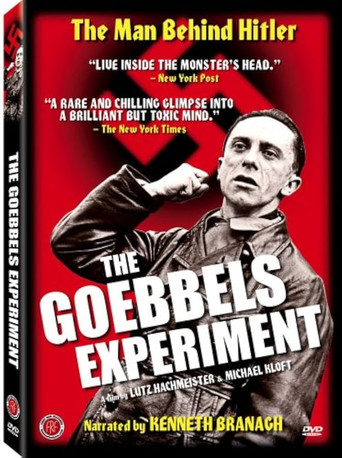
The Goebbels Experiment
Das Goebbels-Experiment
2005 · Film · documentary · 108 min
Directed by Lutz Hachmeister
The Nazi propaganda mastermind behind Hitler speaks in first person as actor Kenneth Branagh reads pages of the diary kept by the chief of propaganda, Joseph Goebbels, revealing the man's most inner thoughts.
1 positivefrom 1 commenter
Where to watch
No streaming data for this title.


2 comments on Hacker News
> Economic crises inducing a transition from democracy to plutocracy/fascism, and massive military spending, ending in wars on multiple fronts.
There is one major thing missing from your description; it's so glaring and obvious that I'm amazed that you don't notice it. Nazis rose to power through a populist platform which promoted ethnic/racial hatred and reappropriation of resources from those perceived as morally "corrupt" (the Jewish people) or "too powerful" (the British empire). The Nazi leaders did not come to power first and then all of a sudden decided to exterminate the Jews out of the blue; the they went along with what was a populist sentiment at the time (while adding fuel to the fire by the means of propaganda and mass media which was relatively new at the time), and exploited that precisely that popular, hateful sentiment to guarantee their rise to power. I recommend watching a documentary called "The Goebbels Experiment" for a look from the inside on how it happened.
N.B. By going with what you're suggesting, any possible "empire" is fascist, which is blatantly wrong. Plutocracy is bad for various reasons, but plutocracy =/= fascism and genocide. I find it hilarious when people blame plutocracy for causing fascism because it is precisely the supposed "plutocracy" of the time (which was actually a codeword for rich Jews) which drove (indirectly of course) ignorant/resentful Germans in the 1930s to support Hitler and his clique.
> What we should learn from this isn't that ideas are bad. It's that ideas are very powerful.
Actually what we should learn is that ideas are powerful and especially dangerous if they are combined with a general lack of information and alternative viewpoints as was the case in the first half of the 20th century.
You are incorrect in stating that Nazism was not primarily idea driven. The whole "nationalism" thing started off as a powerful idea in the early 19th century spearheaded by the Romanticist zeitgeist. Previously, people imagined their "tribes" as consisting of their immediate family, relatives, and perhaps friendly neighbors. Europe consisted of multiethnic empires at the time. With the rise of nationalist ideas, people started to imagine their tribes as all people speaking the same language and being of the same "race". Also, don't forget the "socialist" part in Nazism, which was also idea-driven. I recommend watching "The Goebbels Experiment" (IMDB: http://www.imdb.com/title/tt0458375/) to get a hint on how significant the idea-driven propaganda/brainwashing was in the rise of Nazism.
The nationalist wave started off somewhere in Central Europe and reached other parts of the continent much later -- it is still causing trouble in Russia (the surprising rise of neo-Nazi skinheads there with the fall of the USSR), Northern Ireland, the Balkans, and the Basque Country in Spain, for example.