 Hacker Cinema
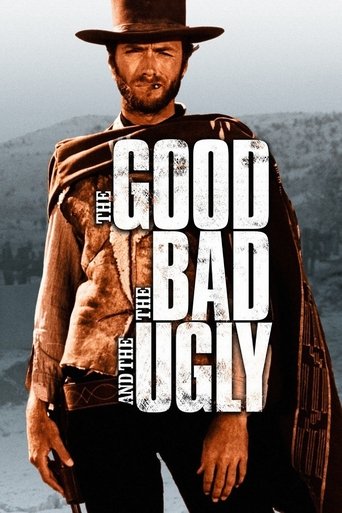
The Good, the Bad and the Ugly
Il buono, il brutto, il cattivo
1966 · Film · 161 min
Directed by Sergio Leone
While the Civil War rages on between the Union and the Confederacy, three men – a quiet loner, a ruthless hitman, and a Mexican bandit – comb the American Southwest in search of a strongbox containing $200,000 in stolen gold.
10 positive2 negative12 neutralfrom 24 commenters
Where to watch
No streaming data for this title.
27 comments on Hacker News
I remember when I read the original story by Stephen King, I thought it was one of the best stories ever.
A year later, I saw the movie at a rental store. I had totally forgotten the name of the Stephen King story and rented it only because I knew it had been nominated for the Oscars.
30 minutes in, I said "This seems familiar!" And then "Oh, I bet this will be a great movie." It was.
I think it's worthy of being amongst the top. It has elements that appeal to a broad audience (not boxed into a specific genre). Great story. Great narration. Great cinematography and sound.
The only other movies in the Top 10 that I think could be ranked higher are The Godfather (which for many years was the top ranked), and The Good, The Bad and The Ugly. For both of these movies, I know a lot more people who didn't like them. I only know one person who didn't like The Shawshank Redemption.
Here’s how it applies to the top 10 movies on IMDb
Shawshank redemption: the well liked male protagonist righteously murders his wife for cheating on him
The Godfather: pretty much encapsulates all of my requirements
12 angry men: no women
Original LOTR: Does women characters incredibly well
Pulp fiction: Mia is in there for a few key scenes, no nonsense
The good, the bad and the ugly: self explanatory. Great male characters
Forest gump: Jenny might be the greatest villain ever for her promiscuity
I can go on and on. All these movies have gravitas. You won’t see any movie post 2015 even crack the top 100 (besides Parasite but that isn’t Hollywood) because that’s about when they lost the plot.
What a great film, one of my all-time favorites. I remember seeing it in the theater without knowing anything about it, and walking out completely stunned and overwhelmed. It felt like I’d just experienced something that would stay with me for the rest of my life.
It belongs up there with Apocalypse Now, Mad Max / The Road Warrior, The Good, the Bad and the Ugly, Blade Runner, and the rest.
A masterpiece.
More of a trope about the styling and colour palatte of now classic films set in Mexican territories (but often filmed elsewhere):
Spaghetti westerns were a series of western films pioneered by Sergio Leone in the 70’s mostly starring Clint Eastwood. They have a very specific style to them. Mostly shot on anamorphic widescreen, they developed a language using editing and framing for confrontations between the gunslingers as well as using and updating Akira Kurosawa’s style. A lot of them are straight up remakes of Kurosawa films (A fistful of dollars is Yojimbo, Magnificent 7 is 7 samurai). The films had a bit of a sepia look to them but that mostly came from the art direction and the wide open desert spaces they shot at. They would use a handful of shots from the west here and there but most of them were actually shot in southern Spain with Italian and Spanish crews. Widescreen aspect ratio, tight closeups (chin to eyebrows), quick cuts timed to the music (provided by the great Enio Moricone). The Good, the Bad and the Ugly is seen as the masterpiece of the series (known as the man with no name series). Another major one is Once Upon a Time in the West. Tareantino is heavily influenced by this stayle and pays direct homage to him on both Kill Bill Vol 2 and Hateful 8. This might be able to give you a slightly more modernized rendition of Leone’s style. from: https://old.reddit.com/r/colorists/comments/rs7igu/spaghetti_western_look/
but you can find similar comments across many film boards.
It expired at midnight on amazon. on google tv I was able to watch it for free on Jan 1. I did a little more research on the film and related ones.
There's the first 3 movies, https://en.wikipedia.org/wiki/Dollars_Trilogy (A Fistful of Dollars (1964), For a Few Dollars More (1965), The Good, the Bad and the Ugly (1966)).
This movie was in the second trilogy, "once upon a time", Once Upon a Time in the west, Duck you Sucker, and Once Upon a Time in America. And from wikipedia there's a much better and longer original European cut that is 3 hours 49 mins instead of the 2 hours 19 minute cut. I can't figure out how to stream that.
Friendly reminder to fans of the genre that you can visit the film set of the cemetery in The Good, The Bad and The Ugly near Burgos, Spain. It's free and I the middle of nowhere. I went this summer and it was an amazing experience. Search for Sad Hill Cemetery.
Yeah I don't disagree that if the AI can get it spot on which I think it will be able to do eventually it will take over. It will take over even if it's not spot on, because the bottom line is all that matters to the major studios now.
> Why would they? Very few people can notice and appreciate the level of detail you are describing
People might not consciously appreciate the detail but I think almost everyone subconsciously appreciates the overall vibe. Everyone can watch that The Good, The Bad and The Ugly clip and see there's something special about that location.
The reason I feel like the execs should be able to see it is that they're cutting off their nose to spite their face. If you watch a movie and come out seeing like you've seen something breathtaking, you're going to tell your friends and ticket sales are going to go up, not just for that movie, but for future movies as well. Whereas if film after film after film is a dud, which seems to be more common for me than not nowadays, you stop watching films and spending your money on films. For me this has already happened - when I was younger I used to go to the cinema once every week or two. The state of cinema is so bad now I might only go once a quarter.
So the execs take these cost cutting measures, but they have the overall effect of losing them money in the long term. The film may end up pulling in 200% over production compared to 100% if they'd have used practical effects. But that "missing profit" isn't missing - they're instead spending it on raising their overall brand value and reputation by offering up a higher quality product.
Like the last film I watched at the cinema was Gareth Edwards The Creator. He'd built up a little bit of brand value with the original Monsters and Rogue One, but The Creator was so monumentally, insultingly bad I don't think I will ever go watch a film he's made again.
> Why would anyone hire 20K people for a movie today?
To make better art. I've seen most of the films in that list are they're incredible films that stick with me and give me a sense of awe today. Watching 1000s of real life people in a scene just creates a sense of spectacle that is just not achievable with current CGI - the brain is just not fooled or impressed like it is when you watch those old films and see the amount of work and effort that must have gone into them. Sergio Morricone hired the Spanish army to build the cemetery at the end of The Good, The Bad and The Ugly and it took them several days to make. Nowadays it just takes someone a few clicks of a mouse but it fucking shows as well. Maybe with AI we'll actually get to a point where the brain can be tricked because it gets the lighting right, but at the minute it just doesn't and the films are worse because of it.
Just look at how incredible this location is:
https://www.youtube.com/watch?v=QpVaoA8RfIk
It's even more awesome when you watch the film in it's totality because it builds up slowly, with bigger and bigger scenarios until it culminates with this.
And even in potato cam resolution, how impressive is this scene from Cleopatra:
https://www.youtube.com/watch?v=g_rLwuVP9Zw
They just hit different when they're actually real.
What's hilarious is that the execs still don't fucking see it. Christopher Nolan is one of the only ones out there still pushing for practical effects and he rakes in the money at the box office more consistently than just about any other director other than Cameron or Spielberg. It's because the films are actually worth watching. Before Oppenheimer, what was the last big film? Top Gun, which also used a ton of real life flight footage.
If I want to watch an animation, I'll watch an actual, awesome animation that takes full advantage of the medium like Into The Spiderverse or something from Studio Ghibli. If I want to watch a movie, I want to watch a real flesh and guts movie. Yet 99% of the stuff Hollywood puts out is some weird hybrid shit that is the worst of all worlds.
If Hollywood starts making better art, people will start going back to the movies. But they've got greedy. In any other industry, if you made a product, and you got 100% more for it than what it cost to produce you'd consider that a success. But these arseholes don't. They want 2x, 3x, 4x, 5x and they want to milk it for all it's worth and turn it into a fucking "universe" until it just collapses into a heap of shit and no-one even remembers why they liked the original.
> Sword users can learn new techniques. Wizards can learn new spells. Characters can become visibly stronger, or to learn to wield stronger arcane forces. But a guy with a gun can... what? Get a bigger gun?
A guy with a gun can learn skills for shooting better. He starts with Stormtrooper shooting skills, and ends like the Man with No Name.
Watch an old spaghetti Western, and there are clear themes that the protagonists are far more skilled at firearms than most people in that world. I'm reminded of a scene in The Good, the Bad and the Ugly (I think) where the character Tuco escapes or something, goes to a frontier store to buy a gun, then disassembles all the guns at the store, quickly and carefully examines all the components, and reassembles all the best parts into the one he then steals, which shows his knowledge and skill. In those movies the characters' skills are taken as given, but I see no reason why you couldn't have a skill-building arc for them any less than for a swordfighter, a martial artist, or, a wizard.
I can only recall a few songs in my lifetime that was instrumentals that were hits.
Apache by The Shadows The good the bad and the ugly from the same movie Ballade for Adeline - Richard Clayderman and lastly Crockett's Theme from Miami Vice.
Also Kenny G was big in my days but then they started with using guest vocalists on their music.
A similarly awful change was made to the color grading for several streaming releases of The Good, the Bad, and the Ugly. It feels like whoever did the color had just watched Breaking Bad and decided to imitate the "make any scenes in Mexico have an orange color grading" style but for the entire movie: https://imgur.io/a/Ub5MO5R
I agree with some other commenters; this is a lot of cherry picking. You could just as easily compare Nosferatu (1922) with Blade (1998) with Twilight (2008) and ask why culture gets happier and less serious as time goes on, “aren’t we all becoming like Brave New World???” Comparing Adam West’s Batman with today’s Batman is just lazy. They’re apples and oranges at this point: different genres, different climates (today the more “fun” stuff is Marvel), different film technology. And if we want to get into it, it’s not “depression” that’s trendy; it’s realism. 60’s Batman dealt with all the same “dark” themes as current Batman: mafia, crime, trauma and grief, etc. But the visual portrayal was different because it was a “comic book” before comic books adaptations were commonplace blockbusters. That doesn’t mean all of 1960s cinema is somehow a comic book movie. Hello: Psycho (1960), Dr. Strangelove (1964), The Good, The Bad, and the Ugly (1966).
There are theaters that are dedicated to playing older movies, and they apparently turn enough profit to subsist in some locations. I think that makes this a top comment on HN with a profitable use case complaining that there's not enough around.
Also, I would watch the shit out of the Good the Bad and the Ugly in a theater. Same with original Star Wars (which I think happened during extra trilogy releases occasionally), The Matrix, the Princess Bride, and anything in that vein which either has a cult following, is a different/better experience to watch in a theater, or both.
Ok, here's my problem with the movie theatre industry. There's 100+ years of fantastic historical content and we're not doing anything with it. 99% of what's shown in theaters is new releases. I understand we don't want to "go stale" as a society and that movie producers also need to make a living, but the balance is just way off.
I would pay good money to see "the good the bad and the ugly" with my kids in a couple of years. If you compare movie theatres to classical music we seem to play only 10% new content at concert halls, the rest are the 100+ year old classics.
These kinds of tropes are in old movies. The 49er whos struck gold and looks like a vagrant. Tuco in the Good the Bad and the Ugly who mistakes a union soldier for a confederate soldier, etc.
Except that it is impossible to find early Disney war cartoons or more importantly “Song of the South”. The absence of SOTS is truly sad as the movie created the song “zippity do da”. “Song of the South” is beyond the pale for today’s sensibility but I do think its availability should be preserved since its titular song is a cultural touchstone much like the music from “The Good, the Bad, and the Ugly” or the line ‘Here’s looking at you kid’ from “Casablanca”
Slightly tangential, but my feeling is that most people don't know where the "the good, the bad, the ugly" expression comes from.
It's a "spaghetti western" movie [0], directed by Sergio Leone, released in 1966, and credited with the rise to fame for Clint Eastwood.
If you have never watched it, I highly recommend it. In the genre, it is probably among the best.
Music was composed by Ennio Morricone, another pillar of Italian cinema and music, who died last July. One of the theme songs for the movie, "The Ecstasy of Gold", is very famous all around the world, and even Metallica played it at some concerts. [1]
Also, interesting detail from a Quora answer [2] - I wasn't aware of the locations used to film until now:
> The term "spaghetti western" was used by American filmgoers and reviewers because most were produced and directed by Italian film-makers, many of them trying to copy Leone’s unique style.
> Most were filmed on low budgets and shot at various locations around southern Italy and Spain. The Tabernas Desert and Cabo de Gata-Nijar were especially popular shooting locations.
[0]: https://en.wikipedia.org/wiki/The_Good,_the_Bad_and_the_Ugly
[1]: https://en.wikipedia.org/wiki/The_Ecstasy_of_Gold
[2]: https://www.quora.com/Where-does-the-expression-the-good-bad-and-ugly-come-from#:~:text=The%20title%20refers%20to%20the,influential%20western%20movies%20ever%20made.
A couple random things:
1. How did Adam and the Ants never get sued over "Jolly Roger"? [1] The melody and even the arrangement are pretty much a straight copy of Morricone's "The March of the MacGregors" [2] from the movie "7 Guns for the MacGregors". Morricone should have at least got songwriting credit on "Jolly Roger", but it is just credited to Marco Pirroni and Adam Ant.
2. There are some interesting covers of Morricone songs. The Ramones did "The Good, The Bad and The Ugly" in some of their live shows. Their version was pretty straightforward...if you heard it in isolation you would not have thought "Ramones".
Wall of Voodoo did "The Good, The Bad and the Ugly". Their version sounded like a Wall of Voodoo song.
Great music stays great even if arranged for and played on instruments quite different from what it was written for. An example of that is the Ukulele Orchestra of Great Britain's version of "The Good, The Bad and the Ugly" [3].
3. If all that comes to mind when you hear the name Ennio Morricone is a bunch of great spaghetti western music, it is worth getting a compilation or two of his work and listening to it.
[1] https://www.youtube.com/watch?v=YR4n-oo32Jg
[2] https://www.youtube.com/watch?v=peGmy_oRz38
[3] https://www.youtube.com/watch?v=pLgJ7pk0X-s
I'm surprised not to see more people adding their favorite movies. Just sticking to things semi-related. I may have to go watch "My Man Godfrey" again but at least for me "The Thin Man" and its 5 sequels stuck with me where as though I watched "My Man Godfrey" years ago but I don't remember any details of it. (same lead actor and he pretty much always plays the same type of person)
"The Man Who Shot Liberty Valance" is a good movie but if you want some other westerns starting James Stewart I can recommend "Destry Rides Again" which is not super serious but I found it throughly entertaining. Also "Broken Arrow" (1950), (not the 90s John Woo movie which is a fun popcorn movie).
Seeing "The Good, the Bad, and the Ugly" on the list I recently saw "The Outlaw Josey Wales" which I enjoyed (also a Western with Clint Eastwood)
Of the movies on that list I've seen the one I'd recommend the most is "Women in the Dunes". I don't want to over hype it I've seen most of the movies on the list and they are all great stories but "Woman in the Dunes" might give you something new to think about where as the others are mostly just great entertainment.
He talks about designing a film for the big screen experience but every film he mentioned except maybe "North by Northwest" is vastly superior in a good home theater. "Persona" by Ingmar Bergman is a wonderful film but would gain nothing on a modern digital screen with Atmos sound and speakers that can break windows. His preferred movies are intimate, patient and beautiful but do not in any way take advantage of the format. Many classic films are actual big-screen spectacles like "The Good, the Bad and the Ugly", "Lawrence of Arabia", "Wizard of Oz", anything by Akira Kurosawa and hundreds of others but his tastes strike me as explicitly and decidedly "small-screen" and almost anti-cinema if you consider the "cinema" distinction primarily the larger format. Small, intimate movies are great but are sub-par experiences in a cinema next to popcorn munchers and mobile phones. I am a huge movie buff who actually had a Filmstruck subscription and still pay for MUBI. I love the movies he loves but they do not work well in theaters. I would much rather watch these at home. I'll go to the theater for Marvel because those movies are much better in a theater. This is simply not true for his tastes.
There are still some oddities.
"How to Train Your Dragon" (2010), 99% with 206 reviews does not make the list, but many older movies, with lower scores and lower number of reviews do. E.g., "The Wizard of Oz" (1939), 98% with 111 reviews, and "It Happened One Night" (1934), 98% with 56 reviews, and "Casablanca" (1942), 97% with 79 reviews, and "Alien" (1979), 97% with 115 reviews.
It looks like the older a film is, the fewer reviews it needs backing its score to make the list.
It's also possible that the age of the review is taken into account, so that a modern review looking back on a film counts more than an older review, because that would probably be more relevant to someone today deciding what older movies to watch.
For example, take "The Good, the Bad, and the Ugly" (1966). It wasn't very well received by critics in 1966. Now, though, it's at 97% on RT, and is regular included in lists of top films (it used to be on the RT top 100, but looks like it has been pushed off).
What I don't understand is how Netflix ended up this way. They attributed the success of a show like House of Cards to their data science capabilities - why would they produce bad movies unless that's what the data points to. Then maybe no matter what, the truth is that the content that gets eyeballs, and why Hollywood makes shallow broad movies is the same: they make money.
If you want to watch some actual quality filmmaking, visit a film festival or watch some Criterion films. Everything else will be "trash". If you want to expand your cinematic palate, explore American noir (The Maltese Falcon), melodrama (Douglas Sirk), musical (Singin' in the Rain), Western (The Good, The Bad, and The Ugly), epic (Lawrence of Arabia). Italian neorealism with The Bicycle Thief, French New Wave with Jean Luc Godard (Breathless). Want to go modern international, City of God, Gomorra, Wong Kar Wai, Park Chan Wook's Oldboy (advisory warning), or my favorite Japanese auteur Yasujiro Ozu.
Any of the above films are considered cinematic gems. Recommendations brought to you by my degree in Cinema and Cultural Studies. The true beauty of filmmaking is conversation over time. Films and directors talk to each other like authors and artists, they write love letters. They become self-aware of their medium (Fellini), "postmodern".
Great film can not fall in the limited boundaries of popular filmmaking. That's why Hollywood films tend to be so broad and shallow, to be palatable by all, no alienation, unless when it comes to race or gender. On the other hand, that problem is not unique to Hollywood or filmmaking.
In 2008 or so The Hot Club of San Franscisco[0] (gypsy jazz/hot jazz a la Django Reinhardt) played a live accompaniment to some work by the silent film actor/comedian Charley Bowers[1]. It was definitely one of the better performances I've ever seen/heard. What a perfect juxtaposition, not even taking into account the obvious caliber of the musicianship.
Ever since I've been on the lookout for similar "soundtrack" concerts, improvised or composed. A live rendition of "The Good, the Bad, and the Ugly" orchestrated by a Denver jazz guitarist is another favorite.
[0]HCoSF Sample Song: https://www.youtube.com/watch?v=8ZlPBYVOXXg
[1]http://brightlightsfilm.com/forgotten-charleys-i-charley-bowers-silent-comedys-wizard-of-the-bizarre/
This article is fantastic, and really brings together the thoughts I've heard expressed about this in a way that is mostly accessible. I think it's a bit dramatic though. It seems like people in every era look back and say "Why don't we create things with the same care things were created with in the past?" The existence of the question implies that what is being made now is somehow worse than what has been made in the past.
While it's possible this is true, I think it's more likely that this is just survivor bias at work. Nobody remembers the terrible summer blockbusters from years past. This years robots destroying cities were the Westerns and Noir of years past. Everybody remembers Casablanca, and The Good, The Bad, and The Ugly, and these titanic movies overshadow the Noir and the Westerns that they were deconstructing. At some point somebody is going to make The Searchers of robots beating everyone up, and another genre will step in to the role of mass-market crap.
I think the actual argument in the case of the "BRAAM"[1] sound is that Inception is a genre defining movie, on the level of Jaws or Il Brutti. It's become a shorthand for Earth-shattering collisions, in the same way Sergio Leone's soundtracks are synonymous with the west, and the Jaws theme is synonymous with being stalked. You already hear people imitating it to give additional context to stories.
[1] Sidenote, because it bothers me: The sound seems much closer to "BWAAAAA" than "BRAAAAM". This is not important, but it bothers me.
Your first link is to one of a series of articles linking Star Wars to: Lawrence of Arabia; E.T.; the Seventh Voyage of Sinbad; The Good, The Bad, and the Ugly; Empire of the Sun; and possibly others. They can't all be major influences!
The start of the YouTube video puts the exposition of the attack from one film next to the exposition of the attack from the other. Is that really such a strong similarity? I'd guess a lot of war/action movies have a here's-how-it's-going-to-go-down scene. Some of the other pairings are closer - I think I buy the one with the line about the number of guns.
So, I see a Dam Busters reference, and that's interesting! But I'd need more convincing that it's used for storyboarding.
Well, suppose the master is damaged, and you need to go back to the original footage and reconstruct the scene using the same post-production methods that were available then? alternatively, suppose business conditions or personal conflict led to a truncated version of the original film being released, but the source materials allow the reconstruction of the director/ screenwriter/ producer's original vision?
The former has been the case with Fritz Lang's film Metropolis, with the complete version available today being a built (IIRC) from a mix of different masters and some raw footage, and the latter has been the case for another silent classic, Erich von Stroheim's Greed, which is a historical masterpiece but was heavily cut at release for both content and runtime. More recently, the version of The Good The Bad and The Ugly you get on DVDs now restores 19 minutes that were cut from the original...and I could cite a bunch of other important films (at least, if you're a film nerd) that only exist in their current form because someone knew the release version was compromised and went looking for the original production footage.
That reminds me how pissed I was when they released The Good, the Bad, and the Ugly on BluRay. One of my favorite movies in hi-def! Then I started watching it. I've seen VCDs with more grain than that. I stopped it after about 15 minutes and put on the DVD instead. The company that transferred that film should never be hired again by anyone.