 Hacker Cinema
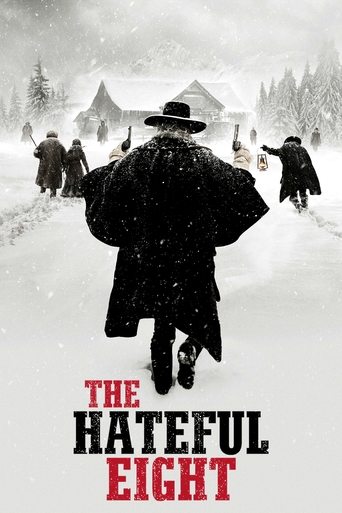
The Hateful Eight
2015 · Film · 188 min
Directed by Quentin Tarantino
Bounty hunters seek shelter from a raging blizzard and get caught up in a plot of betrayal and deception.
8 positive1 negative1 mixed11 neutralfrom 21 commenters
Where to watch
No streaming data for this title.
24 comments on Hacker News
> a movie or TV show
Any movie or TV show recommendations from the past 10 years that is actually enjoyable?
I am pretty much done with movies. I don't even remember the last one I really enjoyed. Sunshine, Interstellar, Hateful Eight, Once Upon a time in Hollywood... Nothing notable in the past 5 years though.
TV shows? Most require a subscription, which I am not willing to do for just a show or two.
I didn’t care for Hateful Eight or Once Upon a Time in Hollywood. It’s always hard for me to decide whether Tarantino is exceptional or has the right people around him at the right time (which is also an exceptional quality). He has 4½ excellent movies (counting Kill Bill as 1) and a bunch of OK movies.
Watch Tarantino movies. "The Hateful Eight" in particular was fantastic. It doesnt look like an action movie, but as someone who really enjoys small details of realism it felt like a very good action movie.
The Hateful Eight.
Really long (it's more of a stage play), but like most of Tarantino's films, the dialogue is stellar.
I went to see Tarantino’s The Hateful Eight projected in all its original glory. I didn’t like the experience: the jitter, the scratches, the flicker of the blindingly bright snow... And the movie itself didn’t seem all that good.
I watched it three times on a blue-ray I bought a year later, and I loved everything about it, every time.
I prefer miniseries. Netflix had the extended version of "The Hateful Eight" broken into a four episode miniseries.
I loved it! Now that I can only watch adult movies after the kids go to bed, I had to watch the original "The Hateful Eight" over two nights.
The miniseries was much easier to watch, and didn't require compromises for running length.
https://www.theguardian.com/film/2019/apr/27/quentin-tarantino-hateful-eight-netflix-miniseries
I'll concede Tarantino films are a good example. I think maybe the difference is that Hateful Eight, Jackie Brown, Pulp Fiction, and Django aren't comedies, and it tends to be a lot less casual. I recall most cases in Django being very hateful, used for a purpose. BS dropped it very casually, as if the characters were normal people talking that way every day (which is pretty accurate).
I'm not claiming anything should be whitewashed or censored at all, just that language in a modern context has an effect on how a movie comes across to the audience. I don't think that a modern audience would find it funny without the social atmosphere of the 1970s. I'm making no claims about the quality of the movie itself, as it actually was made. Similarly, if Huck Finn was written today, I do think it would have a really hard time. It works because of the place it has in history.
Is there a list of theaters that will be getting the film? I know there's a 70mm-capable theater in my town that did the Hateful Eight when it was released, so there's a possibility...
> Big studios don't make movies like The Hateful Eight
It had a $50M budget, that is pretty big, just not in the blockbuster category.
But I simply don't think that blockbusters have ever or will ever care about more complex movies (there are obviously exceptions but not a significant amount). It's simply a numbers game, you make bland stuff that attracts the lowest common denominator and pays the bills with very little risk and then put the money you're left over with to pay for movies with higher risk.
Very true. I hope one day we can have a better premium media market than we have currently so that businesses feel less pressured to appeal to everyone. I don't think you could pay me to sit through a Transformers movie but I would have paid $25 to see the Hateful Eight in theaters.
You hit the nail on the head about how we need more complex stories. I'm not sure if this is a result of me getting older but I think people in general are getting more prone to black vs. white thinking over time (which I suspect is due to becoming bombarded with ads which are always either very positive/funny/nice or vitriolic, or an increasingly polarizing and histrionic media, but I digress). Even movies made for adults usually have some fixed, obvious good guys vs. bad guys these days.
I don't think it's that nobody can understand things anymore, or even that people don't want to, I think people simply don't want to limit their potential sales by making things too difficult to understand. Big studios don't make movies like The Hateful Eight (which I thought was great because it didn't have good guys) because they don't appeal to enough people, and writers don't write with nuance anymore because you get the most impressions if you simply pander to a specific political camp.
I can't agree more. I grew up next to a theater and it was the thing to do. The last decent movie experince I can recall was the film print showing of the hateful eight. I didnt even like the movie itself a whole lot, but the quality, and experince were amazing. I would love to have a movie to get excited about. It all just seems like such low effort drivel now.
I saw The Hateful Eight in 70mm, but it was projected on a normal-sized movie theater screen, and frankly, if anything, it looked worse than a normal film. I suspect the staff was inadequately trained in how to operate a real film projector, as the focus looked a touch soft.
On the other hand, seeing Interstellar in 70mm IMAX was _incredible_. Even with the recent IMAX Laser projectors, 70mm IMAX prints contain much more resolution and it was the best looking movie experience I have ever had. I highly recommend seeing Dunkirk in 70mm IMAX if it's playing near you.
Despite the recent rise in the interest in shooting movies on the 70 mm film, I am not convinced. I saw Tarantino's The Hateful Eight in both incarnations (digital and film-based), and I must say I did not like the film version: the picture was too bright (perhaps, because of snow, as the action takes place in the winter), with a noticeable flicker (probably due to the brightness). It was also distracting to see scratches (however few) and the fact that a mechanical projector is not perfect when it comes to keeping the frame stable.
The digital version, on the other hand, seemed perfect in all respects.
> It won't stay that way by the time you watch it, it will have been copied multiple times, and it's on 35mm again.
No, it's not on 35mm again. I've watched the 70mm projection of The Hateful Eight. At no intermediary point the film was on 35mm.
The intermediate film stocks and the print stock are very special low-sensitivity stocks (Kodak 2383 has ISO 1.6, Kodak 5302 has ISO 6) that have no discernible grain whatsoever. You can't see the Kodak 2383 grain with a grain focuser. All the grain comes from the original negative. You do lose some spatial resolution with multiple copies, but you don't add grain. I'll note that modern print film like Kodak 2383 can resolve 550 lines per mm, and contact printing has a minimal loss of quality due to imperfect optics. Granted, a showprint will always be better than a release print, but the copying process is much better than you give it credit for.
> noise (like film grain) is always a problem
Not really, dithering is essential for all video processing. Your very clean image is actually full of noise. Without dithering, videos (and movies) would look bad.
> I suspect you are missing what never was. Digital is better on both.
Absolutely nonsense. Kodak 2383 has a D-Max or 4, giving a contrast of 10000:1. Kodak Vision Premier Color has a D-Max of 5.5 giving a contrast of about 310000:1. Yes, not a typo, one-third of a million to one. There is no other technology that can achieve these deep blacks. Digital projection doesn't come any close, the best projectors today, (the ones that you won't find in any run-of-the-mill theatre) can barely do 2000:1.
DCI-P3, the color space used in digital cinema was modeled after print stock gamut, but because of technological limitations, it's not identical. Cyans and yellow has a higher chroma on film. Green on film has a higher chroma at the expense of luminosity. Other colors are pretty much the same.
The only way for digital projection to have a higher gamut is to switch to laser projection AND to retire DCI-P3. You need a green laser to produce more saturated greens.
Digital cameras are capable of recording a larger gamut than film, but unfortunately there is no technology to display these colors outside laser projection, and you need to switch the whole movie industry to a new color space.
Maybe you don't find grain to be unpleasant, but I certainly do. I tolerate it when the source had it and there is no choice, but I certainly don't like it.
And no, it's not aesthetically pleasing in any amount. Directors that add it back artificially should be criticized. It looks like there is a swarm of gnats flying across the screen, and unless there are a ton of bugs in the scene it doesn't belong.
> This is 35mm, The Hateful Eight was shot on 65mm stock, which has a camera frame surface are of 3.44 times the camera surface of 35mm film.
It won't stay that way by the time you watch it, it will have been copied multiple times, and it's on 35mm again. The effective resolution as seen in the actual theater does not beat 4k, and you have additional noise which lowers the resolution even more.
The main thing though is that noise is worse than lack of resolution. Depending on how far you are from the screen more resolution is meaningless - but noise (like film grain) is always a problem.
> I miss more the old contrast and gamut.
I suspect you are missing what never was. Digital is better on both.
> Film has a lot of noise.
Film has grain, which is a type of non-chroma signal-dependent noise that is not unpleasant like chromatic signal-independent sensor noise or shot noise you get digitally in photography (not in movies, they have good lighting there).
In fact, grain is actually useful, as it's aesthetically pleasing in small amounts, can increase apparent sharpness. In fact it's so useful digital creations fake back in post-production a small amount of grain.
> The resolution is not as high as you are imagining.
The resolution of 4k projection is not as high as you are imagining either. It's just 4096x2160 lines (often less, depending on aspect ratio) or 8.8 megapixels.
In the best circumstances you can get 25Mpix of useful data from a 35mm frame shot on low grain stocks like 5203. In the worst circumstances you get 10Mpix. This is 35mm, The Hateful Eight was shot on 65mm stock, which has a camera frame surface are of 3.44 times the camera surface of 35mm film.
Either way, the resolution of 4k digital cinema is fine, I miss more the old contrast and gamut.
I suspect that the Hateful Eight compresses considerably better then most movies due to the amount of time outside in the endless snow. If it compresses 20% better then a movie of a similar length (like one of the LOTR), one of those movies could go over the 50GB size.
The filesize of 40GB is very low for a DCP, your standard 90 minute film is typically over 100GB. I recall Hateful Eight being over 200GB.
If they released the actual DCP .mxf files it would be proof that the DCP was truly cracked.
The "economics" here are interesting. One of the sources attributes the piracy to a "market failure". This is not accurate. As price falls to zero and supply is infinite (piracy) there is nothing to restrain demand. Sure I want all those Tarantino special cuts if they don't cost me anything. Got Tarkovsky in 4K? I'll take that too.
Pirates try to justify their thefts in economic terms but at the end of the day they are no different than someone taking socks from Walmart. They want goods or services that others have worked to produce without compensating them for their work.
Seriously, just own it dude. I stole this movie because I wanted it and I could. The Hateful Eight 4K is tearing down the academic pay wall to bring knowledge to the masses. It's a free movie and Cheetos.
Or better yet, The Hateful Eight, in which he takes film to a new level, shooting on Ultra Panavision 70 (which perhaps counter-intuitively is 65 mm film).
Other people are going digital, but Quentin Tarantino seems to be busy taking film to the next level instead :)
I've heard Quentin Tarantino's new film "Hateful Eight" is ~3 hours long, and I'm still quite excited to see it.
Prediction: mass-ticketing, traffic checkpoint operations near movie theaters on the release night(s) of The Hateful Eight.
The lawsuit is without merit, but it's a bummer that QT is considering dropping the film altogether:
http://www.deadline.com/2014/01/quentin-tarantino-hateful-eight-leak-novel/
It sounds like a good concept, and hopefully a better homage to spaghetti Westerns than Django was. I think it's amusingly ironic that he knows for sure that Tim Roth isn't the betrayer, given Roth's history with QT (mild spoiler).
Also worth noting in that Deadline piece: the agency that QT accuses of dispersing the script counters that QT did not do the basic precautionary step of watermarking the script, implying that QT wanted it to be leaked without repercussion (suing Gawker is definitely a way to bring notoriety to the project, though QT has enough notoriety to not resort to stunts)