 Hacker Cinema
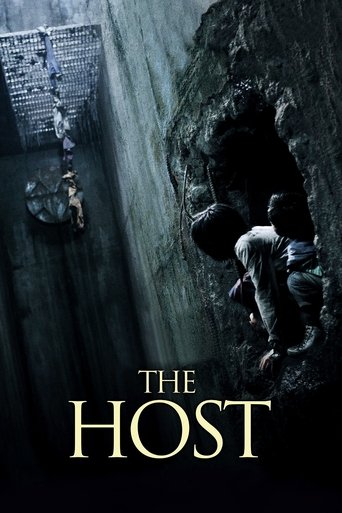
The Host
괴물
2006 · Film · 120 min
Directed by Bong Joon Ho
A teenage girl is captured by a giant mutated squid-like creature that appears from Seoul's Han River after toxic waste was dumped in it, prompting her family into a frantic search for her.
2 positive4 neutralfrom 6 commenters
Where to watch
No streaming data for this title.

6 comments on Hacker News
I asked ChatGPT. It gave me bunch. I got some I've never heard of. I think I'll look into them.
<ChatGPT>
list 50 interesting movies that explore AI.
The Matrix
Ex Machina
Blade Runner
The Terminator
I, Robot
The War of the Worlds
A.I. Artificial Intelligence
Transcendence
The Fifth Element
2001: A Space Odyssey
WarGames
Westworld
The Machine
Her
The Iron Giant
Automata
The Truman Show
The Prestige
The Martian
The Fly
The Bicentennial Man
Surrogates
The Day the Earth Stood Still
Limitless
Robocop
Electric Dreams
The Island
The Time Machine
The Circle
The Arrival
The Host
The Stepford Wives
The Brain that Wouldn't Die
Frankenstein
The Invisible Man
Metropolis
The Thing
Jurassic Park
Independence Day
Gravity
Artificial Intelligence: AI
Avatar
The Hitchhiker's Guide to the Galaxy
The Matrix Reloaded
The Matrix Revolutions
Inception
Interstellar
The Time Traveler's Wife
The Butterfly Effect
The Future.
</ChatGPT>
There's a Korean movie from a few years back called The Host. They have an all-time great hacking scene. Guy calls his friend who works for the phone company to get him in the office then they scour the desks in the evening for anyone who wrote their password on a post-it.
I'd say he is a product of the 2000s, his "Memories of Murder" (imo his best movie) dates from 2003 and "The Host" from 2006, it's only now that mainstream Western audiences have gotten a chance to see his work.
"You could say".
Bong Joon Ho would be a fool to write that everyone read the wrong thing into his movie.
The weak and have-nots are definitely not fighting each other in Parasite.
If you want to read his real thoughts, read the interviews surrounding the releases of The Host and Mother. Or possibly something entirely for a Korean audience beyond the release of Parasite.
Edit: Actually, I read it wrong. And I guess so did you. He is saying the same exact thing I am. Your quote from Bong Joon Ho doesn't actually reference any class fighting. It represents the lower class fighting itself.
"Something I was struck by in the movie is that there's a huge lack of class solidarity between the various working class people. What inspired you to write the relationships that way?
You point out something very important. You know, in Mother, you see the have nots and the needy clawing at each other and hurting one another. On the other hand, in The Host, you see the solidarity between them, they save each other and they gather their strengths together. And you could say Parasite is closer to Mother, where the weak and have nots are fighting one another. And that's sad, but it's also realistic. And from those moments, you get this element of sadness, but also the comedy, as well"
A direct quote from Bong Joon Ho himself.
https://www.gq.com/story/parasite-director-bong-joon-ho-interview
Enlightening article. I find his works take on a new context in the light of the recent rise of Korean art in American pop culture.
The Anglo world condoned Japanese imperialism in Korea and later brought its own influences to Korean culture during the Korean War. This war is as often overlooked and relegated to obscurity as the article's subject himself, but the blood spilt must shine through the heart of America in an inevitable fashion.
The rise of Korean film and pop music in American consciousness is a reflection of the cultural imperialism of the West. This is illustrated in Bong Joon Ho's "The Host" (2006) moments before k-pop and Korean film became so massively popular in America.
Somewhat a reflection of these novels, the film's portrayal of Americans in Korea is not all black and white. The opening scene shows an Anglo American officer commanding a local Korean man to dump toxic formaldehyde into the Han River, leading to the rise of a monster and a mysterious infectious pandemic (sound familiar?). Although the pandemic is revealed to be an American imperial hoax to seize power and quarantine the population, a local Anglo American GI is featured as a hero who fights alongside the protagonist against the monster. A toxic gas bioweapon called Agent Yellow is released in a failed attempt to defeat the monster, even though the gas is harmful to the local population. This may be a commentary on the American use of bioweapons in Vietnam against the cultural threat to American world hegemony (communism).
To summarize this chaotic chain of themes, perhaps as chaotic as "East Goes West", the lasting struggle of asserting a personal and cultural identity in America is very relevant today. What does it take for a man or woman to rise above prejudice and establish themselves as a human being and valued member of society? Why should this struggle exist? Why should Americans be forced to engage with it? It is evidence of evil. The absurdity and irrationality of American racism is very prevalent in its strange and wavering treatment of Asian Americans. I can relate with Kang, not only in his love for America, but also in his frustrations with its politically motivated prejudice.