 Hacker Cinema
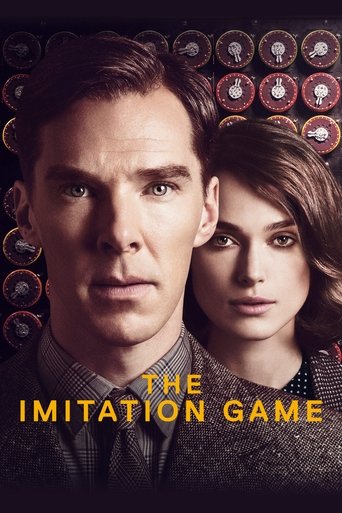
The Imitation Game
2014 · Film · 113 min
Directed by Morten Tyldum
Based on the real life story of legendary cryptanalyst Alan Turing, the film portrays the nail-biting race against time by Turing and his brilliant team of code-breakers at Britain's top-secret Government Code and Cypher School at Bletchley Park, during the darkest days of World War II.
21 positive20 negative6 mixed26 neutralfrom 73 commenters
Where to watch
No streaming data for this title.
76 comments on Hacker News
I despise Imitation Game. Perhaps I put too much emphasis on 'reality' of films and would prefer artistic license (while allowed) is limited but it got so many things wrong
Cdr. Denniston's family for example has said his portrayal is utterly wrong to the facts
Interesting how this technological war behind the scenes probably had a disproportionately large effect on the war compared to how little you hear about it in text books or history class growing up.
The mention Turing a little bit, but I really enjoyed the movie “The Imitation Game” about Turing building the “Bombe” machine and eventually breaking the Enigma code, and the effect that had on the war. Highly recommend!
> That's mostly because a movie about someone who's an expert at building organizations is boring.
Still issue (seriously).
He might be an expert at building organizations in real life, but there is no rule that a movie about him has to focus on that part. Movies are not documentaries.
Examples: Oppenheimer, A Beautiful Mind, The Imitation Game, Jobs, Social Media, and literally every movie that sells tbh.
The imitation game is an interesting one on your list. That was a pretty huge movie. Prime Oscar bait with A list actors
Freaking awesome... thank you very much!
Have you seen the film about Enigma, named "The Imitation Game" of 2014? I once or two asked about one of the main points of the film stated in there, yet no one still responded. Yes, I do sure rarely see films/movies nowadays (but wish so much...) for the time availability sake, but some may find the film interesting for that main point stated, I believe.
I don't think they do hate it, any more than they hate "A Beautiful Mind" which is a pale shadow of Nash's real life, or "The Man Who Knew Infinity" about Srinivasa Ramanujan, or Breneditch Cumbersome's interpretation of Turing in "the Imitation Game" or any other mathematician in film. "Hidden Figures" was a wreck. So what!
They think "yea, thats not very real" and then in a Gell-Mann Amnesia moment pass over the other aspects of film which are utter bullshit, but filmicly necessary like camera pans through walls, 32 year old people playing high school kids, you-name-it.
"that artifact should be in a museum" my arse. Archeologists would be lamenting the lack of contextual work mapping the scene before you disarm the rotating knives, the implicit cultural burdens mis-understood, the grim reality of funding to get a crystal-scull hunting project up in the first place.
It really annoys me when fiction is based on real events, takes a lot of liberty with the source material that it enters into the public consciousness.
The classic case is the "The Life and Voyages of Christopher Columbus" where it was claimed he was aiming to prove the Earth was not flat. My personal peeve is movies like "The Imitation Game".
In the movie The Imitation Game, the Alan Turing character recognizes that acting 100% of the time gives away to the opposition that you identified them and sets off the next iteration of “cat and mouse”. He comes up with a specific percentage of the time that the Allies should sit on the intelligence and not warn their own people.
If, instead, you only act on a percentage of requests, you can add noise in an insidious way without signaling that you caught them. It will make their job troubleshooting and crafting the next iteration much harder. Also, making the response less predictable is a good idea - throw different HTTP error codes, respond with somewhat inaccurate content, etc
That's certainly one opinion, and is even right, to some degree. But there's also movies like the Imitation Game about Alan Turing, which is a movie, and not a documentary, but there are also countless documentaries about him. There's no shortage of hagiographies about Steven Jobs, in both book and film and tv miniseries format, along with Pirates of Silicon Valley which includes Microsoft's part. There's a movie about Aaron Swartz (The Internet’s Own Boy). The movie Antitrust(2001) is fictional, but in the same area.
Hackers (1995) is fictional but a cult classic. Freedom Downtime (2001) is about Mitnick and hacking culture. There's smaller documentaries too. There's that one about Wikileaks, that one about Cambridge Analytica. There's books like The Dream Machine (Mitchell), Unix: A History and a Memoir (Brian W. Kernighan), The UNIX‑HATERS Handbook (Simson Garfinkel et al.). There's http://folklore.org about the early days at Apple. Asiometry has https://www.youtube.com/watch?v=Ffh3DRFzRL0, a 20 minute bit about the Unix wars.
The source code to the original Microsoft DOS is at https://github.com/microsoft/MS-DOS. The Anarchist Cookbook is on Kindle, https://www.2600.com/Magazine/digital-back-issues goes back to 2010.
DefCON got too big for the Riv and the Sahara, and is now at the LVCC. Yeah it's not the same. It's never going to be the same, but some still gather for their yearly mecca and watch Hackers and get drunk in hotel suites paid for by corporate sponsors. Others stay home for various reasons.
Do we still keep what we're doing? I mean, I don't program in Z80 ASM assembly anymore. There are still classes in my code by the focus on OOP isn't what it once was. I'm not sure if I want to call it progress, but I don't program Win32 applications anymore. I can spin up a web app with an LLM in an afternoon, and have it web-scale to the whole world in less time than it used to take to get a computer racked in a colo.
It's not 1979, the cable I use to go from USB-C to HDMI is more powerful than the computer that took us to space. By like, a million times.
Look, I'm not saying we shouldn't respect our elders. By this point, though my beard's not yet grey, relatively speaking I am an elder. I learned to program from paper books. Before ChatGPT, before Stack Overflow, before Google. There are some here that predate me by decades. If you're competing with a $10 million Oracle db system, and going from 6 ASM instructions to 5 in the inner loop will eke out that extra percent of performance, and win you the contract, by all means, sit down, roll up your sleeves, and hand optimize assembly in order to figure out how to get rid of that one instruction.
The joke is oft made, that other fields stand on the shoulder of giants, while in computer science, we stand on their toes. And it's not wrong. I can't wait to for the next new language to pop up and reimplement a DAG solver for their package management woes, and to invent a better sandbox for running untrusted code. That's still an unsolved problem. If this stuff interests you, the Computer History Museum in Mountain View, California is worth the visit. The only problem is that at the end of the tour is computers I grew up with, which has a certain way of making a fella feel old.
The travesty that is happening right now, is in the wake of Paul Allen's death, is the debache with his surviving sister and the Seattle Living Computer Museum.
There's the entertaining bit in the film The Imitation Game (the breaking of Enigma code by Alan Turing) where they realised that a weakness was the daily weather report always containing the words "weatherreport" and "heil bloody hitler" (with obvious addition!) https://www.youtube.com/shorts/fAsSNjedZWI or longer version: https://www.youtube.com/watch?v=SkETN-xENAM
Also a more proper explanation: https://www.youtube.com/watch?v=V4V2bpZlqx8
There are a lot of really amazing TV and movies from the last 60 years. It seems we never have time to get around to finishing what we want, but I am genuinely curious what my wife and kids think about various scenarios presented in shows like Black Mirror.
Likewise, despite their inaccuracy, movies like The Imitation Game or A Beautiful Mind led me to look at the life of Alan Turing beyond just what I learned in college.
Consuming content is very much a time-blocked thing for me. I have some YouTube content I consume to stay up with various AI/ML groups, etc. but that is closer to work-related and not something I will put on during a break from work as that will defeat the purpose of recharging my brain.
It's also interesting to see how movies or shows capture small details that change over time.
I know a great deal about both, Turing being my scientific idol. I thought The Imitation Game was great, though not nearly enough postwar events and his trauma. I realize the title The Imitation Game was meant to be a double meaning, about both Bletchley's cryptographic attempts and Turing's attempts to feign heterosexuality, but the movie ultimately was about breaking encryption, not a study of homosexual life in a bigoted nation. I wouldn't personally call it a biopic. It's a sensationalized version of actual events because the real thing would've been boring. No one wants to watch me, by analogy, sit at a whiteboard beside a computer staring at symbols for eight straight hours.
I'm sorry you didn't get the biography you wanted.
From: https://en.wikipedia.org/wiki/The_Imitation_Game#Historical_inaccuracies
"GCHQ Departmental Historian Tony Comer went even further in his criticism of the film's inaccuracies, saying that "The Imitation Game [only] gets two things absolutely right. There was a Second World War and Turing's first name was Alan".
If you are making a fictional film, knock yourself out. But when you are using a real person's name, have some respect for them and their work.
"Considering how the UK treated Alan Turing while he was alive, he deserved a better institute to honour his memory."
Ouch. Almost certainly nothing like the insult his memory endured from "The imitation game" film though. Everyone associated with that film should feel a bit ashamed.[1]
I'm a UK based software engineer, but I almost never heard anything about this organization. Has anything useful come out of it?
[1] I could only bear to watch the first 20 minutes. But I can't imagine it got any better.
Forgotten not in the sense of lost knowledge, but more that the individual is not known proportionally to the importance of his work, or perhaps consistently when compared to his peers.
While specialists in his field know his work and his name (but not even everyone in software does), the public do not.
While your parents and friends see the dramatised exploits of Turing in films like The Imitation Game, or his face on the currency, the same is not said for Church.
Every field has it's public heroes, usually related to the stature of their work - Fleming and Jenner, Marconi, Ford, Bell. Turing.
Anyone will at least recognise these names, but not so for Church.
I'm assuming the "documentary" was the movie The Imitation Game staring Benedict Cumberbatch. If that's an intentional mistake, I'd guess by "French" they meant Austrian (as Hitler was born in Austria).
Usual caveats about Neal Stephenson apply but I think Cryptonomicon presents a much more compelling portrait of Alan Turing than the film The Imitation game which incorrectly portrays him as a repressed nerd single handedly solving all the problems.
Geez like pretty much everything. See eg https://slate.com/culture/2014/12/the-imitation-game-fact-vs-fiction-how-true-the-new-movie-is-to-alan-turings-real-life-story.html
Enigma was originally broken by a team of Polish cryptanalysts, who invented both a paper method to break it (Zygalski sheets) and the machine shown in movie (Rejewski's bomba). Turing later worked on a team to improve the bomba, which was a significant achievement but he didn't invent or spearhead the whole thing.
All this "don't use a machine to do a man's job" was bullshit invented for the movie, as were like half the other conflicts. Everyone involved knew that breaking Enigma was important, and they were already using a machine to do it, but after the Nazis changed their use of Enigma, the Brits needed mathematical insights to improve the speed of their machine.
The main characters in the film did exist and had some of the personality traits shown, but mostly didn't interact they way that the film showed. Turing was openly gay. Cairncross (the spy) didn't work with Turing. The codebreakers didn't choose which intercepted information to use and how, etc.
You'll enjoy the movie "The Imitation Game" - it's a well-made film about Alan Turing (of Turing-completeness fame) and his working group's cracking of Germany's Enigma encryption system.
FWIW, secondary to that: 100%, industry and NIST are actively voicing this, there's an interesting Google blog somewhere about work on it in Chrome (tl;dr: behind flags in chrome, but you can try it today. I think this is what I'm thinking of: https://blog.chromium.org/2023/08/protecting-chrome-traffic-with-hybrid.html)
Not looking to accuse the commenter of anything, but...
I think the Imitation Game movie may have given some folks a rather simplistic notion of Turing (indeed, I was under such an illusion until I read the biography on which the movie is supposedly based): that he was a tortured genius singly vital to the war effort, who was then persecuted and who then as a result committed suicide. But his real story is more complicated (though, to be clear, I am not looking to downplay how society treated him).
Turing's purposefulness didn't end after Bletchley or his conviction. Up until the end, he was doing ground-breaking work (at least as far as I understand it) in mathematical biology.
There's an article here on the film and it's various inaccuracies...which was based on the Enigma book, apparently... https://slate.com/culture/2014/12/the-imitation-game-fact-vs-fiction-how-true-the-new-movie-is-to-alan-turings-real-life-story.html#:~:text=Joan%20Clarke%20(Keira%20Knightley)&text=Keira%20Knightley's%20character%20in%20The,conservative%20parents%20off%20her%20back.
> The most an attacker might be able to view is the addresses of the sites you are connecting to.
With TLS 1.2 or earlier the attacker can almost certainly discern the real DNS name of the site you're connecting to, in TLS 1.3 this is merely likely (and ECH might some day largely eliminate this risk) but not certain depending on how you connect.
In practice your client hates wasting bandwidth and so precise size measurements are also surprisingly effective. If six people who I'm snooping watch movies from the Fast & Furious franchise on a streaming service and one watches "The Imitation Game" I can tell them apart with more or less 100% reliability. If they all read Wikipedia, six looking at stuff about dinosaurs and one reading about the Senate Intelligence Committee report on CIA torture, I can tell again.
Clients (e.g. your web browser) could do more to hamper this, but they do almost nothing. For example, suppose I'm sending an encrypted HTTP request with some data in it, and it'll fit easily into 4 Ethernet packets. I could pad that last packet so it's always full, and have the decryption step remove that padding for free but clients don't bother, so a bad guy can measure how long my data is to within maybe 16 bytes.
Hodges's book is excellent – delightfully thorough and detailed.
After finishing it (I read it after watching the movie) I was rather shocked at just how many liberties the film had taken. I'm not against a historical movie tweaking things here and there for the sake of drama, but The Imitation Game totally mischaracterised almost everything about Turing and his work in my opinion. I guess, to the movie's credit, it did make me want to learn more about Turing.
"It didn’t want to tip its hand to Zeppelin’s creators, who were likely to modify their file encryption approach if they detected it was somehow being bypassed."
It reminds me of something I learned when watching the movie "The Imitation Game" retelling how Alan Turing and his team cracked the Enigma code. They tried hard to make sure that the Germans wouldn't notice they had cracked it, and only used it sparingly so that it would not be noticeable.
Which, I realized, meant that the British and the Germans had teams of statisticians pitted against each other, one trying to make sure that their actions were not detectable statistically, and the other constantly monitoring the numbers to detect unusual patterns.
That is true. For example Alan Turing was supposedly a nice person, not the quirky loner portrayed in the movie The Imitation Game.
Hacker Culture, to me atleast is somewhat broad.
Here are some places where I found good representations:
1. Halt and Catch Fire: 70s/80s tech scene. Full stack hackers building products, companies. Depicts the hackers, code monkeys, visionary types, managers, financers- everyone. Also shows the transition of the business scene from analog to digital.
2. Westworld (Season 1 only) is brilliant. It depicts the ambition, the hubris involved in creating something new and grand.
3. The Travelling Salesman: P vs NP is solved. What are the implications, what are the uses, how will the State react? What is the role of the people imvolved?
4. Primer: Mind bending movie on time machine.
5. and 6. Imitation Game and A Beautiful Mind: I believe most people on HN will like these.
7. Agora is a hidden gem not many know about. It is anout Hypatia.
8. Dangerous Knowledge is a documentary about paradigm changing science. Godel, Turing, Boltzmann are covered.
9. Fractals is also a nice documentary with interviews from Mendelbrot.
10. Codebreaker is a mich more accurate biography of Turing that covers other aspects of his, not limited to his codebreaking and homosexuality.
11. Internet's Own Boy: The Story of Aaron Swartz: very nice and left a deep impression in me.
____
I am yet to watch:
1. Hidden Figures
2. Stand and Deliver
3. I'm In
4. TPB: AFK
5. Pirates of Silicon Valley
6. Triumph of the Nerds
____
Harvard Professor Oliver Knill has a list and clips from movies where math appears: https://people.math.harvard.edu/~knill/mathmovies/
____
I came to know a lot of these movies through Kagi search and Reddit search. "Best movies for mathematicians and computer scientists" and similar searches.
Who was more influential on computers? Turing or Gates? Hardly anyone heard of Turing outside of computer science and WW2 history buffs. At least until The Imitation Game movie, and most forgot when they left the cinema anyway.
Great suggestions here, many that I've either never heard of or never considered - I look forward to checking them out and please keep them coming, I'm hopeful this can turn into a masterthread to keep coming back and discovering motivational media.
Should maybe have done this earlier but adding a few of the ones I've already watched.
Technical Motivation:
- Silicon Valley (TV show, 2014-2019) - The Social Network (2010) - The Imitation Game (2014) - Halt & Catch Fire (TV show, 2014-2017) - Iron Man (2008) - Primer (2004) - The Martian (2015) - Hidden Figures (2016) - Flight of the Phoenix (1965 original or 2004 remake)
"Sales" Motivation:
- The Pursuit of Happyness (2006) - Door to Door (2002) - Underrated straight-to-TV film about a man with cerebral palsy who wants to become a door-to-door salesman - Glengarry Glen Ross (1992) - Pure sales, persistence and Pacino - Salesman (1969 documentary) (As above, but instead of Pacino it's real door-to-door bible salesmen and what they go through)
Honorable Mentions:
- Mr Robot (2015-2019): probably the most thrilling and technically accurate depiction of technology and hacking ever put to a screen, but as someone else said it's also very dystopian and depressing, and not too motivational except in the brief bursts that they show Elliot setting up a hack. Either way no VisualBasic GUIs here.
- Flash of Genius (2008): about the inventor of the modern windshield wiper who had it stolen from Ford and sued them. The premise is motivational, but I personally found it more of a cautionary tale on what you can lose for your principles when you go up against the giants.
I also found Imitation Game, Molly’s Game and Queens Gambit galvanizing. It’s interesting that those movies elicit that kind of response despite their ostensible message being the human cost of pursuing goals at the expense of everything else. In a similar vein a Beautiful Mind and The Social network also were motivating for me.
I’m not sure if I’m just taking away the wrong message (like the people who read Liar’s Dice and wanted to go into banking) or if the writer’s own subconscious admiration of these people permeated into the medium (or maybe they made it intentionally ambiguous). There is probably some deeper insight into how we all struggle with reconciling society’s veneration of individual success (monetary and/or reputational) with the social expectation that we conform to the norms of society (being social, not abusing drugs, placing social cohesion above everything else)
Midway was an example of of a movie where the director and writer were concerned about historical accuracy, and so avoided the sort of risible nonsense that Stobb lampooned in the imitation Game. I am now curious as to whether you will respond in the way that I expect.
It's certainly true that Turing didn't invent computer science. As a point of order:
> A popular British movie [The Imitation Game] even went so far as to say he invented the computer.
The Imitation Game that was financed by a US production company, with an American screenwriter and Norwegian director? That British movie?
What I find so strange about The Imitation Game that all of this is pretty well-known; anyone who has skimmed the Wikipedia article of Turing and the overview article on breaking Enigma knows that the movie is pretty much complete horseshit. Most of the alterations in the movie removed things that would have made the movie more interesting instead of the utterly bland story they made up.
According to the biography on which the movie "The Imitation Game" was (very loosely) based ("Alan Turing: The Enigma"), Turing was rather direct when expressing interest in the men he knew. Much more so than I would expect for that time. There were several times where he straight up propositioned acquaintances. So it wouldn't entirely surprise me if there was an actual expression of interest in the original story.
I'd also recommend Genius, a mini-series focused on Einstein.
Let's do a mathematics movie list too. I'll start:
+ The Man Who Knew Infinity - Ramanujan and Hardy + A Beautiful Mind - John Nash + The Imitation Game - Turing
As a fan since childhood of Ramanujan, that's one of the movies I'm most grateful for. For a mainstream movie, it provides a great amount of information, while surprisingly evoking the same reverence and awe that I've always held for Ramanujan. I would've preferred more of a deep dive into his actual mathematics to get a feel for why he is ranked so highly among mathematicians, but I accept that it would've lost the interest of a lot of viewers who watch movies for the human story without really gaining much in exchange.
Imitation Game was another great movie IMO. What are some other movies that focus on the life and works of a genius?
I wish we could do the same for Computer Science/Software. Movies like "Travelling Salesman" or "Pirates of Silicon Valley" or "Imitation Game" would be great suggestions but typically things like the Matrix or Ghost in the Shell are recommended which for me are great movies but poor examples of the discipline.
> I couldn't have done a better job in giving them a good feel for the situation and the pressures, the ideas and personalities involved.
Sincerely, I do defer to you for your opinion of Turing's personality - but when I saw the film it was so very disappointing that Turing was written as a lone-genius type - while it didn't drive the plot, I understand it really wasn't what he was like as a person. Come to think about it, I can't think of any mainstream cinema production that portrayed a leading academic as a _normal person_ - they invariably fall into stock character tropes, and The Imitation Game was no exception. That's what disappointed me the most.
Additionally, like many other historical biographies, the film condenses multiple people - or in this case, entire teams of people into single characters. I can understand that for budgetary and storytelling reasons, but the film's decision to substitute Turing's circle of literally a handful of characters for what would have been hundreds of cryptographers and researchers (out of a Bletchley Park workforce of almost 10,000 people concurrently in early 1945!) was enough to break the film for me - and even if that fudging wouldn't have made me take issue with the film the scenes where Turing-and-Chums single-handedly make moral decisions about the handling of high-level intelligence certainly did. Those scenes added nothing of historical value and would have added emotional tension only to viewers entirely ignorant about how military intelligence gathering and analysis works - which, unfortunately, seems to include the film critics.
About 10yrs of my academic career included studying much of Turing's work, I've read his biography by Hodges multiple times (one of the most incredible books ever written btw, covering in great detail everything you could want to know about Turing, his family, his life and his work), and worked closely with some of the best academics in the country on the subject of Turing.
I'm not showing off, and I don't mean to say my opinion is correct, but let's just say I have at least some claim to know what was going on.
I watched the Imitation Game with my wife who knew little to nothing about Bletchley park and Turing. I have to say, that given 90 minutes I couldn't have done a better job in giving them a good feel for the situation and the pressures, the ideas and personalities involved.
I can say with confidence that pretty much everything said or shown in every scene is significantly inaccurate, but taken as a whole, and with an understanding of the restrictions, it's a very good job.
If you can't live without knowing the specific truth, read Hodges. If you can, just watch the film then get on with something else.
I think like just like mathematics, cryptography, computer science and movies like The Imitation Game for example, those who are initiated and curious would gravitate towards the subject as they probably would have eventually, and those who are not, will just be happy to watch the movies, shows or other pop culture about it.
I do not believe it would draw more people than usual because with any endeavour, eventually the wonderment disappears for some people when they realize they gotta put in some work to continue going down the rabbit hole. Many drop off and become observers but not active participants.
I remember watching some sort of British documentary on Alan Turing on youtube when I was in high school. It had interviews from all of the people that knew him during his lifetime. This was long before his story was popularized by "The Imitation Game" and so I can't find it now that there is so much other content.
Does anybody else remember it? It was one of the good ones. From what I remember, the "asshole genius" trope was greatly played up for the film and he was much more human than that even with the treatment he endured.
It seems apparent to me that this is something most people do more or less intuitively (and for those that are especially proficient at it, I can see how it would become manipulative very quickly). I'm getting better at it, but it's still largely a manual/conscious effort.
Tangentially, I also found the way Alan Turing was portrayed in The Imitation Game to hit extremely close to home in this regard. E.g. this key scene: https://www.youtube.com/watch?v=mOjMfUCgyyw. Regardless of how historically accurate it is, the movie contrasts these differences between interacting with computers/math and other humans (in that the former is solely about "factual content" alone) very well in my eyes.
This would have made a nice scene in that awful Imitation Game film, unlike the rubbish they actually put in (as well as other tales of the real Turing - the gas mask worn during hay fever season, for example).
The Martian’s Daughter written by his daughter who was also an intellectual.
https://www.press.umich.edu/4655298/martians_daughter
Given the success of “The Imitation Game” and “The Theory of Everything” I’m disappointed that no one has made a compelling movie about Von Neumann who I think is a far more interesting character both mentally and in terms of personality.
For many, The Imitation Game is an entertaining movie. But it is a very distorted view of Bletchley Park and the code-breaking efforts that took part there. When I saw the movie, I found it very irritating (because the distortions were obvious to me). But most of the audience seemed to love it. There are many good critical articles about the movie (for example, https://www.nybooks.com/daily/2014/12/19/poor-imitation-alan-turing/)
I am not surprised that people working on the Bombe did not know about the Enigma: this was a huge undertaking, with many sections. The Bletchley Park "Roll of Honour" lists all people known to have worked at Bletchley, or other locations on Signals Intelligence - there are well over 12,000 names on that roll.
After I watched The Imitation Game lately I read about the Polish efforts, almost totally ignored in that movie and everything I'd read, as if the British invented the whole thing, possibly Turing single-handedly. The article says "based partly on an earlier Polish design" but doesn't say
Up to July 25, 1939, the Poles had been breaking Enigma messages for over six and a half years ...
The Poles' gift of Enigma decryption to their Western allies, five weeks before the outbreak of World War II, came not a moment too soon .. Gordon Welchman, head of Bletchley Park's Hut 6...writes: "Hut 6 Ultra would never have gotten off the ground if we had not learned from the Poles, in the nick of time, the details both of the German military version of the commercial Enigma machine, and of the operating procedures that were in use."
..French and British military intelligence,...had been unable to make any headway against Enigma. This Polish intelligence-and-technology transfer would give the Allies an unprecedented advantage (Ultra) in their ultimately victorious prosecution of World War II.
Also the name bombe is explained:
The first machine was built by the Poles and was a hand operated multiple enigma machine. When a possible solution was reached a part would fall off the machine onto the floor with a loud noise. Hence the name "bombe".
There is a Polish movie about that story, Sekret Enigmy (1979), but I haven't been able to get hold of it yet.
https://en.wikipedia.org/wiki/Bomba_(cryptography)
https://en.wikipedia.org/wiki/Marian_Rejewski
https://en.wikipedia.org/wiki/Biuro_Szyfr%C3%B3w
Sekret Enigmy: https://www.imdb.com/title/tt0079878/
It's cool that Google is financially sponsoring this project. Grace Hopper is a computer programmer we can all admire, male or female. I imagine I'll enjoy this film for much the same reasons I enjoyed The Imitation Game (despite flaws in historical accuracy).
They better include the 'nanoseconds' scene. [0]
[0]http://highscalability.com/blog/2012/3/1/grace-hopper-to-programmers-mind-your-nanoseconds.html
Not particularly scientific but you could also checkout the 2014 movie Imitation Game: http://www.imdb.com/title/tt2084970/
For bit of background about Turing’s life and efforts in WW2.
Cryptonomicon's sub-plot about Alan Turing got me interested in reading Andrew Hodges's biography of Alan Turing, "Alan Turing: The Enigma".
http://www.turing.org.uk/book/
So did Tom Jenning's excellent review of the first edition of that book from 2001. After Tom wrote that review, Andrew Hodges later published an even more comprehensive second edition of that book, on which the movie "The Imitation Game" was loosely based.
https://en.wikipedia.org/wiki/The_Imitation_Game
Tom Jennings also created FidoNet, published Homocore, and built an electromechanical paper tape driven storytelling machine art installation that incorporated parts of the book and his review.
https://www.amazon.com/review/R2IDYFOKQX8C9T
“. . . Turing was a difficult person: an unapologetic homosexual in post-Victorian England; ground-breaking mathematician; utterly indifferent to social conventions; arrogantly original (working from first principles, ignoring precedents); with no respect for professional boundaries (a ‘pure’ mathematician who taught himself engineering and electronics).”
https://en.wikipedia.org/wiki/Tom_Jennings
Aside from creating the most influential protocol for networking computer bulletin boards, Jennings built Wired magazine's first internet presence, wrote the portable BIOS that led to Phoenix Technologies BIOS, ran an early regional internet service provider, The Little Garden (later incorporated as TLGnet, Inc), and maintains an informal archive of Cold War science and technology.
http://machineproject.com/files/press/tomjennings_artus.php
Jennings's installation presents a conglomerated contraption of antique message devices, connected by cords and wires and plugs as in an assembly line, all intertwined like the participants in an orgy. A button placed before the piece invites the viewer to push it, and doing so the machines come alive. A typewriter with no typist loudly manufactures the story. On the page a disconnected segment of inky narrative describes a boyhood in which Turing spoke with his too-high voice much too often, plus another cryptic bit about his grave disappointment concerning his treatment by the British government and something about two men, random fragments randomly served by a database. Lights blink on another quaint little device and holes are punched in various rolls of tape that unspool onto the floor, adding to the already significant pile of coiled dotted paper. A final note is struck by an odd, tape-recorder-like noisemaker that seems to bespeak, unintelligibly, a further translation of the story generated by these melancholy machines.
http://machineproject.com/2003/events/tom-jennings-story-teller/
Story Teller, an installation by Tom Jennings, is an experimental narrative about British mathematician/code breaker Alan Turing told using obsolete media — perforated paper tape, teletype, phoneme-speech, glowing phosphors and ink-on-paper.
http://worldpowersystems.com/products/Story-Teller/
The logical mechanisms within Story Teller are in fact exactly "Turing Machines", and through no coincidence its symbols are stored on data-storage perforated tape of his era; with only 128 possible symbols on the tape (though any number of them, and in any order) Story Teller tells a story of Turing, in text, speech, and time. The components of the configuration used for the Turing story are the Model 3 Tape Reader, the Model 31 Vocalizer, the Gallery Controller, and a Teletype Corporation Model 28 teletype, suitably modified to work in the Story Teller system. Other configurations, such as for speech setup only, are possible.
If you think the life experiences of gay/trans people in 1930s Europe aren't remotely related to development then you might want to read a little bit about the life of Alan Turing. While it's a little over-dramatised, the recent movie "the Imitation Game" is a good starting point.
The ridiculousness of it all is it's unreasonable at its base to try to prevent encryption as a form of safety and security from violence.
Sure, you can lock up all communication for privacy reasons, and the government can spend all kinds of resources on trying to control to prevent or circumvent encryption - however it's a waste of resources as it's simply a bandaid.
If I wanted to do something violent or evil I/you can simply have regular meetings and use paper communication - the old spy-style stuff. Of course those networks can be infiltrated by governments with the resources, and they can maintain that presence by allowing certain acts within networks to occur vs. deciding which ones they should stop; it's how the war against Hitler was won once their encryption was broken - watch the very well-done The Imitation Game - http://www.imdb.com/title/tt2084970/ - for a reference.
The only real solution is dealing with the root causes. I heard an analyst on TV (a rare occasion for me) mention after Trump's Saudi visit and speech, that he didn't mention that the Saudis should look into the root causes of why there is terrorist activity growing in their countries; of course a lot of it is historical karma and rage from violent acts against their families, however a lot is because people's basic needs aren't being met which prevents the higher levels of Maslow's Hierarchy of Needs from being reached and maintained.
There's a solution and it requires building real community, locally, where you are now - and striving for people to become healthy so they don't develop bias and other coping mechanisms which prevent empathy and understanding and therefore compassion; preventing responsible ownership of weapons isn't useful either, not developing and supplying weapons on mass would be beneficial, however most attacks recently have been with vehicles or knives.
Universal Basic Income will also allow closer to a truly free work market and it can evolve from there, giving people the time to do what they feel is the most important in that moment for themselves, while not having to be forced to working in a shitty environment with shitty managers or co-workers; the health improvement and increased productivity here alone is worth it.
What about "The Imitation Game"? I suppose that movie made Turing a quite well known figure, especially viz. Church.
Totally agree. Have you ever seen the movie The Imitation Game? There's a great quote from Turing's character when he is talking about being picked on and beaten up by bullies at school - "Do you know why people like violence? It is because it feels good. Humans find violence deeply satisfying"
It's that simple, really. It is in our nature, just like sex. We like it. It feels good.
The only reason we try to eschew and condemn such violence in modern society is because it is in our best interests and more productive to society as a whole to not be like that. No other reason. If we all lived in fear and were huddled in our homes in small communities we wouldn't have even half the modern luxuries we do today. Plus, on the larger scale, if it's war you are talking about - well, they cost a lot of money/resources. So they are tough to maintain for the long haul without noticeable economic harm.
People like to say that love is stronger than anger and hate. I have always disagreed. Hate and anger run deeper than most imagine. And they motivate people like nothing else in this world, except perhaps fear.
The one and only reason people aren't butchering each other in the streets is because we have figured out a way that we can all survive. If that were to crumble, you can be damn sure society would look a lot closer to The Walking Dead or Children of Men than Star Trek.
I really enjoyed the 2014 film about Alan Turing, "The Imitation Game" http://www.imdb.com/title/tt2084970/, named after this article: "The new form of the problem can be described in terms of a game which we call the 'imitation game.'"
Another mistake, which had serious consequences to the Germans, was that a German weather ship in the North Atlantic accidentally transmitted their weather report using the Enigma key reserved for naval operations rather than the key used for routine information, noticed the mistake, and then immediately retransmitted the identical message using the routine key. Since weather forecasts have predictable content and format (and are thus easier to decrypt), this error allowed the Bletchley Park people to crack the operations key much more quickly than they otherwise could have.
This episode is described in the book Alan Turing: The Enigma[1], which was the basis for "The Imitation Game" film. I highly recommend this book if you're interested in Turing, cryptography, or the early days of computing. While Turing is best known today for his work on the theoretical underpinnings of computer science (due to the Turing Machine that bears his name), he also worked on the design of one of the early general purpose computers (the ACE[2]) after the war, on voice encryption hardware, and other interesting stuff.
[1] http://www.amazon.com/Alan-Turing-Enigma-Inspired-Imitation/dp/069116472X
[2] https://en.wikipedia.org/wiki/Automatic_Computing_Engine
It gets a fair amount of hate on HN for taking narrative liberties with Turing's actual life story. I won't deny that it does, and anyone who's genuinely interested in Alan Turing would do better to read about him and his work.
But the movie is a dramatization, not a documentary. Because of that, it got the general, non-CS-major public to care about Alan Turing. I'd say that's a pretty decent accomplishment.
I actually had a conversation with my mom about Alan Turing after she saw the movie. That's saying something. She still needs help browsing the web beyond AOL. She thought computers were "unhealthy" and borderline "dangerous" until very recently. I'm pretty sure she thinks her router contains the entire Internet on it. These are the kinds of people who need to be exposed to Turing, and "Imitation Game" breaks through to them. Great. I'll take that as a net-positive.
This movie looks like is has a good chance of doing a better job than even The Imitation Game at ruining and fundamentally misrepresenting a topic I care about and a person I respect.
You're absolutely right. But the movie is not meant to be a documentary about the math, it is meant to be a story about his life. The same goes for Theory of Everything, Imitation Game, and A Beautiful Mind. The different here is that what math they show is actually correct.
I was also disappointed that the discussion afterwards put so much emphasis on him as a person, and not on the actual math, but I don't hold that against the film itself. Movies about artists and authors have never been about their works of art either: the movies are about their lives, and I think it is appropriate for cinema to be used as a medium for biography rather than as a medium for education.
Huh. I was at the same showing and didn't care for it much. The movie only rarely touched on the mathematics and instead focused on his life and personal troubles. At least Theory of Everything and Imitation Game actually showed a bit of work happening. The closest we get in this movie is a bit of argument about primes and then a little of his partitions work (at an extremely consumable level, so much so it was boring). I kept thinking "Hmm, I wonder why they felt hiding mathematics and making it a personal biopic was better than getting people interested in the actual math?".
In my opinion, Carl Sagan's books remain a much better "popular interest in X" method. Explain things to people, sometimes slowly or incompletely, but avoid the hero worship.
I was lucky enough to see The Man Who Knew Infinity this past weekend at the San Francisco International Film Festival. And I'd just like to say that it is a truly beautiful film, and I encourage everyone to go see it.
After the showing, there was a panel discussion with the director, composer, producer, two actors (Stephen Fry!), and three consulting mathematicians who helped the production. One of the topics that came up was the recent (finally!) interest in Hollywood for making movies about technical people. Since the dawn of cinema, we've made movies about artists, writers, and poets. But it is only recently that we've started making movies about scientists (Stephen Hawking) and mathematicians (Alan Turing).
In my opinion, this movie puts both The Theory of Everything and The Imitation Game to shame. It is much more moving and beautiful than both, and it doesn't fall into the either the trap of overly simplifying the math, nor of overly dramatizing his life. If you have any interest in math, science, or computer science (much of which is underpinned by his work in number theory), I highly encourage you to go see this film.
Seriously, those are not content-free movies. You're just not the target market.
But you want to look at what got no awards while The Imitation Game cleaned up? Selma, a movie with way more relevance to America than TIG.
But I'm guessing you're not in the target market for that either.
(And also, as others have already pointed out, the content is bad.)
The Polish developed some machines to break encryption as well. Turing worked in a team and people tend to forget that. http://www.telegraph.co.uk/culture/film/film-news/11229240/The-Imitation-Game-who-were-the-real-Bletchley-Park-codebreakers.html
To be honest they kept it a secret. I bought a painting of the timeline of computers from an estate sale from the dawn of history to 1970 and the people in computers and they don't even mention Turing and the team he worked with. Even if he did a lot of work in the 1950s, he isn't mentioned. The British government kept his work a secret.
So because it was kept a secret the public did not know about encryption and code breaking that encryption using computers until much later.
A lot of government employees aren't tech savvy nor are politicians or leaders. They might never heard of Turing. If they did read a history book on computers it might be old and not mention Turing and encryption.
It is up to use to educate them and remind them that encryption is important to keep our data safe and that a backdoor in encryption means weak encryption.
Of course Snowden claims that the Patriot Act and Prism were made to collect data via domestic spying, and used for politics and power and control. They see encryption as a threat to their power and want to eliminate it.
They did have a throw away line: http://www.subzin.com/quotes/M163327400a/The+Imitation+Game/It's+is+inspired+by+an+old+Polish+code+machine.
I think it's hard to fit team storytelling into the constrains of cinema. It would be interesting to see something like the Imitation Game re-imagined as a TV miniseries developing multiple character arcs.
Makes me want to re-read Cryptonomicon again. The Imitation Game movie was a disappointment to me, after having read that book -- but I have to admit I don't remember if the Polish contribution was mentioned in the book!
My grandfather worked at Bletchley park (used to play chess with Turing) and when he saw "The Imitation Game" he said it was nothing like working there. He said they were all much more respectful and wouldn't yell at each other like in the movie.
>How many Jobs/Apple movies do we need?
One good one I suppose. Made for TV movies and low budget cash-ins don't count. I love the 1980s tech era and would love to see more films handle that. Not sure if this film goes this far back but the rise of mobile is just as good of a story, and probably more relate-able to modern audiences.
>Why don't we have a decent Tesla movie?
Honestly, because it would be terrible. Tesla works as a backdrop to Edison's success but he's a bit player in almost every way. This is like asking why we don't have a Paul Allen movie. Sure, those would be interesting, but not $50m plus dollar investment interesting for a risk-averse Hollywood system.
Also, general audiences won't be too impressed with the guy who failed at a lot of things even though his technical achievements are impressive. Tesla is also a very unlikeable person from the writings we have of people who have met him. He doesn't have the Jobsian charm we're going to see in Apple movies. He doesn't have a Jobsian narrative. He was a stern and asocial weirdo and most likely would be somewhere on the autism spectrum today. It also doesn't help that his ideas went full wack-town towards the end. In a desperate attempt to make money things like death rays, perpetual energy, bullshit medical devices, etc became his norm. Not to mention his vision of wireless energy was ultimately a non-starter as it would pollute the spectrum enough to make things like TV or cell phones impossible.
On a related note, I think creatives struggled with telling Alan Turing's story, but at least with Turing we have all his influence, published papers, his victimhood, and his amazing WWII experiences. Even then, the Imitation Game wasn't very historically accurate. Tesla doesn't have any crowd-pleasing themes of overcoming adversity and his dark side is really dark - endless advocating eugenics, wanting to sterilize the poor, never having any sort of romance, becoming bitter, ultimately failing at his dreams, etc. He isn't this kindly grandfather type his fans make him out to be. He's a mess, honestly. A smart mess, but a mess nonetheless. I think any movie that makes him look relatable or a "hero" would ultimately be dishonest. By the business standards of the time, he was treated fairly. He just couldn't launch his own businesses successfully.
I've seen this depicted in movies also (I think the imitation game (2014) had a scene with it). wikipedia has this: https://en.wikipedia.org/wiki/Evacuations_of_civilians_in_Britain_during_World_War_II
Last night I finally got to watch "The Imitation Game". I was already familiar with Turing and his life, but that movie really solidified with me how terribly he was treated despite the fact that he was responsible for saving so many lives.
This is topical because "The Imitation Game" has been in the news and movie theaters recently:
I come from a Soviet immigrant family whose stance on all things LGBTQ is predictably conservative. Sometime in high school, as part of my interest in CS, I read Turing's life story. The story of a man whose contributions were fundamental to my chosen field being persecuted due to his sexual orientation cinched my views on the matter: talent and contribution are everything, the rest is private and irrelevant.
> I recently watched the film “The Imitation Game” and it’s brilliant despite Keira Knightley’s failed attempt at a posh British accent.
Really?
Born: March 26, 1985 (age 29), Teddington, London, United Kingdom
Is the problem that her British accent wasn't posh enough?
Don't worry, you haven't missed it.
"“We’ll follow the pattern laid out with ‘The King’s Speech,’ ‘The Artist’ and pictures like that and move slowly and deliberately,” said Erik Lomis, distribution chief for the Weinstein Company.
[Just 4 theaters to begin with.]
"The slow but steady expansion will see “The Imitation Game” add six markets and between 25 and 30 theaters on Dec. 12. It will go nationwide in between 600 and 800 theaters on Christmas Day.”
(http://variety.com/2014/film/news/imitation-game-box-office-benedict-cumberbatch-oscars-1201367234/)
I agree with the author's criticism of the movie, but I still personally enjoyed The Imitation Game.
It's good entertainment even if it is quite exaggerated and not 100% historically accurate. If it exposes more people to some of the history of computing and one of its great early engineers then I think that is positive.
Someone submitted a critique to the BadHistory subreddit, the movie seems to diverge quite a bit from reality, and even tried to shoehorn in a a (female) love interest while making little mention of his actual orientation.
http://www.reddit.com/r/badhistory/comments/2mleat/the_imitation_game_or_how_the_breaking_of_the/
Start here: http://www.reddit.com/r/badhistory/comments/2mleat/the_imitation_game_or_how_the_breaking_of_the/
http://www.reddit.com/r/badhistory/comments/2mleat/the_imitation_game_or_how_the_breaking_of_the/cm6v96q
The movie doesn't even mention Tommy Flowers.
Haha right as Turing says "Are you paying attention too." Pretty clever. I don't think this is purely a movie advert though. The Imitation Game relation explains how they expected people to get the non number base/regex clue.
This isn't for google, it's some marketing thing for upcoming movie "The Imitation Game" (based on Alan Turing).
For those interested there's a new movie coming out on the topic called Imitation Game.
Trailer: http://youtu.be/nuPZUUED5uk