 Hacker Cinema
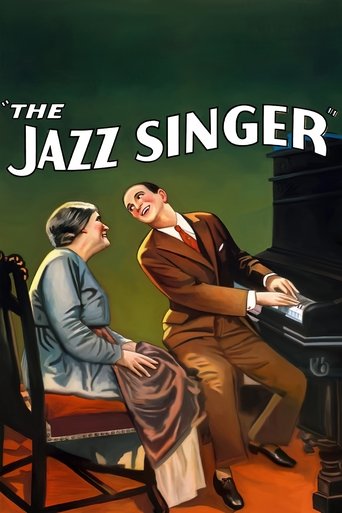
The Jazz Singer
1927 · Film · 96 min
Directed by Alan Crosland
A young Jewish man is torn between tradition and individuality when his old-fashioned family objects to his career as a jazz singer. This is the first full length feature film to use synchronized sound, and is the original film musical.
2 negative3 neutralfrom 5 commenters
Where to watch
No streaming data for this title.
5 comments on Hacker News
Not the parent but here's one article:
>After the release of The Jazz Singer in 1927, all bets were off for live musicians who played in movie theaters. Thanks to synchronized sound, the use of live musicians was unnecessary — and perhaps a larger sin, old-fashioned. In 1930 the American Federation of Musicians formed a new organization called the Music Defense League and launched a scathing ad campaign to fight the advance of this terrible menace known as recorded sound.
>The Music Defense League spent over $500,000, running ads in newspapers throughout the United States and Canada. The ads pleaded with the public to demand humans play their music (be it in movie or stage theaters), rather than some cold, unseen machine.
>Joseph N. Weber, the president of the American Federation of Musicians, made it clear in the March, 1931 issue of Modern Mechanix magazine that the very soul of art was at stake in this battle against the machines.
https://www.smithsonianmag.com/history/musicians-wage-war-against-evil-robots-92702721/
Well, if you're into 'politically incorrect' movies, virtually anything before 1980 will fit the bill. You could start with Birth of Nation which celebrates the KKK. Then move on to the Jazz Singer which prominently features black face. Breakfast at Tiffany's is famous for Mickey Rooney's 'ching chong' routine. There's really no shortage.
Your local community library is also full of extremism. You will find copies of The Communist Manifesto, Mein Kamph, The Turner Diaries, The Anarchist Cookbook, Platos Republic, In Defense of Selfishness and The Koran.
It has “problematic” works like Huckleberry Finn, Satanic Diaries and To Kill a Mockingbird.
It has works written by known racists such as HP Lovecraft, TS Elliot, Roald Dahl, Dr Seuss and Kingsley Amis.
It has hard copies of dangerous films that have been memoyholed by Prime and Netflix like Gone With The Wind and The Jazz Singer. It may also have DVDs that have been produced, directed and acted in by vile, cancelled individuals like Kevin Spacey, Louise CK, Harvey Weinstein, or Mel Gibson.
Good God, it might even have a copy of the Jenna in blackface episode from the third season of 30 Rock. I am clutching my pearls and getting the vapors just thinking about it.
Lost was the first big show I can remember that just had a one to two beat opening theme.
It's weird that it took so long. Early films, the Jazz Singer if you go way back, had a fifteen minute overture, reminiscent of the orchestral opening to stage plays while people found their seats.
Movies eventually realized that, artistic merit notwithstanding, that was boring. They first shortened those intros to a card of the main players. Sometime later the guilds required credits include all craftsman, but just stars. A fair and egalitarian move with the unintended consequences of reexpanding credits, making them... Less fun. Studios just moved the credits to the end and began with some establishing scene instead, as a compromise between the contributors and audience.
I guess anyone who mostly watched things after Lost wouldn't expect long tv intros. But then, most streaming services let you skip them, so it shouldn't be a big deal
The technology associated with film-making has evolved incrementally ever since its inception: from the 1890's Edison Kinetoscope shorts that could be watched by only one person at a time to the 2-reeler comedy shorts circa 1915 to D.W. Griffith's breakthrough with silent feature-length films in Birth of a Nation to the first talkies with 1927's The Jazz Singer to the introduction of color in select 1920's movies such as The Black Pirate (eventually evolving into beautiful technicolor productions) to Disney's feature animations in the 1930's to the first experimentation with 3-D in the 1950's with The Blue Lagoon and other gimmick films featuring knives and other assorted objects being hurled gratuitously at the audience to the widescreen film techniques of the 1950's featuring elongated landscapes that made one dizzy watching them to the modern digital special effects movies featuring CGI in a leading role.
Throughout this history, film-makers have continually experimented with different camera techniques and different types of cameras.
This item relating to Mr. Cameron appears to be another incremental step in this long process. It looks to be interesting and possibly intriguing.
What is being lost in the modern film innovations, however, is what I would call the essence of film-making, which is a play-acted script featuring real people but presented as human drama/comedy/satire/etc. using the recognized camera techniques that distinguish cinema from a live play - rapid cutting, point-of-view camera angles, etc. As things go increasingly digital, and become more and more subject to manipulation of images bearing less and less connection with our real world experiences, we get more and more a sense of watching a cartoon as opposed to real people. It is no coincidence that, in this context, many of the modern plots are drawn from cartoon sources (Batman, Spider Man, many others). As this emphasis on special effects has increased, what has become increasingly lost is the quality scripts (with their corresponding wit, drama, fantasy) that once could be taken for granted in quality film-making. The result is an increasingly artificial experience to which it becomes harder and harder to relate.
Over the centuries, it is the great stories that have moved us, from epic poems to the great novels and, yes, even to the cinema of old warhorses such as Gone with the Wind. Today, technology has become as much a substitute for story-telling as anything else. Yes, it constitutes progress in a real sense (incremental though it may be) but, insofar as it has detracted from inspiring story-telling by serving as a tin-hat means of attracting audiences without the need to develop a great story, it has brought a net loss. Just watch a silent movie like Sunrise (1927) and tell me that CGI and other gimmicks have brought a net improvement to what truly can be inspiring about film.
It is, of course, possible to combine great new technology with great stories but not when the technology itself is being featured as the primary attraction.