 Hacker Cinema
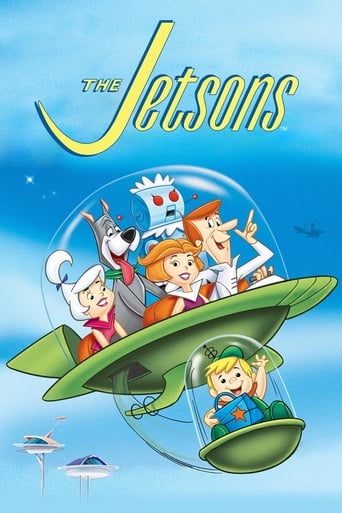
The Jetsons
1962 · TV series · 30 min episodes · 3 seasons
Created by William Hanna, Joseph Barbera
Meet George Jetson and his quirky family: wife Jane, son Elroy and daughter Judy. Living in the automated, push-button world of the future hasn't made life any easier for the harried husband and father, who gets into one comical misadventure after another!
2 positive2 negative8 neutralfrom 12 commenters
Where to watch
No streaming data for this title.
12 comments on Hacker News
I want Rosie (fictional robot from the TV show "The Jetsons")
Basically, I want a robotic butler / maid that will do most of the cleanup around the house.
> “The Jetsons” stands as the single most important piece of 20th century futurism.
LOL. Perhaps it's important to Americans.
I'm not sure I've seen a single episode, I certainly didn't see it when it was broadcast.
We're talking past each other. I understand your argument, and am saying that it's a poor one. You either do not understand why, which at this point must be my own fault, or do not care. I won't post further in this thread, as it's clearly not going anywhere.
> You apparently know the origin is from Yiddish Theater. That's clearly what I was referring to.
The problem, again, is that you weren't referring to it. You were labeling a character "Yiddish". This may seem to you like hair-splitting, but I assure you it's not. In English usage, the word Yiddish does not refer to a person. Full stop. The Yiddish Theater is so-called because it's the Yiddish-Language Theater, not because it's extra jew-ey.
But look, I'll give you the benefit of the doubt that this isn't your coinage. Do you have a reference establishing "The Yiddish Brooklynite" as a common or accepted usage in the way you're deploying it? Maybe a book or article that uses the term to describe Bugs Bunny? Please post, I'm perfectly happy to be the schlimazel here.
> As far as Rosie goes, take it up with the scholarship. For example
Sure, fine. Considering she's a combo maid and maternal figure in a midcentury sitcom you can probably read aspects of Rosie that way. But again you're missing the point, which isn't that you were necessarily wrong. It's that your response to being challenged wasn't to engage with what the other poster was saying, or to argue your point, or even, as here, to type "jetsons mammy" into google scholar and link the first article that comes up. It was to dismiss the comment and continue bloviating in a different direction. This was also in substance the character of your response to me. It's an approach to discussion calibrated to earn points on HN, but not one, in my experience, that shows the interest or capacity to hear something from a different perspective.
Rosie speaks with a Brooklyn Jewish accent. And the thing that made Jane pick her was her working-class unpretentiousness and brazen willingness to talk back to the salesman.
And it's clear that the Jetson family sees Rosie as a person and a member of the family. In a later episode (admittedly made in the 80s and not the 60s), George is looking for a Mother's Day present for Rosie, and he speaks so fondly of her that his boss, Cosmo Spacely, believes Rosie to be a woman with whom George is having an affair.
You have to search really hard to find racism in the depiction of Rosie in The Jetsons.
I hadn't noticed this before, but an actual Star Trek writer posted a comment to Scalzi's post:
> Raging at Trek because its filled with rubber science is a straw man argument. When has any Star Trek show ever pretended to be scientifically accurate? Every Trek show has always been, at the core, an action-adventure drama about contemporary issues refelected off the funhouse mirror of an SF setting. It’s allegory, not extrapolation.
So, don't try to predict the consequences of new technologies by analogies to Star Trek. You'll do as well as predicting the outcome of a war by analogies to Bruce Lee movies. Same goes for Terminator, Dr. Who, and the Jetsons.
And, despite https://tvtropes.org/pmwiki/pmwiki.php/Main/MohsScaleOfScienceFictionHardness, the same really goes for fiction in general: fiction is literally, unashamedly, intentionally, nothing but lies. It doesn't tell you anything about reality, just about its authors' beliefs. And when we're talking about things that haven't happened yet, the authors generally don't know any more than you do; even when they have thought about the subject, as is undoubtedly the case with Star Trek's English-speaking extraterrestrials and audio-transmitting vacuum, they may prefer to portray things they know are impossible because they think they'll be more entertaining or help them achieve some other artistic goal.
Don't reason from fictional evidence. It makes you look like a fool.
Totally agree, and I also generally find the article poorly written. I would reduce it to the following statements: 1. HBO is not showing the entire Tom and Jerry collection, which is bad because even though some episodes contain offensive stereotypes the show is culturally significant and unavailable elsewhere. 2. HBO streaming has bad UX.
Most of the article seems devoted to 1 and focused on the 'cancel culture' reasons why HBO might not be showing the full catalog while also admitting that there is also a large amount of the catalog not on HBO that is not plausibly part of the several episodes that would be targeted for being cancelled. Seems like the premise of the article kind of falls apart at that point, a little self-refuting.
Having the Jetsons and Flintstones on streaming has been a blast for me as well.
will you still be impressed if they also censor(ed) episodes of the Jetsons?
Feels weird watching a Jetsons episode about to land in reality
I think you've hit on the right point. I'm also always curious about how far these definitions can and should be pushed.
Talking in terms of "automation of routine tasks" sounds reasonably descriptive of how the spread of technology works. But, technology is a concept that is notoriously elusive in economics. That's because it's hard to clearly define in concrete terms useable in the context of economic theories, whether they're mathematical conceptual.
For example, we've always been imagining "robots" as tin humans that do stuff people where doing. You have science fiction movies, books and such being written right now with this imagery, just like the 1950s sci fi art, Jetsons. Just like the mechanical turk and automatons of the 1700s.
I think robots are a useful mental placeholder. "Technology will be doing task X." But in reality, technology is usually more like "tools." Imagine a mechanic in the future. Maybe the cars come in with better self diagnosis before he sees them. The parts he needs are already known so he has them ready ahead of time. An AR (or whatever) info delivery thingy tells him exactly how to install or remove parts. etc.
What you have is a more useful mechanic. As long as a mechanic is still involved, I think "tool" is a better description. If people are no longer involved, "robot" seems a bit better. Ahead of time, when you are trying to imagine where technology is going it is very hard to discern tools from robots. Is a lawnmwer a robot? Is a a self guiding scalpel a tool?
I am not commenting this as some sort of social scientist who has all the statistics and research on this.
I can only really speak about the experiences of my own country Norway. When I listen to people of my grandparents and parents generation it is evident that engineers and scientists were held in high esteem in their days. This is what boys often dreamed of being. Fathers of my parents generation would push talented kids to become engineers, architects etc.
In my parents generation these perceptions took a major change. E.g. my mother was a journalists which was not regarded very highly at all but which became very sought after in my generation.
If you look at media both in Norway and other western countries you see a clear utopian perspective where technology solves all sorts of problems for society. Think of the view on rocket engineers and atomic engineers in the 50s and 60s. Scientists and engineers come across as the heroes in the 50s and 60s.
As one gets into the 70s, there is a drastic shift and science and engineering seems to suddenly turn into the source of societies problems rather than the source of its solutions. You see the beginnings of an anti-technology political movement. All the pollution and urban problems that developed in the 60s and onwards is blamed on technology and science. With the hippies you get this sort of back to nature ideas.
Think about the Jetsons, and American cars which looked like they had rocket boosters. All the illustrated science magazines that popped up. Surely there was a technology optimism in earlier days you can trace in adds, TV shows and what not that simply does not exist today.
To me China looks like the 1960s west. You can even see the faint beginnings of the counter culture, where people are increasingly alarmed about all the pollution and environmental destruction.
I would say, because they are obvious.
If you had just watched an episode of The Jetsons and then were presented with a global communications network attached to computers with video screens, live video communications would be about the first thing you would think of. If you had also watched some adverts during the episode however, you would probably come up with live video porn, and maybe Amazon.
"Philip Greenspun Writes About the Singularity," or, "How to Do It Wrong!"
What would you call people who pay $25,000 for a nine-week course of study with a collection of Silicon Valley optimists? “Singularly Stupid”?
Name calling. This can in no way contribute to any discussion where understanding is the goal. Arguably, it follows that the rest of the essay is not intended to help people's understanding.
The idea of the singularity is that technology, especially in the form of artifically intelligent robots, will solve all of our problems and technological advance will speed up exponentially starting roughly around the year 2030.
The point is that the rate of advances in nearly all fields is exponential. Doubly exponential, in fact. That is, the exponent is growing at an exponential rate. And it's not that all of our problems will be solved, it's that the advances will be so dramatic that rules derived from how things are now--this side of the singularity--are useless for understanding what happens after the singularity.
So far technology innovation hasn’t outstripped Malthusian human population growth. We can grow more food more efficiently, but the number of human mouths to feed has grown just about as fast, so that we struggle to feed everyone. A lot of what we’ve done over the past few hundred years has come at the cost of using up the Earth, e.g., clearing forest for farmland or digging up coal and oil and lighting it on fire, taking all of the Cod out of the North Atlantic.
One of the most blatant straw men I've seen in a long time. First, technological innovation hasn't outstripped Malthusian population growth because technological innovation is the cause of it! Frankly, there are a lot of sad things about having 6 billion people on earth, but I think that about 6 billion of them would vote against programs that say, reduced the food supply.
Second, this ignores the amount of stuff we are able to get out of a unit of matter taken from the environment, and the amount of pollution produced by a unit measure of production, and the amount of dispersal for a given amount of pollution. In short, it categorically ignores any good that can have come from technology.
Far from freeing us from cleaning the house, Artificial Intelligence thus far has failed to live up to promises made by professors seeking research funding in 1960 (that reminds me I need to do laundry!).
It's probable that this fallacy has a proper name, but I've always called it Ascription of Intent. And I'm talking about the first implicit fallacy, which is an assertion that professors lied about AI for the sole reason of obtaining funding. The other fallacy is an ad hominem attack, namely that because professors were (allegedly) lying to get funding, AI is [useless|stupid|malevolent|a bad thing].
Given the track record of tech as a mixed blessing and as a slower agent for change than predicted, do young people need to prepare for 2030? Can they prepare by listening to Ray Kurzweil, or anyone else born in 1948? Should they fork over $25,000 for nine weeks or simply watch old Jetsons episodes?
It's coming thick and fast, now. Technology is a slower agent of change than predicted? Really? Who's predictions? I remember a prediction about computers someday being smaller than a rhinoceros, and another about how every town will have one telephone. Even 20 years ago, did anyone imagine that a global computer network would be so pervasive that even logically fallacious essays would be conveyed instantaneously the world over?
Furthermore, his point is specifically and directly addressed by Kurzweil et al. Actually, not even 'et al.' In 'The Singularity Is Near,' Kurzweil talks about how even scientists--especially scientists--underestimate the pace of progress because of their proximity to the drudgery of their own various specialties. He talks about how the aggregate adds up more quickly than humans are able to directly sense, and that it takes analysis to get a true picture of the rate of progress. I think we need to insist that Greenspun at least obey the principle of charity and put the best representation of his opponent's argument forward, rather than the worst. (And not just for the sake of charity, but because that is how collective knowledge--rather than, for example, an author's personal agenda--would be advanced.)
And what does anyone's birth date have to do with it? He may as well have comment on the race, creed, national origin, sexual orientation, or eye color of Singularity advocates.
Maybe I will kick off the comments section with a realistic tech innovation that would change the world in a positive way. My pick: A better battery (cheaper, lighter, higher power density). That would enable the use of renewable energy in every kind of portable application, e.g., cars and airplanes, and also make it much more practical to use wind and solar generation.
Has he not heard of Lithium-Ion batteries? He's not heard of the Tesla Roadster? Is he asserting that battery technology is the only factor limiting the adoption of renewable energy? Power generation density isn't an issue? High capital costs aren't an issue? Regulatory hurdles aren't an issue? It's batteries that are going to save us?
The "[s]pecial offer' at the end doesn't even rise to the level where comment is necessary.
Addendum:
There has been a lot of hand-wringing recently over the direction that HN has been taking. That this article has made the front page should be taken as food for thought in this regard. The content of this article didn't even rise to the level of 'commentary' or 'argument.' It's easy to get off track into name-calling, non-sequiters, and simple wrong-headedness; this applies to comments as well as story submissions. I'm not here arguing whether this article should have been front-paged. I am arguing that, if you care about HN, one of the things you can do is make sure that your comments do not resemble this article in vacuity, stupidity, needless over-emotionalism, or fallaciousness.