 Hacker Cinema
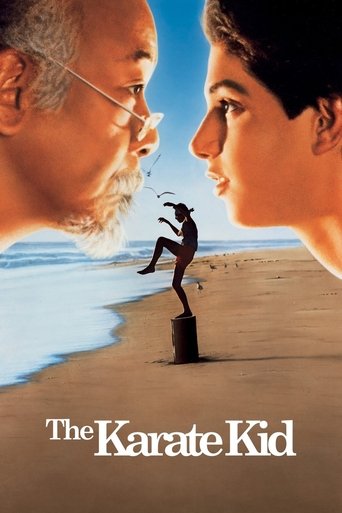
The Karate Kid
1984 · Film · 127 min
Part of The Karate Kid Collection
Directed by John G. Avildsen
New Jersey teen Daniel LaRusso moves to Los Angeles with his mother, and soon strikes up a relationship with Ali. He quickly finds himself the target of bullying by a group of thugs, led by Ali's ex-boyfriend Johnny, who study karate at the Cobra Kai dojo under ruthless sensei John Kreese. Fortunately, Daniel befriends Mr. Miyagi, an unassuming repairman who just happens to be a martial arts master himself. Miyagi takes Daniel under his wing, training him in a more compassionate form of karate for self-defense and, later, preparing him to compete against the brutal Cobra Kai.
6 positive3 negative1 mixed24 neutralfrom 34 commenters
Where to watch
No streaming data for this title.
36 comments on Hacker News
>> Yeah, everybody wants to be the Karate Kid who binged karate studies in one montage and then won the tournament instead of training in the dojo for years and still having to cheat to come close to winning (and still failing) like the chumps at Cobra Kai.
Somehow I think you missed the lesson of that movie - if there is one. It's been a long time and I can't put it into words well, but I suspect it was about someone with character and humility vs brute force and cheating. Something like that, but far different from underdog find shortcut to success.
I recently watched "Karate Kid" with my 8 year old son. I was trying to explain that the reason it looked so good because it was shot on film instead of digital. And we still call making movies "Filming" even though the film is long gone.
Explaining film to a kid that only knows digital cameras was not so easy. "You edit it by cutting long strips apart and taping it back together." "You have to go into a dark room and wash the film in chemical baths." Sounds like some sort of magic ritual.
Now I am wondering if I just think the look of film is better because that is what I watched when I was a kid. Maybe todays kids will think digital looks better.
> 'part task' drills (e.g. firing a tank gun), then practice them in a team environment
Brought to mind "wax on, wax off" from the original Karate Kid movie.
https://thekaratekid.fandom.com/wiki/Wax_On,_Wax_Off
See also:
How 'The Karate Kid' Ruined The Modern World (2010)
https://www.cracked.com/article_18544_how-the-karate-kid-ruined-modern-world.html
"I think The Karate Kid ruined the modern world. Not just that movie, but all of the movies like it (you certainly can't let the Rocky sequels escape blame). Basically any movie with a training montage.
You know what I'm talking about; the main character is very bad at something, then there is a sequence in the middle of the film set to upbeat music that shows him practicing. When it's done, he's an expert. ...
Every adult I know--or at least the ones who are depressed--continually suffers from something like sticker shock (that is, when you go shopping for something for the first time and are shocked to find it costs way, way more than you thought). Only it's with effort. It's Effort Shock.
We have a vague idea in our head of the "price" of certain accomplishments, how difficult it should be to get a degree, or succeed at a job, or stay in shape, or raise a kid, or build a house. And that vague idea is almost always catastrophically wrong.
Accomplishing worthwhile things isn't just a little harder than people think; it's 10 or 20 times harder."
---
Effort Shock and Reward Shock (2014)
https://www.ribbonfarm.com/2014/07/09/effort-shock-and-reward-shock/
"The good news is what I’ve started calling reward shock. In some (not all) domains, it is more than enough to offset effort shock.
When you overcome effort shock for a non-trivial learning project and get through it anyway, despite doubts about whether it is worth it, you can end up with very unexpected rewards that go far beyond what you initially thought you were earning. This is because so few people get through effort shock to somewhere worthwhile that when you do it, you end up in sparsely populated territory where further gains through continued application from the earned skill can be very high.
Programming, writing and math are among the skills where there you get both significant effort shock and significant reward shock."
First off: I think your response was totally reasonable given the lack of any useful or understandable point made in that comment. The hypothesis as given was begging to be asked, "on what basis?" It was almost as if they wanted to be called out so they could share their paper.
Regarding Karate Kid: I don't remember the movie, but I think you are bring too reductionist about reductionism. You can't learn karate by painting a fence, but leaning karate can teach you something about your body mechanics that can help you better paint a fence. And while geology is not astrophysics, learning about groundwater flow and dam construction might provide insights or new considerations into orbital mechanics with regard to how to handle the interaction of masses in a frame of gravity. I am friends with an astrophysicist and acoustics engineer and they seem to gain a lot from each other in their discussions of waves and analysis of measurements.
Regarding music and ship-building: Less known is that Leonardo da Vinci, famous for his paintings and engineering, painted "The Last Supper" with the mathematical help of his friend (possibly lover) Luca Pacioli. The Franciscan monk whose widely disseminated "Summa de arithmetica" gave us double-entry bookkeeping, even he really mostly repackaged the work of the artist Piero della Francesca, who in turn was riffing on Archimedes.
Of course the fields aren't predictive of each other, not exactly. But it can offer new questions or insights. An Archimedean "Eureka" often precedes the proving (or disproving) of the rule. And while that is a mere moment and it takes years of work to follow, regardless of whether you prove something out with words, figures, or art, I think it's that moment that gives the impetus to everything that follows. Sadly, I never trained as an artist, and I have trouble "reading" paintings as communications of geometry. The Tower of Babel seems to extend beyond mere words.
It's easy to see why people might overfit on the Eureka moment, but it might not ultimately be an overfit for humanity at large: it takes a collective to build a body of knowledge.
I also switched entire careers (twice), that led me to be 'professional' at 3 things, which means I'm not as good as someone who 'stuck with it' in any of the 3, but I have an extremely unique skillset. So when you say you're "diluted", I hear you say you're in that very special overlapping part of the venndiagram! Congratulations!
Also, while it doesn't answer your question of how, this reinforces that trying to do is a very good idea. It's a podcast episode of Tim Ferris interviewing Adam Robinson (he was friends with Bobby Fischer, the chess player). The entire episode is very much worth listening to, but a key quote:
> I think the American psychologist Maslow said if your only tool is a hammer, you view every problem as a nail. I would flip that and say that the geniuses have very limited toolsets. They have a hammer and they’re geniuses in looking for nails. That’s their genius. They have a very limited skill set but they master it and apply it incredibly well. I’m reminded of the movie Karate Kid. Where it’s wax on, wax off, sand the floor and then he had that crane kicky move, and he won the California State Championship on the base of those three.
Full quote/episode: https://www.youtube.com/watch?v=oSyMmleisQM&t=31m06s
You sound like Mr. Miyagi from the Karate Kid movies (which is a good thing!)...specifically it remains me of that scene when Daniel-San asks him what "belt" he is...and Mr. Miyagi responds "Calvin Klein"! (At some point, Mr. Miyagi explains that his exppertise of Karate is only for the need to survive encounters, and not worry about which "belt" he had achieved.)
You really have a thing for clowns...
When you post a comment where the only possible outcome is not just positive, but Hollywood film stuff (protagonist is struggling in a new situation and gets bullied, boss/friend/wise elder shows him path to success, protagonist is triumphant over the bully -- literally the exact plot of Karate Kid, Rocky III, Die Hard and countless others), then it reads as idealistic. Your next comment, where you finally acknowledge that not everything is fixable and firing might be an outcome, is a lot more reasonable.
It takes over summer or something like that. He is 17 when movie starts and tournament he wins is when is 18 birthsday gift. Bulk of training is housework chores. No, you cant do housework for few months and emerge tournaments winning fighter out of it. That is literally plot of first Karate Kid.
However, it is kid/teenage fantasy. Which is fine! But not some kind of hard work message movie.
Nah. Superman, spiderman, hluk, any of these got skills by accident. Even karate kid which shown some training, shown imaginary low effort low time investment training. The typical action movie of my youth had guys winning all the fights for no reason other then that they are awesome. Audiences loved it. The past movies had enough of pure power fantasy or other "just gonna win" in it for the whole generation to drawn in it.
And not just American movies. Bud Spencer and Terrence Hill were super famous and did basically nothing but that. They don't train, never ever, they are lazy as cool factor and are strongest guys most sharpest shooters around. Franch movies, fairly often the same thing. Random middle aged man thrown in situation and suddenly climbing and jumping roofs.
And series targetted at kids still show plenty of training. Lego ninja go, winx club, all show training or classroom scenes often.
> I would say Japan's second only to the UK in terms of visible cultural exports here.
That's really interesting, I haven't been to the States until now so that is really news to me. To be honest I had thought that the Japanese "mania" (if I may call it so) had run its course back in the '80s (the "Karate Kid" movies, Akira as an underground (?) cultural phenomenon, the Nakatomi Corporation), with an important continuation in the '90s through the anime mania, maybe also in the 2000s, when many people (re-)discovered Miyazaki and Takahata. Also the JDM car scene that was made famous by the first F&F movies. Anyway, I thought all that was in the past, for example a Mk4 Toyota Supra sold for a record auction price recently [1], I thought there's no way that culture is still part of the mainstream, joining it has become too expensive.
I certainly do notice the fascination Japan as a country still holds among many in the tech-crowd scene like is the case for many HN-ers in here, but I thought that was a local and contained phenomenon.
[1] https://www.thesupercarblog.com/toyota-supra-a80-mark-4-rm-sothebys-auction-record-price-amelia-island/
Terminator is an easy one. The terminator at the beginning has done nothing wrong, and fights a gang[1] of bikers who antagonize him and gang up on him, and fight him together, for being naked after traveling through time.
Karate Kid had the Cobra Cai, I think it was called, the rival school. I didn't see it, but I believe they were bullies. Maybe you're right about that one, although I think Daniel-san triumphs against a bully, there might have been several, or the bully had little supporters. It's a coming of age movie, though. It's also a sports movie, they do Karate-Do, which is for decorative, spirital, and sport purposes, not Karate-Jutsu, the military or let's call it "action".
Robocop, there's that company that makes the robot that Robocop has to fight in the end, there's a lot of people working in that company and together they built an automatic murder machine, which they then set loose. And IIRC they're doing a housing development and have ties to the criminal activity in the city Robocop tries to clean up. And like that evil robot had missiles coming out of its back I think, the special effects were glitchy, which made it look like an even greater monstrosity. Companies are groups of persons so absolutely can be guilty of conspiracy if the facts warrant it, incorporation documents don't give permission to traffic heroin. So it happens to fronts for drug dealing and it almost happened to Abbott Laboratories, also basically for drug dealing, only with a drug patients hated instead of craving.
Rocky does not involve a conspiracy, except of course the conspiracy that Rocky works for, the mob, as a debt collector. Which is the reason behind his conflict with Mickey, while Rocky says "it's a living" Mickey replies "it's a waste of life!" But I think I can hand you this one. One catch: this is a sports movie, not an action movie.
I haven't seen the others.
[1] gang is a well-marketed and very glamourous word for conspiracy, which is the term courts use when there's the formal elements of a conspiracy: meeting of the minds, two or more participants in a crime acting in coordination, there's a third one [EDIT: secrecy, and illegality or bad faith are others] but that's the gist of it, it just means criminal teamwork. Some things you do alone, some things with others, same goes for crime...at any rate, don't accuse someone of being a conspiracy theorist to a judge. Judges deal with conspiracies continually, sometimes multiple different ones per day, and there absolutely are people trying to play that judge by "covering" for each other. You will curry zero favor with that judge by putting the word "conspiracy" in your opponents mouth and then claim he must be delusional. That always works on talk TV, but not in court. Judges simply don't have the luxury of being able to pretend criminals never cooperate, like none of them had a single friend.
Just rattling off the action movies I can immediately think of, I don’t believe any of which include a conspiracy in their plot/synopsis. The only action movie I can think of about a conspiracy is the movie Conspiracy with Mel Gibson, got any others?
- The Last Action Hero
- Robocop
- Karate Kid
- Baby Driver
- Rocky
- The Revenant
- Mad Max
- ConAir
- Terminator
Sad to see no mention of Ryu Ryuko and Higaonna Sensei[0] in the section describing karate in the early 1900s. Higaonna Sensei was the person whose likeness became “Sensei Miyagi” in the Karate Kid movie. Ironically, Kanryo’s student Chojun Miyagi[1] was the one who established another well-known style of karate, Okinawan Goju-Ryu[2]
[0]: https://en.m.wikipedia.org/wiki/Higaonna_Kanry%C5%8D
[1]: https://en.m.wikipedia.org/wiki/Ch%C5%8Djun_Miyagi
[2]: The practice of Goju-Ryu is focused on both mastery of physical control and mental focus (summarizing my experience in this). With the death of Sensei Miyagi, however, the lineage split between his sons who each claimed to be the heads of their own branches of the system.
Edit: Another peeve. In the very beginning of the article they try to group the practice with unconventional weapons — farming tools, bo staffs, etc — into naha-te when the reality is this branch of practice is kobudo. I wish that the author did more research on this section because there are plenty of sources documenting this portion of the art’s history.
In the movie The Karate Kid, 1984. The mother moves to California because there are no more computer jobs in New York. It's stated a few times in the movie that this is why they moved.
He copied his martial arts "technique" from the climax of the Karate Kid movie (crane kick trick)?
> Wired Magazine’s “Greatest Self-Promoter of 2008”
Certainly
> The point here, however, is what University is for all people
Traditionally, that was not true and still is not true in places like Germany. A university is the place where you can get the highest education of a field, or ideally where you study a field on your own. Both requires a lot of prerequisites that not everybody fulfills. I am talking about knowledge, ability to learn although something is not flashy, and the will to endure. And it should be like that, otherwise you loose the ability to train the brightest people of a society. For everybody else, there are applied universities, dual study programs, and well established and respected vocational training programs, here in Germany.
Replacing universities with a netflix-esque experience may seem attractive to students, but is doomed to fail to train students. The question how much teachers should adapt to the wishes to their students is as old as learning itself. In the end the students have to trust, that a teacher knows which material to cover to teach students the desired skills, facts, and abilities. For an example of that, search your trusted video-streaming platform for the film Karate Kid. ;-)
It was specifically discussed in many of my history classes. For those of us of a certain age, it's such common knowledge that it was readily incorporated as a plot point in the movie The Karate Kid.
I mean, what you've just described is the quintessential PG-13 villainy as depicted by the Cobra Kai dojo, in the very first Karate Kid movie, starring Ralph Macchio and Pat Morita.
I watched the Karate Kid the other night. My 10 YO boy fell asleep. The movie is really slow by today’s standards; it has character development. People don’t have the attention span anymore, hence the marvel crap.
Macchio was 23 in the first film, and 28 in Karate Kid 3. This information is at your fingertips.
In all American TV shows set in high school, the actors/actresses are all in their mid-20s. Ralph Macchio was in his 30s when he played the Karate Kid. It's altered people's expectations of how people look at certain ages.
>Another casualty of the internet. Before the web, you would pretty much only learn about whatever martial arts were available in your area. There was no objective truth.
Yeah, thank god for the internet for giving us that.
>In the absence of evidence, comparisons between martial arts were done on a subjective level: does it look cool?
I'm not sure where you lived, but I lived in a peripheral western country in Europe, and even 10 years before the "internet" (www), we had tons of various martial arts schools available, from Kung-Fu to Tae-Kwon-Do to Thai Kick Boxing, Capoeira, Krav Maga, Tai Chi and several more varieties I don't even care about.
Infact, if anything, the golden age of such practices was mostly in the 70s and 80s (with Bruce Lee, Karate Kid, and the pulp action/karate movies).
I'm glad I grew up in the age of Karate Kid movies, when having a black belt was enough to scare kids from beating me up in school. I remember how the first UFCs utterly demolished the movie-mythos of Kung fu/karate, as Royce Gracie and other grapplers made strikers look rather impotent. I kind of missed the early days of UFC, when things were much more no-holds-barred. There weren't rounds or time limits or weight classes (for the most part), which meant that Royce had to beat an opponent 80 pounds heavier for the championship (Dan Severin, but I swear I thought Gracie had to beat even heavier opponents [0]). The flip side was that watching 20 minutes of one guy sitting atop another was not very compelling, and probably unfeasible as pay per view TV.
[0] http://www.gracieacademy.com/news/gracie-breakdown-royce-gracie-vs.-dan-severn.asp
I can tell you how I do it, but I wouldn't necessarily recommend my path to anyone else. I'm not even 100% sure I'd recommend it to a younger version of myself, although I'm also not sure I'd recommend against it either.
Basically, I'm single and childless, and darn close to my every free minute goes into the startup project. When I was working full-time, that meant "after work" M-F and the majority of my Sat and Sun. hours. I make an exception during football season to watch the Dolphins game on Sunday (yeah, yeah, go ahead, say it... I'm a glutton for punishment).
I force myself to take a break every once in a while and read a novel or watch a movie or something... but truth be told, lately, even when I watch movies or something, there's an angle related to the startup. For example, I've been reading and studying a lot about sales lately, and I've seen more than one sales book mention "be like Columbo".
I had kinda wanted to rewatch some old Columbo episodes anyway (yeah, I'm old, deal with it) so I've been watching Columbo and thinking about "how do you apply his attitude / approach to this 'diagnostic business development' thing"? And the movies I make time for tend to be ones that I find inspirational (Rocky, The Karate Kid, Rad, etc.) that help keep me motivated.
About 6 months ago, I dropped down from full-time status to part-time status at my regular job to free up more time for the startup. I had a little bit of money saved, but not enough to quit outright... luckily the owner of the company was willing to be flexible and let me do that. I've pretty much burned through my savings though, and we aren't profitable yet, so I'm going back to working full-time next month.
These days I forgo most social activities like dating, parties, and most non-technical social events. I rarely mountain bike anymore, and almost never set foot in the gym. I bailed on going home to see my parents for Christmas so I could use those few days of "down time" as recovery time. I stay amped up on more caffeine than could possibly be healthy, and do everything I can to the tune of heavy-metal[1] or hard-rock of some sort. My mantra right now is "Caffeine, heavy-metal and adrenaline". \m/
I know, I know... you're thinking "dude, you must be miserable". Nah... I enjoy this in a certain sense, and since I'm 40 now, and haven't achieved anything yet, my mindset now is to say "fuck it" and go for broke. It's now or never, ya know? My mindset is to achieve the biggest and most ambitious of my dreams, or - when life finally breaks me - pull a Leaving Las Vegas deal and go to Vegas and try to drink myself to death.
Do not try this at home...
[1]: https://www.youtube.com/watch?v=KQQcOQsCFnw
This is how America ruins it's best children. I know the story so well, I only had to read the title, though I did skim the article to be sure.
Children need to be given goals and challenged, not constantly told they are good enough. Children need to be shown a path to improvement, not reassurance on their accomplishments.
There's a reason Americans fascinated by movies about hard loving teachers who are proud but never satisfied with their students, like in the Karate Kid or Dead Poets' Society (dating myself there.) Unfortunately we can't bring ourselves to actually challenge our children and sacrifice their short term glee for long term fulfillment.
My 2 favorites are the Reddit Jaws and the Reddit Karate Kid shirt. The jaws one says, "If you watch Jaws backwards, it's a movie about a shark that keeps throwing up people until they open a beach." The karate one says, "If you watch The Karate Kid backwards it's about this karate champ who slowly becomes a pussy and ends up moving back to Jersey." hahah these shirts are great. And like jorde8 my shipping was surprisingly fast!
One of my favorites is this one from The Social Network:
http://www.youtube.com/watch?v=uC5wVJrhzl0
Another is the scene in The Fighter where Micky Ward is talking to his girlfriend and there's the "I'm tired of being a fucking disappointment, I told everybody I was gonna win that fight and get back on track, blah, blah" bit.
And plenty of scenes from the Rocky movies, Vision Quest, Rad, The Karate Kid, and a few others...
It's not just teachers, but any popular media portrayal of someone being successful: the magical teacher, the genius investor, the miracle comeback kid, etc. You have Billy Madison, The Rookie, Kill Bill, The Karate Kid, all of these films showing someone going from zero to AWESOME in less than two hours. I think it's really just the nature of the media and how we respond to it that we want to believe that these kinds of people exist and surround us -- we want to believe that WE can be that kind of person, too.
Karate Kid :)
Now serios:
The Godfather: makes you feel everything is possible
A Good Year: feel-good movie, but I think it really shows why we really struggle. I mean what's the point in having millions if you don't know what to do with them.
I think it's a rule in Hollywood that sports movies must be inspirational. In addition to Any Given Sunday, you've got:
* Invictus * The Blind Side * Rudy * Remember the Titans * Miracle * Rocky * Karate Kid
And that's just a few of the genre.
I don't entirely agree with the author. It all depends on how you interpret the films. For me, the karate kid did not make expertise in karate look easy, but simply possible. It is important for people to realize that, given the appropriate training system, they can achieve anything, and that no domain is the exclusive preserve of the very gifted.
In my case, the film motivated me to put in the necessary hours, and to pass my black belt in shotokan karate in my early thirties, after eight years of almost daily training, the equivalent of about 5000 hours at that stage.
I don't think I was ever under the impression it was going to be easy; but I always did hold on to the belief that it was possible. So all in all, these films were a positive influence.
"I don't understand why it's called "Karate" Kid, when he's in China and learning kung fu..."
It seems like they are just using the name to get people to watch the movie, which is a completely different story.
There is also a small scene where they make fun of the original.
From my perspective, the training montage in Karate Kid demonstrated that it took a LOT of effort, not the little bit this article criticizes it for. Two months of hard work, from sunrise to sunset, to develop muscle memory? It's not the 10,000 hours required to become a world-class expert, but 600+ hours of intensive training is enough to see some pretty decent results. The other movie he criticizes by name, Rocky, was similar. Rocky had 2 months to train for his first fight, and he wasn't starting from scratch.
It's hard to become a world-class expert at anything. You need some combination of latent talent and many thousands of hours of training, hopefully with someone who really understands how to train you effectively. But I don't think either Rocky or the Karate Kid greatly misrepresent the amount of effort it would take for an exceptionally talented individual, with a great trainer, to make the leaps they did.
I don't think the article is worth reading.
According to the author, "Effort Shock" is the phenomenon of realizing something is a lot harder than you thought it was. Then you get depressed about it and give up. This explains failed blogs, failed diets, failed restaurants, etc.
The Karate Kid and other Rocky-esque movies ruined the world because the training montages make it seem like you can go from beginner to expert in a single Survivor song.
I was hoping the author would dig deeper into the subject, but he just repeated the same thing again and again and ended with a plug for his book.
I've never been one for team sports, preferring running, swimming and the like.
But I have read and will read anything written by Bill Simmons. The man is one of the great writers of our time. He's the Stephen King of sports writers, a guy who keeps pumping out solid, often great stuff that transcends his genre.
I don't follow football, but I read Simmons' picks during the season. I don't follow basketball, but I read his trade value column every year. Why? Because
-the guy explains it in an interesting way -puts it in the proper perspective like you said -links me out to great, great stuff I never would have found otherwise (like the greatest YouTube video ever: http://sports.espn.go.com/espnmag/story?section=magazine&id=3712343) -is now living a bit of a glamorous, interesting life that's fun to experience vicariously -can write like the devil
This is a guy who took a week to review the Karate Kid trilogy in detail instead of filing regular columns one summer. http://espn.go.com/page2/movies/s/simmons/020830.html
And yet he attended a funeral for a young athlete who died senselessly, and wrote a "serious" piece that was moving, humble and very honest: http://sports.espn.go.com/espn/page2/story?page=simmons/080312
There are writers who excel at structure, writers who are idea guys, writers who can nail little details, and then there are writers who simply have more firepower than the average man. They can write more, faster, and with more panache than 99% of the folks out there. It won't all be good, but it'll all be interesting. Simmons has a lot of firepower.
Which, to get back on topic, is why it's INFURIATING, that he's cranking out 3-4 podcasts a month and only 1-2 columns at this point. I simply can't listen to the podcasts. They don't fit into my schedule at all, in any way. I don't have an hour to stare at my computer while it plays an audio stream. Bring back the columns.