 Hacker Cinema
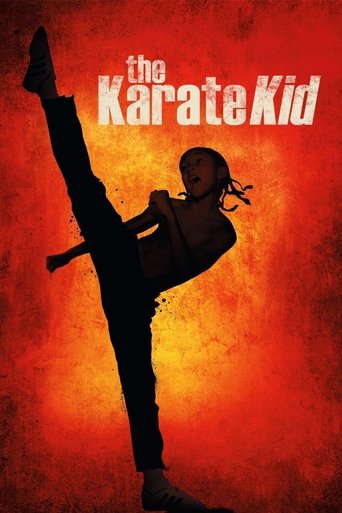
The Karate Kid
2010 · Film · 140 min
Part of The Karate Kid Collection
Directed by Harald Zwart
12-year-old Dre Parker could've been the most popular kid in Detroit, but his mother's latest career move has landed him in China. Dre immediately falls for his classmate Mei Ying but the cultural differences make such a friendship impossible. Even worse, Dre's feelings make him an enemy of the class bully, Cheng. With no friends in a strange land, Dre has nowhere to turn but maintenance man Mr. Han, who is a kung fu master. As Han teaches Dre that kung fu is not about punches and parries, but maturity and calm, Dre realizes that facing down the bullies will be the fight of his life.
2 positive3 negative1 neutralfrom 6 commenters
Where to watch
No streaming data for this title.
6 comments on Hacker News
I recently went to the theater with my wife to see the new Karate Kid movie. We discussed it a bit after, and I said it felt a bit rushed. Like, the character goes from being in a Chinese kung fu temple, to being in the US, with a girlfriend - and an enemy - in the first 10 minutes of the movie.
She made a really good point: we're in the TikTok era.
After she said this, it made much more sense. The whole movie felt like "reels" stitched together, with no scene lasting longer than 5 minutes.
It makes me wonder if people today (especially younger people) would be able to watch a movie like the Godfather? I have doubts.
Honestly, I'm terrified of where we are heading as a species.
I have a handful of "regulars" that I watch repeatedly. Most of them are at the point now that I've seen them so many times that they can work as "background noise" when I'm coding or doing something else. IOW, I can turn the volume down fairly low and it serves a purpose, but I'm so familiar with the story already that I'm not likely to get drawn into actually paying attention to the movie (as opposed to whatever I'm working on) unless I'm at a point where I need a break anyway.
Some of the ones that are on that list for me:
The Matrix
The Matrix Resurrections
The Social Network
Inception
Sneakers
Hackers
Antitrust
Rad
Tron: Legacy
Vision Quest
Rocky (really the entire Rocky franchise)
The Karate Kid
Kickboxer
Bloodsport
Hard To Kill
Above The Law
Not only anime. As a kid American shows and movies were full on “ninjas” and “karate”. My favorite cartoon was TMNT and one my favorite movies was Karate kid.
I think we need to mention the sins of Mao quite a bit more before we're in danger of Godwining.
You know some history. Most people who are reading that Atlantic article don't have this context at all. This is because people get their history from movies, and Hollywood chooses to make movies like the Karate Kid remake (about anti-black racism in China) or this Red Dawn farce rather than movies about the Great Leap Forward and the Cultural Revolution, about the consequences of being "idealistic" and "ideological".
"Ideological" is bad. It's not good. It led to a lot of people dying. And the support for "oppressed peoples" that the OP thinks so much of is intimately tied to the rhetoric of communism, which is invariably and horrifically belied by the reality. To repeat said rhetoric uncritically is to bury those people again. Their deaths were denied in speeches at the time and they are glossed over in writing today. This is wrong. We need to remember them.
So yeah, unfortunately I don't think you can hold up the Maoist era as comparatively positive in any substantive regard without acknowledging that said act is morally equivalent to "Mussolini/Hitler made the trains run on time."
And the thing is - Mao didn't even make the trains run on time. He destroyed China to such an extent that people were forced to eat each other's children to survive.
http://www.nytimes.com/1997/02/05/books/horror-of-a-hidden-chinese-famine.html
For the party newspaper to tell people that it was good for them to eat less at a time when it was also spinning fantasies about the bounty being engendered by the Great Leap was a relatively small, if telling, irony. At the larger, horrific center of Mr. Becker's account is the widespread resort among the Chinese people to that most sickening form of desperation: cannibalism, the selling of human flesh on the market, the swapping of children so people could use them for food without committing the additional sin of eating their own.
It has of course been known for many years that the Great Leap produced a terrible calamity in China lasting from roughly 1959 to 1962. But Mr. Becker, who is the Beijing bureau chief of The South China Morning Post, has written the most compelling and complete account of that calamity, describing it systematically as it affected the countryside, the cities and the immense network of camps for ''rightists'' and other political prisoners that China maintained at the time.
I would argue that these kinds of things are much more important in forming a picture of Mao's China than whether he once gave lip service to MLK. If 99% of people who came to that page already knew the term "laogai", fine, one could arguably move on to a second topic. But we're a long ways away from successfully communicating these high order bits.
I guess my point is this:
> Naihanchi does not in any shape or form prepare one for any sort of fighting
What makes you so sure? I don't think karate is like the Karate Kid movies, where you spend all morning painting the fence and all afternoon doing some ridiculous-looking kata, and then end up applying those moves exactly in a fight.
But I do submit that these kata are designed to teach precisely the kind of movements one would apply in a fight.
I have not ever actually been in a streetfight, and I confess my argument smells a little bit like "I've been doing this ten years, I refuse to believe that I've been wasting my time". Still -- are you prepared to argue that kata training definitely does not teach one fighting skills? Seems like that's an extremely difficult point to argue.
When you are young you can be a karate kid like in the film and don't get a broken leg.