 Hacker Cinema
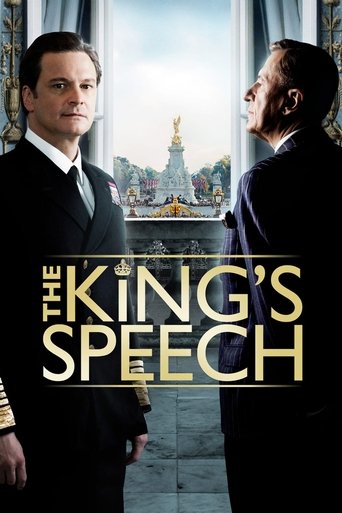
The King's Speech
2010 · Film · 118 min
Directed by Tom Hooper
The King's Speech tells the story of the man who became King George VI, the father of Queen Elizabeth II. After his brother abdicates, George ('Bertie') reluctantly assumes the throne. Plagued by a dreaded stutter and considered unfit to be king, Bertie engages the help of an unorthodox speech therapist named Lionel Logue. Through a set of unexpected techniques, and as a result of an unlikely friendship, Bertie is able to find his voice and boldly lead the country into war.
10 positive6 neutralfrom 16 commenters
Where to watch
No streaming data for this title.
17 comments on Hacker News
since i knew nothing about "the King's speech", outside Colin Firth's movie, here a good layout: https://www.bbc.com/news/uk-politics-32816450
When OP writes "the [...] only one of Rishi Sunak’s time in office", i assume she hopes for it to be the only one.
I wonder if there was an interface that required singing, or possibly it would play classical music while you talk - would it work for you?
I say this because of two things I've heard (possibly misconceptions)
One was that people who stutter can sing ok
the other was the movie "the king's speech" where playing classical music while talking would prevent the king from stuttering.
See "The King's Speech" (2010) for a wonderful film about this process
I very much enjoyed the movie "The King's Speech". (but I won't spoil the movie with details)
The director, Tom Hooper, has made better movies in the past, notably The King's Speech (big winner at the Oscars in its year) and Les Miserables (got at least decent reviews).
Briefly because I'm pecking this out on an iPod :-)
In your description you have just tipped us off to an analytical gift. I would suggest that you deepen your analyses of your speaking performances, develop and test theories, and refine what you described above into a model for improvement that ever more closely fits your problem like a tightening wrench.
Archetypally, I recommend that you watch films or read books like The King's Speech and note every thought pattern and technique that you can single out. "He talked to so-and-so about X. She encouraged him to try Y. In Y he found that..." (Now, who can I talk to? How will I approach their feedback?) Even if you have no speech impediment, these patterns will probably be broadly applicable to your needs. Good luck!
I have a stutter. Here are some examples:
I almost always stutter on the word "but", so I say "though" instead if it fits.
Same as "but", I can't say "butter" easily. In a restaurant if I ask for butter I'll usually say "Could I have some vutter?" which sounds close enough to 'butter' if you slur it just right.
I have trouble saying "dad" so I say "father" instead.
I'll get stuck on the 'm' in "money" so I'll use "cash" instead.
There are hundreds of implicitly defined rules that I've learned over the years. When I was a kid, my stutter was really, really bad. As I've aged, I don't think it's necessarily gotten better, but I've learned all of these rules that let me hide it. So it can usually take people several hours of being around me before I encounter an unavoidable word.
The most awkward part is I occasionally stutter on my own name. But I can mitigate this by leading into it with something else, which makes it easier to say. So when someone asks what my name is, I don't say "Foo", I say "My name's Foo" -- the 's' from "name's" helps soften the first letter and slide into it easier.
If you haven't seen it, watch the movie "The King's Speech". As a stutterer, I found the portrayal quite accurate. Also, the strategies the speech coach gives the king are similar to what I do. For example, there is one line where the king must give a speech and use the word "people", but stutters on the 'p', so he "bounces" into the word by saying "uh-people" which is a lot better than stuttering on the 'p' for 10 seconds.
All this being said, the only time in my life I have been really angry about having a stutter was during an quiz bowl (competitive trivia) match. I buzzed in immediately, knowing the answer, but was unable to say it. I stuttered on the first letter for a solid 5 seconds, and as the judge called time-out I finished the word, but they deemed it past time. And then because I'd said the answer, the other team just buzzed in, used my answer, and got the point.
Freedom is (maybe?) psychologically (perhaps biologically?) untenable in humans.
GNU/Linux ---> too much user choice
Freely shared scientific inquiry ---> technologists giv[ing] control of their knowledge to people who have no knowledge
Everyone probably does want the iron fist in the velvet glove.
The large majority – me included – wants to be passive and rely on an efficient state apparatus to guarantee the smooth running of the entire social edifice, so that I can pursue my work in peace. Walter Lippmann wrote in his Public Opinion (1922) that the herd of citizens must be governed by “a specialised class whose interests reach beyond the locality" – this elite class is to act as a machinery of knowledge that circumvents the primary defect of democracy, the impossible ideal of the "omni-competent citizen". This is how our democracies function – with our consent: there is no mystery in what Lippmann was saying, it is an obvious fact; the mystery is that, knowing it, we play the game. We act as if we are free and freely deciding, silently not only accepting but even demanding that an invisible injunction (inscribed into the very form of our free speech) tells us what to do and think. “People know what they want” – no, they don’t, and they don’t want to know it. They need a good elite, which is why a proper politician does not only advocate people’s interests, it is through him that they discover what they “really want.” http://www.newstatesman.com/politics/politics/2013/04/simple-courage-decision-leftist-tribute-thatcher It's the "masses" who may be the least delusional: The whole point is to know you're not in charge. The elites actually believe they're in control.
In The King's Speech the cause of the king-to-be's stuttering is precisely his inability to assume his symbolic function and identify with his title. He displays little common sense, seriously accepting that one is a king by divine will; and the task of the Australian coach is to render him stupid enough to accept his sovereignty as natural property. In the film's key scene, the coach sits on the throne. The furious king asks him how he dare do this, to which he replies: "Why not? Why should you have the right to sit on this chair and me not?" The king shouts back: "Because I am a king by divine right!" At which point the coach just nods with satisfaction; now the king believes he is a king. The film's solution is reactionary: the king is "normalised", the force of his hysterical questioning is obliterated. ---Slavoj Žižek https://en.wikipedia.org/wiki/Edward_Bernays
"[O]therwise you can kiss anything but the most trite (read: cheap to produce) pop music and plotless explosion-fest movies goodbye."
I'm not sure pop music is cheap to produce (compare the tech work and marketing and all involved in a band playing at your local venue with that at a ... um... Taylor Swift? is she still a pop star? concert), and "plotless explosion-fest movies" tend to be the most expensive movies - "2012" and "Transformers: Revenge of the Fallen" each cost 13 times as much as "The King's Speech".
"If people can't get paid to pursue their dreams, they have to shelve their dreams in order to get paid. Then you have one less author, one less musician, one less movie being made."
Most authors and musicians already do something else in order to get paid.
'Nuclear power plants "want" to melt down, dams "want" to break, influenza "wants" to spread, etc.'
When those things happen, hundreds or thousands or millions of people are harmed. When information spreads, hundreds or thousands or millions of people are enriched. We should find another way of rewarding artists than fighting an uphill battle to constrain value.
The thing is, if you're not doing some sort of incredibly bloated production, you don't need 10,000 people to make a movie. Most movies are NOT Lord of the Rings.
For instance, one of the best critically received movies of the last decade was probably No Country For Old Men. Budget? $25 million. Made back well over triple that at the US box office alone.
The King's Speech? $15 million, made over $135 million
Argo? $44 million, and that had lots of expensive location shoots in the middle east
The Hurt Locker? $15 million
Slumdog Millionaire? $15 million
Crash? $6.5 million
Million Dollar Baby? $30 million
All movies that did very well at the box office, and were made for $25 million or less (with one exception). They also all won the Best Picture oscar. So there is PLENTY of evidence that you can make a great movie without getting anywhere near a 9-figure price tag.
Of course, for "indie" films, you can go well under that. "Clerks" cost about as much a new car. The original Texas Chainsaw Massacre was barely over $100k....the first Saw movie was made for just over $1m and grossed 100 times that.
It may also be your movie tastes differ from his too. Right now I am noticing basically two groups of people (not correlated to age): one group which enjoys the effects, 3D, epicness... and the other which is disillusioned with today's movies (ie yay another movie where I watch CGI dudes shoot around and then get a 3D fly-over the battle-field every 5 seconds).
I think there is something to be said for the funneling of movie budgets into a few MASSIVELY costing movies (ie per the Spielberg interview that was posted on HN last week). I, myself, enjoy a good "Dark Knight", but also something like the King's Speech or The Tree of Life. The question is whether both can keep being made for their respective budgets, and both in film vs other media.
I actually disagree. I am more likely to go to the theater or buy a legitimate copy of a big budget movie than a low budget one, since I'll pay a bit extra for the highest quality experience of the effects. I still love going to the theater, so I see more movies there than by any other method, but for small movies like The King's Speech (not an example of a classic "low budget" movie, but hopefully you get the idea, the scale is small), I'm way more likely to wait for a way I can see it for free (or in one of the streams I already pay for: HBO, Netflix, Amazon Prime, etc.)
Have you seen the film "The King's Speech"?
King George VI must have led a deprived and impoverished life to be so insecure and inarticulate in public. ;)
In a smaller arena, some of the CEO's I have worked under have shown signs in insecurity also. So, I don't think confidence necessarily comes from power and wealth.
This is a really important point, and it'll probably justify its own blog post soon, but a quick response would be this:
I'd class United 93 and Black Swan as being, sort of, emotionally exhausting. And yes, I'm not going to rush out see them again. But that's very different to saying they're a bad film. I would suggest that, at high levels of quality, low levels of rewatchability makes it actually a better film, in a way.
Or, at least, it differentiates them from another terrific film like The King's Speech. If you're the kind of person who likes watching beautifully constructed but largely enjoyable films, your tastes will tend toward the top-right of the graph. But, if you enjoy more difficult or harrowing films, your favourite films might be lower on the rewatchability score, on average.
My point is, while quality is quality, a measure of skill and talent, rewatchability is personal, and groups similar films together in interesting ways. Where your favourite films come out on the graph is really not important to anyone but you, when you're looking for more stuff you like.
You may still disagree, but thanks for taking the time to comment :)
-glen.
I'm not entirely sure why good writing 'suffers more' from proximity to a direct-marketing campaign - acai berries, belly fat, whatever - than it would from, say, an ad for a Ford Focus or The King's Speech. Both offer an equivalent amount of visual distraction.
It's not about visual distraction, it's about reputation and the reputation-by-assocation of the publication on who's website the ads appear. I trust car manufacturers and movie studios a lot more than the people behind those acai berry and belly fat ads, which to me, are as bad as spam about Viagra and Cialis.
Didn't read the article, just the title, but I'd like to chime in to say I'm pretty sure I saw around a dozen good movies in the last year. Subset includes Inception, Social Network, King's Speech, True Grit, Star Trek (too far back? not sure), and The Fighter.
You hear this every year. And it's still true. Hollywood is wall-to-wall sequels, IP translations (games, comics, tv shows, etc. to movies), remakes, and the remake's newer cousin the "reboot".
Yet even so good films are still being made. The Social Network, True Grit (a remake even!), Toy Story 3 (a sequel!), The Fighter, Black Swan, How to Train Your Dragon, and Inception were all great films from 2010 (I haven't seen The King's Speech or 127 Hours yet but I hear those were good too). If this is what the system pumps out while it's horribly broken, I'm ok with more of the same.
There's always going to be a ready supply of churned out pap in any medium. Just go to a bookstore and look at all the crap that they keep pumping out. But that doesn't necessarily stop truly excellent works being published as well. Some of my most loved books have been published in the last several years. And with the internet it's easier than ever to sift through the dross to find the gems.