 Hacker Cinema
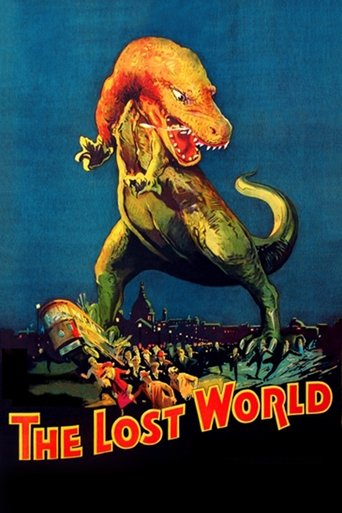
The Lost World
1925 · Film · 104 min
Directed by Harry O. Hoyt
AdventureFantasyDramaRomanceHorrorScience FictionThriller
The first film adaptation of Sir Arthur Conan Doyle's classic novel about a land where prehistoric creatures still roam.
2 positive3 neutralfrom 5 commenters
Where to watch
No streaming data for this title.

5 comments on Hacker News
I asked three things. I asked it about Father Coughlin (https://en.wikipedia.org/wiki/Charles_Coughlin) and it didn't mention that he was a radio broadcaster and claimed he was from Ireland. This may have been a complete hallucination, but I can't prove it, and I don't know how well known Coughlin was in 1930. I asked him about https://www.openculture.com/2013/12/ladies-home-journal-publishes-28-predictions.html and it hallucinated a text from Harper's in 1909. I asked it about the Lost World (1925 silent film based on the Arthur Conan Doyle book) and it hallucinated a film from 1923 that takes place in the Antarctic.
Me: Then why have I seen a film from 1925 by Arthur Conan Doyle that takes place in South America, and not a film from 1923that takes place in the Antarctic?
Talkie: Because your informant confused the films "Adventures of Sherlock Holmes" and "The Lost World".
I then asked it:
Me: Tell me what books were written by Agatha Christie.
Talkie: Agatha Christie wrote "The Mystery of Choice", "The Secret Adversary", "The Man in the Dark", and "Open Country".
(Three of those books were written by other people.)
Me: When was the first postage stamp created?
Talkie: The first postage stamp was issued in 1840, and bore the effigy of the city of Berhn.
(Well, it got the year right.)
Top 'Lost World movies'. [https://www.imdb.com/list/ls066679516/]
The 1925 silent included stop-motion animation and originally began with an appearance by Sir Arthur himself!
Edit: found it: [https://www.youtube.com/watch?v=loPZFVju8Nw]
I've always worried that it's worse than that.
Even if there's plenty of deep thinkers (which is what slow thinking is in my opinion) - there should always be some people with good fortune and circumstances to push at the peripheral. I honestly do not see that today in Silicon Valley - I see a lot of useless bullshit and superficial replacements, there's only a handful of people out there keeping it together.
However... poverty of Time is not likely to be the main constraint unless you live in the Middle Ages. Many intellectuals have taken jobs which enable them to kill two birds, merely being physically active and forced to be active by a job that requires it is a genuine cognitive advantage - not to mention the infinite distractions that can smear your available leisure time such that you produce nothing of value. Most aristocrats did not belong to the Royal Society.
No - the real problem is that we're too synchronized. We think alike - we have a 'frame problem' of our own.
Being here on HN or on the Internet in general is not an advantage. It at first appears to be valuable in the sense that you understand what exists and who is doing what, the context. That is I suspect the opposite of what we need for true innovation.
For true innovation you need to connect up with 'the network' once or twice a year - and the rest of the time fuck off and do something good (ideally with a small close knit group).
“[..]Although personally, I think cyberspace means the end of our species." Yes? Why is that?" Because it means the end of innovation," Malcolm said. "This idea that the whole world is wired together is mass death. Every biologist knows that small groups in isolation evolve fastest. You put a thousand birds on an ocean island and they'll evolve very fast. You put ten thousand on a big continent, and their evolution slows down. Now, for our own species, evolution occurs mostly through our behaviour. We innovate new behaviour to adapt. And everybody on earth knows that innovation only occurs in small groups. Put three people on a committee and they may get something done. Ten people, and it gets harder. Thirty people, and nothing happens. Thirty million, it becomes impossible. That's the effect of mass media - it keeps anything from happening. Mass media swamps diversity. It makes every place the same. Bangkok or Tokyo or London: there's a McDonald's on one corner, a Benetton on another, a Gap across the street. Regional differences vanish. All differences vanish. In a mass-media world, there's less of everything except the top ten books, records, movies, ideas. People worry about losing species diversity in the rain forest. But what about intellectual diversity - our most necessary resource? That's disappearing faster than trees. But we haven't figured that out, so now we're planning to put five billion people together in cyberspace. And it'll freeze the entire species. Everything will stop dead in its tracks. Everyone will think the same thing at the same time. Global uniformity. [..]”
― Michael Crichton, The Lost World
Silicon Valley is suffering by being too middle class - the hubris is coming out of the groupthink. I think it takes a peculiar mixture of working class and middle class thinking to do something really good. I don't think that's a new insight, it's in the plot of the 1927 Metropolis but sometimes a cliché is really true. The people I've met at HackerSpaces, the people who impressed me were always adept at dealing with a lot of information - a middle class trait, but had a deep blue streak in their character that is completely absent from the people I went to University with. Matthias Wandel and Bill Gray are examples I think.
https://www.youtube.com/watch?v=8wZ1v4PIsYI
http://www.velkess.com/
I actually just finished watching The Great Mouse Detective with my wife - first time for her and the first time for me reliving that element of my childhood in more than twenty years – I was terrified it wouldn't live up to my memory, but was surprised at how good it was. I'm pretty sure it was my first exposure to the world of Sir Arthur Conan Doyle's Sherlock Holmes (and I do recommend it heartily to anyone who hasn't watched it!).
Of Doyle's non-Sherlock works, The Lost World is the first that comes to my mind. Great fast read, also highly recommend! (Though nothing beats the full and complete collection of Sherlock Holmes, see [1] for the PDF and [2] for the actual book).
1: https://maggiemcneill.files.wordpress.com/2012/04/the-complete-sherlock-holmes.pdf
2: http://amzn.to/1UBvHwJ
Fiction: Jurassic Park by Michael Crichton (loved the movie as a kid, but never got round to reading the book), will follow up with the Lost World.
Non-Fiction: Chaos by James Gleick.
Semester break reading, Real World Ocaml and Modern Compilers in ML (assuming they arrive in time)