 Hacker Cinema
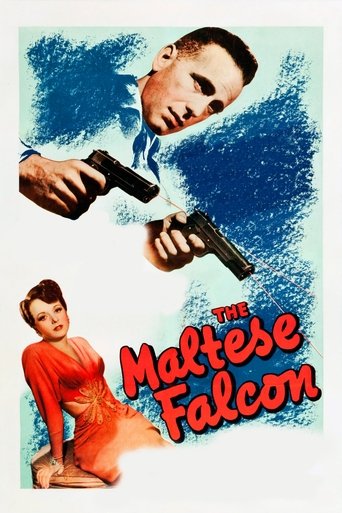
The Maltese Falcon
1941 · Film · 100 min
Directed by John Huston
A private detective takes on a case that involves him with three eccentric criminals, a beautiful liar, and their quest for a priceless statuette.
8 positive13 neutralfrom 21 commenters
Where to watch
No streaming data for this title.
23 comments on Hacker News
Does the movie Maltese Falcon too enter public domain?
Here's what I term my "flypaper" movies. If I happen to glance at the satellite TV guide and notice one of these coming up, there's a good change I'll be watching it.
Lawrence of Arabia The Maltese Falcon Most Hitchcock films Blade Runner The Man From Snowy River The Martian Monty Python & the Holy Grail The Princess Bride Serenity The Thin Man series The Thing Tombstone Young Frankenstein Monty Python and the Holy Grail Clerks and most Kevin Smith movies Baby Drive and most Edgar Wright movies Fanboys Spinal Tap Kung Fu Hustle Apollo 13
Lawrence of Arabia
Otherwise, it's Sierra Leone alright ("movie-set")
(Or Maltese Falcon for a very loose def of "set" or "N Africa")
[0] fr wikipedia for the song
I'm looking forward to classic movies with AI-generated thumbnails that take the main actor or actress and make them do the "Youtube Thumbnail Surprised Face". Imagine The Maltese Falcon or Citizen Kane but with thumbnails that look like [1].
1: https://hard-drive.net/wp-content/uploads/2021/05/youtubers-1024x538.jpg
Out of personal curiosity, how far does this go for you? Would you download (without paying for)
- an old film (the Maltese Falcon, Wizard of Oz, Wings [1927 silent film])
- a really bad film (Santa Claus Conquers the Martians)
- something you already own but don't have access to at the moment
- anime
- none of the above?
Counterweight; Djuna. Good sci Fi.
The Thin Man, The Maltese Falcon; Hammett. Good books behind excellent movies.
I recently watched Beat the Devil. I thought it was pretty dreadful. I had no idea it had a cult following and I can't imagine why. The film really runs out of steam about halfway through and most of the actors seemed to be going through the motions. It is certainly not among the Huston films that I would recommend. Watch The Maltese Falcon or The Misfits first.
That said, Ebert put it on his "Great Movies" list:
https://www.rogerebert.com/reviews/great-movie-beat-the-devil-1954
It's also possibly interesting for having had a 28-year old Truman Capote as screen writer. Except that I really think Capote wasn't a good fit for Hollywood. Breakfast at Tiffany's did not translate well to screen.
On the other hand, Roman Holiday is among my favorite films. It's the quintessential romcom.
For a terrific and unusual red-scare inspired film, let me recommend Johny Guitar. Now that's a film that deserves a cult following.
Thinking about what was possible to make in 1982, it's pretty amazing. It's an absolute classic, up there with the best of the noirs (the actual film noirs), such as The Maltese Falcon, Double Indemnity and The Third Man; the logical answer to the Neo Noir Body Heat the year before. It's like a legacy moving onto such things as Ghost in the Shell and even The Matrix.
I’ll play:
The Thin Man (1934), It Happened One Night (1934), Dodworth (1936), Fury (1936), The Awful Truth (1937), Grand Illusion (1937), You Only Live Once (1937), Wizard of Oz (1939), Only Angels Have Wings (1939), The Great Dictator (1940), His Girl Friday (1940), Philadelphia Story (1940), Rebecca (1940), The Maltese Falcon (1940), Citizen Kane (1941), A Woman’s Face (1941), The Magnificent Ambersons (1942), The Ox-Bow Incident (1943), Casablanca (1943), Double Indemnity (1944), Mildred Pierce (1945), It’s a Wonderful Life (1946), The Best Years of Our Lives (1946), Great Expectations (1946), The Big Sleep (1946), The Red Shoes (1948), A Letter to Three Wives (1949), Sunset Boulevard (1950), All About Eve (1950), A Place In The Sun (1951), High Noon (1952), Roman Holiday (1953), The Wages of Fear (1953). (I slipped two French films in.)
Almost anything by Hawks during those years. Or Hitchcock. Almost anything with Bogart. Or Grant. Or by Wilder.
Tons of noir films skirted the rules.
Look, I’m not a fan of the Hays code but some of those movies were to me better because of what they had to imply.
This is after the Hays code but as an example I recently watched the original 3:10 to Yuma and the remake. I hated the remake. What appeals to me about Elmore Leonard stories is that despite being about bad guys, they have a degree of charm to them (Out of Sight, Justified, Jackie Brown, Get Shorty,etc). The remake took all of the charm out of the original and replaced it with graphic violence and cruelty.
Special effects are not bad per se. The problem is that these days, a lot of movies use FX as a substitute for storytelling.
Just consider Blade Runner: It is just stunning, visually, but it uses these visuals to tell a story, not to distract from a lack of story.
That being said, I agree: Given the choice between good storytelling and good visuals, I'll take a good story any day.
And while we're in this era, let's not forget about "The Third Man", "The Maltese Falcon", or "Double Indemnity".
I don’t know if I agree that the audience needs to care about the MacGuffin for it to be a well written story though. I think in some circumstances it can help, but it’s not necessary (or sufficient) for a good story.
I mean, I read that Lucas thought of R2D2 as the MacGuffin of “A New Hope”, and thought that it was important for the audience to care deeply about him. And it worked. However, as a film device, I think it’s more important that the audience cares that the protagonist cares about the MacGuffin. I still don’t know why I should care about the Maltese Falcon, but I know that Bogart certainly cared. And for me, that was enough to make the story compelling.
I do agree though about Pulp Fiction. The briefcase was a very meta reference where the audience is assumed to know what is going on. And in that case it helped to provide a common thread through the different plot lines. But from a higher level, it was done with a wink and a nod to the audience. It was basically using the MacGuffin as a foil to use as the “typical linear storyline” when what Tarantino was really doing was playing with time lines and points of view.
There was a story I heard that the actors couldn't follow what was going on either, there was a large blackboard with arrows and scenes to help them figure out where they were.
For anyone who's thinking of watching this weekend, the Maltese falcon is another great Bogart movie, and not quite as complex as the big sleep, and my personal favourite.
I do both. And movies. If it’s not worth reading or watching a second or third time, it wasn’t worth it the first time. I read Hamlet every year or two. It gets me every time. I’ve seen the Maltese Falcon about five times, and it still amazes me with its perfection each time. I’ve seen the Pickle Rick episode of Rick and Morty three times, and I fully intend to watch it three more times. Pure genius. Anything good has layers and details that usually can not be fully appreciated the first time through. Do you only listen to a song you like once?
During the "golden age" of Hollywood in the 30s-40s, the studios would crank out one movie per week. Stars would often appear in 3 movies per year. Today, stars shoot a film every 3 years or so. E.g. take a look here:
https://en.wikipedia.org/wiki/List_of_RKO_Pictures_films#1940
In 1940, RKO released 55 films, of which they produced 39. That's basically a film per week. And these were feature films.
For the individual stars, take a look at Humphrey Bogart, who starred in 3 films in 1941: The Maltese Falcon, The Wagons Roll at Night, High Sierra. I don't think there was a year in the 40s up to the mod 50s when Bogart didn't star in at least 2 releases per year. In 1951 he was in The African Queen, Sirocco, and The Enforcer.
Today, take a major studio, say Paramount Pictures. It released 11 films in all of 2018.
What happened was JAWS created the 'blockbuster' phenomena, in which the studios made huge money on a small number of very expensive films with huge marketing budgets compared to previous eras. That totally changed the dynamic. It also made actor pay shoot up.
But it has nothing to do with the cost of the prints -- just strategy of whether you want to make a small number of films with tons of marketing spend like in the post JAWS era or a large number of cheaper to produce films with small marketing budgets like the pre-JAWS era.
In many ways, what is happening with TV and Netflix is akin to a return to the studio model but for episodes, where Netflix seems to be able to crank out a large number of relatively cheap but decent quality episodes, and this of course corresponds to lower actor pay per episode.
Which ironically is what caused me to cancel my Netflix subscription. I initially subscribed mainly for the older movies & B movies that were abundant, but as other streaming services have started many of these have fragmented (and many of them just aren't available). About 3 months ago I cancelled Netflix (kept prime for shipping, Youtube premium for ad-free) when I realized that between the 3 services I couldn't even find The Maltese Falcon on 2 of them, and amazon wanted something ludicrous like $13 to rent it. Not exactly an unknown movie.
I had zero problems torrenting it, and no no moral qualms about it; I'm pretty sure all the actors & crew are dead by now and not recieving any more royalties, plus I have it on DVD but I hadn't ripped it to my NAS & don't have anything that can play DVD's connected to the TV.
The problem is old, going back, one example after another, continually to a famous quote of Jefferson about sewage news at
http://press-pubs.uchicago.edu/founders/documents/amendI_speechs29.html
So, for a fix, first, mostly ignore the newsies (a word from a Bogart character in the movie The Maltese Falcon).
Second, much of politics is trying to get votes from name recognition from shocking statements based on gossip, lies, distortions, made up nonsense, etc.
Well, then, the newsies and the politicians have a strong interest in common: For name recognition for votes the politicians want their shocking stories told, and for ad revenue from eyeballs the newsies want shocking stories to tell. There was a similar remark in the movie Lawrence of Arabia.
So, the second step is mostly to ignore the politicians.
A third step is, for information that might be in the news, fall back to and insist on at least common high school term paper writing standards, rational, responsible content with thorough references to objective, credible, primary sources. With this third step will entertain:
Believe none of what you hear and only half of what you see and still will believe twice too much.
Measure twice and saw once.
Essentially everything you see in the media was put there and paid for by someone who wants to influence your opinion (Sharyl Attkissson).
It's not what you don't know that gets you into trouble. It's what you do know for sure that just ain't so (In the movie The Big Short and there attributed to Mark Twain).
Will conclude that for nearly all the news, printed on paper it can't compete with Charmin and on the Internet is useless for wrapping dead fish heads.
A hope is that the Internet will enable many more new information sources with some with lots of credibility and narrow specialization and that the best of these sources will help the US and civilization.
What I don't understand is how Netflix ended up this way. They attributed the success of a show like House of Cards to their data science capabilities - why would they produce bad movies unless that's what the data points to. Then maybe no matter what, the truth is that the content that gets eyeballs, and why Hollywood makes shallow broad movies is the same: they make money.
If you want to watch some actual quality filmmaking, visit a film festival or watch some Criterion films. Everything else will be "trash". If you want to expand your cinematic palate, explore American noir (The Maltese Falcon), melodrama (Douglas Sirk), musical (Singin' in the Rain), Western (The Good, The Bad, and The Ugly), epic (Lawrence of Arabia). Italian neorealism with The Bicycle Thief, French New Wave with Jean Luc Godard (Breathless). Want to go modern international, City of God, Gomorra, Wong Kar Wai, Park Chan Wook's Oldboy (advisory warning), or my favorite Japanese auteur Yasujiro Ozu.
Any of the above films are considered cinematic gems. Recommendations brought to you by my degree in Cinema and Cultural Studies. The true beauty of filmmaking is conversation over time. Films and directors talk to each other like authors and artists, they write love letters. They become self-aware of their medium (Fellini), "postmodern".
Great film can not fall in the limited boundaries of popular filmmaking. That's why Hollywood films tend to be so broad and shallow, to be palatable by all, no alienation, unless when it comes to race or gender. On the other hand, that problem is not unique to Hollywood or filmmaking.
IMHO, a lot of what is in the OP is correct, but I conclude that a more nuanced view is important.
Yes, I have long wanted, and still want, to know what is important, both to me personally and more generally, about what is going on in the world so still make efforts to be so "informed". Then, over time, I went through much of the negative views about news in the OP: (1) One summer while in college, I was with my parents in DC and read The Washington Post, a lot of it, everyday and at the end of the summer concluded that I'd learned next to nothing and 99 44/100% had just wasted time. (2) Later, one day I counted and found that, in trying to be informed, I was getting 22 print periodicals, concluded that even the 22 were not telling me much of value, and cut way back. (3) I happened to notice in an Andy Hardy movie from the 1930s that then, too, apparently the movie makers believed that their audience would accept that the news was junk information. (4) I have left over from the past three quite good TV sets and with my phone and Internet service have some TV service for no extra charge. Still, I have no TV set connected to a cable or any other source and haven't watched TV in years with one exception: I tried to watch the first Republican debate on TV; mostly that was a flop. I watched the debate later on the Internet and got and read a transcript -- much better.
For the mainstream media, say AP, Reuters, NYT, WaPo, Boston Globe, LAT, ABC, CBS, CNN, Fox, MSNBC, NBC, Slate, Salon, Huffpo, Business Insider, and more, I have a triage:
(i) I am willing to glance at the headlines if only to see what nonsense the MSM is pushing onto the public now. And if there really is a big story, say, a nuke exploded somewhere, then I will want to know and likely that will be in the headlines. Also I get some lessons by example in, say, PR nonsense from some experts in getting attention from even usually next to nothing in meaningful content! Like in the remark about writing news stories of the reporter in the original version of the movie The Thing, if the real story is not good, then he "will make it good". So, the news distorting the truth is an old story. I also learn about "the common man in the street" -- from the fact that millions of people watch that stuff -- maybe the most important thing can learn from watching the news is about people from the fact that each day hundreds of millions of people pay attention to that stuff!
(ii) Any article written by a reporter or news organization, e.g., AP, I nearly always refuse to take seriously or even read at all anymore. From my huge sample of such articles I did read in the past, I assume that such an article fails even common high school term paper writing standards for meaningful, trustworthy content and that it is likely some or all of uninformed, misinformed, biased, and deliberately distorted, fabricated, or lying. I say that such articles are (borrowing from the Bogart movie The Maltese Falcon), with bitter contempt, by newsies and nearly always refuse to read them or, if read them for some special reason, flatly refuse to take the content at face value.
(iii) I am eager to pay attention to news stories on topics I'm interested in and signed by people with high credibility. Mostly for such an article, I keep a copy on my computer with a reference to the source and with an abstract and an entry in an index.
I believe that staying "informed" is important: E.g., here in the US we just had an election for POTUS. IMHO, the two main candidates were very different and promised significantly different, better/worse, results for the US and even my own life.
So, first, I tried to say informed and, to some extent, more superficial than I would like, did. And by watching the campaigns, the candidates, and the reactions of the newsies and citizens, I did get some education in such things -- I got some more insight into people, personalities, politics, e.g., stuff I didn't learn much about studying mathematics!
And, second, I got involved by practicing my writing and posting on-line -- so, I tried to do better as a US citizen.
So, sure, now I get essentially all my news from the Internet. One important approach is to use HN as a filter to find more important content.
Here at HN, often there are references to articles at the NYT. Unless such articles appear to be signed by people with credibility and independent of the NYT, I flatly, automatically refuse to read them. I have, maybe with one exception a decade, zip, zilch, and zero respect for anything the NYT thinks or believes.
The Internet permits a news organization, maybe just some one person, to reach nearly everyone who might be interested in content from that person. From that fact, I am guessing that the Internet -- that does permit deeper presentations of information -- is the key to an irresistible, radical transformation of public understanding and effectiveness in the US democracy.
So, net, with some nuance, I disagree with some of the OP and conclude that the news and staying informed, are important.
OOoooooK, the 30's and 40's saw what spawned the Film Noir movement: a climate of fear and paranoia, somewhat related to fears of Japanese invasion during WWII, but mostly came from movies like Dark Passage, and the fact that two major, photogenic prisons were located here. The 50's saw the Maltese Falcon and the beat poets coming to light.
The 1800's were when San Francisco BECAME weird. Ever hear of Emperor Norton? The Gold Rush? Little Dick? The gold rush brought, specifically, risk-takers and odd hermit folks to the Bay Area, even if only temporarily, and Little Dick was a 15-year old female gang leader who murdered Chinese people as a hobby in the 1850's.
SF has always been weird. The only people here, before, who you could consider not-weird were the blue collar sorts. This was not a town of lawyers and doctors and people with children. It was a town of homosexuals and beats and sailors and hackers and burners and hippies. It was a great town. Now, it's just Manhattan west. A millionaire's playground.
Relying on literary adaptations is a symptom of Hollywood's decline from the golden age of The Maltese Falcon (1941 remake of a 1931 adaptation of a 1930 novel), Gone with the Wind (from the bestseller by Margaret Mitchell) and The Adventures of Robin Hood (way more than a hundred years old in 1938)?
The reason most Hollywood material is adapted material, is that a movie is a hell of an expensive place to try out new ideas. A book costs little to write, and takes one person to write it. And there are lots of them, succeeding, or failing, on the strength of their ideas, writing and storytelling. Cinema has never been the place to run a lot of flags up the pole and see which one the public salutes.
Of course you are attacking the messenger instead of the message. Maybe that's what all true, deep down, committed, card-carrying English majors do!
Thanks for confirming my suspicions about Shakespeare! Teachers for six years, four in high school and two more in college, not counting the drooling Shakespeare fans for decades on PBS, told me that he had such great insight into people, e.g., manipulation, duplicity, self-deception, gullibility, ambition, collusion, loyalty, disloyalty, conspiracy, etc. Good to know that actually he didn't know anything at all about clinical psychology; that's just what I always believed!
So, finally you dusted him off: There's nothing there at all!
In my unique world of subtle hints, clues, creative ambiguity, hidden references (all that good literary stuff), a 'newsie' is someone who writes for a newspaper or other news service. Now, now: In not being willing to 'understand' 'newsie', you are insisting on being thoroughly literal. You must have had a heck of a time with nearly everything in English literature! Since in literature we are supposed to play with words, the meaning of 'newsie' should be clear enough!
Actually 'newsie' was from 'The Maltese Falcon' where the Bogart character said that a "crippled newsie" took a gun from the thug and he, the Bogart character, made the newsie give the gun back! There the newsie was likely someone selling newspapers! A big Shakespeare fan like you should be able, along with many millions of movie fans, to understand the vocabulary in an old Bogart movie! I'm open to still better insults for the target set, hopefully something really contemptible.
I like a good movie, but I know that it doesn't mean anything.
I like art, but I deeply, profoundly, bitterly hate and despise English literature. The teachers kept leaning back in their chairs, gazing at the ceiling, transporting themselves to old maid English literature teacher nirvana, and going all ecstatic about how "great", "the greatest writer who ever lived", he was, etc. May I have the airsick bag, please, right away? Oops, I guess in this classroom they are all gone; BYOB.
I like art well enough to be wildly in love with a large fraction of everything in music from Vivaldi through Rachmaninoff. I like it enough that at a late age, with too little talent, got a violin, took lessons, and made it through Bach E major Preludio and most of the Bach Chaconne, especially the center D major section. I still needed to practice parts of the Beethoven and Brahms concerti and the Massenet 'Meditation' from Thais.
To me some really nice music is
http://www.youtube.com/watch?v=Ts5t_5HeECE
So, that's the Charles Laughton character, or me, lusting after the young Maureen O'Hara character!
These days, the commonly accepted wisdom is that movies were always as bad as they are now, and anyone who says otherwise is just idealizing the past. I offer the following evidence that the quality of movies is not constant over time:
1939: Mr. Smith Goes To Washington, Gone With The Wind, The Wizard Of Oz, Stagecoach, Ninotchka, Wuthering Heights
1940: Rebecca, Fantasia, His Girl Friday, The Grapes of Wrath, The Philadelphia Story, The Great Dictator
1941: Citizen Kane, The Maltese Falcon, The Lady Eve, Sullivan's Travels
Rather than relying on personal taste, I took these from various 'top 100' lists. I haven't seen all of them myself, but the ones I have seen are a mile apart from anything released this year, or any recent year.
This is a fascinating subject.
I recommend the novel "Oracle Night" by Paul Auster for its treatment of this topic. At the core of "Oracle Night" is a short passage from Dashiell Hammett's "The Maltese Falcon," reproduced in full here: http://www.fallingbeam.org/beam.htm. This story within a story within a story is about a man named Flitcraft who is walking to lunch one day when a beam from a construction site falls next to him, narrowly missing him. The experience rattles him so much that, after lunch, he walks away from his job, wife, kids, and city, and starts a brand new life elsewhere, never looking back.
Another work that touches on similar themes is the novel "Fearless" by Rafael Yglesias, made into a movie in 1993 starring Jeff Bridges.
As you say, it can indeed be sobering to consider how thin the threads are that tie us to our lives.