 Hacker Cinema
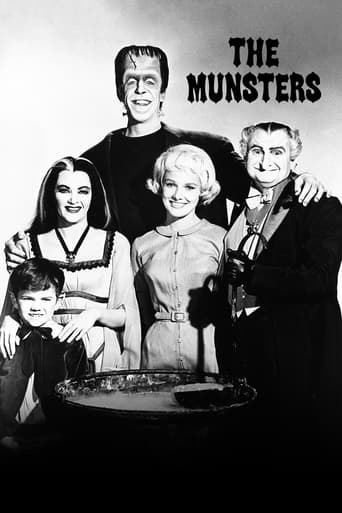
The Munsters
1964 · TV series · 25 min episodes · 2 seasons
Created by Chris Hayward, Bob Mosher, Allan Burns
ComedyScience FictionFantasyFamily
A family of friendly monsters that have misadventures all while never quite understanding why people react to them so strangely.
3 positive3 neutralfrom 6 commenters
Where to watch
No streaming data for this title.

7 comments on Hacker News
Batman was a parody of cop shows, and his utility belt was part of the joke. Get Smart did similar things to lampoon spy movies.
The Munsters had a running gag where Herman would look into a mirror and it would shatter. I'd still laugh every time.
To elaborate a little, I watched season 1 of married with children a while ago and it struck me as a more modern I love Lucy. I can't speak to later seasons.
The Munsters... well, I think I've seen a few episodes. I don't recall the wife (Lily) doing much in the episodes I watched, to be honest. I did see the recent Munsters movie, and Herman is both the cause and solution to their problems, Lily doesn't really do much from what I recall, if she has a comedic premise it's the ridiculousness of her falling for Herman.
Herman was even described as having "the mind of a child" in one of the episodes. The plots often revolved about some childish scheme that Lily tried to put a stop to.
MwC was definitely the oafish husband, again with the childish schemes, much like Ralph in the Honeymooners. It's just a raunchy version of the Honeymooners.
ILL is a rare exception - a reverse Honeymooners.
P.S. I still enjoy watching these shows. Especially the Munsters. Herman always makes me laugh.
Streaming with ads is worse; invariably they cut to the ad 2-3 seconds early, then when you get back it's the last two seconds and then the next segment.
I know ad minutes per hour have increased, because older shows have to be slimmed to air. Sometimes that's fiddling with the credits, sometimes on stations that care less, it's dropping minutes of content; I tried to watch an episode of The Munsters on some sub-channel, and they cut to commercial over the punchline of a joke... which ended up just being omited. Thanks a lot.
I grew up in rural Canada. I dumpster dove for a broken black and white television and spent over a month back and forth to the Radio Shack until I finally managed to fix it. The antenna was now a coat hangar, but I could tune it just fine.
My reward was... 1 channel of CBC (Canadian Broadcasting). With that 9 year old me could stay up late and watch The Munsters and Kids In The Hall.
I know every episode by heart. I can't do impressions of anyone, but I can do impressions of each character in the show. It's deeply ingrained in my brain. A lot of very young Canadians watched that show sans supervision and it opened out minds to a lot of ideas that otherwise were not accessible.
> As a fan of cinema, I've noticed that there is a clinical deadness lately when it comes to representing real people.
> I don't agree with the conclusions of the essayist, but there's something there. Verisimilitude is gone. Real people are gone. In their place, there's a clinical, sterile plastic automaton put together by marketing departments. Even when there's nudity and sexuality, it feels like a paint-by-the-numbers thing and not storytelling.
Last year I got ahold of The Munsters, the black-and-white TV show from the 1960s, and noticed something odd one day when I watched an episode back-to-back with a modern unrelated show: What you describe with people also applies to props. In the Munsters' dinner scenes, the whole set - including the food - was significantly more interactive than anything modern I've seen possibly ever. It made the modern shows rather suddenly feel much more fake than I was used to.
I don't mind the colorizations, but to give you some additional ammo for your argument, check out the TV show "The Munsters" and "The Addams Family". If you're not familiar, they're supposed to live in creepy dark houses, and in black and white, the houses do indeed look dark and creepy.
But in reality, those sets were bright pastels. Actual dark walls and floors didn't show up well on film. Which makes me wonder how right we are with some of our other colorizations.
You can google [what did the munsters set actually look like] to get some great examples.