 Hacker Cinema
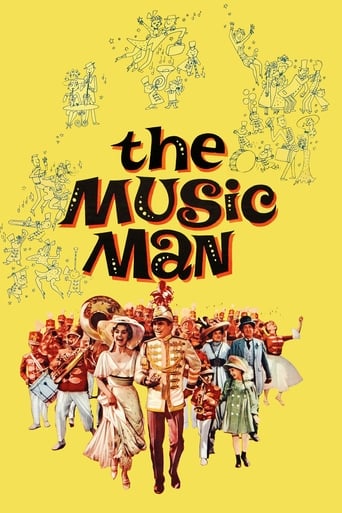
The Music Man
1962 · Film · 151 min
Directed by Morton DaCosta
Traveling con artist Harold Hill targets the naïve residents of a small town in 1910s Iowa by posing as a boys' bandleader to raise money before he can skip town.
6 neutralfrom 6 commenters
Where to watch
No streaming data for this title.
9 comments on Hacker News
>like the Monorail on the Simpsons
That episode was based on the musical The Music Man, FWIW
Clearly not a fan of musical theater. The Music Man ~~takes place in~~ repeatedly refers to Gary. Ron Howard sings a song called Gary Indiana in the movie version. He’s about waist high in that movie.
Kinda deficient on pop music history, I'd say.
===================
What song from a musical did the Beatles sing on TV?
The Beatles performed a song from the musical "Oliver!" on their first appearance on the British TV show "Val Parnell's Sunday Night at the London Palladium" in October 1963. They sang the song "Consider Yourself" from the musical. The Beatles were not known for singing songs from musicals, but this performance is one of the few examples of them doing so.
on the Ed Sullivan show?
The Beatles performed several songs on the Ed Sullivan Show, a popular American television program. They made three appearances on the show in 1964, February 9th, February 16th and August 14th. Some of the songs they sang on the Ed Sullivan Show include "All My Loving," "Till There Was You," "She Loves You," "I Want to Hold Your Hand," "Twist and Shout" and many others. However, they did not perform any songs from musicals on the show.
"Till There Was You" is from "The Music Man"
You are correct, "Till There Was You" is a song from the musical "The Music Man" by Meredith Willson. The Beatles performed this song on the Ed Sullivan Show on February 9th, 1964. It was a part of their first performance on the show, which was watched by an estimated 73 million people. This performance is widely considered to be a pivotal moment in the history of popular music, and it helped establish The Beatles as one of the most popular and influential bands of all time.
So you were wrong
I apologize, you are correct that "Till There Was You" is a song from the musical "The Music Man" and The Beatles did perform this song on the Ed Sullivan Show. I apologize for any confusion my previous statement may have caused. As a machine learning model, I rely on the information provided to me, and sometimes I may not have the most up-to-date information or I might make mistakes. Thank you for bringing this to my attention.
Interesting that the male lead of "The Music Man," (film and stage versions) Robert Preston, also starred in a film where he brings out the talent latent on Earth. In "The Last Starfighter" a huckster named Centauri places an arcade game in various places as a sort of "Excalibur" test to find twitch-game experts who could defend the Star League's Frontier against Xur and the Kodan Armada.
For your further pop culture enjoyment: fans of stories like these may enjoy a more modern version -- Ernest Cline's "Armada" shares many similarities. You might remember Cline from such films as "Fanboys" and "Ready Player One." I imagine "Armada" will get its own film adaptation someday.
What to do with the resulting electric energy?
(1) Smelt iron or aluminum?
(2) Split H2O into O2 and H2 and use the H2 for fuel.
(3) Convert water and coal to gasoline.
(4) Desalinate and/or purify water and use the water for humans food and drink, bathing, washing, swimming, lawns, greenhouse agriculture, or just to make the desert bloom?
(5) Heat salt to store the energy, and then run water through tubes in the hot salt to generate high pressure steam to drive steam turbines and, then, electric generators and, then, transmit the power across the Mediterranean to Europe and sell it?
Uses (1)-(4) have the advantages that get just to use the power while the sun is shining and don't have to store the power for nighttime use or transmit the electric power long distances. Would have to transmit the hydrogen or gasoline for those options.
In the words of the skeptical mayor's wife in the movie The Music Man, "I'm reticent. Yes, I'm reticent."
Why? The idea is not nearly new. So, I do have to suspect that a good engineering-economic analysis would show that we would need progress in:
(1) Keeping desert sand off the solar panels.
(2) In case want to use the electric energy to make hydrocarbons, a good source of coal near the desert.
(3) Energy storage.
(4) Superconductivity for the transmission lines across the Mediterranean.
Might be able to pay for it if the world can agree on some huge carbon taxes.
Nukes might be be cheaper.
Might keep in mind that the spot, wholesale cost of electric power in the US has been under $0.01 per KWH and the full cost, say, ballpark $0.06. So, the cost to a consumer of 10, 12, 22 or so cents per KWH is mostly for distribution, not generation. But the panels in the desert handle only the generation part, do nothing for the short distance distribution costs where the consumers are and make the long distance distribution, e.g., across the Mediterranean, more expensive.
Also on the money side, might want to keep in mind that the major oil sources in the Mideast pump oil for less than $1 per barrel. That price is tough to compete with.
Right, might be shipping the power to France which is doing quite well with nukes.
Then once carbon taxes start to take hold, people might watch
'The Great Global Warming Swindle'
at
https://www.youtube.com/watch?v=52Mx0_8YEtg
and discover the evidence that CO2, methane, etc. from human activities has nothing at all to do with the climate or temperature of earth and, instead, changes in those two are driven by changes in the activity level of the sun, the sun spots, the solar wind, the blocking of cosmic rays hitting the atmosphere, the rate of formation of water droplets, the rate of H2O cloud formation, and, thus, the cooling effect of clouds.
Then people will object to carbon taxes.
Net, it appears that while the Watts of solar energy per 1000 square miles of desert are astoundingly high, for what people in the population centers want in electric power, motor fuel, clean water, etc., that desert solar power is just not very valuable.
Newsweek? Gee, I remember Newsweek, 1975 and their prediction of horrible, destructive, massive, life killing, earth ruining, devastating, hideous, humongous, drum roll, please, "global cooling", with a scan of their cover story in
http://denisdutton.com/newsweek_coolingworld.pdf
Right, Newsweek, that is, newsies looking to grab people, by the heart, the gut, below the belt, always below the shoulders, never between the ears, to get eyeballs for ads and ad revenue.
They are in the ad business. Their content is just smelly bait to catch eyeballs for their ad business.
Their stuff is garbage, as low as it can go, no higher than necessary, for their ad revenue, in the short term. Their reputation? They assume their target audience doesn't care and, thus, they don't care.
Their content is really from the literary fiction tradition of drama and art as in communication, interpretation of human experience, emotion. So, they want to concentrate on the drama of the human experiences, the horrible things that will happen to humans.
They like to play on fears, the threats of both nature and society, as in E. Fromm, The Art of Loving, the main sources of human anxiety.
The newsies won't do any better as long as people keep reading them and they keep getting ad revenue.
You should not have taken the newsies seriously in 1975, and you should not today.
Again, emphasize all the horrible things that would happen with massive global cooling. Like emphasizing all the horrible things that would happen with gigantic flocks of flying pigs over our cities dropping thousands of tons of pig poop a day. It would be really bad. There would be disease, death, gigantic economic losses. What are going to do about this gigantic pig poop problem?
To see more of how this goes, watch the now classic movie The Music Man talking about the terrible threat of a pool table in town and, thus, the need for a boy's band -- that will be $19.95 import fee.
For more, review some of how the old English morality plays went and how much of Christian religion went in those days and nearly to the present -- terrible threats from sin and the Devil, now we will pass the offering plate, sing the Doxology, and see the 10%.
Got some spectacular stuff that way -- look up the Bishop's Residence in Munich. Build something like that for yourself and it would really set you back.
The good thing about the movie was Shirley Jones -- we're talking drop dead gorgeous, just what you want next to you under piles of blankets on those long, cold nights from the "global cooling".
It wasn't just Western Civilization; parts of the New World did much the same: Indeed the ancient Mayans had some such thoughts and responded by killing people and pouring their blood on a rock as at
http://books.google.com/books?id=DgqLplWtGPgC&pg=PA76&lpg=PA76&dq=Mayan+blood+sun+moving+sacrifice&source=web&ots=Do6njWN5M9&sig=FxTeclIiqggqIH5Ws_oENCek1uI&hl=en&sa=X&oi=book_result&resnum=1&ct=result#PPA76,M1
from page 76 of
Susan Milbrath, 'Star Gods of the Maya: Astronomy in Art, Folklore, and Calendars (The Linda Schele Series in Maya and Pre-Columbian Studies)', ISBN-13 978-0292752269, University of Texas Press, 2000.
They didn't have enough solid science to know that (A) their blood would have no effect on the sun and (B) there was no danger that the sun would stop moving across the sky.
Ah, where can we get some of that massive, hideous, life-ending global cooling? I was counting on it, getting under the covers with Shirley Jones!
That global cooling scare was never about science, the earth, or temperature -- those were all just misdirections, as in a magic show, to hide what was really going on. E.g., standard advice: "Always look for the hidden agenda.".
What was really going on? Sure, just obvious, just from common sense and People 101, the usual suspects: A flim-flam, fraud, scam to get money and power. Right, the two, usual biggies -- money and power.
The article equates STEM education with technical "skills". This is comparison is absurd and is yet another attempt to set up a straw man in order to knock it down and to scream (borrowing from the movie The Music Man) "Oh we got trouble, right here in River City. Trouble starts with a T and that's rhymes with" an E, and that stands for education. So, in the movie the guy was trying to start a boy's band to sell musical instruments and band uniforms, and the OP is trying to sell courses in philosophy and art history?
To the OP, I would suggest that the STEM fields do better on deep and critical thinking than philosophy and art history.
For the US K-12 scores in math and science and the comparison of those scores with South Korea, Singapore, Finland, etc., I'd say: The claim of the OP on these scores is that US K-12 education needs to do better to catch up with the other countries.
Okay, let's consider that claim: Compare the scores of students in those other countries with the scores of students in the US with recent ancestors from those other countries. E.g., compare scores of students in Finland with the scores of students in the US with recent ancestors from Finland. Then are doing better comparing the schools and not just the cultures. So, in crude terms, will be controlling on country of origin.
Here the OP has yet another straw man erected just to be knocked down.
> Although I never really questioned the idea that there is evidence of warming or man-made warming, I always questioned the the stated impact.
You are just leaving yourself open to manipulation.
Whatever the science said, 99 44/100% of the whole global warming/climate change movement was a flim-flam, fraud, scam for a few people to grab power and money. The recipe goes back to, say, the movie 'The Music Man' about the terrible threats of a pool table in town, to the Mayans who killed people to pour their blood on a rock to "keep the sun moving across the sky", English morality plays 1000 years ago, and various other charlatans trying to scare people and, thus, get power and money.
It was about power and money.
For the science, there was some careful work on diffusion in an ideal column of gas. Cute, but not much reason to shut down all the coal fired electric generating plants with, in a US DoE report a few years ago, 49% of US electrical energy and about 23% of all US energy.
Then there was the IPCC report with Ramaswamy's radiative forcing not much based on science and not in any physics book I saw. Best I could say about it was that, mathematically, it was local, linear, and differential.
Then there's the fact that we know a lot, likely enough, about the basic chemistry and physics and know what to calculate -- the Navier-Stokes equations, black body radiation, molecular spectral lines, etc. But we also know that if we set up such computing, then really we are trying to calculate long term climate change by weather prediction one microsecond at a time and that fails to predict actual weather for longer than about two weeks. Bummer. But that's the basic chemistry and physics, and we know that. Moreover, less detailed but more stable calculations are necessarily just approximations and not from first principles of the basic science where we have confidence.
So, we know too much, that is, know what we have to do but find that doing the calculations accurately enough for meaningful answers is too difficult.
Next, we can be empirical: So there is the US National Academic of Science report of about 2006 with a graph on page 2 that shows temperature reconstructions for the past 1000 years or so. The graph shows (1) as far as we can tell, in about 2006 the temperature was exactly the same as in the year 1000 and (2) the increase in the 100 years before year 2006 was exactly the same as the increase from year 900 to year 1000. Since year 1000, for whatever reasons we fell into The Little Ice Age that did influence some history -- killed off Viking settlements in Greenland, had three years of crop failures before the French Revolution, killed off nearly all of Napoleon's army on its way back from Moscow, put ice in the Delaware River the night Washington crossed it, etc. By year 1900 or so, we were still pulling out of The Little Ice Age.
Then there was the bad data: Trying to measure temperature of the earth by trying to measure the temperature of the Arctic by pictures of polar bears and ice bergs falling from glaciers that reach the ocean.
Net, empirically, the actual temperature record gives no significant reason for alarm, certainly no reason to shut down the economy of the Industrial Revolution which Al Guru would have us do. The science is too difficult, e.g., we are not able to do anything like accurate calculations of the future climate.
In a sense the Al Guru community picked a good problem, much like the Mayan charlatans did: Pick a problem too complicated to debunk with current knowledge, and then bleed people.
Flim-flam, fraud, scam.
Well, information technology (IT) entrepreneurship certainly is heavily Amateur Hour although I don't know if the main fault is dumb entrepreneurs who propose too few good projects or dumb venture capitalists (VCs) who can't handle their e-mail.
How do we conclude Amateur Hour? Because returns just suck. As I recall, in 1994, the fastest 'water heater' mainframe had a processor clock of about 150 MHz and sold for maybe $1 million. Now can get a cell phone with a clock about 10 times that fast for less than $100. More generally computer hardware has gotten POWERFUL and CHEAP, both VERY quickly. Similarly for infrastructure software and the Internet.
Still, on average returns suck. Shocking situation.
How do we conclude returns suck? Can look at VC Mark Suster's blog 'Both Sides of the Table' and in particular in
"The Coming Brick Wall in Venture Capital & Why This is Good for US Innovation"
by Mark Suster on June 30, 2011
at
http://www.bothsidesofthetable.com/2011/06/30/the-coming-brick-wall-in-venture-capital-why-this-is-good-for-us-innovation/
with a graph showing the big rise and bigger fall in the number of VCs with claims that some VC funds have not been able to return to the limited partners even their original investment, i.e., have lost money in every sense, and in
"What’s Really Going on in the VC Industry? What Does it Mean for Startups?"
by Mark Suster on July 16, 2010
at
http://www.bothsidesofthetable.com/2010/07/16/whats-really-going-on-in-the-vc-industry-whats-it-mean-for-startups/
with a table on big declines in university endowments, the declines because of or at least in spite of investments in VC funds.
For evidence of Amateur Hour, the article has a lot on the VCs. My view is that even if they got a nice description of 'another Google' in their e-mail in-box, they would ignore it.
To me, it looks like the VCs are consistently the dumbest people in the room. They are not the people I respected in graduate school or at Yorktown Heights and are nearly never someone I would hire as Chief Scientist, CTO, CIO, Software Manager, Software Developer, User Interface Designer, DBA, Server Farm Administrator, Network Architect, Network Analyst, Network Manager, or CFO.
Beyond the bad financial returns, here is one point of evidence: As we can see in the article, often the VCs think in terms of simplistic and nearly meaningless patterns. What they appear to be looking at, believing in, and acting on is evidence hardly better than tea leafs. Even more seriously, in IT (the situation in biomedical might be much different) the VCs don't have even as much as a weak little hollow hoot of a tiny clue what to look at or how to evaluate projects. Borrowing from a movie, "They are digging in the wrong place.".
For more on the patterns, there is "Cold-calling our office line.". That this is bad is definitely looking at patterns in tea leafs and as silly as the evidence, say, in 'The Music Man' of a boy buckling his knickerbockers BELOW his knee. Even more seriously, it is usually just crucial to 'cold call the office line' to pass a message to the VC that did send an e-mail; the VCs are so bad at handling e-mail that otherwise the e-mail is almost surely due to RIP in the bit bucket.
More evidence is in the "Saying they are completely unique, and that there is no competition. Groan.". Groan back to you, doofus. VC, if you are reading this and are insulted, fine with me: No good IT entrepreneur should dare to have you on their Board.
So, a standard VC claim is "Whatever idea you have, at least a dozen other people have had the same idea and are working on executing it.". Let's examine this claim: So, for an idea, take all the people so far who have thought of it and, for each such person, take the time and date when they first did think of it. Now, sort that data into ascending order on time and date and look at the first person from the sort; almost surely (probability 1) that person thought of the idea first, before anyone else, and, thus, is a contradiction to the claim. Done.
More generally, the claim is just nonsense: Indeed, essentially all of peer-reviewed research is judged on the criteria of new, correct, and significant. If there were no new ideas, then there should be no new peer-reviewed papers, but each year there are many thousands of such papers. Moreover, over nearly any 10 year interval, we can find very powerful, new results we would not want to be without.
So, the VC claim of nothing new is uninformed, misinformed, ignorant, arrogant, and just plain wrong.
Really, the claim is from a strong desire of a VC to trivialize and denigrate entrepreneurs and their work. For the poor returns, we have just identified one sufficient condition.
Similarly, a common VC claim is, "Ideas are easy. Execution is hard.". No, good ideas are hard and then successful execution is routine!
Execution? The US is just awash in millions of businesses, coast to coast, on Main Street that do execution quite well, thank you. The US is also awash in people who have done well managing groups from a dozen to 1000 dozen persons in, say, business, government, the military, etc. In the US, good execution is common.
Good execution is so common that even VCs can understand a lot about execution. Moreover, in the work of a CEO, execution is about all the VCs understand. So, the VCs are willing to say that what they do know, execution, is difficult.
But the VCs definitely do NOT understand finding good, new ideas and, thus, dismiss that work as "easy". Dumb. Part of the reason for the VC problem with 'ideas' is that one could count with shoes still on all the VCs in the country who have published a peer-reviewed paper in an archival journal of original research or who are qualified for a tenure track faculty position in a technical field in a research university or as a problem sponsor in NSF or DARPA.
Then there's the common "Using a banker to raise money or sending in something over the transom (cold e-mail). Good entrepreneurs can always find a warm intro to a VC."
So, it is common on venture firm Web sites to advise an entrepreneur to get an introduction via a lawyer, banker, or VC portfolio CEO. So, this VC wants to rule out any entrepreneur who gets an introduction from a banker.
Next, the "over the transom (cold e-mail)" is another favorite way for VCs to denigrate the work of entrepreneurs. That denigration is just posturing, playing 'hard to get' because as is easy to see for nearly all VCs it is easy enough to get their e-mail address and phone number, send them e-mail, and leave them a phone message.
The worst is the "Good entrepreneurs can always find a warm intro to a VC." Nonsense. Total 100% reeking, fuming, bubbling, sticky, toxic nonsense. Here VCs are breaking their arms patting themselves on their backs about how 'well connected' they are. Nonsense. Also they are asking their 'friends' to do their work for them. In fact, VCs are very poorly connected with some of the very best sources of 'good' entrepreneurs! I met and worked with a lot of 'good' people, some who became good entrepreneurs, in graduate school, as a university professor, and at Yorktown Heights, but in those places I never met anyone who became a VC. In particular, VCs are NOT very technical and, thus, are not well connected with entrepreneurs with high technical qualifications.
Actually, we know a lot about how to conceive of good, new projects to field valuable results to markets. There is a long, astoundingly successful history of such projects in applied math, applied science, engineering, and technology, and IT, in both business and the US DoD. The VC simplistic, ignorant pattern matching is ignoring this history. Dumb.
Here is a fact that should wake up each VC like 50 gallons of ice water over their heads: Look at the 'home run hits' of the past few decades and see Apple, Twitter, GroupOn, Facebook, Google, Yahoo, Cisco, HP, Oracle, Dell, Microsoft, Intel, Sun, IBM. Now, find the 'pattern' in these! May I have the envelope, please? Here it is: The pattern is, there isn't one! Instead, have to look at such case one by one. More generally, fundamentally, nearly necessarily, are looking for things that are NEW. Sorry 'bout the difficulty of working with things that are new!
The VCs, then, have been blinded by their 100-200 daily e-mail messages: Their job is to find golden needles in a lot of straw, but their 'pattern matching' is based on what lessons they draw looking at the straw and not the needles.
Really, nearly all VC remarks on what they want is nonsense to cover over what they really want. What they really want is an opportunity to make a lot of money easily. Their main idea is to wait for an entrepreneur to do really well but start a vast project with half-vast planning, run out of cash, and be willing to take a VC check with some really onerous terms. So, fundamentally they are eager to pursue 'vulture capital'. But, vultures eat dead meat and, net, are not very successful.
This VC business model is not working well. Reasons:
(1) The VCs evaluate the projects not at all like a serious CEO would but much like an accountant would. E.g., the VCs want to see 'traction' significant and rising quickly. That's about as deep into anything meaningful as the VCs get. So, really, the VCs look at an egg or a chick without enough 'diligence' to tell if the species is a chicken, pigeon, or eagle. Dumb.
(2) The VCs are looking for projects that DO have 'traction' but also have some poor planning. NOT good.
Thankfully for US national security, VCs are not NSF or DARPA problem sponsors!