 Hacker Cinema
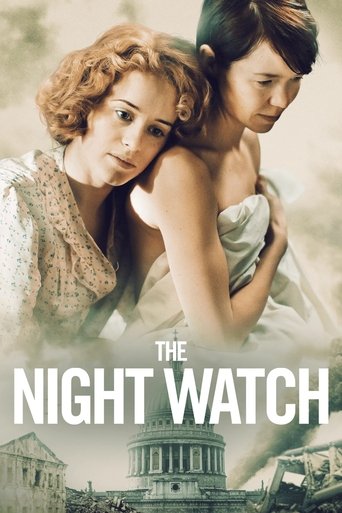
The Night Watch
2011 · Film · 90 min
Directed by Richard Laxton
Four Londoners are inseparably linked by their wartime experiences. In a time when the barriers of sexuality and social convention have been broken down, they enjoy a freedom never experienced before.
2 neutralfrom 2 commenters
Where to watch
No streaming data for this title.

2 comments on Hacker News
I'm very bothered by how much of today's art is based heavily on photographic reference. In some part due to the difference in skill development required by using a photo for reference versus using live references or your imagination/memory/whatever, but mostly because of how much the technological conceits and limitations of that photography come to infect other media which don't suffer from them.
It's most obvious in paintings and videogames. Depth of field, bokeh, motion blur, perspective, lens distortion—even focal length and composition. Once you realize it, it becomes impossible to ignore, and it really compromises the work for me. So many of the most technically adept artists today are using all their skill to effectively simulate one form of art with another. It's an interesting exercise, sure, and I'll never dissuade someone from developing and refining a skill, but in the best-case scenario, I'm just left thinking I'd rather see the photo or the movie, or not see the image at all. And I'm someone who will gladly spend 20min+ standing in front of a Rembrandt.
I don't have any issue with realism in art and think it can be quite effective when used well. But so much of what makes something like The Night Watch incredible is how it feels both convincingly real and compellingly uncanny at the same time due to its rendering from some fuzzy approximation of what the artist observed from his models, conceived in his mind's eye, and meticulously sketched and reworked.
To me, it's the ability to capture and create something within/from that gray area that makes an artist great.
Some funny metaphors and descriptions in the article. Seems like the author is grasping a bit to make programming relatable.
"The coding and the analytical skills on display at such events were like the Force in the “Star Wars” movies: it could be used for the light side, or for the dark."
"He spoke about the Stuxnet code in the way that an art historian might discuss “The Night Watch”: it was “elegant,” “precise,” “sophisticated.”"
"The malware consisted of rows of seemingly random letters and numbers flowing down a page, in pairs. In the margins were some recognizable English-language words—“Windows,” “everyone”—connected by cryptic punctuation. Choi could fluently and sensitively parse all this."