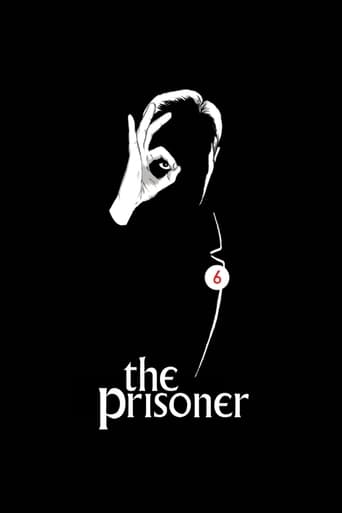
The Prisoner
1967 · TV series · 60 min episodes · 1 season
Created by Patrick McGoohan, George Markstein
DramaScience FictionFantasyMystery
After resigning, a secret agent is abducted and taken to what looks like an idyllic village, but is really a bizarre Kafkaesque prison. His warders demand information. He gives them nothing, but only tries to escape.
27 positive17 neutralfrom 44 commenters
Where to watch
No streaming data for this title.
51 comments on Hacker News
1950 through 1987 were very good years for Science Fiction Movies and TV shows particularly the 1960s.
One show that wasn’t exactly science fiction but was really good was the Prisoner with Patrick McGowan.
They are still very good anthology Science Fiction being written, but unfortunately Hollywood today isn’t doing that many – adaptations as usual Hollywood doesn’t like hire writers outside Hollywood.
It goes back to the 1960s TV show, "The Prisoner".[1] In the village, all signage and maps are lower case only, and in a unique font.
[1] https://www.youtube.com/watch?v=osNmf_zmSyE
Its the rover from "The prisoner 1967".
Operation
In the first episode the rest of the villagers freeze when instructed as Rover appears and attacks an unidentified man who does not comply. The same scenario reappears at the start of "Checkmate", the ninth episode, except that this time the man who does not comply is not attacked by Rover, prompting Number 6 to follow him and discover the human chess game, a key event in the episode.
https://en.wikipedia.org/wiki/Rover_(The_Prisoner)
> UK garage and rave culture took off in the UK with influences from reggae, soul and R&B. Now with the help of BBC Radio 1
I think there's an important middle step here, which is stuff that wasn't "banned" but was nevertheless not on the playlist, and the pirate radio stations whose personnel gradually went mainstream. Both from the Radio Caroline era (Jonnie Walker, rock) and Kiss FM (Trevor Nelson, UK garage). Let's not forget the government's attempts to ban the rave scene.
In comics you had 2000AD and Judge Dredd, inspired by the French Metal Hurlant.
> If you really want to argue for British dystopian science fiction movies
Not movies, but TV: Doctor Who (often dystopian), Blake's 7, the Prisoner, and the little-seen but extremely prescient Doomwatch. And of course the darkest nuclear apocalypse movie, Threads. Filmed in the parts of Thatcher-era Sheffield which looked like they had already been nuked.
UK always simply had less money and a narrower set of TV/radio gatekeepers. The diversity and inventiveness is there nonetheless. So, yes, a lot of things have to get American money and licenses in order to be made.
> but still uncertain about the substance.
Honestly, I'm really enjoying that uncertainty and I couldn't image how entertaining it'd be. It certainly has a special place in this current "Zeitgeist" where video games are played by various generations and people calling each other "NPC"s as insult. There's this massive scale of contemporary enterprises, they all would like to retain that image of being young and full of empathy, while also standing above the law. Have you ever talked to some superior at a company and left with this empty feeling that made you recognize all of this unwillingness to change? Severence just hits that spot and frames it nicely into humor, yet still doesn't laugh about it. I question a bit the addition of the latest department in episode 3 and just hope they can stick the landing with such decisions.
> The only truly exemplary production I can name in this vein being the sole season of The Prisoner (McGoohan, 1967-68).
I definitely see Twin Peaks in the same realm.
McGoohan had a definite plot in mind for The Prisoner and he initially planned it to be a 7 episode series. They ended up making 17 episodes and there's some disagreement about which the "McGoohan's Seven" actually are. To be fair, there's a lot of disagreement about many aspects of The Prisoner, including the best order to watch the episodes as they were broadcast out of order.
Reminds me of the rover on that TV show "The Prisoner".
The 1967 British TV series The Prisoner, episode A Change Of Mind, prescribes the milk-first method, as part of a general instruction on how to make “a decent cup of tea”.
Recently watched it. There are about 2 instances of incredible sexism throughout the whole series but the rest of the time it’s extremely egalitarian. The first episode in particular was so badly sexist that I nearly didn’t watch the rest of the series but was glad I did because the awful misogynist character in the first episode seems to have a complete change of personality and never behaves like that again - the actor playing him seemed visibly uncomfortable at times so I don’t know if he influenced that or whether they got feedback from others to change things.
Get past the first episode and it’s great, like a sci-fi version of The Prisoner. Very much of its time but in a good way - filmed in 1970 but set in the eighties it’s like a vision of the future (past now) that never happened but could have - something very bad clearly happened in our timeline during the seventies to result in everything being so grim when just ten years earlier we were full of optimism.
The Prisoner had a scary good finale, if you downplay the feeling of surreal circus. The hero came full circle.
(btw ignore the movie of the same name, it was unrelated generic sci-fi)
This is not about the price of apps.
It is about running what you want on a device you own.
You may not have realized it, but you do not own your Apple device anymore, in the sense that you can't run what you choose on it.
You are only allowed to play in Apple's carefully tended village.
I'd recommend re-watching The Prisoner [1]
[1] https://en.wikipedia.org/wiki/The_Prisoner
"The prisoner" was an excellent serie but not a documentary. Despite those white balloon similarities, it is fiction
Thing you haven't mentioned is that with no oversight, no transparency no counter, no clear your name, the tyranny which wants to ruin your life doesn't need to build a CSAM scanner to do it. A tip-off to the police, a falsified claim from an "eye witness", an "accident" putting your name on the wrong report to get the machinery rolling and it will, as you say, roll by itself. See what actually did happen to Sir Cliff Richard[1] where "a complaint to the police" got his house raided and his name dragged through the media and despite not being arrested, not being charged, case being dropped, him suing the media and winning, suing the police and winning and the media apologising, he says his reputation will never be completely cleared - and it probably never will be, and it didn't require any specific tech.
"The System" didn't need to wait patiently for a big tech company to build a complicated system with dastardly moustache-twirling weaknesses before it could affect Sir Cliff, anymore than Big Brother in 1984 needed to wait for Winston to be seen taking action on the telescreen in his house before the system crushed him. If "The System" wanted to accuse you, it could accuse your car of having been seen on a nearby road at the time, your likeness being seen on CCTV, and if you get rid of licence plate recognition scanners and CCTV then it would be "an anonymous witness" seeing you in the area at the time or "overhearing you discussing" something.
> "Most people don't understand how life destroying a false accusation is"
Citation needed? Because we were forced to read 1984 and To Kill a Mockingbird in school and I'm pretty sure a lot of other people were as well; we've seen cult TV series like The Prisoner and The Fugitive focusing on the lives of the trapped trying to escape "the system". Blockbuster films have been made about the power of "The State" chasing people such as Enemy of the State with Will Smith. Films in the pattern "wrongly accused must fight to clear his name" and "stalwart good guy fights the system gone bad" are practically genres on their own - The Fugitive as a film with Harrison Ford, Who Framed Roger Rabbit, Captain America: The Winter Soldier, The Shawshank Redemption, and specifically about someone falseley accused by a child, The Hunt with Mads Mikkelsen which is in the IMDB Top 250 films.
Are you also, for example, complaining about the system where doctors and social workers are mandatory reporters if they have any evidence or suspicion of children being abused? That's a "their word against yours" system which pervades the nation, has no oversight, has no objective criteria, no explanaiton of the workings of the brain behind it, relies on humans when we know for certain that there are doctors who make mistakes and errors of judgement and at least some who would look the other way for money.
At least with the tech company CSAM scanners we can potentially have a society wide discussion about how they work in detail, whether that's reasonable, who could and should oversee them and how, what kinds of data cloud companies are obliged to know about their customers and what is reasonable for them to not know, etc. But even in tech circles we can't actually have those discussions, most of the attempts to discuss the details of how it works are drowned out by people who haven't a clue what Apple announced, misunderstand massive parts of it, conflate two or three different systems, don't seem to understand that other tech companies already do this with much less careful design, and cry tyranny and blame China.
Hypothetically, iMessage or any chat system could be built end to end encrypted, any cloud file sync or file storage could be. One end of the spectrum is that they should be. If that's your position then "the system" will probably work around you, that's the "opt out of modern life" position of the "return to the woods" lifestyle. You can't unmake billions of cheap ubiquitous cameras, you can't unopen Pandora's box, and you probably can't stop people emotionally reacting strongly to topics of child protection. If your reaction to that is "not listening, no no no" then it doesn't seem likely to sway "the system" very much at all.
> "CSAM is a dastardly and effective way to establish a totalitarian rule by fear of life in jail, nothing more.
America has effectively incarcerated a lot of people into for-profit prisons without needing this. China has effectively added a lot of population control by rule of fear without needing this. You don't need a high-tech murder-detector to make people fear being thrown in jail for murder.
[1] https://en.wikipedia.org/wiki/Cliff_Richard#Property_search,_investigation_and_BBC_litigation
A classic from the 60s, worth watching (I'm from the 80s). Starring Patrick McGoohan. Obligatory link [1]. "Quote: The final episode, "Fall Out", received a Hugo Award nomination for Best Dramatic Presentation in 1969." This specific episode also has its own Wikipedia entry, [2].
A quote from that article: "There are numbers here, there are no names, so you can't expect it to end like James Bond, so you have to have an allegorical ending. Now (...) what is the most evil thing on earth? Is it jealousy? Is it hate? Is it revenge? Is it the bomb? What is it? When one really searches it's only one thing, it's the evil part of oneself that one is constantly fighting until the moment of our demise. The Jekyll and Hyde if you like, but on a much larger scale." —Patrick McGoohan. Which reminds me of Sad But True by Metallica.
[1] https://en.wikipedia.org/wiki/The_Prisoner
[2] https://en.wikipedia.org/wiki/Fall_Out_(The_Prisoner)
> The best agrument is that privacy is power.
I am reminded of the TV series "The Prisoner" out of BBC, especially the final episode "Fall Out Pt2".
Expounds about "the individual's right to be individual", community, the status quo, and so forth.
And over that "no" is a complete sentence that needs no more explanation.
> famously featured in the opening sequence of "The Prisoner" TV series.
Not just featuring in the opening sequence, but indeed symbolic of the entire show. A quirky, agile stand-out from the crowd that represents freedom and individuality, yet in the end is still imprisoned to follow the same roads as everybody else.
Nabokov was most certainly modern and veering into postmodern at the end.
I was totally thinking about The Prisoner as an example when this came up today! It's clear that McGoohan had gotten bored with neatly constructed thrillers, and wanted to create an allegory and explore deeper themes. The great thing about that show is that every individual episode was a neatly constructed thriller in its own right, even though it always ended back at ambiguous-square-zero (why is he in the village? will he escape or won't he?).
At the same time, it's pretty clear that he had no idea how to actually end the thing, and he told Lew Grade that shortly before they filmed the ending. I think the fiasco of the unsatisfying ending was only partly that people wanted an explanation which McGoohan didn't want to give them because it wasn't the point of the series. It's also that he kind of winged the ending and it just wasn't that good, compared to the high level of the previous episodes. So in a way it did fail the audience, even if at the same time the audience was failing to 'get' the art.
Edit: this is fun: https://www.youtube.com/watch?v=zfXqtDgvpL8
If they do another remake of The Prisoner, this would be a great place to film it.
Tangentially reminds me of thoughts and theories behind the TV show "The Prisoner" regarding society.
I'd say it's highly likely that is an intentional pun. Several of the show's writing staff hold advanced STEM degrees. One of them wrote a mathematical proof specifically to include as a plot device in one episode[1].
[1]: https://en.wikipedia.org/wiki/The_Prisoner_of_Benda
Regarding your point that "I used to question how it happened in WWI/II, but now I see it first hand", not to say it is identical, but consider from: "They Thought They Were Free: The Germans, 1933-45" by Milton Mayer https://press.uchicago.edu/Misc/Chicago/511928.html ""What no one seemed to notice," said a colleague of mine, a philologist, "was the ever widening gap ... between the government and the people. Just think how very wide this gap was to begin with... And it became always wider. You know, it doesn’t make people close to their government to be told that this is a people’s government, a true democracy, or to be enrolled in civilian defense, or even to vote. All this has little, really nothing, to do with knowing one is governing. "What happened here was the gradual habituation of the people, little by little, to being governed by surprise; to receiving decisions deliberated in secret; to believing that the situation was so complicated that the government had to act on information which the people could not understand, or so dangerous that, even if the people could not understand it, it could not be released because of national security. ... "This separation of government from people, this widening of the gap, took place so gradually and so insensibly, each step disguised (perhaps not even intentionally) as a temporary emergency measure or associated with true patriotic allegiance or with real social purposes. And all the crises and reforms (real reforms, too) so occupied the people that they did not see the slow motion underneath, of the whole process of government growing remoter and remoter. ... "To live in this process is absolutely not to be able to notice it—please try to believe me—unless one has a much greater degree of political awareness, acuity, than most of us had ever had occasion to develop. Each step was so small, so inconsequential, so well explained or, on occasion, ‘regretted,’ that, unless one were detached from the whole process from the beginning, unless one understood what the whole thing was in principle, what all these ‘little measures’ that no [patriotic citizen] could resent must some day lead to, one no more saw it developing from day to day than a farmer in his field sees the corn growing. One day it is over his head. How is this to be avoided, among ordinary men, even highly educated ordinary men? Frankly, I do not know. I do not see, even now. Many, many times since it all happened I have pondered that pair of great maxims, Principiis obsta and Finem respice — ‘Resist the beginnings’ and ‘Consider the end.’ But one must foresee the end in order to resist, or even see, the beginnings. One must foresee the end clearly and certainly and how is this to be done, by ordinary men or even by extraordinary men? Things might have. And everyone counts on that might. ... And one day, too late, your principles, if you were ever sensible of them, all rush in upon you. The burden of self-deception has grown too heavy, and some minor incident ... collapses it all at once, and you see that everything, everything, has changed and changed completely under your nose. The world you live in — your nation, your people — is not the world you were born in at all. The forms are all there, all untouched, all reassuring, the houses, the shops, the jobs, the mealtimes, the visits, the concerts, the cinema, the holidays. But the spirit, which you never noticed because you made the lifelong mistake of identifying it with the forms, is changed. Now you live in a world of hate and fear, and the people who hate and fear do not even know it themselves; when everyone is transformed, no one is transformed. Now you live in a system which rules without responsibility even to God. The system itself could not have intended this in the beginning, but in order to sustain itself it was compelled to go all the way." ..."
One antidote to hate and fear is laughter and play; see for example Dutch historian and cultural theorist Johan Huizinga, author of "Homo Ludens" (who was eventually held in detention by the Nazis): https://en.wikipedia.org/wiki/Homo_Ludens
And playfulness and laughter can be regained: https://myshrink.com/dont-laugh-anymore/ "If your nervous system activation increases over your lifetime, chances are you'll lose your capacity for spontaneous laughter. Those folks who notice the difference in themselves might say they are "tapped out" or "I don't feel like myself". Indeed, there's some folks who've never had the ability for a good laugh to begin with. Don't despair. Just because you don't laugh anymore doesn't mean that can't be changed - it's temporary - unless you decide to do nothing about it."
I've started watching the original "The Prisoner" series again ( https://archive.org/details/The_Prisoner ) and reading comments on it. It is becoming clearer that ultimately, fifty years after that series first aired, we are all part of a global village now... For good or bad, we are part of that system -- and there is essentially no possibility of "escape" because that system in some form is everywhere.
And seeing the Prisoner series again decades later -- informed by some comments -- it is also clearer the series does not take an absolutist stand on one side or the other of the free-seeming individual or the structured-seeming community. https://en.wikipedia.org/wiki/The_Prisoner "A major theme of the series is individualism, as represented by Number Six, versus collectivism, as represented by Number Two and the others in the Village. McGoohan stated that the series aimed to demonstrate a balance between the two points."
From the second Prisoner episode, "The Chimes of Big Ben" which I re-watched today: https://subslikescript.com/series/The_Prisoner-61287/season-1/episode-1-The_Chimes_of_Big_Ben
Number Six: You're just as much a prisoner as I am. Number Two: Of course, I know too much - we're both lifers. I am an optimist. It doesn't matter who Number One is. It doesn't matter which side runs the Village. It's run by one side. But both sides are becoming identical. What has been created is an international community, a blueprint for world order. When both sides realise they're the same, they'll see this is the pattern for the future. Number Six: The whole earth as the Village? Number Two: That is my hope. What's yours? Number Size: To be the first man on the moon.
As parts of that now essentially inescapable Global Village system built by all sides over the last half century, we can do what we can when we can to make it better somehow. As in the coincidentally written ~1932-1933 prayer by the American theologian Reinhold Niebuhr: https://en.wikipedia.org/wiki/Serenity_Prayer "Father, give us courage to change what must be altered, serenity to accept what cannot be helped, and the insight to know the one from the other."
For example, the Starship Enterprise in Star Trek is essentially a surveillance state where the computer knows everything everyone is doing all the time -- but somehow we don't see the series through that surveillance state lens. Perhaps that is in part because of the amazing opportunities that cheap energy, matter replicators, space travel, holographic simulations, and so on make possible through widespread abundance for all Federation citizens in that (still) fictional universe? Or perhaps also it is because the surveillance is somehow behind some sort of assumed legitimate authority of access and (virtual) privacy?
See also on the issue of surveillance and power: https://en.wikipedia.org/wiki/The_Transparent_Society "The Transparent Society (1998) is a non-fiction book by the science-fiction author David Brin in which he forecasts social transparency and some degree of erosion of privacy, as it is overtaken by low-cost surveillance, communication and database technology, and proposes new institutions and practices that he believes would provide benefits that would more than compensate for lost privacy."
The recent unrest in the USA is emerging not from surveillance by the police of the citizenry but (via cell phones) from surveillance by the citizenry of the police (and what some specific police officers did to George Floyd).
A related touchstone by Manuel De Landa: "Meshworks, Hierachies, and Interfaces": http://netbase.org/delanda/meshwork.htm "To make things worse, the solution to this is not simply to begin adding meshwork components to the mix. Indeed, one must resist the temptation to make hierarchies into villains and meshworks into heroes, not only because, as I said, they are constantly turning into one another, but because in real life we find only mixtures and hybrids, and the properties of these cannot be established through theory alone but demand concrete experimentation. Certain standardizations, say, of electric outlet designs or of data-structures traveling through the Internet, may actually turn out to promote heterogenization at another level, in terms of the appliances that may be designed around the standard outlet, or of the services that a common data-structure may make possible. On the other hand, the mere presence of increased heterogeneity is no guarantee that a better state for society has been achieved. After all, the territory occupied by former Yugoslavia is more heterogeneous now than it was ten years ago, but the lack of uniformity at one level simply hides an increase of homogeneity at the level of the warring ethnic communities. But even if we managed to promote not only heterogeneity, but diversity articulated into a meshwork, that still would not be a perfect solution. After all, meshworks grow by drift and they may drift to places where we do not want to go. The goal-directedness of hierarchies is the kind of property that we may desire to keep at least for certain institutions. Hence, demonizing centralization and glorifying decentralization as the solution to all our problems would be wrong. An open and experimental attitude towards the question of different hybrids and mixtures is what the complexity of reality itself seems to call for. To paraphrase Deleuze and Guattari, never believe that a meshwork will suffice to save us."
Theodore Sturgeon's 1956 short story "The Skills of Xanadu"(which inspired Ted Nelson to work on hypertext, and in a way eventually led to the World Wide Web) also has an interesting take on privacy in a world where people are surrounded with networked technology. Audio: https://archive.org/details/pra-BB3830.08 Text: https://archive.org/stream/galaxymagazine-1956-07/Galaxy_1956_07
"Equating the BLM movement with groupthink is actually groupthink."
No, BLM one of the best examples of groupthink.
I support BLM, specifically with respect to the notion of police violence against, specifically, Black people.
But the BLM institution itself, is founded and driven by some ideologues with whom I disagree quite a lot.
There are many public events and actions 'in the name of BLM' with which I disagree.
The reason it's 'groupthink' and possibly oppressive, is because I'm not allowed to disagree with any of, without facing social consquence.
To disagree with 'some' BLM issue, is to disagree with the the very notion of 'Black Lives Matter'.
BLM is one of the most incidentally brilliant bits of communication in modern history - take a nominal, unassailable factual truth, like 'Black Lives Matter' - that nobody, but nobody can reasonably disagree with ... and then take that and do whatever you want 'in the name of BLM' - and you can pursue your agenda with vigour and aggression, knowing that you can smackdown anyone who disagrees with you with the moniker of 'racist'.
The F1 had a race in which the drivers and teams 'knelt' before the start, but the CNN article was not in the affirmative 'some drivers support BLM' - no, it was in the negative: "Formula One drivers divided as several choose not to kneel in support of Black Lives Matter movement" [1].
No longer is this a movement which you get to support, but rather, if you do not support the movement, your actions will be made public and you will have to answer to them.
This headline is pretty much on-point with respect to the nature of the article about 'The Prisoner' - though I should add, as having seen every episode in the original series, I disagree with the author's claim that it's about 'one kind of authority', I think the message is broader than that.
[1] https://www.cnn.com/2020/07/05/motorsport/f1-austrian-grand-prix-drivers-kneel-and-stand-hamilton-bottas-spt-intl/index.html#:~:text=(CNN)%20The%20Formula%20One%20grid,the%20Black%20Lives%20Matter%20movement.
Probably off topic but Patrick McGoohan was in a couple of good series for those at home at the moment, apart from The Prisoner, Danger Man was another (A bond like spy), and he also turns up in a few episodes of Columbo. If you like those then try the Avengers - the one with Patrick McNee and Emma peel, there are other series but the Emma Peel one is recognised as the best. Surrealist Spy dramas were at their height in that era, if you want to go further 'The Champions' is another - three spies crash land in Tibet and monks teach them some powers.
It's not a bad novel, but I wasn't particularly captivated by Nineteen Eighty-Four(how the title is actually stylized) because the state it portrayed didn't seem sustainable. This isn't to say there aren't parallels to North Korean society, for instance, but the type of world in Nineteen Eighty-Four doesn't seem like something that today's world needs to be afraid of as a whole; there would be far too many suicides for such a system to be worth it to anyone who wants to maintain power and growth.(Countries like North Korea aren't particularly large in size or population compared to freer nations) Maybe it made more sense in a world that wasn't driven by media and consumer culture. Brave New World made a little more sense, but I also didn't find it that compelling. Maybe I need to revisit the both of them now that I'm in my 30s, as opposed to my early 20s.
I've found the "Village" portrayed in Patrick McGoohan's "The Prisoner" to be a more profound message about the world that we actually live in. If the viewer can get over it being a product of its time, as well as the confusing ending, there's a lot of allegory packed into the show that reflects the direction our own societies are headed in:
- Surveillance is not only treated as a given but is incorporated into the conveniences of everyday life. (e.g. The door to Six's domicile opens not automatically but because he is constantly being watched)
- The state wants your "information", so much that it knows more about you than you know about yourself. (e.g. The authorities predict precisely what Six would want for breakfast, right down to how many strips of bacon)
- The line between government and corporation are blurred so much that all food is produced and branded by the Village, which even has its own logo plastered on everything. (All of the food provided to Six is branded as "Village Food")
- The inhabitants of the village all wear the same colorful(albeit ridiculous looking) clothing, almost all of which is unisex. People come from all sorts of ethnicities, yet are made to comply with a single bland culture in under the superficiality of being "international". (The push for gender equality and diversity, while laudable, can easily turn into its own opposite)
- Most of the village inhabitants(or inmates) are infantilized, are essentially adult children who wear child-like clothing and are even seen playing like children. They have no responsibility or agency, but are perfectly content to live a pointless existence inside a resort-like prison.
- The village has a "democratic" system of electing "Number 2", but this system is merely superficial as those who are actually in power and the media have already chosen who they want in said position, and the population is easily swayed to vote for the chosen one.
- Children are completely housebound, only every being seen in one scene of a single episode in the series. Some have read into this as suggesting that the children of the village are always kept inside for safety reasons, much like how todays helicopter parents and governments overprotect children out of irrational fears like "stranger danger".
- The veneer of the village is cheerful in a saccharine-sweet way, so as to drown out any of those negative thoughts or "sudden attacks of egoism". Much like how we are constantly bombarded by music when we are shopping or simply trying to have a conversation at public venues, the Village has a vast system of PA speakers that are playing cheerful or calming music. The village only goes further in that it also plays music in people's homes without their consent.
- The government of the Village is difficult to comprehend, and those who run it are really prisoners themselves, but work within seemingly indefinite layers of bureaucracy. Nobody actually knows who is actually in charge.
- Those who don't wish to participate in the society of the village, yet would be content on being left alone, are considered "unmutual" and made to be social pariahs. Labeling someone with such a blanket term is an easy way to convince the dim-witted masses into agreeing with a position they might not even understand.
- The education system in the village, in the little glimpse that way saw it, is very interested in making "learning" so efficient as to sacrifice understanding for the sake of rote memorization. A system called "speed learn" is used to give everyone an education in a matter of hours, yet all those who are "educated" can do is recite what exactly they were told without any insight or understanding of their absorbed knowledge.
A series called "Tyranny of the Masses" analyzes The Prisoner in greater detail, though anyone watching The Prisoner by itself without expecting it to be a spy-thriller should be able to figure out a lot of those things anyway.
https://www.youtube.com/playlist?list=PL2pC1JKwn0Bi2y4v6D6fkrf9roSDrEgcx
Overall, I've found The Prisoner to be much more eye opening than even Nineteen Eighty-Four or Brave New World, yet next to nobody I've told has heard about it. It's much more profound and in allegorical to our time, despite it having broadcasted in 1969.
I'd say that the limits of AI and Machine Learning were succinctly captured by an episode of The Prisoner back in 1967:
https://www.youtube.com/watch?v=ljGH07Unfe8
Close, but not quite how it works - there's actually a series of documentaries about the practice of retiring spies called The Prisoner.
https://en.wikipedia.org/wiki/The_Prisoner
I loved The Prisoner! I especially enjoyed how they would change certain details from episode to episode. It's like gaslighting the audience: highly appropriate, given the subject matter.
The Prisoner (1967-1968) is mesmerising.
Le Voyage dans la lune - Georges Méliès 1902 (link provided) holds up after 115 years. Don't be so surprised! Timeless storytelling and design transcends it's delivery medium.
https://www.youtube.com/watch?v=_FrdVdKlxUk
To the people questioning whether good television is still being made, yes of course it is, it might just take you a few years to find it. True Detective, Fargo, Utopia are all great. A la carte streaming (eg select any 10 shows, 10 movies, $10/month) is the future for media consumption. Which platform will deliver this first only time will tell. At the moment original content is the model and there are some evident growth pains.
The Prisoner (and US series Nowhere Man) is great.
Do you have a link for 4th Dimension? Is it a UK TV series? Available on DVD, streaming or ..?
Wales has also https://en.wikipedia.org/wiki/Portmeirion , where the TV series The Prisoner was filmed.
I concur, this was one of those classic series I had planned to see for years and recently bought the blu-ray edition. I wasn't disappointed. Thanks to 35mm it really shines on Blu-ray.
It's remarkable that McGoohan got a free hand with this project. I'm not sure if an actor today would have the freedom to lay out his vision in such a way.
What is an individual?
McGoohan’s series hooked a mass TV audience with its intelligent, clever, thrilling and entertaining scripts. Each episode was an event that left the audience either bewildered and angered, or enthralled and inspired. This was part of McGoohan’s intention, to create debate, have the viewers question their own reality. As McGoohan put it in this interview:
http://dangerousminds.net/comments/we_are_all_prisoners_patrick_mcgoohan_explains_his_cult_series_the_prisoner
And the the book that accompanies that interview "The Prisoner Puzzle" can be found here:
It does come come with interpretations for all of the 17 episodes which some might consider spoilers.
https://www.scribd.com/doc/22260199/The-Prisoner-Puzzle
As a long time fan of The Prisoner I bought the entire series on blu-ray a few years ago and was astonished at the picture quality -- fully 1080 and 16x9. Turns out the show was filmed in full 35mm cinematic quality. Apparently McGoohan had sufficient clout and ambition to master the show with an eye to making it a work for the ages.
Today it looks better than most films. Thrilling.
Loved the show as a teenager in the UK (a repeat; I'm not old enough to have caught the original broadcast).
There's a great write up of an Apple II computer game of 1980 that was based on the show here:
http://www.filfre.net/2011/11/the-prisoner-part-1/ http://www.filfre.net/2011/11/the-prisoner-part-2/
- which makes a good claim for it being a very effective, early "art game" in that its primitive obtuseness all but forces you to hack into the game's code (in BASIC) in order to beat it - a subterfuge well in keeping with the spirit of the TV show.
Great stuff, and being an American game on a computer which didn't get much take up where I lived, a game that I had absolutely no idea existed until reading those articles.
I was just watching season two of Manhattan, a fictionalization of the US atom bomb project. The writers looked like they borrowed elements of The Prisoner when the federal police are trying to break a potential spy. (I am only part way through)
An even earlier example is The Prisoner episode "Many Happy Returns". Almost half of the episode is without dialogue.
See also the 1995 US TV series "Nowhere Man", https://en.m.wikipedia.org/wiki/Nowhere_Man_(TV_series). The single season show is online at https://youtube.com/playlist?list=PL6fJmjt84zZjDCMUCDmvEnUKDwbWUr4JC. Nowhere Man was influenced by the 1960's UK TV series, "The Prisoner", https://en.m.wikipedia.org/wiki/The_Prisoner, online for US viewers at http://www.crackle.com/the-prisoner/.
"Nowhere Man is the story of photojournalist Thomas Veil, who discovers that his life has been abruptly "erased": his friends claim not to know him, his wife claims not to recognize him and is living with another man. His ATM cards and credit cards no longer work. His best friend turns up dead. His mother, recovering from a stroke, is incapable of confirming his existence. In the course of a single evening, every trace of Tom's identity is gone."
Inside joke. It’s the first episode of “The Prisoner,” a legendary dystopic television show featuring a prisoner whose jailers go to great lengths to induce a feeling of helplessness, but he resists.
That’s literally the plot of every episode: The jailers thinking up new ways to teach him that he cannot control what happens, and him coming up with new ways to make the jailers feel that it’s them who cannot control what happens.
https://en.wikipedia.org/wiki/The_Prisoner
Propaganda (and immune responses) have been co-evolving for as long as recorded history. The difference now is that we have free access via archive.org to much of the offensive and defensive literature prior to 1920s, mostly categorized under "occult" and "religion". Newer defensive material can be found via web search, youtube, etc. Offensive material is everywhere.
The ultimate form of propaganda is to convince the target that resistance is futile. It's not. The mere thought of resistance begins to alter the outcome. The best techniques have little to do with technology, e.g. watch "The Prisoner" UK TV series from the 1960's, much of which remains relevant to modern media, http://www.crackle.com/c/the-prisoner
The name "Village" reminds me of the TV series, The Prisoner. In the series a British secret agent is held prisoner in a tightly-controlled, idealized community also called The Village[1].
1. https://en.wikipedia.org/wiki/The_Village_%28The_Prisoner%29
Some degree of "pirates" are just underserved customers. This is a good business move - especially if the brand is strong.
Iron Maiden is a great example, a "thinking man's" metal band that often produced music inspired from famous books (Dune), movies (Where Eagles Dare) poems (Rime of the Ancient Mariner), and tv shows (The Prisoner). Their mascot is very distinguishable.
— (President) Youth, with its enthusiasms, which rebels against any accepted norm because it must, and we sympathize. It may wear flowers in its hair and bells on its toes, but when the common good is threatened, when the functioning of society is endangered, such revolts must cease! They are non-productive, and must be abolished!
[...]
— (President) Guilty! Read the charge!
— (Delegate) The prisoner has been charged with the most serious breach of social etiquette: Cultural defiance of the elementary laws which sustain our community. Questioning the decisions of those we voted to govern us. Unhealthy aspects of speech and dress, not in accordance with general practice. And the refusal to observe, wear, or respond to his number!
(Quotes from “The Prisoner”, Episode 17, “Fall Out”, 1967)
Only to a limited degree. Yes, there were soaps and other serials that had long-running narrative arcs, but not with the kind of sophistication contemporary writers are using.
Let's call it the 'Post-Buffy' school of thought, where character nuance, motivation, back-story, plot and sub-plot are all delivered with a kind of attention to detail formerly only used by novelists. There may be a few examples from the 60's -- The Prisoner comes to mind -- but even that can't really touch the narrative layers we've seen in the last decade: The Wire, Lost, Mad Men, Breaking Bad, Battlestar Galactica, Game of Thrones (TV as novel if there ever was one), Six Feet Under, Dexter, Band of Brothers, and so forth. These aren't just books, they're novels.
This I think is partially the result of the ability of viewers to sit down and spend concentrated time with a series when they come out on DVD. The first time my wife and I did this was maybe 10 years ago with Buffy and Angel, and it was the most fun I'd ever had with television. This was a new experience. We'd lose 4 or 5 hours late on a Friday just chaining one after another, like the Battlestar Galactica skit on Portlandia.
What I think Netflix is doing, and probably what it has massive amounts of data to back up (I watched Buffy through Netflix, come to think of it), is that this new type of viewer engagement -- long sessions of series "gorging" -- has completely transformed the way we experience television. I think this is why they released the House of Cards episodes all at once. This is also probably why they're not releasing viewing numbers -- the new experience context of contemporary viewers has very little to do with the old Nielsen ratings arc, and would be a poor measure of the show's success, from Netflix' own point of view.
There's another bias, where things are overrated because they're unusually good for their time. For instance, "Battleship Potemkin" is often considered one of the greatest films ever made because it was so innovative for its time, despite the fact that when you watch it now, it's easily a shitty propaganda film. It may have been a greater achievement, but as a film, it's somewhat lacking by modern standards. Likewise, MASH and Seinfeld were groundbreaking, but largely because of MASH and Seinfeld, we can and do make better television series today. I think the two biases largely cancel out.
This has some interesting consequences. For instance, in the restricted realm of science fiction TV, it's clear that Star Trek: The Next Generation is strictly better than the original Star Trek, just as the recent Battlestar Galactica is strictly better than TNG, because these series responded to and innovated on each other.
On balance, I still wouldn't say it's necessarily true that newer series are better than older series. It's still rare that a TV series tops The Prisoner, for instance.
Now that reminds me of the (somewhat chaotic) ending of the original "Prisoner" TV series: "We want in formation...", not information.
There's decades of good TV to watch. You don't need the newest stuff. Who only reads books that came out last week? If you've never watched The Prisoner or Fawlty Towers, for instance, you can get access to them cheaply and watch a TV episode every day for about a month. And it'll be better than almost everything you could get with a TV subscription today.
+1 for AirVideo.
Unless I am watching a movie with the kids, I now prefer my iPad 1 to my TV for watching video at home. Curling up with an episode of "The Prisoner" or even "The Empire Strikes Back feels like curling up with a book, and I can watch anything on my network serve without all that synchronization nonsense.
Synchronizing movies is SneakerNet by another name. It may make sense for an airplane flight or a long subway ride, but why on Earth would anyone ever want to do it at home?
I swear, all this box worship makes me think of The Prisoner, Episode Six, "The General". Patrick McGoohan had the right take on this forty years ago.
At the risk of repeating myself, trivia questions are a game, not a source of wisdom. They are a highly constrained genre: a good trivia question requires no special expertise, can be answered in seconds by a human, and - most important of all - has a single, unambiguous, indisputably correct, short answer. In other words, it is the least important form of knowledge. They call it trivia for a reason.
It is doubtful that Watson will be particularly better at answering such questions than Google plus a half-educsted human would be. It might be faster than that combo, but how often are fractions of a second of the essence when Googling? It might not require the human to do as much, but humans are a dime a dozen on Mechanical Turk.
Moreover, taking humans out of the search loop is self-defeating: Google makes money because a human must filter the results. Humans are susceptible to advertising. Watson won't click on ads that he glimpses out of the corner of his eye, and even if he did advertisers wouldn't pay for those clicks. So what is WatsonGoogle's business model?
Or "The Prisoner" TV series.
Well, I'm not saying it IS better, until I play with it I'm just repeating the hype. But the proposition is that it will surf the net better than an iPhone and a MacBook. As I mentioned in another comment, I owned a Toshiba Portegé TabletPC and I can honestly say it was a KILLER web surfing device. Now I'm looking at the same ability to view web pages in portrait or landscape mode, weighing way less, and without a keyboard to get in the way. I could love such a device without ever taking it out of my house.
Toss in the ability to watch all the movies and the entire Prisoner TV show collection I have in iTunes... That's fairly compelling, I can see myself using it in bed before going to sleep. Watching movies with someone in my living room requires the big screen TV. But watching movies on my laptop is not a great experience because of its battery life, I need to have an extra power adapter in my bedroom and run the cord across my floor.
Finally, this could be a killer ebook platform. I won't say it's better than Kindle, but it seems like it could be awesome for viewing all the PDF and Gutenberg Project books I already have.
So... I think there might be something to the idea of a device that does a few things (browsing the internet, personal movie watching, and reading ebooks) better than an iPhone or a MacBook.
Next up: "My Inspiring Canadian Teachers," including Dr. Rupert Ray, English and Film: In the 1970s he was teaching using Alfred Hitchcock, The Prisoner, and The Hobbit as examples. Or Mr. Godlewski, who demonstrated a property of mechanics by performing a gymnastic side lever in the classroom holding on to the wall radiator. Or perhaps Dr. Hiltz, who popped popcorn to demonstrate the statistical model of atomic decay.
I suspect teaching is like any other profession. There is a normal distribution of "evangelism" skill, and every student is going to be exposed to a few inspiring teachers, a lot of decent teachers, and a couple of shockingly boring teachers.
In the end, school is what you make of it. With any luck you will have an interest in the subjects taught by the inspiring teachers you encounter, and will find self-motivation for the subjects taught by the boring teachers.
BTW, for the uninitiated, AMC is streaming all 17 episodes of The Prisoner at http://www.amctv.com/videos/the-prisoner-1960s-video