 Hacker Cinema
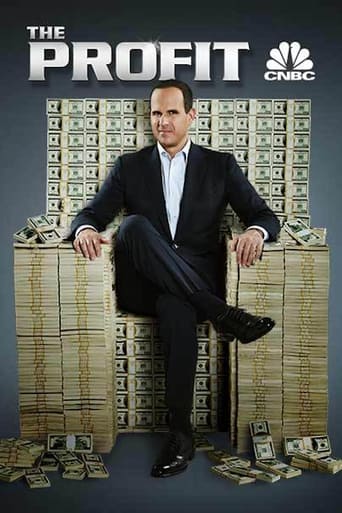
The Profit
2013 · TV series · 45 min episodes · 8 seasons
When Marcus Lemonis isn’t running his multi-billion dollar company, Camping World, he goes on the hunt for struggling businesses that are desperate for cash and ripe for a deal. In the past 10 years, he’s successfully turned around over 100 companies. Now he’s bringing those skills to CNBC and doing something no one has ever done on TV before … he’s putting millions of dollars of his own money on the line. In each episode, Lemonis makes an offer that’s impossible to refuse; his cash for a piece of the business and a percentage of the profits. And once inside these companies, he’ll do almost anything to save the business and make himself a profit; even if it means firing the president, promoting the secretary or doing the work himself.
5 positive2 negative2 neutralfrom 9 commenters
Where to watch
No streaming data for this title.
10 comments on Hacker News
> In fact, I’m so impressed with how well The Profit scenarios illustrate the value of capitalism that I now build upon it a challenge to socialists: please describe in detail how The Profit style enterprise reform would happen under socialism.
It probably wouldn't. So what? Is the argument here really "an economic system is only viable if it can accommodate CNBC's The Profit?" A society with a different economic system would have different structures in place for reforming failing businesses. For instance — off the top of my head — conditional grant or loan programs that oblige the recipient to seek professional management counselling, perhaps. They might work better, or they might work worse. But they wouldn't be The Profit.
That said, I don't think that this sort of enterprise reform happens much under capitalism, either. Sure, it happens on one reality TV show, but that's not a real data point. Consider this claim made in the article:
> Another lesson from The Profit is that firm problems are personal problems. The son who can’t step out from the shadow of the father and the father who can’t let go. The two brothers who haven’t gotten over the death of their father and the problems this creates in the firm they have inherited. The siblings who are still fighting to get their parent’s attention.
This is reality TV! The episode where the problem arose from zoning laws or product/market fit didn't get produced. You can't draw conclusions from something which is designed primarily to be dramatic and entertaining, rather than to provide a realistic survey of the problems faced by small businesses. If this kind of investment were especially profitable, lots of people would be doing it, and we'd be able to point at the statistical impact it has on small businesses instead of appealing to a TV narrative about it.
Ever seen Marcus Lemonis on The Profit?
Great TV show.
There's a great CNBC show called "The Profit" which really makes it easy for a layman to understand how private equity works. On the show, it's interesting to see how the investor who is putting up his money is often uninterested in investing in a company that's growing quickly and making good profit margins.
I can only speculate on what the investor's true motivations is. But there was one episode in particular which was interesting:
1) The investor came in, offered up a few hundred thousand dollars for a 51% stake
2) He immediately had the company upgrade their equipment, purchasing new equipment
3) Eighteen months later, the company was bankrupt
When all the dust settled, the company was re-packaged and sold to another company, the original owners were gone, and the manufacturing was sent overseas.
When the investor was having them buy a bunch of equipment, I was definitely wonder if his prime motivation was to simply have some tangible assets that he could recover once the inevitable bankruptcy occurred.
> So, by losing a small amount of money on some ridiculous businesses
Check out the recap in episode 1, season 5. Some of them make quite a good profit.. and some don't.
> he makes a whole lot more on the back end of being on TV, selling business books, giving speeches..
hm.. did you do the math on this? Seems like you would have to sell a lot of books to cover losses of a few million USD per year [1]. And AFAIK he's not selling any books (?).
[1] https://en.wikipedia.org/wiki/The_Profit_(TV_series)
There was remarkable moment in one episode where the company had made a really bad deal on a long term lease. Somehow Marcus solved the problem and I immediately grabbed my notebook and leaned in...
After a commercial break you learned he solved the problem by, drumroll, buying the entire building! IIRC it was a $20Million+ purchase since it included the neighboring suites as well.
There is much to learn by watching the Profit, but that moment was just another example of a recurring theme. That money can solve a lot of problems.
It's worth noting that The Profit picks companies that are inherently dramatic because it's a TV show.
The goal of a TV show is to get you to watch. Thus, the more of a train wreck, the more likely you watch.
If Marcus was trying to maximize his ROI on the business investments, he would start with different businesses and more reasonable owners.
Instead, he is maximizing the ROI on his TV show and his Brand (ugh, I hate that word).
So, by losing a small amount of money on some ridiculous businesses, he makes a whole lot more on the back end of being on TV, selling business books, giving speeches, and in general looking like a business hero.
The long play here is very, very smart and has obviously paid off already.
No. You need a leader. A flat structure will eventually create problems. And they will be hard to solve. Or you could lose a good chunk of the team due to the lack of direction and management.
The following will not be perfect analogs, I offer them as thinking tools:
8 seat rowing shell: It's hard to think of a better example of a small group of people with a well-defined purpose who train hard and execute hard towards that goal. Yet, the boat has NINE people on it. The ninth peeson is there to keep the team going in the right direction and at the right pace.
A leader is important and he/she does not have to be dictatorial to be effective.
The second example is more of a homework exercise:
Watch a dozen (or more) episodes of "Kitchen Nightmares" with Gordon Ramsay. Think about the most common issues leading to failure. Write a one page note advising your team on how to avoid failure.
The third and final is also homework:
Watch a dozen (or more) episodes of "The Profit" with Marcus Lemonis and write a short conclusion as above.
Business isn't hard if you understand there are commonalities between making burgers, manufacturing baseball bats and, yes, making software. At the core they are the same. Above that they have specialized processes that are aligned with what the business is about. The operating approach between knowledge workers and assembly line workers naturally diverges in a lot of areas.
Think of it as the OS kernel versus abstraction layers above it. The same kernel functions are pretty much required in order to build a successful system. That's where you start. Same with business.
No I don't.
As many have pointed out in this thread, the world is full of entrepreneurs who come from very little and make it happen.
To me saying "I have nothing" is just an excuse. Particularly in the US. If you want to make something happen, you can, it will not be handed to you, but you can.
What these studies never look at (because it is virtually impossible) are the massive numbers of businesses that start from "wealth" and fail miserably. I know people who were handed money and had no worries about failing. And, guess what, most of them fail. Why? Frankly, I don't know the exact mechanism. It has to be similar to folks who win the lottery and proceed to implode within a year or two. Or how about actors who make millions to shoot a movie in a few weeks and the best they can do with their lives in between movies is stuff drugs and alcohol into their bodies?
Nah, money may be a factor for some, but if someone doesn't truly want to be an entrepreneur you can throw millions at them and they'll just blow it.
Some of my favorite TV shows are "Kitchen Nightmares" with Gordon Ramsay, "The Profit" with Marcus Lemonis, "Make me a Millionaire Inventor" with George Zaidan and Deanne Bell and, of course, "Shark Tank".
I actually use them as teaching opportunities for my kids. We record episodes, watch them together and have discussions over dinner. The kids are good enough now that they can identify problems and patterns right away. Now we pause episodes and have discussions prior to the conclusions being revealed. The kids are getting a "virtual MBA" before they finish high school, which is great.
A common thread in a number of these shows are people who either inherit their businesses (lots of that in the restaurant show or The Profit) and proceed to run it into the ground. Almost nothing could be a stronger demonstration that money isn't a success factor in entrepreneurship than to see someone quite literally being HANDED a FULL WORKING BUSINESS only to proceed to destroy it. Why? Lack of focus, grit, drive, etc. All the qualities I mentioned in my prior post. I've seen shows where people end-up hundreds of dollars in debt because they simply had no engagement until someone from the outside slapped the shit out of them in a figurative way and got them to actually work on the business.
Money is just another tool, like 3D printer or a laptop. Millions of people have very expensive laptops. Most, from an entrepreneurial perspective, utterly waste them on Facebook and playing games. At the other end of the scale, a true entrepreneur with grit and determination can grab a second hand piece of shit PC, load Linux into it, use a bunch of free tools, learn to code and make something happen.
Entrepreneurship isn't about money.
I have a hard time getting past this aspect of reality TV. I recently watched a few episodes of "The Profit" which is basically "Kitchen Nightmares" but for businesses, but it just really bothers me how staged it all seems and how resistant people are to take the advice of a guy on a show who they surely put in a ton of effort to get on and must have seen before. When watching this stuff with other people I find it annoying how no one else really see's through the clearly contrived story they're trying to tell.
Does anyone watch "The Profit" on NBC?
I love the few episodes I've seen so far.