 Hacker Cinema
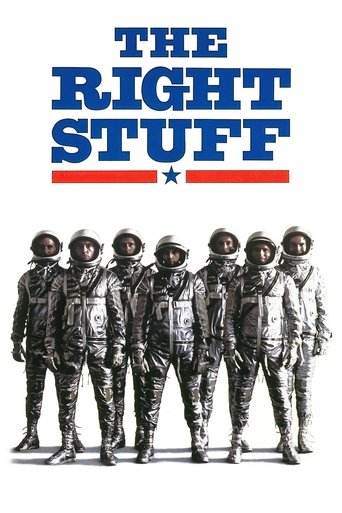
The Right Stuff
1983 · Film · 193 min
Directed by Philip Kaufman
At the dawn of the Space Race, seven test pilots set out to become the first American astronauts to enter space. However, the road to making history brings momentous challenges.
19 positive1 negative3 mixed9 neutralfrom 32 commenters
Where to watch
No streaming data for this title.
33 comments on Hacker News
There's a scene in the movie "The Right Stuff" that shows this. Pretty funny ...
I meant what was shown in this movie [0]. In a nutshell, the ability to remain calm when the unexpected happens, to try to solve the problem, or at least to not make it worse.
[0] https://en.m.wikipedia.org/wiki/The_Right_Stuff_(film)
If you haven't seen it, "The Right Stuff" is an absolutely awesome movie about this era. Of course it takes some dramatic liberties, but is overall also quite historically accurate. So one fun anecdote, that really happened, is that these capsules/suits were so barebones that there wasn't even urine collection. The pilot was expected to simply 'hold it.' In one launch, there was a delay of 4 hours and Alan Shepard ended up pissing his suit - resulting in short circuits among the telemetry. The solution on the next flights was for astronauts to wear rubber pants... seriously! [1]
Put another way, these guys were being treated like a glorified version of Laika [2], and they knew it. It was all about achieving the mission goal as quickly and cheaply as possible. Everything else was secondary. This sort of stuff wouldn't pass muster in a million years in modern times, which again gets back to the original topic.
[1] - https://en.wikipedia.org/wiki/Project_Mercury#Pilot_accommodations
[2] - https://en.wikipedia.org/wiki/Laika
In the movie "The Right Stuff", Gus Grissom is not portrayed in a very positive light, particularly regarding the incident with the hatch blowing after splashdown on his Mercury capsule. Grissom asserted that the hatch "just blew". The investigating panel countered that there had been done all sorts of tests on the bolts and they never "just blew", putting suspicion that Grissom somehow managed to trigger the hatch.
Later investigation found that, indeed, there was a problem with the way the explosive bolts worked, that they could "just blow", and for that reason, they were not on Apollo 1.
If Grissom had not encountered that problem with his Mercury flight, then Apollo 1 would likely have had a different hatch design and they may well have survived that fire.
Later Apollo capsules had a different hatch design.
They talk about this in the "Apollo 1" episode of the mini-series "From the Earth to the Moon".
As a kid I was totally obsessed with this plane. As cheesy as it sounds the movie The Right Stuff served as inspiration. I wanted to become someone to fly it. I must have built this model at different scales 15 different times and devoured everything I could learn about the SR-71. Unfortunately I graduated from high school in 1991 and the peace dividend was in full effect. I also found out in college later that my eyesight and color blindness wouldn’t qualify me to fly. So I studied physics instead. As a professional engineer with 30 years of experience it continues to awe me that they were able to build such a machine in 1964.
"The right stuff" to me will always be a wonderful 1983 movie about the early US space program.
https://www.imdb.com/title/tt0086197/?ref_=nv_sr_srsg_0
I'm sure it was over-dramatized in the film (which I haven't seen, I'm just assuming they prioritized compelling storytelling based on the fact that it wasn't a public television documentary), but supposedly something like that decisionmaking process actually happened. For example, see Wikipedia's synopsis of the book, which was presumably at least somewhat more factual (https://en.wikipedia.org/wiki/The_Right_Stuff_(book)#Book):
The storyline also involves the political reasons for putting people into space, asserting that the Mercury astronauts were actually a burden to the program and were only sent up for promotional reasons. Reasons for including living beings in spacecraft are barely touched upon, but the first option considered was to use a chimpanzee (and, indeed, chimpanzees were sent up first).
Another option considered was using athletes already accustomed to physical stress, such as circus trapeze artists. Wolfe states that President Dwight D. Eisenhower, however, insisted on pilots, even though the first crew members would not actually fly the spacecraft.
This is the dialogue, between Gus and his wife, that addresses the controversy surrounding the incident, during an argument between the two in 'The Right Stuff':
Mrs. Grissom: Look, I am finally Mrs. Honorable Astronaut. But they are treating me like I'm... Honorable Mrs. Squirming Hatch Blower.
Gus: I didn't do anything wrong! The hatch just blew! It was a glitch! It was a technical malfunction! Why in hell won't anyone believe me?
The film acknowledges the controversy, and that Gus maintained his innocence, without drawing any conclusions.
I'm a kid of the 90's but my dad loves "The Right Stuff" so I grew up on that film. Such a cool story. Sorry to see he has passed.
He was one of my earliest heroes. The movie "The Right Stuff" was released in 1983, when I was 12 years old. The movie and Yeager's autobiography, "Yeager, and Autobiography" were frequently consumed during my teenage years. I often watch the right stuff right up to that moment that the focus shifts away from Yeager.
I learned plenty from Yeager's story and his accomplishments. I admired how he became a pilot in WWII, as a "Flying Sergeant", how he worked to break the sound barrier, and how he sought combat commands in Korea and Vietnam.
Today, I am reminded of one minor anecdote that had a big impact. In the book, Yeager describes the treatment he used to avoid permanent burn damage from his F-104 accident in 1963. During college I crashed on my mountain bike and suffered road rash on the left side of my face. The ER doctor advised me that I should expect permanent scars. Remember Yeager's treatment for his face, I used the same (an alternating application of Vaseline and Hydrogen Peroxide). The treatment left me with no scars, just as it left Yeager with no scars.
The lesson for me is that we can learn valuable knowledge in unexpected places, but we have to seek it out. Having heroes, respected authors, interesting subjects, and/or a focus of curiosity is a great way to learn and become inspired. Chuck Yeager met many of these for me, from 1983 when I first found him, to recent years enjoying his Twitter feed. He was a larger than life legend who encouraged me to be more daring, and saved me from permanent scars.
Godspeed General Yeager
This resonates but can also be viewed as testament to the rapid deterioration of American society on all fronts but most importantly in ethics and values.
One great movie that brilliantly captures the American pioneering spirit is “The Right Stuff” [1]. It is old movies like it that can quickly illustrate the magnitude of American decline. Compare and contrast the values projected back then with today’s relentless materialism, cults of personality, money/status worship and a tendency to radically deconstruct everything towards a uniform egalitarian race to nothingness.
[1] https://www.imdb.com/title/tt0086197/
Oh man. So many. Anything by Brandon Sanderson. Most of his stuff takes place in the same fantasy universe, and some of the series are starting to cross over. Stormlight Archives is the crown jewel. Edit: each series takes place on a different planet in the universe with a separate (well thought out) magic system. Different books in different series start to reveal the why's and how's and how it is all linked.
Enjoying the Expanse series right now by James Corey, sci-fi with us living on Mars and in the belt, when a dangerous alien self-replicating molecule shows up.
If science fiction is your thing, I can't recommend higher the Hyperion series.
Freedom and Deamon by Daniel Suarez were really fun, a muder mystery where the murderer is dead and uses an advanced AI to do his dealings.
The Martian was fun, if a little shorter than I typically like. Better than the movie, as nearly always.
I could go on. Gaah! So fun!
Edit: usually not a history person, but also really enjoyed The Right Stuff read by Dennis Quaid. The start of the space program.
The Right Stuff is about Mercury, not Apollo. Great movie though.
A phenomenal movie on the Apollo program and our lead up to is "The Right Stuff" [1]. It's a 1983 film that I only ran into by complete coincidence. It holds up extremely well and is loaded with fun symbolism, real footage, and other stuff making it a multi-watcher. It also gets into the CIAs involvement and the dangerous relationship between visible progress and program/pilot safety.
[1] - https://en.wikipedia.org/wiki/The_Right_Stuff_%28film%29
Anyone taking this ride for the prestige of being an astronaut, rather than intrinsic reasons, is likely to find that, for most people, suborbital flight doesn't count. Tom Wolfe's "The Right Stuff" describes John Glenn's understanding of this perception (though in general, that book is more journalism than history (and the movie is a movie.))
The best book I know on high tech clothing design is Spacesuit from MIT Press[0]. Great story of how the engineers and designers at a women's underwear company (Playtex) massively outperformed all the "military armor" inspired hard-shell suit designs put forward by the favorites of the ex-military-aviation guys running the space flight program at the time.
As someone who has built high-grade muscle and body simulations for the film industry, trying to respond well to the full range of motions and deformations of the human body is definitely a non-trivial engineering challenge. In men's fashion, for example, Italian cut pants look great when you wear them but the front pockets are guaranteed to lose any coins you're wearing when you sit down because the engineering tradeoff swung too far one way and didn't address enough issues the other way (the issue has to do with the way the inner pocket structure is anchored to the seam of the pants, so it never gets out of place but also is forced to tilt the wrong direction dumping its contents if you sit on an overstuffed couch). The spacesuit designers had to get every part of the body right (though as anyone who has watched The Right Stuff[1] knows the original suits weren't actually designed to manage a couple key body functions, which became an issue when launches got delayed).
[0] https://mitpress.mit.edu/books/spacesuit
[1] https://www.rottentomatoes.com/m/right_stuff/
While I love 'The Right Stuff,' Tom Wolfe took many liberties with the truth, distorted events, and did not properly interview his subjects. Tom Wolfe himself admits that Alan Shepard hated it.[1] (Shepard accused him of never interviewing the astronauts)
For me, one of Wolfe's most troubling "creative interpretations" is his portrayal of Gus Grissom. He heavily implied that Grissom "screwed up" by taking a prevalent media theory and running with it because Grissom was already dead and couldn't tell his side of the story.
"""
Even after his death, perhaps because he was an easy target and could not defend himself, the public opinion of Gus was still questionable. In the book and the movie, "The Right Stuff," Tom Wolfe portrays Gus as "the goat among the astronauts, a hard-drinking, hard-living type who courts the favors of barmaids with gewgaws he promises to carry into space. He is also held up to the world as a man who screwed up, who panicked, blew the explosive hatch off his capsule and allowed it to sink to the ocean floor after reentry."
Wolfe described the scene at Edwards Air Force Base after Gus's Liberty Bell 7 flight as such: "And at Edwards . . . the True Brothers [test pilots who were not selected for the astronaut program]. . . well, my God, as you can imagine, they were . . . laughing! Naturally they couldn't say anything. But now - surely! - it was so obvious! Grissom had just screwed the pooch!"
Gus Grissom vs. the Media: Victim or Hero?
http://datamanos2.com/apollo1/grissom-media.html
"""
None of this ever happened. NASA's own internal investigations cleared his name and he later led an extremely successful Gemini mission and the ill fated Apollo 1. [2] He was the first member of the Astronaut Corps to fly in space twice and would have arguably led Apollo 11 had it not been for the fire. [3]
Tom Wolfe wanted to write a dramatic story about a group of people explicitly chosen for being preternaturally calm. So he resorted to creative devices (there are "composite characters" within the book) and fiction to spice things up.
If you'd like to get an accurate view of space history, then I'd suggest these books by astronauts and flight controllers.
Jim Lovell's 'Apollo 13' https://www.amazon.com/Apollo-13-James-Lovell/dp/0618619585 (which takes a very interesting systemic approach to the failure and views it from the perspective of the engineering and other ground crew as well as the astronauts)
Gene Kranz's 'Failure Is Not an Option' https://www.amazon.com/Failure-Not-Option-Mission-Control/dp/1439148813
Michael Collins' 'Carrying the Fire' https://www.amazon.com/Carrying-Fire-Astronauts-Michael-Collins/dp/0374531943 (he wrote a part of this in orbit around the moon while Armstrong and Aldrin made their historic landing)
Eugene Cernan's 'The Last Man on the Moon' https://www.amazon.com/Last-Man-Moon-Astronaut-Americas/dp/0312263511
Shepard, Glenn, Cooper, Grissom, Schirra, Carpenter, and Slayton's 'We Seven' https://www.amazon.com/Seven-Astronauts-Themselves-Scott-Carpenter/dp/1439181039 (written in 1962 by the astronauts themselves)
John Young's 'Forever Young' https://www.amazon.com/Forever-Young-Life-Adventure-Space/dp/0813049334
Together I find these books to be much better than any other compilation, because they were written by the people who were actually there. Some are technical. Some aren't. A few are even poetic. But together they represent a thorough look at the Mercury, Gemini, and Apollo programs.
[1] "In other words they were like Everyman—except for Alan Shepard. He hated the whole thing, down to the paper it was printed on."
http://www.chipublib.org/interview-with-tom-wolfe/
[2] http://arstechnica.com/science/2016/11/with-every-splashdown-nasa-embraces-the-legacy-of-gus-grissom/
[3] According to Deke Slayton the "chief astronaut" who made flight selections, Grissom was on track to be a moonwalker. He was the key decision maker who pushed Armstrong forward as the first person on the moon.
http://www.umiacs.umd.edu/~oard/apollo/poss_moonwalkers.html
I also recommend the movie the Right Stuff. I saw the movie as a kid and it was really something inspirational to me at the time. Nice little article from Wired about John Glenn's depiction in the movie. https://www.wired.com/2016/12/john-glenn-became-big-screen-hero-right-stuff/
While not a replacement for book, 'The Right Stuff' the movie is a great movie.
I've seen that "no second chance" thing personally and it's hilarious to me. WTF? I would hum "Mars The Bringer of War" to FPGA guys at times because of this ( it's the theme used in "The Right Stuff" at Those Times in the movie ).
In the general case, no. The economics of software don't favor it. There are tools that inspect code and make helpful suggestions.
This is why you can't trust your synthesis tools, BTW.
But much worse in software is the cultural ... "zero" ( as in a zero in a filter) about the axis of provability in general. It's a point of despair.
I can tell you that in multiple cases, I was able to represent the "core" logic of systems much that I could build a test rig around it and do exhaustive testing ( with the caveat that it's only as good as the test framework ). Permutaitons are reasonably cheap these days. But to do this, you must nearly eschew the us of third party code and in cases, even large parts of standard libraries.
But the standard answer is to despair and moan "it's impossible." The "prove it correct" people and the "git 'er done" people are two different tribes.
You might like to read The Right Stuff [1], the film is good too but the book goes into quite a bit of detail on how the astronauts were seen as representing the nation.
[1] https://en.wikipedia.org/wiki/The_Right_Stuff_%28book%29
What a weird bunch of decades. This neurotic competition against each's own paranoia feels a bit absurd and sour. And I just finished watching a few NASA movies again (The Right Stuff, Apollo 13, ...) .. similar reasons.
Can't remember who exactly, but think it was Gus Grissom who brought along rolls of coins along during his Mercury mission as a money making scheme.
Remember reading this in The Right Stuff, and it was likely in the movie as well.
A good movie about aerospace and the origins of the U.S. space program (it's also a book) is "The Right Stuff".
I don't think the X-15 is in it, but it can give you an idea of what the times were like http://www.impdb.org/index.php?title=The_Right_Stuff
It's still worth a watch today.
Overall I'd say it was worth seeing, especially on big screen, the effects were great and the exploration of relativistic time dilation was generally really cool in a mass market movie, but there were a number of absurdities.
SPOILERS:
1. Thousand foot high waves don't move across 2ft deep water without breaking. Also, lame camera tricks prevent the astronauts from simply scanning 360d and realizing there's a huge wave bearing down on them. Also, there was no reason whatsoever for Doyle to die on the water planet.
2. Too emo. Too much bawling and crying, too much emotional decision making, the actors weren't convincing as trained scientists or disciplined test pilots. The audience actually burst out laughing when Mann and Cooper got into the fight on the ice planet, and when Cooper just let Mann bash his helmet in a couple times instead of pulling away like normal person would. See 2001: A Space Odyssey and The Right Stuff for how such people should be portrayed. Artistic integrity sacrificed for artful, faux emotional appeal, SOP for Hollywood these days.
3. When Mann crashed the shuttle into the mothership, then Cooper and Brand saved the mothership, one second it was over a planet, and not the first planet they visited that was really close to the black hole but the next one out. The next instant they were in danger of falling into the black hole. Months or years worth of distance traversed in seconds.
4. Cooper saved Brand by dropping both TARS and himself into the black hole, giving Brand on the mothership enough velocity/lack of mass/whatever to escape the black hole. The time dilation effects of him dropping into the black hole should have meant he and Brand diverged greatly in age, yet the end of the movie showed him taking off to go find her, same age.
5. The premise of the movie is that future, advanced, five-dimensional humanity was using its power over gravity, time, and higher dimensions to help humanity of the past survive the dying and 'Marsification' of the earth. But the paradox was never resolved - if humanity of the past couldn't survive on its own, how did it ever become humanity of the future? I suppose they did that on purpose to let the audience have fun debating it afterwards.
There were a few others I can't remember atm, but you get the gist. Some of these, like #3, I suppose have to be done to cram the whole story into a 2hr45m movie (another cool thing about it - nice and long), but others were just annoyingly pointless.
But again, overall it was good, worth watching, and having Kip Thorne co-produce helped a lot. Just don't expect perfection, even with his name in the credits.
The Right Stuff is an entertaining movie, but beware that it plays fast and loose with a lot of facts, and also does a great disservice in its depiction of the beloved and respected Gus Grissom, who was killed in the Apollo 1 fire and was most definitely not the cave man/coward in the movie.
I highly recommend the Discovery Channel mini-series "When We Left Earth: The NASA Missions". This mini-series covers the entire breadth of the NASA missions, from Mercury to the International Space Station. This series is available on Netflix: www.netflix.com/WiMovie/70218722
If "When We Left Earth" sparks your interest. I suggest watching "Apollo 13" and "The Right Stuff" next.
Lastly, I'm currently reading the excellent book "Moon Lander: How We Developed the Apollo Lunar Module". This book gives an insiders view of what it took to build the Lunar Module (LM). I particularly appreciate that the book covers a lot of the hard work, arguments, and drama that are often forgotten when we romanticize the past.
You can see this happen in the movie, "The Right Stuff", wherein John Glenn and the other astronauts insist the spacecraft must have windows so that they can pilot it. The conversation demonstrates how the engineers and the astronauts had totally different ideas of how it was supposed to work.
Too sad.
Just want to say that the mentioned book "The Right Stuff" exists also as a 3 hours movie from 1983. You'll find it on youtube, too (two parts). I really recommend this movie to everyone who's into spaceflight. Full with details and beauty, a true homage.
The Right Stuff http://www.imdb.com/title/tt0086197/
Oohh, that's it - in the film The Right Stuff, there is a sequence of failed launches, with an announcer counting down to ten and pulling a funny face each time a rocket fails.
At the end of the montage a parachute comically deploys with a pop and the guy mugs it up considerably.
I always wondered why they doctored the footage to produce a comic effect. - but hey - it turns out it was genuine footage... From the four inch flight.
Stunning really
The Right Stuff remains one of my favorite movies ever.
If any of you youngsters haven't seen it yet, you should.
The square peg/round hole sequence is of course the embodiment of the hacker spirit (not an original thought of mine, but I can't seem to find the original URL at the moment).
Another space/hackish movie would be "The Dish" about the Australian engineers in charge of one the (of course) dishes used to communicate with Apollo 11. Cliffhanger scene: the dish goes out of alignment for some reason and they need to scramble to regain contact in time to televise the moon landing.
And of course there's always "The Right Stuff".