 Hacker Cinema
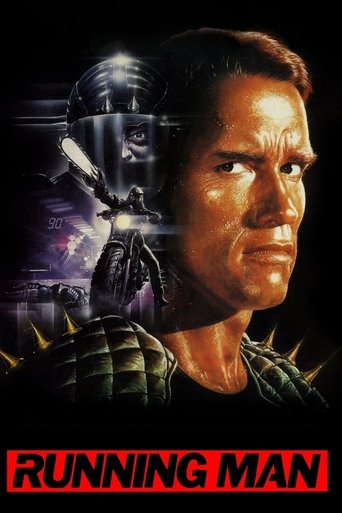
The Running Man
1987 · Film · 101 min
Directed by Paul Michael Glaser
By 2017, the global economy has collapsed and U.S. society has become a totalitarian police state, censoring all cultural activity. The government pacifies the populace by broadcasting a number of game shows in which convicted criminals fight for their lives, including the gladiator-style The Running Man, hosted by the ruthless Damon Killian, where “runners” attempt to evade “stalkers” and certain death for a chance to be pardoned and set free.
8 positive1 negative27 neutralfrom 36 commenters
Where to watch
No streaming data for this title.
Videos commenters linked
From YouTube links in the comments below. Most are clips and trailers; “Full” means the uploader says so.




38 comments on Hacker News
Domingo Gonsales is flown to the moon by tying himself to wild swans, and meets Lunar Christians - The Man in the Moone by Francis Godwin (1601)
Manned mission to the Moon by giant gun - Jules Verne (1865 ish).
Manned trip around Saturn by comet - Jules Verne (1877).
Time traveller sets off to the future - H.G. Wells (1894)
Martian invasion of Earth - War of the Worlds by H.G. Wells (1905)
Global telephone network reaches as many connections as a human brain and wakes up - Dial 'F' for Frankenstein, Arthur C Clarke (December 1, 1975)
Birth of Dr Susan Calvin, founding of US Robotics & Mechanical Men, development of 'Positronic Brain' - Asimov's robot stories (1982 and after)
British space station under construction - The Outward Urge by John Wyndham (1994)
Portal to parallel universes - Sliders (1994)
Doctor Samuel Beckett steps into the Quantum Leap Accelerator and vanishes - Quantum Leap (1995)
Skynet becomes self-aware - Terminator 2 Judgement Day (August 29, 1997. at 02:14 am Eastern Time)
HAL 9000 AI computer operational (1997), first human voyage to Jupiter system (2001), first landing on Europa and alien life discovered (2010) - Arthur C. Clarke's 2001 A Space Odyssey
Moon leaves Earth Orbit after nuclear waste explosion, taking human-occupied Lunar colony with it - Space:1999 (13 September 1999)
Efficient international flight, using Zeppelins and blimps - Rudyard Kipling (2000)
Global climate disaster - The Day After Tomorrow (2004)
Replicants - Bladerunner (2016)
Keanu Reeves smuggles digital information in his brain - Johnny Mnemonic (2021)
Arnold Schwarzenegger kills to survive in a typical American TV show - The Running Man (2025)
Woman relifed into robot, rich people discover workers' rights - Fritz Lang's Metropolis (2026)
First colony mission to Mars, 100 colonists on the largest spaceship ever built - Kim Stanley Robinson's Red Mars (2026)
Tibetan monks finish listing all the names of God, stars start going out - The Nine Billion Names of God, Arthur C. Clarke (when computers were rentable and could print 1000 names per second)
and many more: https://scifi.fandom.com/wiki/Timeline_of_fictional_future_events
Climbing for Dollars is from The Running Man[0], the Arnie version from 1987 - same year as Robocop.
Then in 2001 was "Series 7"[1] (which I got flashbacks of from the 2013 White Bear[2] episode of Black Mirror).
[0]: https://en.wikipedia.org/wiki/The_Running_Man_(1987_film)
[1]: https://en.wikipedia.org/wiki/Series_7:_The_Contenders
[2]: https://en.wikipedia.org/wiki/White_Bear_(Black_Mirror)
Trivia for music nerds like me: Mick Fleetwood and Dweezil Zappa are in The Running Man.
I replied to the dead "What did you read in 2025" thread, so I'll just paste it here.
Usually I hit a book a week pretty reliably, but this past year has been particularly crazy according to my audible purchase history. There are around 80 titles that I've added in 2025 and I've completed the vast majority of them. Some stand outs for me:
Dungeon Crawler Carl - One of the few novels that I think it actually much better in audio format. The narrator is excellent and it's a fun adventure that never takes itself too seriously. I'm not into litrpg typically, but I really enjoyed the 7 novels in the series so far.
The Laundry Files - I've made it through seven of these books and I really like the mix of mundane government IT with supernatural horrors. Tropes come up like the government tracking paper clip usage, and then you'll get a mystical explanation that makes sense in world so suddenly tracking individual paper clip usage doesn't seem so ridiculous. Generally a fun series, but it seems to be moving towards a revolving cast that I'm less interested in continuing on with.
The Library at Mount Char - One of my favorite books this year. Quite dark and mysterious. I liked the payoff and character arcs. But really it's the well maintained atmosphere that pulls everything together.
There Is No Antimemetics Division - What might the science and research of literally unknowable things look like? Things your mind rejects or presences which can influence your mind to make themselves invisible and leaves no memories behind. Weird novel that doesn't hold your hand too much.
Heavy Weather - A sort of modern cyberpunk meets western novel. Storm chasers following a predicted F6 super tornado across the US south.
The Running Man - I'm not typically a King fan, but I do like some of his works. I have fond memories of the movie from childhood nostalgia so finally gave it a try. I do think it's one of his better works according to my tastes.
Mickey7 - I'm a sucker for time loops and death loops and adjacent novels. This was a short but fun book.
The Society of Unknowable Objects - Small group of people collect mysterious objects from around the world to keep humanity safe.
The Invisible Life of Addie LaRue - Another one dealing with memory. What would it be like to be immortal, but everyone you interact with forgets about you minutes after you leave them.
Edge of Tomorrow - Time loops!
The Troop - Decent read if you like horror novels. One of the better horror novels I read for the year.
The Running Man was not supposed to be a documentary...
"The Running man" by Stephen King was published in 1982, the movie starring Schwarzenegger was released in 1987 (another adaptation will be released this year in 2025)
The story is similar to a Robert Sheckley's short story from 1952,"The Prize of Peril" adapted into a movie in Germany in 1970 "Das Millionenspiel" and in France in 1982 "Le prix du danger" (same year as King's Running Man novel)
I would say "The Prize of Peril" is the grandfather of these books, movies and series, as far as I know. Battle Royale is the start of another branch, though : it's not one vs many anymore, it's many vs many.
https://en.wikipedia.org/wiki/The_Prize_of_Peril
Both versions of the running man are very interesting. Whereas the book was more of 'we are all doomed' and the movie was more 'we can take control of this'.
Running man (1987) was an important film in this genre
> Overall, I'd say the most accurate sci-fi I've ever seen, as far as predicting things, is the 1986 Arnold Schwarzenegger movie "The Running Man".
Best I can think of was a surprisingly sophisticated 1970 young adult book by John Christopher, which had a mid 21st century Britain run by a Brave New World style low key authoritarian surveillance state divided between overcrowded cities that had very modest use of technology like electric cars and "holovision" and well to do rural areas that have an Amish style renunciation of technology like cars (but really the continued existence of their society depends on tech). Particularly because it lampshaded all the sci fi that was coming out at the time by having a teacher tell the kids "we stopped spending money on the space programme because it was a waste of money"...
(Oryx and Crake is very good too, though the sequels lose a bit because it turns out all the cliches about the world outside their gated community are actually true...)
The Running Man was based on a psuedonymous Stephen King novel, FWIW
Arnold Schwarzenegger's movie "The Running Man" predicted exactly this back in 1986. Most of its other predictions have also come true already, or are getting very close.
Is the fact that all tech has mostly the same look related to the fact that it's mostly all just used for consuming the same content?
I think this is part of it (but then again, we're consuming mostly the same content we always have), but I think there are bigger reasons. It's more about how fewer companies are designing/producing tech. Add that to the fact that each company's design is branding, and we're unlikely to see such radical changes to the designs of popular tech, like a ThinkPad, and many companies want to copy the successful look of say, a MacBook, rather than risk creating something new (all these look-a-likes are probably all using the same off the shelf parts, so that lends itself to having a similar design as well).
The next is the advance of touchscreens. A flat panel can be the UI for anything, and it's probably so much cheaper than developing purpose built UIs. For this reason, all UIs are the same flat panel touchscreen with different graphics on them instead of a unique-looking array of physical buttons, switches, dials, etc., let alone any custom parts.
It's like seeing the alternate possibilities for how tech could have developed, and invites you to ask "What if we had tech just like now but used it differently".
I just watched the Running Man over the weekend. Even though it was set in a dystopian 2019, the tech that the film imagined for 2019 looked so much more playful and interesting than what we have today. Compared to some more recent film's guesses about future tech which usually involve graphics on a touch screen that may or may not be invisible.
Is this just nostalgia for physical buttons or is do we all get excited to play with physical objects? That, I really don't know...
I'd say its a fine suggestion. A dystopian movie portraying a futuristic, overly bureaucractic government which is highly dependent on unreliable whimsical machines paired with a hyper consumerist society.
Robocop and Running Man portray similar scifi futures / society.
If true this would not be a surprise as overlays of sports events is quite common now:
https://p11.tv/digital-overlay-advertising-at-real-madrid-home-matches-with-img-and-project11/
The best one of sports overlays is from The Running Man:
https://www.imdb.com/title/tt0093894/
https://www.youtube.com/watch?v=fc8kTma-36c
Every few years I re-watch the Running Man - and it gets scarier every time. Last time I watched it we only nearly had the video forgery technology from the movie (in civilian hands, at least). Now it actually exists.
agree —- i kept waiting for the author to spend more time on the indignity and exploitation Mr. Beast is dispensing. there are desperate people out there that will leap at a chance for this much cash. how long until we see a Mr. Beast version of https://en.wikipedia.org/wiki/The_Running_Man_(King_novel) (the arnold movie is ultra cheesey and fun too)
I think many people don't reflect on the show's messaging beyond the surface level "catchy costumes and violence in a game show" aspect (which honestly wasn't even new when Arnold Schwarzenegger portrayed it in Running Man).
The social critique of Squid Game isn't the squid game. It's the world outside the game. It's why so many of the participants not only volunteer but also volunteer to come back after having already experienced it. The world outside the game show is portrayed as so bleak that hundreds of people would rather compete in a life-or-death "game" that promises fairness and a life-changing cash reward.
And the critical message of the show is that this world outside the game is not significantly different from ours. The game is a grotesque exaggeration of a get rich quick scheme but there are plenty of examples for people hoping to beat the odds or being willing to scam others for promises of great fortunes (look no further than the way the GameStock pump and dump was framed as a proletarian revolution until it was revealed most of the stock movement was the result of established investors jumping in to cash out on the gullible masses still tweeting "diamond hands" memes as the tide was starting to turn).
The cheap gore horror sells the show, but the implications of the story it tells, what people are willing to do to themselves and others for the promise of a carefree life, and how characters from all walks of life can end up in the gutter and devoid of hope, is why people dig their claws into it for more than just a few viral marketing memes. It speaks to the zeitgeist, especially during a pandemic that has repeatedly demonstrated failures of government and society, and economical interests being placed above the individual's well-being.
Before 2020 many people likely believed that their country would come together in a crisis like this, that people with power would forego their own interests for once an help out or that the wealthy wouldn't do less than even the bare minimum to contribute to the society that made them rich. In 2021 I don't think there are many people left having any such illusions about the systems they exist within.
So yeah, detached rich people betting on the dying and desperate like horses in a race strikes a chord with people right now. A show casually presenting a social reality in which poor people are willing to participate in such a "game" even more so. Note that this show's success on Netflix followed both The Platform and Snowpiercer (or the serialization thereof) as well as Parasite and Knives Out. There's a common thread between the themes of these films and Squid Game managed to strike the nerve.
It's such an uninspired version of Running Man/Battle Royale/Hunger Games/Hostile/Movie of your Choice from the Dystopian "Rich people watch poor people do bad stuff for their entertainment" genre.
IDK, I hate capitalism as much as anyone on this site, but UGH what a boring take.
Honestly, "You" is a much better satire on the platform right now.
The problem with your wager is that on a long enough timeline, the doomsayers are always right.
So saying anything OR societal collapse is going to evaluate to true.
There are any number of disasters, both terrestrial and cosmic, that can radically change the landscape of the Earth.
I also don't really find discussions about what's going to happen beyond our lifetime that interesting for the most part. Often, they're just fantastic wishing attached to some loose thread of logic.
The Island
Escape from New York
The Running Man
Akira
Strange Days
A Scanner Darkly
Back to the Future II
Blade Runner
2001: A Space Odyssey
2010: The Year We Make Contact
Death Race 2000
1984
Terminator 2: Judgment Day
Freejack
Westworld
Real Steel
Pacific Rim
12 Monkeys
The Abyss
Timecop
And a host of other films and books are set in futures that are now our past. And while some of these are fantasy designed to entertain, they all make assumptions about what would be possible by that time. And we have fallen woefully short of those predictions. So short, that "flying cars and meals in pill form" is a meme about such predictions.
Think of it this way. Ever see the movie where they put the neck shackles on people that blow up if they do something wrong? Running Man is an example. With local device scanning, I feel apple is putting a neck bomb on me, but promising they won't blow it up unless I do so and so. I can't take the neck bomb off and never should have let them put it on in the first place. My head is now at the mercy of Apple now and forever because it's locked on. Now Apple can change the terms of service, boom. Apple has a bug, boom. Why in the hell would I want this neck bomb on me?!
I remember watching "The Running Man" when I was a kid and thinking that the scene were Arnold loses the fight to the Jesse Ventura guy, that in the movie was a "Deep Fake", was so unrealistic... man, we are already there. Nothing can be believed anymore.
Minority Report came out in 2002. I remember people were talking about the targeted advertising going on in the movie. Two years later Facebook came out along with their pitch deck[1]. Now that movie seems quaint.
Developers and entrepreneurs are actively chasing dystopia. We've become increasingly numb and blasé about the encroachment of the internet and smartphones into our lives. Eventually we'll have The Running Man with live streaming. The end result of our social isolation and filter/engagement bubbles due to technology is moral apathy and rot. To speak the VC speak, the past few years have validated a market for cruelty, hate, and mob justice. The only question left is, how do I buy in today? Citizen seems like an early answer to this.
[1] https://app.slidebean.com/p/s15UZQkE7T/Facebooks-original-pitch-deck
Just another variant of deepfakes. All movies are “fakes” by definition. They also retrofit ads into live sporting events covering other billboards for over a decade now. None of this is new in fact.
Some people might even prefer the tracking part:
“So if you like wine then the hero of a film could be drinking a particular bottle that you might be tempted to try. Or if you are teetotal the star might be sipping on a bottle of branded water.”
-
Wonder how they will redo the dystopian The Running Man with ads:
https://en.wikipedia.org/wiki/The_Running_Man_(1987_film)
-
And while at it we already edit text and whitewash news and books. How about adding product placements from finance companies to The Merchant of Venice:
https://en.wikipedia.org/wiki/The_Merchant_of_Venice
The Running Man is great on so many levels including deepfakes. Arnold really was ahead of his time with those action movies including Terminator, Total Recall and Running Man.
You ever see the movie The Running Man[1]? What you describe reminds me of that, media run amok creating the narrative and literally killing people in the process for entertainment.
[1] https://www.imdb.com/title/tt0093894/?ref_=nv_sr_srsg_0
You're probably right that Hunger Games was the immediate inspiration for PUBG. I understand Hunger Games to basically be an American adaptation of Battle Royale though (and also derivative of The Running Man.) Battle Royale already had "cult classic" status in America by that time. The naming of the genre seems to support the notion that the public was generally aware of Battle Royale. Before Battle Royale the term was in use, but generally referred to free-for-all boxing matches. The modern use of the term to describe Hunger Games or PUBG seems to closely resemble the premise of the Japanese movie/book.
Somehow this reminds me of the "Running Man" movie. There was a comercial playing that said something like: "Citizen, denounce your neighbor, and get some extra dollars"...
There should have been more positive visions of the future. These idiot companies took the shit from the 80s as script it seems.
OK seriously, the other day at work we were talking about a coworker and one of my other coworkers said, oh you mean Sam Elliot because the first coworker looks like Sam Elliot from Roadhouse. Then there was a 15 minute discussion about the film Roadhouse. I went home and on my youtube recommended videos to watch was one about the movie Roadhouse. I only had my phone on my desk and my work desktop has no internet access. Is this just coincidence¿
Just yesterday i watched Running Man on my Plex Player running on my raspberry pi. Again I now have multiple Running Man videos in my youtube queue.
I hate it but feel so helpless about it. Maybe it is all coincidence and i am just that lucky and should buy a lottery ticket. Does anyone else have this stuff happen?
How about The Running Man? I never read the book but I believe the villain was a game show celebrity, same as in the movie.
>The battle royale subgenre started with the Minecraft hunger game mode, and grew more popular by H1Z1: King of the Hill, and then by PUBG.
Minecraft had nothing to do with it. PU was inspired by the Battle Royale novel/movie and The Running Man. He forked the Day Z ARMA2 mod and made DayZ: Battle Royale, and that predates H1Z1 KotH by 3 years.
Your comment reminded me of the 80s movie Running Man. There are no rules, there is only winning.
Which is the antithesis to principles of competing fairly. And in Running Man there were undiscovered rules, but only ones to game the sport which came crashing down resulting in a loss of trust of the institution.
Transparency is key for trust in sport and thus continuality of the larger body.
Corporate control: One or more large corporations control society through products, advertising, and/or the media. Examples include Minority Report and Running Man.
• Bureaucratic control: Society is controlled by a mindless bureaucracy through a tangle of red tape, relentless regulations, and incompetent government officials. Examples in film include Brazil.
• Technological control: Society is controlled by technology—through computers, robots, and/or scientific means. Examples include The Matrix, The Terminator, and I, Robot.
• Philosophical/religious control: Society is controlled by philosophical or religious ideology often enforced through a dictatorship or theocratic government.
So I wasn't the only one to get a feeling that The Running Man (the movie version, specifically) was coming true when I saw a friend playing HQ.
You should try watching "The Running Man" from 1987, starring Arnold Schwarzenegger. At the time, it was a somewhat silly dystopian movie, extremely loosely based on some Stephen King story, with a really unique cast including Jesse Ventura, Mick Fleetwood, Dweezil Zappa, and Richard Dawson from "Family Feud".
Now, 30 years later, it seems remarkably prescient.
ED-209 wants to have a word with Robocop + I decreased frustration and societal unrest by massively funding Entertainment:
http://bit.ly/2mwwO7T
Basically, "Running Man" was entertainment / fiction when I read it as a kid, and it will be a documentary by the time I'm dead.
They don't have rights to stream any decent movies
That seems hyperbolic. Just browsing around (I decided to cap this at 5 minutes):
The Interview
Forrest Gump
Major League
Pirates of Carribean
Hot Fuzz
Armageddon
Kingpin
A League of Their Own
Inglorious Basterds
Scarface
Django Unchained
Legally Blonde
E.T.
Days of Thunder
The Princess Bride
Crocodile Dundee
Clear and Present Danger
V for Vendetta
Galaxy Quest
Running Man
Big Trouble in Little China
Talladega Nights
Kill Bill (1 and 2)
Star Trek Movies (including The Wrath of Kahn)
Tommy Boy
Team America World Police
Lilo & Stitch
Jay & Silent Bob Strike Back
Wayne's World
Clerks
Bill & Teds Excellent Adventure
This was done satirically in an episode of Community (Season 5 MeowMeowBeanz). Where people interact with one another to gain "MeowMeowBeanz" a score, in a phone app.
Also within a 2 days society starts to look like something out of running man or hunger games.
Reminds me of the Running Man (1987) scene where, in supposed real-time, a video production editor synthetically composes Arnold Schwarzenegger's and Jesse Ventura's characters together in a deathmatch. One would have to go from rigid-component origami birds on static frames in this CMU paper to semi-solid human figures on moving frames in the movie. 3D models of famous actors' bodies are already made for special effects, painstakingly rendered and composited together in batch mode.
(Personal recollection: there was a solid model Shaq's head at 3d modeling company Viewpoint Datalabs back in the day. His head is huge.)
Stills from Running Man taken at about 01:19 - http://imgur.com/rQlxigG
I would say two things in response to this.
Firstly, think of the plight of the screenwriter who has to a) adapt a story that will take most people about a week to read into a three hour film; and b) has to create something that will make lots of money. I can completely understand the resentment felt at a beloved book being turned into a very different film - I have seen a number of well liked stories turned into something completely different (see my next point). I think you just have to view film adaptations as a completely different product.
Secondly, there is a long history of books being turned into films that do not bear much relation to the original work. A few examples from my own life. The Stephen King novella "The Running Man" was turned into a film that contained the same themes, but was a very different story. The film "The Lawnmower Man" was also taken from a Stephen King short story of the same name. The story of the film bore absolutely no relation to the film, and to this day I can't work out how they could possibly draw any relation between the two. A long time ago I hired a video of a Dean R Koontz story called "Watchers". I had enjoyed the book and jumped at the chance to see a film adaptation. I was to be disappointed. What I watched, whilst having the name of the book was not an adaptation of that book - the story was completely different. I can only think that they wanted the name of a popular author to help sell their shoddy film.