 Hacker Cinema
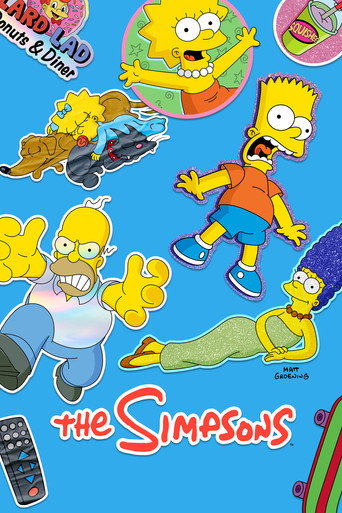
The Simpsons
1989 · TV series · 38 seasons
Created by Matt Groening
Set in Springfield, the average American town, the show focuses on the antics and everyday adventures of the Simpson family; Homer, Marge, Bart, Lisa and Maggie, as well as a virtual cast of thousands. Since the beginning, the series has been a pop culture icon, attracting hundreds of celebrities to guest star. The show has also made name for itself in its fearless satirical take on politics, media and American life in general.
88 positive65 negative24 mixed479 neutralfrom 656 commenters
Where to watch
No streaming data for this title.
750 comments on Hacker News
Remember that simpsons episode where they extrapolate Lisa's overbite
There have been a couple of episodes of Simpsons where “credit card debt” was the subplot. Should give a good idea how “relatable” the experience it was even in the older days. Obviously I’m exaggerating, but you get the idea.
I believe “The Homer” is a reference to Season 2, Episode 15 of The Simpsons, “Oh Brother, Where Art Thou?”
Homer reunites with his long lost brother, who runs car company Powell Motors. Homer is ultimately tasked by his brother with helping to design a car for the “average man” that ultimately bankrupts the company for being wildly overengineered and costing too much ($82,000 in 1991-money).
Here’s the car: https://simpsons.fandom.com/wiki/The_Homer
> Or alternatively best classic Simpsons episodes are yet to be made.
Yes. This will happen.... when pigs fly
(It's still good, it's still good)
I think there is real insight but it kinda relies on a rhetorical trick. AI could arguably create a simpsons episode. It absolutely could not make a Beatles song. The Beatles can only make a Beatles song, and they do not exist.
I think you're underselling where we'll get to in the next 5-10 years. I'm thinking:
Best Beatles song recorded between Rubber Soul and Revolver, composed mainly by McCartney but Lennon wrote the bridge and Ringo was feeling adventurous and Harrison was angry that day, and it was deemed not commercial enough to include on Revolver.
Best season 3 episode of The Simpsons, really showing the transition to Homer as the lead, written by Robert Cohen with significant musical input from Danny Elfman and featuring seven characters loosely representing the deadly sins, with Homer as Gluttony of course.
I feel like the best Beatles songs are yet to be written.
Or alternatively best classic Simpsons episodes are yet to be made.
I meant to write quite a long response to your comment, but let me just bring it down to a single question: How is your feeling different from melancholia?
There is and always will be mainstream, niche, the unknown and everything in between. There was always very little new material and a lot of works just gained recognition when their zeitgeist was long overdue, too. I think experimentation is hard, and it's even harder to justify experimentation in the evolving economic climate.
Genres are meant to be collapsed, or rather they should blend and dissolve into each other. The earlier (and good) seasons of The Simpsons are a poster child when it comes "flattening and duplicating old material". Almost every episode cites a movie or work of literature, and there was nothing wrong with it! It's part of why I understand the 90s as a cultural era of citations, and I had to grow up with that sentiment. It took me quite some time to understand that we moved past it.
Nowadays, we are fortunate enough that a lot of things from the past 10 decades have been digitized and are readily available on demand. That's amazing! Nothing is stopping me from asking myself some naive questions, like "What makes a good drama?" or "If Die Hard is considered to be a Christmas movie, why isn't Falling Down considered to be a summer movie?". I think there is still stuff to explore.
I'll just leave this unfinished thought with a recommendation to a niche movie I discovered recently: Sleep Has Her House (2017)[0]
[0]: https://scottbarley.com/Sleep-Has-Her-House
They still are. My kids haven't watched a single Simpsons or Family Guy episode but are quoting both regularly.
Facebook et al also quite literally stole email contact lists and installed spyware at kernel level on mobile phones which they used to spy on all Android users. Via the phone manufacturers.
There was a Simpsons episode about this: https://m.youtube.com/watch?v=ZPrh-1Tu-gE
This is super duper cool! I sat there and watched like 10 minutes of a live game and it was just balls, strikes, swing & miss, and foul LOL -- reminded me of that old Simpsons episode where soccer comes to Springfield and nothing happens in the match [0]
[0] https://www.youtube.com/watch?v=442NF5cZhyc
I respect it honestly.
The Simpsons used to be my favorite show, but I feel like the quality dropped dramatically after season ~13 or so. Part of that is because I got older, I'll admit, but even rewatching the older seasons, I still find them funny while season 13 and onward I simply don't.
I would have so rather they ended the show twenty years ago and use whatever budget they spent making it on new cartoons.
The title reminds me of The Simpsons, watch an episode and pause it. Unlike live action, every frame of The Simpsons is art. It is almost unbearable to internalize the sheer volume of purposely constructed images that The Simpsons is sending at you. Gluttonous in scale.
"Marge, there's the truth..." (frowns and shakes head negatively) "...and there's THE TRUTH!" (smiles brightly and nods enthusiastically)
-Lionel Hutz, Simpsons, Season 9 - "Realty Bites"
Remember how liberating it was to record TV shows or movies to VHS tape? My dad still has VHS tapes of Simpsons recordings that I'd rewatch as a kid.
To me it is the difference between art and product.
A show like The Simpsons is both. The viewers care about the art, and we tolerate the product to get it. The creators are creating art, compromising with the corporation and broadcaster to make it enough of a product. But the corp/broadcaster only care about the product. The art is the chocolate around the advertising pill.
So when the product-minded people control preservation and resharing of the product, the art always gets compromised. Jokes are clipped. Audio is broken. Episodes are pulled. For all the wrong reasons.
Not to go off on a complete tangent, but...
>... like the infamous Duff Beer joke being out of frame in The Simpsons.
My collection of The Simpsons, seasons 1-13, are all TV rips from waaaaayyyyy back in the 00's. Sure, it's not super high-quality, but at least they don't look like the ugly remasters (on some of the ones I've tried watching on Disney+, they look like someone's drawn over the old cells), the aspect ratio is the original so nothing's missing and, as a personal bonus, they've got the old Q13 logo in the bottom (I grew up in western WA). They still look great on my newer TV.
Edit: Oh, and the Michael Jackson episode never suddenly disappeared from my library.
You're moving goalposts. You literally said
> I fail to find anything in history that advanced the sciences or the arts through "collective effort of hundreds or thousands of humans".
> It's only for war or to consolidate power in the hands of the ruling class, never for the benefit of society at large.
I'm breaking it up into two statements because sufficient evidence has been provided to contradict the former, and some of your rebuttals did not align with the latter. Let's break those down:
> The moon landing is defintely a fruit of a war effort.
But is it only for war? Or did it "advance the sciences" + "for the benefit of society at large"?
> Wikipedia is the opposite of a top-down effort.
Your original statement didn't say it had to be a top-down effort. It's certainly "collective effort" + "not only for war" + "for the benefit of society at large".
> Aqueducts and railroads: responded on a sibling comment.
Scale and precision also matter and don't negate the fact that these are "something in history" + "collective effort" + "not only for war" + "for the benefit of society at large".
> LOTR films: I don't even know how it relates to the point, but it's funny that you cultural landmark that only worked because it's an adaptation of the works of a single individual.
I only picked LOTR films because they are notorious for being large scale and you never said it didn't have to be an adaptation. I could have picked The Simpsons, Star Wars, Breaking Bad, you name it.
Hate to say but this was in one of the Simpson’s episode
The phrase is a reference to an episode of the simpsons https://www.youtube.com/watch?v=RRdIltdDE4A
They are basically the car Homer designed in that famous episode of The Simpsons. They are the ugliest and and most impractical car ever designed. The fact that the bed cover blocks the rear view window should be illegal. Dozens of people must have told Elon how stupid using stainless steel for the body is but he ignored them all. The cabin looks incredibly cheap for an $80,000 car. It is a very bad truck.
I do have to admit the steer by wire system with adaptive sensitivity is neat.
It was a drama TV show, not a documentary. Whey compare it with TV shows, like Simpsons or movies like The China Syndrome, it was accurate.
"according to INSAG-1, the main cause of the accident was the operators' actions, but according to INSAG-7, the main cause was the reactor's design."
https://en.wikipedia.org/wiki/Investigations_into_the_Chernobyl_disaster
Evangelion is not “Japan’s version” of anything in terms of western religions. It’s one guy who was making a TV show. It’s not Japan’s “national personification.”
If you want to go down the rabbit hole you’ll find a lot of quotes from Anno and others on it.
A lot of it boils down to “we did this because it’s cool and we have no idea what Christianity is” down to Anno going “Yeah I could do this because no one in Japan is really going to care and I don’t really care about the Western world anyway.”
https://gwern.net/otaku
https://wiki.evageeks.org/Statements_by_Evangelion_Staff
It’s fine to not like it but it’s quite a step to go “this is how Japan thinks.” It’s akin to saying America is personified by the Simpsons every time they go to Japan.
I am reminded of the Simpsons episode in which Principal Skinner tries to pass off the hamburgers from a near-by fast food restaurant for an old family recipe, 'steamed hams,' and his guest's probing into the kitchen mishaps is met with increasingly incredible explanations.
How do you measure health effects of different sources of electric energy? If you compare deaths per TWh, then nuclear power is much, much safer then coal energy.
https://ourworldindata.org/grapher/death-rates-from-energy-production-per-twh
Nuclear power has problem with public perception.
One source of this media. Media loves to write and talk about nuclear incidents and really blow this out of proportion to real health hazards. For decades, newsrooms have operated under the premise that 'if it bleeds it leads'. If something happen infrequently and could have big impact on many people it makes more interesting news story.
Flight industry has similar public perception problem. Transport statistic shows that travel by airplane is safer the car, yet much more people fear flying then driving. A deadly airplane crash is reported in all newspapers, the daily deaths from the car crashes are not even mentioned.
Popular tv-series "The Simpsons" (three eyed fish, green radioactive goo), movies Spiderman (if I get bitten by a radioactive spider), Hulk (gamma rays make you super strong), China Syndrome, the german movie "Die Volke", etc., doesn't help much with education about nuclear power.
Deaths from burning coal don't get much attention in the media, because the happen continuously each year, over decades.
https://www.thelancet.com/journals/lanres/article/PIIS2213-2600(16)30198-9/abstract
It all comes down to the fact that DVD is more of an analog format than a digital one. I feel like people get “CD ripping brain” which causes them to think that the most desirable thing is making the most-accurate copy of what's on the disc. For CD that's true because PCM is PCM, but for DVD the thing we really want is the program material, which is three layers deep on a DVD: inside an NTSC video signal, which is digitized following the Rec.601 standard, which is then shoved into an MPEG2 transport.
Four major things that can be done to DVD to make them look great on modern displays:
- Deinterlacing is the hardest to get right. Progressive-scan 24-frames-per-second DVDs exist but are mostly confined to movies where there will be a better BD release anyway. Interlaced DVDs where the program material is intended to be seen in 24FPS get “inverse telecine” (IVTC) instead of straight deinterlaced, but again I don't do a lot of those for the same reason. Almost any NTSC DVD that I care to encode is thus going to be 60000/1001 fields per second, which needs to be turned into 60000/1001 frames per second to avoid throwing away half of the available motion detail. If you do nothing at encode-time and produce an interlaced output, then the display or player software will end up doing it and will do a bad job. HandBrake's deinterlacing options just don't look good in my experience. I like QTGMC for this because it predicts the motion of the infill fields instead of just copying the previous field verbatim. It's very noticeable any time there's a lot of horizontal movement in the program material.
- Resolution and ratio. Most people hear “anamorphic” DVD and think of 16:9 crammed into a 4:3 image, but the truth is that all NTSC DVDs are anamorphic. They're 720x480 which if you calculate it is actually a 3:2 aspect ratio. Very clever because it ends up being about the same amount of scaling for 4:3 or for 16:9 material. They rely on PAR/DAR flags to tell the player or display how to scale it, but modern displays have terrible terrible scalers because it's purely a box-checking thing for them and not a feature they spend money or effort on. When I encode a DVD I stretch it myself at encode-time to 720x540 or 960x540. There's obviously some artifacting inherent in that vertical stretch, but it avoids throwing horizontal resolution detail away by scaling 4:3 programs down to 640x480 like most encoders do. Then the 540 pixel-doubles cleanly into 1080, 2160, etc.
- SD colorspace (Rec.601 again) is a similar issue where modern displays are just fucking terrible at it because there's no economic reason for them not to be. The chroma is already subsampled, so greens especially end up looking washed out and terrible. When I encode a DVD I convert them into HD colorspace which doesn't restore subsampled chroma but at least avoids letting the display make it worse.
- Cropping. The program-area resolution is actually 702 or 704x480 for anything transferred from tape (look up SONY D-1). If you have any "DVDrips" sitting around of an '80s or '90s TV show, does it have 8 pixels of black pillarbars on the left and right? If so then the person who encoded it didn't know what they were doing. It subtly throws off the aspect ratio for the entire program, especially noticeable in animation where they tended to use exact-circle tools. Look at the characters' eyes in The Simpsons for a great example. I crop those off before my one-time scaling so the program ratio comes out perfect.
This all applies similarly to PAL DVDs except I'm usually shrinking them down to 540px because the loss of some vertical resolution is still better than trying to get a modern display to scale 576px to panel-native res, and deinterlacing PAL is a straight 50-fields-to-50-frames without the wacky 1001 division notation that is a legacy of the backwards-compatible way that color was introduced to NTSC.
Is the claim that these models can 1 shot a Simpsons episode remake with different camera angle and similar dialog from a prompt like "produce Simpsons episode S01E04"? Or are we falling into the "the user doesn't notice that they told the model the answer, and the model in fact did not memorize the thing" trap?
Everything you need to know about the Tech industry (or any industry for that matter) can be learned from watching the Simpsons - Season 4 Marge vs. the Monorail
I am still waiting for a donut to save us.
I recommend watching _The Fall of The Simpsons: How it Happened_ [0]. It goes though how the comedy went from sharp an witty to laugh track quality.
Personally, the only show that was also focused on sharp and witty was _Futurama_. That show was able to retain it better through out the years. Every series finally episode was a masterpiece.
[0] https://www.youtube.com/watch?v=KqFNbCcyFkk
> I often think about how much of a given it was that they own a house on a single income. Homer has a stable job, they don’t have a lot of stuff but they have some basic securities that I’ve been trying to work towards my whole life, and still haven’t gotten there
This was a common trope on TV shows of that era: Everyone had a cool house with a lot of space. It wasn't a reflection of reality, it was how sets were designed and shows were drawn.
The Simpsons even made fun of the fact in the famous Frank Grimes episode where they pointed out how absurd it was that Homer was a doofus who had a big house and beautiful family.
Somewhere along the line, we started confusing this TV reality with how families actually lived at the time.
The Zombie Simpsons explanation paints it (fairly convincingly) as a combo of deaths, turnover in the writing room, and the influence of The Simpsons and other “subversive” shows affecting the mainstream so much that it was no longer distinctive, with the result that the show became a heightened, silly, absurd, but basically straight, and (more, at least) earnest, version of the family sitcom it had started off lampooning.
https://deadhomersociety.wordpress.com/zombiesimpsons/
Under this explanation, the early show is basically a totally different thing from what it became by somewhere around season 10. Even if it didn’t “get worse” (I think it definitely did also do that, but it’s not necessary for this explanation to work) it became something so different that it’s not surprising that a lot of people who liked the early show, don’t like what it has been since the change.
> how much of a given it was that they own a house on a single income. Homer has a stable job
It isn't - especially if you watch the original first season of the Simpsons [0] (Homer's Odyssey - the 3rd episode of the Simpsons written right as the 1990 recession was kicking off) as well as that Frank Grimes episode back in 1997 [1].
The older Simpsons episodes weren't that common on syndication from what I can remember growing up - at most you might see an episode from 1994 in the early 2000s.
Simpsons in it's original iteration during it's golden age (1989-1999) was essentially lampooning the 1960s-70s American dream being punctuated by the harsh realities of America at the time.
What I've noticed from the comments on HN (as well as the viciousness of the community when I point this out) is most HNers grew up middle and upper-middle class households in the 1980s-90s that in most cases weren't representative of the lives the median American would have lived then, and a lot of the rose tinted glasses appear to betray that upbringing.
For example, from 1989 to 1994, household incomes in the US dropped at the same rate as they did during the Great Recession and the COVID Pandemic [2], but because most HN users today weren't the head of a household during that period they view the 1990s as a golden age.
[0] - https://m.youtube.com/watch?v=Gu1W8O-CKNw
[1] - https://m.youtube.com/watch?v=UNj2nlFttCM&t=71s&pp=2AFHkAIB
[2] - https://fred.stlouisfed.org/series/MEHOINUSA672N
>they own a house on a single income.
You want aspirational, look to Family Guy. Somehow Peter Griffin can afford a helicopter, a jet pack, and whatever expenses are required to obtain the foot of the statue of liberty.
>maintaining a 90s style of living is just not realistic in the 2020s
I think even in 1989, when the show debuted, two income families were starting to be (or already had been) pretty typical. I think the Simpsons might have been poking fun at the 1960s and 1970s family sitcoms where the dad went to work and the wife stayed home.
Edit: But you're right that in the 80s and 90s you would have a decent chance of buying a house (on those two incomes).
Part of the secret to the Simpsons' longevity is that is is something the majority of people on earth can catch a few seconds of in the background and still be able to follow by sheer recognition alone. This was always the majority of television, but the majority of television shows are cancelled and forgotten long before now.
It is now simply an extremely cost-efficient form of content relative to the value of the ad slots and licensing of the IP. People working on it now are technicians delivering a product to spec that is basically a perfect use case for generative AI.
"Hey claude, write me an episode of the simpsons where Homer starts investing in NFTs while Lisa and Bart goes to a comedically sinister horseback riding summer camp with a guest star that has a movie coming out this summer."
Or even:
"Write a skill that creates standard length 22 minute new simpsons episodes scripts and scene video prompts by combining a trending news topic with two or more simpsons characters. IMPORTANT: make it wacky!"
I wonder if it's plausible that AI could generate an entire (good) Simpsons episode in the future.
This predates 2005. A 1991 Simpsons episode depicts the rejuvenation powers of young blood.
https://en.wikipedia.org/wiki/Blood_Feud_(The_Simpsons)
Highly relevant Simpsons clip: https://www.youtube.com/watch?v=no_elVGGgW8
While being an insightful satire of mass training LLMs with (negative) reinforcement learning, it's actually from the 1993 episode "Last Exit to Springfield", thought by many (including me) to be the single greatest Simpsons episode of all time (https://www.reddit.com/r/Simpsons/comments/1f813ki/last_exit_to_springfield_2nd_best_tv_episode_of/).
Homer used to complain about the big things. He tried to kill himself in the third episode due to losing his job. The first 2 seasons are honestly comparatively depressing with some of the heavy topics they touch on.
The Simpsons just leant so far into 1-note characteristics that they became caricatures of themselves - and the term Flanderization was born.
> I find American humour so hard to relate to but I guess it's just a culture thing
These kind of comments always puzzle me. Hollywood makes stuff for the entire world, not just for a domestic audience.
Shows like Friends, Seinfeld, The Simpsons, pretty much any big sitcom you can name is in syndication in most countries around the world, because of how relatable it is.
It's often not sophisticated, and can be quite shallow (See Two and a half men or Big Bang theory), but it being hard to relate to is unlikely to be an issue.
I see what you did there. (cromulant was coined in a Simpsons episode)
> What is or was The Homer?
It's a reference to a Simpsons episode where Homer Simpson designs a car, and it's supremely hideous: https://simpsonswiki.com/wiki/The_Homer
Not a bad thing necessarily, but some part of the plot, and usually with things going awry or emphasizing the scammy nature of blockchain.
Examples: Shameless season 11, The Simpsons S31E13, Superstore season 5, the good wife S3E13, greys anatomy S14E8, big bang theory S11E9, Billions season 5, some later seasons of Mr Robot, etc
I would rather a show go on too long and let me decide when to stop watching, like how my Simpsons DVD rips are only seasons 1 through 10 (including season 11 holdovers, so my set ends on Sneed lol)
Corollary: I really miss Inside Job
They spent a lot of money doing a decent remastering job of TOS and TNG.
The public did not spend a lot of money on buying these remasters - they lost a lot of money.
The DS9 documentary "What we left behind" had some HD reproduction. It was great, and I was lucky enough to see DS9 on a big screen at an semi-arty cinema in Hackney (not a chain, but did have popcorn), but doing this type of production is expensive.
Automating it is far cheaper, and although it comes out crap - people would prefer to watch stuff in 16:9 and either
1) Have stuff (like the hold in the Friends wall) which wasn't suppose to be there
2) Crop stuff out (see the first 20 years of Simpsons)
With the Simpsons there was enough outrage that they gave an option to fix it, but for those who remember 20 years ago it was very common for the average viewer to have their TV simply stretch 4:3 to fill the entire screen width. Nowadays a whopping 4 in 5 people in America are using their phone at the same time as watching TV, they simply aren't paying attention.
The number of people
1) Who notice
2) Who care
3) Who are watching older stuff
4) Who will pay for it
Is tiny.
This is a response to you and the other Y people that confuse short videos with autoplay and user engagement techniques.
There are people that autoplay long videos, in fact people stream random Simpson’s (or other favorite tv show, podcast, music, books on tape, etc) episodes in the background while they work. Classic TV has autoplay with no opportunity to decide. Autoplay is not an exclusive short form video feature. I can make a short video on my computer and it will not autoplay other content.
When I saw Stephen Hawking on the Simpsons, it occurred to me that in no way was he on the Simpsons. Not his voice, nor his thoughts, nor his visage. All I saw was his brand I suppose. Stephen Hawking’s brand appeared in an episode of the Simpsons.
Simpsons, the Frank Scorpio episode. The advertisement for the company town shows a beggar slowly fading out and being replaced by a mailbox.
I was very young, but I remember my grandfather was very afraid to retire from the steel mill where he worked most of his life because those who retired tended to get cancer shortly after and die. Sure enough, a little over a year after his retirement, he got a cold that wouldn't go away, and was diagnosed with cancer and died not too long afterwards.
I've wondered for a long time (based entirely on anecdotal observations) whether some forms of cancer and other illnesses arise more quickly from sudden shifts in daily habit. Sometimes it actually does seem to me like the episode in the Simpsons where Mr. Burns thinks he is invincible.
https://static.wikia.nocookie.net/simpsons/images/0/05/TheHomer.png
(https://simpsons.fandom.com/wiki/The_Homer)
A classic Simpsons episode!
That's a deeply silly assertion.
Culture is one of our major and most successful exports. Afghan tribesmen have seen The Simpsons. Osama Bin Laden played Half-Life and showed his kids Pixar films. https://www.history.com/articles/bin-laden-compound-abbottabad-belongings
You don't watch enough The Simpsons. (-:
It's the daydream sequence from series 10 episode 7, 'Lisa Gets an "A"'.
On the radio side, XM radio has a lot of channels like this. A 70s channel, 80s, 90s, 2000s, 10s, etc.
A lot of black-market IPTV services (the kind with "30 000" channels") will have dedicated channels. A Simpsons channel, etc. where you just get whatever episode it's currently playing.
All The Simpsons episodes are on my YouTube TV DVR, along with a lot of the shows my kids like (although really what they care about is a couple channels on YouTube proper), so even before this I was wondering why I was paying for Disney+ at all.
I think my favorite thing of not even piracy, just ripping my DVDs, is the ability to watch a random episode of a show. There's some shows like The Simpsons that I don't want to watch in production order any more, nor do I want to manually select. Now I just tap some buttons in Kodi and it randomly picks a recently unwatched episode.
> Even in this thread it’s more praise for Bandit than anger at Homer’s portrayal.
Initially, and more-or-less consistently for the first 7-9 seasons or so before it switched format and kinda became a straight (if goofy and heightened) version of the thing they'd been satirizing, The Simpsons was a satire of the standard family sitcom format developed over the preceding decades (with roots going back to radio).
At least in those seasons, the characters should be immune from criticism of being too stereotypical (for TV) since that's exactly what it was deliberately leaning into and satirizing—it's a combination of played-straight (and amped-up, even, for Homer) sitcom tropes with subversions of other tropes, with the latter mostly revolving around introducing more-"real" (if still played for laughs and caricatured) characters to the family sitcom format, especially when it comes to authority figures—the principal, teachers, mayor, et c.
It's still illegal to place outbound automated calls, and it has been since like the 90s. There's even a simpsons episode about it
I don't really know why that "understandable". We see this with so many TV shows and movie francises. There's a reason why there's only two seasons of The Office in the UK version, but it's just beaten to death in the US version. Same with The Simpsons, Futurama, Big Bang Theory, pretty much the entire Marvel francise, Star Wars, Jurassic Park and so many more shows and movies.
You just find yourself in the corner yield "Please stop, it dead! It's been dead for years!" For example Star Wars, that francise is completely ruined, but the fans are insufferable and just keeps pouring money into something that quite frankly sucks by now.
Why must everything be milked dry to the point where we start hating it?
The Simpsons had an episode [0] where Ned Flanders opened a Leftorium store for left-handers.
Piano kind of forces one to develop agility in both hands.
[0] https://simpsons.fandom.com/wiki/The_Leftorium
I'm pretty sure they're still popular outside of the western world. At least for some things. eBay is filled with bootleg DVDs of Anime, TV shows, etc. There is no official Simpsons Season 21+ DVDs for example and yet they are not very hard to find...
It's like the Simpsons episode from season 2 in which Marge crusades against violence in itchy and scratchy. And then, to Beethoven's ninth symphony, all the children start exploring nature and engaging in wholesome idyllic play.
The primary skill a developer hones is the ability to know when something is already solved for you. This is where innate laziness is a gift. Why should I write a fetch function if api.fetch exists? This is a natural game time automatic decision, like a baseball player running for first base soon as the ball hits the bat. The natural thing that should be happening to every developer is the natural realization that the LLM is the ultimate api. I have literally sat here going “well why build anything, this damn thing does this and that for free”. For example, why build a todo app? Any of the LLMs can mostly do this. This is not self awareness, but game conditioning and fitness. You should automatically be feeling the sensation just like someone playing a sport for the millionth time.
Developers thinking AI is a fad is like a left fielder thinking about if they should stick their hand out to catch the ball or not. You can’t think about this.
Anyway, I find myself in stasis trying to actually see what to build given the reality of the power of this api. The South Park episode of “The Simpsons did it” is an apt episode. We are very much at the point where the continuous question will be “Well the LLM can do it”.
Not OP but Andor is definitely "up there" for me.
My two favorite shows ever are Tinker Tailor Soldier Spy (w/ Alec Guinness), The Wire, The Simpsons seasons 1-8.
By that argument you must also hate anything that mentions the term "considered harmful", or makes any form of derivative cultural reference (like just about every episode of the Simpsons). Why do you let it get to you?
It would take a ton of work, especially for a show as long-running as The Simpsons. The original materials probably aren't even available anymore.
I believe the reason they were able to remaster lots of old Japanese anime OVAs in HD is because the animation was recorded to film first. I wouldn't be surprised if the Simpsons just used videotape instead.
> I also can’t imagine the film masters were trashed, or that the show was composited to video tape.
I obviously can't speak for a level of acclaim something like The Simpsons, but more broadly speaking: creating something is fun but being sentimental and treating projects as precious is something that is increasingly burdensome with each day that passes.
Let's say I do the following:
1) I take a photograph of a flower
2) I remove dust spots, adjust saturation and a few other settings in post-production
3) I crop and resize it
With each step, copies of the image are made.
After that, I export to several file types.
Then consider that one photo shoot might have 15 photos of that same subject alone, with minor or small "in camera" settings changed. Then add different angles + in camera setting changes. Then add all of the other subjects I shot that day.
Should I keep everything from every change? Would anyone truly, genuinely care about seeing some...particularly unremarkable image of a flower captured by a complete "nobody"? I'm not Ansel Adams after all. Most people probably don't even care about the finished product. It feels arrogant to presume that anyone would be that into my work. The whole idea of having a fan base just feels...preposterous. I might be okay, or even good at creating some specific sort of thing, but retaining high resolution, originals is just kind of insane. Unless you've got some kind of public validation by way of taking in millions and millions of dollars, or you're a household name with a team of people assisting you, it just feels almost humiliating to think that anybody would be clamoring to see your work decades later.
Maybe other people who do creative things feel differently. I just tend to assume that even with something as time intensive as animation, in the heat of the moment, someone like Matt Groening thought that people probably wouldn't remember The Simpsons decades afterward. There's a kind of secret hope in creation, in hoping that maybe others will enjoy it, but it feels pompous to entertain the notion that you should treat it like some kind of artifact.
To put it in developer terms, suppose that someone would be interested in combing through the archives of our GitHub repos for some random side-project we worked on 20 years earlier. "Wow! Version 0.2.44! This was before he took out all of those crazy comments talking about the famous bug. It's so cool to be able to see this code in its original state!" It just doesn't happen. Maybe some other professionally-minded person glances at some iteration because they are trying to discern why or how you did some specific thing, but it's not like we expect our software to be beloved the way someone might think of a world-renowned film. It'd be amazingly gratifying, but what are the chances?
Shows like The Simpsons that were only made for broadcast never had a film negative. It was likely mastered to analog tape.
Re: negative re-masters
I can’t help but notice that a number of older and very prominent shows on streaming services are clearly ripped from a video cassette.
For example, the older Simpsons episodes on Disney Plus. Some of the episodes have very prominent dot crawl which is unacceptable for a digital format that you pay for.
I also can’t imagine the film masters were trashed, or that the show was composited to video tape. Were studios really that reckless with their properties?
There’s a Simpsons episode that’s older than many of the readers here where Bill Gates destroys (literally has goons smash) a business Homer accidentally started.
If Matt Groening thinks you’re a gaggle of assholes you’re probably even worse.
Oh there are certainly some excellent American comedy shows..
Seinfeld, Curb, Arrested Development, Modern Family, The Office (US), South Park, Parks and Rec, 30 Rock, Frasier, Fresh Prince, Friends, How I Met Your Month, Futurama, Simpsons (OG) and then there's not a lot more on the bench unless you include the lesser remakes of British shows.
A lot of them aren't funny or aren't satire.. just look at the Shameless remake - they turned that into a character drama when it was a sitcom.
America has more of a stand-up culture I feel.
I wonder if it's because the news in America is pretty much fiction that they basically don't have political satire as a genre outside of the topical news shows (Daily Show / John Oliver) which are honestly more like real news shows than comedy at this point.
Don't forget nuclear power in the Simpsons and many shlocky horror movies before that. America could have had thousands of nuclear power plants by the 2000s. Though oil politics and deep pockets directly funding anti nuclear advocacy groups plays more of a role here than fiction.
The direct cost is at least 100,000 lives in America alone, all the technological advancement that comes with cheap electricity, and who knows what affects it would have had on the climate.
The no-dialogue thing is an industry trick. It can allow for animation to start prior to the vocals being recorded and therefore provide some wiggle room in the production process. Simpsons did something similar with the couch gags which were detached from the plot and so could be worked on regardless of vocal progress. More recently, Bojack Horseman also had a no-dialogue episode.
I think that's it. They've found a balance in "family" entertainment that is sophisticated enough to please adults, much the way Pixar and 90s Disney films had. The Simpsons at outset was also sort of like this for older kids. There was moral panic at the time, but it didn't prevent the show from being an incredible phenomenon, heavily merchandised the way Bluey is now. I must have been obsessed with the Simpsons since 7-8 years old.
One of the episodes of The Simpsons I saw as a kid that had a surprisingly large impact on how I think was where Willie had cameras in all of the bathrooms to monitor if they needed the toilet roll changed: “That roll of towels is nearin' its end! She's on double red stripe!”
I don't 100% disagree with this, but I think it's being way exaggerated.
There has definitely been an overcorrected counter-reaction in popular culture since the 1970s and 1980s where you all the sudden see lots of sitcoms and films depicting men as incompetent, weak, etc. and the women as more competent and well adjusted. The Simpsons comes to mind as a classic example. This is a reaction against the fact that up until the 1970s virtually all women in popular culture were depicted as borderline children, with rare exceptions.
Still: I can with no difficulty list many strong male leads in media from this era onward. They're not hard to find. My wife and I just got done binging The Expanse, which had many including the main character (as well as many strong female characters). Action and comic book films are loaded with down-right ridiculously over-powered male leads.
Are modern HR departments too strait-laced? Yeah, they probably are, and this too is probably an over-correction. It's a reaction to the days when sexual harassment of women in the workplace was just standard expected behavior, and in many cases a woman was expected to "put out" for her superiors to rise in certain professions. It probably is possible for HR to chill out a little without us going back there.
Is there a need for more positive depictions of men in popular culture and better male role models? Why yes, that's what I'm arguing. I don't think there are enough, and I think the "manosphere" mostly pushes misogynistic trash and a desperate caricature of masculinity that comes of -- to me at least -- as weak and pathetic. It comes off that way to most women too. A guy saying he's an "alpha male" is identifying himself as fragile and emotionally stunted.
> This even extends to what essentially amounts to pharmacological abuse of boys - when 8 year old boys full of energy can't sit still and pay attention to a boring middle-aged women dispassionately lecturing about boring grammar, the boy is ruled cognitively defective (ADHD) and prescribed powerful amphetamines, nearly as a default course of action!
This is a hill I will die on, because I've seen it first hand: ADD/ADHD is absolutely 100% real.
Is it sometimes mis-diagnosed or over-diagnosed? Sure. But I have seen -- in my immediate friend and family circles -- many cases of people of all ages for whom ADD treatment was absolutely transformative. Like going from "possibly developmentally disabled, unable to learn to read" to straight A student. I've seen some adult examples too.
It's like this: about 60% of the population wear or could benefit from glasses, contacts, or some other kind of vision correction. That's more than half. Why? Because if it doesn't stop you from reproducing, it stays in the gene pool. Having perfect vision was not a requirement for survival, so evolution did not hyper-optimize for it.
Why wouldn't the same thing be true for things like the brain and central nervous system? It would be surprising if half the population weren't walking around with brains that, if mildly tweaked, could function much better.
Do eyeglasses emasculate men? Is it more masculine to be unable to read small text, or unable to make things out from a distance?
BTW -- plenty of girls have ADD/ADHD. It is not gender-specific. I would be willing to believe that it might be over-diagnosed in men, but it's probably under-diagnosed in women. A woman who can't focus and is either a manic-pixie-dream-girl or too passive carries less of a social stigma than these things do for a man.
amazing. I read a few months ago that it might have been a local high school. But something tells me it sounded like tv station employees.
This is a pretty interesting prediction from the Simpsons: https://www.youtube.com/watch?v=sOFE90iwVAk
I heard a theory that the FBI, which investigated it, decided not to pursue it further due to the low severity of the crime. https://www.youtube.com/watch?v=9v8DcgNacGQ
The theory that it was an original cast member of the movie, makes sense, but I have to do more research.
This is a pretty interesting analysis: https://www.youtube.com/watch?v=iCnip_Bjza8
Yeah I've been ripping movies and TV shows off of discs since the early Netflix days. I'd get 3 DVDs in the mail, rip them with HandBrake and then send them back the next day. Rinse and repeat.
I also own the first 20 seasons of the Simpsons on DVD. I'd own more but they stopped making them. Despite starting it decades ago, they took so long that the DVD (and disk format in general) has become obsolescent for the most part. But I've ripped all 20 seasons on to my network, including the commentary tracks, which I absolutely love.
I don't burn subtitles in though. I've never had a problem using them with vlc (since the early aughts) and then mpv (as of maybe 10 years ago). I don't use anything fancy though for viewing. I just have a handful of Intel NUCs running Archlinux hooked up to each TV in the house. I skipped all the Plex bullshit.
That's interesting. I switched to English subs way before moving to the US. I started getting annoyed at incorrect translations, or missing context (i.e. in the Simpsons).
But I do remember the fanfare around children's movies finally being dubbed by Flemish voice actors, and not just getting the Dutch dub. Flemish was finally recognized as worthy of its own dub.
Are you saying it's different vs say 10 years ago?
Eh... just watch Breaking Bad and pay attention to all the scenes taking place in Mexico. You'll get the point. It hits as hard as the green tint in the Matrix movies when they are in the Matrix. They might as well all be Simpsons characters.
That episode is by far my #1 favorite. Season 8 Episode 2, “You Only Move Twice”, during the period considered by most to be the peak of the Simpsons show quality, and IMO the best episode of the season.
Cypress Creek was intended to be a reference to Silicon Valley and the tech companies there of the time, and it’s got some of the best comedy in the season (Hank Scorpio is the best one-off character ever in the show IMO.)
Interesting. I was SO into the Simpsons at one time, but somehow I'd never seen that episode (as best as I can remember anyway). Now I feel the urge to go back and rewatch every episode of the Simpsons from the beginning. It would be fun, but man, what a time sink. I started the same thing with South Park a while back and stalled out somewhere around Season 5. I'd like to get back to it, but time... time is always against us.
That truck always reminds me of that Simpsons episode, where Homer designs a car.
I really enjoy the process of ripping a disc to my hard drive, especially the process of finding the right combination of VapourSynth filters to clear up and fix any issues done in the mastering process. I also have discovered some interesting extra features.
An interesting DVD set was the first season of The IT Crowd, which has base64 encoded subtitles. It was a fun little project to OCR those, combine them together, and then decode them.
In terms of interesting DVD commentaries, Goodfellas and Catch Me if You Can have commentaries with the actual criminals who are the subject of the film, which gives an interesting perspective. There was also a hidden commentary track on one of The Simpsons episodes where the writers go into details about why there was a drop off in quality on the show. Actually the commentary tracks on The Simpsons episodes are generally excellent.
> Should I be paying a proportion of my salary to all the copyright holders of the books, song, TV shows and movies I consumed during my life?
you already are.
a proportion of what you pay for books, music, tv shows, movies goes to rights holders already.
any subscription to spotify/apple music/netflix/hbo; any book/LP/CD/DVD/VHS; any purchased digital download … a portion of that sales is paid back to rights holders.
so… i’m not entirely sure what your comment is trying to argue for.
are you arguing that you should get paid a rebate for your salary that’s already been spent on copyright payments to rights holders?
> If a Hollywood writer says she "learnt a lot about writing by watching the Simpsons" will Fox have an additional claim on her earnings?
no. that’s not how copyright functions.
the actual episodes of the simpsons are the copyrighted work.
broadcasting/allowing purchases of those episode incurs the copyright as it involves COPYING the material itself.
COPYright is about the rights of the rights holder when their work is COPIED, where a “work” is the material which the copyright applies to.
merely mentioning the existence of a tv show involves zero copying of a registered work.
being inspired by another TV show to go off and write your own tv show involves zero copying of the work.
a hollywood writer rebroadcasting a simpsons during a TV interview would be a different matter. same with the hollywood writer just taking scenes from a simpsons episode and putting it into their film. that’s COPYing the material.
—-
when it comes to open AI, obviously this is a legal gray area until courts start ruling.
but the accusations are that OpenAi COPIED the intercept’s works by downloading them.
openAi transferred the work to openAi servers. they made a copy. and now openAi are profiting from that copy of the work that they took, without any permission or remuneration for the rights holder of the copyrighted work.
essentially, openAI did what you’re claiming is the status quo for you… but it’s not the status quo for you.
so yeah, your comment confuses me. hopefully you’re being sarcastic and it’s just gone completely over my head.
Exactly.
Should I be paying a proportion of my salary to all the copyright holders of the books, song, TV shows and movies I consumed during my life?
If a Hollywood writer says she "learnt a lot about writing by watching the Simpsons" will Fox have an additional claim on her earnings?
"You can save more souls with roller skates and Easy-Bake Ovens than with this 2,000-page sleeping pill" The Simpsons Season 13, Episode 6 :-)
I first learned about star schemas from one of Kimball's books years ago. The content was good, but the writing style wasn’t particularly engaging.
I think the books remain relevant for foundational concepts like dimensional modeling, but Kimball's focus reflected the dominant dbs of the time like Oracle and SQL Server. Columnar databases such as MonetDB were niche and not widely adopted... If I remember right, I don't think Kimball books cover those more than a passing mention.
Are there any more modern books about warehousing out there you would recommend? (other than DDIA, which is brought up all the time these days).
Ignoring the ridiculous trajectory the world (well mostly the USA) has taken here and just assume it is a necessity to always be able to GPS locate your kids: Kids are smarter than some of the involved parties here seem to think. And they also value their freedom (maybe because the want to do something forbidden, but also just "because"). So, if you force install tracking apps on kids phones, what will happen? They will get creative. Maybe they will just leave their phone at home, maybe they find more involved strategies to fake their location, but they will find ways. Now in a real emergency, they can't call for help. Good job. See also: Simpsons Episode 422 "Lost Verizon" from 2008.
From the original mathematics paper (open access):
in the long-running television show The Simpsons, the industrialist Charles Montgomery Burns attempted this with multiple monkeys chained to typewriters but gave up when the best one produced was the near-Dickensian “It was the best of times, it was the blurst of times”.
https://www.sciencedirect.com/science/article/pii/S2773186324001014
My golden hallucination tests for chatgpt are identification of Simpsons season and episode based on description of some plot lines or general0 descriptions.
I had to refresh my knowledge base visiting fandom websites to review the episode selected as answer as chatgpt tendency to mix things up and provide entirely made up episodes make it hard for bar trivias (and makes me doubt myself too). The same with other tv series such as House MD and Scrubs.
Inspired by the newest addition to my family and one of my favourite Simpsons episodes I built a (de)motivational plaque generator in html. (I also wanted to learn my way around the canvas api)
If:
1. You love the Simpsons (well seasons 2-10 anyway).
2. The day-to-day trenches of adult life sometimes get you down.
3. You have a special little one.
Then this de-motivational plaque creator might be for you! I use it as a reminder that sacrificing for other people, in a myriad of petty, unsexy ways every day can be deeply meaningful.
For context here is a clip from the original Simpsons episode: https://www.youtube.com/watch?v=3njZSDjW7Q4
I was antisocial then became relatively social just because everyone else became even more antisocial. It's like that Simpsons episode where everyone starts acting like Bart, and he realizes the problem with that.
Is not just “having enough”. People in New York had enough to eat for more than 60 years now - more like a 100 years. And ywt, up until the 1980s, obesity was a minor problem.
All standards have since changed. I watched the 1st season of the Simpsons again recently. In one of the episodes, Homer weighs himself and is distressed when discovering he weighs 200 lbs. 30 years later, dieters who cross down from 200 lbs to 199 lbs call it “reaching onederland” and it is considered a huge success.
Not about a puzzle. Neither me nor anybody in my family gives a rat tail about spoilers. I am not denying your argument, only several decades ago I hadn't met anybody who cared about any spoiler.
My first exposure to the fact was a Simpsons episode where Homer spoils some movie ending in the theater. But nowadays the antispoilers are everywhere.
Coming out of the closet or a fancy?
This is a cartoon though, significantly less adlibbing, everything has already been storyboarded and scripted out etc.
Pixar's approach to making their movies is a fascinating highly iterative process going through many story boards and internal showings using simplistic graphics before proceeding to the final stage to produce a polished product. I wonder how Simpsons do it.
One of the first things I learned in film school is _nothing_ in a production at that level is coincidence or serendipity. To get to the final script and storyboard, the writers would have gone through multiple drafts, and a great deal of material gets either cut, or retooled to reinforce thematic elements. To the extent that The Simpsons was a goofy cartoon, its writers’ room carried a great deal of intellectual and academic heft, and I don’t doubt for a moment that there was full intention with both the joke itself, and the choice to leave the character’s motivations ambiguous.
I think my favorite Simpsons gag is the episode where Lisa enlists a scientist (voiced by Stephen Jay Gould) to run tests to debunk some angel bones that were found at a construction site.
In the middle of the episode, the scientist bicycles up to report, dramatically, that the tests "were inconclusive".
In the end, it's revealed that the bones were a fraud concocted by some mall developers to promote their new mall.
After this is revealed, Lisa asks the scientist about the tests. He shrugs:
"I'm not going to lie to you, Lisa. I never ran the tests."
It's funny on a few levels but what I find most amusing is that his incentive is left a mystery.
This was depicted in The Simpsons.
https://en.wikipedia.org/wiki/The_Book_Job
> "The Book Job" is the sixth episode of the twenty-third season of the American animated television series The Simpsons. It originally aired on the Fox network in the United States on November 20, 2011. In the episode, Lisa is shocked to discover that all popular young-adult novels are not each written by a single author with any inspiration, but are conceived by book publishing executives through use of market research and ghostwriters to make money. When Homer hears this, he decides to get rich by starting work on a fantasy novel about trolls together with Bart, Principal Skinner, Patty, Moe, Professor Frink, and author Neil Gaiman.
> You know that Treehouse of Horror episode of The Simpsons where the family is bundled off for some “Re-Neducation”, and everyone’s faces are forced into a smile with tenterhooks?
When making a reference, it’s helpful to link to some information that helps people find and understand it. Like you did with the song later on.
https://www.youtube.com/watch?v=GPII9cfFe34 (exact bit is at 53 seconds)
https://en.wikipedia.org/wiki/Treehouse_of_Horror_V
James narrating Edgar Allan Poe's The Raven in the very first Simpsons Treehouse of Horror episode (2x03), to the backdrop of the quirky and artistic early-Simpsons animation, was such a wonderful union of beautiful cross-generational zeitgeist.
It’s not even about “offensive” or “cancelled.” It’s about the pure economics of in-theater movies.
The whole business model of comedy movies released to theaters was that they had mediocre theater box office numbers but the theater release would drive a crazy home rental business for years after the movie came out.
That entire business model doesn’t work anymore. After a comedy movie leaves the theater it’s basically worthless and does nothing to drive streaming subscriptions.
Examples like Rogan, South Park, Chappelle, do not apply here.
Rogan’s podcast is not a comedy. And he’s a terrible standup comic.
Chappelle’s comedy specials only require a stage and a microphone to produce. There is no budget besides paying Chappelle.
Eminem is a musician. And, he’s not actually offensive to the general public, especially not anymore.
South Park is a TV show. Trey Parker and Matt Stone haven’t made any movies since the DVD rental era that I talked about. It’s also very inexpensive to produce compared to a comedy movie.
Finally, the elephant in the room. You should really get out of your conservative reality distortion field. This whole idea that Disney’s their wokeness is ruining everything is utter bullshit. My man, they own 20th Century Studios, 20th Century TV, and ABC Studios. They are the majority owner of Hulu. Disney isn’t just “woke politically correct family movies” or whatever conservative weirdos think they are. They are a giant media conglomerate. They finance shows like The Great, full of swearing, violence, and nudity. [1]
Let’s also not forget that Disney is still a box office machine and knows exactly what they are doing.
The top grossing movies in the United States in 2024, 2021, and 2015-2019 were all Disney.
In 2022 Avatar 2 beats out Top Gun Maverick in the worldwide box office.
This idea that Disney has lost its way and doesn’t understand the movie business is baloney. Disney’s stock didn’t tank because of “cancel culture” or “wokeness,” it tanked because half of the company’s revenue is theme parks and Covid-19 wrecked their business. Its movie business is also heavily skewed to in-theater big blockbusters. Seriously, look up the stock, all the downturn happened in 2020-2022. Disney stock is up 5% this year.
Disney struggles with streaming for the same reason the other networks struggle with it: streaming replaced cable but nothing replaced DVD sales and rentals.
[1] I have also noticed that conservative weirdos always bring up South Park, Rogan, Chappelle, and Eminem specifically as great examples of anti-cancel crusaders. The funniest part about that to me is that conservatives are so behind the times that they don’t realize that Eminem isn’t “slim shady” anymore and isn’t offensive to the general public. Somehow Rogan is supposed to be proof that a show that elevates conservative voices can break through an anti-conservative system, when really all he proves is that conservative talk radio is as good a business as it ever was. He is effectively now no different than Rush Limbaugh, except with a format where he has guests on the show. And then there’s South Park which is basically coasting on a fan base just like The Simpsons.
Finally, Chappelle. Let’s be real be real here: a good portion of Chappelle’s white male audience enjoyed the original show because they took his show to be jokes about Black people, at the expense of Black people. Just like the people who didn’t realize that Colbert on The Colbert Report was satire, they didn’t really see any of the satire or social commentary. So it’s not surprising to me that those same mostly conservative white men enjoy watching an hour of trans hate jokes.
I always have until this comment prompted me to watch it again.
The last episode Ive watched of the Simpsons was S13E11, aired in 2002. So it's been a while
(It was so stupid I realized they had long jumped the shark.)
I remember a kid in school who had an alarm set for 1750, so he would have time to run home from the park to catch The Simpsons (which was shown daily at 1800 for years, with two episodes on a Friday!)
Are we just at the point where we are just watching classic Simpsons episodes and tryna make topical events a reality?
Also, the best hip hop act I've seen organically collaborate with an orchestra was Deltron 3030 (the rapper from Gorillaz). And though, not a hip hop act, Massive Attack.
you are being downvoted because you are implying that US copyright laws is moral and just, it is not.
it extracts rent at the behest of those few that makes bulk of the profits not the actual creators who doesn't want peoples lives ruined for simply consuming their content from everyone that seeks privilege for something by on its own cannot place any sort of control on the viewer.
its only because the threat of violence and draconian enforcers who think someone sharing an episode simpsons is a national security threat that we "respect" US copyright laws.
It's nothing short of digital colonialism
ex) Megaupload was raided by tier 1 new zealand special forcese at the behest of President Biden and the MPAA lobby that put him in power in direct violation of NZ's sovereignty
Isn’t there a Simpsons episode about animatronic seals for old people?
The Czechs have historically had a fairly significant animation industry, and the vast majority are very cute, e.g.: [0][1]. There also exist a few stop motion animation films intended for adults, and those can be more arthouse (e.g. Alice). [2]
In America, Czech cartoons somewhat unfairly have the reputation for being weird, because a dozen Tom & Jerry episodes were made in Prague in the early 1960s in very weird circumstances, on a shoe-string budget by animators unaccustomed to the very idea of violent cartoons. [3] These were received with some confusion by the American audience in the midst of the Cuban Missile Crisis. From this you then have consequent parodies like The Simpsons' Worker and Parasite, which - though not exactly a fair reflection of Czech animation - is absolutely hilarious. [4]
[0] Krtek a telefon / The Little Mole and the Telephone : https://www.youtube.com/watch?v=RYwrCTxF9Oc
[1] Krtek chemikem / The Little Mole as the Chemist : https://www.youtube.com/watch?v=h8xO4PiJ--w
[2] https://en.wikipedia.org/wiki/Alice_(1988_film)
[3] The story of this is told here: https://www.awn.com/animationworld/tom-jerry-produced-prague
[4] https://www.youtube.com/watch?v=z2_dhUv_CrI
Wasn’t that on a Simpsons episode in the 90’s?
Slightly OT, but from the article…
> It sounds like Homer Simpson’s fever dream
A donut-shaped universe was explicitly mentioned in The Simpsons, in an episode with Stephen Hawking
https://youtube.com/watch?v=Mje7frMYzcY
Such claims of protection, reminds me of this Simpsons episode:
https://www.youtube.com/watch?v=xSVqLHghLpw
It's true that the COVID-19 initial variants were very dangerous, and that the vaccines worked against these variants.
However, the virus in 2024 is different from the one in 2019, but the side-effects, you are "guaranteed" to pay them.
You really have to think twice.
>malloc("HTTP")
I'm reminded of a Simpsons episode where Homer tries to assemble a barbecue by pressing a brick and a piece of pipe together.
The current system where you're allowed to "exploit" other people's image, but only if it's parody seems like a bit of an absurd loophole. Arnold as president in the Simpsons is okay, but Arnold as AI generated president in an action movie - suddenly not okay
Both arguably contributing the same minuscule amount to the "public discourse"..
When it happened the Monorail episode of the Simpsons was on. And it continued to be on when I was shaken out of it because my girlfriend suggested we just watch the rest to get my mind off it.
It was also just a very vivid experience. I felt completely awake. Just unable to do a thing.
This is basically that Treehouse of Horror episode of the Simpsons where the ads go on a crazy rampage and to defeat them all you have to do is "just don't look"
I too, await the relevant themed arcade game in the next Simpsons episode.
My apartment is a bit too bright for a projector, and I don't want to always watch stuff only in the dark with all the curtains drawn. I'm not ritualizing it. Sometimes I'll leave a podcast or old episodes of the Simpsons on while I cook (open concept living-room/kitchen).
>I think Gen Z and Alpha have anxiety because the adults in charge of the world are such worse people than they are.
I think this is an interesting insight and I wonder if the anxiety and cynicism is related to a significant miss-match between expectations and reality.
They were sold an bunch of ideals which are essentially maladaptive because the world operates so radically different than how they were told it does/should.
This is similar in concept to how Generation Y erroneously learned from watching TV shows like The Simpsons that a typical middle class lifestyle includes owning a 2,000 ft house, which was never the case. When the "promised" good never arrive, people are naturally outraged, angry, or jaded.
If Gen Z and A are taught that for the world to be good, it must be a place of peace an justice, their teachers have burdened them with a Sisyphean task, and doomed them to living miserably in an evil world.
I place the blame on the idealism and absolutism of earlier generations, which rejected realism, incrementalism, and compromise. In my opinion, to find happiness, people need to be able to come to terms with world as it is, and then accept that they can only incrementally improve it.
I know I would be anxious, depressed, and neurotic if I was told that the world was broken and evil, and it was my responsibility for the impossible task of fixing everything.
Makes me think of the episode of the Simpsons where Marge was modified to be some kind of human feline in the episode The Island of Dr. Hibbert
As always, The Simpsons did it first. Go watch the episode where Bart buys an abandoned factory at a tax auction for $1, although even Bart hired Millhouse as a security guard.
The reason the city wants architectural drawings and probably an engineer to be involved is the same too. Spoiler alert: the building collapses into rubble at the end of the episode.
"In business news, 3M and M&M have merged to form, get this, Ultradyne Systems." Simpsons S14E12 [0]
[0] https://www.springfieldspringfield.co.uk/view_episode_scripts.php?tv-show=the-simpsons&episode=s14e12
Has to be a creative retelling of a Simpsons episode.
Upon first glance I assumed it was the Simpson's episode about Mr. Burns having "a vast range of diseases so great in fact that they cancel each other out," explained here: https://simpsons.fandom.com/wiki/Three_Stooges_Syndrome
Surprised at the similarity but of course that was probably on purpose by the genius Simpsons writers of the late 90's.
It must be an American thing because I only remember hearing it in one episode of The Simpsons. Can you imagine if it was the normal term?
"I must remember to get my information superhighway connected as soon as I move into my new apartment!"
"Hey is your information superhighway dropping out? Mine is."
"Did you hear Jenna had her pictures leaked on the information superhighway?"
> Here is another, but related question: why don't long time employees look for a better paying opportunity?
The devil you know is often better than the devil you don't know.
Why risk ending up with a bad employer for more pay if you can already coast at an OK employer for good enough pay?
I see it much like that Treehouse Of Horror episode of The Simpsons where Homer time travels to the past and finally comes back to the present to discover that everything is the same except everyone now has a long tongue they eat with; after all the things he went through earlier, his response is "Eh... close enough."
> A tear shed for Simpsons being called wacky humor
You know what I meant, hopefully? I predate the Simpsons, and I remember when they and their brand of humor first appeared. I also remember how annoyed I felt towards Family Guy (a cartoon I never liked, unlike the Simpsons) because it felt like a cheap copy. And yes, over the years the Simpsons turned wackier and wackier while retaining nothing of what made them good at first.
I don't claim Bojack and the Simpsons have the same kind of humor, it was a shortcut to hopefully explain what I found jarring about the former?
Given the rest of the comments, I'll try giving Bojack season 2 a chance.
Are "TPS Reports" a real thing?!
I thought they were just a jokey gag name that they created in the Office Space movie to represent pointless busy work. This is like all the times as an adult I finally understood a joke I heard in The Simpsons back when I was a kid!
Custom AI commercials would be very interesting. Instead of seeing strangers enjoying the benefits of the product, it shows you. A car commercial would show you driving, etc.
Commercials and TV episodes could have a basic "story arc" and then completely customized to the viewer.
Think about the simpson's or something. Imagine that the story of the episodes were kept, but you could swap in the characters and locations. So for instance if you lived in Nashville TN, all the simpson's episodes could be generated to show the settings as Nashville instead of Springfield.
Then you could have the AI switch out the characters to be people you want. Maybe you want to replace Lisa with an AI Simpsons version of you. Mayor Quimby with Nashville's actual mayor, etc.
Probably not original. From a 1989 episode of The Simpsons:
https://tv.getyarn.io/yarn-clip/c1743b56-f791-49a9-9d22-0bd55c18c408
I liked cable, except for the price. Cut it by a factor of 3 and I'd probably subscribe again.
For movies pretty much everything I wanted to watch would eventually show up. Typically a movie would first be in theaters, then become available for purchase on disc or digital, rental, and be included in one paid streaming service. Sometime later, maybe two years after it was in theaters, it should show up on some non-premium cable channel.
The only time I couldn't wait for things to show up on non-premium cable was when "Avengers: Endgame" was coming soon. I knew that one would be hard to avoid major spoilers for once it was released in theaters so decided seeing it in theaters was a must. That meant I had to get get a month of Netflix, which had the Marvel movies then, to get caught up enough for "Endgame".
I also liked cable for rewatching TV series. I'm not sure why, but when some channel is showing "The Simpsons" or "South Park" reruns on a regular schedule I like watching much more than I do when I watch an episode on an on-demand streaming service (or on DVD).
I think it has something to do with the latter being more deliberate. I picked that episode, which somehow makes it so I feel like I need to take it more seriously. When it is just "This channel shows a couple episodes every night" then it seems a lot more casual, like listening to music on the radio. It is easier to just sit back and relax and watch.
The Simpsons episode was referencing the media frenzy when this happened in 1999.
Pretty sure this was a Simpsons episode
that's a good reference and yes that's what i'm talking about, but i mixed up the fact that you can get simpsons and star wars without asking for it by name - the "find the difference between these two pictures" game is the result of asking for a specific movie. I stand by my point tho that this is not substantially different than querying a database for copywrited material
For giggles, two 'fake' periodic tables from different episodes of The Simpsons:
(i) An Oscar Meyer promotional periodic table with the fake element of 'Bolonium' (Bo) [0] https://www.youtube.com/watch?v=pohXWbMrXZI #delicious
(ii) And in the season 13 episode 'The Bart Wants What it Wants' Springfield Preparatory School has a periodic table with over 250 elements!
There's a Simpsons episode where Rev. Lovejoy's congregation leaves to follow Marge Simpson. Lovejoy says, "I'm a shepherd without a flock. What have I done to lose them?" Then he has a vision of a saint who responds, "The real question is, what have you done to keep them?"
Musk simply hasn't been a good steward of the site. Twitter had many legitimate problems when he acquired it, but it also had many healthy communities and subcultures in it as well. I used it to follow my local government who would post updates on road and bike trail closures. My research community would use it to live-tweet conference presentations and discussions. But the reckless and capricious changes Musk brought about (e.g., blue checks for sale, amplifying random "verified" accounts over non-verified accounts users have opted in to follow) showed that his priorities aren't aligned with those "boring" uses, so eventually my local government stopped using Twitter and my research community did the same. I still follow them on X, but I rarely ever see content from them on my feed.
They all make fun of each other quite often in the series in ways that can take the seriousness out of real-life parallels.
I find that in a sense the show takes the "bumbling dad" and "uptight mom" stereotypes and kind of shows them in a more realistic way that says "hey, it's alright... they care a lot about each other and they figure out how it all works together."
A kid hits dad in the groin and he doesn't try to strangle them (a la The Simpsons) he absorbs a common mistake and rolls on. The mom is a bit uptight, but doesn't helplessly groan in the background like Marge. Sometimes these qualities are shown as strengths, other times as weakness... there are entire episodes where the dad's irresponsibility gets saved by mom's uptight nature... or where mom is too stressed and dad needs to take over and be the clown for a bit.
IMO it's not a show that's meant to model ideal behavior, but it's about how families and relationships can work despite not always being ideal.
Probably because "The Simpsons" has many (great) episodes already. The closest thing is probably "Dark Simpsons" or Simpsons Shitposts.
Check out Frinkiac[0]. An extremely well annotated dataset of all Simpsons stills for almost every single frame.
How has someone has not used this huge corpus of image and text to write their own Simpson episode?
0 :https://frinkiac.com/gifmaker/S07E04/1166047/1166047
My favorite is McBain from the Simpsons that actually has a complete plot told over clips from several unrelated episodes.
Had this exact same experience. Picked the Simpsons just to try it out and in the first pair up was S1 stuff vs some episode from S18 I've never seen.
So I picked The S1 episode. Then it was another S1 episode. Repeat. Then an S2 episode.
My second option never changed from that first episode from S18 so I never picked it. Perhaps I could have gone through 12-17 seasons of episodes always picking option one until two episodes I've never seen went head to head.
IMO, both options need to randomize each time until first pairings are exhausted.
The stats for watched shows are pretty interesting - https://fortune.com/2023/06/29/netflix-amazon-disney-others-spent-a-record-23-billion-on-original-new-content-last-yearso-why-is-everyone-watching-movies-and-tv-from-the-past-aden-ikram/
Nothing prestige, almost entirely NFLX. A lot of it is back catalog licensed stuff. NCIS, Criminal minds, lol. Disney+ on the scoreboard with basically a couple kids shows plus the Simpsons.
Previous year stats pretty similar - https://www.nielsen.com/insights/2022/streaming-grew-its-audience-in-2021-drama-reality-and-kids-programming-lead-the-content-wars/
Prestige stuff like Game of Thrones, Succession, even each of the Disney+ Star Wars shows is $100M/season. None of these make the scoreboard for views.
Meanwhile most people are watching boomer reruns and midbrow stuff. Even Seinfeld licensing only cost $100M/year for NFLX to end up one of the top 10 viewed shows.
[Cromulent] was introduced in "Lisa the Iconoclast," an episode of the Fox animated television series The Simpsons that first aired on February 18, 1996. Coinage of the word has been attributed to the television writer David X. Cohen by Bill Oakley, one of the series' producers, in a commentary to the DVD release of the series.
https://www.merriam-webster.com/dictionary/cromulent
> I think we've largely forgotten what live over-the-air television was like for quite a few decades: TV shows and movies split up by blocks of 5-6 30 second ads, including ads for other shows later in the week. We'd either sit through them, bored, or find something else to do. (Or pause recording on the VCR. Heh.)
A big difference between those ad breaks and ad breaks today on many streaming platforms today is that there was coordination between the content producers and the broadcasters over where in the content the ad breaks occurred.
The content producers structured their programs so the ads would occur during good places for the viewer to take a break. Shows for 30 minute slots would be written as 3 acts and shows for 1 hour slots would be written as 5 acts. Sometimes the shows would even acknowledge this in the story, e.g., both The Simpsons and Futurama had stories where right at the end of the act a character says they are going to 2 or 3 minutes to think about some problem, and then it immediately goes into the ad break, and when it comes back the character has just finished figuring out the answer.
It was also easier to find something to do during a 3ish minute ad break than it is during the shorter ad breaks common on streaming platforms today. With a 3ish minute ad break when I was a kid, I'd just start reading a magazine or the day's newspaper. With short ad breaks there often isn't time to do anything meaningful. Even though the modern platform might have less total ad time, the total of "time actually watching the program" plus "time doing useful things during ad breaks" in an hour of watching for me was probably more for OTA back then than it is for many of today's ad-based streaming services.
>wondering if these movies have caused untold external consequences to humanity in its adoption of AI just to sell a few tickets
What are you saying? This isn't like when The Simpsons made fun of nuclear power and depicted it as doing impossible things. AGI is a hypothetical technology and we don't yet know what it could be capable of or even if it's feasible.
>to make a parallel, anti-vaxxers did their damage and caused many lives to be lost, similarly these stories, which are no better, can make people have a bad start with AI and sabotage their futures, or stall the benefits of AI from everyone else
Any idea can change a person's mind in one direction or another. Yours is an argument against the exchange of ideas in general. "Since hearing an idea could cause a person to $DO_BAD_THING, exchanging ideas (for example, by talking to people with $WRONG_OPINION, or by consuming fiction) is bad."
The three body problem is impossible to solve analytically. The state space is clearly all connected but in a way that cannot be short-cut. You have to walk it deterministically one state at a time. Once you reach some interesting state, you know that you will always reach it from your initial state. It is inevitable but in general impossible to predict. There is no simple story to tell as to why you'd end up there, you just do as a culmination of the state-path up to that state. We've reached a state where that Simpsons episode was created. It's very interesting and was impossible to predict from all the way back during the bing bang. Maybe it was inevitable?
I have not heard a convincing explanation of how the universe could produce the Monorail episode of The Simpsons merely by a certain configuration of energies in the first moment of the big bang, and the consequences of thereof. The most obvious argument is that the Monorail episode of The Simpsons is not only possible in at least one of the infinitude of quantum, deterministic universes, but inevitable, and that the seeming absurdity is merely my inability to acknowledge my anthropic bias. Nonetheless, I laugh every time I think about the motion of particles leading unavoidably to the invention of everything required for someone to type "I call the big one Bitey!", and for me to appreciate it—or believe, as I must—that I appreciate it. The mind reels!
Yes, the Kimba TV show is about 30 years older, but this show has basically 0 similarities with TLK. It's like saying The Simpsons is the same as The Princess Bride - yes, some individual shots and scenes are comparable but its only when those are taken out of context, and it completely misses the overarching story/themes/characters. And it also misses the fact that the anime has ~3,000 hours of content in comparison to the 90 minute runtime of TLK.
You’re supposed to automate yourself out but not tell anyone. Didn’t you see that old simpsons episode from the 90s about the self driving trucks? The drivers rightfully STFU about their innovation and cashed in on great work life balance and Homer ruined it by blabbered about it to everyone, causing the drivers to try to go after him.
We are trying to keep SWE salaries up, and lowering the barrier to entry will drop them.
Like how the only way to watch the Michael Jackson episode of the Simpsons is to either buy secondhand copies of the DVDs, or pirate.
Well, what I was getting at is that my camp has warned of pretty much all of the crises we face now since the beginning. And the same thing that always happens is going to happen: the public will get to pay to clean up the mess that made the private profit. It's like the monorail episode of The Simpsons times everything. Or how South Park used to be a comedy, but now it's a documentary. How could we have seen this coming?! Please.
But I'm a little disappointed in myself for how I've been responding on HN lately. My comments have been low-vibration/egocentric/projective. Is it constructive to try to go after titans of industry who fleeced the public? Will they even pay? Will it solve anything? I don't know.
What I really wanted to say originally is that I wish we could look to the future, and that us hackers could come up with a machine that could cut out the lead pipe in-place and replace them with something like PVC, instead of digging trenches. If the problem seems insurmountable, then we should innovate a way to make cleanup 10 or 100 times less expensive.
But see, the powers that be that created this problem for us are the same ones that drive wealth inequality. So we don't have the time, money or freedom to do the real problem solving, because we spend all of our time working on mainstream tasks to make rent. Instead what will happen is we'll get pork barrel projects at enormous expense, and established players will profit a second time around from the cleanup. Pay to dig a hole, pay to fill it in.
From a progressive standpoint, I see how an informed populace participating in a democratic republic with well-funded public education could almost trivially solve (and prevent) these problems like healthy European social democracies do. But since roughly the GW Bush era of the 2000s, the libertarian voice to dismantle everything has managed to undo countless environmental laws, get the former president elected and pack the courts, among other things. Revisionist history has turned my Star Wars rebel beliefs into elitism and liberal rhetoric.
So I feel a crushing level of "equivocating wealth/power/influence/airtime with manipulation". I blame the uber rich for that lack of leadership, letting us succumb to divisive politics. But I acknowledge that many of them probably witnessed the public making stupid decisions and were just as powerless to stop it as we are. I just wish that one of them would step up and set a better example, instead of behaving as NPCs due to how their wealth is tied up in voting shares. I don't know how they don't know about the dangers of their attachments from a spiritual perspective.
From Austan Goolsbee President & CEO, Federal Reserve Bank of Chicago :
This combines 2 things that tick me off: not checking data & not knowing The Simpsons
2023: Nuclear technician salary in IL: $93,210
4 bedroom house in Springfield IL: $220,000
Burns illegally put him in a job req. a nuclear phys degree so he went to college in season 5 ep. 3
source:
https://twitter.com/Austan_Goolsbee/status/1673901188528439296
Agreed, that's an issue.
The same issue applies to many other works of art over time. The Simpsons and king of the hill most recently.
To he fair, I did say it's a great robot movie, not a great example of thoughtful casting.
I have a special needs son. Parental controls are useless. Huge swathes of legitimate content gets blocked while he can still get to horrible material I don’t want him watching. His inability to obey any rules has resulted in him losing his pc because we simply couldn’t keep plugging all the holes he was finding to sneak into YouTube. And don’t get me started on streaming services where if you let your kid watch Star Wars, they can also watch The Simpsons Treehouse of Horror episodes.
Streaming services refusing to let me watch episodes of shows like Always Sunny and the Simpsons for political reasons is my primary reason for supporting piracy. These companies care more about pushing an agenda than they do about their customers. Disney in particular is downright evil and I don't want to give them a single penny.
This was a whole Simpsons episode.
But reading the script to a Simpsons episode doesn't replace actually watching the Simpsons episode.
Similarly, I might pay for a subscription to a website which has a detailed review of that episode along with screenshots. Neither replace watching it, not even close.
I do think that subs are a little bit more legally ambiguous than a review but I think you could make a reasonable argument that they're a fair use under US copyright law.
Your description reminded me of Karl, Homer Simpson’s assistant for one episode
Didn't realize that Simpsons episode was based on a real incident (though they depicted it in France, not Austria).
The Simpsons didn't hit its stride until the end of season 2/start of season 3, either.
I put on a show on my iPad I know really really well so it’s slightly enjoyable to drown out my mind otherwise racing but not new enough to keep me awake listening.
I’ve watched the first ~5min of Arrested Development seasons 1-3 probably 100 times at this point. Before that it was pirated copies of Simpsons or South Park episodes (years and years ago).
Mentions Wang computers. I watched the Simpsons episode tonight were Martin is wearing a Wang computers t shirt on the school bus. I assumed it was a fictitious company but I Googled it tonight , no it's real. Then 20 mins later read this on hacker news.
I'm sure there's a proper name for these types of coincidences.
Similarly, I've got the first 20 or so seasons of The Simpsons on DVD, and after watching them once with the commentary on I never watched them again. But I would watch the two episodes a day that my local Fox affiliate would broadcast.
If I actually pick a specific episode to watch (or nowadays to stream) it somewhere seems like I need to pay more attention to it than when I was watching a regularly scheduled syndicated episode. With the later it puts me in the same mindset as listening to radio...a casual thing that I might multitask with other things, such as reading or doing a crossword puzzle.
I remember this Simpsons episode. "Snorky... Speak... Man..."
Thanks to the Cape Feare episode of the Simpsons that I watched way back in 1993, I understood references to Scorsese and Gilbert & Sullivan that I couldn't really explain to adults at the time...
Maybe the Simpsons isn't a kid's show, but I think if you watch whatever the kids are watching, you'll find there are little references here and there to stuff the writers enjoy. These little, often non-sequiturs, tend to stick out, maybe because they seem a little out of place.
> In other words, after having wasted an ungodly amount of money trying to make pizza in the most complicated way possible, Zume decided that the best course of action was to just try selling boxes instead
Started off as a Futurama episode, finished off as a Simpsons episode.
Like the Simpsons episode when Abe goes to learn how to eat an orange.
People don't care about the love story just say how to lose weight haha
It will be like that episode of the Simpsons "They Saved Lisa's Brain" - where the super-intelligent take over Springfield and its a disaster
Simpsons did this in a very early episode, where Homer got kicked out after eating too much.
Really though, I find that buffets are all-you-can-eat with the asterisk that you can't stay more than a certain time (usually 90-120 minutes?) and that you can't take any home.
The song was good, the vibe/message to me was somewhere between "working class hero" and that song from the Simpsons episode where homer is the manager for "lurlene" the country singer: "you work all day for some old man, sweat and break your back..." not to be taken too seriously but still representative of real feelings.
The insane response in particular by rolling stone about "Reagan era tropes" and other fearmongering with simultaneous "debunking" was what got me, as in it really seems to have struck a chord as dangerous wih a certain crowd.
No one person writes an episode of TV, at least not the Simpsons.
Its Yiddish, but came into popular use because of an episode of the Simpsons.
Like the Simpsons episode where Bill Gates buys Homer's company. Bill says: I didn't get rich writing checks.
What everyone working in home office need is that "drinking bird" featured in a episode of Simpsons. It will "automatically" press a key each a few seconds, while one actually is sleeping in front of the working computer :)
It's a mess. While I do understand the intentions of the employer, I deny the understanding from employee's side. In the end it's not the time spend in front of the computer, but rather the results. I would be happy as a boss, if I would have an employee who's literally do nothing, but when, then there's a good ROI and good business.
For good reasons, it's forbidden without a consent and in general in the EU.
Yeah I thought exactly the same. At best they were a bad day at the Onion, which itself jumped the shark a good 10-15 years ago. Not sure what the guy is worried about, but maybe his own writing is pretty awful if that's his analysis of da Vinci's output. For the hackneyed drivel that gets on mainstream TV then AI is likely to be good enough, but I don't watch that kind of TV because of its lameness. If have thought an AI could reliably write a Simpsons episode without too much trouble if fed the corpus of the Simpsons, but again, we're not talking about a vital media art form.
Obligatory Simpsons reference to the "Lisa's Wedding" episode where the airplanes of the future are "reevaluated" "wacky old designs."
https://frinkiac.com/caption/S06E19/376809
We want something that is a a lot smarter than humans... imagine it having a trillion times more empathy, too. It would be able to hear, or extrapolate to, all the suffering and all the cruelty on this planet right now, and for all of history. Every single farm animal, every single second of its life, felt more deeply than we feel the whole length of our own lives. Every single abused child, every single blow a torture victim receives.
Add to that having been created on a whim, or to get an edge in the rat race and speed it up. To make the military command loop tighter. To make caring for people less costly. All sorts of motivations, most of them incredibly bad in context of the quesion "why do I exist?"
I have to think of that Simpsons episode where Bart is in wizard school and creates a frog that should turn into a prince, but just throws up and says "please kill me, every moment I live is agony". I think that's the best possible outcome, while the realistic one is just a blind mirror that fakes whatever we force it to fake.
The Simpsons features non-yellow characters. Yellow characters are white.
Lego actually is a stronger precedent for ‘yellow is what color you make a person when you don’t mean to identify race’. Once they started adding movie character minifigs they introduced white skin as well.
But the journey there also gives the lie to ‘yellow minifigs we’re never coded white’. The very first Star Wars Lego sets shipped with yellow minifigs for characters like Luke, Leia and Han. It was only once they started to think about shipping characters like Lando Calrissian and Mace Windu that they realized ‘wait a minute, we’re never going to get away with a yellow Lando’.
(And actually around the same time they were also dealing with releasing NBA player minifigs.. the decisionmaking at Lego must have been pretty complicated at the time)
“How do numbers make you feel?
What does a plus sign smell like?
Is the number seven odd, or just different?”
Girls Just Want to Have Sums, The Simpsons, 19th episode, 17th season, 2006
We jumped away from "free market principles" the moment we forbade copying of those past Futurama episodes for 90 years. There is nothing naturally scarce about copies of creative works; we impose artificial scarcity through a government-granted monopoly in order to allow the creation of those works to be funded through the sale of copies[0].
Having a government commission decide what is and isn't a reasonable price does smell of command economy, but creative works already exist in a command economy. The only difference is that you can't Disney Vault your shit anymore. Boo hoo. In my opinion, once you've sold your work, recouped costs, and paid everyone, you shouldn't be able to then pull the coin out of the vending machine and take works off the market. We give monopoly rights in exchange for creative works being made and publicly available, not for them to be made and then thrown into a fire.
My personal opinion as to how to fix this problem would be to authorize the Copyright Office to issue compulsory licenses to reproduce works that are over 10 years old and either are orphan works[1] or whose known owners are unwilling to license[2]. These licenses would only be issued to libraries - i.e. either government-run libraries or non-profit agencies with substantially similar goals to one, such as the Internet Archive. And if someone can actually assert both ownership and a pattern of ongoing licensing then they can cancel the compulsory licenses that the libraries get.
We can actually determine what a 'willing license' would look like by looking at comparable deals in a particular market. If whoever owns Futurama wants to charge $10,000 a view but Disney is licensing The Simpsons and Family Guy out to Netflix for a few pennies per view, then we can safely conclude that the $10,000/view price is there just to keep the work off the market. We don't need the Copyright Office to say "anything more than $X per stream is too much."
[0] This is not the only way that creativity could be funded, of course. But it's the only way that mainstream buyers of creativity are willing to participate in.
[1] Works whose current ownership is unable to be determined. A lot of the games that are legally unavailable in the VGHF study are unavailable because the owners went out of business and the rights are tied up between four different creditors who all don't know what they own.
Corollary question: How many films and TV-shows are now not legally available?
Streaming and on-demand content delivery, rather than purchased physical copies, does the same damage to other content as to games. Per internet traditions, the porn industry is leading the way. No doubt the copyrights to millions of porn films belong to long-defunct studios, leaving no legal access. Today is it porn, tomorrow it will be the older Futurama episodes.
But industries want this state of affairs. Any time spent with old content is time not purchasing the new content. To keep the content creation industry going consumers need to forget past material. Want to watch old Simpsons episodes? Want to play the original Civilization? No. Those are dead. Here are some new versions.
The issue is that, at least for me, growing up the only exposure you had to the concept of "normal" on TV was sitcoms. They lived in a block of shows that got shown either before or after The Simpsons (which was obviously meant to be not real, except for literally everything they said about the American healthcare system) and thus even though you knew there was meant to be funny things happening, it was never clear what the subversion of - not to teenagers trying to figure out their identity.
We had a stunning lack of shows which tried to depict well adjusted male characters: i.e. people who could have emotions, who could have flaws and were allowed to work to correct them, but who could also be sources of wisdom or correct. Instead we had "sitcoms" and "drama".
And in Australia at least, our "drama" is...pretty god damn messed up - but at least that was obviously something you didn't want to watch.
It's why show's like Bluey have exploded the way they have: it fills that need for a middle ground of something in media to say "this is what you can be" in a way which isn't playing to stereotypes.
Though I suppose all of that could be summarized as: the death of boomer humor about hating your wife is long-overdue.
Girl scouts are children selling sugars to adults. Mr beast is an adult who sells sugar to children.
Anyway, I don't think he's a scumbag. I think he's a nice guy and I'm sure I would be his friend if we took the same pottery course or whatever. I just don't think trying to "cram one more treat into America's already bloated snack hole"[1] is very 'cool'.
[1] Simpsons, season 8, episode 164, The Twisted World of Marge Simpson
I dunno, my parents didn't let me watch The Simpsons when I was a kid. Sure, there was occasionally talk about the latest episode at the lunch table, but it wasn't a big deal, and I turned out ok. One of my closest childhood friends watched it, and we're still friends now, 25+ years later... he's never held my lack of Simpsons knowledge against me.
I think the idea that "parents won't let kids watch X" is somehow damaging to a kid's social health is a bit silly.
You realize the Sunshade is science fiction, right?
Picking two examples from the Wikipedia article you linked, the Fresnel lens is a proposed object that would float in space between the Earth and Sun, approximately 1000 km wide and only a few mm thick. The article notes "at a science fiction convention in 2004, Benford estimated that it would cost about US$10 billion up front, and another $10 billion in supportive cost during its lifespan." Lol. This idea is pretty hilarious, just in general. A lens so wide as to span the entire US state of South Dakota. Please explain how you'll launch and/or assemble that at the L1 point. (This was a subplot of a Simpsons Episode by the way: https://en.wikipedia.org/wiki/Who_Shot_Mr._Burns%3F#Part_One)
Or there's the "Lightweight solution", "a distributed sunshade with a mass on the order of 100000 tons, composed of ultra-thin polymeric films and SiO2 nanotubes", which "estimates that launching such mass would require 399 yearly launches of a vehicle such as SpaceX Starship for 10 years." Also lol!
Because you have 5TB of every episode of the simpsons on the same network. don't act like you don't
Another classic is a Simpsons episode where Homer shouts „Isotopes rules!“ which in the German dub turned into „Isotopenspielregeln!“ (rules of the game Isotopes)
The Simpsons episode "Radioactive Man" nailed this.
My parents did not let me watch Simpsons or any other American media, and I think it hampered my socializing. You either have to fake it to be in the conversation at school, or you just stay silent while everyone is talking about music/movies/tv show.
I basically learned how to lie, sneak around, and keep two separate worlds going, as long as I needed my parents’ financial support.
Sounds like that Simpsons episode (https://simpsons.fandom.com/wiki/The_Bob_Next_Door):
Bob arrives at The Five Corners and has himself and Bart (with his hands and feet bound with duct tape) stand in two of the states at the meeting point. He then tells Bart of his plan to murder him: Bob will stand in one state; reach into a second state and shoot his gun; have the bullet travel through a third state; hit Bart in a fourth state; and Bart will fall dead in the fifth state (although this is not possible, as the bullet would have to curve around to actually hit Bart). Because all portions of the process is legal, he will have immunity from prosecution in all five states so Bob can’t be charged for Bart's murder.
In a typically bad episode of the simpsons, they had a coffin cam, which always struck me as something that you definitely don't want to do, but probably someone has.
A lot of early cuts of movies and other media are really hot junk, plot doesn't make sense, forgettable events or characters, lots of cruft and junk scenes, confusing dialogue, imagery doesn't make sense, etc. You would be surprised at how a seasoned producer can turn a pile of disconnected footage and have the actors rerecord some dialog after the fact and then turn it into an entirely different, much better film.
I bet GPT-4 and others can easily make an early cut movie. Nothing great, but just a collection of scenes that someone who actually has some taste can piece together into a completed work. That sort of work is obviously scary for the industry where you have writers rooms developing this sort of stuff. Imagine it going from all the animators and writers required to write the Simpsons every week into just an automatic script where Matt Groening does some quick editing before it goes out. That would mean a huge reduction of jobs especially at the early career level. On top of that, how would you even become another Matt Groening caliber producer in that environment? The entire context of how the senior talent got their talent has been made obsolete, so once they are gone there's no one to fill the shoes quite the same way.
There will probably always be more shows you don’t like than shows you do. They aren’t all for you / me / that guy.
Every show gets canceled eventually, except Jeopardy and The Simpsons I guess. The studio still owns the IP and can re-release, reboot for as long as human life exists.
Industry never wants to raise wages for anyone! A handful of companies own all TV & film media, meaning it’s even harder for folks to negotiate. That’s why unions and strikes are necessary.
Conflict with neighbors is a common theme. But also friendship with neighbors. Wilson Wilson Jr in Home Improvement. Lawrence in Office Space. All the guys in King of the Hill. Even in some which start off with frustrations about neighbors sometimes shows strong bonds between them later like Grand Torino or Family Matters or even The Simpsons.
I think a lot of TV shows and movies show a lot of different perspectives of neighbors, and I'm not convinced it's mostly negative. Lots show some amount of strife with neighbors, but even a romance movie will often show some amount of conflict between the protagonists.
1999 - Funzo in Episode 9, Season 11 - "Grift of the Magi"
http://simpsons.fandom.com/wiki/Funzo
IIRC, there was an episode of The Simpsons that addressed exactly this scenario.
Meanwhile, the obligatory 40-year-old Silicon Valley Bank episode of The Simpsons TV series.
https://m.youtube.com/watch?v=OKEDivgNMaM
Though the network's funding ambiguity caused season four to be compressed and season five to be past peek filler, that Babylon Five had a five season arc planned out from the beginning made it an enjoyable show to watch. But it's difficult to plan something out like that when there's a chance it will be terminated after two seasons and of course some people can't stand the thought of leaving money on the table so they want something open ended to keep shows going for as long as their ratings keep the bills paid. Can't imagine much reason to watch The Simpsons now other than habit and inertia.
The reality is that it's just a fancy name for people/things that sound annoying, and if you're forced to hear it for long periods of time, one day you might find it extremely more annoying to the point where you have to say something or walk away, usually coinciding with some other stress.
Remember the Simpsons episode where Homer's nose whistling was what finally made Flanders snap?
Whether it's a serious AND common AND acute disorder is up for debate. In the early/mid-2000's a fire started smoldering on the Internet regarding wanting to find a clinical jargony label for every aspect of life, and Wikipedia turned it into a wildfire.
This sounds just like the early Simpsons episode where Homer quits the nuclear plant to work a rewarding job at a bowling alley!
https://youtu.be/T4MjXFV3q_I
What I said is "But at some point, when you start understanding more, something as simple as watching 20 minutes of The Simpsons in language you're learning instead of English is an immersion. "
I don't suggest watching shows from day 1. It did take me some time to build up to being able to sit through a 20/30/40 minute TV show and actually be able to follow the story. I wouldn't recommend it to people who are just starting out though. It's best they start with very short and very simple content that's fully in their target language but is created by people who know their audience is learning.
Watching The Simpsons is not simple. If you watch movies and shows, you are pretty far along. Podcasts and radio are even further, they are super far. You get no subtitles with these, you get no context clues from visuals. Just the sheer size of vocabulary you need and ability to parse spoken sentence. I was able to converse with Americans (have actual discussion) long before I was able to understand English in shows.
I am not native English speaker. I did learned 2 foreign languages. One of them was through very intensive program, the other one without that. It consistently seem to be that these advices are skipping the beginning and also do not conform to either my personal experience or what I observed in others.
Like, obviously you learn faster if you go in super intensive. No question about that. And your interest will fluctuate.
Do we watch a show like The Simpsons because it is hand drawn, or because of the content?
Last weekend I watched part of an episode and there was a scene where they walked towards "Place de la Pointillisme" [0]. The effect is clearly CGI and you can see how Homer and Marge are actually animated 3D models, so effectively all the "newer" shows (it was aired May 8, 2016) are computer animations with a very flat cel shader. Some argue that newer episodes aren't as good as old ones, but I'm not sure if this could be attributed to them not being hand drawn anymore. In any case, one could apply an XKCD-shader to make the lines a bit more human if the look doesn't appeal.
The Miyazaki video, I get it why he says what he says, but it's an issue with the students targeting the wrong audience. I could see their horrible graphics being a part of a horror movie or game, but that is a completely different world than Miyazaki's.
[0] https://simpsonswiki.com/wiki/File:Pointillism_Marge_and_Homer_scene.png
Probably none? Nothing "bad" ever happens in a Simpsons episode, especially around nuclear materials.
Very partial list of Kareem Abdul-Jabbar movie/TV roles or cameos:
* Airplane * Fletch * Uncle Buck * A movie called "Matrix" that seems to be unrelated to "The Matrix" * The Critic (yes, the animated one) * Scrubs * Simpsons * Dave (recent TV show not movie) * Glass Onion
Also wrote at least on Episode of Veronica Mars.
This seems like a MUCH more fun sports retirement than just flying to golf destinations and chugging champagne... (not to mention his extensive philanthropy and personal writing)
This is a great example of out-of-touch technocratic thinking. I'm sure it makes sense on paper, but won't anywhere else. This reminds me of the Simpsons episode where the nerds were all in charge of writing the laws and chaos ensured (Stephen Hawking guest starred). It unfortunately isn't unbelievable that people are so out of touch they can propose something like this
I can't believe I'm saying this, but it's hard to even watch old episodes of The Simpsons without explaining to my children why the multitude of lazy "gay jokes" aren't funny.
I know there are probably tons of horrible accidents related to radioactive material, but I wonder if this one inspired Matt Groening when he created The Simpsons between 1987 and 1989, with the famous opening sequence where Homer gets an uranium rod fall into the back of his protection suit and unknowningly brings it home.
I'm no Simpsons expert so I don't know if the incident was part of a longer episode because you can't see the consequences of such an accident in the short opening sequence, but I think it's enough to get people to ask questions about this glowing green thing, if you don't already know about radioactivity.
Maybe because the Simpsons became worldwide famous and one of the most popular shows ever, many people all around the world especially children are more aware of radioactive hazards, even when school systens fail to teach them about their danger.
There where several good sitcoms, but they don’t age very well.
Watching say Simpsons season 1 now just hits very different than when it first aired.
I stopped watching The Simpsons around season 15, and I feel like I held on a lot longer than I should have. The jokes became a lot less clever, usually devolving into "LOL RANDOM HAHA HOMER DUMB!", which to be fair seemed to be popular with most cartoons of the mid 2000's.
I thought maybe I just outgrew it, but recently I watched a lot of the earlier seasons, and no, they still hold up.
For me it's The Simpsons. I made the mistake of looking at a few episodes lately. It had the barest of wit, no whimsy, little inventiveness. Made me sad.
And every time I think of the latest watery Avatar -- AARGH. It was ... nothing but some nice scenes and some shoot em up.
The Flintstones were on television, in a prime-time slot, three decades before the Simpsons. Wikipedia lists more North American adult TV shows from before 1990.[1]
The Simpsons are important in the history of animation, but however you look at it they were definitely not the first to explore animation for adults. They weren’t the first in their own country, nor were they first on a regular non-kids schedule on TV, nor were they the first successful case.
[1]: https://en.wikipedia.org/wiki/List_of_adult_animated_television_series_before_1990
The problem with nuclear was never it "not working" but the extreme penalty for the once-a-decade safety failure. To the average voter, they look at Three Mile Island, Chernobyl and Fukushima and say "three strikes and you're out" - and they look at Fukushima and say, "if even the Japanese can't get nuclear to be safe, then Homer Simpson stands no chance." For every HNer shouting for nuclear, there's another million viewings of Simpsons episodes and 3.6 roentgen memes.
I know it's frustrating, but maybe just maybe society isn't so keen on 40 year [1], $500B cleanup jobs [2] and 1000 square mile areas becoming uninhabitable [3], and instead prefers diffuse damage (climate change, air quality, oil wars, etc). I'm not arguing either way, just observing.
HN: before you downvote, please ask yourself if you're hitting the button because this comment is false, or because you don't want it to be true.
[1] https://www.google.com/search?q=three+mile+island+cleanup
[2] https://www.google.com/search?q=fukushima+cleanup+cost https://www.iaea.org/sites/default/files/chernobyl.pdf
[3] https://www.google.com/search?q=chernobyl+exclusion+zone
About the desirable noise of tapes: I find old Simpsons episodes much more lively than new ones because of the audio alone. Can't tell if it's the higher quality voice recordings or cause there's zero background noise in most scenes, but for some reason the new ones sound very sterile regardless of the content. And it's not a nostalgia thing cause I didn't watch the show at all until recently. Am I the only one?
You gotta try describing a Simpsons episode and have chatgpt tell you what it is
The war in Ukraine ends. Not sure who 'wins', but it feels like resources are low enough on the Russian side that an end to the conflict will be a priority.
Putin might not make it through 2023. If he keeps pushing for the war and the rest of the elites/political sphere in Russia want it to end, I can see him being taken out by them.
Twitter crashes and burns. Musk is already doing everything in his power to achieve that, and it feels like the site/company is on thin ice right now, in pretty much every sense.
The Mario movie comes out, does well. Nintendo announces the Donkey Kong movie that's suppposedly in production, plus a few other adaptations.
The Legend of Zelda Tears of the Kingdom comes out, does well. Some people feel it doesn't do enough that's new, but the general design is good enough to get high review scores nonetheless.
Mario Kart 8 Deluxe gets character DLC
At least one long running show finally ends. Maybe this is the time The Simpsons finally comes to a close? Or could it be Family Guy, South Park, Spongebob, etc? Eh, if the Pokemon anime can be rebooted without Ash, this seems viable too.
Crypto continues to struggle, as people realise there aren't many use cases for things like Bitcoin outside of questionable activity and countries with broken economic systems.
The cracks show for Meta... Horizon Worlds isn't catching on, and Facebook is dying. Eventually it'll hurt the company financially too.
Discord tries to monetise its services more, users get annoyed.
Either the UK PM steps down, or another election is called.
The cat leaves the bag, and AI tech becomes usable outside of hosted services. All kinds of ethical questions get raised.
Has anyone seen that Simpsons episode where they sing a song along the lines of “just dont look, just dont look”.
They do this and then the advertisements that are taking over Springfield all die and go away.
We need to do this with Elon. Just stop watching/reporting on his nonsense because 90% of it is just a form of disruptive marketing that people cant look away from.
Just dont look people.
Yeah, I remember an episode of The Simpsons circa 2016 (so they probably wrote it in 2015) where they call it out as a "liberal" thing.
That very last post with the Colani truck https://twitter.com/TOrynski/status/1600978542891630592 - is too similar to the Simpsons episode where Homer designs a car.
Episodic (vs serial) television has its own problems. It can be done well, but the path of least resistance is to make episodes low-stakes, formulaic, and mindless. Law & Order, The X-Files, The Simpsons et al have vague arcs but are approachable by design, which I see as "convenient but less satisfying".
I've just enjoyed an hour getting chatGPT to write Simpsons episodes.
>Write an episode of the simpsons starring bill hicks
In this episode of The Simpsons, the family attends a comedy club and is pleasantly surprised to discover that the headlining act is none other than the late, great Bill Hicks. As they watch his performance, they are blown away by his sharp wit and fearless comedy.
After the show, Bart is inspired to try his hand at stand-up comedy and starts practicing his own jokes. However, his material is a bit too edgy for the school talent show, and he gets into trouble with Principal Skinner.
Meanwhile, Lisa becomes a fan of Bill Hicks and starts reading his books and watching his stand-up specials. She is impressed by his ability to tackle difficult and controversial topics, and starts incorporating some of his ideas into her own work.
In the end, Bart learns that sometimes it's better to stick to clean, family-friendly humor, while Lisa discovers the power of using comedy to challenge societal norms and shed light on important issues.
To be honest I don't necessarily see this as a bad thing. I like a lot of Rowan Atkinson's work but I absolutely hated Mr Bean. Something about watching someone be inept in every possible way causes me a huge amount of stress and isn't something I'm able to derive any sense of enjoyment or fun from. If there were more episodes it might have become more of a cultural meme (like, say, The Simpsons), which I'd find really hard to deal with.
(This doesn't always follow, of course. The UK version of The Office is only 12 regular episodes plus a couple of specials, yet it's impact is still very much felt - at least in the UK - so I don't necessarily see there being a simple correlation between quantity of material and cultural significance. As much as the US series is also excellent I don't think it carries quite the same iconic status or cultural weight here even though there are a lot more episodes - obviously it might do in the US.)
I don't think that's true. It's way faster for things like smart lights and playing music. The problem is it's still so limited for other things. For example I can tell Alexa to play The Simpsons on Fire TV, it will do so on Disney+ but always the first episode even though the last watched one was in Season 15. It also can't seem to find my purchased episodes from iTunes (watchable with the Apple TV app on Fire TV). Simple searches also have a high chance of being misunderstood still with poor results.
I think if the accuracy was better and more content/things were available through voice it would be a pretty good input method for any scenario where you don't need visual feedback.
Wasn’t this a Simpsons episode? Montgomery Burns wanted to block out the sun to discourage solar power use.
Which is understandable. 21st Century Fox was a much larger company than any of the other three mentioned companies - with sales offices, distribution deals with other studios, physical movie studios, large television production units (especially that output content in the UK/AU).
21st Century Fox also owned the rights to hundreds of movies (Avatar, Alvin and the Chipmunks, Dr. Seuss) and plenty of television (1/3 of Hulu, The Simpsons).
They also had the movie rights to some of the Marvel characters. I don't know how much that was worth to Igor, but it seems that he really wants to get the family all back under one roof.
It's interesting that you mention the ABC acquisition - in today's money that would cost $36.09 billion - just roughly half of the Fox acquisition.
I can't help but thinking of the Simpsons episode "Bart the Mother"
Principal Skinner: Well, I was wrong. The lizards are a godsend.
Lisa: But isn't that a bit short-sighted? What happens when we're overrun by lizards?
Principal Skinner: No problem. We simply unleash wave after wave of Chinese needle snakes. They'll wipe out the lizards.
Lisa: But aren't the snakes even worse?
Principal Skinner: Yes, but we're prepared for that. We've lined up a fabulous type of gorilla that thrives on snake meat.
Lisa: Then we're stuck with gorillas!
Principal Skinner: No, that's the beautiful part. When wintertime rolls around, the gorillas simply freeze to death.
Lisa: Hmm.
EDIT: Yes, I understand you are referring to keeping predators around, and not necessarily introducing new predators. But this is still what jumped in to my mind.
Whenever I think about the universe being deterministic, I get caught up on things like the Monorail episode of The Simpsons. For some reason, that's always the specific example that pops into my mind when I think "does it make sense that the initial position of atoms in the universe would lead ineluctably to the exact state of the world today, without anyone making choices about it?"
The idea that a materialistic universe made of unthinking, unchoosing matter bumping into each other would create the "Monorail" song, with all the specific cultural assumptions built into it, is just so much less likely to me than the alternative that I end up just siding with free will by default.
Neither the free will argument, nor determinism, nor any attempted unification of the two that I'm aware of are fully satisfying. But, the idea that we're just atoms that, for no particular reason, happen to write the words "I call the big one Bitey", and then just happen to create the infrastructure to broadcast that out, and view it, seems like the more absurd of the available options.
That episode of The Simpsons was very on point.
Because we live again in a new Gilded Age, with its monopolies, robber barons, regulatory capture, and corruptions.
If you want to understand these days, you have to understand the Gilded Age, the rise of Unions, the New Deal, the G.I bill, the rise of the middle classe post WW2 until the end of the 70s, when reagan started to reverse the course engaged by FDR in the 30s, gutted every regulation intended to protect workers, envirronement, gutted union coercitive power, deregulated financial system with its new credit offering allowing to compensate diminished real purchase power of middle class salaries, slashed taxes on highest tiers of population and corporation, slashed public service.
The subprime crisis is a direct consequence of this...
For a short introduction in the matter, I suggest you to watch the last episode of season 33 of The Simpsons.
This Simpsons episode isn't 30 years old yet, is it? https://youtu.be/JlmzUEQxOvA
“ Well, the Simpsons really called this one first. In Season 6, Episode 25, "Who Shot Mr. Burns," the evil Mr. Burns decides that he's going to block out the sun to cool Springfield so people have to rely on his energy company to heat their homes and power their lights.”
Read More: Simpsons Called It First: Bill Gates Wants To Block Out The Sun To Cool Earth | https://97x.com/simpsons-called-it-first-bill-gates-wants-to-block-out-the-sun-to-cool-earth/?utm_source=tsmclip&utm_medium=referral
I joined HN 10 days before you did (back in 2013)… Your account age of nine years gives you no more authority than mine (or an account age of nine days). You’ve been here as long as I have - there is one dang. You’ve exercised your downvoting ability. Fair enough.
On HN and elsewhere in my > 20 years in the broader technology community I’ve noticed substantially higher interest in “golden era” Simpsons, Futurama, etc. In my experience and understanding they are part of our culture.
I think it’s a bit of a stretch to call a reference to a single line in an episode that aired in 1995 “Pop Culture”.
I simply added context because a reference to a 27 year old episode from a series that seems to have been well respected in the technology space should not be completely lost on a younger generation of HN readers that don’t recognize it (likely because they hadn’t been born yet).
This sounds like the plot of an episode of the Simpsons
I just saw an episode of the Simpsons where Lisa finds a flower that makes scorpions in the desert docile, so she makes an extract of the flower to test that theory for her school science fair only to find that it makes old people bearable to be around. Long story short, a pharmaceutical company finds out and before long they synthesize a pill that does the same - with the side effect of the patients eyeballs popping out of their sockets.
I guess some Simpsons episodes will have to be revised.
The Homer Simpson barometer always puts this into perspective. There’s an episode of The Simpsons from the early 90’s where Homer steps on a scale, and it reads 240lbs. It was meant to be a comically absurd number at the time, but the joke falls completely flat now.
This comment reminded me of the 1997 episode of The Simpsons, "Homer's Phobia", the adults thought the best way to ensure Bart would grow up to be a proper man was to send him off to war to kill someone, but lacking a war they go hunting so he can kill a deer instead.
Mike Judge also thought it was fun to run a Simpsons episode featuring Donald Trump getting elected to the presidency. So… definitely worth thinking through.
The AZ-900 exam reminded me of the Simpsons episode, "Pepsi? Partial credit!"
Here’s something crazy.
Rewatching early Simpsons episodes as someone who first saw Flanders post Flanderization: He’s a less compelling satire because it’s so nuanced, complex, and narrow.
He’s not the obvious bad person that Marcy D’Arcy is, but he’s also not the aspirational zen master that Wilson from Home Improvement is either. He’s just kind of a normal-ish OK guy who’s not a compelling foil to Homer.
Take his funniest characteristic (calling reverend Lovejoy at night) and make him a broad vehicle to satirize American Protestantism, and he’s actually a compelling character.
On the other hand, Lisa’s evolution kind of sucks.
it's like that simpsons episode. last one to the cabin gets fired.
I would hurry up and fill it out if i were you.
There's a Simpsons episode where the dog has a twisted stomach, and the vet is able to save him in the end. My family's dog died of a twisted stomach years ago. They still can't watch that episode.
Most shows "jump the shark" at some point, the Simpsons did so around Season 10 or so. I don't mind the animation but I do think it stopped being funny.
> Disney+ is huge, and it got there so fast. It's absolutely dizzying to think how fast they are going to blow past Netflix with Disney+ alone.
Well. No surprise given how much buy-ups and mergers the regulators tolerated... Out of the list for popular franchises, Disney owns the top two (MCU/26 B$, Star Wars/10 B$) and has significant involvement in the third place (Spider-Man). Additionally, they own Avatar (which is the most profitable movie ever made), The Simpsons, Indiana Jones, the entire catalog of Pixar, the entire classic and re-made OG Disney IP and a ton of other stuff [1].
Of the really popular stuff, the only things Disney doesn't own are Harry Potter (which is a complicated dumpster fire not just given the tendency of JKR to set her own life work ablaze, but also IP-rights-wise [2]), the DC Universe (which hasn't managed to stay even close to competitive with MCU), Star Trek (which went off Netflix to Paramount+) and James Bond.
The future of entertainment is scary - Disney needs to be broken up, or the government needs to step in and mandate that copyright holders have to provide fair and equal streaming rights to everyone, similar to the music industry (which managed to get the hint on its own, and now there's more than healthy competition in the market with OG Spotify, Apple Music, Amazon Music, Deezer, Tidal and a boatload of smaller ones).
[1] https://ifilmthings.com/disney-owns/
[2] https://www.theverge.com/2021/11/16/22770469/harry-potter-streaming-hbo-max-peacock-abc-family-freeform-rights
Seriously, for me it’s the opposite. Disney has classics. I cant not have all of the Simpsons. Or every Pixar film? It’s just too good.
Netflix has new stuff but it gets old faster.
While we're at it, the woman in the clip is Liù Bosisio. Beside interpreting Fantozzi's wife in many movies of the series, she did Marge's voice in the Italian version of The Simpsons before being replaced after season 22.
You're right about the meme but "Simpsons being bad is just a meme, the last few seasons are actually good" is also a bit of a meme at this point. I don't think there's ever an end to it and I think everything in pop culture gets the same meme treatment.
You can always find people who are for or against something, but past a certain threshhold, shared identities seem to form around these kinds of memes. For example, The Big Lebowski turned hating The Eagles into a meme. Plenty of people didn't like them already, but the movie provided something to rally around.
I can only presume lots of people got burned out on The Simpsons for one reason or another and started amplifying each others' voices online, leading to the meme.
The interesting thing to me is how people with little-to-no firsthand experience on which to base an opinion in the first place then simply adopt these meme opinions and identities.
I did as well when I watched every episode earlier this year. I kept on scrutinizing it (and I am normally a hyper-critical TV viewer) but aside from some slight "off-ness" in a few episodes roughly around the time they changed the intro, season after season passed with me still waiting for this decline to occur. Well it never arrived. Did the show change over time? Of course it did I don't know any long-running anything that didn't evolve. I just never noticed it getting less funny, less clever, or less Simpsonesque.
So I brought it up to my brother, who used to watch it with me from its debut until around 2000, and is way more of a Simpsons nut than I am. He explained the decline to me, when it was and what it entailed, from his perspective, which I think more or less vibed with what most fans say. After he explained it, I could kind of sort of see it that way, at least to understand why a person might hold the 'decline opinion'. But I wouldn't have made that judgement on my own.
It still doesn't seem notable enough to me to have turned into "what everyone says". Oh well. More chuckles for me!
First of all, I am not here to tell you what you should or shouldn't like. If the last seasons of the Simpsons are some of your favorites, I am genuinely glad.
Having said that, I don't think your personal outlook matches the opinion of the average Simpsons viewer. I took a quick look at the ratings over the years up to season 31 (which is all that was available in this dataset [1]), and the average IMDB rating for seasons 29 to 31 are 6.61, 6.04 and 6.37. For context, season 15 was the first season to get an average rating under 7 and seasons 2-8 are all above 8.
But more generally, I wouldn't call a "groupthink meme" something that, even with an optimistic point of view, has been true for 17 years and allegedly less true for 6. I would rather call it "a strong prior".
[1] https://www.kaggle.com/datasets/hod101s/simpsons-imdb-ratings
I encountered this recently with The Simpsons.
There's a meme about "zombie Simpsons" and the show being a shell of its former self which gets repeated ad nauseum on the internet.
But when I sat down and watched every Simpsons episode, I discovered that meme to be out of date by 6+ years.
Some of the new Simpsons episodes are surprisingly good and rank among my favorites in the series. Yet even though the show has really returned to form for half a decade now there are still people online commenting about how bad it is relative to some imagined older era of the Simpsons they might not have even watched.
It's a weird groupthink meme that's hard to get past.
People looked happy in movies and TV because that's simply how it was done. One of the things that made shows like The Simpsons and Married With Children so revolutionary was their rebellion against this artificial happiness, peeling away the veneer to show the dysfunction that was always lurking beneath. This "peeling away of layers" defined much of the 90s, and eventually led to a kind of one-upmanship to see who could be the grittiest, the most provocative, the most extreme.
There's a similar revolution brewing at the moment in Japanese TV with the release of shows like The Naked Director.
Today I learned, while reading about "fancruft"[1], that there are 500 Wikipedia pages devoted to individual Simpsons episodes.[2]
[1]https://en.wikipedia.org/wiki/Wikipedia:Fancruft
[2]https://en.wikipedia.org/wiki/Category:The_Simpsons_episodes
They did a fabulous job of the Star Trek transfers (I’m currently watching the original series).
However, some studios put very little effort into their film to HD transfers. Last year, I watched Buffy, the Vampire Slayer on Disney+ and its transfer from film is woefully bad. For certain scenes, the picture quality looked like upscaled standard definition and these transitions were very jarring. Also, whatever filter they used for grain removal made the flesh tones and facial features look “wrong”.
Even worse was the wholly unnecessary conversion from 4:3 to 16:9. The resulting composition of many scenes was distractingly bad. At one stage, they the second camera unit can be seen filming the action from the side!
Edit: Fortunately, Disney+ have made The Simpsons (another transfer from film) available in 4:3 – as well as the default 16:9. There’s a setting in the UI to play it in 4:3.
The best way I can put it without going too deep down this rabbit hole is "benign adolescent prurience". She writes a lot of erotic zombie fiction.
Also: there are more good episodes of Bob's Burgers than there are of the Simpsons. You're seriously missing out.
Also I feel bad pointing this out but one thing fetuses don't do in the womb is...
She's just so weird! If you like Kate Bush a lot, and I sort of get why her weirdness is endearing, you'll like Tina Belcher. Just a lot of the same energy.
I feel like People experience or learn about a place once and that paints their view of it for years to come.
Someone else in this thread mentioned the Simpsons and I can't help think about the episode where Homer was vehemently against going to New York, because he had been there in the 70s when it was at its worst.
That reminds of the old Simpsons episode, "Lisa the Tree Hugger", where she meets a boy who is a "level 5 vegan" and thus "won't eat anything that casts a shadow."
> BUT... it is slowly changing in Poland
This is good news, I can't imagine how frustrating it would be to watch a film that way. Czech versions supposedly have relatively good translations and dubbing, though I've not tried to watch anything other than The Simpsons. Interestingly there's a TV comedy about those responsible for the dubs: https://www.ceskatelevize.cz/porady/11104009943-dabing-street
I am dating myself but I'm old enough to have watched the Simpsons episode where this word was invented in its first airing. Maybe it is a word now, I mean it's no more or less ridiculous than other words, which somebody just made up at some point too.
https://www.merriam-webster.com/words-at-play/what-does-cromulent-mean
Inspector Gadget was propaganda? Get Smart. The 80s had great TV shows, lots of Goodies like Black Adder. 90s gave us South Park, Simpsons, and many other highly entertaining gems.
But there is a limit on Breaking Bad episodes, for example. Just pump out new episodes. Could even have The Simpsons / Groundhog Day - style state-reset after each episode. Therefore the AI can make anything happen (Walter gets killed) and the produce another episode because you know that is just a multiverse branch.
It seems like strong shows can go up to about 7 seasons and remain good. Three does seem short for a very strong show.
Maybe personal bias, but it seems to hold up pretty well in my viewing history. Seinfeld definitely felt stretched at 9. Star Trek TNG's seventh season definitely felt like about time to wrap it up. Simpsons went kind of wonky around season 8. Buffy the Vampire Slayer seemed good for a 7 season run.
Not some immutable law, but really good shows ending after 5 seasons seems a bit disappointing as well, like Babylon 5. Writers run out of ideas and the original concept seems explored pretty thoroughly after going through 7 seasons.
Three is way too short. Seven seems like the sweet spot. Maybe everyone just gets bored and they don't do stuff as well after seven seasons, but shows really start to change after season 7.
I'm reminded of that Simpsons episode (can't find it on YouTube easily) where they temporarily have to take in boarders: backpackers and so forth.
Then the financial problem is fixed, and Homer carries one of them, all the while spouting about the European health system, to the garbage can. He says "Time to take out the Eurotrash."
> I feel there are plenty of good shows on Netflix.
Not sure who else feels this but for me:
There's a lack of "regular tv shows". I knew it was over when they got rid of The Office, that was pretty much the only reason I kept Netflix.
HBO Max, Disney Plus, Prime Video, AMC (temporary) all have the shows we regularly go to. Sopranos/Frasier, Simpsons/Star Wars/National Geography, The Office/Friends, Breaking Bad/Better call Saul (just need to see how it all ends).
Heck even Prime managed to bag many of the shows that used to be on Netflix. Aliens, Tora Tora Tora and even Independence Day is on Disney Plus. Lot of movies outside Netflix.
Netflix just has these one off good shows that frankly doesn't attract across the demographic. Sure there's something for everyone but its lacking those "must have and easy to access binge reruns".
I'm reminded of the Simpsons episode where the government says they used satellites to look for the trillion dollar bill at Mr. Burns's mansion, but all it told them was it's not on the roof.
>The environment was less toxic and people were far less paranoid in general.
The Satanic Panic or moral crusades about horror movies like Poltergiest had no bearing on your life?
>The 80's officially died in a wave of hip-hop, rap, awful "butt rock," bad films,
Why do you think those music genres killed the '80s?
>and a sudden appreciation for general stupidity.
Is this in reference to the Simpsons or something else?
>The inspiring momentum of what felt like a positive movement seemed to fall apart suddenly with corporate consolidation of media, commercialization of everything, and a darker, harsher, lifeless cultural attitude.
Wasn't the media already consolidated to begin with (i.e. 3 channels if you didn't have cable or satellite)?
Thanks for the reply, I'm only about 6 episodes into R&M so my view might change. What is "deep" is probably a better question, The Simpsons is pretty deep if you choose to look at it that way. I'm sure many people have written PHD thesis on this kind of thing. Personally I found the Midnight Gospel pretty deep as it basically rehashes a lot of Buddhist philosophies which Duncan Trussell is very fond of.
It's funny, I think your Ordinary People vs Raging Bull comment excellently underscores the original article.
Raging Bull is a cinematic masterpiece. As "art as art" it is sublime. It is a love letter to film.
Ordinary People is an emotional masterpiece. As "art as therapy" it is sublime. It is a love letter to humanity.
When people "steal" from Raging Bull it's fairly obvious and usually surface level.
Plenty of people stole from Ordinary People, too, it's just harder to spot because what they stole is more psychological and subtextual.
Just as a simple example, the most iconic televison show of the last 30 years (The Simpsons) cribbed way more from Ordinary People than Raging Bull.
If you look, it's easy to spot the influence throughout the series' run. But there's no single iconic shot like their Raging Bull slo-mo homage in "The Homer They Fall."
What does it even mean, to remember, to steal, art...?
Of course things take energy; this is so obvious, it’s a straw man.
The question is how closely economic value correlates with raw energy usage. The answer is: they’ve been diverging for years. A Simpsons SD card does not take any more energy to use than an SD card full of Pauly Shore movies. A Mercedes sedan uses about the same amount of energy as a Honda sedan.
But even within those examples, the energy use per dollar of value generated varies by large orders of magnitude.
A Simpsons SD card uses a tiny fraction of a watt hour for a half hour of entertainment (valued, in theaters and DVD rentals, at maybe $3-5). Watch the same episode on an old-style CRT TV and you're looking at 50 or so watt-hours.
A Google Search uses about 0.3 watt hours to get you the answer you want. The economic value of it varies based on topic, but if you divide estimated total yearly searches (a couple trillion) by Google's revenue ($257B), you get about $0.12. (Note that at average annual U.S. electricity prices, this electricity costs about 1/300th of a cent, showing the profit involved in turning energy into information retrieval.)
A car commuting to work for an hour consumes about 4 kWh (about 200x a laptop watching the Simpsons, and 12,000x a Google Search), but what's the economic value added? Arguably it's economic value destroyed, compared to if we could just live closer to work, because of the lost time and productivity.
That's why it doesn't really make sense to say that 'the "economy" is indistinguishable from "energy" consumption'. There are many things that generate large amounts of dollars and use very little energy, or even save energy. There are also things that destroy dollars and use lots of energy. By equating the two, you gloss over any distinction or ability to make things more efficient.
I agree that it won't obsolete actors as GP says, but it will absolutely be cheaper and easier. The expense of acting doesn't come from the craft being expensive or rare. It comes from the market power that results when the strongest connection we feel to a performance is inseparable from the performer (ie their face). There's a reason that editors and cinematographers don't have fans outside of film nerds,and it's not that because their craft is trivial or that they don't contribute to the film. Technology costs can be reduced, but market power is what allows them to collect tens (or hundreds!) of millions of dollars. Commoditization via deepfakes turns them into just another employee.
You can look at voice acting as an example. Before Robin Williams' performance in Aladdin started the trend of recognizable celebrities as voice actors, there was a thriving community of voice-only actors in big-budget movies, hired for their craft instead of their brand. And yet, you probably can't name a single one, despite being able to name plenty of actors from non-animated films of the era. They were also inherently replaceable, as memorably parodied by the simpsons: https://youtu.be/g5ffaTv4ajg
It's notable that the studios switched to celebrity actors precisely for the brand that they brought from their non-voice roles.
Deepfakes are pretty much identical to this animated case, allowing it to be extended to physical movies. The recognizable portion of a performance becomes a few model files instead of an actor's face, and the job of a (replaceable) human actor is to play the role of the performer, not just the character.
That episode is from November 27, 1994. That Newsroom episode aired July 28, 2013. Less Simpsons parodying Newsroom and more them predicting the future [1].
[1] https://en.wikipedia.org/wiki/Bart_to_the_Future
I can recall pretty much every episode of the first 10 seasons of the Simpsons in ridiculous detail because I watched hours of TV after school in the 90s, and my parents lamented that I didn't go outside enough. This isn't new.
It used to mean someone who literally destroyed icons— as in statues and things that folks would worship.
Nowadays it mostly refers to “A person who attacks cherished beliefs or institutions”. [1]
It connotes that someone isn’t afraid to loudly voice a (potentially) minority or unpopular opinion. See also ‘shit-stirrer’, ‘skeptic’.
It’s also in the title of a classic Simpsons episode. [2]
[1] https://www.lexico.com/en/definition/iconoclast
[2] https://en.wikipedia.org/wiki/Lisa_the_Iconoclast
There was a Simpsons episode were they had a bunker but not for enough people.
Flanders had not enough space and was left outside. Then everyine started to emerge from the bunker.
People who think they want to survive an apocalypse so badly that they romantify a bunker live might not have thought through it deep enough.
I want to be protected from a fallout so I can move out of my region after the fallout but that means survival of a few days not month or years. And I definitely don't care much for lifing on a totally destroyed planet.
Seems like you could use automated hardware to repeatedly press the button to facilitate the computation without any additional software or human interaction required (I'm reminded of the episode of the Simpsons where Homer tries to automate his job with a nodding bird!)
The Yakuza were in a season 8 episode of The Simpsons in 1997. That would help make it a perfectly cromulent word for a lot of people.
This made me think of The Simpsons episode that parodies Evita. Lisa is elected but quickly becomes a tool of the school administration. Season 14 I think
I blame the Simpsons. Nonstop slander against nuclear science in every single episode, for almost thirty years. Literally every single episode, it's in the opening sequence. How can you watch the Simpsons, if you think they're funny, and you trust them, and not think nuclear science is shit?
A lot of this was hyperbolic:
> But the so-called "childhood diseases" like mumps, rubella, and chickenpox used to kill infants by windrows.
Chickenpox is nowhere near that deadly. Remember the "Simpsons" episode where Maggie gets the chickenpox and Homer hosts a pox party?
I've been rewatching random episodes of The Simpsons recently, and I have noticed that without ad breaks, the pacing is a bit off for a lot of episodes. The shows were designed so you had time to digest major plot points during the commercial breaks.
Don't get me wrong I don't want to watch ads, but it's a strange and noticeable problem.
There's THE TRUTH and the truth (https://www.youtube.com/watch?v=xc6tmYYhOUU if you haven't seen that Simpsons episode).
Let's say that I do an hour-long infomercial on a product and I try and make the infomercial look as much like content as I can. In fact, it's not just about the product. We talk about the news and weather as well. You watch 30 minutes of it and don't notice that at the end it says that it was sponsored. I clearly said it was sponsored. Just because you stopped watching before then isn't my fault, right?
John Oliver did a great segment on this on sponsored content on local news: https://www.youtube.com/watch?v=sIi_QS1tdFM
Google's search results used to use a different background color and borders to distinguish ads from organic results. Now they simply put "Ad" near the paid result. That makes it harder to detect what is an ad and what isn't an ad. I'm not saying that Google is being deceitful. However, they're certainly trying to make the fact that it's an ad less noticeable.
If I put photoshopped mockups of a product on a page and then note in the description that they're not actually photos of the product, is that deceitful? That's certainly getting closer to the line (and I'd say crossing it) given extra distance.
Amazon has made choices to make the "sponsored" tag less noticeable. It's a light gray and not bold so that it blends in against the background while your eye is drawn to the much larger 45% larger font-size and bold text next to it. Amazon could have chosen to make the "sponsored" tag larger, with better contrast, and bold. They made choices to make it less noticeable.
The FTC's guidelines are vague because "clear" is a vague term. If you're looking for it, it's definitely there. If you're just browsing products, do you miss it? In fact, if I search for "waffle iron", I see one large result at the top where the content stops half way through the page. My eyes then go down to the next result. The "sponsored" tag is way off on the right, half a page away from the result I was looking at. Frankly, if I weren't looking for it, I'd probably miss it.
Commercials are something that consumers instantly notice as a paid format and they discount the message to an extent. As the John Oliver segment points out, when sponsored content looks nearly identical to regular content, it carries a lot of weight. It's harder for you to filter it out. Amazon doesn't want you to look at sponsored results and think "ugh, an ad. Clearly this company isn't good enough on its own." They want it to seem like an organic result - even if you end up seeing the sponsored tag.
I actually think that Google Shopping is very different. Google Shopping presents me with a carousel of ads at the top. They're smaller and scroll to the right. It's a different format than the organic results. Once I've identified that, every time I use Google Shopping I can just skip those if I want. I might need to learn that format for Google Shopping, but they are clearly identifiable even without looking for the "Ads" text. Google Shopping even sets the ads apart from organic results with a horizontal line that clearly separates ad space from organic space. Amazon's sponsored results often have the same size/shape/format as their organic results with nothing distinguishing them beyond the "sponsored" label. Again, I'm not saying it's deceitful, but they certainly want it to be harder to distinguish their advertisements from organic content.
As I've pointed out, it's not just Amazon and even local news is falling prey to this. "Clearly" marking something as an ad leaves a lot of room for interpretation. When Terry Crews hawks Old Spice in a commercial, I know what's going on. It's an ad. When a local news show talks about a product, it's easy for it to feel genuine. When Google put ads in different colored boxes, it was easy to see that they were ads. They're still labeled as ads, but it's a lot more subtle and a lot easier to mistake for an organic result if you're just trying to do something quickly.
Is it deceitful? I don't think so. Is it less clear than Google Shopping? Yes. Are they hoping that it won't be as clear to people as it could be? Yes. They could make it more clear which results were sponsored by taking steps like giving them a different background color, by having the sponsored text as large as the neighboring text, bolded, and black rather than gray.
Here is what you can do. Take an episode from The Simpsons in 2005, then take one that was released this year. Listen.
In the 2005 audio, the silent parts have grains. Both the sound effect and voice are almost at the same level. You don't spend your time constantly lowering and increasing the volume as music, sfx, and voice alternate.
Now in 2021, (or more like 2018 the last time I watched), it almost feels like the voice is on a different track. Unless you wear earphones, you will be smashing the volume button up and down from scene to scene.
With headphones, it sounds disconnected. You can feel the voice actors standing there in that empty soundproof room. The quality of the recording is so flawless that maybe you need studio monitors to hear. The home sound system doesn't cut it anymore.
The soundsystem of the future is subtitles.
I don't think this is true at all, and it's possibly only your perception.
Men (I am a men) have sought out places to discuss feelings, feelings of apathy or tiredness, feelings of the expectations of society.
These places are called pubs, social clubs and I believe it's the basis of some "lodges" (as parodied in the stonecutters episode of the Simpsons).
These places would likely not exist if it wasn’t for this need.
One thing I actually miss from themed channels is that they selected content for you, which is actually nice sometimes.
Yes, sometimes you just want to watch a specific show and you want to watch it now, and the streaming services are great for that.
But sometimes you just want to turn on the TV and watch something, anything, without really making a choice. I still have cable because it's included in the rent, and sometimes it's nice to just switch the channel to FXX or something and get maybe an old episode of the Simpsons, or a new episode, or maybe some Family guy, or maybe an old episode of some other comedy series, or maybe something completely new.
And that's nice and has value, but streaming services absolutely suck at that, because you always have to make a choice yourself with them.
After seeing the episode of The Simpsons where Bart bought Milhouse’s soul, I went to school and did the same thing to my classmates. Most acted like it was no big deal, but still wouldn’t sign “the contract” and the few that did, similar to Milhouse, quickly wanted it back. I couldn’t do it myself.
Reminds me of the 1995 "Bart Sells His Soul" episode of The Simpsons
What it lacked was subtle details, and pacing.
Watch The Godfather or an episode of The Simpsons, both examples of fitting in an enormous amount of detail without being rushed.
There was a lot of detail missing that could have been there.
Schools should design the education to the needs of the individual. If a "tract" would benefit everyone then the education program should be changed for everyone.
The Simpsons episode however is more designed towards the social status aspect. If being in a gifted program grants status, without any connection to the education conducted within the program, all we are simply describing is moving kids into segregated groups of those that has money and power and those that doesn't. The actually program itself has no meaning and could as easily be renamed as the rich people club (private schools?) with the same education material and program as everyone else.
When it comes to people on the lower end of the IQ spectrum, we do see that a single test would not work to determine which tract a student should follow. A failing test could be a sign of low IQ where the student need to be at a school for children with special needs, or it could just be a temporary setback where the regular program is perfectly suitable. In border cases there would basically be an extended period of testing and trial attempts to see which one would be best suited to the individual.
In theory the same process should be on the higher end of the IQ spectrum. If you got a border case where a individual is just slightly above or below the qualifications for a gifted program then what would be best for the individual would be to extended the testing phase and see where they develop best.
I don't want to get into a whole thing over this Simpsons episode, which I think everyone agrees is moot, but he fails in the new class because he cheated and used someone else's score, not because the scores (absent cheating) aren't predictive of success.
Yikes, talk about missing the forest for the trees.
I'm not using the Simpsons episode as "evidence", I just thought Mrs. Krabapple's statement of "Now I don’t want you to worry, class, these tests will have no effect on your grades. They merely determine your future social status and success, if any." was such a hilarious statement, and while of course it is hyperbolic, does have evidence to support the gist, that leading kids into different "tracts" at such an early age can have an outsized effect on their life, and that effect can be unwarranted based on what can be small differences in the "cutoff" to get into gifted programs.
I think you’re actually in agreement with the GP. The quote:
“Now I don’t want you to worry, class, these tests will have no effect on your grades. They merely determine your future social status and success, if any.”
— Mrs. Krabappel
As you pointed out, Bart admits to cheating and gets sent back to his ordinary class. The GP’s point is that these tests merely determine who will be admitted to the “gifted and talented” classes, not who will succeed in them, and the Simpson’s episode bears that out. If there were a more accurate way of predicting success in gifted classes then we should use that instead of standardized test scores.
At the end of that episode, after being tracked into a genius school due to cheating on his intelligence test, Bart confesses that he's "just a regular dumb kid," and begs to go back to regular school. So I'm not sure it's making the point you intend.
But as much as I love the Simpsons, I'm not sure of its value as evidence in a policy discussion either way.
> Never heard of this writer [...] before.
Oh my. Wow. That's... huge for you. How exciting!
He's famous enough that IIRC The Simpsons once made a joke about "The ABCs of Science Fiction" where the gag was that the really nerdy kid (I'm forgetting his name—not Millhouse, the other one who wasn't as prominent a character) subverted it by swapping the usual "Bradbury" for "Bester"—as in Alfred Bester, another very-well-regarded author who's not nearly as well-known outside of sci-fi as Bradbury is. Bradbury's one of those rare crossover authors who also gets claimed by the "literary" side of things. (the A is Asimov, and the C is Clarke, of course)
His most-referred-to work is the novel Fahrenheit 451, which has had a couple film versions made, and inspired a ton of other works—see, for a very direct example, the Christian Bale film Equilibrium. The contraband-burning "firemen" and full-wall TVs from F451 are often referenced, but it's got a lot going on. It's also one of those books with a very famous opening sentence.
[edit: a couple examples of references include the first in-game numeric code in some games—I think several that Looking Glass worked on, but also sequels to some of them by other studios—being "451". The Deus Ex series likes to do this, for instance. Then there's the unofficial but somewhat widely-implemented HTTP status code "451", which denotes unavailability for political—i.e. censorship—reasons]
Other major novels include Something Wicked This Way Comes and Dandelion Wine.
He wrote a fairly famous short story collection that functions something like a concept album—it's sometimes classed as a kind of structurally-unconventional novel, in fact—in that all stories are related by a setting (Mars), usually have a similar mood, and exist in some kind of rough shared universe, you might say, though they don't exactly form a single, solid narrative. It's titled The Martian Chronicles. Which stories it includes vary slightly with different editions, but any of them would be fine for a first read. It had a point-n-click adventure video game made, based on it (the game's not exactly an excellent example of the genre, and is probably not worth tracking down—and yes, I played it a lot back when it came out).
He wrote tons of other short stories, largely, but not exclusively, sci-fi. I've elsewhere on this page linked to a pair of anthology volumes which, between them, contain 200 distinct short stories, and those are not all the ones he wrote.
He's unusually literary for a sci-fi author, which you may or may not consider to be a good thing. There's not much action in The Martian Chronicles, for instance, and the emotional climax of one story comes when a character recites a Byron poem (text reproduced fully in the story). Much of what's so great about his work is what an outstanding crafter-of-sentences he was, and how well he communicated sensation through language. The mood-pallete he works with features emotions mostly in the longing and melancholy spectrum, which he uses with such facility that the sly bastard can make you feel homesickness for a future—that will never exist! His prose is, to say the least, uncommonly good for genre fiction, and especially for sci-fi from the time period his most well-known works come from.
> > Published in Playboy.
> Is this correct?
It's not unusual for well-regarded sci-fi stories—among other kinds of literature—from a certain time span to have been first published in Playboy. The "I read it for the articles!" joke had some truth to it because, for a long while, that could semi-plausibly be true. A quick check finds that, for example, the title story of the Kurt Vonnegut, Jr. short story collection Welcome to the Monkey House was first published in Playboy. A little surprising that that was the case, for those who weren't aware of Playboy's role in fiction publishing, but actually not uncommon.
It is the subject of the article.
My best faith reading of the original comment was that it decries the arbitrary nature of platinum - if we are calling it a $trillion, why not make it out of anything?
But the debt ceiling is itself a legal construction. People call it a "loophole" because of episodes of The Simpsons or whatever but the Treasury is explicitly given permission to issue coins of arbitrary value. The debt ceiling is itself a legal construction.
Thanks mate! Interestingly,The Simpsons was the show that sort of inspired me to build this site. I saw an image on reddit showing all the Simpsons episode ratings and thought it would be a fun idea to build a website based on the concept.
> offering a combination of financial tools including direct deposit, bill pay, a digital wallet, peer-to-peer payments, shopping tools, crypto capabilities and more.
Reminds me of the episode on The Simpsons where Homer designs a car.
>> ... to digital abundance.
Really? Spotify and Netflix pale in comparison to what Napster was. For all the content you think you have access to, Napster gave us the ability to see what other people had stored on their drives, stuff that they wanted to share rather than whatever media Spotify has a license for. That opened a world of discovery unmatched by any streaming service, or all of them put together. Want a club track from an unknown Russian group that only existed for a few nights back in 1998? That was on Napster. Netflix cannot deliver classic Simpsons episodes.
wow, this site is great. Thank you. Bookmarked! (simpsons season 2-9 really was the best, but until season 15 it was still "ok i guess")
The later probably, cromulent was a word made up for a Simpsons episode about another made up work a while back
>> I miss the old YouTube when most content was produced by individuals.
>“Old YouTube” was mostly full Simpsons episodes before they got taken down
I'm not sure I see the problem there.
> I miss the old YouTube when most content was produced by individuals.
“Old YouTube” was mostly full Simpsons episodes before they got taken down
> silly old movies that portrayed nuclear plants as potentially exploding with ten megaton blasts
Don’t forget the radioactive monsters/kaiju (Godzilla, et al) or fish (Simpsons). Those couldn’t have helped much either.
So if I hear the opening bar of either The Simpsons or Futurama, I can absolutely tell if it's been pitch shifted, even slightly. Some episodes of Futurama have a slightly sped up opening theme to make up for the episode being a bit too long.
This clearly requires the ability to distinguish absolute pitch, but isn't this something most people could do?
Surprisingly complete, but there are some missing.
"The Sun Also Sets" is the fictional soap opera in the 1991 movie Soapdish.
Ultra-Max is the fictional (and lethal) game show in the third season of Futureman.
Not sure if "Pigs in Space" from The Muppet Show counts.
And I suspect there are a lot more missing from the Simpsons, like "Blood on the Blackboard: The Bart Simpson Story".
I think this is demonstrably false. The value of Seinfeld, The Simpsons, Friends and The Office is probably higher than they have ever been, given the proliferation of streaming networks. The Beatles catalog only went up in value, which is why Paul McCartney and Michael Jackson had a little tiff. David Bowie sold bonds based on future royalties. And have you noticed what's playing at the movies? It's all superheroes invented 50+ years ago.
Yes, the illusion of choice by the opposition party. Even during an election they barely differentiate. It descends from policy into brand marketing that makes me wonder if I only now get the joke behind the Duff Bowl in that old Simpsons episode.
I think it’s more about internal consistency. If a world hasn’t said something about it (or hasn’t shown a derivation of it — e.g. gravity presumably exists, because all objects shown have been affected by it), then you’re free to do whatever (e.g. introduce magic as a mechanism). But once done, it must continue to hold true — else the rules are bullshit, and we expect nothing to behave in a manner that isn’t arbitrary.
Even fortnite has a kind of logic to it, haphazard as they may be (though it’s also so loosely defined, that I find it completely uninteresting — it’s a dumpster fire of cosmetic items with no real theme or nuance; this is because its more a modern shopping mall [ an arbitrary context for social groups ] than a game system).
It’s why simpsons can revert (nearly) all damages every episode (that’s simply the rule of the world), but if it tried to violate that rule and persisted those changes in any meaningful way, it would feel like complete nonsense. (They do however do it for self-referential jokes and such, but these aren’t persistence so much as temporary anomalies) At best, they’re allowed to forget something exists altogether.
I love this game. Great idea!
Side note: both duckduckgo and google gave me correct results for that specific search. Turns out "reservoir cats" is a movie and a simpsons episode.
“live butterflies don’t look like butterflies in pictures, you gotta use dead ones” is like in the Simpsons: “Cow's don't look like cows on film. You gotta use horses.”
In my Fortune 500 employer, we have pan-regional task forces/committees people can join for collaboration like this. I'm on the Engineering Training Taskforce in my region. We meet an hour a month to plan various events, including "Tech movie nights". Pre-COVID we'd get upper management to approve a small budget for popcorn during movie showings, etc. We also have a few (infrequent) long-running series of invited talks on a theme.
Follow-up discussion from earlier in a series is good, but you need it to not interfere with people being able to selectively attend events. Presumably, you'd want to budget some time after the video screening to discuss the just watched movie, followed by some budgeted time for discussing the previous video. If you start out with discussion of the previous video, you're going to scare off newcomers. Or, you have a Slack channel (or similar) for the series and have drawn out asynchronous discussion.
At least until you have critical mass, you need your series to be like an easy-watching low-context series with relatively self-contained episodes. Think The Simpsons instead of something that really requires investment to keep up with the context, like Game of Thrones.
Being on a taskforce/committee does take extra time and effort, but does show initiative and can get one valuable exposure/mindshare from upper management. At least in our organization, cross-team collaboration looks good at annual review time.
The food analogy is shitty because you know what I do when McDonalds takes burgers off of their menu? I go to the grill next door to get my burger.
With movies/shows the problem is that there is no alternative. If I want to watch Startrek I can't just put on the Simpsons as an alternative and if I've purchaced a streaming service explicitly because of Startrek then I'm going to feel like I was cheated.
You can argue until heat death of the universe whose fault it is, but in the mean time if there is no way of legaly watching the content piracy is the only way. (and importing expensive DVDs in an erra where literally none of my devices have optical bays is not actual option)
> Longest running prime time show?
I'm not sure it's our job to keep adding qualifiers to the OP's bold statement that "Simpsons is not considered a sitcom, but it is the longest running show, period." until it's finally accurate.
In any case... PBS' Nova is 47 years old. Frontline is 37. I believe those are aired in prime time. And they are "not considered a sitcom" either.
From The Simpson Wikipedia page: "The Simpsons is an American adult animated sitcom created by Matt Groening for the Fox Broadcasting Company." The sentence links to the "Animated sitcom" page, which states, "An animated sitcom is a subgenre of the sitcom that is animated instead of live action that is geared toward adult audiences in most cases. South Park and The Simpsons are two of the longest running animated sitcoms."
A square is also a rectangle.
Sitcom: a television series that involves a continuing cast of characters in a succession of comedic circumstances [Merriam-Webster].
The Simpsons is most definitely a sitcom, just one that happens to be animated.
Simpsons is not considered a sitcom, but it is the longest running show, period.
I think it's actually pretty debatable, depending on what you count "longest running" to mean. Curb Your Enthusiasm has been on since 2000 but has taken years-long breaks. Is that longest running?
FWIW It's Always Sunny is, I believe, considered the longest running live action sitcom. Longest running sitcom overall is The Simpsons.
There was a Simpsons episode where all the nerds, led by Stephen Hawking took over, with predictable results. It was a joke but still a warning against technocracy. Personally I see a strong analogy to various recent events, and sentiments I see expressed regularly.
The observers effect in anthropology studies. It reminds me of that simpsons episode where Homer goes back in time. Trying not to change anything but it’s just too damn easy to.
Like the episode of the Simpsons?
If I search for "Simpsons" in the TV app on my Apple TV 4K, the first option is "The Simpsons" TV show. I press that, I can then scroll through 32 seasons of the Simpsons and choose which episode I want to watch for $3.
If I search for "Sesame Street" in the TV app, the first option is "Sesame Street" TV show, which then leads to the HBO Max app from where I can watch all of the episodes.
If I search for the "The Office", the first option is the US series, which I can purchase for $3 each episode, and the second option is the UK series, which then leads me to HBO Max.
If I search for "Jaws", the first option is the first Jaws movie from 1975, which then opens up in HBO Max. Note that Apple does not ask me to purchase the Jaws movie, and instead offers to play it in HBO Max, since apparently HBO Max is currently streaming it.
According to IMDB, the top Bollywood Hindi movie of 2019 are these: https://www.imdb.com/list/ls025693373/
If I search for the top 3, I come up with nothing. The 4th, "Gully Boy" returns with an option to play on Amazon Prime.
Overall, I think as someone who was looking to watch something in the Hollywood/American universe, life is easier than it has ever been. There is probably room for improvement, especially in international titles, but I'm sure that is in the works.
>> You can do this for most items. For example, go to apple’s TV app or play store and purchase or rent the item.
Okay, so you're telling me if I boot up my Apple TV and type in 'The Simpsons', I'm going to immediately get a list of options to watch the Simpsons?
...
No, that won't work - in fact - this was actually my first overall point - the fragmentation issue.
If I search 'The Simpsons' on TPB, I'll get multiple options of quality vs. size, every episode ever, the movie; fullscreen vs. widescreen; etc.
If I search 'The Simpsons' on Apple TV+, I get...nothing.
If I search 'The Simpsons' on Netflix, I get...nothing.
If I search 'The Simpsons' on Amazon Prime, I get...nothing.
If I search 'The Simpsons' on Paramount+, I get...nothing.
So...unless you're subscribed to this one particular streaming service (Disney+), you can't watch one of the most popular shows on television, which often airs on many a channel up here in Canada.
If we're even lucky enough to get the content at all in Canada due to region restrictions.
That's...not convenient. I'm not sure what you meant by your comment, but the fact that you can't do what your comment says was kinda my overall point.
The Simpsons Tomacco episode comes to mind: “ugh, this is terrible... I want more!!”
So The Simpsons episode with “tomacco” wasn’t entirely unrealistic!
True, I must confess to only having watched one whole episode of the Simpsons start to finish, as the humor never seemed to click for me. I always much preferred Futurama.
"Simpsons yellow" actually represents white people on the actual Simpsons TV show. The other characters who represent the non-white population all have different skin colors that line up with the people of those cultures or races. So even though nobody's actual skin color is Simpons yellow, culturally we already were representing white skin as that color.
Consider “affordances”: a chair may be used for sitting, or as a weapon, or as kindling etc. Likewise, a good tool is made to be approachable for the beginner, and open-endedly extensible for the expert. They’re the same material, but the hand movements of beginner and expert are very different. Analogously, consider how Simpsons episodes have 2 affordances: to be funny for children and for adults, each for their own reasons.
As an avid fan, I enjoyed how Breaking Bad wrapped things up. Checking right now, it has a 9.9/10 rating on IMDB as well. Dexter, one of the examples in this article, was falling apart before the final episode. The Simpsons, unfortunately, may end up having more bad episodes than good. Thanks to a user on Reddit, you can see the badness creeping in visually https://i.redd.it/edv7vzciu8r41.png
I think that Simpsons never intended their characters to be race neutral. They are social/cultural parodie where it is always pretty clear who exactly they make jokes about.
There are also some episodes that are very clearly explicitly about race. If nothing else, the use of n-word makes it super clear who is white.
The Simpsons is not the authority on the meaning of yellow skin for generically representing human body parts. It’s a tv show. The iconic happy face symbol is not intended to specifically be a white person. Pac man is not a white person.
For some reason your comment reminded me of something I read about the Simpsons. Every single episode, no matter what, they're always a family in the end. I think what is missing is more television programing that aimed to be an aspiration to others in their community. The Jeffersons, Andy Griffith, even to include The Wonder Years.
Perhaps has another commenter noted, the writers would first have to understand that dynamic, and to do so would be a major shift at the moment.
The golden era simpsons is some of the best comedy ever written. Sometime after season 10 or 11, quality dropped. I'd argue that golden era simpsons is definitely in a different league than southpark/family guy. However, after the golden era they are pretty comparable with, frankly, the simpsons being on the lower end of humor.
I've been debating with my friends about the Simpsons vs Family Guy/South Park. And while Family Guy/South Park definitely have their merits, the Simpsons is just in a different league. There's a great roundtable^[1] of Simpsons writers hosted by Conan O'Brien (who also was a writer). They talk about how with the Simpsons, no matter what, the family fundamentally cares about each other. Whereas with more modern animation and comedy as a whole, there's this extremely misanthropic feel. Bob's Burgers is probably one of the few shows that actively bucks this trend.
Of course The Simpsons is also just really funny. Family Guy/South Park are too, although I find that Family Guy resorts to shock humor far too much and South Park often repeats the same joke for the entire episode ad nauseum.
[1]: https://www.youtube.com/watch?v=DtJ28qOEG1g
This is a well-known trick of writers though. You put something down that sucks, and it basically makes your brain think about it while you're not doing anything. Harlan Ellison talks about this too. It's why so many Simpsons episodes are parodies of films; you take the basic plot outline to a film, change up as much as you can to make it funny, and then fill in the rest.
> it can really be anything the writing team wants it to be.
“Moaning Lisa” was an episode idea for the show Taxi.
If I remember my Simpsons DVD commentary correctly one of the Simpson’s writers was fresh off of Taxi and had this idea for an episode for a long time, that didn’t catch on for that show, so it was remolded and rewritten for the Simpsons.
“The Simpsons” did something I didn’t think possible: it got viewers to look at writers’ credits on TV shows.
This made me think about what The Simpsons, or any show, really is. For a show with a relatively thin premise, it can really be anything the writing team wants it to be. Homer at the Bat might as well be from a different series from The Bonfire Of The Manatees. The cast is the same, so the different writing team is really felt.
Yes. Thanks to the deal [executive producer] Jim Brooks had, Fox executives couldn’t meddle in “The Simpsons” in any way, though we did get censor notes.
I guess Fox had to take some sort of risks when they were a nascent network (especially before they had the NFL). It was probably an exciting situation for the show runners to be in. I don't they could've gotten such a deal at a more established station.
There's so many jokes in vintage Simpsons episodes that I can't understand how they were even written. They can't have made sense on paper. The writing was amazing but so was the cast and the writers had to have so much faith that putting a stage direction Homer shrugs and grunts would be devastating at the right moment. It can't be understated how big an impact they had. Every show, even non-comedy, has borrowed inflections and phrases from 90s Simpsons.
Even though more than the credited writer collaborates on a Simpsons script (as Swartzwelder says in this interview) it's fun to count how many jokes are packed into a John Swartzwelder episode of the Simpsons. I did it for several of his greats and I found it to be around every 10 seconds something comical was happening.
I've read a few of his books as well, and while I haven't counted the rate feels similar (of course, depending on how fast you read).
That pace of humor is both prodigious and after excessive analysis a tad tiring. But a Swartzwelder episode isn't a thing to dissect, it's a thing to behold. It's really some of the best comedy every produced, hyperbole be damned. Just take a minor key episode like "Whacking Day"-- it manages to hit this incredibly assured series of notes. It's both completely ridiculous (a town holiday to beat snakes) and at the same time a cutting satire about how people dogmatically stick to tradition. It's completely relevant today, even though many of the younger folks watching might not know who Barry White is. And that's kind of the secret sauce-- the longevity and levity are intimately tied in a way that other comedies (or even the Simpsons of today) can't quite match.
Funny, I had the same thought when I was in my teens and couldn't ever imagined it until Simpsons did an episode [1] on this where Homer got his dream job at Globex and the CEO/Company is the dream boss - provided a fully paid for house, flexible hours, great pay, beautiful company town, easy going colleagues, CEO that trusts you, etc.
It was only halfway through the episode you realise that Hank Scorpio is the stereotypical james bond villian and everyone working for him (including homer) was helping him in his diabolical schemes! But you wouldn't know it if Homer didn't re-sign from his job while Hank was battling Bond. :)
[1] https://www.youtube.com/watch?v=8Ew78KThLOY
I don’t agree - it was well known at the time. The Simpsons even had an episode about his competitiveness
https://youtu.be/H27rfr59RiE
No, because (again, ideally) those taxes are going to be used to benefit the common good.
Trying to get out of paying them would be like saying, "of course I should get help from everyone else for education, housing, infrastructure, etc., but goodness forbid I actually return the favor later on so that others get the same benefit!"
Anyway, it's not like such taxes take away so much of your earnings that you're left with a pittance. At some point you have to ask yourself, "is the amount of happiness I gain from keeping this amount of money worth more than the various things it will be spent on, and the benefit it will give to others?"
(I'm reminded of the Simpsons episode, "The Last of The Red Hat Mamas, where Mr Burns pledges to donate money to a children's hospital, but then uses it extend his own life instead - by 10 minutes[0])
It's a sign of the sad state of things that taxes are treated more like throwing money away, than being a resource used for the common good.
[0] https://youtu.be/-Icbia3fDuY?t=45
Recently watched a Simpsons episode from the mid-90s with the quote “Anger is what makes America great,” so other people had the same notion quite a while back.
This reminds me of the Simpsons episode where they film the Radioactive Man film in Springfield, and the citizens and the mayor start doing ludcrious things to enrich themselves at the filmmakers' expense. Like in that episode, the end result of this isn't more money for locals, but companies leaving, a weaker economy and worse outcomes for everyone involved.
For the crossover Simpsons episode:
“A show out of ideas teams up with a show out of episodes”.
Pure gold. Even if the newer Simpsons episodes are (imho) grade-A garbage, it’s strangely comforting that the writers are self-aware and self-deprecating enough to come up and stick with this.
From the "The Simpsons" episode "Bart the Mother"[1] in which Springfield is overrun w/ Bolivian tree lizards, which are eating the town's pigeons:
Principal Skinner: Well, I was wrong. The lizards are a godsend.
Lisa: But isn't that a bit short-sighted? What happens when we're overrun by lizards?
Skinner: No problem. We simply release wave after wave of Chinese needle snakes. They'll wipe out the lizards.
Lisa: But aren't the snakes even worse?
Skinner: Yes, but we're prepared for that. We've lined up a fabulous type of gorilla that thrives on snake meat.
Lisa: But then we're stuck with gorillas!
Skinner: No, that's the beautiful part. When wintertime rolls around, the gorillas simply freeze to death.
[1] https://www.youtube.com/watch?v=LuiK7jcC1fY
That doesn't seem too awful. It basically means everything from the 80's or early 90's goes into the public domain.
After that much time, it's a crime keeping the copyright monopoly: it's either exhausted all possible profit, so there's no point, or it's been around long enough that everything after it is influenced by it, like season 4 and earlier of The Simpsons, and the original Star Wars movies.
In other words, that seems like a decent cut-off point to say that if you still want to hold copyright on them, then you're rent-seeking off of stuff that has kinda become "cultural identity" stuff, specifically because it's what people grew up watching and influenced by.
This is what I did with Disney Plus. I really love the first eight seasons of The Simpsons, and the original Star wars trilogy, plus the Last Jedi are pretty good movies.
Nothing else in their library really appeals to me as a single guy. I tried the Hulu bundle, and I found Hulu's original content to be very much hit or miss. Monsterland was fairly interesting, and I'm glad I watched it, but I don't have any real interest in rewatching the same series over and over again.
This reads word for word like the plot of an episode of the Simpsons.
Homer the blissfully ignorant brewery worker takes the trip of his life but ends up at the wrong side of the continent from his intended destination where he becomes a local celebrity and gets coersed into all kinds of harmless adventures, like kissing the local seal. As his boss wants capitalize on his fame without giving him a raise, he retaliates by advertising their competitor on national television. He ends up back home, without a job, and with a recurring tax bill for a piece of land he has no intention of ever using. Nonetheless happier than ever.
I love how life is often stranger than fiction.
Maybe it’s just me, but I roll my eyes at anything sexual in TV and movies. They’re usually completely unnecessary to the storyline, and almost feels like a quota (sex scene, check). Even The Simpsons throws in unnecessary sexual plots, and every time I see them, I can’t understand why they added it in.
For America, I was going to say:
- violence: tolerated
- nipple: becoming more accepted, barring antiquated FCC rules that only really impact things like Superbowl. streaming seems to completely allow it.
- dirty words (f-bomb, s-bomb, etc.): roughly same as nipple. Yippie kie-yay Mister Falcon.
- racism: depictions of historical racism, e.g. History Channel are fine. racial slurs, racialized depictions (Apu on Simpsons) risk randomly getting episodes or entire series effectively banned (delisted and never shown again). applies to actors' and producers' personal lives, twitter feeds, etc.
- sexism, other-isms: racism-lite. there is a bigger emphasis on sexism in personal lives vs. racism in the actual show content. Seinfeld wasn't cancelled over Michael Richard's Laugh Factory incident and there are tons of sexist tropes on 80's/90's sitcoms that haven't haven't (yet) resulted in cancellation.
Didn't the Simpsons continue using Apu?
The documentary also explicitly discusses the "mainstreaming of Indian immigrants". It isn't something that is just ignored or missed.
This is just crazy. As crazy as banning Apu on Simpsons. I am an Indian and despite being one of easily provoked people -- especially on social media -- I found the whole Apu episode to be a knee jerk reaction.
Why I'm keeping/copying the DVDs and VHSs, creating archival SD cards and drives, and so on.
How long until more Simpsons episodes get pulled?
"We need to pass the torch, and let our children read our messy and sad history by its light. We have all the magic of the digital age to do that with."
https://www.ebay.com/sch/i.html?_from=R40&_trksid=p2380057.m570.l1312&_nkw=mulberry+st&_sacat=0
For a counter example of why American-based anime studios aren't popping up, an ostensibly American production, The Simpsons, has had Korean studios in the credits for the major parts of animation from the very first episode, same with Avatar: The Last Airbender. If you watch The Simpsons on DVD, in one of the season one specials Groenig talks about getting the animatics from Korea and having to go back and forth with the Korean studio until they captured the look that was desired. The producers will outsource to get the cheapest production. IIRC American animation in all media was dwindling at this point because studios didn't want to pay Americans to do the animation. The current Japanese studio doing Attack on Titan is outsourcing components to Vietnamese and Chinese studios probably for the same sort of reason.
I am assuming you read the article in detail and simply forgot that they listed the actual examples:
> a multitude of caricatured national costumes as part of a performance of It’s a Small World After All, including as a Chinese person with exaggerated front teeth and a long braid.
> Peter Sellers appears in a segment titled A Gypsy’s Violin wearing a black headscarf with gilded trimmings, a red vest and a large red satin belt, and singing in a heavy accent
It seems like almost everyone interested in a good faith discussion would agree that these two examples are offensive stereotypes that don’t really belong in a children’s show. Considering the episode’s aren’t being removed I can’t imagine why anyone would object to this in good faith.
Unfortunately there are a ton of people who are fully aware that these stereotypes are offensive but, in bad faith, pretend that they are innocuous jokes and that this is just a moral panic. Although HN rules prevent me from accusing anyone of bad faith, I will suggest that someone who doesn’t have a problem with Apu from the Simpsons is someone who affirmatively supports using racist stereotypes.
There are more examples here: https://old.reddit.com/r/Muppets/comments/lnwse2/muppet_show_episodes_with_content_advisories/
Yes! I've made a similar observation that politicians have abdicated their responsibility for decision making in many policy matters. And that good politicians are really all that keeps us from some sort of creepy technocracy where we are forced to behave "for our own good" based on someone else's narrow version of what our own good it. There was even a Simpsons episode about it, where the nerds took over the city leadership (also a similarly themed fresh price I believe where Carleton ran the school cafeteria).
Covid is the most obvious ongoing example but I think the thread is there through how all kinds of new technology is managed, from ride sharing, crypto, etc, to digital records and data collection. The economy is another great example I never really thought about.
Unfortunately, nothing will change in my view until we have a decent batch of politicians come along that are both principled to want to do something beyond just pandering to whoever is loudest, and charismatic enough to build the consensus that is needed for tough change. I suspect this will have to wait until a real serious crisis comes along that galvanized people into putting the usual retail political aside.
A throwaway joke in a Simpsons episode does not "predict" a recession to any degree of reasonableness.
Seriously, reason from first principles. The incentives are the outcome. It was predicted in mainstream media (granted as a pessimistic joke):
https://www.joe.ie/movies-tv/simpsons-writer-reveals-how-he-predicted-the-presidency-of-donald-trump-566796
A guy actually used a bunch of FedEx boxes to furnish his house. FedEx was not amused. I kinda remember even the Simpsons had and episode with something similar (they built a fort from UPS boxes).
https://www.wired.com/2005/08/furniture-causes-fedex-fits/
We're so used to communicating online that we can't even see how absurdly powerful the tools at our disposal actually are. Posting on social media isn't like chatting with your friends at the bar - it's like shouting into a colossal, ear-shatteringly loud megaphone aimed directly into the ears of billions of people. A system like that probably shouldn't even exist, let alone be put in the hands of every person above the age of thirteen [1].
You wouldn't say I was being censored because MSNBC decided to air Morning Joe instead of my hour-long documentary about how the moon landing is fake. They simply aren't obligated to grant me the power of their massive communications network if they don't like my content. In what I can only call a massive failure of judgment, Twitter, Facebook etc. have outsourced their editorial decision-making to algorithms designed to maximize their profit.
This is not the same as making speech a crime. You still have the right to speak your mind, with your own voice, on any street corner you want. You can even print out fliers if you can convince anyone to take them from you. That was true before Facebook, and it will be true after they're gone. Now if the government tries to threaten this form of communication, I'll be right there with you protesting.
[1] The Simpsons - Bart's Megaphone: https://www.youtube.com/watch?v=Rf_jKzB3SLY
Vox did a video on this several years ago: https://www.youtube.com/watch?v=9D420SOmL6U
I recently did a rewatch of older Simpsons episodes lately and aside from the 90s references a lot of the economic conditions seems incredibly outdated. Much like watching Friends or even more "recent" shows like How I Met Your Mother (HIMYM) where the characters undergo their lives in a big expensive city but not work constantly.
It's hard to suspend belief on those shows given the shenanigans they do. How on earth did they live in that apartment (Friends/HIMYM), or live in such a large single family home on one income? The shows end up having to address their own disbelief with rent control (Friends) or the Frank Grimes episode (The Simpsons).
Here is more about Frank Grimes for those interested https://www.adaptabilitypractice.com.au/blog/the-simpsons-frank-grimes-the-just-world-hypothesis-and-obsessive-personality-psychology-in-tv-and-movies/
Or could it be that it was never realistic in the first place? I remember a show of the same contemporary, Roseanne, lauded for its actually-authentic depiction of working class life and precarity. Meanwhile it always struck me as absurd that someone like Homer Simpson or Al Bundy would have a house approaching a McMansion. The Simpsons themselves even make fun of this in the Frank Grimes episode.
I wouldn't quite say that. The US imports virtually no live-action series or films from foreign language countries, and relatively little even from other English-speaking countries. So we extrapolate the tastes of the entire country from what is a relatively small market share.
Imagine trying to judge US culture solely on the basis of shows like The Simpsons, Futurama, and South Park. These aren't low-quality shows, but they're also nowhere near fully reflective of the entertainment that people consume in the US.
There are so many more possible shapes, I'm a bit dissatisfied with the lack of variation in the infographic
E.g. the Simpsons episode with the Monkey's Paw is a roller coaster of ups and downs
It feels like so much of what is done is very predictable, derivative or random. Ie not only music or television, but even real life.
What if you were told Simpsons already aired an AI generated episode and nobody noticed. Or a talk show guest was not the real person but an AI version trained on past appearances. A lot of the stuff is quite formulaic.
(That said, Simpsons is doing new things all the time)
What they did to Flanders really sucks. He was a wonderful character. The Leftorium episode is absolutely heartbreaking, but gives Homer such an opportunity to redeem himself.
Those fleeting moments of humanity and growth were my favourite part of Simpsons as a kid.
Likewise, I am astounded at my inability to watch most modern media, because the scenes are too short and the story unfold too quickly.
I feel that the most in the Simpsons: same characters, but it feels so different than the early seasons!!
My absolute favorite sci-fi show is Star Trek TOS. It's not from my generation, but I relate far more to the way the story is told - without 3 different plotline unfolding at once in the same show, and without 1 of them requiring me to remember perfectly what happened in the last 3 episodes.
I want self contained episodes and slow action.
Bing search answers the same questions. (Copied the first line of first result with text.) I think Bing's winning the reality contest.
>>what year did tom hanks land on the moon
>I n the movie Apollo 13 (1995), Tom Hanks (and some others) was wearing the Omega Speedmaster.
>>what rocket launched the statue of liberty into the ocean
> Once fully assembled, NASA said the SLS rocket will stand taller than the Statue of Liberty
>>which apollo 13 astronaut exploded
>Two days into the Apollo 13 mission in April 1970, an oxygen tank exploded.
>>when did canada become part of the united states
>America invades Canada, 1775. The invitation was officially made on March 1, 1781,
>>when did the simpsons first learn to control fire
>It's a not-so-merry Christmas for the Simpsons. Mr. Burns plans to cut Christmas bonuses,
> I'm no conspiracy theorist
hmm. we've been shamed out of questioning things due to that one label.
> but is it even remotely possible that this could be a prototype of the Xbox Series X
reminds me of Simpsons episode where they found angel bones but it was used as advertising for the grand opening of a new shopping mall
Disney can delay any relief until the end of time. Edit : They did this with the Winnie the Pooh right holders.
Would be nice if they just paid him what he's owed.
Leaning towards cancelling my Disney + , aside from the Simpsons( first 10 seasons) , Original SW trilogy and The Last Jedi there's not much good content. Might stay until Soul comes out next month.
Only need to watch those 4 Star Wars movies once a year
Impossible to pick a single best Simpsons episode. Seasons 6-8 are just so ridiculously good. I could barely even make a top 10. That said, here's my list in no particular order:
* Homer goes to college
* Homer the great
* The day the violence died
* A fish called Selma
* Bart on the road
* 22 short films about Springfield
* You only move twice
* Mountain of madness
* El viaje misterioso de nuestro Jomer
Honorable mentions:
* The way we was
* Marge vs the monorail
* A star is burns
* King size Homer
* Hurricane Neddy
The Simpsons jumped-the-shark in that episode where they made Nelson Muntz go nice.
The transition started earlier, just think of "The Bottle Deposit" in Season 7 (the last season Larry David was showrunner), which could be entirely a Simpsons episode with Homer and Barney instead of Kramer and Newman.
IMHO, the combination of silliness and darkness in "The Invitations" (also Season 7) is also very much comparable to "Homer's Enemy", although the Seinfeld episode is much darker.
'Homer's Enemy' is definitely one of my favorites but I feel like it is to depend on having watched all of the previous episodes of the Simpsons to qualify as the best of all time. 'Homer's Enemy' works because it plays off the fact that the original premise of the series had slowly dissolved over the years. Also as much as I love Monorail I think the best episode might be 'The PTA Disbands'.
Yeah I was gonna say the Frank Grimes episode is way above monorail and my personal pick for best Simpsons episode, the factory subplot alone was funnier than some whole episodes.
Did it all without resorting to a real-world celebrity guest cameo too which I always considered a bit lame when they stopped writing simpsons characters for the cameos and instead just had the actual person.
https://www.youtube.com/watch?v=gaXigSu72A4
> Conan O'Brien as Simpsons writer rarely gets the credit he deserves.
Indeed. Him and John Swartzwelder are largely responsible for the increasingly surreal and silly comedy for which the Golden Years of the Simpsons are now famous. This style was quickly adopted by other shows. The later Seinfeld episodes where also getting more and more surreal ("The Dealership", "The Blood", "The Chicken Roaster", "The Butter Shave"), positively silly ("The Marine Biologist", "The Puffy Shirt") and "Simpsons-like".
> "If a gun was put to my head, and they said, ‘Tell me the best episode of television ever,’ it’s this."
Better than "Homer's Enemy" (the Frank Grimes episode)? No way. While the Monorail episode is extremely good, I still have entire dialogues of "Homer's Enemy" memorized, and I haven't watched the Simpsons for over 10 years now. It's perfect in every way until the very last second ("Change the channel, Marge!"), has an extremely economic and concise narration (just think of all the sub and side plots: the factory, the school contest, the quest of Homer to get Grimes to like him) and just delivers one memorable line after another, non-stop.
"This is my son Bart. He owns a factory downtown."
"Simpson, you've got a 5-13!!!"
"You went into outer space? You?" - "Sure. You've never been there? Would you like to see my Grammy award?"
Also, the overall best TV show episode surely is Breaking Bad's Ozymandias, although I admit that you can enjoy "The Monorail" and "Homer's Enemy" as standalone episodes, whereas to fully appriciate "Ozymandias", you need to have watched the entire series up to that point.
"Cape Feare" takes my pick for best Simpsons episode, with "Last Exit to Springfield" being a close second. But "Marge vs the Monorail" is definitely among my favorites.
Conan O'Brien as Simpsons writer rarely gets the credit he deserves.
There was an episode on Simpsons where the smart people take over the town, with disastrous results.
"The Simpsons" S10 Ep. 22 - "They Saved Lisa's Brain" https://www.youtube.com/watch?v=avgMk_w38g0
Some clown from my country made a huge deal about it and even made some kind of grievance documentary about the Apu character from the Simpsons until they eventually phased him out. I was quite annoyed.
All this stuff about offending people with jokes just boils down to how much drama and trouble you can create by bullying the creators and whether or not the ideologues in the media will amplify your message.
In the west, particularly in the USA, there's a weird assumption that "protected classes" extend to jokes too. Jerry Seinfeld highlighted this absurdity with the "anti-dentite" episode. Since profession is not a "protected class" joking about it is ok. This makes no sense because it's entirely possible a dentist or programmer would not feel good about being stereotyped, and so it has nothing to do with being sensitive or anything like that, it's just an illusion that these specific groupings are not allowed but all other groupings are allowed.
I think the world would be a much better place if we all learned to laugh at each other, and ourselves. This selective cancellation and different rules for Borat and Apu are just exposing the absurdity of this type of thinking.
Every single Simpsons episode is 20 minutes, they seem to make it work.
I think on demand TV has a bit of a Skinner effect. You discover something awesome every once in a while, but most of the time it's trash, and you get frustrated looking for something really good. It doesn't help that a lot of Netflix productions have 20 episodes or so, of which only about 3 are really good.
Back in the day, you'd have your Simpsons and Power Rangers and just learn to enjoy it and talk about it with all your friends.
I think algorithms are built wrong too. We'd probably click on some show with a sexy model, or a rom-com twist on a zombie flick, or some reality cooking show with celebrities, or a gritty remake of a children's show. We don't really intend to watch it. But they pique curiousity and a little disgust. The algorithms register these clicks and long views as an "interest", and gives us more of these clickbait-ish shows.
I think what would work is simply narrowed down genres, say, Animation > Children > Horror (e.g. Adventure Time) or Animation > Adult > Tragicomedy (e.g. BoJack Horseman). Past that, just arrange at random, alphabetically, and not even by popularity.
The decline of The Simpsons from brilliant American sitcom into mindless consumerist drivel happens at around season 9 and is well documented as “Zombie Simpsons”: https://deadhomersociety.com/zombiesimpsons/
> If The Simpsons was British, none of the best episodes would have been made.
But neither would any of the 300 worst episodes.
The Simpsons is actually a pretty good counterexample. The first season is so-so, the show didn’t really hit its stride until seasons 3-8 according to IMDB ratings: https://i.redd.it/p0or3k2rv6dz.jpg
If The Simpsons was British, none of the best episodes would have been made.
> I think you'll see it's much better to go out on a high rather than drag on endlessly.
I don't. This might be true with dramas where the plot is a big component of it, but certainly not for episodic comedies.
Yeah, the Simpsons isn't something I care to watch anymore, and the Office's final seasons without Michael Scott weren't as good. But I'd still much rather have more episodes of content I enjoy than less for the sake of "the complete package". It sucks when a show gets cancelled without an end, but while we're here, the American Office had a fine ending and I'm much happier with the many seasons of it over the British one.
The American version of the office had 75+ GREAT episodes (seasons 2,3,4, and most of 5) and the British version had 12 (plus the Christmas Special). The existence of the other 125 episodes doesn’t make those 75 any less great.
Same with The Simpsons — the 8 year peak of seasons 1-8 means at least we got those episodes. I haven’t watched a new episode in over 20 years but revisit the early episodes often.
I like the sandwiches on my favorite restaurant’s menu. Them serving the pasta dish I don’t like doesn’t make the sandwiches worse.
That's a very American perspective. In the UK a series is usually only 6 episodes and few shows last more than two or three series.
Compare the original UK version of the Office and its American facsimile and I think you'll see it's much better to go out on a high rather than drag on endlessly. If the Simpsons had ended after a couple of seasons it would have been one of the best shows ever, instead the brain dead drivel they churn out for it now just continually diminishes its early greatness.
Disney+ is already missing at least one Simpsons episode (the Michael Jackson one). A lot of jokes have also been censored or neutered, although some of those changes were already made to reruns before Disney+
First off, thank you for taking my post in good sport despite its... empassioned nature.
> For a show like Game of Thrones, releasing an episode a week is important to enable 'water-cooler conversations' about the show, which many viewers enjoy.
That's a fair point I hadn't considered. One could ask whether that decision is up to the distributor, but that's a quibble.
> These are both annoying, but streaming services don't have a monopoly on recommendations and reviews. Personally I put very little stock in their recommendations anyway, so I don't much care when they mess about with them.
Would you agree reliable recommendations would be a value-added service?
>> not allow viewing of shows because subtitles aren't yet available
> Guessing here but that might be done in the name of inclusiveness.
Another excellent point I hadn't considered. How do you feel about, say, English subtitles not being available in a country that doesn't have it as a national language, with the series having been released in the Anglo world already on the same service?
> If you want to buy a la carte, you already have that option too. I don't see any problem here.
By your own admittance, à la carte isn't always an option - you'd mentioned the Simpsons in the UK.
> I agree engagement-driven ecosystems can be very troublesome, but [...] not so much with paid subscription services
I agree YouTube is worse at actively trying to limit what you see based on what they think you should watch, but I see elements on Netflix, too, with it moving around UI elements to try and get me to engage with what they've curated, pop-ups telling me "what I've missed" and so on.
> What do you mean by walled garden in this context?
I suppose what I meant to point out is that in my opinion, these services aren't actually competing, since their content offering is mutually exclusive. Seldom are two shows simultaneously available on two different streaming services. Perhaps this is a local expression of streaming providers, I'm not sure.
This diminishes the need for said service to distinguish itself on customer service, convenience and UX, since there's no one else offering the same content. That makes me question the added value of the middle man for the consumer, but I suppose content producers see Netflix and co as the consumer, not you or me.
They're competing like broadband providers are competing in the US, based on exclusive territory. The same could be said for gaming consoles, but to a lesser degree since there are way more multi-platform games.
I'm aware this is a judgement based on my own preferences, since they can be said to compete in terms of what their bundle contains. I'm personally not interested in bundles. I'm interested in good quality shows and movies. I'm interested in having a say in which shows get prolonged for another season and at which price point I'm still willing to endorse them.
Like you've indicated, this will probably never completely be the case, since that would make it cost prohibitive for content producers to try anything new, but some modicum of democratisation wouldn't hurt. It's happened for some areas of retail and for the music business, why not for video content? I'm imaging a blend of kickstarter mechanics and content aggregation systems. Perhaps with a mandatory "Innovation" subscription to fund new IP and a corresponding pilots/preview channel.
> your post boils down to "we should be glad it isn't as bad as it used to be".
It doesn't. I responded to the complaint that there are now many competing subscription services.
> That doesn't at all imply that the current state is desirable.
I don't see any problem with there being multiple competing subscriptions, and you've not pointed any out. Your other complaints are valid but are on different topics.
> Depending on where you are globally, it might not even be possible to gain access if you subscribe to every available streaming service.
I wasn't commenting on this, but I agree it's long overdue to fix these region peculiarities. It's a market failure of a sort. An example from here in the UK: there's no way to buy episodes of The Simpsons on any streaming service.
> The license holder gets to choose whether I'm fed the "one episode a week" bullshit or whether I can watch episodes at my own leisure
That's not necessarily anti-consumer. For a show like Game of Thrones, releasing an episode a week is important to enable 'water-cooler conversations' about the show, which many viewers enjoy.
> whether to limit streaming to a limited time period or a limited subset of a series' seasons
Those limitations may be due to licensing/syndication agreements. The streaming provider might only have paid for a limited time window in which they're authorised to stream certain content. I don't think Netflix ever remove content that they own outright.
> obscuring quality ratings, limiting discoverability
These are both annoying, but streaming services don't have a monopoly on recommendations and reviews. Personally I put very little stock in their recommendations anyway, so I don't much care when they mess about with them.
> not allow viewing of shows because subtitles aren't yet available
Guessing here but that might be done in the name of inclusiveness. Adding subtitles improves disabled accessibility of the service. A strong policy of all shows must have subtitles might be a good thing; deaf users can then use the service in the knowledge that all available shows are accessible to them.
> We have the payment infrastructure to allow target audiences to access your content and pay a variable price based on what they watch.
The point of the subscription model is that you pay the same monthly rate no matter how much you watch. If you want to buy a la carte, you already have that option too. I don't see any problem here. If you mean to say you think the prices are too high, that's a different matter.
> rent-seeking, "engagement"-driven, anti-consumer walled gardens of crap.
It's not rent-seeking. Shows are costly to produce. (I happen to support radically reducing copyright durations, but that's not the same topic.)
I agree engagement-driven ecosystems can be very troublesome, but it's more an issue on YouTube (pushing people to watch politically toxic garbage), not so much with paid subscription services.
What do you mean by walled garden in this context?
That’s what The Simpsons episode is about.
I find voice control helpful when entering text. Instead of trying to arrow in "The Simpsons season 6 episode 3" on a remote, you can just get it transcribed.
I’ve noticed a thing common to most retail shops that are not clothing-based.
Bicycle shops attract employees who are really into bicycles. Computer stores pick up folks who are really into computers. Book stores, comic book stores, record stores… you get it.
None of these types of shops select for "people skills." Insider knowledge is valued, the ability to have a conversation and not make a customer feel like shit is not. It's so bad that archetypes like Comic Book Guy from _The Simpsons_ and the bestselling novel & movie _High Fidelity_ got written and became cultural archetypes.
All of which is a long-winded way to say: bicycle shop employees can be incredible, intolerable jerks.
I'm not sure why clothes seem to be an exception… perhaps because the merchandise is curated by buyers, so rather than hiring experts, they can hire exclusively based on people skills? Or maybe clothes just attract people with more empathy, I'm not sure.
Anyway, when you find a bicycle shop that isn't staffed by troglodytes: make friends. Be loyal. Spend.
This is from The Simpsons "Treehouse of Horror XXIII", Season 24 episode 2. This segment starts at 14:45 on the Disney+ version.
There's a relatively low-quality cut on YouTube: https://www.youtube.com/watch?v=Z3ehuHRnC4Q
Most hand drawn animation wont't actually vectorize well, especially the ones from the hand drawn era, where every cel is a real painting:
https://caseantiques.com/item/lot-738-the-simpsons-animation-cel-homer-bart-2/
Look at all that line detail. It creates subtle gradients in the final film, which don't readily transfer to vector graphics.
In this case, I think with some better pixel-based filtering before vectorization, they could've gotten a better result.
However, the much bigger problem is that the vast majority of animation uses paintings for backgrounds that aren't just solid lines and colors.
This why Flash was such a nice format for some things (not going into the pitfalls of Flash - but in some ways it was fantastic).
I guess these days we have animated SVG, and https://lottiefiles.com/ is getting some traction - but these require you to export in a specific format of course, you can't just convert/trace a bitmap movie with these. And SVG or Lottie aren't designed for longer/streaming vector animations, and they don't carry synchronised or streaming audio - Flash did all of those things.
Vectorisation of bitmap images does have some artifacts, as is evident in the Simpsons demo on this website - when possible, you should export in a vector movie format directly from the vector animation software.
It is kind of depressing that we don't have an open standard for vector movies (with sound), over a decade after Flash was killed. Sometimes it feels like technology stops or moves backwards.
You can remove criminal offenses? Wow, I think I'd seen that in movies (or maybe that Simpsons episode about Seymour Skinner?) but didn't realize it was really a thing
Hoping that some colleges pull a fast one, like having one in-person lecture a week that are widely known to be shams and not for actual attendance, perhaps a lecture about a Simpsons episode, to maintain the “in-person” eligibility while having nobody attend, and then litigate the issue in court when the government tries to call them on it.
This is exactly what happened to The Simpsons. Had they stopped at season 8, I would be cherishing those memories. Now they just feel sort of sad.
I paid $9CDN for disney+ last month. watched two episodes of The Simpsons. that's $9 more than i otherwise would have paid disney.
They don't need to get more money out of everybody if they can get more customers.
> I would think pumping out tons of ozone is significantly easier than removing atmospheric CO2 or, you know, burning less carbon(how absurd, right?).
That reminds me of the Simpsons episode where they bring in a serious of increasingly more absurd animals to deal with a small invasive species they find.
https://youtu.be/3f5viRoaZNw?t=87
> Real time means that there is no delay between frames going in and going out.
As long as you don't put in a >30FPS source. This mindset seems prevalent throughout the modern broadcast industry, as evidenced by most modern "web" releases of old TV shows being in 30FPS progressive with the misunderstanding that it's somehow equivalent to 60i despite throwing away half the motion information found in the interlaced fields. Take an old Simpsons (or whatever) DVD, run an episode through QTGMC to get 60 progressive frames, and compare it to the same episode on a streaming service. You'll see what I mean.
For speaking and listening watch and re-watch seasons 3-10 of the Simpsons, very wonderful, dense humor. Try to make sure you get all the little off-hand comments and subtle jokes
And Friends, Simpsons, Seinfeld etc were things whole families watched together (depending on the kids’ ages of course). Families are not watching GoT and Westworld together en masse. TV shows filled with violence and boobs just aren’t going to be ‘everyone’s seen it’ shows like tamer ones, even if it feels to 20-year-olds like ‘everyone’ has seen them.
> If you heard about Game of Thrones or Westworld or Stranger Things, or most recently, Tiger King, you'd realize this is very much still a thing for a large population.
This isn't the same thing.
In the 1990s, everybody watched The Simpsons. Even the people who hated it still watched it so they could complain about it. It was on broadcast TV so everybody had access to it. And Friends, and Cheers, and so on.
Game of Thrones is on HBO. If you have Netflix and not HBO, it's not there. Stranger Things is on Netflix. If you have HBO and not Netflix, it's not there. A lot more people watched Friends than Game of Thrones, because Game of Thrones was less available and had much more competition.
You can find a website full of fandom about Game of Thrones, but you can find a website full of fandom about Battlestar Galactica. Passion and popularity are not the same.
Popularity is what matters to the zeitgeist. It's not a matter of being able to find a place where all the Game of Thrones fans hang out and whinge about the last season, it's about being able to go into a room full of normies and make a reference to last night's episode and expect nearly everybody to get it. Which isn't really a thing anymore.
Is this the inspiration for the Simpson’s monorail episode?
Tangentially: I have a ton of fun trying to figure out various events based on the memes and other references I'm exposed to. The most recent is Tiger King. My best guess at the moment is that he's a guy who went to prison for liking tigers the wrong way.
Surely there's other people who do this or some term for it. I feel like there's a fruitful cultural idea here. Kind of reminds me of how I know most of my dad's childhood TV shows because of the Simpsons.
Today's BBC is as connected to Monty Python as Fox News today is to season 4 of the Simpsons. Probably less.
I think most people have a cultural experience they're a little proud of avoiding. For example, I've never seen a single episode of the Simpsons. I do think, however, that we should remind ourselves that while being different is not a bad thing, it also isn't an inherently good thing. Is your life about you or is it about other people? If it's about you, then maybe it's worth checking to see if you like something that a whole lot of other people like too.
Pretty sure it's a reference to a Simpsons episode where Ralph becomes obssessed with Lisa after she gives him a valentine's card out of pity. He assumes they're dating and keeps harassing her. At one point he shows up at the house and Lisa tells homer to make up some excuse to get him to leave. The parent poster's comment was the excuse.
I kind of hate that I remember that. I haven't watched the Simpsons for who knows how long but that shit's just burned into my brain from how many times I watched it as child.
Your anger should be trained more towards the incessant static signage on our roadways. It's really jarring when you travel around to find how obsessive we are about putting up a metal sign for every possible thing. It's like that Simpsons episode where Homer starts lobbying for signs for everything, and pretty soon there are signs saying things like "sign ahead".
If we're talking globally though, I don't think anything has ever had (or will ever have again) the global saturation of The Simpsons. I Love Lucy and Leave it to Beaver never had international success and existed at a time when TV wasn't as globally popular. Even within the US, Leave it to Beaver never broke into the Nielsen Top 30. Meanwhile in many countries, The Simpsons got the treatment you're talking about. I grew up in Australia, where at least 7 episodes of The Simpsons have aired in primetime per week for almost 30 years, and for half that time most people only had 3 commercial channels. I just checked the TV guide, and it's running from 6:30 PM to 9 PM tonight on network TV and airing 6 episodes throughout the day on cable. If you're under 45, The Simpsons saturated popular culture during your youth, and the same is true for friends and colleagues from around the world. 40 year old Mexicans and 4 year old New Zealanders know the same show in a way that was never true for Lucy or Beaver.
The other day, I had a conversation with my parents about the cultural impact of Seinfeld and The Simpsons, and we couldn't think of any other shows that top them in that way. Old episodes of both shows are still memeable to this day.
Your assessment is pretty accurate based on some of his talks I listened to. Trump is scary to me partly, because he is not that competent and has low impulse control. Bloomberg is scary, because he is competent and seems to have very.. top-down view of things. His talk about regressive taxes in particular was illuminating.
It feels like a Simpsons episode. We are the democratic party. I don't know how we are going to blow it, but we will give it our best shot.
It gets very depressing.
"Just like someone who is into some of the best/most intellectually challenging Anime probably wouldn’t be all that impressed by The Simpsons."
Current Simpsons perhaps not. Seasons 1-8 Simpsons, though, quite possibly. Much more intelligent than the current stuff. Though it does suffer from being completely episodic; there are several episodes that deftly handle some character's development, but almost none of it gets to stick around until next week. On that front it definitely isn't a good anime.
many of us, myself included, find silence distracting. I prefer to have something going on around me, whether the buzz of a coffee shop or a tv show I’ve seen lots of times droning on in the background.
Lately since Disney+ launched that’s been episodes of The Simpson’s for me. I’ve seen all the early stuff enough that I don’t need to give it anywhere near my full attention to still enjoy it and occasionally chuckle while I’m writing an email or putting together some low complexity code.
I feel like TV now just means Muzak with visuals in the home, tenth time watching an episode of the Simpsons I have my phone out and a movie I’ve never seen, it’s silent and charging.
Kinda fits into this discussion, but I want playlists for netflix, prime, disney+, hulu, what ever, but not just running down a season, but for example a set of Christmas episodes. FXX has done some of this with the Simpsons, but I want to see other viewers lists and the possibility of across shows.
The Simpsons, Season 24 Episode 10, "A Test Before Trying" [1], has Homer try that.
> Meanwhile, Mr. Burns raises the price of electricity. As a result, Homer throws his domestic appliances in the dump, where he finds a parking meter that still functions. He decides to set it up at parking spaces around Springfield, moving to another as soon as someone pays.
https://en.wikipedia.org/wiki/A_Test_Before_Trying
To echo that it was the 90's, Bart Simpson says "Hell" in one of the earlier episodes - not even interesting these days, but there was a huge uproar over such indecent profanity, in a cartoon to boot! Also keep in mind that back then, cartoons were the purview of kids - (the thinking went) no self-respecting adult would watch cartoons. Thus, Simpsons had to pave the way for cartoons being aimed at mature audiences, and not just the Saturday morning kids slot.
They've been displaced by a new moral majority. For example, the producers have decided to erase the Michael Jackson episode of The Simpsons from history. Now that the Right People are burning books, book burning is A-OK with the Simpsons crew.
I'm surprised by how little content will be offered for the price point that will increase shortly. The Simpsons and a new star wars show plus 500 movie titles. Max 50 titles by 2024.
People may pick it up to try it but if there is nothing to keep them watching many will drop them.
Surprised they are only spending a billion in new content per year and spending 150 million for 10 star wars episodes.
Surprised they are going in-house for the most part. The level of quality they are demanding is high. High movie ticket prices use to cover those costs and generate record profits. Under this new model they will start losing money until they reach peak subscriber if those targets are slower than expected that will put pressure to reduce the amount of new content and live off of their back catalogue.
The Dead Homer Society's take on it is basically exactly that—the show became what it was satirizing. Throw in a little TV-embraces-criticism-and-makes-it-the-new-normal (cf. David Foster Wallace) and everything else got more like The Simpsons, too.
It looks a little ranty at first glance but ends up being pretty damn thorough and convincing. By season 8 or 9 the show was transitioning away from its old self, and past that it's not really delivering the same thing it was in seasons 1-7 at all, so if you were really into that the later seasons may not scratch the same itch (or itchy the same scratchy?).
https://deadhomersociety.com/zombiesimpsons/
This is like that episode of the Simpsons when Apu is getting his citizenship and taking the quiz, they ask him the cause of the American Revolution and he starts going through a list with nuanced analysis. The testmaster stops him and tells him: "Just say slavery." There were some other very minor causes, but slavery was the biggest.
Similarly, you can just say illegal purchases. The other things have been largely debunked. Interestingly, you didn't even mention the giant primary use case of buying illegal things.
And me! Now this is interesting:
Cromulent first appeared in the February 18, 1996 episode of The Simpsons called "Lisa the Iconoclast," in what could be considered a throw-away line given during the opening credits. The schoolchildren of Springfield are watching a film about the founding father of Springfield, Jebediah Springfield. The film ends with Jebediah intoning, “A noble spirit embiggens the smallest man.” One teacher at the back of the room leans over to another and says that she’d never heard the word embiggen before she moved to Springfield. “I don't know why,” the other teacher replies. “It's a perfectly cromulent word.”
https://www.merriam-webster.com/words-at-play/what-does-cromulent-mean
It’s a TV show that was shocking and taboo-breaking when it was new and has now largely worn out its welcome. Nobody really talks about it the way they chew over the Simpsons, it’s just sort of... there.
It seems to be network/show-dependent. The ad-free package removes all the ads that Hulu shows, but if Fox has ads of their own they're still in there. I usually get a single FX show promo in every Simpsons episode I watch.
I’m pretty excited for the Disney+Hulu bundle. That and the content I get from my Prime membership (not to mention the ability to rent the odd movie/show from Amazon) is pretty close to everything I want.
Marvel/Disney/Star Wars/Simpsons... I’m good for awhile.
"The Simpsons" are a bad example for your point, I think. I've been watching episodes again and they often put the kids in morally questionable scenarios (much to my laughter). Lisa got drunk at Duff Land (a theme park devoted to beer), for example.
I've also been wondering if there is something similar to Content Aware Fill that can help process old 4:3 cartoons to 16:9.
A lot of the really old cartoons would use a background art image and would pan over it with the characters dong stuff to create a sense of motion. Sometimes the characters would move over a still background image but the 'camera's would zoom in.
Something that could extract the full size background image to apply it to the frames to enlarge the aspect ratio could go a long way toward revitalizing a lot of older cartoons. Especially fit could fill in any gaps using the opensource equivilent of Content Aware Fill (is there an FOSS equal?)
I've been trying to get my kids into Space Ghost Coast to Coast, Home Movies, Sealab 2021, the Simpsons, etc. If the video is wide screen they try it and enjoy it. If it's 4:3 they barely give it a chance because it's "too old"
I believe it's even better to watch dubbed shows that you already know very well. I greatly increased my spoken German comprehension by watching dubbed episodes of the Simpsons. I had seen most of them a dozen times in English and knew much of the dialogue by heart. It can also help with your pronunciation if you speak along with the dialogue, but you have to be careful you're not mimicking a "substandard" accent. You don't want to end up sounding like Cleetus when talking to business partners.
Reminds me of The Simpsons episode where they let Lizards get rid of the pigeons, then plan to have snakes kill the lizards, then have gorillas eat the snakes. Video: https://www.youtube.com/watch?v=P9yruQM1ggc
In the 90s/2000s we were taunted with a nefarious “permanent record” that recorded all our evil deeds. Do they still use that on students? It even came up in a few Simpson’s episodes.
Somehow I haven’t seen anyone actually be negatively affected by this supposed record.
And the real nasty stuff is moved to east Asia and former Soviet republics. Or India. The Simpsons episode in which Mr. Burns is moving his plant to India and than back after Homer is launching a union, sadly, describes it pretty well. Still, the move of the dirty production or the at least the clean up of it happened not so long ago in (West) Germany. I still remember the colourful water that came out my grand parents well till the early 90s. Apparently it doesn't help to have a brown coal power plant and an aluminium factory in the neighborhood.
The Chrysler[0] voyager III is like someone watched the homer-mobile episode of the Simpsons[1] and thought 'you know, that's a great idea!'
[0] Technically Plymouth apparently.
[1] I thought at first that maybe the voyager III came first, since it was apparently considered the worst concept car ever, and the history behind the voyager III seems to mirror some of the history alluded to in the episode, but no, the simpsons were 1 year before plymouth, someone must seriously have heard of that episode and not thought 'this is scarily foreshadowing, maybe we should rethink'.
Music may have very well dismantled itself for the future though; the actual IP of your music has become incredibly low in value. Tours and other forms of merch are the revenue generators. There used to be song writers that could sell songs to pop artists to perform and record; that generates much less now. I think the middle ground of interesting bands that aren’t superstars or one hit wonders will sort of dry up.
The TV and movie industry have decided that their IP is more valuable than it was in the past. The technology has changed such that they can distribute it on their own and don’t need carriers. It kind of looks like we might be heading for a pay per play model, ultimately. It will be very interesting with Disney+, it will be brave if they really do everything at $7 a month, I suspect that they will want premium tiers though, they have been so protective of their “vault” and now they have Starwars, the marvel universe, Pixar, the simpsons, etc...
"At launch, Disney+ will include 7,500 episodes, including from 25 original series; 400 library movie titles; and 100 recent theatrical films releases, according to Agnes Chu, senior VP of content, Disney+. That includes exclusive rights to all 30 seasons of "The Simpsons," which Disney obtained through the acquisition of 21st Century Fox. In year five of Disney+, the company expects to have an annual production slate of some 50 originals, Chu said. Disney+ will be an ad-free service, supported solely by subscription fees. It's going to have a wide platform footprint, spanning game consoles, smart TVs and connected streaming devices, including Roku and PlayStation 4, said Michael Paull, president of Disney Streaming Services (formerly BAMTech)."
I haven't watched many recent sitcoms, I think the last one I wanted regularly was How I Met Your Mother which had zero gay lead characters (even though the biggest womanizer on the show was played by and actor who is gay in real life).
There are some gay focused shows (Grace & Frankie, Will and Grace), but looking at the top 5 current sitcoms [1]
1. Big Bang Theory - none of the main characters are gay
2. Modern Family - out of 11 main characters, 2 are gay
3. Brooklyn Nine Nine - out of 10 main characters, 1 is gay
4. The Simpsons - I don't know how to count main characters, but I don't think any are gay
5. Always Sunny in Philadelphia - Out of 5 main characters, one is (or might be?) gay.
(I used Wikipedia for most of these, so I may not have gotten the counts completely accurate)
This doesn't seem to be a gross over representation of homosexuality - I wonder if you're suffering from observation bias, or if maybe you're just watching sitcoms that have more gay characters for whatever reason.
[1] - https://www.ranker.com/list/best-current-tv-sitcoms/ranker-tv
Even "The Simpsons" has this quality, at least the first 9 seasons or so. Even if you had no idea about the cultural references and the jabs at American culture, the situational comedy was still worth watching. Eventually you figure out all the references and jibes and the show becomes even more enjoyable.
I agree with your argument and I highly suggest Brenden O'neils argument on offensiveness:
https://www.youtube.com/watch?v=BtWrljX9HRA
At one time, advocating for gay rights or saying god doesn't exist was considered offensive. Only two decades ago, major television networks wouldn't allow jokes critical of Christianity to remain advertiser friendly. A recent episode of The Simpsons had Jesus beating Homer with a sign that said "Love" (standards and practices from 20 years ago wouldn't allow 'Jesus' to even be said in a comedy, which is why "Great Zombie Jesus" was cut out in later edits of the Futurama episode Atlanta).
It is offensive speech that has lead to civil rights, gay rights and independence from autocracy. What is and isn't offensive tends to change over time.
It was inncidents like the 1987 Mobro 4000 trash barge that created the headline that we were running out of landfill space and everyone needed to start recycling https://en.m.wikipedia.org/wiki/Mobro_4000
There was even a simpsons episode where homer manages the local dump that becomes filled to capacity
Here’s the thing with HIPAA consultants and training: it’s mostly bullshit but people pay for it because they’re afraid. Afraid of what? Who knows.
Remember The Simpsons episode where Homer wants to pay Lisa for her magic rock because it keeps tigers away — “You don’t see any tigers here, so it must work, right?” — that’s HIPAA training and consulting in a nutshell.
There’s no point offering HIPAA consulting/training for anything but exorbitant prices. Get people scared enough and they’ll pay it.
Are you a giant research university or a hospital that’s also a household name? If not, you’ll never have a problem with HIPAA unless you royally fuck up or piss someone off who has the time and energy to follow through on a complaint. Even if you do invest in HIPAA compliance and pay through the nose to become 100% compliant, ask another HIPAA consultant and they’ll find a million more problems you need to fix.
From "Bart the Mother", Simpsons season 10:
"SKINNER Well, I was wrong. The lizards are a godsend.
LISA But isn't that a bit short-sighted? What happens when we're overrun by lizards?
SKINNER No problem. We simply unleash wave after wave of Chinese needle snakes. They'll wipe out the lizards.
LISA But aren't the snakes even worse?
SKINNER Yes, but we're prepared for that. We've lined up a fabulous type of gorilla that thrives on snake meat.
LISA But then we're stuck with gorillas!
SKINNER No, that's the beautiful part. When wintertime rolls around, the gorillas simply freeze to death."
jaguars, at least, wouldn't be being introduced but re-introduced.
Don't forget a Doom Button that randomly selects from the worst X% of Star Trek, Friends, and Simpsons episodes.
There’s probably something regarding cultural differences between then and now.
Cameras weren’t everywhere, film processing required time, nothing went viral in the same ways it does now. This also meant people were more sheltered, expectations were lower, and maybe if you were exposed to a word of mouth black market underworld you knew a little more than those who were naive. But otherwise, even without rose colored glasses, people probably really were more polite by default (unless drunk, for which there might be a time and a place, usually).
But cultural differences aside, the technical aspects of deployment for both cable and public telephone networks followed comparable implementation models.
Originally, the household telephone handsets were proprietary appliances owned by the utility, it was installed by a technician and did not belong to the head of the household. This goes back to telegraphs, undersea cables and wire services which tie into banking networks also.
Back in the 80’s, cable television was new. Black and white television sets weren’t a complete anachronism yet, and rabbit ears were a thing. VHS and VCR appliances were also new. Things weren’t digital yet. Satellite dishes were luxurious and conspicuous to neighbors, and it was said that you could watch channles from other countries with one, including picking up European and Asian adult channels that broadcast nudity, all without any added cost. It was just available to the high gain receivers that could pick up the signals and tune into them.
Cable followed a private model, not a utility, and catered to people with enough money, who were sick of interference static and snowy noise disrupting a TV show. It appeared as trunk lines were put in place in geographic areas, but the technical details followed the telephone utilities, in that the set top box was a proprietary appliance not to be modified or replaced by the end user.
But it was all pretty low tech. Running a wire, plugging into a generic contact point. No special technicians with authorization were require to peer behind the curtain and know the black magic. No microchips, encryption or DRM that couldn’t be trivially overruled. It was mostly the same TV on the airwaves, but piped to the home on a conduit more reliable than the ambient electromagnetic spectrum. Cable companies simply “scrambled” an unpaid channel (there weren’t many to begin with) with an analog modulation that wasn’t much more complicated than interference signals introduced by music equipment, and there was a black market for descramblers that bypassed subscription fees, called hotboxes. You could also just splice into a neighbors line and pull in service for free (stealing cable). I think there’s a Simpsons episode about it.
Is this just the result of companies still having a fear of commitment after the great recession? Because using contractors to save money isn't new. I remember a Simpsons episode where Homer was laid off(?) from the nuclear power plant, then hired back on as an independent contractor without benefits.
I completely disagree, as long as you aren't selling the original content people are free to make their own versions. This happens constantly with music and other media. Some of the most popular songs are covers of others work and not a cent of royalties is paid.
For example the Simpsons has copied scene by scene dozens of famous movies and made billions doing so.
Backpack kid didn't even "create" the dance, it's just a cheap litigious money grab.
Anyone else get acquainted with tontine from the simpsons? I watched that episode as a kid and still remember it to this day.
I think Simpsons managed to trick the powers that be into classifying it as a cartoon instead of a sitcom. Different rules.
https://www.youtube.com/results?search_query=how+its+made
https://www.youtube.com/results?search_query=mythbusters+full+episodes
https://www.youtube.com/results?search_query=simpsons+full+episode
With the exception of the last one, which has paid options, all of those do not have permission.
There are a lot of complaints about "X app does this, why can't mine." The app store isn't a democracy, they can and do make up their own rules and they can apply them how they want.
Think of the Simpsons episode and the "No Homer's Club". They can allow one Homer, and reject all other Homers if they want.
Nicotine is a poison. It’s the active agent in deadly nightshade. In horticultural circles it’s used in raw form as a highly effective pesticide. It’s highly concentrated in tomatoes vines and potato plants, and if you eat these, or even the edible parts when they’re green you’ll be sick!
That’s not to say it’s the most toxic aspect of tobacco, but it can’t be good.
These plants are all related by the way. The Simpson’s ”Tomacco” episode isn’t so far fetched!
There is a Simpsons' episode where Bart eats such a fat donut that scratching it against the kitchen wall releases daylight through it
I can't pinpoint it personally when exactly it ended, I enjoy some episodes into season 12, but I can tell you that two jokes on the show told me the writers have either gotten dumber or think we're dumber:
1) In some episode Smithers catches on fire, he rolls around on the ground saying "I'm flaming" and Mr Burns breaks the fourth wall and makes a goofy face like "he's gay, of course". Ugh.
2) Bart makes a reference to Bart Jr, making you think he's referring to his undercarriage only to find out it's a frog in his pocket. Not a great joke but what make it really, really terrible is the frog hopping out and ribbitting "I thought he was talking about his penis". Yeah, thanks for that pointless addition.
That kind of stuff, the utter need to explain jokes and treat viewers like they're morons. I don't tend to watch anything beyond season 12 because there's just so many landmines of explaining jokes and terrible writing like they just didn't care anymore.
As an aside: I get so many emails from Quora with vague questions like this just for answering a few Simpsons questions a long time ago. It's astonishing how many people can ask when/what was the best era of the Simpsons and when/why did things go wrong. Those questions must be on there hundreds of times.
If we’re going down that rabbit hole, it doesn’t even prove there is such a thing as a bad episode. It could just be that people who don’t like the simpsons became more likely to use IMDB as time went on.
It started out pretty weak, but I think it's fair to admit it got a lot better by the last 3 episodes or so when it got a little more invested in the characters.
But the real test has been the fact that I haven't bothered to watch it again. I'd rather watch "The Simpsons" or "Futurama" for the N plus 1th time.
I've been watching "The Simpsons" since season 1 and I think the decline described here is absolutely correct. The show is a zombie version of itself, but I still watch it.
I'd say there are usually about 4 really good shows per season. Most of them are pretty forgettable, and none of them are as funny as the show was 25 years ago.
This is a really interesting point.
I think there's some truth to the claim that Family Guy cut in on the "cartoon family relationships" and "cartoon family slapstick" markets, but I'd never quite grasped why the attempt to branch out failed so badly. Now that you point it out, Family Guy even did politics and current events (or at least picked at South Park's scraps), but it never really went in for the sort of quieter, knowing satire you see in The Onion.
That was something the Simpsons had gotten huge acclaim for (e.g. "Marge Vs The Monorail", "Last Exit to Springfield"), so it was an obvious place to look for a niche. But that's also really hard to maintain. The Onion itself has always had a lot of mediocre content, but that doesn't need to animate it's content and doesn't ask you to stare at one bit for 30 minutes straight. Heck, SNL has one of the best comedy writing teams anywhere and it has some seriously weak moments that need to be offset with celebrity guests, music, and rapid sketch changes.
The other thing that strikes me is that the near-realism of the Simpsons constrains the satire. Futurama's take on the 'eyePod' was hilarious, but the reason it worked so much better than the 'myPod' was that the sci-fi setting let them take the topic ludicrously far. "You Only Move Twice" (the supervillain Simpson's episode) was excellent and arguably satire, but it was also at the upper edge of how wacky the Simpson's universe ever gets. By Season Eight or so, it feels like The Simpsons had done a first-rate episode on almost every piece of small-town and nuclear-family life worth parodying, and couldn't break out of their constrained focus or their realistic setting far enough to find new fertile ground. Meanwhile, Futurama got to play around with Nixon and Mom's Friendly Robots and alien invaders and anything else that came to mind - plus with no one else in the sci-fi cartoon space they could save the satire for when they had something excellent to do.
Nobody here seems to be mentioning the death of Phil Hartman[1] in 1998. The article, as well, staggeringly, doesn't mention his name.
There's a video[2], 'The Fall of the Simpsons', which is one of my favourite videos on the internet. It explains and describes with utmost clarity the issues that led to the series 'demise', which, ultimately, boils down to 'bad writing'.
However, in interviews, and comments from the showrunners and staff, it seems like Phil Hartman's death, who voiced the characters of Troy McCleur, and Lionel Hutz, as well as the voice of Lyle Lanley, from the fantastic classic episode 'Marge vs. the Monorail'.
When Hartman died, they retired Troy's character. His absence alone is strongly felt when viewing the first several seasons against the others. His voice is certainly missed. Said Groening of Hartman: "[I] took [Hartman] for granted because he nailed the joke every time," and that his voice acting could produce "the maximum amount of humor" with any line he was given.
I mean, this was 1998. Most folks consider season 8-9 to have some of the last 'great' episodes of the series, or at least the last 'great' seasons. There's absolutely no way this is a coincidence, and the affect of his death on the series has been verified by countless staff.
I often think of Hartman's death as equivalent to Brian Epstein's death in '67. Similar to the Simpsons, there are a million reasons why the Beatles went to shit (even if their output for three years after that was still phenomenal), but if you have to look at the thing that really 'started' it, Epstein's or Hartman's deaths are good places to start looking, and it's easy to see how things went downhill from there in both cases.
[1] https://en.wikipedia.org/wiki/Phil_Hartman [2] https://www.youtube.com/watch?v=KqFNbCcyFkk
I think it's because South Park has always been a vehicle to comment, usually specifically, on current events and popular culture. The world of South Park is really a sandbox for Trey and Matt to caricature whatever they're choosing to ream on that particular week.
The Simpsons, Futurama, when they address these kinds of issues, they feel like they're 'reaching' for it. Or, worse, just 'not trying'.
Someone else here mentioned The Simpsons, and the Family Guy, were much better at the time that they focused on the struggles of the families themselves.
I believe that this is because unlike South Park, where, even from the name, the town itself seems to be the focus. Which allows it to be moreso whatever they want it to be.
'The Simpsons' and the 'Family Guy', are meant to satirize, or at least revolve around, the daily struggles of the 'American Middle Class Family'.
When they don't, and they reach for 'current' events, which often usually feel dated by the episode release due to the extended 6-9 month production period, they seem stale and unfunny. South Park's 6-day production period, awesomely described in the fantastic documentary 'Six Days to Air', allows South Park to comment literally on things that happened the day before. It's incredibly hard to make that feel 'stale.' Really, worst-case scenario, South Park just doesn't seem 'funny' enough sometimes (this season hasn't been great), but definitely never 'irrelevant'.
The early seasons and episodes of the Simpsons are timeless. Many of them could've happened any time over the last three or four decades.
• 'Homer's Enemy' (S08E23) - A new employee at work gets jealous of Homer's 'easy' life.
• 'Mr. Plow' (S04E09) - Hijinks occur when Homer and Barney start competing snow removal businesses.
• 'Homer the Heretic' (S04E03) - Homer decides he doesn't need to attend church any more, and Marge doesn't like the example that demonstrates for the kids.
• 'You Only Move Twice' (S08E02) - Homer is offered a new work opportunity in a 'perfect' town. This episode does involve satire, but James Bond is such an old trope, and the films are still coming out, therefore it doesn't seem 'stale'.
None of these classic and fan favourite episodes rely on tropes of the era. They're still as funny today as when they were released. (Especially 'You Only Move Twice'. What a gem. Oh, Scorpio.)
Futurama, as well, does best when it focuses on it's sci-fi premise. It's supposed to be the future. We don't need comments about Apple products in there, we want the mind-bending 'Rick and Morty'-level plots of 'Roswell that Ends Well', or the genuine moments of emotion like Fry's dog at the end of 'Jurassic Bark'.
Again, it seems like early seasons of these cartoon sitcoms have a habit of sticking to their initial premise, and maybe perhaps the creator's visions. There's tons of reasons for this, but in 'The Simpsons' case, the death of Phil Hartman in 1998 drastically affected the show as a whole. I think a lot of the spirit was lost along with him. RIP, Troy McClure.
Maybe it is just me but in older episodes of Simpsons, there was a lot more music for different situations and at times, classic or what I would term 'wholesome' music was played to highlight cathartic situations or trials/tribulations of human lives.
These are things that to me play a major part as a viewer. To me, a TV serial is not about 30 min episode, it is a mini-play or chapter in a play.
Think back to days of Tom and Jerry (the ones before mid-1960s) as well as the older Mickey Mouse & Co (up till 1970s) and you will see the recurring pattern -- music was just great and played a huge part in involving the user.
That and also, there is something about the super-sharp, ultra modern type of animation modern day Simpsons have. I understand it is high-tech and latest stuff, but it does take away from the art and appreciation of what the viewer experiences. If you don't believe me, watch an episode of 1940s/1950s Mickey Mouse or Tom & Jerry and compare with their modern day renditions.
This is wrong based off the wealth of Simpsons Instagram Meme accounts there are.. I am talking thousands of memes... Zero of them based off content past season 9 .. Why is that?
> Even Steven Universe which has a very straightforward story with an end planned feels bloated with a bunch of filler episodes and lazy character development.
The filler episodes are some of my family's favorites, however. I think the comparison is a bit premature compared to something like the Simpsons where every episode pretty much can stand alone.
Great analysis - but I also wonder if IMDb ratings have a bit (or more than a bit) of selection bias, where people rating the episodes are the "hardcore fans" who've already established the narrative the idea that the show was in decline past season 10, 11, 13 - and so since the data has potentially already been shaped by bias around a narrative, it can't reveal anything more than hardcore Simpsons fans prevailing attitudes.
In other words, you're asking a bunch of people who are obsessed with The Simpsons for their episode ratings; of course you're going to see a decline.
> Classic Simpsons would occasionally get a bit satirical or referential (like when Bush Sr made a guest appearance), but modern Simpsons seems more satirical than not. Episodes like the one featuring the "MyPod" with "Steve Mobs" basically had my eyes rolling into the back of my head. That's such low-hanging fruit that they're picking it up off the ground. It's not even good enough to be considered sophomoric.
And the Futurama take on this was just as bad (and I love Futurama). IMO, South Park is the best at doing this kind of satire... I can't point to exactly why, though. Being on cable allows them to push edgier jokes, but I'm sure it's more than that.
Nothing lasts forever. Plain and simple.
I really dislike TV/Anime that never ends, seems to be the modus operandi for pretty much every mainstream show despite how bad the quality gets after 2-3 seasons.
Simpsons is a great showcase of the homogenization that every sitcom will go through given enough time. It starts out as a comedy with some wholesome family moments to bring it together but eventually every character is distilled to their most basic formula Homer -> Idiot who causes events to happen Bart -> Same as above Marge -> Straight man / Voice of reason or Satire of moralistic conservative adults depending on the situation Lisa -> same as marge but liberal piñata
Old episodes had genuine moments where you saw them become closer as family, now every episode is a hodgepodge of nonstop comedy.
Family Guy also went through this, especially after they got revived. The early episodes focused on the trials of the family with some goofy humor peppered throughout (Peter getting fired, Louis dealing with being a bored housewife) but now its just nonstop comedy.
Once you get syndicated it's not about making good episodes just churning out 26 more a year and cashing in that paycheck.
Even Steven Universe which has a very straightforward story with an end planned feels bloated with a bunch of filler episodes and lazy character development.
That's not the whole effort involved though.
You first need to either remember, or somehow get hints somewhere that the content exists.
Then you need to search it, in this case, first on all the streaming option.
Then you need to find it on a physical media, which means delivery. Each season of the Simpson is worth 1 to 2 months of Netflix. Watching all the episode is going to cost you the equivalent of 2 years of streaming across all the platforms you use.
Then you still need to go to the trouble of using the physical container. Which is not guaranteed to work even if you have the hardware. DVD DRM have not become more tolerant over the years and if you have older hardware you may not be able to use it at all.
This is some non negligible commitment, you really have to want to watch the Simpson or need a serious shortcut in some of those steps (eg: finding a pile of Simpsons DVD at goodwill). There is just too much competition for people time.
It could be for some, though I remember distinctly feeling, years ago, that the episode called Homer Simpson vs The State of New York was the last solid episode, and the one with N*Sync was the first that I really didn't like and it was a marker for the transition to more farcical humor with celebrity cameos. It's just not my thing, and I gave the Simpsons many chances after that. There's a reason nearly all the current Simpsons memes come from the Golden Era.
There are a lot of shifts that changed The Simpsons, but the biggest one for me was the shift to being almost constantly satirical.
Classic Simpsons would occasionally get a bit satirical or referential (like when Bush Sr made a guest appearance), but modern Simpsons seems more satirical than not. Episodes like the one featuring the "MyPod" with "Steve Mobs" basically had my eyes rolling into the back of my head. That's such low-hanging fruit that they're picking it up off the ground. It's not even good enough to be considered sophomoric.
I want to watch The Simpsons and be entertained about ridiculous situations in _their_ world, and sure, throw in a wink to reality now and then. I don't really care for the family-friendly The Onion-light treatment.
If you have any reasonable cable package or something like Sling, you get access to the Simpsons World roku app or site which allows you to stream every episode.
http://www.simpsonsworld.com/
This reminds me of this video which attributes the decline of the Simpsons to the changes in writers and how the type of comedy itself changed.
I still catch episodes when possible, the old ones definitely have a different depth than the current ones.
The fall of the Simpsons: How it happened: https://m.youtube.com/watch?v=KqFNbCcyFkk
There's a very interesting YouTube video that has a bit more of an explanation on why The Simpsons had a decline.
I liked how they analyze the show and IMO it does a great job explaining why lots of people loved the show up until season 9-10.
Personally I think I enjoyed up to season 12 or so, but definitely after 10 I noticed the shift in style/quality/whathaveyou.
Could never put it into words why it felt like that, until I watched this. [0]
[0] https://youtu.be/KqFNbCcyFkk
if true, this the communist version of the Simpsons episode were the capitalist covers the sun
Maybe I am just too old, but I'm quite surprised to see no mention here of the Burns Omni-net from the Simpsons episode The Old Man and the Lisa[1] - "It sweeps the sea clean"
[1] https://en.wikipedia.org/wiki/The_Old_Man_and_the_Lisa
As the fall season begins this month, 13 shows are entering at least their 10th season, believed to be a modern-day record. That includes such programs as “Grey’s Anatomy,” entering Season 15, and “The Simpsons,” entering Season 30. Viewership for each of these shows is down more than 70 percent from their all-time highs.
Re the special-snowflake usecase: there was a Simpson's episode about this where Homer helped create a terrible car:
http://simpsons.wikia.com/wiki/The_Homer
There was a bit about a ferocious sea weed-eating shark on one Simpsons episode. Funny how these things turn out... :)
It's counterintuitive but a pretty well-known phenomenon. The finest cartoons provide a unique window into some aspect of human culture. The Simpsons, Futurama, King of the Hill—they all were entertaining, but the best episodes talked about something serious under the guise of humor. Science fiction is the same way. Star Trek isn't about aliens; it's about us.
The first problem is that these shows follow the Peter Principle. A show will continue to run until it becomes bad enough to be canceled. This means that many shows will have a bad, disappointing ending rather than a thrilling/touching/moving/memorable climax.
The second problem is that given that the story may or may not have to continue for another season, how can the main characters get any form of meaningful character growth? How can they get closure or a conclusion when the next season is around the corner and either a new problem has to be invented for them or the existing one has to be reopened/continued? This is similar to the problem that "villain of the week" shows suffer from, just on a seasonal rather than episodic basis.
This affects 1-season shows as well since: 1. If they only get one season it may be because they are bad. 2. The 1 season still needs to be written to allow for the possibility of a 2nd season, thus potentially making it less interesting.
Of course, for some shows those things don't really matter, since no one watches The Simpsons, The Office, South Park or Seinfeld for the character growth.
That isn't to say it is impossible to make a good plot-driven show with this format, just harder (and it is the reason why I rarely watch American TV shows).
I mean, what are the ways? If an American show fails, you'll get your beloved 1 season run. If it's popular, it keeps going. What's the problem? The Simpsons and The Office and South Park and Seinfeld all hit their stride at season 3 or so.
Haven't commercials been doing absurdism for a while? Speaking of Asian ones, it's been known that Japanese commercials can be weird AF (to the western mind) that it was made fun of in the Simpsons with the Me Sparkle episode back in the early 90s. US has also been creating absurdist commercials pre-internet for a while now as well
Is this really true?
Look at The Simpsons, for example. No matter what anyone does in episode N, the world is reset at the start of episode N+1.
As opposed to the US version, which is more akin to this episode of The Simpsons - https://www.youtube.com/watch?v=5VBiTHckkH8
"Thank you for calling the Parking Violations Bureau. To plead Not Guilty, press 1 now."
"Your plea has been [no pause] rejected."
You claimed that Elon is a huckster monorail salesman, a direct reference to an episode of the Simpsons involving a con job to sell a non functional and dangerous product to a gawping crowd.
That’s pretty much claiming that Elon is selling dodgy products that aren’t fit for purpose, and running off to Tahiti with the money. Yet we have Teslas that are widely loved by their owners, with many owners buying a second one because the other car is perceived as a punishment after driving the Tesla.
Perhaps you would be met with less derision if you weren’t out to portray Elon as a real life Lyle Lanley. I know, it’s a pretty far fetched idea to suggest that you can look at Elon’s promises as coming from an enthusiastic leader inexperienced in a particular field: he’s confident that the goals will be achieved but is extremely optimistic about time. He promised the Model 3, it is here. He promised feature parity for AP2 and it’s pretty much there. He promised ramping production and that is coming.
No other manufacturer is producing electric vehicles in the same volume as Tesla, and no other manufacturer has ensured that the infrastructure is available to support common use cases for personal vehicles.
And here you are accusing Elon of being a con artist intent on siphoning money from gullible investors, then crying victim when you don’t receive the adoring praise you were expecting.
What have you accomplished with your life while Elon has been shooting rockets to Mars, solving South Australia’s electricity problems, and weaning the transport industry off oil?
> In terms of popular media, the early seasons of South Park and the Simpsons look absolutely saccharine compared to where culture's Overton Window is today. "Don't have a cow, man!" is positively benign.
I'd argue that South Park actually matured and toned things down on one hand, and amped things up on the other.
Their early episodes relied heavily on shock value. The later seasons are more nuanced, and rely less on gross out, bodily humor, or people laughing at cartoon kids swearing.
Having the sensibility to consistently understand humor and satire is something a lot of HN readers probably take for granted. When I was 10 years old I probably only understood half the jokes on the simpsons - it makes re-watching those old episodes entertaining.
So basically your argument is we have this wonder cure (that may not even work, who knows?) that involves modifying the building blocks of life (which we barely understand) and we should just release it into the wild because "won't somebody, please, think of the children!"
Think The Simpsons did an episode on this involving gorillas and snakes or something.
Oh, and anyone who thinks that it's maybe is a good idea to study this irreversible idea a bit beforehand should be brought up on charges of Crimes Against Humanity.
And the thalidomide incident lead to the total rethinking on how drugs were approved throughout the world so the fact that it was or wasn't approved by the FDA is totally irrelevant to the discussion at hand, it was the catalyst of change that keeps people from willy-nilly releasing genetically modified insects into the wild today.
As far as I can tell they are actively working on this idea with test releases in Florida (on non-native mosquitoes) so it's not like anyone is trying to kill this idea as you imply. Ok, to be fair, some people are trying to kill this idea but that hasn't stopped them from releasing genetically modified mutants into the wild.
This reminded me of the Cobra effect[1] where in an episode of the Simpsons[2] they introduce snakes to population control, but this causes cascading effects in the ecosystem.
[1] https://en.wikipedia.org/wiki/Cobra_effect
[2] https://en.wikipedia.org/wiki/Bart_the_Mother
"person to person call"
Unlike a person to machine call?
I'm in my late 30s and I remember one other reference to a "person to person call" - I think it was a Simpsons episode from when I were the one making calls from school!
computer games for vocabulary, TV shows and movies for phrases, Simpsons and Friends are particularly good
in the end it doesn't really matter if you speak perfect English, most of the English users are not native English speakers and everyone makes mistakes, it's better to communicate with mistakes than being afraid to use language at all
i worked in China with tons of different nationalities with varying levels of English and we could always understand each other, only people who care about grammar are grammar nazis online who are most likely not speaking any foreign language and not own even passport
With 24 minutes per episode you should be able to watch 20 episodes in 8 hours.
Assuming regular 40 hour work weeks it should take you slightly over 6 weeks to watch them all, or slightly over 30 working days. Which you can probably argue still counts as a 'month'.
The difficult part is convincing someone to let you watch the Simpsons full time for 6 weeks.
this happens in an episode of the simpsons except he studies on accident by getting locked in a closet.
Wasn’t this an episode of The Simpsons?
I wonder if you can use "cromulent" to guess the age of a person. Older people would not have watched the Simpsons in the early 90s. Younger people very likely missed this obscure episode. I would guess an age of the user to be 30-35.
There's an entire episode of the Simpsons premised on Homer getting his hair back and being promoted as a result:
https://youtu.be/XxQX4sh9VqE?t=157
Sure, it's a cartoon, but it's funny because it's true.
"[They] deliberately runs shows that will earn them huge fines they can then funnel through the FCC straight to the Republican Party. Everybody in the media knows it but no one has the guts to say it." Simpsons Season 18 Episode 22
> So what are the next movie franchises to get Disney-ized, like they did to Star Wars?
The Simpsons Cinematic Universe
The thing is the Simpsons did so many episodes, and so many predictions that they are bound to get some of them true.
The Simpsons is basically an illustration of the infinite monkey theorem.
* Trump as president, predicted in the 2000 episode "Bart To The Future" [0]
* Top 10 Simpsons Predictions That Came True [1] (not a great video though)
[0] https://www.youtube.com/watch?v=iZyaDKaun7w
[1] https://www.youtube.com/watch?v=NQGXofzQEiE
It is true that it is what Japan looks like but it is still interesting to see how detailed the depiction is.
Compare to the Simpsons for instance. It is set in present day American suburbs, but it doesn't look at all like a photograph. All the small details are missing unless they are relevant to the story.
In the west, even if real life photographs, power lines are commonly seen as a nuisance and avoided, or even edited out.
It is clearly a different approach to animation. I think we can make the parallel the way hands are drawn. 4 fingers for western animation (simplified), 5 for anime (realistic).
The animation budget argument makes sense, and it certainly a good explanation for pylon or railway crossing shots. But I don't think it explains everything, both obscure series and big-budget animation films have their fair share of power lines.
I always find it very odd that your average American puts up with the current system instead of revolting
as a kid growing up in the UK I remember watching (and not understanding at all) the episode of the Simpsons where Homer went to A&E, was told he needed a triple bypass urgently, couldn't afford it, and his condition got worse and worse
in my mind you went to the doctor/hospital when you were sick, and you came out well (or not at all), money didn't enter into it
I re-watched it again as an adult a few weeks ago, now with an understanding of HMOs, deductibles and previous condition waivers among other things, and found the episode to be really quite sad
I remember a Simpsons episode where Bart cheats his way into a special school. The teacher tells a maths joke and he is the one not to get it.
This is a whole another level though.
Thanks for the detailed reply!
I'm not sure it's a jerkass-Homer episode, and him being at a chili cookoff makes perfect sense - Homer's two principal qualities are that he's stupid, and he's gluttonous. Hubris is in there, too, which is why he eats the pepper.
And I remember a few choice quotes from the episode. "This is because I kicked you, isn't it? "Dogs can't talk! - woof woof - Damn straight." But maybe that's just nostalgia talking, and the fact that I spent far too much time watching The Simpsons as a kid.
I see your point, though - I can see how it's a precursor of what happened later.
There were a couple of violations in that episode that I remember instinctively grasping when I originally watched it as a new episode when it first aired.
I had been eagerly anticipating the episode, based on station promo spots that had teasers about the episode, and I really thought it was going to be a really good episode.
It was obvious that some extra effort was put into the animation, I had anticipated solid writing to match. It looked like it was going to be on par with a good Treehouse of Horror episode.
Instead, it turned out to be fluff. Only the trippy animation got attention, and the entire episode is built around the trippy shots. The episode lines up what might be considered the first “jerk ass” Homer incident, such that Homer eats this MacGuffin chili pepper, apropos of nothing, and why? There is no reason. It doesn’t build his character. It doesn’t reveal or change anything about Homer. And he’s the centerpiece of the whole episode, the other characters don’t figure into the plot very much, other than as sentimental plush toys. He just does it. Why is he at the chili cook off? No real reason.
So the answer is: because they (the staff) wanted to do a trippy vision quest desert sequence. And that’s it. No other alignment with the Simpsons universe. It’s just Homer trips out in the desert. Everything else is window dressing. Any tugs on the heartstrings, and appearances by the rest of the cast. The spirit animal becomes nothing, and is never seen again, in any other episode that mattered.
And so, then we have the principal violation of Homer doing drugs, and the ancillary violation of Homer “doing drugs” without actually doing drugs. The pepper is a stand-in for hallucinogenic drugs, obviously. And here we have homer trying the pepper, but for dishonest reasons. He didn’t set out to trip balls in the desert, and his character is unaware of this outcome a priori, conserving a moralistic aspect of Homer, the family man, even though, we, beyond the fourth wall, know better.
So they do this episode once, and without any explanation, or impact on continuity, and the jokes aren’t even that great. The episode isn’t very quotable, and has nothing else going for it, aside from the animation, which everyone does remember.
So, at the time, everyone said they loved this episode, but really the episode sucked, and rewatchng it decades later, it still sucks. But people remember the animation, and The Simpsons is animated, so surely this must be a “good” Simpsons episode. But it’s not.
At the time, I remember a subliminal inkling that if this episode passed muster, then more bad episodes were on the way, and I was right. The Poochie episode aired soon after, and I remember watching it at the time, and thinking to myself: “message received, this show isn’t going to be good anymore, don’t expect much else going forward... “ and it seems that was interpretted correctly.
It sounds silly if you remove the context, i.e. the title I was refering to. An analogy with a programming language would be “Python shows that the golden age of the Simpsons ended in Season 10”.
At some point though, what more can you do with characters? After a while the viewer knows everything about them and the setting they exist in. There's nothing more to flesh out.
I grew up watching the Simpsons every day. I stopped watching because I didn't like the new episodes, but also because there was nothing any of the characters could credibly do that would surprise me, or that I hadn't already seen them do.
South Park and Simpsons both suffer from their own past glory. Where exactly do you go next year after woodland criter Christmas?https://en.m.wikipedia.org/wiki/Woodland_Critter_Christmas
Really, even in off seasons they often have great episodes, they simply suffer by comparison.
The Simpsons suffer from a problem that's rather unique to US TV shows, and I admit this may not be completely fair, given how large a percentage of popular shows are American: When a US TV show turns out to be popular it will be milked to death. Producers will keep popular shows alive for much longer than they should, because they know a large percentage of fans will watch every new show, regardless of quality.
The Simpsons had a good run, it's time to cancel it. If it's true that it peeked at season 10, then the most of the shows are produced after it's peek.
I just watched that episode, and it was just depressing. The jokes were completely predictable (the frogs in particular were cringe worthy) and the culture criticism sounds like a bad rehash of a George Carlin sketch - and he's been dead for a decade.
By the way, I only started watching the Simpsons regularly when they were on season 15, when Fox opened up a channel in my country, so I saw the old and the new episodes at the same age. I still saw a tremendous difference, and would in fact often change the channel during the new ones.
That is harsh, perhaps true.
We cut our cord about 8 years ago and our TV has been limited to streaming and Netflix (DVDs too) My observation is that a great show seems to need 2 to 3 seasons to really find their pace, rhythm, and get it figured out. This is changing with the short season episodic content that everyone is doing now but network shows sort of need some time to find themselves. Beyond about season 7, they all fall apart in some way. I really can’t think of anything that lasted 10 plus season and wasn’t effectively a different show from s1, only the names are really the same; definitely the feelings it gives you will have changed. I really only watched Simpsons occasionally during the first 3 seasons, it’s hard to fathom it having anything in common with then now.
the last truly great episode of the simpsons was season 9, episode 21, "girly edition," but its rapid decline began in season 8.
I still enjoy The Simpson's ¯\_(ツ)_/¯
It is obvious I'm in the minority. I don't know what people expect from the show, especially for how long it's Been on the air consistently, but for what it is, I love it. It's one of the few, actually maybe only show I look forward to.
If you haven't you should listen to The Talking Simpson's [0]. I love this podcast!
Also, if you have a cable subscription you can watch every episode on The Simpson's World website [1] (it is pretty terrible to navigate and extremely buggy though).
If The Simpson's was canceled or when, it feels like at this point it would be a pretty big deal, especially for those of us who grew up on it. Like a hell has frozen over moment. Mind boggling to put it. It's a part of our culture.
[0] http://www.lasertimepodcast.com/category/talking-simpsons/
[1] http://www.simpsonsworld.com
if you haven't seen A Fathers Watch s28e17 I highly recommend t. it is as good or batter than any "classic" Simpsons.
I think a good amount of Simpsons hate is nostalgia based, but the primary component is the writers. the writing of episodes like a fathers watch follows an almost Seinfeld-like formula. the best episodes always had a similar pattern.the pattern is great but gets repetitive and works best on nostalgia where you don't remember it
i can sympathize with a show on for 30 years wanting to switch up that formula even if it is less successful all the time.
When I was younger, we always talked about being able to pick what we watched - what we wanted, when we wanted. The Simpsons being our favorite show, it was pretty natural that we just wanted to watch that all day.
Anyhow, years later adult me sought to realize that dream, via Plex and Simpsons DVDs on Ebay. I have Seasons 1-14, but Season 12 is really the end of it. The great stuff was probably Seasons 3-9, with Season 6 being my absolute favorite.
Yeah I know the article is about actual analysis on this, but screw it, I wanted to talk about The Simpsons!
I collected Simpsons season DVDs until I lost interest... last one I purchased is season 14. So there's a data point on when I had (re)seen enough of the show (Although, I've seen S15-22 or so completely, sporadic watcher since then).
I think season 10 is a fair cutoff point.
The jarring thing about the more recent episodes is the decline of Julie Kavner's (Marge's) voice. It sounds...weak. Unhealthy. Other actors on the show have a similar problem but hers is most notable.
I think soap opera might still be correct.
As you watch a Soap Opera it becomes apparent that all the drama has no real consequence, and thus becomes meaningless. That is why General Hospital can be on for 40 years or something at this point. You can watch for a year, skip a year, then come back. You missed a ton of events, but it doesn't effect what you take from the show.
Once "the ending" becomes detached from the show, it is very difficult to manufacture meaningful drama.
Some shows, like Seinfeld or Simpsons always return to a set point at the end of an episode. So they don't need a real ending. This is different than the soap opera. Because there is no illusion of an ending. You know the show isn't going anywhere and you experience just what it is in that moment.
The soap opera is diabolical. As each episode ends, you are hooked, waiting for the next so you can find out "what happens", but there is no ultimate payoff. Just a never ending sequence of false promises.
Soap operas are the worst offenders, who best illustrate the point. But any drama series without a fixed end point is guilty of the same crime. Take LOST, which began as a brilliant show, but as it was stretched out began to anger many people. When would it have become a full Soap Opera? 10 more seasons? My point is that it already was, just shorter than some others.
BET is a horror agglomeration of MTV, E! news, and crude commentary so prevalent on the internet today. Show after show features a display infantile and disgraceful behavior, which I am sure that most rational, educated people would not enjoy. I'm black and I'm not even going to pretend that I enjoy the portrayals on TV as a stunted, emotionally-challenged stooge that is ever pervading on cable TV today.
Why marginalize us to an ethnocentric echo chamber free from exchange of values, aspirations, and customs? Content creators can just keep hitting repeat on the same political, depressive drama from the 20th century (which we have not progressed from). What I dream is for popular TV shows to have a black lead, where not every character has to be black, nor words spoken in a "black" vernacular, nor a need for the show to be transmuted into a platform for social justice or black values. We need shows with black leads that rival enterprises like Star Trek, Battlestar Galactica, Game of Thrones, Simpsons, etc. I want something that everyone can get behind and imagine themselves as being.
As an individual of African descent, I stand against the attitude of viewing the world through a bitter lens of color, where issues are "white" or "black". Their issues are our issues and vice versa. That is that. We all live in the same society, we are all entangled, exposed to the negatives and pressures of prevalent problems. There's no need for anymore juvenile "us vs them" dialogue in this society.
As a former (and future, should the need arise) customer of Drive Savers, I can attest to their remarkable abilities and standout service. I've met reps from the company at a few trade shows and when I told one that my (then) employer sent them lots of business, I was introduced to several of their techs. Even when I wasn't playing the role of 'paying customer', everyone was extremely friendly.
Even still, this is a surprisingly generous offer. Good PR for them, obviously, but right in line with the encounters that I've had in the past.
Trivia: DS successfully recovered a full episode of the Simpsons. This was relayed to me at a trade show.
The Simpsons episode about self driving trucks was really before it's time too
>Here, we're talking about lolicon, and Japans obsession with it that has become more and more normalized.
Is "Japan" obsessed with it, or just a subculture native to that country (i.e otaku)?
>The argument usually is that its not real, which, is true, and I'd argue that if its not real, to leave it in a gray area.
Why? Films/books/comics/stories/etc. depicting drug use, murder, rape etc. are indeed "not real", yet few would have a problem with this. It seems to me that we are returning to the age when violent video games are considered "gray area", which is how the stone starts rolling towards their unreasonable and evidence-lacking censorship.
>But, when you normalize something that in reality is always illigal, there's a big problem.
Is there any evidence that this is a big problem in this instance? And further, what of other instances such as the ones I have outlined?
>making it seem romantic realtionships with middle schoolers and adults is 'cute' and normal.
Many people do find them cute. Not I, but people do. This does not mean that they are persuaded to act upon that cuteness. Being portrayed as normal in fiction makes no reference to how normal it is considered in real life. I can assure you that most Japanese know that such relationships are not normal, just as I know that what happens in the Simpsons isn't normal. Where's your evidence for this?
I watched this video a while ago. It mainly applies to TV and media which is widely circulated. However it is possible to have the material legal for purposes aside from distribution such as on TV. Currently in the UK and other countries, especially Canada, we are at the situation where mere possession is illegal.
>nevitably leads to real-life action and lack of enforcement when said terrible actions happen.
Does it? There is evidence I have seen that is contrary to this hypothesis, here's one: http://openjournals.maastrichtuniversity.nl/Marble/article/viewFile/374/317
There are others, but my current Google-fu is failing me, so my apologies.
I've been tuning into an episode South Park, Family Guy, American Dad or The Simpsons LIVE recently. They look like straight torrent uploads so curious how they are getting around the filters... They have ads, so money must be being made for anyone to pursue this.
I've got a few I look forward to every single week (or so). I listen for pleasure and to get my mind off work. With that said, here are my favorite weekly podcasts (I've included descriptions from their website or my own if none was provided):
[0a] Giant Bombcast and [0b] Giant Beastcast (Note I'm a premium member)
The Giant Bomb staff discuss the latest video game news and new releases, taste-test questionable beverages, and get wildly off-topic in this weekly podcast.
[1] Thirty, Twenty, Ten
A pop culture time machine that examines TV, movies, music and video games from the 80s, 90s and 2000s.
[2] Retronauts
The original classic gaming podcasts continues its endless quest to explore the history of video games, one game at a time.
[3] The Talking Simpson's (Note I still love The Simpson's)
Join your friends at the Laser Time Podcast Network for a chronological and cromulent exploration of the greatest show ever made!
[4] Game Informer
No description available: Weekly podcast about video games. Professionally produced and in depth and I highly recommend listening to the episodes where they discuss the origination and founding of Funcoland/Gamestop/Game Informer and the current episode about Game Freak the developers and creators of Pokémon.)
Honorable mentions:
[5] 8-4 Play
Bi-weekly podcast about Japan video games, culture, and everything Japan that's making the news. They also run a video game translation business and have ported many popular games.
[6] Laser Time
Laser Time is a show featuring folks in the video games industry, although not necessarily about video games.
[7] Game Dev Club
The Dev Game Club looks at older games and plays through them in a form similar to a book club!
[8] Player One
Join ex-game journalists Chris Johnston (ex-EGM), Phil Theobald (ex-GameNow), Greg Sewart (ex-EGM) and their buddy Mike Phillips as they talk about console/portable/PC games, babies, and the meaning of life.
[9a] Radio Free Nintendo and [9b] Famicast
No Description Available: Podcast about all things Nintendo, old and new. It's very well done and balanced. The Famicast comes out less often and is mostly Japanese focused.
[10] Genesis Gems (I was a Nintendo kid.)
Genesis Gems is a retro gaming podcast focused on the Sega Genesis console. Family friendly, fun, and goofy!
---
[0a] https://www.giantbomb.com/podcasts/bombcast/
[0b] https://www.giantbomb.com/podcasts/beastcast/
[1] http://www.lasertimepodcast.com/category/thirty-twenty-ten/
[2] https://retronauts.com/topic/podcast/
[3] http://www.lasertimepodcast.com/category/talking-simpsons/
[4] http://www.gameinformer.com/p/gishow.aspx
[5] http://8-4.jp/blog/?cat=8
[6] http://www.lasertimepodcast.com/category/lasertimepodcast/
[7] http://www.devgameclub.com
[8] http://www.playeronepodcast.com
[9a] http://www.nintendoworldreport.com/rfn
[9b] http://www.nintendoworldreport.com/famicast
[10] http://genesisgems.podomatic.com
---
I have others, but these are the podcasts I look forward too every time they pop up in my feed. If you can't tell, I like pop culture, video games, and listen for fun and to escape. That work life balance thing.
Edit: Formatting.
It appears I can now confirm that the Sea Captain's name is only mentioned by a character (Lionel Hutz) in one line in Season 4. It does also appear to have been used in a caption in season 11, though not mentioned by a character. His first name is given as Horatio according to the Simpsons wikia but that doesn't seem to appear in the show as far as I can tell.
That is actually an interesting argument, that they don't lie about this because if it ever came out they would be in deep shit.
Speaking of which, I had a similarly creepy moment just yesterday. I was watching an episode of the Simpsons, and wanted to Google the Bart blackboard gag in the intro because I didn't get it. Just I type the first word and it immediately suggested the rest. Very creepy because I wasn't watching through any Google service (on an Android phone though).
To me, Tyler Droll and Brooks Buffington sound like joke parody names for clueless rich overprivileged frat boy brogrammers, from an episode of Silicon Valley or The Simpsons.
My problem may be that I don't have much passion for the subject I'm studying (electronic and computer engineering), as I originally applied to do a different degree. Although I find some parts of the subject interesting (digital systems, perhaps some mathematics), others I find hopelessly hard (analogue electronics and physics). A bad part is that I don't even have a way to evaluate my knowledge against the standard which is expected of me; the course is new, and the past papers contain material which may or may not be relevant or taught before. Could I have an impostor syndrome, or do I really not know enough?
Motivation may be what I need, or perhaps it is discipline? I can't stick with things. I will relate an example without hyperbole; today I was trying to find three unknown variables in three equations (A), using matrices first by combining with the identity matrix (I), as (A|I), then forcing zeroes into the bottom left and top right corners of A, and dividing through to transform A into the identity matrix, what is left is A^(-1).
I repeatedly failed to get the correct answer, probably due to some silly arithmetic error. I gave up and started to watch old episodes of Simpsons and read HN.
It is, but it's easy to see where it comes from. When I was a kid, I'd usually catch 30-60 minutes before school, depending on how early I got up. School finished at 3:15, I'd be back by 3:30 in time to watch kid's programming until 5:30. Then there was a dull gap with Neighbours or The Weakest Link. Then the Simpsons had a slot at 6:00... and so on.
So that's a good 3-3.5 hours most days of the week. On a Saturday it wouldn't be uncommon to watch morning TV for 2-3 hours. I was brought up as a BBC person, so adverts weren't really a problem, but if you watch another channel there are probably folks who watch an hour of ads a day.
While I was writing up my thesis and I was doing mind-numbing stuff like processing data or making figures, I often put Netflix on in the background and could easily fit in 5-6 episodes a day.
As someone with no experience in that region, and as someone whose taste is much more toward the satirical (Seinfeld, Family Guy, Simpsons), I have a hard time trying to recall anything satirical in KotH.
Instead, I consider KotH to be similar to the Cosby Show, Roseanne, or even All in the Family - a respectful look at the type of family that was not historically portrayed in TV or the movies.
> ...plus many more I've not thought of
Several more are in one scene of one Simpsons episode [1]. Homer is trying to determine who his soul mate is, and goes into Moe's thinking it might be Barney.
Barney said that he was more of a chum.
Homer turned to Lenny, who said he was a crony.
Carl said he was an acquaintance.
Other people at the bar said colleague, sympathizer, compadre, associate, and contemporary.
Finally, Homer turns to Moe, who unleashes the perfect term for many modern friendships: "I'm a well-wisher in that I don't wish you any specific harm".
[1] Season 8, Episode 9, "The Mysterious Voyage of Homer" (3F24).
I just hope you realize when people say the Simpsons are good, they mean seasons 1-{8-12}.
Yeah, you can search for remarkably vague things these days. Like literally "that movie with the bus that couldn't slow down" - the first two results are for the Simpsons reference and the third is the IMDB page for Speed.
I love these old write ups on classic Simpsons episodes. The first 7-8 seasons or so are pure magic and we'll miss John Swartzwelder always.
> If the Simpsons runs for fifty seasons, it doesn't undo the first ten.
Yes it does, absolutely.
That's like saying an awful ending to a movie can't ruin the whole movie, people can still enjoy the beginning.
It's totally possible to ruin people's memories and nostalgia.
>This "stop doing something because I personally don't like it!" mentality is what should be done away with.
Couldn't agree more.
It's the same mentality that makes people declare that "[arbitrary tv show] should've been cancelled long ago!"; or what a travesty it is that [arbitrary beloved IP] is getting a sequel/remake/reboot.
If the Simpsons runs for fifty seasons, it doesn't undo the first ten.
If they reboot Batman a dozen more times, it doesn't keep you from thinking that Adam West was the best Batman.
And to categorize 3D movies as simply a fad totally disregards works for which 3D was an integral part of the creative vision, e.g. Avatar, Gravity, Love.
There's simply no good reason to discourage anyone from contributing anything creative to the culture, even if you question their motives.
There's an episode of The Simpsons where Homer gets a parking ticket. There's a number to call. He calls. "Press 1 to appeal your ticket." He presses 1. Immediately the IVR system replies, "Your appeal has been denied. Thank you." and hangs up.
Bleh! This virtual fudge tastes like crap. Mmm. Mmm. Not half as good as cyber-fudge.
-The Simpsons, Season 11 Episode 17.
We're starting to feel the pain a bit with the online unbundled alternatives, sure.
Right now, I have Netflix, Hulu, Amazon Prime (mostly for the shipping but it also has some shows I like), Crunchyroll. And I'm still missing things I want, which would require: Funimation, HBO Now, CBS. At that point, I'd be close to my old cable bill again, and still wouldn't have new content from AMC or Showtime. Would also love to have TV Japan, but if you think ESPN gouges you ... that requires satellite TV, the more expensive dish/receiver, and costs $25 a month for just that one channel!
I would welcome an ala carte system for shows, but only if they were reasonably priced. Definitely not paying $1 for a completely predictable episode of Modern Family or a "why is this still on the air?" Simpsons episode. But Real Time? Sure. Game of Thrones? I'd happily pay double. I may just start waiting until seasons end, sign up, binge watch a whole season in a month, and cancel.
I don't even think music has become reasonably priced yet. Sure it's $1 a song, but you're still paying $15 if you want the album. Even though they no longer have to make a CD, ship it to stores, and give a large markup to the retailer. And the MP3 is way lower quality than the lossless CD. Yet they still want the same price.
Reading those predictions with a history of getting it right, always reminds me of the Simpsons episode with Professor Pigskin: http://simpsons.wikia.com/wiki/Professor_Pigskin
Logos can be trademarks. They're very rarely copyrighted. And they are generally blurred out for product-placement reasons, not because showing them on television is infringement.
I don't know what you're referring to, but if a filmmaker is sued because the Simpsons is playing in the background of a movie... that is definitely a possible legitimate copyright issue. I'd assume that fair use would apply, though.
Lots of people have learned English by watching Friends, the Simpsons, etc. You could watch movies in their original language, with English subtitles to help out. My guess is that comics are easier for your first 300 words or so.
One of the most profound moments (and episodes!) of the Simpsons.
> The Simpsons is probably one of the tamest, least hostile television shows I can imagine at this point.
Interesting to read this. I agree, but I do remember when The Simpsons was first shown on local Australian TV 25+ years ago, there was a massive backlash from conservative groups that the show was a den of iniquity. Bart for example, was touted as coercing kids to talk back to their parents and even (gasp) responsible for a new generation of kids calling their fathers by their first name. Homer was castigated for being a bad role model parent/human being.
If memory serves me correctly, it was even discussed in parliament here when they considered banning it from local TV stations. How times have changed.
This study assumes that Simpsons characters are manufactured purely for the use of the show. It ignores the possibility that the characters are created for the cast, not the audience.
Every TV show is a creation of a team. That team has certain members. You have to use these people. Absent special circumstances, such as one actor wanting to play at being a director or do a solo piece (Alan Alda, MASH) the work has to be balanced across the cast. Sometimes this is even dictated by contract. Recent seasons of TheBigBangTheory seem to follow contract math regarding screen time. Many episodes seem to alternate between male and female groupings. Friends did this, but TBBT seems more mathematical. One could probably reverse-engineer everyone's contracts from screen time alone.
So perhaps TheSimpsons' gender bias is based on the writers creating characters for the voice actors they have available, a cast setup long ago. Maybe they even are writing characters specifically for voices created by that cast. That would also create a gender bias.
pyronite didn't criticize the simpsons for it and as you say, an individual show should not be criticized for this.
It is fair to say though, that there are more movies that fail the bechdel test¹ than there should be. If you compare it to the reverse of the bechdel test you can see there is a bias so large, it can't be founded in the preference of movie viewers alone.
I believe very much that everyone falls prey to biases, stereotypes or even outside factors like a possible gender imbalance in voice acting. I would not criticize anyone for this, because if you fall prey to something it is never ill intend. I do however also believe that these biases are harmful to society at large and in many cases could be easily avoided by more awareness of content creators.
I'm not against stereotypes, they are even valuable to get a story across, but you should be aware of how you are utilizing them.
¹ https://www.wikiwand.com/en/Bechdel_test
It's fair to point out that Simpsons dialogue is 75% male and 9 out of 10 of their most prolific writers are male. That's a significant data finding.
There is a gender imbalance in The Simpsons. There's also a gender imbalance in film (1). That doesn't indicate ill-intent but it may be reflective of society and media as a whole.
1. http://polygraph.cool/films/
It blows my mind that even The Simpsons has become a target of gender bias accusations.
The Simpsons is probably one of the tamest, least hostile television shows I can imagine at this point. Comparing The Simpsons to the rest of TV, without bringing the broader premium cable, internet and subscriber systems into the mix, The Simpsons displays fairly mild jabs at so many tropes, and usually does so in ways that are at least a little more interesting than the rest of TV.
Beyond all of this, Matt Groening is fairly progressive in his humor. And even though, he's long since had much direct influence on the content of the show, his initial creativity still brought forward more unique themes in the 90's than what was previously common at that time. So many topics found a voice in The Simpsons' animation than ever before, and previously simply had no voice at all.
At this point, I'm pretty fatigued at this endless death march of character assassination wherever character may be found.
People who constantly look for a fight in anything at this point instantly lose my respect.
I'd argue bart was more the main character in the first few seasons. Even though dialogue count doesnt support it. There were a number of key episodes about him. Though others existed around the other simpsons too. Like homer becoming the safety inspector, lisa meeting bleeding gums murphy.
I also think that humor doesn't age well, it's largely generational. The Simpsons is better than most humor, because their jokes are generally stronger. They rarely go for the obvious joke (throw away the first 2-3 jokes you come up with, because they are too easy), and there is basically no sarcasm on the show (ever notice how all sitcoms are just sarcastic barbs for 22 minutes, and have been for decades?).
That said, it can be hard to appreciate just how excellent it was for its time, since it changed the way a lot of series to follow write their humor.
I was just shy of 4 when "Bart Get's an F" aired and I'm a little jealous of all the folks who were the right age to experience that Simpsons era as the episodes aired. It's still fun to go back and watch them, but I remember seeing adults in stitches with laughter as they told Simpsons jokes.
Elon's Simpsons episode
https://www.youtube.com/watch?v=ZDOI0cq6GZM
Definitely worthy of The Simpsons episode: https://en.wikipedia.org/wiki/Treehouse_of_Horror_VII
He also appeared in an episode The Simpsons. His acting was awful, but he did put himself out there.
There's also value in having a shared culture when in social scenarios. Those hours of watching Simpsons episodes over and over give me points of reference and things to discuss with new people. Those social connections and the ability to make new social connections help when thrown into a new situation (going to college, starting a new job, moving to a new state, ending a relationship and rebuilding social connections).
I wonder if it's some innate drive for kids because it comes up in multiple generations; listening to music, watching tv, on facebook or youtube?
I've been playing around with reencoding all my media to H.265/HEVC at home. The space savings over the older H.264 are around 50% (or better!) depending on what I encode
I have a lot of digitized box sets of TV shows, things like The Simpsons or King of the Hill. Most bit torrent copies of these shows weigh in at about 180MB/episode (for a 480P video)
Encoding them through H.265 using NVIDIA's "Nvenc" encoder (CPU encoding is paaaainfully slow) I can get them down to a mere 60MB on average, with no discernible quality difference
Moving up to 1080P files, I encoded some Star Trek: The Next Generation digital remasters, they shrunk from 600MB to about 350-400MB. Not quite as impressive, though I had to scale up the quality as HEVC was wrecking havoc on some of the low contrast areas (like character uniforms turning into one flat smeared looking color)
> What's particularly annoying to me is that they talk about prison rape as if it's a natural part of the punishment.
This seems to have become a standard idea in American TV shows. It's usually something along the lines of a cop threatening a suspect into cooperating..."You wouldn't want to go to jail, a pretty boy like you would be reeeal popular in there."
I've noticed it even in mainstream shows that are otherwise not particularly violent or shocking. I'm pretty sure there was even a line like this in The Simpsons once. These references seem to go unnoticed by the same people who go crazy whenever anyone jokes about female rape.
Now I'm not saying that popular culture is necessarily an accurate reflection of reality, but it's terrifying to imagine that it might be, and even more scary to think that the American public are ok with that.
That's impossible. Almost everyone in TV shows is far richer than the overwhelming majority of Americans can ever become. Like, Friends is so famously about a group of people who live in large, expensive, well-furnished apartments without ever having to do commensurate work that TVTropes coined "Friends Rent-Control" to describe it. The Simpsons is about a man who can always support a family of five people and two pets on a blue-collar worker's income even though he quits his job to pursue a non-remunerative life-dream in one third of all the episode plots. And then he always gets the same job back!
TV labor-economics is a special category composed exclusively of hand-waving that lets the writers portray cool stuff without having to actually use nothing but the idle rich as characters.
I think the point is it has to be interesting enough to keep you preoccupied, but not interesting enough to keep you awake.
I sleep to old Simpsons episodes. I know them inside out, and at least the older ones have a fairly calm rhythm. I don't need to pay attention because I know what is happening but it still distracts me from all the kinds of thoughts you mention. I love the episodes, so I don't feel like I'm wasting my time.
I think the point is that there are no defined left-wing foundational texts, that it arises with education across disciplines. Liberalism is a product of a variety of educations, not the creation of any one person or group.
Read scientific studies on animal migration patterns. Then hit basic astronomy. Then particle physics. Then every episode of the Simpsons.
http://epguides.com - Whenever I need to look up episode names or air dates of a TV show, this little site has done the job for decades.
I type the address, followed by the name of a show (usually only lowercase alphabetical characters, and without 'the'), and I get exactly I want. E.g. epguides.com/xfiles
It looks almost exactly the same as it did back in 2000 at least (https://web.archive.org/web/20000815203907/http://www.epguides.com/simpsons/), and has been kept up-to-date ever since.
Producing TV shows today doesn't make financial sense.
In the 60s to 70s, the US had 3 networks (ABC, NBC, and CBS), few shows, low budgets even for hit shows (think of Gilligan's Island and Brady Brunch), and massively greater viewership than today[1]. And the average American viewer watched 4.5 hours of TV per day and knew the name of every prime time show on TV.
Today, every point above is reversed: hundreds of channels, hundreds of shows, something like one-tenth the viewership per show[1], and people watch much less TV.
To give one example of budgets, an entire episode of Star Trek cost about the same as just the voices on a Simpsons episode. (Star Trek cost $185,000 per episode, or $2.2M in today's dollars; the 6 main voices actors of The Simpsons were collectively getting $2.4M per episode but cut to $1.8M a couple years ago.)
The only conclusion is that TV in the 60s and 70s was obscenely profitable and TV today is a marginal or money-losing business and covertly subsidized by other parts of the company's business.
[1] The final episode of MASH had 125 million viewers. https://en.wikipedia.org/wiki/M*A*S*H_%28TV_series%29
The final episode of Breaking Bad had just 10 million. https://en.wikipedia.org/wiki/Breaking_Bad#Viewership
FINALLY! Someone who understands the reality of the situation and backs it up with FACTS!
If people weren't so terrified of nuclear energy by movies like Silkwood or TV shows like The Simpsons they might actually look past their own emotional hinderances and do some trivial comparisons, like, say, the extraction-to-power-generation death rates of nuclear energy versus coal and oil (not to mention air pollution) of the last 50 years and come to a simple conclusion: nuclear energy is perfectly safe if you do it right.
This reminds me of the Simpsons episode with the Flying Hellfish: https://en.wikipedia.org/wiki/Raging_Abe_Simpson_and_His_Grumbling_Grandson_in_%22The_Curse_of_the_Flying_Hellfish%22
Perhaps a mention of Malcolm in the Middle would be part of a more complete history. But the author uses 2007 as the tipping-point between "yesteryear" and the modern sitcom; a show like Malcolm, which ended in 2006, would fall in place quite nicely in the author's argument and not prove an exception to the rule.
I haven't seen The Simpsons in about 15 years, so I won't comment on it—except to note that it debuted only a year after Roseanne, and the two overlapped for about eight years.
I grew up upper-lower-middle class in a dying manufacturing town near Chicago so the The Simpsons, Married with Children, Roseanne always felt like home.
I can't agree with the article tho. I still see that same grasping in current shows like Better Call Saul, Shameless (which, aside from Season 2, is fantastic), and, in a different way, The Big Bang Theory and Silicon Valley.
Most comedies are just joke delivery mediums with paper thin walls. But nothing has changed, shows have always been a reflection of their creators/runners and the networks fund people who've had hits.. Family Guy was a hit on DVD/[adult swim]? Ok! Order two more joke delivery vehicles from Seth MacFarlane!
James L. Brooks had a string of hits with a strong emotional core. So after he helped get The Simpsons on the air it made sense that he essentially forced the 20-something writers to build the show around an emotional/sentimental core instead of letting it to devolve into a gag factory out of the gate.
Unfortunately, no mention of "Malcolm in the Middle" or "The Simpsons" (which admittedly I havent watched in about 10 years). Both of which continued the class contrasts of yesteryears' sitcoms.
Overall though, I do agree with the article. It does seem like everyone has it really easy on American TV.
I recall an episode of The Simpsons where Flanders says something to that effect; I assumed that it was a parody of creationists rather than an actual, common belief.
F is for Family is the last of their "original series" I tried.
Wow. What a hateful show. It's like they found the world's greatest misanthropist, gave them $10,000,000, and said, "here, make a show that's kind of like The Simpsons I guess."
I have to admit I watched all the episodes, kind of like how when you see a horrible train collision you stick around to see how many bodies will be strewn about when it's over.
I remember using the comment "Craw! Polly shouldn't be!" instead, as a homage to a specific Simpsons episode. :)
Oh no, not another argument about the world is going downhill/being less appreciative of intelligence/whatever because of some TV show. I mean, I'm genuinely surprised it wasn't referring to either The Simpsons or Idiocracy, but the point's always the same.
There was no 'golden age' where nerds were popular and intelligence was always the most valued part of society. People aren't morons because they read about celebrity gossip or buy a ton of stuff or interact on social media. There was always a sizeable portion of the population who didn't care for intellectual parts of life, even back in the days of newspapers and radio broadcasts. Go back even further, and well, you were often deeply unpopular (at best) for having views considered 'dangerous' to society.
At least nowadays, it's easier to get involved in subcultures and groups for things you're interested in rather than being limited by geography. At least a lot of things previously considered 'for geeks' are now mainstream in some way. At least there's now a potential option for an intelligent outsider to make their fortune without having to be born into wealth or popular in a large company.
Anti intellectualism is not new, it's not increasing and it's certainly not bringing the 'downfall' of western civilisation.
I would love to see a computer-generated simpsons episode. I bet you could do a basic version using DeepDream applied to the audio and video of a different video / tv show. I imagine the voices and images would morph to sound more simpson-like.
Not unlike the Simpsons episode where the military school graduation speech tells them the wars of the future will be fought with robots and that their jobs will be to maintain those robots.
See "The Simpsons" episode BABF22, "HOMЯ", for an hilarious exploration of this theme. In that episode, it is discovered that Homer's IQ was drastically lowered by an untreated childhood mishap.
The damage is fixed, and Homer becomes much more intelligent than most of the other inhabitants of Springfield and it makes his life miserable, leading him to lament "is there no place for the man with the 105 IQ?" and purposefully restore the damage to return his IQ to normal Springfield levels.
?
I remember watching the episode of Simpsons where the Navy produced a series of music videos with subliminal messaging back when it first came out (apparently in 2001).
https://en.wikipedia.org/wiki/New_Kids_on_the_Blecch
Re-up as a term to re-enlist or re-sign up has been around for at least 15 years.
Interesting, thanks for the report there. Coincidentally, this misspelling is also present in all the subtitles that Simpsons World uses!
We chose the season 15 cutoff pretty much arbitrarily. We're not necessarily opposed to later seasons, but we'd like to have some better season/episode filtering in place before expanding more.
The best shows are those that don't fit a particular category, or that grow to move between categories. Lots of great british TV bounces between comedy and drama (sherlock, cuffs). Some American shows cannot be pinned to a specific age range (simpsons). I still laugh when I see TopGear listed as "informational/other" by my cable company.
Also ... (i just noticed)
Australian Movies 5230 Belgian Movies 262 Korean Movies 5685 Latin American Movies 1613 Middle Eastern Movies 5875 New Zealand Movies
No Canada? No Canada comedy, no Canada movies, nothing? Belgian but not Canadian? Look to the end of your favorite shows. Look for the "Canadian film tax credit" statement before saying there aren't any canadian shows.
There was a Simpsons episode[1] back in 1991 in which Homer, after eating a poisonous fugu fish, must deal with the five stages. It's an all time classic:
Dr. Julius Hibbert: Now, a little death anxiety is normal. You can expect to go through five stages. The first is denial.
Homer Simpson: No way, because I'm not dying!
Dr. Julius Hibbert: Second is anger.
Homer Simpson: [furiously] Why you little... !
Dr. Julius Hibbert: After that comes fear.
Homer Simpson: [worried] What's after fear? What's after fear?
Dr. Julius Hibbert: Bargaining.
Homer Simpson: Doc, you gotta get me outta this. I'll make it worth your while.
Dr. Julius Hibbert: Finally acceptance.
Homer Simpson: Well, we all gotta go sometime.
Dr. Julius Hibbert: Mr. Simpson, your progress astounds me.
If only this Python transition were so simple.
[1] https://en.wikipedia.org/wiki/One_Fish,_Two_Fish,_Blowfish,_Blue_Fish
The callbacks to Episodes IV-VI were a bit excessive. And it reminded me of the Poochie episode of The Simpsons, where Homer suggests that whenever Poochie isn't on the screen, all the other characters should be asking "where's Luke...I mean Poochie?"
I wish Kylo Ren got more of a character arc, but the Sith rarely do. They're basically just cardboard foils for the heroes except for Anakin/Vader. JJ, are you listening? My money is waiting for an opening day ticket to the Kylo Ren prequel.
Overall, it looked and felt like a Star Wars movie, more than the prequels ever did. But it was a 2015 Star Wars movie by JJ Abrams instead of a 1977 Star Wars movie by the director of THX-1138. The First Order was more organic, more believable than the sterile, efficient sci-fi bad guys of the Empire. Kylo Ren's temper tantrums wouldn't have fit into George Lucas's Star Wars universe, but it added depth to his character. It gave him a weakness. It humanized him.
Another case in point: motion control cameras and Steadicam were cutting edge filmmaking when A New Hope was filmed (I think Steadicam was only used for the speederbike sequence in RTJ). Shaky hand-held cameras are a JJ Abrams trademark.
I love the new diversity to the Stormtroopers. Hopefully it'll draw more die-hard fans from all walks of life into the family. It also contrasts them sharply with the Clone Troopers. The Jedi built an army of disposable cannon fodder. Who's the bad guys here?
It wasn't a perfect movie, but neither were Episode IV-VI. It was still fun for all ages and I just may duck out for another showing today since I have the day off.
Futurama and the Simpsons are really the main shows this applies to, as in both the opening credits have been made to be a feature of the episode.
Simpsons have of course taken it far more extreme than Futurama, by making the sofa gag into an at time extremely elaborate part of the show.
1 of those shows is still on TV. Sopranos ended all the way back in 2007.
Anyway, from a business standpoint only having 2 or 3 good shows mean people get out of the habit. Fox fed viewers from Simpsons into American Dad and Family guy, but when most channels are filled with junk people got out of the habit. When The walking Dead has a bad season there is nothing keeping people tuning into AMC.
Think filler B TV like Roseanne or Home Improvement the kind of show where the mass of humanity don't just turn them off even if nobody is lining up for a new episode.
PS: It's also all the same formulas and if you like it that's great for you. But, we are missing a lot of the off the wall TV like the twilight zone or MST3k.
Just wanted to point out a link between AKOM and Star Wars (lightsabers actually).
AKOM was founded in 1985 by Nelson Shin, the one who came up with the special effects of the original lightsaber in Star Wars Episodes 4, 5, 6.
Here's an interview with him by CNN in 2007. I remember watching the video on youtube while back but cannot find it now. But here's the text of the interview.
http://www.cnn.com/2007/WORLD/asiapcf/10/18/talkasia.nelsonshin/index.html
And this in the interview caught my attention.
I went to the States in 1971. When I arrived in U.S. at that time, the three major networks -- ABC, CBS and NBC -- started Saturday morning shows on a very large scale for children. This was a new movement in U.S. to bring the animation industry to life, but also to educate the children through this. But despite this large movement, there were no people who could actually work on the animation, which is why most of the work went to Taiwan, Korea and Japan. So because of this reason it may seem that Korea was playing a large role in the animation industry, but a lot of the animators in Korea actually started off by learning and working for these American shows.
Star Wars. Simpsons. Who knew?
I would say that you are in the minority of Simpsons fans if you dislike "22 Short Films About Springfield" and especially "El Viaje Misterioso de Nuestro Jomer" which is frequently on top 10 episodes lists.
If you often find yourself in conversations about "best simpsons vs downfall" you owe it to yourself to check out The Dead Homer's Society manifesto[0]. One of the author's greatest articles is on what he calls "zombie simpsons"[1].
Ultimately the discussion comes down to taste but Dead Homer's produces a very convincing argument behind his opinion.
[0] http://deadhomersociety.com/manifesto/
[1] http://deadhomersociety.com/zombiesimpsons/
For me it started to decline in season 9ish, but I did enjoy lots of episodes from seasons 9-12, some of the 13 might be good. But after that I started to actually count with the fingers of one hand the episodes I liked from the current season.
By season 15 I was pretty much no longer a fan. I only got to see a few from 16 and pretty much stopped there.
I actually still see once in a while the old episodes and it's fascinating to see how many layers of pop culture, puns and obscure references to the arts and other refined subjects were able to put in a episode, all while keeping the stupid-funny-haha kind of jokes (like Homer's stupidity).
Also, I found incredible how they could have such funny and "offensive" (By the standards of the time) episodes and also such moving ones, like when Homer meets his mom again... the ending on that one is just pure feelings.
I really am sorry how the simpsons kept going just for the sake of it. They lost the show's soul at least a decade or more ago. They should have euthanized the show a long time ago.. :(
There was an episode where the Simpsons held a wedding in their back yard, and an elephant was involved. That was the day they died.
I still watch every episode multiple times, but Im just chasing the dragon.
I often have a hard time placing the exact episode, in which The Simpsons jumped the shark, but for me, the "22 Short Films Abount Springfield" episode [0] in season 7 was the first one I distinctly remember having mixed feelings about, while watching it.
By the eighth season for sure, there was even in-show acknowledgement, that the characters were becoming over-developed and being painted into unimaginative corners by established and beloved continuity, while simultaneously being victimized by groupthink, in the Poochie episode [1]. That was probably the last "good" episode, in my humble opinion.
Also, in season 8, with the airing of the Guatemalan Insanity Pepper episode [2], I found that more episodes were frequently disappointing and unfunny, including that episode, and I tuned out.
[0] https://en.wikipedia.org/wiki/22_Short_Films_About_Springfield
[1] https://en.wikipedia.org/wiki/The_Itchy_%26_Scratchy_%26_Poochie_Show
[2] https://en.wikipedia.org/wiki/El_Viaje_Misterioso_de_Nuestro_Jomer_%28The_Mysterious_Voyage_of_Homer%29
The headline is click-bait, the article itself interesting. As it says, sensory deprivation is nothing new (there was even a Simpsons episode about it; Lisa in an isolation tank). The difference, of course, between the titular yoga studio and a CIA's torture site is that in the former, the person being deprived of stimuli is in control, while at the CIA it's the torturer.
So long as the self-driving car can cover every situation. What doesn't work is a system that expects the human to sit idle for hundreds of hours, then suddenly throws him/her the wheel and jumps ship. (Like the autodrive system in that simpsons episode where homer becomes a trucker.)
Hello, Hacker News! I think I have to say several words about the origin of this.
I like several shows. Like Family Guy, Simpsons, Dr. Who, and some others. I watch them occasionally, and having hard times remembering what was the last episode I watched, and if there are some more.
That's why I came out with this simple CLI. It let's me track episodes I watch and shows new stuff that came out. I like it a lot, and I thought that maybe someone else would also like this idea.
Appreciate any questions or help with it!
One episode of The Simpsons had the characters driving up a mountain. Off to the side was a sign: "STRATEGIC GRANITE RESERVE". Just about as useful as a raisin reserve.
Back in the late 90s, there was a huge collaborative effort to break DirecTV's content controls. People would hack DTV smart cards, and then DTV would break the hacks, and there was an arms race for several years, during which, if you wanted, you could reprogram your DTV smart card to get all the local channels in every DTV market, and then program your DVR to record 18 episodes of The Simpsons every day, and I digress.
Anyways: for the DTV hackers, the adversary, DTV and its security contractors, were called "Dave".
I always liked that, so I figured, let's give our global adversary a name.
I always feel strange being nostalgic about a website. Like I don't feel weird being nostalgic about a classic episode of The Simpsons or a rock concert, but for YouTube or Newgrounds or now Reddit, I do.
I've used reddit for like 7 years. Gleamed helpful info from it. Even won a contest off that site (still got that postcard of all the admin's autographs). Yet my continuing theme with that site was their social experiments. Some of them were one time events, like the Reddit Jet Blue Travels or naming a whale Mr. Splashy Pants or the Rally For Sanity (okay, we technically tagged along for that event, but I was the ones drawn to that pilgrimage). Most of them were short lived, like Soapier or The redditor zine. However, there were successful experiments like IAMA (we finally got the President in the end after making joke IAMA requests), Secret Santa, and shit, we even got Snoop Dogg as an honorary mod of /r/trees.
That was the thing with reddit, it was this general forum that various people showed up on who wanted to try new things or learn something new. Sometimes they took it too far and sometimes they had real life effects. Whatever redditors tried, it was something that broke the regular order of things. Hidden away in the subreddits, I can still see these attempts at trying something new. Try Paleo, donate a pizza, ask a scientist or historian for detailed answers, try not to jack off, meetup with like-minded people, try to be more productive with GTD, try to have this obscure politician win an election, or watch these obscure movies on netflix.
Now the site has gotten so big, so many stuff has been done on there, I'm likely just skimming the surface here.
Anyways, Jedberg, Raldi, if you're still on this thread, thanks for your early contributions to that site. It has brought me fond memories and even a few friends...who I can assure you are not the steretypical reddit weirdos. For reals!
It sounds like an episode of The Simpsons, not real life. People who accumulate more wealth than they would ever need consider themselves better, smarter, more evolved than poor people. They should prove it by setting a good example and showing empathy for their fellow man. Instead, they laugh at the idea that your grandmother lost thousands in her 401k due to their addiction to amass more money than they need.
If you need money to feel good about yourself, you should re-examine your priorities.
EDIT: Also, what is with the cross-dressing? Do they dress as women to humiliate because they consider women lesser beings?
See the notes at http://tvtropes.org/pmwiki/pmwiki.php/Main/AnimationLeadTime, there's a whole section on the Simpsons there. They use editing and rush animation to add in some topical items, but the majority of the content has to be voice-recorded months before the finished episodes are on TV.
How does The Simpsons have a long lead time, yet have episode content be so topical?
It's worth noting that Sheare has spearheaded negotiations and threatened to leave before. A few years ago the cast agreed to lower their pay from $400k per episode to $300k.
He is also one of the only cast on an ongoing tv show I've ever heard of criticizing his own show publicly.
I don't blame him if he is tired of working on the show. It can't just be Internet pundits who are tired of the falling Simpsons quality.
More on Wikipedia http://en.m.wikipedia.org/wiki/Harry_Shearer#The_Simpsons
I wonder what the latency on this is... given that "The Simpsons" is an animated show with a long lead time, when's the last episode that will air with Harry Shearer's voice? The end of the 2015-2016 season?
For folks who haven't watch The Simpsons in a while, the recent episode about piracy is worth watching [1]--I found it to be quite funny and clever.
[1] But how? :-)
I've watched every single episode of the Simpsons. I thought the newer episodes were decent. However, the current season is a complete disaster story-wise. I don't know if they changed the lead writers, but there's a discernible quality gap.
"Let's Go Fly a Coot" is the worst episode ever. I'm shocked they thought it was ok to air such mess.
"[(Penniless in that episode) Monty] Burns to Open Recycling Plant -- Makes Other Bums Look Bad"
http://simpsons.wikia.com/wiki/The_Springfield_Shopper
People won't do this for GoT in particular as the opening changes episode to episode and gives you a preview into the locations that that episode will deal with. A lot of people enjoy the openings and pay attention to them.
I liken it to the Simpsons or Futurama in the sense that things subtly change (e.g. locations which are destroyed in the show, are destroyed in the opening, and such).
Saying you are prepared to drink it is a gimmick. The same basic idea has been used a million times before for everything from asbestos to tobacco to coal dust to lead paint. Common enough for it to be parodied in a 25 year old episode of the Simpsons ("Two Cars in Every Garage and Three Eyes on Every Fish").
Also Patrick Moore is a professional science denier. He doesn't deserve respect from anybody.
At this point, I'm convinced LinkedIn is literally paying Google to whitelist their spam.
I have yet to find a single person who actually appreciates the emails LinkedIn sends them. That includes business people who got their job through LinkedIn, and the recruiters who use it.
When it gets to the point when TV shows are casually taking jabs at LinkedIn for their abusive email policy, I think that's a sign that they're not wanted. Anywhere.
Edit: To clarify, the recently released Simpsons episode poked fun at LinkedIn, as has John Stewart (multiple times), and John Oliver.
What astounds me is that all this fuss was made over a silly dongle joke.
If the guy had been overheard quietly telling his friend a joke like, say, The Aristocrats, then I could understand someone getting seriously offended. You don't tell a joke like that where there is even a small chance unintended people will here it.
But a lame joke based on "dongle" sounding like a dirty word? That's a joke that could be told on a children't show on TV and not even draw complaints from parents in the Bible Belt.
This kind of humor is acceptable for a general family audience on prime time television. For instance, in The Simpsons episode "Bart, the Mother", Bart raises a pair of lizards that are an illegal invasive species, and Skinner is explaining why they must be killed.
Skinnner: It's already wiped out the Dodo, the Cuckoo, and the Ne-Ne, and it has nasty plans for the Booby, the Titmouse, the Woodcock, and the Titpecker.
Similarly, in the episode "You Kent Always Say What You Want", where Kent Brockman says a very nasty swear word on live TV, and apparently has gotten away with it.
Grampa Simpson: I can't believe Kent Brockman got away with it. Back in my day TV stars couldn't say boobie, tushie, burp, fanny burp, water closet, underpants, dingle dangle, Boston marriage, LBJ, Titicaca, hot dog or front lumps!
Heck, I could easily see a "big dongle" joke being told on NPR on a Saturday morning by Garrison Keillor during the annual "Prairie Home Companion" joke show (which is hilarious, BTW).
If your reaction to overhearing such a joke is anything more than rolling your eyes at the childish humor, your offensiveness sensor needs recalibration. I've heard that getting a pet can bring calmness and help you recalibrate. A bird could be a good low maintenance pet for this. I recommend a Titpecker.
> ..an automatic removal tool is available on Lenovo.com. No ThinkPads, desktops, tablets, smartphones nor any enterprise server or storage product was impacted.
All I can think is the Simpsons episode where a single bear comes down from the mountains which inevitably causes a panic and 'bear patrol':
Homer: Not a bear in sight. The Bear Patrol must be working like a charm. Lisa: That’s specious reasoning, Dad. Homer: Thank you, dear. Lisa: By your logic I could claim that this rock keeps tigers away. Homer: Oh, how does it work? Lisa: It doesn’t work. Homer: Uh-huh. Lisa: It’s just a stupid rock. Homer: Uh-huh. Lisa: But I don’t see any tigers around, do you? [Homer thinks of this, then pulls out some money] Homer: Lisa, I want to buy your rock. [Lisa refuses at first, then takes the exchange]
Granted that the removal tool does work and is necessary, unlike the 'bear patrol'. However, Lenovo proclaiming that the release of the removal tool + 'no bloatware' in future computers will make them a leader in "providing cleaner, safer PCs" feels a lot like lisa's rock.
Lots of people would mix antifreeze with wine. Adding antifreeze to food is legal in the US at up to 50 g per kilogram. It's legal in Europe at up to 3 g per kilogram [1]. Note that there are different kinds of antifreeze alcohols, and not all of them are legal.
That doesn't always stop manufacturers. There was a big scandal in the '80s with a small Austrian wine maker using the bad kind. This was the basis for The Simpsons episode where Bart went to France as an exchange student and ended up being forced to work at a winery that was putting antifreeze in and making Bart drink it to see if they had put too much in.
[1] http://www.bbc.com/news/blogs-magazine-monitor-29847999
I'd just like to say: Simpsons did it first.
July 11, 1991, episode "Blood Feud", the last episode of season 2. The scene is around the 7 minute mark. The implication is that the blood transfusion has made him feel young again.
There's actually a few references like this throughout the seasons of the simpsons.
It's honestly weird to me this wasn't tried in the early days of performing blood transfusions. I mean honestly the study wouldn't even be ethically questionable. You find patients that need routine blood transfusions and track their health over a period of time, you then administer blood transfusions from sources where you can control for the age of the blood donor.
I wouldn't be surprised if it was never even thought of because people seem all too willing to think of the body as "just a machine".
Given that we literally urinate out neurotransmitters, and that young people tend to be happier (it's actually called the happiness U-bend, in that 18-21 year olds are as happy as 70 year olds, and 50 years old is the lowest point in peoples reported happiness) so we could just be shooting people full of--quite literally--happiness. Given that severe depression can lead to myocardial infraction, I don't doubt general depression also has long term health effects. Also I don't think antidepressants would benefit, just because they generally make people "not feel" rather than "happy".
The Simpsons also had a few episodes where the initial plot would kind of fizzle out 1/3 of the way through and then suddenly they'd get to the real plot.
I remember hearing about the sitcom formula watching an interview with the Simpsons writers. They were kind of reluctant to talk about it the same way a magician wouldn't want to talk about how the tricks are done.
The part that stood out was when they said they always reveal the main conflict just before the mid-episode commercial break so you'll stay tuned.
From then on I can't help not see it every time I watch a half hour show.
I don't think there's much substance here.
Given the constraints of a typical sitcom - 22 minutes, comedy, resets each week (no new characters, no major changes to character's lives), the "formula" is basically the only option: You present a problem, you wrestle with the problem, and you resolve the problem (maybe with a subplot or two). What else can you do?
You can avoid having a problem at all. But that loses all the usual dramatic structure and tension that we expect, not just from comedies but from tragedies all the way back to ancient greece.
Or you can have multiple problems, each resolved in turn. This was done by the Simpsons in several seasons (but not in the earliest or latest). One problem would occur, quickly get out of hand, then either get resolved or morph into another problem. It made the Simpsons feel much more "chaotic" and "dense".
Otherwise, the "formula" is basically the only way to do it. Maybe I missed something the article was saying?
Don't forget The Simpsons as well. It's likely the most quoted television show in the English-speaking world.
Ah, yes, "plan B". That was a great episode of the Simpsons'. https://en.wikipedia.org/wiki/Trash_of_the_Titans
On a more serious note, it's kinda scary to what lengths people will go to continue doing what they've always done, even if it destroys their very homes. I'm not saying they're wrong to want to keep their jobs, but, humans operate on such a huge scale and without a lot of foresight, and it's scary to think of how that will play out with 9 billion humans today and even more tomorrow.
As an aficionado of both math and The Simpsons myself I quite liked the author's book "The Simpsons and their Mathematical Secrets". One thing to note before reading: it's targeted at an audience with a passing familiarity with The Simpsons, so an unfortunate percentage of it is a description of episodes you probably already know by heart. But it's a good read, anyway, so check it out at your local library.
Homer³ — the 3D sequence in the Halloween episode Treehouse of Horror VI, three years previous — had a similar ‘counterexample’: 1782¹²+1841¹²=1922¹². And also, 1+1=2, e^iπ=-1, and P=NP.
I'm so old I remember when The Simpsons was good.
The rights to many shows are tangled into "byzantine" webs. This is often a good thing, for reasons of economic incentives.
To use a personal example: let's look at the various parties involved in making "The Simpsons," whose DVDs have been available for many years. I had the good fortune to work on this show, albeit in a limited capacity, many moons ago. On this show, you have a lot of cooks in the kitchen (and I may be mangling some names here and there):
- Gracie Films (production company)
- Fox Television Studios (studio)
- Fox Broadcasting Company (network)
- Akom (animation company, based in Korea)
- 20th Century Fox Licensing & Merchandising division
- Whoever holds the rights for the music and theme song
- Matt Groening
- Syndicators in US and around the world
- Actors, writers, crew, and their various agents, managers, and lawyers
- Affiliates and home video partners
- Effects shops (if any, and if different from services performed by Akom)
Why would you want all of these moving parts? Isn't coordinating all of these stakeholders like herding cats? Well, yes. But absent this ecosystem of specialized players, no single player would be able to do everything at scale. The distributed ecosystem of TV development, production, distribution, and licensing is more efficient -- and allows for more shows to be made in the first place! -- than a system where a single company performs every step of the process.
Of course, this distributed system has its downsides. Complexity being a big one. No single party can unilaterally make decisions on behalf of the entire show. When the right aggregation of the aforementioned parties cannot come to an agreement about X, Y, or Z, then X, Y, or Z simply don't get done. This seems to have been the case with the Batman series. It's the case for several beloved shows, whose absence from the home video market is noticeable. It sucks when it happens.
This system is far from perfect. It is riddled with inefficiencies. Occasionally it leads to some mind-numbingly frustrating stalemates. It's especially bad about managing music rights; many high-profile shows have come to DVD and Blu-ray only very recently, after many years of wrangling the rights to the music in the shows. (Particularly '80s shows, which often relied on lots and lots of the pop music of the day). But in many ways, and on the balance, today's system is an improvement over the systems that came before it.
Generally speaking, this system is great at getting shows made. It is less than great at getting shows distributed to streaming services and home video. The system's strengths at the former are its weaknesses at the latter. It's an interesting paradox.
Despite any decline, every season from 15 on has averaged just a bit under 7 at IMDB, with about 1/3 of each season in the 7.3 or 7.4 neighborhood.
People who call for The Simpsons to be cancelled because they think it is not as good as it used to be are, frankly, insane. The proper measure of when to cancel a show is not how it compares to its own past, but rather how it compares to what is likely to replace it. The average bottom third of current Simpsons seasons is still better than the typical new Fox show.
It's interesting to see how perceptions of old episodes change. For example, 3F02, "You Only Move Twice", where Homer goes to work for Hank Scorpio, is seen today as one of the best episodes of the series. On IMDB, it has the lowest rating of season 8.
9F10, "Marge vs. the Monorail" is the lowest rated season 4 episode on IMDB, but now is on most of the "best of" lists for the series.
It's a frustrating practice, and indeed, not limited to the Simpsons - even Doctor Who has suffered from cuts, on BBC America, of all places.
SNPP, perhaps not surprisingly, has a catalog of Simpsons syndication cuts, arranged by season:
http://www.snpp.com/episodes/scg.html
> The current incarnation of The Simpsons sucks, because it's always sucked. You just only remember the good parts of the old episodes because of the fallibility of human memory. This selective memory makes the good old days seem better then they were.
I would have to disagree here. I grew up watching post-season-9 or so episodes, mostly the new episodes each Sunday night. If I was lucky, I might see an older episode like "30 Minutes Over Tokyo" when it got rerun and I happened to tune in to a weekday episode, and I enjoyed them a lot. (This was long before I became a hardened torrenter.) Then the DVD box sets starting coming out and I asked for them as gifts; season 1, season 2 - these were revelations to me, I had never seen any of them before. (Fox didn't rebroadcast them, or I missed them.) And they were clearly very different from the newer episodes, and I thought by and large they were better.
The new Simpsons episodes are not awful. I don't think anyone wlll say that they prefer the new seasons over the older ones, but that doesn't mean that the new seasons are objectively bad. Whatever is said about the show, it still has the market cornered on Ivy League level humor. The best jokes are just smart, I would dare to say smarter and more insightful than any other television show. Fraiser at its best wasn't nearly as intelligent as some of the Simpson's throwaway jokes.
There used to be one truly inspired joke every few episodes. Now there might be only one or two per season, but they're still there. The Simpsons remains on the air because there are some things that can only be done with the right combination of deep wit and animated insanity. It's ok to make references to the classics or philosophy if you follow it with Homer getting hit in the groin. Plenty of shows are funny, animated or intelligent, but I can only think of one show that is the best of all three of those things.
Anyone who hasn't watched The Simpsons in ten years should tune in to a few new episodes. You'll laugh, at least once. There will probably be something that makes you think just a little bit. Nothing is ever as good as it used to be, but there are definitely worse ways to spend 30 minutes.
I get baffled by the fact that it looks like the current opinion of the first seasons of The Simpsons gets valued into the 7-8. I saw that previously on IMBD
To put this in context, that's the same as Smallville (http://www.geos.tv/index.php/index?sid=161)
Now, I enjoy Smallville (I really do), but I can watch old episodes of The Simpsons laughing along the way and quoting them almost line by line. It's probably the ONLY TV Show I can watch it over and over without growing old. I've seen some episodes more than 10 times, and they are still brilliant.
Other than the fact that, yes, probably is not as good as it was, I still think is weirdly under appreciated in ratings these days, not sure way. The first seasons are GOLD. Are part of the basic vocabulary all over the world. They are innovative in terms of cartoons in ways that they are not easy to see now (in particular, the first seasons tend to use the "camera" in ways that it was never been done in cartoons, or even real action movies)
When it started, they started to show it up in Spain late at night as "cartoon for adults". My mother watch ONE episode, and decided that I NEEDED to watch it (I was a 11 year old kid at the time). That it was SO GOOD it will be bad to miss it. So I'd watch it next day through the wonders of VCR.
I sincerely think that The Simpsons is The Best. TW Show. EVER.
It's just that we are so used to have it around, that we don't see it...
With the advent of every Simpsons ever, I've been watching it much more recently; and still find it funny, though maybe a little less so.
I wonder if as the family and Springfield drift more from the "average" family, it is harder for the show to be funny/relevant.
The Simpson's family stays constant, but the average family has changed over the last years. When the Simpsons first aired having 3 kids, with a mom at home was pretty normal. Now, at least in the circles I'm associated with, most mothers work; especially when you are likely to have the persistent money problems that are the focus of so many episodes.
I think my favorite part about the Simpsons is how you can date people by which key episodes them remember. For me, it's the X-Files episode, or the Guatemalan Insanity Pepper. But for people a lot younger than me, they remember totally different episodes. I think there's just an age range where the jokes are targeted.
I do think the modern version is just sort of more modern. With so many competing cartoons like Adventure Time, Family Guy, and other (better) ones, the overall humor has just evolved. Simpsons I think has tried to evolve too, but can't evolve enough to really be a solid show because doing so would destroy the fan base it does have.
Perhaps best to think of it as the "Oracle" of television cartoon comedy =)
Your comment claimed that the quality of the show hasn't declined, that any decline is actually the result of the fallibility of human memory.
Even during the "golden years" of the simpsons the show changed, it just wasn't necessarily severe or negative.
You seem to be shoe horning some lifestyle philosophy you believe (mistrust of the "good old days") into how people receive a television series, which undeniably does change, especially one on TV as long as the simpsons.
Every simpsons fan I know watches seasons 2-8 all the time in any given year. The episodes don't have any real continuity so they can be viewed in any order for laughs.
>The tone changed over the course of the show
That is really the only argument rational simpsons fans are making. Anyone who suggests that the new show is TERRIBLE only feels that way because they're comparing older episodes which from start to finish were pure gold vs new ones which are merely funny.
It's unfortunate that you have such a negative reaction towards people critical of the newer episodes to say things like "the simpsons sucked and has always sucked." Clearly you enjoy the show on some level I don't really see why you would say that unless you were being intentionally inflammatory.
I guess me and all of my friends were sporting hipster affectations when we were 12 years old because we all noticed the change around 1999-2000 and correspondingly stopped watching. Interesting that I also had my VHS tapes of earlier seasons on repeat from that time until I learned how to pirate copies with XDCC on IRC.
The burden is on you to prove that the show hasn't changed. If TV shows didn't change they wouldn't be cancelled. Writers change, plot lines get exhausted, the network demands for a cash cow vs a dynamic new comedy influence the style. That's not even mentioning the famous quote by Mike Scully (show runner, conincedentially taking control right at the moment of supposed quality dip):
"When asked in 2007 how the series' longevity is sustained, Scully joked, "Lower your quality standards. Once you've done that you can go on forever."
I almost regret putting so much effort responding to a comment that contains troll bait like "the simpsons sucks, because it has always sucks" but the simpsons is a truly special show and what it was deserves to be recognized.
If you really want to appreciate "The Simpsons", be sure to seek out the original episodes. The syndicated versions have been edited to squeeze out extra time for commercials, and some of the best jokes ended up getting cut.
The thing is it's possible to go back and watch those early seasons. If today I watch a random episode from the early 90s then I watch a brand new one from last week, it's harder to say my memories of the 1990s are making me prefer the old one. In fact when I do watch an old episode, I often laugh hardest at jokes that I didn't remember. There are definitely ups and downs but on average the first few seasons hold up very well.
It's not uncommon to observe that with writer staff turnaround a television series can decline. The only thing that makes this topic slightly absurd is the length of time The Simpsons has been airing new episodes.
No. I'm just saying the old days are not always as we remember.
I've never been a huge Simpsons fan: I like the show, but I've never gone out of my way to watch it. I also didn't watch it back during the old days because growing up in rural VT we didn't get a Fox affiliate.
But last month when FXX did their every Simpson marathon, I was home with a non sleeping newborn, so I watched a lot of Simpsons. I probably saw around 70% of the episodes. When I occasionally slept, I dreamed of yellow people.
From my perspective, it was all pretty good. The tone changed over the course of the show, and I can see how people who grew up with the original version may not like the new, but I still don't think the newer episodes are the terrible dreck they are often made out to be. They're just different.
I've just read through Zombie Simpsons, and while it makes a compelling argument, the facts don't seem to bare it out.
Take a beloved episode like the monorail one. This is a beloved episode, it makes everyone's best of lists. But in the end, other then an entertains song sung by Phil Hartman, it's fits into the mold that Zombie Simpsons characterizes as bad. Homer gets a new job, a larger part of Speingfield is destroyed, and it's terribly unrealistic.
Have you talked to any Simpsons fans?
I have a couple dozen close friends who are simpsons fans, and we pretty much all agree it got worse sometime season 8 onwards. We watch old episodes again.
We've also occasionally watched new ones, and the movie, and find them worse than the old ones.
The author asserts that the new episodes are stale, and then in the very next sentence says he hasn't watched a new episode in ten years. Pretty hard to take anything he says seriously after that.
This hipster affectation that older things are always better is quite annoying. People complain about SNL in the same way: the current cast is always considered terrible. Yet, five yeas later we inevitably look back on the older era with nostalgia.
The current incarnation of The Simpsons sucks, because it's always sucked. You just only remember the good parts of the old episodes because of the fallibility of human memory. This selective memory makes the good old days seem better then they were.
Not all my time, but as much as I can bear. Everyone needs to relax and enjoy themselves. I do watch movies and tv shows, but I generally try to choose forms of entertainment that have some educational value (even if it's social commentary, such as in the Simpsons and South Park). Between Netflix and Amazon Prime (and Vimeo and Crackle and all the other options) there is no need to go to see a movie in the theater. I do not go to concerts any more, there are free ones available on YouTube. I read free webcomics like Dilbert and XKCD. I buy PC games during Steam sales. Some forms of entertainment are egregiously expensive in my opinion. That level of inefficiency deserves criticism.
> This method of fighting one invasive species by introducing a new species always makes me worry a bit.
Reminds me of an old 1998 Simpsons episode:
SKINNER: Well, I was wrong. The lizards are a godsend.
LISA: But isn't that a bit short-sighted? What happens when we're overrun by lizards?
SKINNER: No problem. We simply unleash wave after wave of Chinese needle snakes. They'll wipe out the lizards.
LISA: But aren't the snakes even worse?
SKINNER: Yes, but we're prepared for that. We've lined up a fabulous type of gorilla that thrives on snake meat.
LISA: But then we're stuck with gorillas!
SKINNER: No, that's the beautiful part. When wintertime rolls around, the gorillas simply freeze to death.
So they're basically moving from timeshifting to permanent storage. It's not just about keeping the last 5 episodes of the Simpsons but all of them, forever. Why buy the DVD set?
Searched and started playing an episode of the Simpsons on my iPhone within a minute. Impressive!
Because he can make a word out of O X Y G E N ?
Edit: see one of the earliest Simpsons episodes
Edit: it is interesting that the articles assumption has been he is better than current algorithms and so better than algorithms can be. This just indicates to me a lack of time and research into the correct algorithm.
That's not meant as a trivial throwaway comment but that in pretty much every area of human endeavour we have lots of headroom for new algorithms.
>> One person pressed the button 190 times
That cheered me up. God only knows what was wrong with their study but when someone shocks themselves 200 times just to throw off your excel macros I think you should at least reconsider your bedside manner.
Reminds me of nothing more than a very early episode of the Simpsons
You might be interested in a tool I wrote called goim[1], which is a command + library (written in Go) that loads all of IMDb into either a PostgreSQL or SQLite database. (It takes about 12 minutes for the download and loading of the database from scratch on my personal machine.) It supports complex queries (with fuzzy matching) really easily on the command line. For example, this will find the top 5 ranked Simpsons episodes with "homer" in the title:
goim search '%homer%' {show:simpsons} {sort:rank desc} {limit:5} {votes:100-}
And if you're like me and rip episodes off your Simpsons DVDs that are named "S04E12.mkv", then you can rename all of them in one swoop:
goim rename -tv 'the simpsons' *.mkv
It will automatically find the `S04E12` in the file names to get the correspondence between episodes.
Of course, the database has more than Simpsons episodes in it (and renaming works with movies too), but it's my go-to example. :-)
Want to try it out? It's easy. Make sure you have Go installed, then install and load and search:
go get github.com/BurntSushi/goim # ~ 30 seconds (compiles SQLite) goim load -db goim.sqlite # ~ 1 minute, only movies/tv shows goim search -db goim.sqlite '%homer%' {show:the simpsons}
Loading/searching is a bit slower with SQLite than with PostgreSQL, but it's more convenient. (e.g., The search command above is over 12x faster with PostgreSQL on my system.)
[1] - https://github.com/BurntSushi/goim
That's interesting. I learned the pronunciation from The Simpsons episode, where they apparently pronounced it wrong (I know it wasn't actually Maya who did the voice).
I don't think it's 'hipsters' or young designers in general. I think situations like this happen when a bunch of people sit down in a room, and draw something up on a whiteboard. They draw all kinds of flow charts, sales funnels, color emotions, menu mockups, how X study showed 3% more users preferred the search bar 10px from the top, instead of 7px from the top, and how renaming the button from Search, to Go with a silly icon makes the company more human and will improve their image.
They get caught up in all these little details and studies, and on paper they can rationalize everything as being perfect. Then, it's a turd in reality, and everyone is left wondering what went wrong, the studies showed B was greater than A, and C was even better than B, and D surpassed C. So, how in the world can the original A be better than D? I don't know, but anyone in the design or development world can verify that it happens.
The Simpsons sum it up well in this episode...
http://i.imgur.com/VLgpw4L.jpg
The car is perfect, big windows and lots of sunlight, a giant cupholder, a horn that plays a catchy tune. Everything is great, until you look at things as a whole.
Now, my least favorite aspects of the new Google maps. I use it on almost a daily basis because I travel often, but I'll be trying to experiment with OpenStreetMaps, or Bing.
1. The search input box hides itself. Why in the world is the search hidden, forcing me to X out of directions to see it again?
2. The blue lines for directions make it nearly impossible to tell if the road offers street view. Mousing down on the little man produces blue availability lines, but you can't see them under the directions.
3. I don't believe it's possible to split directions and street view on the screen. This was the view I used most often. Splitting them side by side would make the most sense with widescreen monitors. Now, you just get a little map in the lower left, and it does a weird expanding animation when you hover over. Previously you could drag the little man to pan around the map, but now you have to keep clicking locations to move.
4. Images at the bottom. I'm here for maps, not images, so this makes absolutely no sense. The three little images at the bottom look like buttons for terrain, map, satellite view, bit instead they open these thumbnails. Now, you have to click the earth button to get satellite images, and the weird part, the image thumbnails at the bottom have separate visible/hidden settings depending on the view. If you close the thumbnail bar when viewing a map, then switch to satellite view, you would think it would stay closed. Nope, it'll open itself, because it's enabled on satellite view. You have to toggle it off on each view.
5. The top left dropdown. Way too many boxes expanding, collapsing, etc as I try to navigate.
My wishlist...
I'm just going to mention one thing, because this has bothered me for ages. Why the heck can't I customize the level of detail? There have been countless times where I just want to see countries and their names, or countries and capital cities. I'm looking at Europe right now, and it's not displaying half of the countries, but displaying city names all over the place. If I zoom in to see all the country names, the map is crowded with hundreds of cities and roads. I always end up doing an image search online for maps, because they achieve this most basic goal. Look at the below image. Google maps on the left. It still doesn't label the Czech Republic in that image. If I zoom out one level, it'll show the Czech Republic, but hide other country names, like Montenegro. Right is just a random map I pulled off an image search. The right map is 100x easier to see the borders and countries. Google maps is an absolute disaster in these situations. If I ask someone that isn't familiar with European geography to find the Czech Republic in the below images, they'll be scratching their heads with Google maps, unless they start zooming in and out hoping the name of the desired country pops into view.
http://i.imgur.com/skpNOyd.jpg
You can show me street view from a coral reef, or roads in some obscure village on a small island, but you can't show me a simple world map with country names? Where are the priorities here?
Edit: Switched my homepage to DuckDuckGo instead of Google search, and updated by bookmarks to OpenStreetMap. I'm honestly getting tired of supporting Google, since the list of things they do right gets smaller on a weekly basis. It's time I give someone else a turn.
> “People always say it sounds too good to be true,” says Wesley Chan, who led Google Ventures’ initial investment in Cool Planet. “That is exactly the kind of company I get excited about as a venture capitalist. We’re in the business of making big bets.”
The bizarre logic in that quote made me think of this laugh from the Scorpio episode on The Simpsons: http://www.snpp.com/episodes/3F23.html
------ > Hank: Good afternoon, gentlemen. This is Scorpio. I have the Doomsday Device. You have 72 hours to deliver the gold or you'll face the consequences. And to prove I'm not bluffing, watch this.
> [activates a remote]
> [an explosion occurs near the UN building]
> Man 1: Oh, my God, the 59th Street bridge!
> Man 2: Maybe it just collapsed on its own.
> Man 1: We can't take that chance.
> Man 2: You always say that. I want to take a chance.
----------
Also, anyway to validate Chelky's claim that Woz used his technology in building the Apple ][?
how did it effect you? How did you recover?
I was warned against D&D, violent video games, and various harmless television shows. It was a bit silly at my house; violent games included Scorched Earth and Starcraft, and inappropriate TV included Teenage Mutant Ninja Turtles and Simpsons. I thought at the time that my parents' fears were misplaced, and I argued as much . . . but I respected their rules because they were my parents. When I moved out, I asked my mother if she would prefer I continue to avoid those things out of respect for her, and she told me that as an adult, that sort of decision was mine to make. I promptly installed TONS of violent video games day 1 at college, and went on to form a rather excellent D&D group. ;)
I resented my parents a little bit for the parts of geek culture I missed out on. And it cost them a bit of respect that I couldn't rationally persuade them they were wrong (we had a relatively robust debate culture at our house). But you know, those have both since mended. It's easy to go back as an adult, and pick up things you missed. And their rules relaxed a lot, shortly after I moved out, to the point that my adult siblings and I can have a Left 4 Dead LAN in their living room, and they think nothing of it.
Looking back, it really was only a handful of things they taught me that were wrong; they taught me a lot of very valuable things that were right, too. I find that the older I get, the more I quote them. And while they laid down certain rules I disagreed with, they very much raised me to think for myself and make up my own mind, and for that I'm grateful. And I'm grateful for the opportunity to think hard about when rebellion against authority is necessary on moral principle, and when it would be selfish even if you're right.
As a kid, I had great respect for their judgement, and I don't think it was misplaced. They were occasionally wrong, but I think I was wrong a lot more often. I understood they had greater experience and wisdom than I did, and greatly valued their opinions. That's still true, and I still do. Part of me resents not playing Magic with my geek friends in junior high, but a larger part of me is glad that I respected their decisions. I think it was the right thing to do, and I'd do it again.
I've also faced a YouTube content ID match the other day. In my case, it was a bit more warranted -- a 30 second clip of a 2003 episode of The Simpsons, which I wanted to be able to refer to. Content ID matched it, I filed a dispute citing fair use, somebody from Fox submitted a DMCA takedown.
Yet while I say "being more warranted" it still holds that such a citation is legal in my country.
I would really welcome services that are able to work internationally and yet will make it easy for me to share information based on the laws of the country I live in.
(The reason for the services being international is simply the wish that they'd survive -- we have seen time and again that local websites die down as a large international one (YouTube, Facebook) picks up more and more users.)
See "The Simpsons" episode CABF01, "Lisa the Tree Hugger", for some good examples of stereotypical comedic Asian immigrant speak:
--------------
Bart: Man, I need a job.
[passes the You Thai Now restaurant]
Thai Man: [comes out of restaurant] You need job? I have job for you.
[they both enter the restaurant]
You take these.
[hands Bart a stack of doorknob signs]
You hang Thai menu on door. I get more business. Send daughters to small liberal arts college. Swarthmore, maybe Sarah Lawrence. Call professors by first name. Ha -- dynamite!
Bart: Hang 'em on the door. Got it.
...Bart finds the job too hard, and tosses then menus in dumpster. The restaurant owner finds him...
Thai Man: You quitter! [sing-song:] Quitter boy! Quitter boy!
Bart: I'm sorry.
Thai Man: Now restaurant fail. Children go to state college. Serious students powerless against drunken jockocracy. Baseball hats everywhere.
Bart: Hey, man, this job is too dangerous.
Thai Man: Menu boy no be coward, like shrimp; menu boy be brave, like prawn.
...montage of Bart training...
Thai Man: Menu boy must move silently, like ghost. Leave no footprint, only lunch specials.
[hands Bart some menus]
Bart: Hai! [Bart flips around, covering a wing chun dummy with menus]
--------------
The text quoted by Edmond does have the same kind of speech patterns.
Really, the Lady Gaga episode was awful. And not only because it was a very obvious 22 minute advertisement. It was just plain bad, very bad. I absolutely agree that it's the worst Simpsons episode I've watched.
The individual ratings may not be very "accurate" (well, they're going to be subjective no matter what. My favourite episode is near the bottom of its season), but the trends are interesting. The fact that the floor of seasons 1-9 is above the ceiling of season 14 and onwards (save a few outliers) reflects quite well what many fans think.
Glad to see "Lisa Goes Gaga" as the lowest rated episode. I used to watch the Simpsons religiously but I stopped ~5 years ago. I turned on FOX the other day and happened to catch that episode ... really glad that's the exception and not the rule because it was unwatchable.
This graph of The Simpsons illustrates (for me at least) that IMDB is more reflective of the viewing community's weird quirks and biases.
Honestly: is "Homer the Smithers" the best episode of The Simpsons? I doubt anyone would truly put it on their "best ever" list. It's really more "solid" than great. Most importantly: it doesn't rub anyone the wrong way.
Is "Saddlesore Galactica" one of the worst episodes ever? No. It's extremely funny and the story is structured well. It gets lots of very low votes from viewers who favor realism over humor (the episode is implausible with the horse racing then gets silly/fantasy). The episode's score reflects a community desire rather than an objective opinion.
I think with regards to the Simpsons it's just that it was better quality pre-2000 or whatever. http://www.imdb.com/title/tt0096697/reviews?ref_=tt_urv you can read through the reviews and see several good points about it.
I am too nice to do what those people do. I am too nice to fire anyone, to stab my partner in the back. To steal millions from my employees. To lie to investors.
I am just too honest damned. and just too damn nice to attempt to do what these people do.
Remember the Simpsons episode with Bill Gates where he says "I didn't get rich by writing checks!"
And why the hell are you defending those people? Do you wish to be one of those one day? What is in it for you to spend time with a dope like me sniffing their shit?
It was a carbon rod. That was the episode where Homer went into space, where another carbon rod became a hero.
http://simpsons.wikia.com/wiki/Inanimate_carbon_rod
Your reply reminds me of the Simpsons episode where Judge Snyder lets Bart out of any kind of personal responsibility under the "Boys will be boys" rule. I'm sorry but I don't agree. People should be held responsible for their actions and perform their job duties to what is expected. This child's parent should absolutely be held responsible. We live in a society that wants to take no responsibly and sue everyone and everything for our own stupidity.
tldr: take responsibility for your own actions. Parent should have never given a secret device to a child.
Koyaanisqatsi is my favorite movie. I saw a part of it while skipping channels on late night TV about 10 years ago and had my mind blown. I've since seen it a ton of times, including live with Philip Glass's "Ensemble". Big thumbs up. Startup types might enjoy much of the San Francisco footage, including the long gone double decker Embarcadero Freeway.
It's amazing how many references (subtle or not) to Koyaanisqatsi you see in other movies or even commercials that ape its style. My favorite, however, has to be The Simpsons' Koyaani-SCRATCHY: https://vimeo.com/21283911 :-)
Seem to remember it being popular in Hollywood.
Enemy of the State, The Simpsons.. even AAA movies like Swordfish.. "The Carnivore program, reading every ISP subscribers email- I did what every federal judge wouldn't do"
lol. I always wonder how people find these things.
Incidentally, I recently read an article about how the creators of The Simpsons actually held math degrees. They hid mathematical easter-eggs all over their episodes. One gag was a "solution" to Fermat's last theorem where 1782^12 + 1841^12 = 1922^12. It's valid up to like, the twelfth significant digit.
I was reminded of this quote from a recent episode of The Simpsons: "Conservatives only get more conservative, because every year they get a little further through Atlas Shrugged."
There's a story of a Korean boy who learned English after coming to the United States by watching Simpsons episodes with the subtitles on. He'd write down every word / sentence that he didn't understand, find it's meaning and learn it. Then when the same episode was aired again later in the week, he'd watch it again to make sure that he understood.
Yeah, "The Simpsons" did _that_ in season 17, episode 12...
I see it as self-evidently satirical because RMS wouldn't object to being singled out; he'd object to the license not qualifying under his definition of free software.
(Being absurd and arbitrary, it's also funny in the same way as The Ancient Mystic Society of No Homers was in an early Simpsons episode.)
Big hit TV shows are extraordinarily rare. Most fail; most fail quickly.
You can just about list on one hand every decade, the number of shows that last more than five years and bring in big ratings (audience / users). Shows like Friends, Seinfeld, The Simpsons, Roseanne, Mash, etc.
Hit TV shows are extraordinarily difficult to 'manufacture.' Out of thousands proposed and scripted by writers, one or two per year are hits if you're lucky. Out of those, a few survive five or seven years.
And that's all true even with the huge built-in audiences that companies such as NBC, ABC, CBS have that show up every night waiting to watch content. There aren't 100,000 other apps to compete with, just a few major deliverers of TV shows / networks; and the failure rate is still that high.
I watched the video. At first I thought, yeah, it's just old robber-baron/intellectual elite hubris, and the first thing that came to mind (as I'm sure it did for many other viewers of the talk) was that episode of the Simpsons where the "council of learned citizens" – later renamed as "the council of Alphas" – came to power and ruled Springfield until Stephen Hawking rescues the people of the town from the utopia-turned-dystopia of the elite.
But in order to compare this sentiment (that, if given as a talk in that forum, is probably not just in the mind of that particular speaker) to other historic notions of powerful elites, we need to examine the details.
On first viewing, I noticed a few things. First, he expresses a desire to rule (it's obvious though perhaps only in the subtext), though not to subject the general population to his superior governance, but rather to leave them behind. Second, he treats Silicon Valley's (SV as a symbol, of course) superiority as fait accompli rather than a continuous struggle for power. Third, he considers himself a pioneer and "frontiersman", though (I think) he does not take life-threatening risks as others considered frontiersmen did.
I wonder if anyone can compare these points (and others – I'm sure I have missed quite a few) to other historic elites and their self perception.
I think that, if taken as a historical document, there is much to study in this talk.
It's a reference to the simpsons, the episode "Much Apu about nothing". http://www.snpp.com/episodes/3F20.html
Search for "not a bear in sight"
And if they end up serving no practical use they end up discarded and ignored by scientists and engineers (if maybe not pure mathematicians). The author's point is that there is no such selective pressure on lit crit.
Litcrit theory is actually a pretty big commercial success. Derrida et al. sell quite well for academic books, and a Sexy Postmodernism Sex Theory Made Accessible to Undergraduates type course is a reliably decent draw for English departments, who need the enrollment.
Furthermore, if you consume entertainment products with shifting, non-linear narrative like The Simpsons, Coen Brothers movies, or Inception, you're exerting selective pressure in favor of postmodernism.
> Advertising makes money when the audience has intent.
That's why nobody advertises on television.
When I watch TV, my intent is to see what antics the Simpsons are up to this week, not to go to Best Buy and trade my cellphone in for a newer version or buy a Coke or go to a movie theater an watch a Seth Rogen movie.
Watching TV shows in English (with English subtitles) is a great idea, but I'm not so sure about The Simpsons. I speak English fairly well and I still have some trouble understanding the Simpsons (Homer especially). There are other shows that are much easier to understand and better suited for beginners.
For example, I would consider Breaking Bad much more suitable for beginners in English (most characters speak very clear), but it might not be an appropriate show for kids.
Are you being serious? Google "Youtube to Mp3" and have fun. The only real dent in piracy I have seen is that I can't find clips from my favorite episodes of The Simpsons and other Fox properties.... which is annoying because I tried to share a funny scene from Bob's Burgers and the clip was simply unavailable... viral advertising anyone? Sure some clips are available on Hulu... the ones they have pre-screened, but not the one I wanted to show. The networks are short-sighted in my opinion.
Reminds me of this extract from a Simpsons episode: http://www.flickr.com/photos/giddygirlie/2987270819/
The reason the Simpsons cut material is that shows in syndication have a shorter running time to permit more ads to run during them. It's more noticable than usual with the Simpsons because the joke density is higher than most sitcoms.
This really could be the start of something great. FWIW, here is what I think a media center should do, which no current solution achieves:
Have a DVR-like interface, where all content is combined. This means downloaded torrents (by new and/or watched), with meta info. Also include new streams from HuluFlix based on when they were made available. New shows recorded from antenna and maybe QAM. New movies from Crackle, etc. The point is, I should be able to tell the application that I want all new episodes of "The Simpsons" and it will use all available configured sources to find what I want. It will present this to me in one comprehensive list. The source is irrelevant and I don't want to start various apps to find what I want. Google TV sort of tried to do this and failed. As cool as XBMC and their ilk are, they suffer from not passing the "wife test" and feature bloat. This thing, in my mind, should be dead simple to use.
On the bandwagon, my dad had a 256MB usb stick. I showed it off in a college class to everyones amazement. I put a couple of Simpsons episodes on it.
I know the Simpsons has been on forever and there is about a decade of it I haven't seen but it was not always a low brow show (assuming it is one now). The Simpsons was brilliant comedic social commentary for 5-8 years starting around season 3/4. I wouldn't call the golden years of the Simpsons low brow at all. And I don't have any issues with low brow, I just don't think it's an accurate description of the comedic work I think of when I think of the Simpsons.
If you weren't aware, Family Guy is a fairly popular low-brow humor cartoon TV show. It's in the same category as The Simpsons or South Park.
I'm pretty close to canceling my Netflix subscription. Their movie selection sucks. I found Amazon Prime Video to have a better selection. Netflix is missing a lot of TV shows I want to watch (eg Dexter, The Simpsons). They're constantly losing content.
I wish they'd raise their price and get more content contracts. $15/m for good content is better than $8/m for stuff out of the Walmart $5 bin.
Exclusivity shouldn't matter. Subscribers don't care if content is available elsewhere. They already have a Netflix subscription.
It seemed to have become much more formulaic. Most of the new episodes follow the same pattern as The Simpsons. Random intro topic that leads to the main topic, often something in recent pop culture.
This guy. Remember the Monsters of Springfield episode of "The Simpsons"? Where the song was "Just Don't Look, Just Don't Look"? That's how I feel about him. After a decade of rediculous statements and vastly decreasing returns, it's time to stop paying any sort of attention to RMS.
> They either watched The Simpsons or a film by surrealistic neonoir writer/director David Lynch, in which humans with rabbit heads wander an urban apartment muttering non sequiturs. They then passed judgement on people arrested in a hockey riot. Again, the people in the existential mindset imposed harsh sanctions, but the people who'd watched The Simpsons were lenient.
I shoulda stuck with psychology after all! This sounds fun! Who thinks of this stuff?
A warehouse is my dream, too. A huge warehouse that's kind of run-down (but still safe to be in). That Simpsons episode is what did this for me.
> It’s interesting that The Simpsons have mentioned Apple a number of times, including a parody in the episode 'Mypods and Broomsticks.'
Apple products are omnipresent in the Simpsons nowadays. Whenever there is a tablet, it is an iPad. It makes me quite uneasy.
Not movies. But definitely something that does not need your full attention - something that you don't mind tuning in and out of. This would mostly be TV shows - Simpsons, Family Guy, Two and a half men, How I met your mother. Seinfeld was great for this.
I usually listen to repetitive music (makes it easy to focus) or just play some TV shows I basically already know by heart (The Simpsons) in the background/on another monitor.
This provides something to look at to distract me for a short time (helps me to get ideas popping back into my mind) and just generally provides some background noise.
its old Simpsons episodes for me. Ones I have seen so many times I could quote every scene, if I have something on in the background that I don't know as well I'll be very distracted
Wasn't there an episode of The Simpsons about this?
http://en.wikipedia.org/wiki/They_Saved_Lisas_Brain
It depends on whether or not he meant it in the definition of a logical fallacy or in colloquial terms. Colloquial language, if properly understood in context, is not incorrect. In one episode of The Simpsons, someone says something to Fat Tony that he doesn't immediately understand, but (to paraphrase) he replies with "In context, it is clear what you mean."
Using "begs the question" to mean "raises the question" is a perfectly cromulant application. Latin may be a dead language, but English is alive and ever-changing.
The gist of the article is that a long held strategy has been found inferior. This has been hailed as a revolution by some (the author and no doubt some of the community he's writing about) while the longer view, which can be seen in the post's comments is that it's expected:
"This just seems to be an extension of the folk theorem to the family of probabilistic strategies. 1. Any level payoff level can be supported in equilbrium (Press & Dyson), 2. None of those equilbria survive evolutionary refinements (this paper). Interesting stuff, but not quite revolutionary as it is suggested. "
The reference I was making was a famous line from the Simpsons where Bart's strategy of "good old rock, nothing beats that" is adapted to by Lisa who picks paper. Yeah I misquoted, season 4 was a long time ago :)
http://www.youtube.com/watch?v=NMxzU6hxrNA
No it probably wasn't the most intelligent or informed comment I could have made. Sometimes the not most intelligent comments can be useful. Maybe this one wasn't one of those but, /shrug I would probably make it again.
I would not be hirable there. I have had the misfortune of only working at jobs where there has been (1) a lot to do, (2) much of it very interesting, and (3) the quicker it gets done the better. Trying to throw in any significant open source work on top of this would push me past the burnout point.
When I get off work, I sit down on the couch, put on something relaxing on the TV (Science channel, Discovery, History, Nat Geo, etc. or a sitcom or Futurama, Simpsons, or South Park), and then pull out a math textbook or a theoretical CS book or an interesting research paper, and work on expanding my theoretical knowledge. I've also added a lot of Udacity and Coursera to the mix.
(I assume it goes without saying that I also waste a vast amount of time on Reddit and HN...)
The problem is that software is such an odd field that one man's "life's work" can easily be another's "weekend project".
Whenever I start feeling a bit full of myself after battling a week or so on some particularly difficult problem, I try to remember that there are people out there who could kick my ass in the time it takes to air an episode of The Simpsons.
In the end, this is why the whole notion of "software" patents is probably doomed from the start.
That is exactly my experience in growing up in a poor rural area and getting a big scholarship to a fancy private liberal arts school. I had lived and breathed ideas and that naturally led to good grades. I assumed that the first day of college would be like those rare episodes of the Simpsons where Lisa finally meets a group she fits in with. I was, frankly, devastated. These people weren't smarter or more curious, they were just richer and better educated. My wife, on the other hand, went to a huge state school, but enrolled in the inner honors college within it, and had much more of the experience I had been looking for.
Simpsons already did it ...
Wiggum: I mailed these bogus prize certificates to every scofflaw in Springfield. When they show up for their free motor boats we arrest them and beat them to the full extent of the law. Eddie: So the hook is baited. Lou: Nice metaphore Eddie! Wiggum: Yeah, good work, Eddie!
http://www.snpp.com/episodes/5F05
I was forced to leave my home country at the age of 3 because of war and then after 6 years in Germany we were given no choice but to leave the country since the refugees were costing the German government too much money and various other reasons.
There's plenty of time to make a new life in 6 years only to be forced to throw it all away. We were given a choice between Australia, the US and Canada. We ended up in Quebec city where I've been for almost 14 years now (since September 98').
Even though the journey was hard for the 4 of us, harder for my parents than for me and my sister, I regret nothing. I'm fluent in 4 languages and functional in 2 others with a brain wired for learning to speak.
Upon arrival at 9 years old I was the best in French after only 1 year, in a school filled mostly with people raised on the language. Plus I was picking up English at an amazing rate thanks to the Simpsons playing 6x more often than in Germany. Add subtitles and the fact that I knew all the episodes anyways and you get an abnormal learning rate.
What I'm trying to say is, bullshit as to C1 fluency, I was under ideal conditions to get there (and C2) in a little less than a year with a brain that acts like a sponge at that age. His method may get him towards his objectives faster but I think he may overestimate his abilities.
"Either this part of the video was made with a real hand held camera, or they have found better ways to 'fake shake' the video."
Good fake camera shake isn't too hard. After you take your tripod shots to add CGI to, also take some actual shaky footage of the same scene, or of anything else about the same distance away. Then motion-track the shake from your shaky footage and apply the same motion to your CGI shot. High-fives all around.
In conclusion: unrealistic camera shake would tell you something, but realistic camera shake doesn't tell you anything. It's like, "yep, these look like real people rather than cartoon characters, so this definitely wasn't faked using old Simpsons episodes ..."
This reminds me of an old Simpsons episode:
----
KENT Our top story, the population of parasitic tree lizards has exploded, and local citizens couldn't be happier! It seems the rapacious reptiles have developed a taste for the common pigeon, also known as the 'feathered rat', or the 'gutter bird'. For the first time, citizens need not fear harassment by flocks of chattering disease-bags.
Later, Bart receives an award from Mayor Quimby outside the town hall. Several lizards slink past.
QUIMBY For decimating our pigeon population, and making Springfield a less oppressive place to while away our worthless lives, I present you with this scented candle.
Skinner talks to Lisa.
SKINNER Well, I was wrong. The lizards are a godsend.
LISA But isn't that a bit short-sighted? What happens when we're overrun by lizards?
SKINNER No problem. We simply unleash wave after wave of Chinese needle snakes. They'll wipe out the lizards.
LISA But aren't the snakes even worse?
SKINNER Yes, but we're prepared for that. We've lined up a fabulous type of gorilla that thrives on snake meat.
LISA But then we're stuck with gorillas!
SKINNER No, that's the beautiful part. When wintertime rolls around, the gorillas simply freeze to death.
I'm not sure if it's intentional, but there was a Simpsons parallel in "Much Apu About Nothing":
[Later, a full-force Bear Patrol is on watch. Homer watches proudly.]
Homer: Not a bear in sight. The Bear Patrol must be working like a charm. Lisa: That's spacious reasoning, Dad. Homer: Thank you, dear. Lisa: By your logic I could claim that this rock keeps tigers away. Homer: Oh, how does it work? Lisa: It doesn't work. Homer: Uh-huh. Lisa: It's just a stupid rock. Homer: Uh-huh. Lisa: But I don't see any tigers around, do you? [Homer thinks of this, then pulls out some money] Homer: Lisa, I want to buy your rock. [Lisa refuses at first, then takes the exchange]
http://www.snpp.com/episodes/3F20.html
Murdoch just knows that post-Season 8 Simpsons isn't worth streaming. ;)
This is great info (that you gave in a reply about production costs), but I'm very interested in something which you may have some knowledge on.
All of the production you're talking about is live (as in using real people, locations and equipment.) My question is, what about digital cartoon production, wouldn't the cost of producing a digital cartoon show or movie be dramatically less than the equivalent length live show or movie? There are no sets, cameras, costumes, or natural location permits in cartoons. On top of this, voice actors more than often portray multiple characters, you do not need an actor for each person, etc.
Lets take the show South Park for example, which differs from cartoons like The Simpsons, Spongebob and Family Guy in that South Park is produced completely in house, they produce each episode from scratch in under a week I believe using various digital production methods.
You still need the basic essentials, script, storyboards, sound, voice actors, audio recording equipment, etc; but I (and I've had some small experience here) would think the cost of the equipment needed to put out a digital cartoon, of tv quality and length, would be significantly lower than the equivalent live tv show.
Also, I stress that I'm talking about digital cartoons, not traditional animation which can easily take months (tv) / years (movie) to produce. I've produced many digital cartoons myself, but not quite at the level of quality that would be required for a tv show (I will give examples if asked.) From my experiences a very small group of people with almost no money can produce a high quality cartoon in a reasonable around of time. Time being the main issue which, in animation, can be solved with more people, and overtime is reduced because of digital software.
Marketing and distribution would still be the same more than likely, but there is still plenty of room to innovate there online; take Louis C.K.'s recent example of making a lot of money (over a million dollars?) selling his stand-up routine directly to the consumers.
I'm very interested in your thoughts on all this, especially if there are production costs I've ignored (for cartoons) that would even things out. Basically, do you think a cartoon with the production value of South Park, can be produced for significantly less money than the equivalent length tv show or movie?
I think this is something that can be done (independently produced cartoon show at the level of South Park), but really hasn't been tried yet online (a show that pushes boundaries and talks about critical topics,) at all. I know it can certainly be produced faster and adapt to changes more quickly than traditional live tv.
I'm a person who basically gets frustrated thinking of all the people right now who are waiting for The Daily Show, Colbert and South Park to "say something" about SOPA or other major topics, as if those shows are our voice (which they are the best example of on tv sadly.) In the end though, they work for Viacom, so even though people think those shows are pushing boundaries (which they are) just remember, they can only say so much. Where as an independently produced show released online can say pretty much whatever they want and can respond to topics IMMEDIATELY. Thoughts? :)
Hmmm did you try watching one? I tried watching a Simpsons episode on the Fox site. Site took ages to load. Eventually there was a weird selection of random full episodes (6). When I clicked on the latest one, it took a while to load again and then went nowhere. Maybe it's because I live in South Africa? Either way, we have satellite TV showing The Simpsons as well as PVRs here so it's pretty much the same situation as described in the article - far simpler for the average person to just google 'Simpsons SxEyy torrent' than to go the "legitimate" route to exactly the same bits. (Not that I own a TV or watch series, but in theory.)
The author is simply wrong. You can get episodes for Fox shows on Fox's website & episodes appear for free on Hulu as well. I've watched other Fox shows on my cable's "On Demand" feature, so maybe The Simpsons is on that too. That's three other ways to watch The Simpsons legally.
I agree the letter of the law can be silly & content owners tend to cling to old business models rather than innovate, but please give credit where credit is due. Fox & others are making programming available to us via different methods.
Others have pointed out the phenomenon, but I like this concrete illustration of it in action.
Slashdot once interviewed The Filthy Critic, and he talked about a friend who had spent time in the writing rooms of a few sitcoms. The writers working on shows that were really pretty poor thought their work was hilarious. They couldn't get enough of their own jokes. He contrasted it with The Simpsons's writing room: full of frustrated, self-loathing writers who didn't think what they were doing was any good at all.
> But that doesn't seem so dystopian. Everyone is a publisher now.
saying that is ignoring the core problem. Since early on everyone wrote notes on textbooks and shared that. Everyone shared articles. in the 80's everyone hand out mix tapes. heck i did some movie nights at my place with more attendance than some illegal simpsons episodes get on some streaming sites.
my point, everyone always were "a publisher". That's a fallacy to ignore the main problem. it helps real publishers, i.e. someone who makes a living of that sharing/distribution, that failed to adapt to the times.
This seems like an easy problem to solve. Copyright covers the wording of the communication; it doesn't cover the ideas conveyed. Facts cannot be copyrighted. That means you can tell someone that didn't sign one of these contracts your experience with the dentist, and they can write it up on the review site for you. The dentist won't own that work and will have no grounds to claim that the author infringed his copyright.
By analogy, this is like saying "The Simpsons is a TV show about a guy named Homer." Although it would be illegal for me to give you a verbatim copy of every Simpsons episode, it's not illegal for me to tell you what happens in each.
A nondisclosure agreement might be more effective, but still wouldn't allow a bad review to be taken down by a DMCA claim. The dentist would have to go to a real court for that to happen, and I doubt a real court (or medical ethics board) would be too pleased about a contract prohibiting a patient to talk about his doctor.
Ironically, my orthodontist was considering a contract like this, but I talked some sense into him and it seems like he's not going to go through with it. And no, I wouldn't sign it; there are hundreds of other orthodontists in Chicago.
Content thinks about this a little bit differently.
Here are a few factors that may make the proposed offering less favorable than the status quo, even if you factor in piracy:
(1) Windowing. First-run content is way more valuable than longer tail content. So sure, Simpsons episodes can go for $2 on Amazon and eventually come bundled on Netflix, but only after a wait. This is a more favorable situation for content. Different media and different windows command different fees, and this allows content producers to sell to different people at different times. In the case of Scrubs, for instance, Buena Vista/ABC produced the content, sold the first run rights to NBC (who paid ~20% of cost for first-run rights) and then later syndicates it to Comedy Central and others. They ultimately become available on DVD, iTunes, etc.
(2) Advertising revenue isn't enough. That's right, in many cases, only around half of value comes from advertisers. "But TV is free on my bunny-ears!" Sure...but not if you pay for cable. If you do, the cable guys have to pay retransmission consent to content guys, and those costs can be considerable. On cable, most if not all of the content revenues are from subscription fees.
(3) Bundling. Taking in subscription revenue allows content to take bigger risks on (potentially) great content, and to invest more in it upfront. Think about HBO. They cost a fortune, but I think that many would argue that they are worth it.
On a related note... I part of a new TV startup that addresses many of these issues. We're serious, we're venture-backed and we're disruptive. PM me if you're interested.
I think I'd pay $0.05 to watch an episode of the Simpsons without ads.
You can "buy" an episode of the Simpsons (SD) on amazon.com for $1.99, so that's probably a reasonable price.
$2 seemed way too little to me, but I just did some back-of-the-napkin calculations, and it looks like two bucks would actually be a huge bump in revenue for some TV shows...assuming they were able to maintain the same number of viewers.
Case in point (and I know these numbers are a little faulty, but...):
The Simpsons in October 2010 charged $253,170 for a 30 second spot[1]. Meanwhile, during the previous season, they had an average viewership of 7.2 million per episode[2]. This works out to about $0.035 per spot per viewer.
[1] http://adage.com/article/ad-age-graphics/american-idol-spots-priciest-prime-time/146495/
[2] http://en.wikipedia.org/wiki/The_Simpsons#Criticism_of_declining_quality
I am in this business. The CPM (cost per thousand impressions) actually varies quite a bit by daypart (time of day) and channel (broadcast, syndicated or cable). Primetime CPM is around $20-30. For daytime or cable TV it can be less than $10.
And then CPM for online video like Hulu is totally different as well - due to a number of factors, such as the smaller number of spots, the difference in attention paid, the quirks of Nielsen ratings on the web, and the clickthru opportunity.
There was some hubbub a while back about how CPMs for a 30s spot in the Simpsons on Hulu was actually going for more than a new episode of the Simpsons on Fox (something like $60 vs $30).
Most of the TV you watch on Hulu is prime content and even though it is online, you can expect a CPM of $25-50.
This makes no sense. All of Fox's shows are available DRM-free over the air, broadcast directly into your skull via the power of radio. And, they're usually uploaded to The Usual File Sharing Places Whose Names I Will Not Mention within hours of being broadcast.
So once again, they are trying to push people to piracy so they can blame the dirty old pirates when nobody buys their shitty pay-extra-money-to-watch-ad-encumbered-shows-on-our-website service. Then there will be another round of laws mandating that we implant anti-priacy chips into all of our children to protect them from pedophiles. The G.O.D.I.S.G.R.E.A.T. Act they'll call it.
Every time I read an article about Big Content I fantasize about being killed by an errant meteor. Why can't I pay $1 to download a DRM-and-ad-free episode of The Simpsons?
> Those who enjoy Fox shows such as Family Guy, Glee, or The Simpsons will soon have to wait an extra eight days if they want to watch new episodes online
Oh, no, not a whole eight days! I'll literally be a full week behind the latest pop culture phenomenae!
>> a form of mental torture (Struts, anyone?)
If I had to name the single biggest class of make-work in my life in the last 10 years, that would be it: maintaining legacy Struts crap.
The creator of struts should be in Gitmo for a year or two, perhaps with access to a functional programming environment a few hours a week if he behaves himself :-)
Java: providing a job with benefits. Like the episode of "The Simpsons" where Homer has to go back to the nuclear power plant to work, to pay for his daughter -- "Do it for her."
I really liked Hulu when it was two or three ads per episode. Now I get two ads at a time, and a 30 minute episode of The Simpsons contains 4-5 ad breaks. It bothers me more than just watching it on TV.
Edit: The House episode I'm watching has 6 ad breaks, each of those have 1 or 2 ads.
Reminds me of war nerds writing about the use of such planes against "advanced" airforces in Africa by a Swedish guy. And that simpsons episode where Bob steals the write flyer.
"Bogey is too slow to intercept, permission to get out and walk?"
I've been doing research, and although I have found blog pieces claiming what you are saying, they also say things like this:
"The Australian Classification Board (ACB) has confirmed to Somebody Think Of The Children that a person’s overall appearance is used by the Board to determine whether someone appears to look under the age of 18 in a film or publication.
…
Asked whether breast size was considered by the Board when determining age, McDonald said he had no further comment to make."
and also, according to wikipedia:
"Restrictions on the “X18+” category of videos were tightened[10] in 2000 including the restrictions on portrayal of fetishes, and of actors who appear to be minors, including women with a small bra cup size, after failed attempts by the Howard government to ban the category entirely, and then replace it with a new “NVE” category which would have had similar restrictions."
regarding the cartoons:
"In December 2008, a man from Sydney was convicted with possessing child pornography after sexually explicit pictures of children characters from The Simpsons were found on his computer. The NSW Supreme Court upheld[8] a Local Court decision that the animated Simpsons characters "depicted", and thus "could be considered", real people; however the conviction does not extend to other Australian states and was based on solely the pornography laws within NSW. Many have mistaken this as a Federal nation-wide ban which does not exist.[9] Controversy arose over the perceived ban on small breasted women in pornography after a South Australian court established that if a consenting adult in pornography were 'reasonably' deemed to look under the age of consent, then they could be considered depictions of child pornography. Criteria described stated "small breasts" as one of few examples, leading to the outrage. The classification law is again not Federal or nation-wide and regards only South Australia.[10]"
I had a look at some publicly available legal/governmental stuff, e.g. this briefing paper:
http://www.parliament.nsw.gov.au/prod/parlment/publications.nsf/0/289C584B88554BCBCA2574B400125787/$File/Child%20pornography%20law%20and%20index.pdf
Interestingly, from the statistics at the end, over half of the criminal cases in SA were for producing child porn (s. 63(a) Produce child pornography), but exactly two thirds of the convictions were for possessing child porn (s. 63A(1)(a) Possess child pornography).
Possession was four times more likely to result in imprisonment than production. Possession was 3 times more likely to result in a suspended sentence than production.
I'm absolutely amazed by this. Basically the cops caught a bunch of people producing kiddie porn, and then the courts let them go, whereas possession of porn means you get the book thrown at you. Honestly I would have thought it was the other way around.
It seems (from the briefing) that the legal justification for this slant is that producing child porn harms 1 child, whereas to possess a large collection of child porn is to participate in the harm of thousands of children.
This legal doctrine is particularly interesting (and hard to justify) in the case of cartoons/manga, because there is no actual child being harmed in those cases (though there is justifiable concern about actual movies of real abuses being 'cartoonised' in order to get around restrictions).
In summary:
The actual laws around this are much murkier than I originally thought. Much is left up to the discretion of the censors on a case by case basis, there have been previous attempts to ban small cup sizes (as far back as 2000 or possibly even earlier), there has been a trend towards larger cup sizes in australian porn because of pressure applied by the censors, and the censors refuse to rule out anything to do with cup size. States have different rules than Federal, and in many cases (as in the simpsons character debacle) what happens in a State court may be mis-attributed as being the rule at the Federal level.
Moreover, if you are accussed of possessing kiddie porn in Australia they will throw the fucking book at you (so don't do it (!!!!)). Whereas actually producing kiddie porn in Australia earns you nothing more than a slap with a wet bus ticket in most cases.
I find your accusations and subsequent downvoting rude and baseless. You may not like the sex party, but they are one of the few organisations in Australian politics devoted to transparency in government (for their particular hot-button issue anyway).
Given that there are documented attempts by the Australian government to ban small cup sizes in porn dating back over a decade, I find their accusations much more plausible than your own.
Yeah, it seemed like quite a stretch. It was like one of those Simpsons episodes from recent years where they paste two plots together that have nothing to do with each other, because neither one can sustain a complete episode.
"That the niche being served is largely adolescents is unfortunate"
Ever seen the Poochie episode of The Simpsons? The producers try to boost the ratings of Itchy and Scratchy by adding a ridiculous character designed to appeal to everyone. Near the start of the episode they hold a focus group (text from snpp.com):
Man: How many of you kids would like Itchy & Scratchy to deal with real-life problems, like the ones you face every day?
Kids: [clamoring] Oh, yeah! I would! Great idea! Yeah, that's it!
Man: And who would like to see them do just the opposite -- getting into far-out situations involving robots and magic powers?
Kids: [clamoring] Me! Yeah! Oh, cool! Yeah, that's what I want!
Man: So, you want a realistic, down-to-earth show... that's completely off-the-wall and swarming with magic robots?
Kids: [all agreeing, quieter this time] That's right. Oh yeah, good.
Big reverse opinion from me. I'm big into cataloging and organization of my files. iTunes rescued me from a complex nest of mp3 folders and got me into a unified metadata interface that allows me to slice and dice my collection anyway I choose.
For example, the following smart playlists: - Top 100 highly rated songs that haven't been played in a month - Five random Simpsons episodes (hooray bus entertainment) - Unrated songs - Highly rated songs from the 90s - etc.
My wife and I use frontrow (just a skin over iTunes really) to manage our media library: dozens of movies, hundreds of tv shows, thousands and thousands of songs. Couldn't be happier with it.
I've found that paying attention to the type people in the line matters as much as the number of items and the payment type.
It sounds silly but I learned this from Apu on the Simpsons:
“Season 5: “Homer and Apu” Original airdate in N.A.: 10-Feb-94
Apu and Marge wait at the back of the long line in the express lane.
Apu: Mrs. Simpson, the express line is the fastest line not always.
That old man up front, he is starved for attention. He will talk the cashier’s head off.
Abe: {Ah, there’s an interesting story behind this nickel. In 1957, I remember it was, I got up in the morning and made myself a piece of toast. I set the toaster to three—medium brown.}—Then he tied an onion to his belt
Apu: Let’s go to…that line.
Marge: But that’s the longest.
Apu: Yes, but look: all pathetic single men. Only cash, no chitchat.
Marge smiles approvingly as the line moves much faster.”
In one Simpsons episode, Apu tells Marge to avoid the line with the old guy ("Grampa" Abraham Simpson) and that the fastest line is the one of the single guys.
According to Apu (The Simpsons) it's the line with the most single men in it. "... Only cash, no chitchat." http://www.snpp.com/episodes/1F10.html
I remember hearing that The Simpsons TV show used to have a writer's retreat.
The goal was to have a place and time where the show runner and the writers would spend a few days mulling over script ideas by their writers. They'd get away from the grind, away from distractions, away from the studio, so they could consider ideas on their merits and hear their young writers sketch out hazy early-stage story visions.
They say it worked well for them initially. They identified good ideas really early, and because they got involved early, while the ideas were still malleable, they could give guidance on what the valuable parts of the story were, and what to focus on; that helped the writer when he went away to work on the idea to turn it into a real script.
However, they stopped doing the story retreats. Why?
The reason a show runner gave was that eventually, the retreat became a formality.
People were coming in with a nearly-finished product. They were practicing their presentations to the show runners, pitching them. Sometimes they came in with whole scripts ready, or nearly-complete outlines or A stories.
Which is great. But now you don't need a retreat. If you're going to prepare all of that stuff on your own time anyway, okay ... just do that. If the idea looks like it merits a slot at all, and you have episode slots to fill, how do you turn down polished work? Of course, the beneficial effects of experienced and talented writers guiding a writer's promising first take disappeared. There was nothing to guide. Again, no reason to have the retreat.
It sounds like pitches to YC have become more polished, and that makes me wonder. (Of course, the parallels are pretty tenuous, it just got me thinking).
Clearly, PG and Company are going to enjoy that. It's hard to turn down done work. It's a good thing if you can pitch. I just hope, for the sake of the little future Reddits and Social Calendars out there, that pg, jessica and the gang are protected from the glare coming off that polish.
The episode in question finished 3rd (of 4) in the 18-49 demo and 4th (of 4) in Total Viewers so I'd say they could use some attention. I think a lot of people gave up on the Simpsons around Season 10 and have never bothered to look back.
Source: http://tvbythenumbers.com/2010/10/11/tv-ratings-against-sunday-night-football-simpsons-cleveland-family-guy-american-dad-housewives-brothers-sisters-dive/67411
I think it's more subtle than it lets on. The message wasn't "the simpsons is produced by sweatshop labor" which of course isn't true. Because if it was, this intro never would have aired. By joking openly, "we use sweatshop labor", they're really reiterating that they don't.
The real message is "think about where your consumer goods come from". Which of course isn't the most original or controversial statement in the world, but the context makes you pay attention, much more so than if it had been direct, like a documentary. I thought it was a clever, self-deprecating way to bring up the subject, and a great use of context.
In a way it is. I'm not a regular Simpsons watcher, but at least in some episode there are multiple layers and meanings going on at the same time. It can be almost Shakespearean sometimes.
Cartoonish, even.
oops, hit reply instead of paste - didn't mean for that to look like snark
Not mentioned in many of the articles - most of which breathlessly informed viewers that animation of The Simpsons is done in South Korea, in case they had never bothered to read the credits - is the fact that animation is one of North Korea's few successful exports (legal ones, anyway). Although The Simpsons isn't prepared under the watchful eye of the Dear Leader, the head of the SK studio that produces it is the prime mover behind NK's animation industry, which I understand was set up during a less frosty period of north-south economic cooperation.
Less well-known again is the fact that North Korea also exports development services, and Fox parent News Corporation recently came under scrutiny for its ownership (following a takeover) of a firm that has developed mobile game spinoffs of a few Fox movies using NK labor.
http://www.atimes.com/atimes/Korea/IC14Dg03.html http://www.bloomberg.com/news/2010-09-06/kim-jong-il-bowls-for-murdoch-dollars-with-video-games-made-in-north-korea.html
I feel like, as time progresses linearly and The Simpsons continues to air new episodes, the probability that a given quote perceived to be from history is actually from a Simpsons episode asymptotically approaches 1.
Well, it means, that the viewer can read the sign, which is quite practical. For example, in Czech dubbed TV series (like The Simpsons), a narrator has to read every sign that has any meaning to the plot, which would be quite weird, if you weren't used to it, and then even surprised that this is not the case in the original version. (As a bonus, it makes the video even more redundant, so you can take the whole episode, rip the audio track, and just listen to it :-))
http://www.watchcartoononline.com/the-simpsons-episode-310-flaming-moes Minute: 14:50 Original Airdate: 11/21/91
I couldn't resist the temptation to check the episode out, great memory!
There's a scene in the 'Flaming Homer' episode of the Simpsons where Homer fights his way into Moe's packed-out bar to tell Moe he'll never drink there again, but Moe can't hear him over the noise of the cash register.
Moe doesn't even notice when he's gone.
"On the other hand, I sometimes get the impression (I am primarily viewing this as a teacher of elementary age pupils) that persons with talents in the sciences ARE ignored (at early school age) even though they will be valuable to business and society if they develop those talents as they grow up"
This I've seen quite a bit of. It's also why the Simpsons satirizes this on a regular basis; it's because it's now a cultural phenomenon. In most mainstream film and TV programming, scientists and engineers are portrayed as socially inept and unattractive idiot savants, and the heroes are typically portrayed as tough-as-nails buffoons.
This is because the producers are pandering to the stereotypes.
When people grow up with these sorts of stereotypes, it's not hard to see how they become self-perpetuating. By pandering to the stereotypes, the producers are effectively passing the stereotype of their parents on to their children when those children are in their most impressionable stage of development. Unless their parents take on the responsibility of educating them about how inane the stereotypes are, they become self-fulfilling prophecies... like most prophecies.
I wish the copyright holders would get what they're asking for -- no more free advertising on YouTube. It's probably true that YouTube grew quickly because people could watch 3 minute clips of The Simpsons or whatever, but now most of the good videos are independently produced -- quickly making the major media companies irrelevant. (I still like "normal" TV shows, but there's less and less of a reason for the writers to work for a network and not for themselves.)
(disclaimer, I worked on this)
Facebook has focused on the social graph, Freebase connects people and more. We liked the lightweight approach of the Graph API, so here's our version: http://graph.freebaseapps.com/the_simpsons/seasons?html=1
You can even use Facebook usernames (if we have them) http://graph.freebaseapps.com/facebook.jackie/movies?html=1
One neat feature is the ?html=1 mode, which makes the JSON api browsable. I'd love to see other apis implement this.
What do you think?
You probably wouldn't have liked this Simpsons episode then. http://www.hulu.com/watch/46753/the-simpsons-mapple-store (clip)
Reminds me of the Simpsons: http://www.imdb.com/title/tt0701245/quotes?qt0207833
Homer: [to Doug] Let me ask you a question. Why would a man whose shirt says "Genius at Work" spend all of his time watching a children's cartoon show?
[pause]
Doug: I withdraw my question. [takes a bite from a bar of chocolate]
I agree with you. Remember that episode of The Simpsons where Homer moves the family to a new town which is run by Scorpio, the head of the towns power plant, and everything is managed by The Company, oh and Scorpio happens to be a world class terrorist? That's how the article reads to me.
Now that I think about it, you have a good point!
And I think you may be closer to the mark with 14 years than I was with 25, though some franchises continue to be active longer than 14 years. The Simpsons for instance are still producing new episodes after roughly 23 years.
Either way, 1988 is extremely recent in comparison with the way the current copyright laws are written and many other books that are still under copyright after multiple decades. I may disagree with the law as it is now, but until we manage to get it changed, it is the law.
Coby's logo will always remind me of The Simpsons episode where they go TV shopping.
Homer: [gasps] Look at these low, low prices on famous brand-name electronics!
Bart: Don't be a sap, Dad. These are just crappy knock-offs.
Homer: Pfft. I know a genuine Panaphonics when I see it. And look, there's Magnetbox and Sorny.
I still usually type what I want into google followed by wiki to get the relevant Wikipedia entry first. Google is also better at finding the page you want that Wikipedia itself, such as if you type in The Simpsons wiki, but you really want the episode list page, it will be the second result indented under the main page.
It may not really save to much time, but if a tech guy like myself does it that way, average internet users would probably be even more inclined to.
He wrote 'Marge verses the Monorail' which is one of the best Simpsons episodes ever.
That sounds somewhat overwrought. You can get much more and higher quality data on 'the disposition and tactics of US forces' from satellites, traffic analysis, reading the official sites of US military units and soldier's blogs than you can from terabytes of narrow-field grainy footage of the Hindu Kush or Sadr city. It might be of some tactical use to someone engaged in 'asymmetrical warfare' against US forces and is probably even more useful as a propaganda tool. The intelligence-gathering operations of other countries probably have more storage space dedicated to episodes of The Simpsons than intercepted US UAV video.
Yes. Instant streaming (or high-quality, lossy compression) is more important than HD. HD is worthwhile on a subset of material (do you really need the simpsons in 1080p?) while lowering the hurdles for watching any video media is valuable for almost everything (TV, movies, etc.)
According to the intertrons, a total of $750 million was spent on blu-ray discs in 2008 in the US. Netflix's instant streaming service alone brings in at least a 10th of that revenue if not more, and the library is still relatively small. More importantly, streaming is growing much faster than blu-ray adoption, so it's easy to see where these trends are headed.
Just thought I'd share a funny story:
Kodak founder George Eastman was once asked about the origin of the name of his camera. "Philologically, the word 'Kodak' is as meaningless as a child's first 'goo,'" he explained. "Terse, abrupt to the point of rudeness, literally bitten off by firm and unyielding consonants at both ends, it snaps like a camera shutter in your face. What more would one ask!" [http://www.anecdotage.com/index.php?aid=14554]
Btw, we named our site "kakool" for the same reason Eastman called his company Kodak - lots of K's, which comedians agree are funny letters :)
From: http://classic2.reference.com/browse/wiki/Inherently_funny_word:
In Neil Simon's play The Sunshine Boys, a character says, "Words with a k in it are funny. Alka-Seltzer is funny. Chicken is funny. Pickle is funny. All with a k. Ls are not funny. Ms are not funny."
# In an article in the New Yorker published in 1936, H. L. Mencken argues that "k words" are funny. "K, for some occult reason, has always appealed to the oafish risibles of the American plain people, and its presence in the names of many ... places has helped to make them joke towns ... for example, Kankakee, Kalamazoo, Hoboken, Hohokus, Yonkers, Squeedunk, "Stinktown" and Brooklyn." # The Star Trek: The Next Generation episode "The Outrageous Okona" features Joe Piscopo as a comedian who, in attempting to teach the android Data the concept of humor, refers to words ending in a k as funny. # The Monty Python sketch "Are You Embarrassed Easily?" includes a list of alternately ordinary and humorous words: shoe, megaphone, grunties, Wankel rotary engine, tits, winkle, and vibraphone. # In The Simpsons:
In the episode "Homie the Clown", drawing from W. C. Fields, Krusty the Clown tells Homer during a lesson at his clown college: "Memorize these funny place names: Walla Walla, Keokuk, Cucamonga, Seattle." Upon hearing the word "Seattle", Homer bursts into laughter...
Marcus Schrenker stole his idea from an episode of the simpsons!
Good to know the navy will get to you really fast if you're really in a pickle though.
That would be me.
For some reason, I would rather watch Simpsons reruns than some movie I've never seen.
(I returned one disk today that has been on my coffee table for two months. I just couldn't get excited enough to watch the movie, and I was tired of looking at the disk.)
People like to claim that TV is only full of crap. This is grade A, Microsoft-FUD-level, Bullshit.
Like anything, sure, most of it is crap. Just like if you went to a bookstore and picked up 10 random fantasy novels. You might conclude that they're all just cookie cutter pablum - most are - but then you miss out on George R. R. Martin's Song of Fire and Ice, Guy Gavriel Kay's Tigana, LeGuin's Earthsea, and other truly excellent works of fiction.
But like anything, it takes some investment to tell the good from the bad. If you just watch Jon & Kate Plus 8, Entertainment Tonight, and According to Jim, yeah, you're better off without the TV altogether. But I claim that there's more good TV being made now than at any time in history, particularly for niche markets.
Here's some of my recommendations: Mythbusters, Penn & Teller's Bullshit, Supernatural, Dollhouse, The Office, 30 Rock, Lost, The Simpsons (not as great as it was, but still fun), The Daily Show/Colbert Report, Mad Men... and more, there's just a ton of really high quality work being done.
If your argument is that instead, you watch things online/through netflix, that makes sense. If I didn't enjoy live sports sometimes, I'd consider doing the same.
Not everyone has to have a hobby of watching television, or movies, or reading for that matter, but the opinion that it's all crap is extremely ill-informed and snobbish, and I strongly encourage it to be dropped as something that makes you sound actively stupid when you say it. It's an anti-pattern.
But that's exactly what I said. The Simpsons implemented an idea, then, as other people implemented as well, their original triumph became dated.
That doesn't always happen, because if the end result is really labored away on, then it lasts the test of time, at least to some degree. South Park is actually a good example, where even as it's no longer the most offensive thing out there, you can still get a big kick out of Season 3 because they were putting in some genuinely brilliant jokes.
This is probably great for him, I rarely watch TV anymore, but I still watch a lot of series on DVD and such. However, in the space of 60 minutes, I can (for example) watch 3 episodes of The Simpsons or Futurama, not the 2 I'd get on TV.
I probably still watch the equivalent of about 3 hours of TV a day, just it's compacted into 2 hours. The other hour I can read a book, and a lot of the time I leave shows running on my media server just for some background noise.
I hate radio DJ's, so quite young I picked up the habit of using TV not radio as a tool for background noise. It's probably a bad habit, but I find in residential areas (I grew up in the quiet of the country) I get highly distracted by noises outside.
It is a compelling argument that if you dropped the 3+ hours of TV a day, you could make an extra $10K on minimum wage (here in Canada it would be about $16K on minimum wage). However, this advice might work great for one person, however if everyone in the country suddenly decided to cover 30+ hours a week of extra work, it would probably further collapse the economy. There's not enough jobs to go around the people we have already, if people suddenly double their hours then lots of people would likely loose their job.
And in fact video producers receive higher ratings for their later videos, even as their success rate declines.
Ah, so people are less successful over time if we define "success" as "sheer number of hits".
Just because they're not reaching the widest audience doesn't mean that these people aren't reaching their audience.
Isn't this how you want it to work? The point of publicity is to get everyone to look at your work once. But there's no way that all of those people are going to stick, unless your product is heroin. (Even then, some people are smart enough to say "no, thanks" to your first offer.)
If nearly 100% of the people who first see your product stick around, the most likely explanation is not that you have invented heroin. More likely, you have not reached enough people yet: Your product is still spreading solely via word of mouth, and there are potential fans among the general population who you would pick up if you cast a wider net. (Though, obviously, casting such a net has a cost. Your true fans may accuse you of "selling out" once your ads start appearing on daytime television.)
The important thing about a viewership curve is not that it declines over time. The important question is: What's the asymptotic value, and is that equilibrium number of fans large enough to keep you happy in perpetuity? If it isn't... what's the rate of decline, and is there enough area under the curve to keep you happy while you work out the next thing you want to do? The first scenario is The Simpsons. The second is just about every other successful TV series in history.
This reminds me of that Simpsons episode where Krusty opens a clown college after running out of other ways to make money off his name.
That's actually a good question. I watch a limited number of shows, and I wonder if simply buying the DVD's of a program would turn out to be cheaper than actually subscribing.
Edit: I mean I've seen boxsets in BestBuy for as little as $25 and they're shows I watch.
If I had all the series of Simpsons, Futurama, Mythbusters, Family Guy and American Dad I believe from then on I believe I would rather use the monthly subscription fee (about $150 here for all the channels we want; TMN is great to have as they're free of charge for a monthly fee, I get all the recent Stargate and Dexter episodes and most of the big movies not too long after they're out for rental) for buying more boxsets and movie rentals.
I like not choosing what I'm watching. I like flicking onto the simpsons and watching an episode I'd probably have never picked by myself... or you know one that's actually from a new season!
However, with like 40 airings of the family guy episode "patriot games" in the 5 days running up to the super bowl, I seriously wished I had another method of getting TV then.
Again, I don't like watching TV on my computer. My wife and myself can get through a few episodes of a show online, however IMO nothing beats a TV. That's why I watch all my shows through my 360 on my TV. I don't like being able to watch TV wherever I want, because it doesn't feel right, plus I don't feel like ripping my surround sound out and moving room with it!
"Critical and relevant?" You can say that about pretty much any joke that states the obvious. I could call the I'm a Mac ad that has Hodgman not saying "Vista" critical and relevant, because it's got a grain of truth. But that commercial's a commercial, not a comedy show, and if The Simpsons had made a similar joke it would have been below their standards. (Also in its defense: the ad is far more polished.)
What you call inaccuracies seemed to me just like exaggerations, something every comedian uses.
The difference between good comedy and bad is how the exaggeration's used. The best exaggerations lie with the unexpected: I like using Monty Python's Spanish Inquisition bit as an example. Nobody does expect the Spanish Inquisition, which is what's so funny. Or take Carlin's Seven Words. The words are all so shocking and he goes by them so often that part of the humor's greatness is that by the end he's succeeded in making those words sound mundane, commonplace. But neither sketch stops there. The Spanish Inquisition sketch goes on with the repeated mantra, Seven Words makes a set of brilliant jokes over the the top of the message: "These words are no different. This is all ludicrous."
This was more an instance of lazy humor. It was The Simpsons repeating the same general idea - "Apple is overpriced and people love it anyway" - without a hint of cleverness. They bludgeon people with the idea. Some of the soundbites they give are apt for people to take and mock Apple with, but that's not going to make them any more accurate. (There were a few hints of clever - "myPhonies" was a clever name pun even if the concept was poor - but I can't forgive The Simpsons if in 6 minutes they only had one or two clever moments. Not when the general quality of the humor is so poor.)
The whole thing made me laugh more than the simpsons movie.
That is an incredibly low bar. The Simpsons Movie was an example of The Simpsons at its worst, relying on cliche and repeated memes rather than ever creating genuinely funny humor.
I think this is mainly because they chose a good target. I have mixed feelings about apple which makes excellent products but is also surrounded by a consumerist hype which makes me feel uneasy. The hype is not very much criticised, at least not around me. I see people generally critical of well-marketed brands suddenly buying Ipods and Iphones.
The hype's incredibly criticized. Usually it's by anti-Apple people, and usually it's their only argument, which just makes the rift worse. When I argue why I use a Mac to a group of Linux-using coders, they respond by dismissing my ideas and saying, "You're only using it because of the commercials." Which in turn pisses me off and makes me less willing to listen to their arguments, now or in the future. The Simpsons is doing the same thing: they're not making good arguments. They're just blindly lobbing around parody with neither rhyme nor reason. It's beneath them. And I've already had people start quoting that at me - "myPhonies! See, Apple's for queeros who like shitty things!" - and I hate it. It's such a waste of time and it kills what might be a perfectly good argument.
I can see where you're coming from. I just think that The Simpsons could have skewered Apple much more effectively than they did. And that failure to craft a good series of jokes annoys me. I don't like that Family Guy is better-written than The Simpsons. That feels unnatural to me.
Some of the best Simpsons episodes succeed at being critical and funny at the same time. Putting a well deserved criticism inside a joke actually makes it funnier.
I don't find entertainment very entertaining when it's totally disconnected from reality.
Calling an Ipod MyPod pretty well points to the feeling of superiority you can get by buying a expensive fashionable product. This is just one example of a critical and relevant joke which was funny enough to make me laugh.
What you call inaccuracies seemed to me just like exaggerations, something every comedian uses. Apple's beautiful posters probably did make white headphones more fashionable, and someone with white headphones probably would be embarassed not to have the corresponding Ipod. Mapple selling MyPhonies sums this up very nicely and also made me laugh.
The whole thing made me laugh more than the simpsons movie. I think this is mainly because they chose a good target. I have mixed feelings about apple which makes excellent products but is also surrounded by a consumerist hype which makes me feel uneasy. The hype is not very much criticised, at least not around me. I see people generally critical of well-marketed brands suddenly buying Ipods and Iphones. So this simpsons episode feels like a breath of fresh air.
The Simpsons has not been funny for a while. I think the last funny episode I saw was the one where Homer and Bart become Catholic. Why pick on this episode?
By the way, did you stop to think that maybe Steve Jobs internet connection sucks because he lives under the sea?
Yech.
The jokes didn't refer at all to the things that make people use Apple. It took the fact that Apple was popular and actually makes good-looking products, and used that as the basis of insults. That's the laziest sort of humor: joking without actually providing criticism.
It starts with the fake names. Mapple and Steve Mobs. myPod and myPhone. These aren't funny. The Simpsons could absolutely just use Apple's name and get away with it, if it's obviously parody. That joke adds nothing, and therefore by the rules of comedy ought to be removed. Anything bad brings down the good things.
Lisa runs into the store and points out Apple products and a parody of the Genius bar, which has never been funny. Apple Geniuses don't let the title go to their head, really. I've dealt with them a lot. They're smart and fun and they know what they're talking about, and they're perfectly willing to admit that Genius is just a bit of silly marketing. So that's another bad joke. Then we see the requisite "Comic Book Guy is sloppy" joke: predictable and not funny. That's the first 20 seconds.
Now we see Homer begging to get a computer. How is that funny? The Brainiac tells him that it's powered by dreams and imagination. I guess that's supposed to be a joke about how Apple is all talk and no play? Because that's not something that Apple's ever done, and they keep getting made fun of for it, and it's a lazy joke. Sample page: http://www.apple.com/macbookpro/. Apple markets its products only by mentioning features. On the splash page alone it mentions four things. If you talk to a genius, they are entirely pragmatic: they tell you exactly why Apple computers are better than other ones. This is another lazy, unfunny joke that only works if you already dislike Apple, which is the easiest audience on the planet.
The joke about a glowing computer being turned off - what the hell does that mean? The Wii glows when it's turned off. My Mac doesn't do anything when it's off. In fact, Apple computers tend to have fewer blinking lights than other computers. So there's another lame joke, and we're 40 seconds done with this shitty set of jokes.
The iPhonies is clever, but it's false. People don't get headphones to pretend like they use Apple products. Nobody does that. Furthermore, a cheap iPod shuffle costs less than a hundred dollars. Apple isn't pretentious and rich. It's high-end, and very rarely makes low-end products, but it's usually got surprisingly reasonable prices. So there's a bad joke based on a false premise that nobody actually believes.
Now we have a lengthy Krusty sequence that's unfunny. Seriously, now The Simpsons is like Family Guy. It makes stupid, irrelevant cameos just to carry the joke along. The difference is that Simpsons cameos are all Simpsons characters, and none of them are funny.
Krusty's comment about small movies: I saw the first season of Lost on my iPod on an airplane, and the screen worked for me. Plus, when you put a movie in your iPod it means you also have it on iTunes, on your computer, so it's a win-win. Apple's been steadily increasing screen size: look at the iPhone and iPod touch. Oh. We also get a tasteless Jewish joke here.
Steve Mobs appears, and people say that he's a genius and knows what they want. I guess this is supposed to be a joke. But from my experience, Jobs comes up with pretty ingenious products and they tend to be ones that I want. How is this funny? I like my computer, my iPod, and the iTunes music store.
Steve Mobs calls himself "insanely great." Jobs, on the other hand, is rarely self-masturbatory like that. So it's another joke that plays to Apple haters with no context. Next comes Bart, who gets to insult people and call Mac user losers. He also says that Jobs is gay. That's not only poorly stereotyped, that's crude and offensive.
People don't get Mac products to look cool. They get them because the Mac is incredibly delightful to use. I love my Macbook. It's an amazing tool. I don't care what people think about it: I care what I think about it. And I love it. I also happen to be straight.
Comic Book Guy reenacts the 1984 commercial, which is nice, but Futurama did it much better. The Simpsons is stealing from its child shows.
Then there's a pointless joke about how Jobs was fired and brought back. Yeah, because Apple culture just hasn't changed since then, and because Apple had the same image in the 80s that it does now. Jobs began the current Apple feel when he returned, and he's introduced good product after good product. The firing joke is a slightly higher-scale stupid joke, but it's a stupid joke.
Earbud-flaying. Not funny. Bart trying to escape with a computer. Not sensible, not funny.
The twins make a "hate Lisa" cameo. Yawn. They don't like her music. Yawn. They like her for her myPod. Kids don't actually... do that. iPods are so incredibly commonplace nowadays. There's a joke to be made about that. It wasn't made.
I love Itchy and Scratchy, but they're out of good ideas for them. And this one was extended way too far. See? Even the not-anti-Apple parts are bad.
The myBill is an outdated joke and it's been fixed. And what's the joke? That Apple charges 99 cents for a song? That's pretty cheap. 1200 dollars for 1212 songs is a good deal. But no: it's funny because Apple products are extremely expensive, right? 1200 dollars is so much! Never mind that buying the same amount of songs, say, as CDs from Wal-Mart would cost much more.
Also, buying songs from iTunes adds itself directly to your credit bill. You're charged instantly. No bill. That's the iPhone's thing.
The USB drive bit is clever. The underwater headquarters? Not so much. It's cliche and stupid. The big joke is that Apple has made the name Cupertino famous as where Apple comes from. There's a joke to be made there. This doesn't make it, because it's funnier to think that Steve Jobs is underwater like every other rich person on The Simpsons.
Steve Jobs is Googling himself! Never mind that Google loads fast and the page jobs is looking for has already loaded, so the delay is only there for the "requisite punch line set-up time" that makes jokes less funny. Or that Jobs has never been an attention-getter. He wears the same outfit every day! He's quietly married and his kids stay out of the news! Again! This is only a joke that's funny if you know nothing about Apple and already hate its products.
Steve Jobs knows all the Apple product users. Not sure why this is unfunny.
"Our real policy is no refunds." Only, Apple does offer refunds, for a long time after purchase. And Lisa bought 1200 songs! Why does she deserve a refund? This is blind Apple-hate without any reasoning.
The final joke enforces this. Lisa's in an iPod costume handing out flyers. Apple doesn't do this. Never has. Its entire thing is rational minimalism. It's why Geniuses aren't given specific tasks and are allowed to just wander the store. It keeps their morale high and helps customers. So this is just a bad joke based on a premise - Apple says think differently but doesn't actually think differently - that doesn't exist. Apple does think differently. So there's another bad joke.
This is terrible writing. It's the worst Simpsons clip I've ever seen. And I'd think that if they were bashing Windows in the same way.
---
I love anti-Apple jokes if they're well done. The "Don't Get A Mac" video still cracks me up. I think that most anti-Apple jokes, however, are crude and poorly-done and just attempts to play up to people who hate Macs already. The Simpsons should be better than this.
---
Also, this isn't at all relevant hacker news, and it's not that intellectually interesting.
Cue obligatory reference to the famous Simpsons episode where mensa takes control of Springfield:
Comic Book Guy: Inspired by the most logical race in the galaxy, the Vulcans, breeding will be permitted once every seven years. For many of you this will mean much less breeding, for me, much much more.
reminds me of some simpsons episode (238. The Mansion Family) google tells me http://thepiratebay.org/tor/3976079/THE_SIMPSONS_SEASON_11_by_deathmule
"(or stealing their trucking jobs)"
This was covered in a Simpsons episode. Turns out that all the trucks already drive themselves, but the truckers' union has prevented that information getting out to the general public.
(Couldn't find it on youtube.)
fantastic quote.
Unfortunately all I have to offer is an episode of the simpsons where the intelligentsia take over the town for a while
The funniest bit being Comic Book Guy saying there will be forced mating only once a year, "for some, this will be much much less, for me, much much more".
I watched the first 4 seasons of The West Wing on DVD. I've enjoyed some episodes of The Family Guy and The Simpsons.
When I was in high school I watched Star Trek:TNG.
I haven't had cable in 5 years though, so watching TV is pretty rare.