 Hacker Cinema
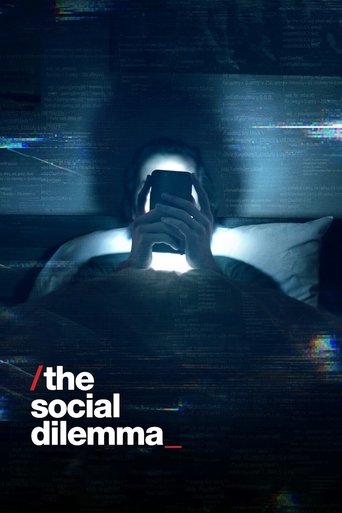
The Social Dilemma
2020 · Film · documentary · 95 min
Directed by Jeff Orlowski
This documentary-drama hybrid explores the dangerous human impact of social networking, with tech experts sounding the alarm on their own creations.
32 positive13 negative3 mixed28 neutralfrom 76 commenters
Where to watch
No streaming data for this title.
89 comments on Hacker News
I think Tristan from The Social Dilemma documentary - his co-founder's dad - was the one who invented the infinite scroll and he deeply regretted it.
Reminds me of a few parallels, mainly the attention economy [0] and The Social Dilemma documentary [1]
[0]: https://en.wikipedia.org/wiki/Attention_economy
[1]: https://en.wikipedia.org/wiki/The_Social_Dilemma
A good time to (re-)recommend the movie "The Social Dilemma".
Reminds me of that Netflix documentary. The Social Dilemma.
“Race to the bottom of the brain stem”
> I wonder how Meta employees can keep a straight face lying their faces off.
Did you see that Social Dilemma documentary? People only find their conscience after they've checked a big bankroll.
I've been in tech for almost two decades now and I've seen many many many good people throw their values right out the window once the price was right.
I found a practical way to foster critical thinking skills and encourage independent thought at the end of Netflix's documentary, The Social Dilemma:
> I follow people on Twitter that I disagree with because I want to be exposed to different points of view.
Here is another good opportunity for it.
There was an excellent Netflix documentary several years ago about this: The Social Dilemma
I highly recommend it!
Dive into the world of marketing with these top Netflix picks for 2024!
First up, "The Social Dilemma," a gripping exploration of social media's impact on society.
Next, "The Great Hack," revealing the dark truths of data exploitation in marketing.
Then, "Abstract: The Art of Design," offering invaluable insights into design and user experience.
And finally, "Fyre: The Greatest Party That Never Happened," a cautionary tale in event marketing.
Each film provides unique lessons to enhance your marketing strategies and connect with consumers. So grab some popcorn, relax, and let the learning begin!
1. Facebook owns WhatsApp and uses it to collect data about people, such as who they communicate with, how and when. They also know about many of the websites you visit and what you do there. They know everything you do on Facebook, Facebook Messenger and Instagram. They buy mountains of data about us from other sources. By analysing all of that data they can probably do a reasonable job at guessing the content of your WhatsApp messages.
2. WhatsApp tries to get every user to accept the option to backup messages and photos to Google Drive, where they sit unencrypted and accessible by Google. Even if you reject that option yourself, your correspondents are likely to have enabled it (if only just to stop WhatsApp from nagging about it) and so your messages are available for Google to read. Example of why this can be bad: https://www.vice.com/en/article/zm8q43/paul-manafort-icloud-whatsapp-bad-opsec-witness-tampering
3. Google Photos asks WhatsApp users if they'd like it to back up their WhatsApp photos. Even if you reject that option, your correspondents may have enabled it and so your photos are stored online unencrypted and accessible by Google.
4. Why should we limit what Google and Facebook know about us? Google and Facebook influence our behaviour for the benefit of their paying customers. Their computer systems are too powerful for our minds. They work against us, not for us. Companies like Facebook will come to be seen like tobacco companies, except that the harm is as from mind altering drugs. There is a documentary on Netflix called The Social Dilemma which explains this well. The polarisation of societies and the spread of conspiracy theories are some of the effects. The only defence is to disengage.
5. Read about Chinese-style social credit to understand why you want companies like Facebook and Google to know as little about you as possible. This is a good overview: https://nhglobalpartners.com/wp-content/uploads/2021/10/china-social-credit-system.jpg
In the previous decade or so, everyone has been shifting to technological fields. Whether they are computer science or even things like marketing.
I think CS will be, if not already, very crowded.
I think it's psychology, particulary being a therapist. I know this is hard if you already graduate. But in the next few years unfortunately more people will get depressed and anxious. And they will need more therapist. This is because of social media and similar stuff (I think this topic has been discussed greatly. For more information see Social Dilemma movie.)
This will even increase greatly in the future, due to virtual reality. I think Apple Vision Pro will ruin society more and more.
I think digital addiction is currently the most pervasive public health issue that is also the least recognized. Sure, we made documentaries like the social dilemma... But whatever... the numbers speak for themselves. Teenagers in the US spend an avg 8 hours/day on the screen.
In this industry people are quick to say "but it's a tool! It depends on how people use it!" But the reality is that we very well know how some specific demographics use it, and we know it's overall not good. Both because of the addictive component, and the bullying/graphic content, etc.
Honestly, I felt this post just shows how delusional the people are who made out with billions during the tech boom of the past 25 years.
I was a huge techno-optimist in the late 90s and early 00s. If anything, my opinion has totally switched over the past 10-15 years as I increasingly see technology ripping societies apart, and benefits only accruing to those at the very top. So excuse me if I gag a bit from a post from newly minted billionaires saying how those crowing about the downsides of tech are just a bunch of Debbie Downers.
Tristan Harris, who was featured a lot in The Social Dilemma documentary, was on Bill Maher recently, and I totally agreed with this point he made: we have to forget all the optimistic stories we tell ourselves about tech, and instead just look at the incentives. With social media, we told ourselves all these stories about how it would bring us closer together and keep us better in touch with friends. But the financial incentives that exist for social media companies is solely based on stealing more and more of your attention: what keeps you scrolling to the next block. And it turns out nothing grabs attention like outrage. Tristan's point was that with newer tech like AI, we're likely to repeat the same mistakes if we just tell ourselves the same stories about all the good that can come from AI and ignore the incentives of those top companies speeding ahead as fast as they can. And if you look at those incentives, I don't think it bodes well for the rest of the 99.9% who won't control major AI systems.
We used to call it Web4, in fact.
Jack Dorsey was the reason we went back and renamed everything to Web5. I was always thinking how 2 + 3 = 4, but then Dorsey went full 5 and we wanted to make sure when people google "Web5" they find us. Our soft goal is to have Intercoin rank higher than Bluesky for "Web5".
> relying on centralized entities which clearly is a problem >More or less of a problem than out and out scams?
Probably more. The societal impact and problems from centralized social networks are documented in many places, including the Social Dilemma documentary, the breakdown of society, record levels of sadness in teenagers, having social network addiction be classified as a disease in many countries including China and now USA, states like Utah trying to protect children from it, and much more more.
I have been documenting just the loneliness part here for a decade: https://qbix.com/investors/articles
https://rational.app goes further into the breakdown of society due to these centralized, closed-source Big Tech oligopolies
I guess you like having public forums being privately owned by large groups of people, but the world needs open, decentralized alternatives. Sorry if HN doesn't think so anymore, but they should embrace the "hacker ethos" instead of stockholm syndrome shilling for the corporate VC world.
We got a glimpse of that in the documentary Social Dilemma.
I expect it is going to get substantially worse. With the power of AI, data mining behavior for attention is going to surpass anything we have likely seen before.
Was a bit embattled due to the numerous downvotes for supporting the post, likely due to shills.
If you honestly want to learn about the subject I'd start with the PBS Frontline documentary called "The United States of Secrets."
Next, learn about "surveillance capitalism." The Facebook and Social Dilemma, on Netflix are eye-openers.
Another milestone was Apple giving their OS away for free. Combined with Linux always being free and popular on servers, that made expensive Windows a much harder sell. There's a big cost to develop a modern OS, so there's a great incentive to "monetize" away that cost. In practice that means advertising and surveillance which is exactly what you are seeing here.
This is a story developing for over ten years. That a few pieces of the thousand piece puzzle are not delivered on a silver-platter is immaterial to the discussion.
Thank you for that video. A few things about it:
1) He shows how an actual physiological cause of some cases of severe ADHD have persistent behavioral implications, such as a split between the knowledge and executive parts of the brain illustrated (crudely) in his diagram.
2) Around 2:211 "now you might be able to train up some of these executive functions, we don't know that yet." Indeed, even for many actually problematic cases, we don't know yet how far non-medical interventions can go.
3) My main question is this: What is the proportion of people diagnosed with ADHD that actually have such a pronounced physiological divergence? My point is that it is small, and the DSM-5 criteria are applied by simply choosing M of N symptoms to be present. The same is true for autism spectrum, and for gender dysphoria, and all have been on a tear in terms of diagnoses, in countries around the world where governments and schools specifically instituted related top-down policies about it:
https://www.cdc.gov/mmwr/volumes/70/ss/ss7011a1.htm to quote the Introduction: ASD prevalence estimates have increased from 6.7 (one in 150) per 1,000 children aged 8 years at ADDM Network sites in surveillance years 2000 and 2002 to 18.5 (one in 54) in surveillance year 2016 (3–10). Over time, the proportion of children with ASD who also have intellectual disability has decreased from approximately one half in 2000 and 2002 to one third in 2016 (3,4,10).
https://www.nature.com/articles/s41598-021-95421-9 (Sweden) to quote the abstract: The incidence of GD, defined as ≥ 4 diagnoses increased significantly during the study period and mostly in the age categories 10–17 and 18–30 years, even after adjusting for register coverage. We concluded that the validity of a single ICD code denoting clinical GD in the Swedish NPR can be questioned.
and so on.
4) Even in cases of e.g. gender dysphoria, we simply don't know enough about how many cases are due to social media and peer groups, and there are many activists who are looking to silence inconvenient studies such as the 2018 study of "Rapid-Onset-Gender-Dysphoria" for teens https://en.wikipedia.org/wiki/Rapid-onset_gender_dysphoria_controversy
Humans are social animals. If we were as diligent in looking at the social and dietary causes for children, as we are for adults, we would probably find a lot better solutions than just medicating people. For example:
1) Giving up sugar https://www.youtube.com/watch?v=cPyFIvCvh8U
2) Documentaries on how profit-seeking industries create attention disorders an addictions: https://en.wikipedia.org/wiki/The_Social_Dilemma
3) Diabetes and coronavirus: https://www.elsevier.es/en-revista-clinica-e-investigacion-arteriosclerosis-english-415-articulo-covid-19-diabetes-a-bidirectional-relationship-S252991232100022X
4) Loneliness is a significant variable affecting depression https://pubmed.ncbi.nlm.nih.gov/29792097/
As for conspiracies, look, how crazy do you want to get? What if you knew that the FDA tried for 40 years to bury certain effective treatments that cure cancer. Even though tons of people were getting cured, they tried harder than they ever have to shut it down for years. It sounds like some hyperbolic nonsense, but tell me after you look this video (flip through it): https://www.youtube.com/watch?v=rmxUsAI29fw ... it has all the studies, texts results from medical journals, double-blind studies, TV footage of multiple congressional inquiries, repeated admissions from the CDC directors themselves on video, etc.
Once you start looking for this stuff, it is hard not to come to the conclusion that our society isn't exactly set up for anything other than "medication".
I am not a doctor, but can I suggest a non-medical intervention that probably doesn't have any adverse effects, but may help?
Under capitalism, the social networks compete for your attention, by sending you notifications. It's a "tragedy of the commons" where the commons is human attention: if Facebook doesn't get you to click during dinner, then Twitter will, and then it'll grow through those tactics. Thus the market forces these corporations to give you addictive newsfeeds, tell you when someone replied to your comment, etc. There are analyses comparing the brain to pavlov's dogs and the addiction to a slot machine.
In China, internet addiction is classed as a disease but it's also studied from a social point of view, not just prescribing mediation right away. https://journals.sagepub.com/doi/full/10.1177/1868102621993134
Here is what I would recommend:
1) Realize you are NOT alone or atypical. The human attention span has declined because of the system we live in. We now have shorter attention spans than goldfish. https://www.wyzowl.com/human-attention-span/
2) Notice how much of your ADHD is connected to anxiety and investigate the causes of that anxiety, maybe with a psychotherapist or other counsellor. Map out what kind of things you are afraid could happen if you don't react to them quickly. See if you can rearrange your life to diminish the need for quick responses (such as Slack or real-time chats). Consider worst-case scenarios and if you also have OCD, consider ERP therapy.
3) Learn to use "Focus" on your phone, to turn off distractions for long periods of "Flow". Set expectations with people (this may be hard if you work in capitalism for an employer) to schedule times to talk to you, and only allow calls for emergencies from friends and family. It will take you AT LEAST A WEEK after you remove your anxiety of missing something important, to start fully relaxing and not expecting a notification to jump out at you.
4) Watch the movie "the social dilemma" and try out its recommendations (taking 1 day a week off from all electronics completely -- live how people have lived throughout history) and spend it socializing with people, eating dinner, reading a book, etc.
5) Look at your sleep, diet, are you taking walks or exercising? What is your job? Anyway, there is so much you can investigate holistically and take control in your life, before you ever have to consider that ritalin is your only hope. (And if you do want to try a nootropic, you can try modafinil perhaps... it's not an amphetamine... but again, I think medications take away our agency and should be tried only if all else fails)
None of that requires medication, so try that first.
That's not the source of the problem, just a symptom. What caused the financial problems for social media was the censorship, blatant propaganda and use of addiction based behavior modification to subjugate the population; AKA population control.
Reddit might actually be one of the worst offenders, but because they aren't public, and have a smaller user base, they went unscrutinized. I highly recommend everyone watch the documovie the Social Dilemma.
TLDR; Social media is military grade psychological weaponry aimed at the most vulnerable amongst us.
The Social Dilemma and The Great Hack documentaries on Netflix cover this in greater detail but basically they don't need to read your messages, when the can predict your behaviour so accurately. IMHO this is actually worse than reading your messages.
Maybe our economic systems have to be rethought? A tree is worth more dead than alive..... European economies have been accumulating wealth for centuries through colonization and exploitation of humans lifetimes... in the end what do you have? inflated real estate prices, overly mechanized agriculture producing basic junk foodstuffs, increasingly authoritarian political policies designed to restrict or bore people from contributing to civil society... this is leading to an existential crisis .... So many good films out there which capture the essence of the problem, that dreadlock guy who works? for Microsoft has a very good quote in "Social Dilemma" (1)
One suggestion would be politicians to be chosen by jury, for periods of say a year to lock them out of having so many fingers in lobbyists pies...
(1) https://files.fm/f/nm8vs6h5g
Seconded for My Octopus Teacher.
The Social Dilemma was also worth watching.
"The Social Dilemma", what a great documentary showing how ad business, recommendations, attention grabbing works in social networks and how it impacts society, it basically shows "how sausage is made" and how it impacts the whole world and the risks associated with it https://www.imdb.com/title/tt11464826/?ref_=nv_sr_srsg_0
"Planet Earth II", breathtaking documentary about animal life on earth with extraordinary scenes https://www.imdb.com/title/tt5491994/?ref_=rt_li_tt
"Inside Job", documentary about 2008 crisis, masterpiece, narrated by Matt Damon. https://www.imdb.com/title/tt1645089/
"The Last Dance", I'm not a fan of basketball, it's a doc about Michael Jordan, one of the best docs I've seen, sounds boring but you can't wait to watch the next episode, recommended even if you don't watch sports like me, it's about extraordinary person/athlete and what it takes to be GOAT https://www.imdb.com/title/tt8420184/?ref_=rt_li_tt
"Zero Days", great doc about stuxnet exploit https://www.imdb.com/title/tt5446858/?ref_=rt_li_tt
"Human", what it is to be a human from different perspectives https://www.imdb.com/title/tt3327994/?ref_=rt_li_tt
"Over the Limit", documentary about olympic gymnastic and shows the price of winning at any cost. https://www.imdb.com/title/tt8184202/?ref_=rt_li_tt
"Life Story", beautiful doc about animals, great scenes https://www.imdb.com/title/tt4150884/?ref_=rt_li_tt
"Planet Earth", extraordinary scenes of animals lives https://www.imdb.com/title/tt0795176/?ref_=rt_li_tt
"Blue Planet II", like Planet Earth but in water https://www.imdb.com/title/tt6769208/?ref_=rt_li_tt
"Cosmos", doc about cosmos, nature of the world etc, very good https://www.imdb.com/title/tt2395695/?ref_=rt_li_tt
"The Tinder Swindler", "Posing as a wealthy, jet-setting diamond mogul, he wooed women online, then conned them out of millions of dollars." Surprisingly good https://www.imdb.com/title/tt14992922/?ref_=rt_li_tt
"The Farthest", about first human made object leaving our Solar system https://www.imdb.com/title/tt6223974/?ref_=rt_li_tt
"Our Planet", https://www.imdb.com/title/tt9253866/?ref_=rt_li_tt
"Cartel land" https://www.imdb.com/title/tt4126304/?ref_=rt_li_tt
I think your comment is both wrong and spot on.
IMO the "wrong" part is that most heroin users will tell you they fucking love heroin. It makes them feel great/escape from life's problems, and users know this. The fact that users also know that heroin is destroying their lives isn't incompatible with loving it.
The "spot on" part of your comment is that the addictive dynamics between social media and heroin are basically exactly the same. And over the past 5-10 years as this awareness has grown (e.g. documentaries like The Social Dilemma), social media companies have paid lip service to acknowledging some of the dangers of "endless scrolling", but the rise of TikTok has proven that the lip service was always bullshit. The second another company came along with a stronger drug, all the incumbents are immediately trying to copy that addictive drug. They don't give 2 shits about your well-being and never did.
You may not be aware of the full extent of the problem. It's not just the "time wasting" of the old days, just ~15 years ago. Try these documentaries:
- "The Social Dilemma" on Netflix
- "The United States of Secrets" on PBS.
- John Oliver on Data Brokers, https://www.youtube.com/watch?v=wqn3gR1WTcA
There are others I can't remember off the top of my head. You may feel differently when you find out about companies profiting off the current (as in right now) whereabouts of your child.
There were several "glitches", not many because of the cost if revealed and the power of brainwashing, because the system is so well built to hide the lies.
Everyone would rather shut up, as long as they get paid. The internet just amplifies these behaviors anonymously.
No conspiracy needed either. As sinister as this sounds, this is how people and society work, if you bother to look...
Ex:
1. Jim Cramer: https://www.youtube.com/results?search_query=jim+cramer+manipulation
2. Book: https://www.amazon.com/Trust-Me-Im-Lying-Ryan-Holiday-audiobook/dp/B07RK54H63/ref=sr_1_1?crid=2S33G3P4L9DD0&keywords=trust+me+im+lying&qid=1654194580&sprefix=trust+me%2Caps%2C218&sr=8-1
3. The Social Dilemma: https://www.imdb.com/title/tt11464826/?ref_=nv_sr_srsg_3
Though I haven't deleted my social media accounts, I don't use them at all even on an occasional basis. I have them for reaching out to my acquaintances/old friends, access content behind login(when I've been shared with their links), etc. After watching The Social Dilemma(1), I've grown even more averse towards social media.
Many regular social media consumers feel that they get useful info out of it along with their entertainment content. Consider this, there are specific sources to get entertainment-netflix,local newspaper website's movie/gossip section,etc. And if one is looking for useful info, the chance of finding the info that is really useful/timely in the specific moment of their life is more via a web search than their infinite feed in their Facebook/twitter/instagram. If you really need an info then you wouldn't rely on random chance/luck that's needed in finding that in your feed.
Here in India, WhatsApp is ubiquitous, it is kind of used as a work chat as well when people are logged out of work MSTeams/Skype. So I have WhatsApp installed but I don't go to it to browse the status messages/pics people post, no matter how tempting it is :). I use other more privacy friendly apps for messaging with family and friends.
It is hard to tell people to stop using social media, sometimes people find it offending/intrusive. But the perspective of life changes if you don't use social media. You seem to have time for more things in life.
We also have to admit that many don't have the luxury(work/professional reasons) to avoid social media altogether.
1- http://thesocialdilemma.com
Frances Haugen, the supposed Facebook whistleblower, slipped up in her 60 minutes interview and revealed that she works for US intelligence. The effort she was employed to advance is acceptance of more censorship of Meta and the like. Conspicuously absent from the publicly promoted discussion was any mention of the free alternatives such as the fediverse. 'The Social Dilemma' movie had similar objectives and narrative framing.
I anticipate that self-hosters, linux users, and people who are not Facebooked will be further castigated as radicals and worse in the future.
Also note the irony that Substack contains Google and Amazon trackers.
They don't monitor your everyday traffic, so it is a huge number of additional data points for profiling. Everything in those documentaries were considered conspiracy… until they were proven correct.
To anyone that is reading, I also recommend the "Social Dilemma" on Netflix, although it comes in from a slightly different angle, encouraging addiction that feeds back into this one.
Netflix does this also. I've noticed in a documentary, I believe it was "The Social Dilemma", which now includes comments about COVID-19 disinformation campaigns.
> our digital lives are now lived within black box straight-jacketing walled gardens, mediated by undemocratically wielded algorithms and protocols.
> all i see today are walls instead of bridges.
Whenever I read these comments I wonder if people are using a different Internet than I am, because this isn't my experience at all.
I can access whatever I want, discuss whatever I want, and interact with whoever I want online. We have a multitude of platforms to choose from and I don't even have to pay for most of them. Honestly I don't even look at ads because I downloaded a free ad-blocker plugin for my free web browser and it all just works.
Even my social media is nothing like the dystopian claims I see online. I don't use Facebook much, but whenever I open the app it's just fun photos and updates from the people I want to keep in touch with. I have zero problems with that because I enjoy seeing the people around me happy, having fun, and succeeding.
I suspect these dystopian viewpoints come less from real-world experience and more from bouncing ideas around in echo chambers. It seems the people who are most opinionated about what social media is or isn't are those with the least direct experience in the matter, instead substituting hyper-dramatized accounts from news stories, HN comments, and agenda-pushing documentaries like "The Social Dilemma". There's a certain sense of elitism involved wherein the anti-social-media and anti-silicon-valley people feel that they are the only ones who see through the facade and understand what's really going on.
What do you mean? Public trust in the media is at an all time low. News companies almost died at the advent of the internet but came back fighting by drive engagement with emotions. Even documentaries like “The Social Dilemma” are guilty of using the tactics they blame FB for using. Trump made his presidency off of “fake news” and distrust of the media. The game is all about starting with a narrative that follows your audience’s wants and then cherry-picking facts to confirm that bias. All sides are guilty of this. FB’s PR department is guilty of this as well, if we are to be honest.
Facebook is like vendor lock in for human social interactions and emotions.
That's probably why Zuckerberg tries to acquire competitors - trying to lock in your behavior and then sell it to the highest bidder. Makes sense when you think about it.
When I suggest people delete FB apps from their phones, they start writhing uncomfortably, and try to justify not doing so by making some half-ass claim that their social life will suffer if they did. Its the same response I would expect from someone who is a moderate alcoholic and is told to drink less wine during the week. The addiction is obvious.
My experience after deleting FB apps from my phone - social life changed for the better and I feel less anxiety. It turns out, most of my FB "friends" weren't really my friends. And I can still check FB / Insta via web if I wanted to. Added bonus - FB can't track me as well.
FB will do what FB does - try to steal as much data and attention and sell it to the highest bidder. But you can only blame them so much. Collectively, its on people to change and take responsibility if they feel they have grievances related to FB.
Still, I have hope - awareness for social media's downside effects is only increasing. Ms. Haugen's testimony and the Social Dilemma documentary demonstrate that.
there are people who will actually look down on you if you work at certain big name tech companies,
there are some people who are apologetic that they've worked at FAANGMULA+ like Tristan Harris at google, susan fowler at uber
I think you really should watch Tristan documentary the social dilemma to see what many "lay people" think (the opposite of high regard and awe)
Faang companies impact Is not equal
Facebook is not apple and not google.
Working on Facebook Oculus is in no way equivalent to the culture surrounding google's deep mind.
They are serving drastically different communities.
I think people who are truly conscientious will not care about branding as much as the value of the work they are producing, they will be able to think about it objectively separate from the company brand, they will be okay with working without a big name, and no attention because they trust their own judgment.
this is precisely why I still believe startups have more potential energy than established corporations, regardless of what the cynics think.
when I see anyone thinking about glitz and glamour before what they will actually be doing, I lose trust in their judgment.
impact on project > company brand
The "Social Dilemma" is pure propaganda and manipulation, there's very little facts or stats stated in that film that aren't heavily misleading.
Maybe the GP was thinking of the documentary/drama: The Social Dilemma
I hear you. The documentary The Social Dilemma pointed this out so well. There needs to be centralized management and many big companies are trying to build large teams to manage all the craziness. I think having detailed user preferences and using machine learning to understand if the notification even needs to be sent are a few things that stick out that I've seen some engineering programs focus on. Here is a description of what LinekdIn started doing a few years ago.
https://engineering.linkedin.com/blog/2018/03/air-traffic-controller--member-first-notifications-at-linkedin
I don’t know… I think people are cynical these days in large part because the world around us is dominated by this status angst.
But it wasn’t always this way. Not even close. I’ve met many people who grew up in pre- and post-WWII Germany, and from how they describe it, the concept of status didn’t really exist then as it does now.
Yes, there were rich and poor. But people fell in love with and married people in their towns and villages, and were not unhappy in doing so. With the exception of the war (a significant exemption, true) people’s lives seemed clear-cut, and no one felt the need to constantly be posting or drip-feeding off of likes or views or even money.
These apps and platforms are recent inventions, and they are dangerous. Status is no longer a local or regional commodity, it is global. And your status is constantly being evaluated against every metric.
Instead of being satisfied with being the best wine-grower in the region, for example, one is now forced to also compare oneself to the best bodybuilders in the world and the richest businesspeople.
Though at times overdramatized, ”The Social Dilemma” is a great documentary on this topic. I would also recommend Tristan Harris’s podcast episode with Joe Rogan.
Watching "Social Dilemma" on Netflix (a movie made by Netflix) was quite an irony. Most people "waste" more time on Netflix than all other social platforms combined.
Yet, "Social Dilemma" covered/blamed every company except Netflix :)
thanks for this info. I recognize him now from the Social Dilemma movie.
To be fair, it is very possible to not currently monetize or lead capture along with little to no intention for that in the future. You just want to build an audience for the sake of it.
Of course when that power of a solid audience is actually there, then the more profit seeking intentions may come in.
Still, there’s no way to tell what path the person will go down. I don’t think assuming bad faith in your last paragraph is needed.
A trope on HN is acting holier than thou or rationalizing own behavior. IE piracy of media or ad blocking scorched earth style without true principled reason like malware or tracking.
The biggest I have found is the person likely doesn’t make their paycheck now or in the recent past from super principled pious-like work. Or they did make their money that way and are now changed.
Like The Social Dilemma film. Almost entirely filled with multi millionaires and two billionaires who made at least a chunk of their fortunes from social media. Money they are most certainly keeping and power/influence gained they are most certainly using too — I mean they are on this trending big documentary talking about helping the common man vs big social media/tech while not being the common man because of money from said industry.
This reminds me a lot about the goals behind the center for humane technology, and their amazing podcast https://www.humanetech.com/.
They also are the ones behind the Netflix documentary « the social dilemma ».
The Netflix documentary, The Social Dilemma exposed the algorithms are designed to create "engagement" or clicks, that may look different for different people. If you happen to begin clicking links that make you angry you will have a feed that skews towards the kinds of posts that infuriate you (this is typical - rage really sucks most of us in). If you select links with puppies all day long, that is what you are going to get, puppies. I have personally seen this in my YouTube feed. If I select two or three videos on a particular topic all of the sudden my feed is filled with those videos. Personally it is really aggravating. I may want to watch one or two videos about JRR Tolkien, but I don't want to see a bunch of fan theory LOTR videos.
Disclaimer: I work at Google too (not ads), all opinions my own.
I'm surprised the author focused singularly on the "funding the open web" stance, and did not discuss the alleged negative externalities created by advertising-driven business incentives. The top comments of the blog comments (e.g. https://www.jefftk.com/p/why-i-work-on-ads#lw-Nvd9ZHJLxZpNZDPKr) also point this out.
For instance, The Netflix documentary "The Social Dilemma" discusses these at length, and it forms a lot of the political zeitgeist around regulation of adtech companies (e.g. driving polarization, radicalization, depression and such).
> The question is, what is the alternative? I see two main funding models:
It's possible to simultaneously believe that ads are currently the effective way to lower barrier of entry to accessing content, and also believe that ads are a detriment to people's mental health.
One alternative would be an ad-supported system that performs less-personalized ad-targeting, and in doing so influences people's behavior less but generates enough revenue to keep the lights on with a reasonable profit margin. The government has laws for regulating natural monopolies like this, where they prevent utility companies from price gouging but grant them a certain amount of margin.
Agreed. Although it's the concentration of power that is harmful in long term than who is holding that power.
Moreover, I am not sure how much manipulation humans are able to detect ; a small misinformation injected into twitter timeline or a small bias in facebook can cause ripples across the world's outlook over time that we can't even notice when it's happening. Social media companies which provide these feeds always get away by saying it's by the algorithm recommendation but who is tuning those parameters? Only a small amount of human population asks 'why' type of question and rest of them just absorb the content and it shapes their mind. I watched the movie Social Dilemma sometime back and slowly this has been dawning on me - wtf we are witnessing. World is falling in hands of these social media companies, they are storing our data, they profile us, they manipulate what we see, they tell us what they want us to see ; it's mind-boggling that the world is sleeping on this much centralisation of power happening in broad daylight.
> I don't think I have ever seen a mainstream publication refer to Google apps and services as spyware. Which of course is what they are.
You seem pretty active on HN so I'm a bit skeptical that you honestly believe this. But I'll respond in good faith anyways. Here's the first result from Google (didn't even use DDG)
- (Washington Post) Goodbye, Chrome: Google’s Web browser has become spy software[0]
But since you're active I'm sure you know about The Social Dilemma, Snowden, etc. I've seen episodes on 60 Minutes, CNN, Fox, and pretty much everywhere that calls criticism to companies like Google and Facebook. Does China get called out more often? Yeah. Why? Because we're in a cold war with them. But still in many of these pieces I've seen them make slights at American tech companies. Things like saying that what they do is bad, but what China does is worse.
[0] https://www.washingtonpost.com/technology/2019/06/21/google-chrome-has-become-surveillance-software-its-time-switch/
you're probably right. i think everyone would have been fine with "crazy uncle brian going off on a tangent," and leaving me be, except i didn't tangent.
when i left facebook i just left and when i left whatsapp i told people about signal two weeks ahead and then just left with that one message.
i think the problem was that i had convinced the patriarch of the group to join me and people wanted to be in contact with him, so the dissatisfaction was directed toward me.
ironically, i was the one who talked down the group from the fearfully dire outlook about social media when we discussed the netflix "documentary" "the social dilemma" a few months back.
i thought the latter part of the documentary that had the predictions of our society being destroyed because of the revelations exposed about what social media is doing to us was cringe and i explained to the group why.
OTOH, i told people "yeah, the first part is totally true and not a revelation. they are absolutely hacking your social biology to get you more engaged in what they have to offer. it's not a surprise to anyone really as the ML systems and technology that optimize for that are well understood and pretty standard. heck, i've even written some of those algorithms myself."
that's actually part of why i left facebook. i realized that i had become complacent about things i should not have become complacent about.
fwiw, my productivity and happiness have increased dramatically since i left facebook/whatsapp. YMMV
It's like that Social Dilemma movie which is 100% based on the tactics of fear and engagement generation it ascribes to social network.
If you have not seen it, the documentary "The Social Dilemma" (currently only available on Netflix) goes over this in detail, with first-hand accounts from the people who created the "addiction algorithms"... as well as references to research on how self-harm and suicide attempts in teens and pre-teens has skyrocketed since the advent of social media.
You don't know they have a dial, everyone is taking one sensationalized (and overly dramatic) documentary and making it as gospel. Portraying it as a "dial" is also doing a complete disservice to the actual technical problem involved.
The documentary was successful in underplaying the challenges of moderating/recommending at scale and, in my opinion, scapegoating social media companies as the source of the problem when they're really a symptom.
The main focal point of The Social Dilemma, Tristan Harris, as creator of the Centre for Humane Technology has an obvious agenda (not saying he's wrong). Take the documentary for what it is but to throw the baby out with the bathwater is wrong when there are obvious benefits to social media.
Regulating social media is a fool's errand imo, it's a lose-lose. Either you let ideas flow which includes bad actors/ideas to propagate or you now create gatekeepers and censors with ever moving goalposts. I'm not against more regulation but do you really think the United States Congress is capable of passing legislation to effectively tow that line? Doubtful.
The Social Dilemma movie highlights this brilliantly, as does Tristan Harris in his Joe Rohan interview https://youtube.com/watch?v=OaTKaHKCAFg
I believe the Social Dilemma documentary on Netflix answers this question pretty well.
This is all great but it reminds of a Netflix documentary social dilemma
As this clearly shows how companies fight for users attention so then can spend the most time on their app
There is nothing bad showing relevant ads, but thats not the point, this data can be used to manipulate you in many ways.
To get an idea how bad it is watch this Documentary on Netflix - The Social Dilemma
Kind of weird to see WhatsApp on that list but not Netflix. I wonder how much Netflix has managed to stave off scrutiny simply by creating the Social Dilemma documentary.
The Social Dilemma struck me as a pretty manipulative movie. It depicted recommendation algorithms as three evil scheming clones, interspersed with a skit showing a family with the worst case of social media addiction the writers could imagine. This provides huge latitude to exaggerate and mislead. I don't think many people would explicitly endorse the claim that social media addiction is so bad, preteens can't last half an hour before smashing open locked boxes to get a hit - but that's what the movie showed!
One big recommendation for all to watch "The social dilemma" on netflix also.
The social media apps on the phones are specifically agonized over, tested, and refined continuously to increase interaction, aka make users into addicts.
Beliefs don't exist in a vacuum - hoax memes spread much like COVID itself. Media literacy is scarily low among most people, even those who are brilliant in other ways. Metaphorically we are failing to vaccinate against misinformation in primary education, leaving tech giants the impossible task of policing misinformation on their platforms designed to maximize engagement for profitability. 'The Social Dilemma' documentary (Netflix) dips into this if you haven't seen it.
Looks like they have taking the pages out of FB - they must be a social dilemma movie fan
Let’s assume that it’s truly a tool of idealistic, well-intended, and purely beneficial capitalism with side effect of world brain intelligence used for private and public interests.
It is still extreme power, like practical knowledge of nuclear fission.
Popular understanding of the greatest risk of holding such power is the movie “The Social Dilemma”, which is hardly the equivalent of “War Games”. It briefly hugs itself sharing a vision of a world where technology doesn’t collect and manipulate. In the history of the market, have we ever accomplished that?
We’re not on the sidelines. We continue to actively use hardware made by others on networks run by others to push more and more data to a plethora of centralized services, and even with P2P mesh networks that won’t stop. It’s Pandora’s Box. AI may end up killing or putting us in tubes like in The Matrix just to try to save us from ourselves.
But if we try to stop it or slow it, we risk not finding cures for disease, dying from an asteroid or rogue black hole, not seeing more wonders of the universe, or not experiencing the 2049 holo equivalent to Brittany Spears in Toxic.
Sort of reminds me of the fictional "Extreme Center" movement in "The Social Dilemma" (great documentary, btw, regardless of your political party).
I can't read the flagged comment, but just the quoted part of the comment in this post seems true to me, even if your "why not these" lists are interesting.. but not a negation of the quoted idea.
Also seems to be compatible with the idea, which has gotten a lot of play in the Social Dilemma Netflix movie, that people engage harder with things they disagree with, and not so much at all with positions they do.
meh, people here in Germany are privacy focused as hell and even here nobody cares for more than five minutes when some data scandal breaks, of which we have at least one every year now.
AI, surveillance capitalism, manipulation and so on have been in pop-culture and news for years now, 'the social dilemma' just aired on netflix and a lot of people seem to have watched it, there's a documentary about 'big data' on TV every month, every other sci-fi movie has it as a plot point, we're all aware of it. People are genuinely indifferent about it. People will complain about it in theoretic debates but the number of people who actually delete the apps off their phone is basically zero, which tells you what you need to know.
Yes, that's true. At the same time the argument of "The Social Dilemma" is that at Facebook scale you just need a very small effect to influence the crowd in a way that matters. Paraphrasing the documentary (from memory): tuning human behaviours 1% in the direction you want, worldwide, is what Facebook sells and what their customers pay for.
meh Documentaries are way less information condense compared to written text. For a very quick approximation: - Speed of speech ~ 120 wpm. - So 1.5 hours constant talking would mean roughly 10'0000 words. Keep in mind that that is without all the pauses and dramatic music. - An A4 page would roughly come out at 500 words. - Which means that you could fit 1.5 hours of _constant_ speech in 20 A4 pages.
Since this is infotainment I bet that it's way less than that. Another advantage when trying to get an objective perspective from reading, is that there is no dramatic or eerie music in the background giving you queues on how to interpret the contents on an nearly subliminal level. Furthermore there would not be any faces that your less advanced parts of the brain would attach feelings to.
The social dilemma might probably have been condensed down to a 5 page PDF. All these dramatizations are maybe good if you want to discuss this with 5 year olds, but it's not dense with fact in any sense.
Apart from the bad points, posting a PDF press release in response to a documentary people watched on Netflix is kind of stupid. How many people who watched The Social Dilemma will actually see this press release, let alone evaluate its points?
> For example, in 2018 we changed our ranking for News Feed to prioritize meaningful social interactions and deprioritize things like viral videos.
I wonder what happened in 2018
> [Cambridge Analytica] closed operations in 2018 in the course of the Facebook–Cambridge Analytica data scandal, although related firms still exist.[0]
I'm sorry, but if you're going to lead with a policy change that was made after pretty much the largest scandal in your company's history, I think you know you're doing something wrong. If you want to claim the moral high ground changes need to happen before they become scandals. It is okay to make mistakes. It is okay to fuck up big time. But this just feels disingenuous. The reason people like The Social Dilemma is because it is real people saying "sorry, we fucked up. We take the blame, but let's solve the problem." This response feels like a childish response of "We didn't fuck up, you did."
> We don't sell your information to anyone.
IIRC the movie didn't claim this. Most people criticizing FB aren't claiming this. FB is selling access to the data.
> just like any dating app, Amazon, Uber, and countless other consumer-facing apps
I'm reminded of my mom saying "If all your friends jumped off a cliff would you?" I can't be the only one. Just because Netflix is guilty of similar crimes doesn't mean you're in the right. No one respects this defense.
This response is weak and does not feel genuine.
[0] https://en.wikipedia.org/wiki/Cambridge_Analytica
> But ‘The Social Dilemma’ buries the substance in sensationalism.
This was my conclusion too. There were some genuine good parts, but most of it felt too hyped because the explanations were too flavorful and simplistic, or taken too far. It felt like I was watching The Secret or Zeitgeist.
> Rather than offer a nuanced look at technology, it gives a distorted view of how social media platforms work to create a convenient scapegoat for what are difficult and complex societal problems.
This sentence lacks the nuance that they criticize. While I think it's a fair position to state it gives a distorted view (due to simplification, for example), that doesn't mean they're creating (or intending to) create a convenient scapegoat.
> The film’s creators do not include insights from those currently working at the companies or any experts that take a different view to the narrative put forward by the film.
Well current employees have a lot to lose in being honest, if they disagree. And the documentary did have experts that had a different view that was actually telling a different story than the narrative. I was actually on the lookout for it, because I was upset with the simplistic cookie cutter bullshit it was feeding us.
---- Reacting to the points ----
1. They say they're making efforts to make responsible use possible. The issue with this is, we can't check this. So reputation and trust is all we can go on. So I'm putting this in the neutral category.
2.
> We don't sell your information to anyone.
Wasn't Cambridge Analytica a thing? If so, then I don't care if you sell or don't sell, info gets out there. It feels disingenious to put that sentence in there as a response to "you are not the product".
I agree that the mantra is nonsensical "you are the product". Uhuh, right, because it's short and sweet it must be true? Nonsense, all explanations that I've ever read that were true never devolved to mantra-like statements. IMO it's a "code smell" that something is off.
...
I'll stop here, this is getting way too long.
Long story short: Facebook is being questionable here at best, despite that I agree in general with them that The Social Dilemma is nonsense.
The incentives here are all warped :/
The Portugal drug model (or similar scale legalization and decriminalization) has a lot to do with it. A lot of the people who end up committing murder or are nailed for egregious drug offences are only in the position they're in because of bad policy. This is something that can be directly acted upon and changed.
I am very, very sceptical of the idea of a "conviction" for a non-crime. Racism, though deplorable, is not a crime, and it shouldn't be. Thought and speech are necessarily divorced from action in the "world of atoms". These classes of offence are very, very different.
My argument isn't that racism should be ignored, either. Rather, I don't think that any of the "cancel culture" that seems so prevalent actually does anything positive. It doesn't change views, it further polarizes and solidifies what you refer to as "ingrained racism".
There is a strain of thought that some murder is justified in the name of political liberation (take Assata Shakur for example). Many of these same people will try to persecute people for perceived racism. This is the world-view I'm referring to. If you'd like more tangible examples, I could dredge them up, but I don't think it would be worth either of our time(s).
Edit: For that matter, how do you rehabilitate someone like Dick Costolo, who today tweeted "Me-first capitalists who think you can separate society from business are going to be the first people lined up against the wall and shot in the revolution. I'll happily provide video commentary." in response to Brian Armstrong of Coinbase choosing an apolitical company approach?
Edit 2: Can't reply to the child comment. I don't have the solutions, but I would propose:
1) Reworking or regulating social media to be less polarizing (see The Social Dilemma, a film that just came out on this).
2) Criminal justice reform and drug decriminalization, so violent crimes and murder become less commonplace, especially such crimes that could be easily prevented by better policy. Also, clear the criminal records of those convicted for non-violent offences.
3) Establish "free speech zones" or something similar on university campuses, to allow space to refute heinous ideas in open discussion (ala Chomsky).
> Ultimately, this omission of experts and lack of nuance results in The Social Dilemma feeling like a missed opportunity. On the plus side, it informs a wide audience about issues like surveillance, persuasive design practices, and the spread of misinformation online, which may encourage them to hold big technology companies accountable. But who gets to convey this information and how it is framed are also crucial. Amplifying voices who have always had a seat at the table and continuing to ignore those who haven’t will not lead us any closer to resolving the dilemma the film claims to present.
I'm very very grateful that the film exists, and for the conversation it's started. But I agree with this assessment. The film paints a dark picture and then leaves viewers on their own to figure out what to do-- beyond maybe taking their kid's phones away.
I disagree with TFA's notion that diversity at tech companies would help address the core problems of intrusive surveillance tech. Only stronger countervailing social institutions can do that.
To take my own medicine: vote, ask your representatives for regulation, use your technical expertise to draft bills or run for office, engage your community on issues that matter.
“ Much of our current social polarisation and conflict is not, as The Social Dilemma suggests, between those influenced by social media’s “fake news” and those influenced by corporate media’s “real news”. It is between, on the one hand, those who have managed to find oases of critical thinking and transparency in the new media and, on the other, those trapped in the old media model or those who, unable to think critically after a lifetime of consuming corporate media, have been easily and profitably sucked into nihilistic, online conspiracies.”
...
“ The film’s first chapter makes it sound as though social media’s rewiring of our brains to sell us advertising is something entirely new. The second chapter treats our society’s growing loss of empathy, and the rapid rise in an individualistic narcissism, as something entirely new. But very obviously neither proposition is true.”
Tim Kendall also appears on the Netflix documentary, “Social Dilemma”. I would highly recommend giving it a watch.
These things aren't mutually exclusive, a testimony in Congress is inherently a public memorialization.
Tim Kendall has been an outspoken critic for a long time and also a recent central figure in the movie "The Social Dilemma" which is the about the same thing and will lead to more speaking engagements on the topic.
That doesn't dilute the message. If you think it does, what does a better arbiter of this aspect of reality look like? Who would that person be and what would their credentials be?
> "I also noticed the word "disinformation" which in itself these days is rather politically polarising. What's wrong in the world where open and balanced conversation must not be allowed?"
Weaponized Social Media has become a very real, powerful, dangerous and global force. I'm sure there are other materials I could cite, but the recent Netfix film "The Social Dilemma" (esp the 2nd half) paints the picture very clearly.
This relates to the thread about the movie The Social Dilemma.
> Documentaries are made a clear statement of narrative intent. You can disagree with the positioning, but a documentary never pretends to be something other than a documentary.
Except that the masses believe "documentaries" = truth. I know I did when I was younger. No documentary claims to be "agenda ridden 'movie' from biased individuals funded by even more biased individuals".
> If it's not defamatory I can post it on YouTube. If it's solid journalism with an original and interesting angle there's even a fair chance I'll be able to sell it a media network.
Except that you still depend on social media. You depend on youtube or netflix to give you preferential treatment.
> If I want to create my own global social network - that's a slightly more challenging project.
It's also challenging to get the money, not only produce the film, but get netflix to it special treatment and of course buy the "ad" push we see on social media ( ironically enough ).
"The Social Dilemma" isn't just a "documentary". It's a part of a well funded propaganda campaign. There is obviously political and financial backing for this behind the scenes. Not that I'm against the sentiment because social media monopolies or any monopolies are a threat to society. And I also include netflix as a monopoly threat.
What I feel like many people miss in this argument is that there's still currently no reason for the vast majority of people to want or care about the future being decentralized. Not only does majority of the population think companies like Facebook aren't manipulating them (these people will claim they're manipulating the "other side"), but even the people that do realize that Facebook is manipulating them don't care. They find the ads useful, and enjoy the recommended videos. They'll watch The Social Dilemma and go right back to browsing Twitter.
There's still no good reason that anyone outside of a technical audience holding certain ethical beliefs would want something other than a decentralized system. Most individuals don't care about being their own bank, for example.
In my eyes, the only way the future becomes decentralized is through a massive change in the fabric that makes up much of the developed world.
An interesting thread that points a couple of issues in the movie: https://twitter.com/vaishnavi/status/1307455391249301504
Summarizing: the people interviewed were not the one who should have been interviewed. People from in house policy temas and others are much more knowledgeable about this and have been raising these types of issues all along. It would also have helped to show a much more diverse picture than a bunch of repented tech bros.
At the end of the thread, two additional posts reinforce and expand the message:
https://slate.com/technology/2020/09/social-dilemma-netflix-technology.html
https://librarianshipwreck.wordpress.com/2020/09/17/flamethrowers-and-fire-extinguishers-a-review-of-the-social-dilemma/
Documentaries are the worst way to put forth a legitimate argument (in this case, the argument is that social media is bad). The Social Dilemma, like other docs meant to persuade, is shallow and one sided. Entertainment in the guise of information.
The only thing worse than a free product that manipulates you, is a paid product that still manipulates you. The height of irony in The Social Dilemma was the shot where LinkedIn and Google (separately from YouTube, which is fair game IMO) were listed among these evil addictive technologies and somehow Netflix, a pioneer of autoplay and binge watching, didn't make the cut.
That aside, the insidious thing about this movie is that many of the issues in brings up are real. There are real problems with social media addiction, ad tech, and filter bubbles. Changes do need to be made. Some might even need to be forced onto the big tech companies. However, these problems are not the root of all evil, as The Social Dilemma would have us believe.
They are certainly not the primary cause of societal upheaval we've been seeing. Political polarization in the US has been rising since the 90s, well before social media became dominant. Racism and police violence have never really gone away. Blaming tech for everything both makes it harder to fix the real problems with tech and easier to ignore the problems that exist elsewhere in society.
Off the top of my head, some things that deserve just as much blame for the problems this movie pins on technology:
1. The death of the Fairness Doctrine in 1987 (https://en.wikipedia.org/wiki/FCC_fairness_doctrine)
People can see distorted views of the world without the help of social media. One can argue that even now, Fox News and other mainstream media have a greater role in shaping public opinion than social media does. Not to mention the conglomerization of local news (driven by capital rather than tech) and the nationalization of media (enabled by tech, but driven by the MSM).
2. The slow death of the middle class, in the US and elsewhere.
An underlying assumption of The Social Dilemma and its line of argument is that people are dumb and easily manipulated. I suspect the educated elite, well-represented in the movie and over-represented here on HN, are particularly succeptible to this kind of thinking, myself included. But I think the reality is that most people care about their livelihoods more than anything else, and the polarization and upheaval we've been seeing (from Brexit to Trump) can largely be attributed to different reactions to this erosion of the middle class. The left might attribute it to unregulated capitalism and a failing social safety net. The right might attribute it to globalization, immigration, etc. The underlying phenomenon is the same, and has very little to do with tech, unless you're talking about factories and shipping costs.
3. Some problems have always been around - social media just makes everything more visible.
The last century saw two world wars, plenty of revolutions and armed conflict outside of that (which seems like a gross understatement, but there are too many to list), the death of the British Empire and the rise of many new nations, lots of social upheaval in the US... the list goes on. There's plenty to say about the 21st century as well, but looking back on history, I don't know if things have really gotten that much worse.
To put it differently, many on HN (myself included) love to tinker with tooling - editors, note-taking apps, what have you. But at the end of the day, we have to get back to the real work, and use those tools to accomplish meaningful things. If you look at social media and Internet technologies as tools for society, then yes, it's valuable to scrutinize them and see how they can be improved. But at the end of the day, we also need to get out into society and get to work, with whatever tools we have at hand.
> He refined it to, (rough quote), "Changes to your behavior and actions are the product"
That's true of all media. Doesn't matter if you pay for it or not. Even netflix. Even this post.
What is the "documentary" trying to achieve? Change behavior.
Who is behind the social media campaign?
"Ask HN: What do you think about “The Social Dilemma”?"
https://news.ycombinator.com/item?id=24468533
> That distinction made the insidiousness much more clear than the former statement.
Just as insidious are "documentaries". They are just as sneaky and agenda driven as facebook algorithms.
The Social Dilemma is a film currently showing on Netflix. The film focuses on how large tech companies exploit society for profit. If you can see the film, I highly recommend it. If you do not know what the inner workings of tech-fueled psychological operations are like, then the film will enlighten you. If you already know about the inner workings of these technologies, then you will be impressed with how well the film explains things to lay persons.
The linked article is a lengthy review of The Social Dilemma. The review contains a recap of some of the film and presents what I believe are valid criticisms of the film. The final line in the review is a good summary of the criticisms: "But as far as the film is concerned, your role in resolving this dilemma is to sit patiently on the couch and stare at the screen until a remorseful tech insider tells you what to do."
Something important to keep in mind after watching the film -- always follow the money. People who made significant amounts of money contributing to the social problems we face today are now free to make more money telling us how to address the problem. As the review points out, "When there are dangerous fires blazing everywhere it matters whether the voices that get heard are apologetic arsonists or firefighters."
I see the real problem to be that capitalism tends to give power to individuals with unbridled hubris and greed. The hubris of some people (in any field, though here we are talking about the tech industry) is stunning. In my opinion, extra layers of technology do not solve problems -- extra layers of complexity mitigate symptoms and create new problems, while decreasing the stability of the overall system. We should not hire arsonists to run fire departments.
See also Tristan Harris, and the new Netflix film "The Social Dilemma"
I think movie will be pretty major, since it summarizes many points that people following it "know", but in one place. I essentially live and breathe this stuff at this point, and yet it is ridiculously hard to talk about.
You can see it in the start of the show - when people are asked what the problem is. Everyone's brains just stall with the scope and challenge of putting it into words.
It is great at explaining concepts and problems to people, which are very hard to discuss just using conversation.
I was discussing polairzation increasing since the year 2000, and the implications of that with someone. It took me almost an hour of discussion, to get an acknowledgement of the possibility.
One look at the Social Dilemma's animation on polarization trends over time? Never have to make that argument again.
@blueterminal: There are many proposed solutions, some better than others. GDPR is a step in the right direction, it should not be easy or trivial to collect huge amounts of data on people. There is no good rational justification for this behavior. Consumer protections is important and should be extended to how algorithms are used. Fine-grained targeting of ads (political or not) should not be allowed, due to the obvious negative consequences for societies. An expert panel could be given the task to make some sensible compromises.
The irony is that such regulations would ultimately benefit the companies that are currently being criticized, making long term survival more likely. Regular people would be better of too, and I would not need to discuss movies like The Social Dilemma on HN.
I think this film can do just that, but for non-techies. We can't really blame non-technical people for not understanding or caring about these things, when the underlying mechanisms are of such a technical nature. That is why I really liked The Social Dilemma; I can watch it with family or friends and make them aware of the negative effects of algorithms, that are less obvious from a regular users perspective.
I agree that many (most?) people will be back at their phone within hours, even after watching The Social Dilemma. At the same time I find Jaron Lanier's comment compelling; even if only a few percent choose to get of algorithm-driven platforms after watching the movie, it is enough to wedge out room for a different conversation, and before long "everyone" knows at least one or two people who have taken a conscious choice to distance themselves from surveillance capitalism.
In addition, even though most people will be back on Instagram in no-time, the movie offers a new reference point and some common ground to talk about the undeniable consequences linked to social media, without being instantly labeled a freak or conspiracy nut. Most people need time to digest information like this, and might come around further down the road.
I'm a fanboi! I found this film incredibly powerful (esp. the comments during the closing credits). I've become a real bore when chatting with friends and other parents about this subject. Now I can simply say "watch The Social Dilemma" and return to discussing the weather!
I found the tips on https://www.humanetech.com/take-control very helpful to interrupt my addition to my phone (particularly the monotone one).
Coincidentally just watched Capital on NetFlix. It’s not a great watch, but a decent way to absorb an abridged version of the book. Pairs well with The Social Dilemma for a documentary night. Mark Blyth is an economist with plenty of content on YouTube that touches on similar topics.
For adjacent book recommendations I highly recommend Goliath by Matt Stoller on the subject of capital and monopoly power in the US over history.
Well, they just launched a very good documentary that might have an impact, so at least now they are doing something:
https://www.nytimes.com/2020/09/09/movies/the-social-dilemma-review.html