 Hacker Cinema
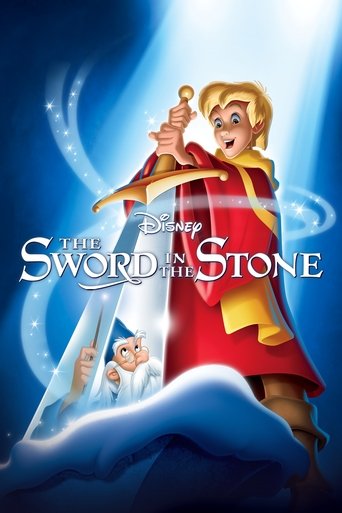
The Sword in the Stone
1963 · Film · 79 min
Directed by Wolfgang Reitherman
Wart is a young boy who aspires to be a knight's squire. On a hunting trip he falls in on Merlin, a powerful but amnesiac wizard who has plans for him beyond mere squiredom. He starts by trying to give him an education, believing that once one has an education, one can go anywhere. Needless to say, it doesn't quite work out that way.
5 positive6 neutralfrom 11 commenters
Where to watch
No streaming data for this title.
11 comments on Hacker News
Walt Disney died in 1966. There were less but still many notable traditionally animated films (or films which blended some modern technology with hand drawn cels) since then.
The Jungle Book - 1967
Little Mermaid - 1989
Beauty and the Beast - 1991
Aladdin - 1992
Lion King - 1994
It's likely more a question of what you grew up with. When I was a kid I remember heavily disliking many of the earliest Disney animated movies like Pinocchio/Dumbo/Bambi but I absolutely adored the animated Robin Hood, Sword in the Stone, etc.
From watching Severance, the closest parallel to me for a company I ever actually worked for is Disney. Disneyland performer was one of my first jobs, and the orientation is a lot like Lumon's. Video history of the company's reach and achievements. Tremendence reverence for the founder. Disneyland has a statue of Walt holding hands with Mickey at the junction between Main Street and Fantasyland and Main Street itself is a reproduction of Walt's hometown as it was when he was a kid.
And there is absolutely a cult of devoted followers. Even I personally had literal groupies from this job. There were women annual pass holders who'd be there every day to watch me and try to become friends with me. The memorabilia auctions were among the most insane things I've ever seen. Comers from everywhere in the world paying tens if not hundreds of thousands for the slightest piece of something authentic the same way someone will drop a cool mil for a baseball signed by Babe Ruth. There were people who collected annually released pins who'd been doing it for 70 years.
For the fans, it starts in childhood, too. The relationship is so deep that Disney fanatics love the company more than they love their own friends and family sometimes. Even for me, my very first favorite film was The Sword in the Stone, the Disney cartoon from the 60s about King Arthur. I don't even remember it, but my mom tells me I was rewatching it like teenage girls of the 90s rewatched Titanic when I was 4 years old. Disney imprinted itself into me before I even formed permanent memories.
They had global reach, too. Disney perfected this kind of thing way before Apple did.
There is another element to Lumon that I don't think Apple has, too. That's the company town. They own almost everything. Virtually everyone works there or is related to someone who does. Disney kind of had this with the City of Anaheim for a long time, but the city has probably outgrown it at this point. But at one point, they owned most of the land, employed most of the people. Disney owned both of Anaheim's pro sports franchises at one point. One of them was even named after a Disney movie! They had deals with the city to restrict airspace visible from within the park and never to build anything that could be seen to preserve the illusion that you're in an entirely self-contained world separate from the real world. Cal State Fullerton was called "Cal State Disney" at one point because so many of the students were employed there.
The lord of the rings is a good one, especially if you skip the songs. Then it’s simply an adventure story.
The Sword in the Stone is pretty good in this regard. Apart from that first book (which is published as a standalone book) the entire Once and Future King is too complex for a child, I think (instead it would come off as boring and obscure).
But in general almost any book a kid wants to try to read will be fine.
Also: back in the day when small towns had a single cinema screen, movies would travel around as physical media and play for a week or two. So they had to be appropriate for anyone in town else the cinema owner wouldn’t take them.
My kid loved those Fred Astaire musicals. I do too. For him they were just fun. To me, many of them were quite racy and quite explicit! But all that just went over his head.
> All this misandry and trying to portray any masculinity as toxic is just lame. It's very similar to Disney's queer coding of villains. I remember in my teens, while being a sexually confused and closed queer how sensitive I was to that bullshit and how awful and ashamed it made me feel. It's ludicrous how it's being done again, just the aggressor and targeted demographics are different now. I can't tell if that's just Disney's Modus Operandi, or of this is some type of bitter revenge writing. It sucked then and it sucks now, and it will continue to suck. We need to do better.
I disagree with a lot that you say, but I think I can agree with this paragraph.
The story of "Wish" needlessly shat on King Magnifico and I felt pretty uncomfortable about that writing. So I can agree that there's definitely an element of coding the Disney villain in a certain way.
Scar is the effeminate uncle. Ursula is coded as a drag-queen. Moving to the more recent movies: I can also agree that King Magnifico was coded as toxic masculinity (handsome, successful king), but they did a poor job in the movie saying why he actually deserved the punishment he got (or the betrayal of his wife).
That being said, its also just... how Disney movies always seem to have been written? Both the good and bad ones. Not really an excuse mind you, but for a happy-go-lucky musical for children, a lot of Disney Villains get rather harshly punished, and not all of them seem like they deserve said punishment.
> The only challenge these modern Disney SFLs face is not believing in themselves (and as someone who struggles on and off with self esteem issues, I realise how difficult those can be, but also it's not "enough" to base a whole character around just that), usually with a sprinkle of "blame the patriarchy" in there too.
Well lets talk about Live Action Mulan for example.
There's no "blame the Emperor" scene. In fact, the emperor is a badass who takes to single-combat on the frontlines. Maybe you could argue that the Bori Khan (the new name of the main bad guy) and his relationship with Xianniang / Witch / Hawk is a bit of a blame the patriarchy (female witch subservient to a warlord). But on the other hand, villains are often seen needlessly abusing their underlings (Darth Vader needlessly kills his officers. Megatron abuses Starscream, etc. etc.). So I'm not entirely sure if this is beyond the norm in these kind of settings.
People blame Mulan for a lot of faults and say its clear of Disney's issues today. But... has anyone aside me actually watched it? Its a crappy Chinese Kung Fu movie yes that has issues deciding if Wuxia is cool or not... and that's the main problem with it.
But if there's some level of "Woke messaging" going on here, I'm not seeing it.
---------
Edit: after further thought, Toxicly Masculine male villains were at least a thing since The Sword in the Stone, and Gaston from Beauty and the Beast. I argue it's not really a recent trope either.
Well in the animated Disney documentary Sword in the Stone we see Merlin come back from from Bermuda wearing Bermuda shorts and shirt so we can surmise it's always been the garb of wizards ; ).
I actually have some and I like projecting an air of fun since I'm an introvert.
> including, unfortunately, the removal of the Madame Mim fight that showed up in the Disney movie
Where does this character come from? Searching for Madam Mim or Madame Mim seems to turn up nothing but Disney results. Searching wikipedia for Madam Mim does nothing but redirect to the cast of The Sword in the Stone.
Wickedpedia makes a claim similar to yours:
> Madam Mim appears in the original version of the novel, but not in the revised version featured in The Once and Future King
This appears to say that "the novel" refers to some other novel than The Once and Future King, but of course there is no primary Arthurian source in the form of a novel. I can't really understand it.
It's difficult to extend Wickedpedia the benefit of the doubt, because it goes on to say this:
> Kahl animated her [Madam Mim's] initial interaction with Arthur while Thomas oversaw her famous Wizards' Duel with Merlin. He is a witch Madam Mim who is more which than oversaw. He is also a tiger similar to Shere Khan from The Jungle Book, though he is not in a forest.
The Once and Future King, by T.H. White.
The Sword in the Stone is probably my favorite Disney movie so I was delighted to discover the movie was based on a book which was even better.
For me, The Princess Bride and the animated Disney Sword in the Stone (and a bit later, The Hobbit) shaped my early understanding of Europe and gave me a life-long love of Europe and European history. I even migrated here from the US in my 30s and, although I have yet to find any dragons, I love the old castles, historical centers, and other reminders of history all around - just enough to keep me connected with the fantasy books and films I loved as a kid.
> I don't know what you think a Disney story is, but all of Disney's major works are based on existing folk stories and other works already in the public domain.
False. Here's some of their animated features based on copyrighted works (as best as I can tell):
Dumbo
Bambi
Peter Pan
Lady and the Tramp
One Hundred and One Dalmatians
The Sword in the Stone
The Many Adventures of Winnie the Pooh
The Rescuers
The Fox and the Hound
The Black Cauldron
The Great Mouse Detective
Treasure Planet (partially based on the 1987 TV miniseries Treasure Island in Outer Space)
Meet the Robinsons
The Princess and the Frog
Big Hero 6
(I'm using the list in https://en.wikipedia.org/wiki/List_of_Walt_Disney_Animation_Studios_films, and picking out the “based on” or ”inspired by” credits that look recent enough.)
Does your nickname come from Merlin's Owl (Italian translation) of Walt Disney's "Sword in the Stone" movie? :-)
>I know that Disney stops people from taking Walt's original concepts. But is that a bad thing? What concepts did Disney steal? None: he made his own. Other people can do that too.
This is completely wrong. Nearly every famous early work of Disney's was "stolen" from others. Among the more famous are Snow White (1937), Fantasia (1940), Pinocchio (1940), Dumbo (1941), Bambi (1942), /Song of the South (1946), Cinderella (1950), Alice in Wonderland (1951), /Robin Hood (1952), Peter Pan (1953), Lady and the Tramp (1955), Mulan (1998), Sleeping Beauty (1959), 101 Dalmatians (1961), The Sword in the Stone (1963), and The Jungle Book (1967).
The first iteration of Mickey Mouse, called "Steamboat Willie", was copied directly from Buster Keaton's "Steamboat Bill."
This is an excerpt from one of Lawrence Lessig's speeches about the topic: "It was a parody, a take-off; it was built upon Steamboat Bill. Steamboat Bill was produced in 1928, no [waiting] 14 years--just take it, rip, mix, and burn, as he did [laughter] to produce the Disney empire. This was his character. Walt always parroted feature-length mainstream films to produce the Disney empire, and we see the product of this. This is the Disney Corporation: taking works in the public domain, and not even in the public domain, and turning them into vastly greater, new creativity. They took the works of this guy, these guys, the Brothers Grimm, who you think are probably great authors on their own. They produce these horrible stories, these fairy tales, which anybody should keep their children far from because they're utterly bloody and moralistic stories, and are not the sort of thing that children should see, but they were retold for us by the Disney Corporation. Now the Disney Corporation could do this because that culture lived in a commons, an intellectual commons, a cultural commons, where people could freely take and build. It was a lawyer-free zone."
To address your second point, "the idea of capitalism" does not necessarily require giving anyone permanent, state-enforced monopolies of anything, no matter how well written it is. Any justification for copyright has to stem from a benefit to society. Strong arguments can be made for giving creators temporary monopolies of a limited scope, but permanent monopolies are bad for both innovation and the public.