 Hacker Cinema
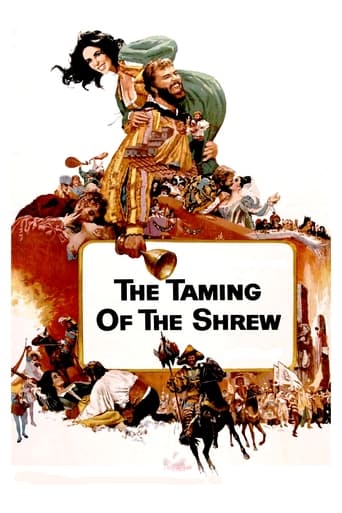
The Taming of the Shrew
1967 · Film · 117 min
Directed by Franco Zeffirelli
Italy, 16th century. Petruchio, a choleric, lying and poor rural landowner from Verona, arrives in Padua in search of fortune and a wife, while Baptista, a wealthy merchant, announces that he will not allow Bianca, his youngest daughter, to marry until the temperamental and unruly Katherina, his eldest daughter, does.
1 positive3 neutralfrom 4 commenters
Where to watch
No streaming data for this title.



4 comments on Hacker News
There are a fair few that were made into movies in the 60s and 70s that are definitely worth a watch. I saw Taming of the Shrew for the first time in a long time and caught some hysterical jokes that I completely missed as a kid.
But how many films are essentially just Hamlet or The Taming of the Shrew?
I guess my response to this is that basic music theory is roughly equivalent with basic acoustics, has more bearing on generalized musical practice than what you are implying, and that even reading sheet music is an abstraction that requires foundations in a musical culture that has a prerequisite of certain assumptions that may not actually hold.
If you listen to CPE Bach knowing that each note can be bent (as on a guitar, because it is a clavichord), then the written music makes more sense because each note can be tuned to be harmonic with the fundamental. The sheet is just a sketch. The presumed required bend in each note totally changes the expectations of the key it is written in.
Or, if you are listening to a gamelan, then the beating of notes becomes an essential rhythm of the instrument, informing the tempo of the ensemble as a whole.
Music theory is a combination of acoustics and music history, but the acoustic part is more fundamental/basic. Like knowing "Clueless" is based on "The Taming of the Shrew" is informative, but the fundamentals of quality movie making or movie consuming do not require you to know anything about Shakespeare.
> Asking them five times is almost certainly harassment.
Yet this behavior is romanticised is popular culture, and has been from the dawn of time up to and including the present: Oddyseus and Helen of Troy, Shakespeare's "The taming of the shrew", tons of Fred Astaire movies, as well as modern movies like "Ghost", "Life is beautiful", "Chasing Amy", TV shows like "Sex and the city"... I could go on. Lucikly I don't need to, since TVtropes has a site dedicated to this character (the "dogged nice guy"). And note that many of these are targeted at, and very popular with, women (who are usually at the receiving end of the initially-unwarranted attention). Apparently this behaviour can walk a thin line between illegal and very very romantic.