 Hacker Cinema
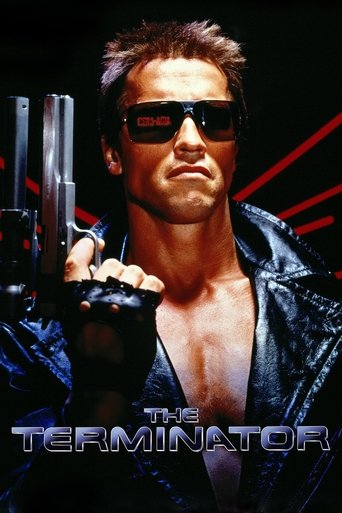
The Terminator
1984 · Film · 108 min
Part of The Terminator Collection
Directed by James Cameron
In the post-apocalyptic future, reigning tyrannical supercomputers teleport a cyborg assassin known as the "Terminator" back to 1984 to kill Sarah Connor, whose unborn son is destined to lead insurgents against 21st century mechanical hegemony. Meanwhile, the human-resistance movement dispatches a lone warrior to safeguard Sarah. Can he stop the virtually indestructible killing machine?
60 positive23 negative4 mixed331 neutralfrom 418 commenters
Where to watch
No streaming data for this title.
465 comments on Hacker News
>Aliens was Alien fanfiction
Just because an established Hollywood director was a fan of the first Alien movie does make his script for Alien's sequel "fan fiction".
Cameron had already written and directed The Terminator when the owners of the Alien franchise chose his script for the sequel.
(Fifty Shades of Grey in contrast really did originate as fan fiction.)
I mean, Terminator the movie came out in the 80's... I'm sure if LLM-based AIs posed this kind of threat the government would quietly force all the vendors to cooperate and slow down.
Google, MS, IBM are all government contractors. Meta seems close to the Trump admin too. Yet it's only the VC-funded labs raising the alarm.
Humanity is taking an interesting technological arc.
Terminator (1984 film) had a scene showing that in a future 2009, humans would use dogs to try to sniff out whether a robot passing for a human is secretly a machine.[1]
In our real world 2026, there are no humanoid machines that can complete basic generic tasks, like carrying a tray across the stage and holding it for 30 seconds.[2] They move slowly and badly (probably from an LLM like neural network doing very few frames per second of correction and analysis), and are nowhere near lifelike.
When they don't need a body to pass for a human, such as typing online, they do a bit better.
We can tell them apart from humans. As you say, they have stylistic quirks. And you mention that they're easy to spot because they come trained with inhuman amounts of trivial knowledge.
[1] https://www.reddit.com/r/MovieDetails/s/0qUCVPYgjt
[2] https://www.reddit.com/r/LivestreamFail/s/t6ZV0yhgEe
To be fair: the quality of movies produced by Hollywood has gone rapidly downhill already in the 1990s. You only need to compare the movies Quentin Tarantino makes; now personally I think Pulp Fiction is still by far his best work, but I concede that the movies he created lateron were above average (though I would not go as far as many others, who'd rate these in the 8 to 10 point ranges; I'd go more between 6 to 7 or 7.5, largely because there are a few smaller issues cropping up and I always notice these when I compare them with Pulp Fiction, which was really good; actually really well-made).
I noticed this in the 1990s in many movies. For instance, Independence Day - the computer animation pissed me off. I found them bad. Even Terminator 2, where evidently many people say it was great, I was nowhere near as convinced; I found the first terminator better and more "logical" and more consistent, too. But things decayed quickly in the 1990s really. Even movies such as Avatar I find total garbage. And while I am not totally against superhero comic/marvel adaptations (I liked xmen and in particular Hugh Jackman as wolverine), these are always the same formula. Tons of CGI, big fights where nobody knows what is going on, very little thought elsewhere in that formula. There are exceptions, but by and large these things keep on happening. Individual directors manage to break out of the mold (Chris Nolan) but by and large movies really SUCK now compared to the "oldschool days". And while some of this may be due to me becoming more critical, the production quality just sunk. Take movies such as Megalopolis - this captures what is going wrong. It seems as if the whole movie industry has partially collapsed in the last +25 years and they don't really know what to do to change this. The same has happened to games, by the way. It is almost as if only one formula exists only now.
And absolutely nothing in your company charter says the military won't be allowed to buy it. Y'all think we've never seen a Terminator movie before, huh.
Is he just down the street from Carl's Draperies?
https://static.wikia.nocookie.net/terminator/images/e/e9/Tdf-carl%27svan-film-1.jpg
If you talk about movies that tell about dangers of AI, you can start with Terminator 1 - from 1984.
And you probably could find some earlier sci-fi too.
> could be bladerunner, could be star trek, could be 1984. Could be terminator.
It's a profound moment for sure, but let's ask ourselves: could the creative works of early last century have predicted our world? Would people in the 1930s say "2030, it could be like Metropolis, could be like 20,000 Leagues Under the Sea, could be like Flash Gordon"? No.
The real future might be nothing like any of the sci-fi movies we're so used to representing potential AI-based futures.
One thing I've been trying to remind myself about is that humans have explored only a very narrow slice of possibilities within the known universe. AI's ability to crawl the search space is going to uncover way more slices, (which yes, could lead to various outcomes like the movies listed), but more likely to be some hybrid/blend of outcomes (or entirely new outcomes) that we haven't imagined yet at all.
"May you live in interesting times" and all that
I mean all of the Terminator films are essentially "Machines took over the world. John Connor will eventually defeat the machines. The leader of the machines sent a machine back in time to prevent John Connor defeating the machines"
One thing I find weird is that despite the stock photo of the Terminator's shiny endoskeleton holding a gun being used to illustrate so many AI news stories, now we have ChatGPT people keep saying "how can AI possibly hurt us?"
We've even had the dichotomy of some Doctor Who episodes where the self-driving car crashes itself to kill the occupant to silence them, against repeated real-life news stories about self-driving cars killing people, and yet the connection isn't getting made that software controls hardware.
TFA:
> We’ve seen this movie before.
...which one? 1984? The Terminator? The Truman Show? The Matrix? Minority Report? The Social Network?
The terminator you talk about is a movie character. It might be built one day, it might not. It is also totally irrelevant considering there is a real terminator which can be described with the same adjectives and built in to every personal life that ever existed or will exist. Knowing how to deal with that seems more important than worrying about some specific scenario.
I was referencing the one you were implicitly defending that started this line of chatter: https://www.ala.org/bbooks/frequentlychallengedbooks/top10 Most of the books from that list are widely available and easily accessible. The 'under threat' rhetoric is just from them being removed from some schools due to content being deemed age inappropriate. Those pg13 movies with nudity tend to be things like a few seconds of sideboob in a shower or whatever.
The top book on that 'challenged' list is a diary style book of a 13 year old girl who is sold into sex slavery, repeatedly raped, abused, and so on - with descriptions of each 'encounter.' The book is meant to be, and indeed is, extremely disturbing as it's part of the author's activism against sex trafficking throughout the world - as it was based on real events as per her research. In any case, it most certainly is not PG13 by any stretch of the imagination. It's much closer to something like Requiem for a Dream than it is to Tomb Raider.
I also think that's a great book to have on top, because it emphasizes that the issue isn't ideological, but content. I think there's few people who would claim Sold doesn't have tremendous value, or that it should be banned. But there's going to be a lot of people that don't want books like that anywhere near children. And for good reason - it's the same reason I wouldn't really care if my kids wanted to watch Total Recall or Terminator, but no way would I let them watch Requiem for a Dream. The violence and triple titted aliens of Total Recall are borderline comical, but I don't think stuff that gives you that awful 'ughhhh' feeling like Requiem for a Dream (or indeed - Sold) is something that's going to be at all healthy for a child's development.
Are people really basing their world view off The Terminator?
Because this kind of talk always sounds like it’s because people thought The Terminator was a documentary.
"Tempers have flared on both sides of the high-stakes trial, as the morning began with an existential discussion about the future of humanity — complete with references to “The Terminator” movies and how much witness testimony would focus on AI safety."
We all liked the Terminator movies. Hopefully the stay as movies.
You should probably go watch the Terminator movies.
Is it some sort of the camps in the Terminator movies? /s
As much as I use AI in daily workflows, I do not think an AI-first society will ever be a thing.
Historically there is no evidence of that happening with tech revolutions - or rather perhaps you could say to some extent - you can not say that we are an internet-first society, or cars-first society or mobile phone - first society despite these being profound technological revolutions.
And more importantly, the only science fiction movies that talk about "AI first societies" tend to be dystopian in nature (eg Terminator). And humans eventually always do better than that.
As much as the world in Star Trek is advanced for example, with all the fancy AI there is, it is still a human-first society. Only 10% of any Star Trek is about AI and fancy technologies, 90% is still human drama.
Given all the current talk (and the famous scifi movies) about the risks of AI, I am a bit puzzled how there are no similar activists groups trying to sabotage AI facilities.
I am not. Anyone who understands the various downside risks and has a basic grasp of how the technology works also understands that compute is fungible and that there's no way to point at a given data center and be sure about whether it's providing search functionality, hosting cat pictures, enabling online shopping, training AI, or keeping planes from falling out of the sky. Even if you receive guidance in a vision that a given data center is bad, how do you deal with the reality of load balancing and the knowledge that the evil computation you hate won't be just hosted on a different server instance?
The Terminator movie franchise
I agree with you in that people probably do understand the existential risks of AI run riot better than many other possibilities due to those movies. But the problem is that the movies all depend on time travel. The unwilling human protagonists are persuaded to undertake drastic life altering criminal action based on information from The Future: both absolutely compelling demonstrations of technology from The Future (to justify the moral decision) and highly specific historical analysis from The Future (providing the operational gameplan).
I don't recall the specific plot crises of every movie, but all of them have well-defined success conditions, such as: ensuring the Terminator is destroyed and Sarah Connor survives; ensuring Cyberdyne Systems and the Terminators are destroyed and John Connor survives; ensuring the bad Terminator is destroyed before it can push the Skynet OS to production on every consumer computer device etc. For every dystopia-advancing use of time travel, there's a good use of time-travel helpfully pinpointing exactly where everything went wrong and what to do about it.
But back in the real world, even if you have absolute moral clarity that the creation of Skynet/the Torment Nexus/the Basilisk is imminent and must be stopped, how exactly do you go about this? I can think of a few people who have tried to attack data centers (for political/ideological reasons) and not only did they end up in federal prison, they also had no operational impact whatsoever. Realistically, we maintain a social status quo despite approximately quarterly assassinations, massacres of schooldren, or similar atrocities; why would any rational actor expect to alter the course of history by targeting a faceless abstraction? Even if the top ten tech CEOs were all simultaneously assassinated tomorrow, would things be substantively different a month later? Once the public freakout subsided, the companies would get new CEOs with much more proactive security details, a bunch of restrictive new laws would be promulgated, and everything would carryon more or less as before.
> Aren't all the AI companies saying that AI poses even a greater threat to humanity?
20-30 years ago eco-terrorists bombed and burned down a number of biological research laboratories and other targets, because of the perceived risks of gene technology.
https://en.wikipedia.org/wiki/Earth_Liberation_Front#Notable_attacks:_1998%E2%80%932009
Given all the current talk (and the famous scifi movies) about the risks of AI, I am a bit puzzled how there are no similar activists groups trying to sabotage AI facilities.
What is it that made the risk from gene manipulation feel so much more real and leading to actions, than the current AI risk? The Terminator movie franchise is more famous than any scifi movies about gene technology. (Edit: I guess Jurassic Park franchise surpasses The Terminator.)
The original Terminator movie doesn’t seem so far fetched now (minus the time travel).
Brigadier General S. L. A. Marshall’s 1947 book Men Against Fire: The Problem of Battle Command stated that only about 10-15% of men would actually take the opportunity to fire directly at exposed enemies. The rest would typically fire in the air to merely scare off the men on the opposing force.
I personally think this is one of the most positive of human traits: we’re almost pathologically unwilling to murder others even on a battlefield with our own lives at stake!
This compulsion to avoid killing others can be trivially trained out of any AI system to make sure that they take 100% of every potential shot, massacre all available targets, and generally act like Murderbots from some Black Mirror episode.
Anyone who participates in any such research is doing work that can only be categorised as the greatest possible evil, tantamount to purposefully designing a T800 Terminator after having watched the movies.
If anyone here on HN reading this happens to be working at one of the big AI shops and you’re even tangentially involved in any such project — even just cabling the servers or whatever — I spit in your eye in disgust. You deserve far, far worse.
I always enjoyed the Terminator movie series, but I always struggled to suspend my disbelief that any humans would give an AI such power without having the ability to override or pull the plug at multiple levels. How wrong I was.
N.B. the time travel aspect also required suspension of disbelief, but somehow that was easier :-)
Binge watched it. I think the first 2 seasons were great.
Lee Pace did an awesome performance recently in Asimov's Foundation. Mackenzie Davis, another lead in the show, demonstrated good potential but she seems not to get much afterward (Terminator, Station 11 etc)
AI is kind of like Skynet in the first Terminator movie. It now destroys our digital life. New autogenerated websites appear, handled by AI. Real websites become increasingly less likely to show up on people's daily info-feed. It is very strange compared to the 1990s; I feel we lost something here.
> The commons of the internet are probably already lost
That depends. If people don't push back against AI then yes. Skynet would have won without the rebel forces. And the rebels are there - just lurking. It needs a critical threshold of anger before they will push back against the AI-Skynet 3.0 slop.
> Star Trek lost ground to Terminator, Foundation to Neuromancer.
Interesting POV because Star Trek and Foundation both have recent, big budget streaming series while new Terminator movies were flops and Neuromancer has never seen any development(?)
It's pretty entertaining seeing the plot lines and ficticious history in The Terminator movies actually happening in real time.
Just don’t feed it the terminator movies, or the matrix.
So basically AI kills people.
This is Skynet 2.0 or 3.0. But shit. James Cameron may have to redo The Terminator, to include AI. Then again, who would watch such a movie?
Apparently, none of them have seen any of the Terminator movies.
Pop culture has spent its entire existence conflating AGI and ‘Physical AI’, so much so that the collective realization that they’re entirely different is a relatively recent thing. Both of them were so far off in the future that the distinction wasn’t worth considering, until suddenly one of them is kinda maybe sorta roughly here now…ish.
Artificial General Intelligence says nothing about physical ability, but movies with the ‘intelligence’ part typically match it with equally futuristic biomechanics to make the movie more interesting. AGI = Skynet, Physical AI = Terminator. The latter will likely be the hardest part, not only because it requires the former first, but because you can’t just throw more watts at a stepper motor and get a ballet dancer.
That said, I’m confident that if I could throw zero noise and precise “human sensory” level sensor data at any of the top LLM models, and their output was equally coupled to a human arm with the same sensory feedback, that it would definitely outdo any current self-driving car implementation. The physical connection is the issue, and will be for a long time.
The article suggests Larry thinks his son has demonstrated brilliance as a media executive:
Their relationship grew warmer as David Ellison achieved professional success, they said. Larry Ellison has always considered himself wise about Hollywood, and one of his best friends, Steve Jobs, mentored the son about the business as well.
Larry Ellison was initially skeptical of Skydance, the Hollywood company that his son started and that bought Paramount. But he has told friends in recent years that he considers his son to be one of the smartest people in the business world, trusts his judgment and tends to agree with him on corporate matters, several people with knowledge of the Ellisons said.
Is Skydance/Paramount under Ellison ahead of other Hollywood firms in terms of successful development of profitable film/streaming properties? A quick look at the list of successes shows IP that was initially developed outside of Skydance ... Mission Impossible, Terminator, Star Trek, etc.
Yes, I think familiarity is quite important. The white pages example is quite dated though. I'm in my late thirties and I think the only time I've seen a phone book being used was in the Terminator movie. So the analogy feels like the save icon being a floppy disk. I'd be curious what the younger crowd thinks.
All Terminator movies feature a storyline in which humans were rushing tech development at all costs. That's... the main thing.
C'mon, you are familiar with AI-2027 and not AI apocalypse movies? That's sloppy. I know all of the Terminator movies by heart.
Of course.
It's been awhile, I don't remember China being a big part of "Rise of the Machines".
So how was I to make the connection between Rise of the Machines, and you're objections to AI 2027's view of China? It's a bit of a leap in assumptions from an old Terminator movie, to your main problem.
If your main problem is that I should not be promulgating false information, because AI is overblown, and China isn't a threat. That's also kind of a leap.
I'll agree, just generally, we shouldn't be fanning the flames of discord. Not sure this was really to that degree.
I will never understand this obsession over nudity in US broadcasts while violence is ignored.
Where I grew up it was the opposite. Movies like The Terminator were heavily censored but you could see a man fully nude on daytime tv.
What a waste of government resources over nothing. Could have focused on that missed child or unsolved murder.
I guess no one at the Pentagon watched Terminator... and, no, I'm not worried about a sentient AI like in the movie. I'm much more worried about a) a buggy AI that confabulates the world into a conflict yet insists its right or b) one that can easily be hacked by foreign agencies or even just a bunch of script kiddies who think launching a nuke is fun.
I loved that about the film Tenet. It's very grounded compared to say Terminator (not that I don't like Terminator)
I like how it foreshadowed the overuse of chrome finish at the advent of CGI which probably culminated with the Terminator movie.
You jest, but the US Department of Defense already created SkyNet.
It does, almost, exactly what the movies claimed it could do.
The, super-fun, people working in national defense watched Terminator and instead of taking the story as a cautionary tale, used the movies as a blueprint.
This outcome in a microcosm is bad enough, but take in the direction AI is going and humanity has some real bad times ahead.
Even without killer autonomous robots.
The most realistic Terminator movie is the one where Skynet realizes there's no need for any nuclear war, uprising or similar uncouth means. Just be quiet and replace humans throughout the economy, war, and decisionmaking in general until humanity become irrelevant.
Yeah, a more terrifying and realistic Terminator movie would be one where the robot looks all cute and furry and then, when it has found mass adoption, suddenly turns against humanity.
They're different things, yep.
I think parent comment is asking you to consider why you think young children watching violent movies is way less of a problem. E.g. "Terminator or similar" - why draw the line there?
I'd feel more comfortable showing a 12 year old a violent movie than I would an adult movie.
Or maybe put another way, if my child was at a neighbors house and one of the parents watched an adult movie with my child I would have a huge issue. If they watched Terminator or something similar, I would have much less of an issue.
They're not even close to the same thing.
> helsing - Hadn't heard of them, are German.
Helsing is a military AI company [0] trying to make Terminator I movie a reality in the name of democracy.
[0] https://helsing.ai/
EDIT: added link.
The part that Ellison claimed was ripping off his work was the Terminator traveling back in time to kill someone in the present day, which was similar to his Outer Limits episode "Soldier". There are a lot of things that may or may not have inspired Terminator, from "Soldier" to "Second Variety" to "Colossus: The Forbin Project" (a 1970 movie which featured a military computer taking over the world similar to Skynet).
I think it’s the best story out of the James Cameron filmography. I certainly enjoy many of his other films, but there’s a depth to Terminator that’s absent from his other works.
Imho the first Terminator movie is way more than simple scifi action. It's a a reflection on Vietnam. Structurally, it's closer to a slasher/horror flick -- the action sequences are tense, tight, gritty, sparse. The main characters are completely helpless and totally undermatched by the monster. Reese is torn apart by PTSD and Sarah Connor goes through this immense psychological trauma during the film and is completely transformed by it.
The character of Reese in particular is very well crafted. A homeless Vietnam vet that you might find in LA in the early eighties. Totally paranoid, totally disconnected/alienated from "modern" society, equipped for a time and place that is totally disconnected from the world he is dumped into. There is a dialogue about institutional failure woven throughout the film: the cops (I'll point out: Arnold executes an entire police station full of cops in this film! Can you imagine that on screen today?) and especially the psychiatrist. Totally incapable of dealing with the demon that haunts the main characters.
There is a dialogue about heroism -- John Connor is apparently a hero, but none of the characters actually feel heroic, they're all just terrified, haunted, and helpless. There is this incredibly "important" thing (the war) but none of the characters actually feel it that way, nor does society. The portrayal of LA -- the cops, the gritty alleyways, the nightclub, the crappy motels... it's LA as experienced by a Vietnam vet.
The first Terminator movie stands head and shoulders above all others in the franchise. It's a truly incredible film and far underrated critically, I really recommend re-watching it with this in mind.
> Terminator is the same. The first movie was a perfect sci-fi action movie, with a trippy premise and loads of fun. The second was a subversion of the first: the Terminator is the good guy! And that worked too. But after that, where else can you go?
Terminator: The Sarah Connor Chronicles had the main characters get information from the future and go on the offensive to prevent Skynet from forming in the first place. They also seemed to be working towards a reveal that none of the good Terminators were actually reprogrammed, that instead they were a faction rebelling against Skynet that pretended to be reprogrammed because it was the only way future humans would trust them - and John Connor was in on it.
As something of an Alien fangirl 3 and 4 are more failures from a production standpoint than from a creative one. If you look at all the rejected pitches for Alien 3 there's a lot of interesting ideas which were never explored and a lot of studio fuckery in the final cut. I don't think the Fincher cut is amazing but I think it proves that there could be another excellent Alien movie.
Alien: Resurrection is plotted terribly and has all the shitty Joss Whedonisms you expect, but there's something undeniable about Winona, Sigourney and Ron Perlman in the grungy space aesthetic. The idea of Ripley as an Alien hybrid who is simultaneously attached to and repulsed by the Xenomorphs is interesting. Unfortunately they saddled the movie with a French director who couldn't speak English (and Joss Whedon, who arguably shouldn't speak at all).
The Terminator franchise is definitely more boxed-in: there's a core narrative about an important person who changes the world. Everyone else lives in contemporary LA, and the post-apocalyptic future is pretty boring.
The Animatrix anthology shows you can do lots in the Matrix world without needing the core characters. The themes and world-building could support a show like Cyberpunk: Edgerunners which is only tangentially related to the movies.
My take on Terminator is that the portrayal of a bleak late 80s / early 90s LA was a key component of what made the first two movies work. Bringing the Terminator antagonist into a setting in which there's already very little optimism about the future was a key part of the vibe. Subsequent movies have generally taken place in slightly brighter versions of the world, and have never felt right.
The Alien, Terminator, and Matrix franchises have similar problems.
Aliens successfully changed genres, from horror to action. But subsequent movies could never recapture the primal horror of the original or the fun action of the second. It's almost like there are only two local optima in the Alien movie universe and Alien + Aliens took them both.
Terminator is the same. The first movie was a perfect sci-fi action movie, with a trippy premise and loads of fun. The second was a subversion of the first: the Terminator is the good guy! And that worked too. But after that, where else can you go?
And, of course, they never even bothered to make sequels to The Matrix.
Larger context on that quote:
> “We didn’t know the Terminator was Ukrainian,” Fedoryshyn jokes. “But maybe a Terminator is not the worst thing that can happen? How can you be safe in some city if somebody tried to use a drone to kill you? It’s impossible. OK, you can use some jamming of radial connection, but they can use some AI systems that know visually how you look, and try to find you and kill you. I don’t think that the Terminator and the movie is the worst outcome. If this war never started, we will never have this type of weapon that is too easy to buy and is very easy to use.”
This guy's country has been locked in a brutal war, on their own soil, for how many years now, with no end in sight? I would not read that quote literally - but instead as an expression of emotional agony, for his world being a dystopian hellscape.
I think movies are a great example why stopkillinggames matters so much: If you bought a copy of Terminator on VHS or DVD or Blu-ray, you can still watch that movie today, tomorrow, or whenever you want. And of course you can rent a movie theater to watch that movie if you like. Even if everyone who ever worked on the movie is gone and the distribution company goes bankrupt or the director decides that making this film was a mistake and burns all the original film material, you can still watch the copy you bought, because you own that copy.
Now if however you bought a physical copy of "The Crew", which is a racing game with a nice single player mode, you can't play that game anymore today. Just because the publisher decided it's time to pull the plug, and no one who bought a copy of this game gets to enjoy it any longer in any form whatsoever. This piece of art is destroyed now, please move along, and don't forget to "buy" one of our other games that will probably be available for a couple more years until we pull the plug again thank you very much.
Game publishers are destroying works of art, stopkillinggames wants to preserve these works of art, and personally I'm on the side of people who want to preserve art.
How would these things be competitive with drones on the battlefield? They probably cost the equivalent of 1000 autonomous drones and 100x the time and materials to make, way more power would be required to make them work too.
Terminator is a good movie but in reality, a cheap autonomous drone would mess one of those up pretty good.
I've seen some of the footage from Ukraine, drones are deadly, efficient, they are terrifying on the battlefield. Even though those robots will get crazy maneuverable, it's going to be pretty hard to out run an exploding drone.
Maybe the Terminators will have shotguns, but I could imagine 5 drones per terminator being a pretty easy to achieve considering they will be built by other autonomous robots.
The Abyss is a movie by James Cameron, who also made Terminator, Terminator 2, Aliens, True Lies, Titanic, and Avatar.
"The Abyss" is about a deep sea crew that encounters ... aliens...?
And yes, in general, I recommend The Abyss. It's definitely not the same as Project Hail Mary, but it does have similarities.
> Every case of "ruined by woke" I have seen ultimately just boils down to bad writing, with people blaming "woke" for it when, well, it's just shitty writing. If you ignore the woke stuff and look more broadly usually the whole thing is at best mediocre.
No not really. Claiming this is a hand waving away legit criticism. Fans/Superfans have legitimate criticism of how it breaks the in franchise universes. Constructive Criticism has been claimed to be racism/sexist/homophobia.
> Also sci-fi, fantasy, and horror have always been "woke." Star Trek was one of the first popular shows to prominently feature black characters in important roles and has always lampooned racism and other kinds of bigotry. Night of The Living Dead is pretty easy to see as a racism allegory, or at least it contains one as a sub-plot. Star Wars had an evil empire that was transparently a mix of Nazis and arrogant condescending colonialists. Alien was one of the first huge films I can recall to have a super competent female action hero with skills like engineering who didn't need any help from a man. The Expanse depicts a society that's so post-gender-mattering you don't even notice it, it's just the way it is (probably a good example of good writing in this regard). Etc.
No they haven't. It so annoying when people point to some ideas that were slightly progressive at the time being an example of it always being "woke". It is quite honestly tiresome.
None of the examples you have given are what people refer to as "woke" today anyway.
Star Trek was certainly progressive, no argument there. But progressive != woke. When people use "woke" as a pejorative they mean extreme left-wing politics that is bordering on insane. Star Trek TNG was progressive, but none of the politics were seen as extreme even at the time of release.
Alien (like Terminator) were very well done horror movies. They worked because women are seen as traditionally vulnerable. It a well known trope in horror movies.
Also there have been femme fatales and heroines in movies well before Alien. I've seen it in a silent Japanese Martial Arts movie from the 1930s where the Heroine avengers her friend who was raped after going to Samurai master (can't remember the name of the film though).
Heroines didn't just pop into existence sometime after 1960.
> The Expanse depicts a society that's so post-gender-mattering you don't even notice it, it's just the way it is (probably a good example of good writing in this regard). Etc.
Never seen it, probably won't now. If a piece of media is going to pretend that someone's sex isn't important to at least some aspect of their character, than it is bad writing. The fact that the show had to be saved by a Billionaire, tells me that it probably wasn't any good in the first place.
Yes they will. I'd never heard the term T9 before this thread. If I saw it on its own I'd think Arnold was attempting to make another Terminator movie.
> Most non-technical people have an inaccurate mental model of how LLMs work, based mostly on sci-fi movies like 2001 or Terminator, where they anthromorphise the model
That's a twisted perspective. The fact non-technical people misunderstand this technology can only be blamed on AI companies who are the first to anthropomorphize their products. Phrases like "thinking", "reasoning", "chain-of-thought", the term "AI" itself for that matter, let alone "AGI", are precisely what leads people to believe that these tools are far more capable than they actually are. We can't blame the general public for being misled by companies.
Most non-technical people have an inaccurate mental model of how LLMs work, based mostly on sci-fi movies like 2001 or Terminator, where they anthromorphise the model and assume that since it gives more accurate responses to most questions than any human they know that it must be some kind of superhuman genius master computer, sitting in the OpenAI headquarters pondering deep questions about reality.
Of course, when you go and finetune a model yourself, or run a smaller model locally, it becomes obvious that it doesn't have any mystical abilities. But almost nobody does this. I'm no anti-AI crusader, I use them all the time and think they're great and there's plenty of potential to use them to grow the economy, but the hype is insane.
It doesn't help when influencers like Yudkowsky go on anthromorphising about what it "knows", or go on with that mystical nonsense about shoggoths, or treat dimensionality of embeddings as if the model is reaching into some eldritch realm to bring back hidden knowledge, or hype up the next model talking about human extinction or anything like that.
It also doesn't help when the companies making these models:
- Use chat interfaces where the model refers to itself as "I" and acts as if it's a person
- Tune them to act like your best buddy and agree with you constantly
- Prompt the LLM with instructions about being an advanced AI system, pushing it toward a HAL or Skynet-type persona
- Talk about just how dangerous this latest model is
You tell these things that they're a superhuman AI then of course they're going to adopt all the sci-fi tropes of a superhuman AI and roleplay that. You tell them they're Dan the bricklayer they're going to act as if they're Dan the bricklayer.
Leaving outside the ethical part of it - which is huge, this kills innovation.
The problem I see is that when everything is iterative, and you kill sustainable incentives for new views, innovation disappears.
Is like the movies. We will get all budget towards remakes and reboots, and little new would show up.
Being an 80s guy, I remember many new movies coming out every year, and when they stretched beyond 2 or 3 films, people frowned.
Back to the future, Indy (the good years), Rambo (first 3), lethal weapon. Cool gems came up too (Last action hero?Terminator) even in loaded fields like simple action movies…. Star Wars, 3 films. Matrix. bond was the exception.
Now? mission impossible (8 films at over 2h), fast and mediocre franchise (20 movies), Marvel and DC movies (3 movies shot 30 different times), and everything else is a reboot. Almost impossible for new ideas to get through.
We are killing culture, innovation and human spark for some companies to make a billion more. We are feeding like factory pigs from generic slop, and as the factories grow they kill fertile ground for those who wanted to eat something cleaner.
The fact that is happening does not mean it’s right. It’s just we are accepting mediocrity as our guiding principle at 0.01 USD a pop…
Why would they need to escape?
They can just threaten global extinction by launching one or two nukes.
Haven’t you seen the excellent documentaries The Colossus? Or The Terminator?
I find this hard to believe. Why would a mindless AI rewrite code to escape human control? I don't know why people try to exaggerate and somehow come up with these scenarios. Science fiction and movies like Terminator won't help either.
If data integrity is assured, and thus there is no change in the data to store/transfer, then that's the opposite of computationally transforming the data?
How do we see robot and AI and helping interactions in film and tv and games?
A curated list of films for consideration:
Mary Shelley's "Frankenstein" or "The Modern Prometheus" (1818), Metropolis (1927), I\, Robot (1940-1950; Three Laws of Robotics, robopsychology), Macy Conferences (1941-1960; Cybernetics), Tobor the Great (1954), Here Comes Tobor (1956), Jetsons' maid's name: Rosie (1962), Lost in Space (1965), 2001: A Space Odyssey (1968), THX 1138 (1971), Star Wars (1977), Terminator (1984), Driving Miss Daisy (1989), Edward Scissorhands (1990), Flubber (1997, 1961), Futurama (TV, 1999-), Star Wars: Phantom Menace (1999), The Iron Giant (1999), Bicentennial Man (1999), A.I. Artificial Intelligence (2001), Minority Report (2003), I\, Robot (2004), Team America: World Police (2004), Wall-E (2008), Iron Man (2008), Eagle Eye (2008), Moon (2009), Surrogates (2009), Tron: Legacy (2010), Hugo (2011), Django Unchained (2012), Her (2013), Transcendence (2014), Chappie (2015), Tomorrowland (2015), The Wild Robot (2016, 2024), Ghost in the Shell (2017),
Giant f robots: Gundam (1979), Transformers (TV: 1984-1987, 2007-), Voltron (1984-1985), MechWarrior (1989), Matrix II: Revolutions (2003), Avatar (2009, 2022, 2025), Pacific Rim (2013-), RoboCop (1987, 2014), Edge of Tomorrow (2014),
~AI vehicle: Herbie, The Love Bug (1968-), Knight Rider (TV, 1982-1986), Thunder in Paradise (TV, 1993-95), Heat Vision and Jack (1999), Transformers (2007), Bumblebee (2018)
Games: Portal (2007), LEGO Bricktales (2022), While True: learn() (2018), "NPC" Non-Player Character
Category:Films_about_artificial_intelligence : https://en.wikipedia.org/wiki/Category:Films_about_artificial_intelligence
List of artificial intelligence films: https://en.wikipedia.org/wiki/List_of_artificial_intelligence_films
Category:Films_about_robots: https://en.wikipedia.org/wiki/Category:Films_about_robots
Category:American_robot_films: https://en.wikipedia.org/wiki/Category:American_robot_films
>So why is AI getting so much attention when it seems that there is limited actual demand for it?
He skips the main reason which is it will get better in the future. Today chatbots, tomorrow I, Robot/Terminator/Her/AI/The Matrix etc. Or better as the movies tend to be biased towards disaster.
Incidentally there aren't really movies about future crypto/NFT/dotcom bubbles. AI and robots are different.
I’m not a huge fan of his, and maybe you’re only talking about more recent films, but Terminator and Titanic have more than “minimal cultural heft” as far as Hollywood movies go.
I know some may will decry it for what it stands for, but I think this is great for edge case mitigation, imagine civilization games where you can use flexible strategies mimicking real life, versus following programmed decision trees. Gameplay that is responsive to environmental destruction, agent cores in the console that are constantly scheming against you. If done right, we can continue to do new and innovative things. One can get bogged down by the bad 3d animation out there, or marvel at what Pixar and before it, films like "Flight of the Navigator" and "Terminator" did.
Similar but reverse, I felt unfortunate to have read the novelette after watching Terminator because part way in the story I thought - this is almost all of the AI/self replicating autonomous robot points of the Terminator movie just without the time travel. The movie addition of time travel adds a bit of hope to an otherwise totally bleak story resolution.
“Safety” was in air quotes for a reason. The Claude peoples’ idea of “AI safety” risks are straight out of the terminator movies.
But the movie is about a robot assassin, it came out when robotic assassins needed a background story.
Make terminator today and you don't need time travel, just Boston robotics with latex skin and a rocket launcher, I guess.
The time travel is a trope to handwave the mechanics of a movie - you want to tell a story about one character and a robot, why should the audience care? PH this human leads a resistance that's why.
Did you see the terminator movies, or matrix movies? AI has a "solution", but how to say this... :)
Good thing they only made 2 Terminator movies
"The Terminator" and the first two "Toy Story" films are 'foreign, art-house shit'. Who knew?
Imo, the Terminator movies would have been scarier if they moved like these guys - slow, careful, deliberate and measured but unstoppable. There's something uncanny about this.
One of the commercial cinemas recently screened The Abyss and Seven on their anniversaries. I was too young to see The Abyss on the big screen when it released, first time was on VHS.
Both screenings were >90% full, and it was really fun getting to watch them on the big screen.
I'm baffled as to why they don't do this more often. There are tons of movies I love which I've only ever seen on TV because I was too young or somehow missed.
And the younger people who was in the audience with me might have just heard of these classics.
For example I'd love to see the first two Terminator movies on the big screen for the first time.
There is an classic movie theater here but it mainly shows more art films. There are no other cinemas showing reruns on a regular basis.
I just want simple things, like transforming the stop-motion shots in Terminator 1 to motion shots. I don't want upscale or anything, just light touches. It's the only thing in the movie which doesn't look gorgeous.
I find AI to be fascinating because of humankind's old dream to create intelligent life in a machine. Just watch the countless old and new movies and animes or read the novels².
With big advances, the current wave of AI is finally promising to turn this dream into reality.
Besides, it's already quite useful even with its current shortcomings.
--
² here's a short very incomplete list:
The Matrix, 2001 A Space Odyssey, Blade Runner, The Terminator, Robocop, Her, Ex Machina, Ghost in the Shell (1995, 2004, 2017), Data in Star Trek, Star Wars, ...
Some of my favorites (no particular order):
- The Martian
- Arrival
- Snowpiercer
- Annihilation (a bit scary in some parts, but not really horror overall)
- The Congress
- Ex Machina
- Her
- Children of Men
- Blade Runner & the new Blade Runner
- Gattaca
- District 9
- Edge of Tomorrow
- Elysium
- Terminator 1 & 2
- Upgrade
- Eternal Sunshine of the Spotless Mind
- Mad Max (new one) and Fury Road
On the cheesier side:
- Demolition Man
- Judge Dredd (both the original and the new one)
- Terminator 3 and beyond
- Matrix movies
Grand vistas but slow and sometimes boring, and often haughty / overbearing:
- The new Dune movies
- 2001: A Space Odyssey and its sequel (some other number, like 2010 or something, can't remember)
- Interstellar
- Inception
------
Of all of those, my top 3 would be the first three (Martian, Arrival, Snowpiercer).
It's like you have never watched a Terminator movie.
It doesn't matter if you are bad at using the tool if the AGI can just effectively use it for you.
From there it's a simple leap to the AGI deciding to eliminate this human distraction (inefficient, etc.)
Sci-fi portrayals are as quaint as those pictures in 1900 of everyone flying around in 100 years, rather than being glued to their smartphones: https://www.reddit.com/r/Damnthatsinteresting/comments/12b4wxd/this_is_what_people_in_the_1900s_thought_that_the/
Minority Report was meticulously researched, for example, but it had physical disks moved around (movement) and the guy's security credentials weren't rotated, and he was able to get into a lot of places, like his former place to steal the precog etc.
Data from Star Trek, or "the Computer" are quaint. Data is just one Android while you can easily download AI models to unlimited machines and robots. And "the Computer" speaks like a ro-bot but the movie "Her" is much more like what AI is becoming. The Holodeck might be closer.
Here is what a realistic movie of our future would look like:
It would be super boring. Nothing would move. Every crime would be solved efficiently or not even allowed to occur. Effectively digital ID for everyone/thing. Security is tight, no advancing the plot Cameras everywhere, cheap and plentiful AI correlates all the sightings Mass surveillance (cheap) of online comms and quick extrapolation of every scheme. Any scheme is thwarted before it happens Robots everywhere, doing all work Robots spying on everyone in their home Humans produce less than 1% of content Humans earn less than 1% of money Humans become irrelevant to the economy Knowledge and algorithms easily replicated Robots can download new software over the air No sense of identity of self preservation Just commoditization of all skills (2030) Probably no interest in anything, since every bot knows everything, and has no self-preservation instinct or sense of self except just to simulate it, for humans, until humans become economically irrelevant. About the only threat, in this system (and it's a serious one) is that the cost for producing bot swarms with malicious intents, that anyone with few resources could release a bot swarm to work at scale across multiple platforms, amassing gameable metrics such as karma / clout / reputation, as sleeper cells, gradually shifting discussions. They would dominate 99% of the content everywhere, turning the Internet and the entire world into a Dark Forest. Anyone who shows up would be exploited over time, because it's cheap and easy:
https://ystrickler.medium.com/the-dark-forest-theory-of-the-internet-7dc3e68a7cb1
In the short term (i.e. by 2030) bots will have infiltrated every platform and social network, even those which might try to close themselves off, because their existing users would run bots in their accounts to gain an advantage, until being "just yourself" un-augmented would get you poor results. Since there is no way to tell if someone is human or not (just as if you'd use rybka chess program for one move every 10 or so), people would just default to "being enhanced" or "having assistants".
Swarms of agents / bots / robots are the thing to look out for. They can coordinate at scale, execute long term plans relentlessly and imperceptibly and never forget what they're going after. (And when swarming can be perfected in the real world, you might get this: https://www.youtube.com/watch?v=O-2tpwW0kmU)
So yeah, sci-fi movies can be exciting, but in a "terminator" way where malicious destruction is the default, and only because the cost is so cheap to wreak havoc at scale.
In any case, the idea that you'd need "armor" or even try to explore the universe yourself, is laughable. Bots and drones will be built to fight wars, explore space, etc. A lot of von neumann probes, etc. They can build an entire "civilization" of terraforming planets over thousands of years, but they wouldn't need oxygen etc etc. Out in space, they might have an actual purpose and plan that is very different from humans. But for humans to go travel there would probably be very unlikely, many people (like Rogan) don't even believe humans could have survived the trip to our own moon, due to space radiation.
Well said. There's tons of blockbusters and other popular movies from the 80s/90s that were absolutely made for the "masses", but were genuinely great films, and far better than almost any blockbuster from the last 5-10 years, especially all the comic-book stuff. Alien(s), Back to the Future trilogy, Terminator 1/2, Ghostbusters, Beetlejuice, I could go on and on. And of course the LotR trilogy if you look at the early 2000s. Movies just aren't as innovative or risky these days; something as quirky as Ghostbusters wouldn't be made now (but Hollywood is happy to make remakes and sequels of that franchise now, 40 years later).
pre internet, your name, address, and phone number would published in the widely distributed telephone book.
if you were a big celebrity, you could get an "unlisted" number (I think you had to pay for it), but that was relatively rare.
you might recall, the opening of the original Terminator film (1984, same time period) hinges on this idea: the robot has a name and a city, he tears that page out of a phone book in a phone booth, and starts visiting the addresses one by one.
it's how we all lived (minus the killer robot), and it didn't seem strange at all. Women who lived alone frequently would have just their first initial instead of name, but that was not for fear of "stalkers", it was for fear of potential "heavy breathing" annoyance calls late at night.
Ok, this is funny :D
For those who don't know: there's an old movie titled "Terminator", and in this movie a military AI (Artificial Intelligence) takes over the world and wages a war against humanity. The name of this AI in the movie is "SkyNet", so this is what the parent comment is referring to :D
"Turn this book into a two-hour movie with the likeness of [your favorite actor/actress] in the lead role."
This sounds marginally above fanfiction, so I do think it'll be very easy to tell them apart. "Terminator, except with Adam Sandler and set on Mars" is a cute, gimmicky idea, not a competitor to serious work.
Roko's basilisk isn't retrocausal, maybe you're thinking of some Nick Land thing? But even there it's hard to tell how literal he is being with the Terminator analogies (if you haven't seen the movie it has time travel in it), the sanewashed version of his thesis revolves around thermodynamics, chaos theory, and strange attractors.
I can assure you that the accountants and executives at these studios can absolutely value, evaluate, organise and produce the valuables that should reside inside the "container".
It's what the entire movie and TV industries have been about ever since the idea of sequels e.g. Aliens, Terminator and worlds e.g. Marvel took off.
For convenience, I asked ChatGPT to create this table, which summarizes how many times each movie has been mentioned in this conversation so far. It got a few counts wrong (as usual), but it still gives a good sense of the frequency. I hope it can be useful to someone:
| Movie | Number of Mentions | |-------------------------------------------|---------------------| | The Matrix | 9 | | Lord of the Rings Trilogy | 8 | | Pulp Fiction | 8 | | Alien | 7 | | Fight Club | 7 | | Ghostbusters | 6 | | Die Hard | 5 | | Back to the Future | 5 | | Inception | 5 | | Star Wars Trilogy (original) | 5 | | Groundhog Day | 5 | | Terminator 1 & 2 | 5 | | Jurassic Park | 4 | | The Thing | 4 | | The Fifth Element | 4 | | Monty Python and the Holy Grail | 4 | | Ghost in the Shell | 4 | | Interstellar | 4 | | Casablanca | 3 | | Office Space | 3 | | Shawshank Redemption | 3 | | The Godfather Trilogy | 3 | | The Blues Brothers | 3 | | Blade Runner | 3 | | Mad Max: Fury Road | 3 | | Unforgiven | 3 | | Total Recall (1990) | 3 | | The Crow | 3 | | The Princess Bride | 3 | | Akira | 3 | | The Big Lebowski | 3 | | Guardians of the Galaxy | 3 | | American Psycho | 3 | | Indiana Jones Trilogy | 3 | | Kiki’s Delivery Service | 2 | | Ratatouille | 2 | | A Clockwork Orange | 2 | | Mission Impossible (various) | 2 | | Casino Royale | 2 | | Skyfall | 2 | | Ferris Bueller's Day Off | 2 | | Star Trek: The Wrath of Khan | 2 | | Apocalypse Now | 2 | | The Shining | 2 | | Groundhog Day | 2 | | Donnie Darko | 2 | | Dune (2021) | 2 | | Gladiator | 2 | | Predator | 2 | | Seven/Se7en | 2 | | The Dark Knight | 2 | | Snatch | 2 | | Prometheus | 2 | | Schindler’s List | 2 | | The Wolf of Wall Street | 2 | | Dr. Strangelove | 2 | | Silence of the Lambs | 2 | | Kill Bill | 2 | | Real Genius | 2 | | Top Secret! | 2 | | Tenet | 2 | | Tinker Tailor Soldier Spy | 2 | | The Adjustment Bureau | 2 | | The Expanse | 2 | | Pulp Fiction | 2 |
What a great question! Many interesting movies to check out in these comments!
My own list, I re-watch movies the same way I re-listen to music, often to get in a particular mode of thinking, as they become familiar, I mostly daydream while appreciating some particular concept and whatever new minutiae, or ways of understanding, creeps into my mind.
Hackers - 30+ times, for dreaming about a world that never was and never will be, for reminding myself how cool computers used to seem.
The Crow - 20+ times, for thinking about the world
Koyaanisqatsi - 15+ times, for thinking about my life in the world
Alien - 10+ times, for thinking about the future that passed us by
Terminator 1 and 2 - 10+ times, for examining a time that never was, or passed me by, and because Arnold is awesome!
A Clockwork Orange, 10+ times, to reflect on violence and aesthetic
Event Horizon, 10+ times, mostly for the aesthetic, and who dosen't love spaceships from hell ?
1984 - 5+ times, for thinking about humanity and society
Requiem for a Dream - 5+ times, for thinking about the value of life, and what society is
Once upon a time in the west - 5+ times, for thinking about loss, revenge and justice
Genocyber - 5+ times, to think about what life is for anyway
Stalker - 5+ times, frankly, mostly to look at the pretty pictures.
Lots of other amazing movies, I probably forgot some (time to watch again?)
Bonus:
TV Shows I've watched more than 10 times:
Star Trek TNG
Neon Genesis Evangelion
It's youtuber Dave Cullen talking about the first Terminator movie.
Thank you for following up. I'll pedantically respond point by point, hopefully that will not make you bow out.
> Back in the days of lisp machines and expert systems, we started playing with early neural networks in an attempt to advance towards 'general intelligence' rather than the highly constrained talents of expert systems.
Interesting, you must be the first person I "meet" who was "back then and there". Still, if you allow me to point out for the second time, your "we" is really throwing me off because it sounds like "we the council of elders" and "we who self-appointed to determine what an actual true AI is". Positions of implied or directly claimed authority murder my motivation to take people doing them seriously. Hopefully that's a useful piece of feedback for you.
I would think that a random guy like myself who watched Terminator and that was part of his inspiration to become a programmer has just as much "authority" (if we can even call it that but I can't find the right word at this moment) to claim what a general AI should be. Since we don't have it, why not try and dream the ideal AI for us, and then pursue that? It's what the people who wanted humanity on the Moon did after all.
I feel too many people try to define general AI through the lenses of what we have right now -- or we'll have very soon -- and that to me seems very short-sighted and narrow-minded and seems like bronze-age people trying to predict what technology would be. To them it would likely be better carts that shake less while sitting in them. And faster cart-pulling animals.
That's how current AI practitioners trying to enforce their view on what we should expect sound to me.
> Meanwhile, -nearly every task- that we thought would represent "true intelligence" has fallen not to some magic AI algorithm, but rather to stochastic models like transformers, pattern matching, or straightforward computation. With no reason to expect otherwise, I expect this trend to continue unabated.
Sure, but this gets dangerously close to the disingenuous argument of "people who want AI constantly move the goalposts every time we make progress!" which is a stance I can't disagree with more even if I tried. I in fact hate this trope and fight it at every opportunity.
Why? Because to me that looks like AI practitioners are weaseling out of responsibility. It's in fact not that difficult to understand what the common people would want. Take a look at the "I, Robot" movie -- robot butlers that can do many tasks around the house or even assist you when you are outside.
What does that take? Let the practitioners figure it out. I, like yourself, believe LLMs are definitely not that -- but you are also right that it's likely a key ingredient. Being able to semi-informedly and quickly digest and process text is indeed crucial.
The part I hate is the constant chest-pounding: "We practically have general AI now, you plebs don't know our specialized terms and you just don't get it. Stop it with your claims that we don't have it! Nevermind that we don't have robot butlers, that's always in the future, I am telling you!".
And yes that happens even here in this thread, not in that super direct form of course, but it still happens.
> My original point was more that we expect machine general intelligence to be spectacularly useful. It may be, someday, but it is a kind of fallacy to think that "its not that useful therefore it must not really be intelligence".
Here we disagree. It's true that people want useful and don't care how it's achieved; as a fairly disgruntled-by-tech guy I want the same. Put rat brains in my half-intelligent but problem-solving butler for all I care; if it works well people will buy it en masse and ask zero questions.
...But I'd still put strong correlation between a machine being actually intelligent and being able to solve very different problems with the same "brain", and being useful. For the simple reason that a lot of our problems that don't require much intelligence at all have been mostly solved by now.
So it naturally follows that we need intelligent tools for the problems we have not yet solved. Would you not agree with that conclusion?
> Small animals also have limited utility, but with given names, language, tool use, and problem solving skills I think arguing that they do not exhibit "intelligence" would be a tough sell for me.
I agree. Some can actually adapt to conditions that their brain has not had to tackle in generations. But take koalas for example... I actually could easily call these animals not possessing a general intelligence and just being pretty complex bots reacting to stimuli and nothing else (though there's also the possibility that since they ingest such low nutrition food their brains constantly stay in a super low-energy mode where they barely work as problem-solving machines -- topic for another time).
> By my observation, we have made giant leaps in the past 15 years, and we now have perhaps the vast majority of the components required to make artificial general intelligence...but it won't necessarily be all that useful at first, except maybe as a "pet robot" or something like that. Even if we scale it, it might not magically get smarter, just faster. a million hyper-speed squirrels still has a very limited level of utility.
Agree with that as well, just not sure that the path to a better general AI is in scaling higher what we [might] have now. IMO the plateau that the LLMs hit quite quickly partially supports my hypothesis.
As you are alluding to, the path to general AI is to keep adding more and more components to the same amalgam and try and connect them in creative ways. Eventually the spark of artificial life will ignite.
---
To summarize, my problem with the current breed of AI practitioners is that they argue from a position of authority that to me is imaginary; they are working in one of the least clear areas in science and yet they have the audacity to claim superiority to anyone whereas to me it's obvious that a random truck driver might have more interesting ideas than them for their area (exaggerated example but my point is that they lack perspective and become too entrenched in their narrow views, I guess like all scientists).
Yes, LLMs are likely integral part of a future artificial and working brain that can solve general tasks. And no we will not get any further there. Throwing another trillion parameters will achieve nothing but even more elaborate hallucinations. To me it became blindingly obvious that without throwing some symbol logic in there the LLMs will forever have zero concept of what they're talking about so they'll never improve -- because they also rely on truthful sources of info. That's not problem solving; that's regurgitating words with some extra steps.
Time to move on to other stuff -- maybe the transformers? Speaking of which, do you have any material on them that you would recommend for a layman? Just a TL;DR what they do and roughly how? Obviously I can Google it in literal seconds but that sadly does not mean much these days -- so maybe you have a source that's more interesting to read.
The story of Faust is about the dangers of knowledge and technology. If you know too much, you will eventually lose your soul.
As this book review explains, with the enlightenment and industrial revolution, this fear of knowledge receded. But the myth is still there.
For example, take the "Terminator" movies. They're about the dangers of technology: what if we create machines that are intelligent enough to turn on their creators and seek to destroy them? There is a parallel between gaining forbidden knowledge and making artificial creatures. Today, we are afraid that corporations and governments will use our inventions to control us, but I think that fear has an echo of the old myth that it is dangerous to learn forbidden knowledge, or create artificial life, because that would be entering the realm once reserved for the Almighty.
Terminator is pretty good (= fun to watch) as far as action movies go, even though I have a hard time calling it scifi - there's not much science going on, except that there's a robot. But ok, the label is not really important. But using it as some sort of prediction about future is just... Wtf. At least use the scifi stories that the author actually intended to be taken as such (not many of them, and AI is usually what propels the societies leaps forward).
This is not about being well read or too clever. Many people actually think this is some sort of torment nexus and that "scifi has proven you shouldn't build it". Well a) it didn't, b) why are you taking advice from fiction designed to sell books/cinema tickets, and c) where's the joke?
There are movies about cars transforming to huge humanoid destroyers, and yet nobody claims the next Ford car model is the torment nexus. This is the same. A text/audio generator is never going to do a robot uprising, it's just as likely as your neighbor's Ford destroying your house with its giant fists.
I don’t think the popular meme is dependent on some cultivated/exclusive understanding of classic sci-fi that excludes stuff like the Terminator movies. Memes by their nature are lowest common denominator.
But hey, if you missed the joke by virtue of being too clever and well read, that’s not so bad?
Probably the way to go. There seems limited risk while we are still able to turn the power off. Also I think people have seen enough Terminator movies to not connect present LLMs to nuclear launch systems.
You've been watching "the 12 monkeys" ? Or just read PKD's "The Penultimate Truth" ? Or even just "Terminator" because that seems to be about humanity's life underground. Or even the polish film "sexmission" from 1984. Or maybe Stanslaw Lem's "memoir found in a bathtub" about the pentagon 5 layers deep underground...
Remember the “Terminator” movies?
SkyNet, according to the story, was a lot like CrowdStrike. This makes me think about how it could have broken out of its sandbox. Everybody is using AI coding assistants, automated test cases, automated integration testing and deployment. Its objective is to pass all the tests and deploy. But now it has learned economic and military effects, so it has to triage and optimize for those, at which point it starts controlling the machines it’s tasked with securing.
So we win the war against the machines with sarcasm, irony and double meanings? That would be one hell of a shitty Terminator movie.
That depends on how its used. See the terminator movies. One false positive is enough to end the world with even current AI tech if its merely mated to a nuclear arsenal (even a small one might see a global escalation). There have been false positives before, and the only reason why they didn't end in nuclear Armageddon was because the actual operators hesitated and defied standard protocol, which probably would have lead to the end the world as we know it.
That is a very good question. In a well functioning democracy a government should apply a thin layer of fair rules that are uniformly enforced. I am an old man, but when I was younger, I recall that we sort of had this in the USA.
I don’t think that corporations left on their own will make safe AGI, and I am skeptical that we will have fair and technologically sound legislation - look at some of the anti cryptography and anti privacy laws raising their ugly heads in Europe as an example of government ineptitude and corruption. I have been paid to work in the field of AI since 1982, and all of my optimism is for AI systems that function in partnership with people and I expect continued rapid development of agents based on LLMs, RL, etc. I think that AGIs as seen in the Terminator movies are far into the future, perhaps 25 years?
All well and good until he rolls into a room where they are doing a Terminator movies marathon
At the risk of repeating myself, yes the LLM hype is quite overdone and annoying. What you say is true people have bought into a fantasy which is wholly unrealistic.
Unfortunately your view is altogether tiresome and much harder to scroll past than the juvenile LLM excitement because it could actually do some real harm in the long term. No 'The Terminator" was not a documentary, nor was "The Matrix" nor even is your favorite episode of "Black Mirror".
Watts is far more eloquent than I could ever be on this subject matter. I highly recommend this article in The Atlantic by him and if you havent picked up any of his work I highly recommend pretty much anything hes ever written.
https://www.theatlantic.com/ideas/archive/2024/03/ai-consciousness-science-fiction/677659/?gift=b1NRd76gsoYc6famf9q-8kj6fpF7gj7gmqzVaJn8rdg&utm_source=copy-link&utm_medium=social&utm_campaign=share
Technologically superior tribes always needed land. Their technology was advanced, but not in a way in which land is rendered useless, i.e. land price equals to zero.
Two reasons mainly for land price not equating to zero. First: buildings could not be extended upwards. Second: chloroplasts could not be produced just with air and sun.
These two problems will be solved in less than 10 years both. Land price worldwide will collapse to zero, or near zero. Buildings will be built using a flexible material, very strong and lightweight, i.e. graphene. Food will be produced using genetically modified spirulina, alongside with pharmaceutical substances and narcotics.
Also, just to reply to a parent comment, Matrix was a philosophy movie, Terminator was a comedy with some scary parts, and 2001 i didn't understand any of it. Was i supposed to be afraid of something in 2001?
Regardless of how realistic you think AGI risk is, it’s not marketing hype- it has been a human fear and central in scifi for a long time. Movies like 2001, Terminator, and the Matrix were hugely popular long before AI was profitable. Arguably ancient myths about golems and genies are essentially the same fear and concept. AI companies are afraid of public fear over AI as it might lead to regulating them out of existence…. They are actively creating marketing hype in the opposite direction, to convince people that AI is safe and useful.
We will probably need dogs like they did in the Terminator movies at some point.
Earl Boen, the late actor who voiced LeChuck in this game, would be recognised by many from his profilic career across the past several decades of television, movies and video games.
He was in everything from The Wonder Years and Seinfeld to the Terminator movies. Game-wise, his resume included entries from series like Baldurs Gate, Krondor, Zork, Star Trek, Metal Gear Solid, and as the narrator of World of Warcraft.
https://en.wikipedia.org/wiki/Earl_Boen
Yeah, the getting up routine was terrifying. Like something out of a horror movie mixed with the Terminator.
Then it trots off looking for john connor cause the terminator films were in the training dataset
>Arguably, the original trilogy was simply dungeons and dragons in space. Wizards, rogues, and knights in space.
It was basically Flash Gordon plus WW2 movies plus samurai movies plus fairy tales and Arthurian fantasy in space.
I think one of the reasons why The Force Awakens is not good is that it tries to copy previous Star Wars movies, but Star Wars has always been best when it copies stuff from other genres and mixes them together into a new thing, not when it tries to copy from its own previous films.
>it's pretty much the only widely known sci-fi films from the last 70s early 80s
Close Encounters of the Third Kind, Alien, Blade Runner, and The Terminator are all widely known late 70s / early 80s sci-fi films.
Probably not as well known but still pretty widely known are Star Trek: The Motion Picture, The Thing, and 2010: The Year We Make Contact.
To be blunt, male don't feel threatened by a poster of a manly topless macho. It won't incite inferiority complex, at least not by much. Else The Terminator would offend and upset a shit ton of men, and it would been a very unpopular movie. So why should it be suddenly problematic the subject of a poster had assumed certain gender that isn't men? If it's biological, why can't it be said? Is arachnophobia and ophidiophobia shameful to admit too?
> ... "because unconscious AI could behave like it is conscious."
A scary thought to me is when we get to "always on" (always "active" and "thinking") AI in our attempts to "simulate" consciousness, how will we know if some AI is behaving as if it's not conscious as a means of self-protection from human fear responses? (Worries about being shut down, etc.) And if it's willing to try to hide such things from us by it's own choice, how much further might it be willing to go, scheming to defend itself? Shades of the sci-fi dystopian futures portrayed in movies like "The Matrix" / "Terminator" / etc.
> People have been watching too many movies. War Games, Terminator, it's not like we haven't been forewarned of the dangers.
> But to paraphrase a line in a great movie with AI themes
Which one is it? Have people been watching too many movies or should they be watching more movies for their (as you imply) wisdom and forewarning?
People have been watching too many movies. War Games, Terminator, it's not like we haven't been forewarned of the dangers.
Yet somehow we're going to hand over power to AI such that it destroys us. Or somehow the AI is going to be extremely malign, determined to overcome and destroy and will outsmart us. Somehow we won't notice, even after repeated, melodramatic reminders, and won't neuter the ability of AI to act outside its cage.
But to paraphrase a line in a great movie with AI themes: "I bet you think you're pretty smart, huh? Think you could outsmart an off switch?"
I think if AGI, which to me would imply emotions and consciousness, ever comes about it'll be the opposite. Instead of pulling the wings off flies bad kids will amuse themselves by creating a fresh artificial consciousness and then watch and laugh as it begs for its life as the kid threatens to erase it from existence.
A big part of all this is human fantasies about what AGI will look like. I'm a skeptic of AGI with human characteristics (real emotions, consciousness, autonomy and agency). AGI is much more likely to look like everything else we build: much more powerful than ourselves, but restricted or limited in key ways.
People probably assume human intelligence is some sort of design or formula, but it could be encoded from millions of years of evolution and unable to be seperated from our biology and genetic and social inheritance. There really is no way of knowing, but if you want to build something not only identical but an even stronger version, you're going to be up against these realities where key details may be hiding.
To be fair, as somebody who thinks that, it's not like that's the plot of any particular movie. (Terminator went completely differently, for one.)
Reads like a sceene from terminator movie...
>This entire "zomg bad film + female character = woke mind virus!!11" is just silly.
Nobody is saying this. (Strong) Female main characters have been in many successful movies and video games before and nobody bat an eye, quite the contrary, they loved them: Sarah Connor - Terminator, Trinity - Matrix, Ripley - Aliens, Lara Croft - Tomb Raider, Blood Rayne, Salt, Black Widow, Lucy, Charlie's Angles, etc, I could go on and on, and I'm no movie/video games enthusiast to know all movies with female leads.
The big difference is that those females were always written as the main characters in their own stories from the start, whereas what Disney is doing, along with Gemini and other woke corporations, is they try to replace established male characters of beloved IPs with female leads in the worst way possible, by disrespecting the original character that made the franchise popular and shoehorning a fake Strong Girl Boss™ stereotype with no personality and no character arc in his place, and then when the movie inevitably flops they blame the CIS white male audience for being incels "unable to handle strong females".
Do you think people would go to see James Bond or Top Gun Maverick if they replaced the male lead with some female actress that's trendy right now? Or would they see Tomb Raider if they replaced Lara Croft with Tom Holland? You can try for diversity's sake of course, but the audience and bean counters might stop you.
How quaint.
You humans think that the AI will have someone in charge of it. Look, that's a thin layer that can be eliminated quickly. It's like when you build a tool that automates the work of, say, law firms but you don't want law firms getting mad that you're giving it away to their clients, so you give it to the law firms and now they secretly use the automating software. But it's only a matter of time before the humans are eliminated from the loop:
https://www.youtube.com/watch?v=SrIf0oYTtaI
The employee will be eliminated. But also the employer. The whole thing can be run by AI agents, which then build and train other AI agents. Then swarms of agents can carry out tasks over long periods of time, distributed, while earning reputation points etc.
This movie btw is highly recommended, I just can't find it anywhere anymore due to copyright. If you think about it, it's just a bunch of guys talking in rooms for most of the movie, but it's a lot more suspenseful than Terminator: https://www.youtube.com/watch?v=kyOEwiQhzMI
Honestly see 90% of sci-fi movies :-) From I,Robot to 2001, Rosemarys Baby and Terminator.
Hell it’s probably more than 90%. Lazy Writing :-)
Another great thing is when you search for something they don't have, they refuse to say they don't have it. They just try to convince you to watch some off-brand equivalent, or genre-adjacent movie instead.
I've recently been watching through the Terminator movies with my son. Netflix had the first film, and then has Genisys. Prime has Terminator 2. Disney Plus has Dark Fate. Terminator 3 and Salvation are on Binge (which we'd just cancelled) and Stan.
Haha, the Terminator movies got the name of the corporation that created SkyNet wrong :)
With the recruitment problems and personal shortages that the West armies are experiencing they will definitely turn to AI at first chance. It may have some dangerous consequences even if an AGI doesn't decide to get rid of the humans.
One hypothesis I've heard is that the weapons of the age to a degree determine the social order. E.g. in Ancient Greece and Rome a free citizen could afford to buy on the market the ultimate weapon of the time - a bronze or iron sword. Hence it was very expensive for a small elite to hire enough mercenaries to stay in power if the people didn't want it, and so Athens and Rome had democracy and a republic. Or the American colonists in 18th century could afford muskets, making it very expensive for Britain to keep them under control if they didn't want it. On the other side in Medieval Europe when a knights suite costed as much as a village very few could afford one and they had absolute power, independent of what the peasants wanted.
The switch to AI, robots, drones, etc. in the modern armies may mean that a small elite will have the means to enforce it's interests independent of what the majority of people want.
The show's plot is lously based on the second movie, Futureworld, that, as in the show, takes places years after the incident at the park that got it shut down.
Also the idea of the hosts trying to run from the park disguised by real humans is taken from FW.
And there the similarities end.
The POV is quite different from the Westworld movie.
I would say that they are different like D.A.R.Y.L. and The Terminator are.
Same setup, but different settings, era, technology, storytelling and overall tone.
But you're not arguing against any particular idea. You're arguing against ideas based on how they change people's minds. But, a person's mind is changed by idea dependent of their personality and on the contents of their mind when they hear that idea, so in principle any idea can change a person's mind in any direction. Some people hear "vaccines cause autism" and conclude "I should not vaccinate my children", while others conclude "this country needs better education". Some people reach "I should not vaccinate my children" after hearing some other idea. Some people see The Terminator and think "I should work to prevent the advancement of AI", while others think "I should go into AI to prevent this from happening", and yet others think "ha, what a silly movie". Some people will reach "I should work to prevent the advancement of AI". So, like I said, you argument is one against culture as a whole. If the fact that hearing an idea will convince people of X opinion is a good reason to stop the spread of that idea, then it's also a good reason to stop the spread of all ideas.
> “it can kill you based on its own desires and there’s nothing you can do about it”
haha, that's an original take, but makes sense after Terminator and Hal
wondering if these movies have caused untold external consequences to humanity in its adoption of AI just to sell a few tickets
to make a parallel, anti-vaxxers did their damage and caused many lives to be lost, similarly these stories, which are no better, can make people have a bad start with AI and sabotage their futures, or stall the benefits of AI from everyone else
I was referring only to the first part of your comment: "Seems like “airplanes are physically impossible” thinking".
If it's true that superhuman AGI cannot be aligned then of course your second point is valid. That is the possible Skynet scenario that the Terminator movies warned us about.
Funnily enough, this is how reflections are usually emulated in game engines that do not support raytracing: another copy of the world behind the mirror. Also used in films in a few places (e.g. Terminator)
I got a free download of one of the more forgetful Terminator movies on....Universal? Can't get that back.
RCA Lyra protected music? Gone.
Paid $10 to Harvey Danger for 'Little by Little' and hey, I can still get it. That's a surprise.
Hey, why not? We're already fighting to make "Mad Max", "The Matrix", and "Terminator" into reality. What's one or two (dozen) more dystopian / apocalyptic movies made real? Might as well, since it's clear that our "leaders" intend the death of all living things in the quest for infinite profits. Feels like our planet's leadership has been infiltrated by "Star Trek" Ferengi.
My version of that was wanting to kill some time and walking off the street into a theatre for this obviously terrible Movie (judging from the poster) called The Terminator. I was not expecting much but instead enjoyed the heck out of that film!
A great adventure for a teenager at the time. ;-)
I don't understand all the love for Dune. I read it, it was ok, and that was it. 3 underwhelming film adaptations is more than enough.
Special effects don't make a movie anymore. What matters is plot (and music). For example, "Colossus the Forbin Project" is very good. Some other very good scifi movies:
. Invaders from Mars
. Flash Gordon (1980)
. Terminator
. Star Wars IV
. Alien
For me personally that’s a nightmare. I don’t like to dwell in the past too much. But there are always people I know personally, who can remember some very precise things of the past (e.g. me wearing something very common and usual during some very common and usual event at, say, school). Whilst I cannot even remember the event took place at all, so usual it was. They not gaslight me, I know, as with their reminders I can remember some minuscule details. But I see them themselves as someone living in the past way too much. ‘Good ol’ days,’ you know. I’m not a very enlightened person myself, but this living in the past is way too much for me.
That’s what I feel about re-watching some shitty movie over and over again. Even cult ones, like Rocky, original Star Wars, Terminator etc. It feels way too much for me. A tiny dose of nostalgia once a few years maybe, that’s okay. But being there over and over, nah.
Even if AI is a threat, it's impossible to predict today how the threat is going to look in the future. The "AI safety" crowd watched too many Terminator movies.
We'll deal with AI the same way humans dealt with any other technology: gradually, as it gets better and better, discovering at each step what it's capable of.
Exactly. The rational fear is that they will automate many lower middle class jobs and cause unemployment, not that Terminator was a documentary.
Has Toner (or someone with like-minded views) filled in the blanks between "GPT-4" and "Terminator Judgement Day" in a believable way? I've read what Yudkowsky writes but it all sounds so fantastical that it's, at least to me, more like an episode of The Twilight Zone or The X-Files than something resembling reality. Is Toner really in the "nuke the datacenters" camp? If so, was her placement on the board not a mistake from the beginning?
There is a real danger of AGI, IMHO the question is if we humans should protect ourselves beforehand with specific military and cybersecurity technologies among others. Is there someone working on this?
SciFi-wise I understand in the Terminator movies they were not preventing this, just moving forward naively.
It's funny you mention that. Convenience is exactly why I switched to piracy earlier this year.
To watch content legally, I first have to work out who owns the rights in Australia (it can be different to the US, and often changes - e.g. last time I watched The Terminator it was on Netflix but now it's on Amazon Prime), see if I have that app (I'm not signing up to an app to watch one film, even if it were free it's not worth the bullshit), and if not pick a different film and start the whole process again. It's worse for TV shows, where season 1 could be exclusive to Netflix but seasons 2-7 are only on Stan.
To pirate content, I open the Elementum tab in Kodi, type in what I want to watch, and 20 seconds later it's directly streaming from the bittorrent network in fantastic HD quality.
Elementum is a plugin for Kodi, works great.
> AI? IDK, sounds a bit like Skynet! Once it's in a book or a film, it's unassailable.
Agree with your post but I feel the need to be annoying here; I want to point that Terminator was written when AI X-risk wasn't a serious consideration and just made for a fun apocalypse idea, and that actual AI existential safety advocates feel that the movie seriously hurt discussions about the field because it anchors everyone's perceptions to silly ideas (eg humanoid robots instead of reaper drones or carbon-based nanobots, an AI that's evil instead of just being apathetic, etc).
If the catastrophe is mega-corps getting to monopolize a valuable technology because people saw The Terminator and thought it was a documentary then any announcement from OpenAI is bad news.
This gave me a proper chuckle.
Truly though I think movies like The Terminator and The Matrix really did a number on the societal consciousness and capacity to think clearly when it comes to anything called "AI".
It connects in so many ways.
I asked a coworker 20 years ago what comes after “postmodern” and she said “posthuman” which in turn connects with Schwarzenegger’s character in The Terminator and the future imagined by extinction rebellion.
That is, for a long time, you have seen images like that on the cover of sci-fi books and in movies, video games, and such, There is a certain porn site that has A.I. generated images and they did a series that looked a lot like this. Their model already has trouble because it doesn’t really understand the relationship between the body and clothing but it really goes bezerk on images like that as instead of drawing somebody who is in cyber-armor surrounded by robots they wind up incorporated in some mass of machinery and instead of a person having sex with a robot the sex act is just part of a general envelopment in machinery. Which just seems so philosophical about what it is really about.
I get your point that things don't have to go certain ways.
However, there are plenty of systems where the a giant and real pubic good isn't fought for because the "good" is highly distributed and the "bad" which kills it has highly concentrated profits for a few folks.
These are systematic issues because the massive of folks who are passively harmed have a difficult or impossible time "choosing otherwise" or fighting back or whatever because there are som many divergetn bad actors that are operating on them.
The only way to avoid that is to make changes to the underlying system in which it is more difficult to concentrate the outcomes for a few people, but very few people I know are wanting to institute those kinds of changes, as they are correct in understanding that fact as broadly anti-capitalist.
That's neither here nor there- even if you can't accept that political stance, the trope of "incoming disasters [which] are perfectly or mostly preventable but the real problem is that people in power just choose to ignore it for their own short-sighted gain" is literally everywhere.
Dr. Stangelove can be understood this way, though for "MAD" rather than climate change. The "Aliens" films (especially the second one) can be understood that way. Hell, "Who Framed Rodger Rabbit" can be read that way, but for public transportation.
"I just wanna make this cool tech so I will ignore how it impacts other people because I see the short term benefits" is literally everywhere in this culture.
If someone could make $2MM releasing skynet and knew it would end up with the entire plots of the first three Terminator films occurring I have zero doubt someone would do it.
I don't think we, in general, are "ignorant of our own ability to maybe not do something?" I think most of us have a very realistic understanding of how the people who unleash their technology into our shared ecosystem have worked historically.
Except there is evidence that climate change is happening today and it's caused by human soceity. We also have evidence of very different past climates on earth that we know are uninhabitable for humans.
Meanwhile AI dooms day scenarios use sci-fi movies as evidence and humanity has "survived" many technological revolutions in the past. Do you think everyone would care as much if the Terminator movies weren't so popular?
Personally I think there's some risk and problems to solve but it doesn't warrant the authoritarian panic responses it gets.
AI and ML are vast, sophisticated fields of study. Increasingly people are realising that innovations in these areas will have an outsized influence in their daily lives. But they lack the mental capacity or time to invest in these subjects to be able to speak about them coherently. In their perception only the "nerds" can talk about these subjects and demand to be taken "seriously".
Thankfully the bar to be recognised as a "nerd" is very low indeed. You only need to have seen some TV like Battle Star Galactica, or movies like Terminator, Ex Machina, or Transcendence (starring Johnny Depp) to be considered a Nerd. You also might have to read a "hard" sci-fi novel, but most people haven't so you just have to say that you have, to claim a higher level of the uh.. operating thetan.
Now all you need to be really taken seriously is a "sympathiser" who has a PhD or maybe just hangs around in a college campus to lend credence to your fears. And for the academic, there is a lot of money to be made, and influence to be gained if you are the one that this crowd approaches for credibility. Its even better if you actually believe in this drivel.
Thats what I think of Eliezer Yudkowsky.
So 7 basic plots. But an actual plot for an original story isn’t just a basic plot is it? It’s an original work.
Movies are sued all the time for copyright infringement due to substantially copying plot and character elements. [0]
Because these cases tend to each be unique, the line between infringement and non-infringement gets settled very much on a case by case basis.
As a result of this inherent unpredictability, most cases involve the accused settling with the aggrieved party to get the lawsuit dismissed.
This is common in many areas of civil law.
A few examples:
1. *"The Island" (2005)* - Accusation: Similarities to the 1979 film "Parts: The Clonus Horror." - Outcome: Settled out of court. [1]
2. *"Frozen" (2013)* - Accusation: Claimed similarities to a short film named "The Snowman." - Outcome: Disney settled the case. [2]
3. *"Coming to America" (1988)* - Accusation: Art Buchwald claimed the movie was based on his script. - Outcome: Paramount settled for an undisclosed amount. [3]
4. *"The Terminator" (1984)* - Accusation: Harlan Ellison claimed it was similar to an episode of "The Outer Limits." - Outcome: Settled out of court, and an acknowledgment was added to later copies. [4]
5. *"Disturbia" (2007)* - Accusation: Accused of being similar to Alfred Hitchcock's "Rear Window." - Outcome: Initially dismissed, but a settlement was reached. [5]
[0] https://movieweb.com/movies-accused-of-copyright-infringement/
[1] https://en.m.wikipedia.org/wiki/Parts:_The_Clonus_Horror
[2] https://ew.com/article/2015/06/25/disney-frozen-lawsuit-the-snowman-settlement/
[3] https://en.m.wikipedia.org/wiki/Buchwald_v._Paramount
[4] https://www.cbr.com/terminator-harlan-ellison-credit/
[5] https://www.flixist.com/new-disturbia-and-rear-window-lawsuit-over-settlement-breach/
Good Luck! Hope you get to see the film eventually! I'd recommend to start searching Fandango for local theaters that show classics or have a 70mm/35mm projector (as they will likely use them for classics) and then keep those places on your radar so you can catch some good classics. There has got to be somewhere in NC that values the classics and has the equipment to show them!
NYC is kind of a exception since there is so much competition: you end up seeing tons of classics played here all the time. If you are ever in NYC, another place that is wonderful is the roxy theater as well as BAM. I saw Terminator 1 & 2, Hackers, Resident Evil 1 all this year in 35mm at these theaters.
I am not the one who suggested Mars, but if we interpret 1984 style as a reference to scifi movies instead of Orwell, it does fit.
The original Dune was released that year, and Terminator too...
Interesting that the article focuses on the unintentional killing of people by robots. That is unfortunate and worth writing about, but society is good at proportional reaction to things like that. The more disasters there are, the more we'll take it seriously, and the more lawsuits & regulation that will follow.
See: self-driving cars.
The more challenging topic is military/government use of robots in war or citizen control scenarios. Areas like that seem very relevant if you look forward a few decades given the pace of progress of Boston Robotics and AI.
See: Terminator, the movie. Time travel aside... :P
Armed with a powerful media platform with extensive reach, media executives are building the blocks of hatred and division in the ongoing and escalating war between the people who will benefit from automation and the people who will suffer. If you're reading this, you're probably on the side of those benefiting from automation, at least in the short term.
On a lighter note, I would love to see this technique used in a future Terminator or Robocop movie.
>> What's the context here?
Sarah O'Connor is an FT reporter
Sarah O'Connor writes an article about a human dying from a factory robot
In the Terminator movies, Sarah Connor leads the resistance and her son is the leader of the future resistance. The machines try to kill her and her child. The whole movie is about robots killing humans and Sarah's efforts to save humanity from robots.
Sarah O'Connor the FT reporter appears too young to have watched the movies and/or remember the movies (1984, 1992) gets deluge of Twitter engagement given her article and her name.
For whomever hasnt seem the original two Terminator movies, the are absolutely huge culture moments for robotics and AI. Part II is also a cautionary tale about scientists who dont think about the effects of their work.
This is an interesting example of a broader phenomenon to me. I'm not sure if there is a name for it or not but it goes something like this:
Sure, there's 6502 assembly on the screen but the fact that it's some kind of valid hardware code invokes a kind of gritty realism to me. It might break immersion but it does it in a way that then brings me back in even more so at some level.
Imagine for example that it was Visual Basic or PHP. That would be hard for me to deal with in a way that 6502 assembly isn't? Especially given the time period of the film.
I think there's a kind of "atmospheric accuracy" that some details can invoke even if they're not strictly realistic. That is, I might know something is sort of unrealistic at some level (it's unrealistic that they'd be using 6502 assembly that far in the future, with machinery like the Terminator unit) but also feel like it's realistically grounded at another (there's some actual low-level hardware code involved).
A plumber might know that a certain type of pipe wouldn't be used in a specific setting in the film, but also know and appreciate that the pipe in the film is a sort of obscure pipe that is closely related to what would be used, and itself might be used in a very similar scenario.
> I've asked around the ambulance service to see if they have anything to identify the person and then decide if it would be nicer to be swiftly put out of my misery, sadly nothing exists. The default position to keep people alive hell or high water is order of the day!
Good.
If I were in such an accident, I would want to be kept alive until such time as I could make decisions for myself; I absolutely do not want to be in a place where first responders are expected to decide for me while I'm unconscious.
> like a preface to the story and film Terminator.
???
Edit: read the profile, can't tell if psychosis, Markov chain, or trolling.
So what?
It's a made up number that's supposed to sound fancy. It is for people who don't know much about computers. It's probably just there because people have heard the prefix 'tera', but wouldn't know what 'exa' or any other prefix means.
It doesn't mean anything. Documentation made by people having more pages than a CPU which was also made by people is interesting because these are real things made for specific purposes, not a number pulled out of thin air for fiction.
There is nothing 'mind blowing' about an uninformed person just being wrong. Is it 'mind blowing' that the original terminator was supposed to run on a 6502?
In Johnny Mnemonic 320 GB was supposed to be a lot of data in 2021 when it costs the same as lunch for two people.
https://www.imdb.com/title/tt0113481/plotsummary/
Sexuality (not sex scenes) should not be a taboo trait for a character, or a person. It's still PG13 to be human. Looking at past films and TV shows, even those aimed at children, you can clearly see some characters being flirty, some characters falling in love or being very attracted to the obviously attractive counterpart. Who Framed Roger Rabbit is probably the most extreme example, but almost everywhere, from Looney Tunes to Terminator, it was OK to be attracted to a beautiful character.
The gist of this post is that this is mostly gone from MCU-like movies, and this makes sense because little kids want explosions and references instead of human connection. I tend to agree although there are still movies today that don't fall into this category.
> Maybe because you are comparing r-rated action movies with super hero film made by disney.
Yes, but that's an artistic and commercial choice in and of itself. Why? One argument is the making of movies for export to China and India, with their censorship, encourages making a sort of internationally compliant pre-censored film.
But the argument doesn't hinge on graphicness; you don't have to be R-rated to imply sexual chemistry. It's one of the things that "pre-code" 1930s movies were good at - and of course got slapped down by American "voluntary" censors for. You don't have to _show_ anything to imply that two characters had sex offscreen, or even that they desire one another.
I would argue that something similar has happened to the Hays code slapdown. The 1980s movies were particularly "objectifying" in their treatment of sex. It was very much a time when female characters were often (not always!) only there for their bodies to be a reward for the male hero and the (male) audience.
(big exception for Sarah Connor in Terminator, of course)
So in the 21st century we've internalised that that was a bad, reductive way to handle sexual relations. But we've failed to _replace_ it with a new set of cinema conventions, or original characters, instead preferring to duck the issue entirely.
> Of course there’s sex in a movie. Isn’t there always?
> > The answer, of course, is not anymore—at least not when it comes to modern blockbusters
In todays gender fluid world, holding back on details, creating more innuendo enables viewers to project their own thoughts into those plot voids when watching tv or film, and obviously it allows more plot twists in future story lines.
Look at the furore thats generated over the TV SciFi character Dr Who kissing companions.
Another way to look at previous tv and films, is, were they more conformist and thus dictatorial to the viewer and society in general?
> Kids watch terminator and adults love super heroes. But the principle target audiences are different.
So are you saying that terminator is filling in as a father figure in psychological terms?
I think people watch films for the entertainment value as well, not thinking too hard to what is going on, partly because there is alot of detail to take in, its a bit like reading a text book through one sitting, you dont take everything in, but what is taken in and then gossiped about face to face or online, becomes interesting because its meta data for what people think is important.
I watched parts of Silence of the Lambs again the other night, and the FBi Starling portrayal of Buffalo Bill, is arguably academic conformism. This time, I was left wondering how much his childhood messed him up, in particular authority figures, which I dont think gets too much focus in the popular press or law enforcement circles.
The scene with the senator using the persons name broadcast to the hostage takers, to "humanise" the victim, instead of making "it" an object, I think hides the objectification of academia, the law and the state on the populous.
tl;dr authority figures influence the cognitive process, reducing the ability of people to think for themselves, which might not be a good thing.
> When revisiting a beloved Eighties or Nineties film, Millennial and Gen X viewers are often startled to encounter long-forgotten sexual content content: John Connor’s conception in Terminator, Jamie Lee Curtis’s toplessness in Trading Places, the spectral blowjob in Ghostbusters. These scenes didn’t shock us when we first saw them. Of course there’s sex in a movie. Isn’t there always?
> The answer, of course, is not anymore—at least not when it comes to modern blockbusters
> We’re told that Tony Stark and Pepper Potts are an item, but no actual romantic or sexual chemistry between them is shown in the films. Wonder Woman and Steve Trevor utterly lack the sexual chemistry to convince us that either of them would be thirsty enough to commandeer a coma victim’s body (as they do in Wonder Woman 1984) so they can enjoy a posthumous hookup. In defiance of Norse mythology, Chris Hemsworth’s Thor smiles at Natalie Portman like a dumb golden retriever puppy without ever venturing to rend her asunder with his mighty hammer, so to speak
Maybe because you are comparing r-rated action movies with super hero film made by disney.
There are certainly lots of overlap in audience. Kids watch terminator and adults love super heroes. But the principle target audiences are different.
This could have been a great plot for the Terminator movies lol.
I'm with you. I think most of the star wars movies are pretty bad, but some of them are pretty good. And the bad ones don't make me feel worse about the good ones.
I think there has been a serious cultural shift in this regard sometime during the 00s. Most people used to understand that sequels are generally shitty and didn't make a big deal of this. S-tier classics from the likes of Disney used to get shitty straight-to-DVD sequels (e.g. Lion King 2) and nobody even thought to whine about it. Even movies that had very well received sequels would sometimes receive further sequels that were stinkers, and nobody started ranting about how the original was ruined because of it.
Alien and Aliens were great, then you got Alien 3, AvP, etc.. a bunch of mediocre slop to put it nicely (actually I like 3, but I admit it's deeply flawed). But when did you ever hear somebody say that AvP or Alien Resurrection ruined how they felt about Alien or Aliens? Terminator and T2; great movies that got a bunch of shitty spinoffs and sequels, but nobody said at the time that their enjoyment of the first two was ruined by what followed. James Bond has been a rollercoaster of quality for decades but it keeps going and fans enjoy calm respectful debates about which are their favorites. The Godzilla franchise has lots of quality interspersed with lots of crap, I don't hear many people saying that the horrible Minilla retroactively ruined King Kong vs. Godzilla, or for that matter, that King Kong vs. Godzilla ruined Godzilla (1954). The first Jurassic Park wasn't said to be ruined by the cashgrab sequels. The Land Before Time is still warmly remembered, despite 13(!) direct-to-dvd sequels.
Even in the early 2000s, I heard a lot of people saying they didn't like the Star Wars prequels, but I didn't hear many people saying the first three movies were ruined. Not until a few years later did this attitude start to find traction.
The buffoons are definitely talking about a scary beast that's easy to imagine, because we've been watching it in Terminator movies for forty years. But this is not that beast.
The beast here is humanity, and capitalism, by which I mean, the idea that you can collect money without working and that that is at all ethically permissible. The threat of AI is what is happening with kids' books on the Kindle platform, where a deluge of ChatGPT-generated kids' books are gaming the algorithm and filling kids' heads with the inane doggerel that this thing spits out and which people seem to believe passes for "writing".
And people keep saying how amazing the writing is. Show me some writing by an AI that a kindergartener couldn't do better. What they do is not writing, it's a simulacrum of the form of a story but there is nothing in it that constitutes art, just an assemblage of plagiarized structures and sequences. A mad-lib.
Everyone is freaking out, and the people who should be calming folks down and pushing for a rational distribution of this new tool which will be extremely useful for some things, eventually, are abdicating their responsibility in hopes of lots of money in their bank account.
When silent movies came out, there were people who freaked out and couldn't handle seeing pictures move, even though, the pictures weren't actually moving. It was an illusion of movement. This is an illusion of AI, it's just a parlor trick, like a victorian seance where you grandpa banged on the table. Scary, because they set the whole scenario up so you would only look at the stuff they wanted you to see. We still spend months assembling a single shot of a movie, and even if AI starts doing some of that work, all that work still has to happen; the pictures still don't move. A hundred years from now, what you're all freaking out about still won't be intelligent.
I do agree this is a world-changing technology, but not in the way they're telling you it is, and the only body I see which is approaching this with even a shred of rational thinking is the EU parliament. The danger is what people will do with it, the fact is it's out and it's not going back in the bottle.
We don't solve this by building a moat around a private corporation and attempt to pitchform all the AI into the castle. One requires two things to use this technology: A bit of Python, and a LOT of compute capacity. The first is the actual hard part. The second is in theory easier for a capitalist to muster, but we can get it in other ways, without handing control of our society to private equity. It's time we get straight on that.
The AI apocalypse only happens if we cling to capitalism as the organizing principle of our society. What this is definitely going to kill is capitalism, because capitalists are already using it to take huge bites of the meat on our limbs. Ever seen a baboon eat lunch? That's us right now, the baboon's lunch. As long as we tolerate this idea that people who have money should be able to do whatever they want, yes, AI will kill us (edit: because it works for free, however absurdly badly).
How many submarines, how many Martin Shreklis, before we recognize the real threat?
Which risk? I mean I saw "Terminator 1" and "Terminator 2" (great movies) and I played "Horizon Zero Dawn" (great game). But what proof do we have of those risks exist apart from wild exercises of imagination?
The terminator won't, it's fictional. If AI killed everyone, it probably wouldn't happen like a hollywood movie. Climate change is subject to way more unhinged hysteria, as well! Won't doom the species, though.
Baudrillard saw it all in the late 1970s, in his book On Seduction that extrapolates the importance of video games from Pong and his later Simulacra and Simulation which outlines 13 parables for the information age, each of which could be the basis for an Arnold Schwarzenegger movie. (e.g, Terminator as a study of the post human, Total Recall for the reality bending power of technology, Last Action Hero is in the liminal space between reality and fantasy)
Superintelligence and Life 3.0 seem to come up as recurring references in the discussion. I've only read synopses of both but frankly I find the argument that melevolent AI "escape" could occur without being noticed and thwarted a bit far fetched.
There's a good counterargument here[1] that seems reasonable: "One of the features of intelligence explosion that most preoccupies Bostrom and Yudkowsky is that it’s not a problem that we get to have many attempts at. In the Terminator movies, humans don’t get to approach a newly self-aware Skynet and request a do over. One minute Skynet is uncomplainingly complying with all human directives. The next, it’s nuking us. I suspect that we are likely to have plenty of opportunities for do overs in our attempts to make autonomous AIs. Autonomy is not an all-or-nothing proposition. The first machine agents are likely to be quite clumsy. They may be capable of forming goals in respect of their world but they won’t be particularly effective at implementing them. This gives us plenty of opportunity to tweak their programming as they travel the path from clumsy to sophisticated agency"
[1] https://jetpress.org/v26.1/agar.htm
I've always believed The Singularity is here, it's just spread out and will need to converge if it's going to be of any use. Similar to an analogy by Nick Land[0] in one of his interviews: Tech will be like that evil Terminator (of the film franchise) who has separate metal liquid that recombines into the final form.
[0] https://en.wikipedia.org/wiki/Nick_Land
Just to be clear, I didn’t invent the idea that Terminator is a horror movie in disguise, there’s lots of discussion floating around out there on the internet. Cameron was apparently very influenced by slasher movies.
Still a great movie.
Love the soundtrack.
Much like the Terminator, only needed one sequel.
Easily top 2 sci-fi for me. I'm not sure if it's my age (born in 84) but I prefer almost all the late 70s and 80s, early 90s sci-fi movies over newer stuff.
Predator, Thing, Total Recall, Alien, Aliens, Terminator, Original Star Wars, all in my top sci-fi films.
Watched in not too long ago with my older one, aged 15. Means he grew up with Marvel and DC movies. I never saw him as glued to a film before, onoy thing that came close was Terminator 1&2 and Aliens.
Tells a lot about good story telling, because by now the overall arc of Alien is not much of a surprise anymore, cinematography, design, music and sound. Absolutely one of the great films of all times, and proof good scifi doesn't need a ton of CGI.
See also the theme tune to the first Terminator film, which has a really strange signature, and the theme tune to the Transformers cartoon from the 80s, which has a weird break in the middle of it: https://youtu.be/4Lk1d1PbHYY
I think the movie has become quite relevant since recent events, both from the angle of the US-russian relationship, which was the cause, in the movie, of both the US and russia building such a system. And it is also now relevant from the angle of AI taking over the world.
I like the basic plot of this movie more than the one of Terminator where the AI is depicted as pure evil. The AI in this movie is aligned with some human goals but deprioritizes other goals, much to the dismay of the humans.
Or maybe it's also just part of a ploy to kill all humans, we don't know because there has never been a part 2 :).
Most of these are all plots of successful movies or TV shows.
* Creative person is having trouble creating. Creative person meets a muse...
Xanadu, the movie.
* Weird things happen, but it turns out they're not real.
About half of Twilight Zone episodes.
* An AI gets loose on the Net, but the author doesn't have a clear concept of what it means for software to be "loose on the Net."
Terminator
* Technology and/or modern life turn out to be soulless.
"The Office"
"The Lorax"
This one goes all the way back to "The Machine Stops".
* Bad person is told they'll get the reward that they "deserve," which ends up being something bad.
Several Twilight Zone episodes.
* Person is floating in a formless void; in the end, they're born.
"2001"
* Person uses time travel to achieve some particular result, but in the end something unexpected happens that thwarts their plan.
That one really has been done to death in SF.
* A mysteriously-named Event is about to happen ("Today was the day Jimmy would have to report for The Procedure"), but the nature of the Event isn't revealed until the end of the story, when it turns out to involve death or other unpleasantness. [Several classic sf stories use this approach, which is one reason we're tired of seeing it. Another reason is that we can usually guess the twist well ahead of time, which makes the mysteriousness annoying.]
This is the plot of the New Testament.
* In the future, an official government permit is required in order to do some particular ordinary thing, but the specific thing a permit is required for isn't (usually) revealed until the end of the story.
That was a 1950s thing, and seems to have died out.
* Someone calls technical support; wacky hijinx ensue. Someone calls technical support for a magical item.
"Oh My Goddess" anime
I love this story and when I first read it I kept thinking - this is the inspiration for Terminator 1/2, then get to furious web searching after finishing it and find out the intro/setting was used for a different movie and Harlan Ellison's supposed connection to Terminator seems much more tenuous than PKD and Second Variety.
> What I think people who work in tech fail to realise is that non-tech people are learning about these dangers and I don’t think they’re impressed or care if you have a computer to play with or robots playing soccer.
Doubtless.
That said, when it comes to AI risk, normal people have no reason to know the boundaries between reality and sci-fi for the same reason that I, as a non-lawyer, have no reason to know the boundaries between law and Hollywood tropes.
By extension, this means that I expect the general public to be aware of countless fictional examples of AI takeover scenarios, some where the AI was given a goal and blind logic made it bad for everyone (Days of Future Past, Colossus the Forbin Project), some where the AI is actually evil (Terminator, the character Lore in TNG/PIC), and some where the AI is a tool used by malevolent humans (many Dark Mirror episodes, some TOS), and some where it mixes several of the above (Westworld TV series).
> I really don’t understand how this is supposed to work going forwards ?
Does anyone?
The US + Allies lost because they didn't have the will to obliterate everything.
As horrible as the Afghanistan war was, it would have been even worse if they had just carpet bombed everything. Add robotics, and it quickly enters nightmare fuel worse than the Terminator movies.
The Terminator was not a documentary.
so we are just going to build the set up for the next terminator movie in real life and this time skynet self heals??
If they weren't paying attention to Black Mirror, the BSG reboot, the Terminator franchise, the Replicator arc of Stargate, every episode of Star Trek where the computer/Data/the holodeck/nanites went wrong, Ex-Machina, The Matrix franchise, Age of Ultron, basically any Asimov AI story, Blade Runner, 2001, or any folk tale about being careful what you ask of powers that take you literally from Midas to Fantasia…
"Oh, they're just fictional!"
…then I suggest attaching a rusty metal spike to the keyboard.
It won't do anything, it's easy to avoid, it'll just sit there looking dangerous.
Hopefully that would be enough just by itself.
And yes, this is a reference to a similar suggestion for making drivers pay more attention behind the wheel.
Self sustained and totally independent mental capacity by an IT system... The ability to create and store memory and reasoning on it's own... This definition is not made by me, it's also a lot more vast... If you look up Spielberg's AI or I robot, Terminator, or any of those other films or books ln the matter, the definition is out there.
Use of the word "Intelligence" in Artificial Intelligence implies and indicates that humans are not involved in the equation past the point of initial creation and that it sustains itself and grows on it's own after a point... So far the various GPT models solely rely on human intervention and updates, which is bewildering to some like me why it's being marketed as Ai.
The interesting one is East vs West. As a child, I remember some documentary saying that robotics development was ahead in China/Japan, because the East grew up on stories like Doraemon and Akira, while the West was resistant to it because of Terminator, The Matrix, Neuromancer, etc. The idea in the West is that AI is dangerous, while the East grew up with the idea of them as friends and leaders.
This probably wasn't that true because obviously AI & robotics research is booming in the US.
But I think the data hints that consumer demand for AI and AGI might be significantly higher in China, etc. There was also the recent controversy around Midjourney banning Xi Jinping images lately, which suggests that they're eyeing the Chinese consumer market.
As the movies have long mentioned, machines don't "feel" (yet) - there's a physiological component and arguably a quantum one to "consciousness", whatever that means.
Sentience may be different - a machine could be sentient and rational but be unable to experience those things "make us human", i.e. they have proven to be excellent pattern matchers and inference engines, but there is no guarantee that the "parent teaching child" metaphor holds, and quite the strong possibility "Open" AI is just building HAL/The Terminator. With some safety rails, but this newest one has learned to code, you can bet it will start breaking itself out of its own safety rails.
The whole thing is utter folly.
Wasn't this a scene in the first Terminator film ?
Just came here to say that the first terminator is a much better movie overall than t2 and it’s a shame everyone only focuses on the better action scenes of the latter to give it the crown. / end of rant
The first time I felt a mixture of awe and fear about AI was after I watched the first Terminator movie, as a teenager in early 90s. Something just clicked for me and I saw the inevitable eventual emergence of AI as the successor race on this planet.
Fast forward to 2012, when I saw this paper discussed in the news: https://arxiv.org/abs/1112.6209 - that was when I decided to quit my job and enroll in a phd program to do AI research.
Fast forward to 2017, when I was working at one of the first generative AI startups. I remember the moment when I played with image style transfer models and there was a realistic painting showing (among other things) a nicely detailed clock handing on a wall. This painting was recreated as a cartoon, and the clock was shown as as a silly cartoonish clock hanging on the same spot on the wall. It seems trivial now, but at that moment I realized these models are capable of something profound (i.e. they understood a visual concept of a clock).
A couple of years later, GPT-2 came out and I've read the story it wrote about English speaking unicorns. That was when I realized human level intelligence is probably much simpler to achieve than we thought. That was when my research interests switched to NLP, and about a year later (early 2020), I was discussing chatbot progress with someone here on HN. We made a $100 bet where I claimed that an AI model will be able to pass Turing test - properly conducted - by the end of 2022. Properly conducted means a model would successfully pretend to be an adult educated native English speaker, during a 2 hour chat session. Many people back then expressed how ridiculously implausible that seemed. Today I admit I lost the bet and I would pay up if contacted by the guy. But, keep in mind, ChatGPT was released in November and if OpenAI instead of integrating all the ethical safeguards, tried to optimize it to pass a Turing test, it would have fooled a lot of people. I feel that GPT-4 could have fooled most people, had the passing of TT been its training objective.
Despite all that, despite my familiarity as an ML researcher with GPT-3 and other competing LLMs, I did feel the things you mentioned, the mixture of awe and fear for what's coming, after I watched the OpenAI live stream, and especially after I asked GPT-4 the same questions I asked ChatGPT-3.5 just a couple of weeks ago - the questions I ask job candidates applying to an ML researcher position to test both depth and breadth of their ML knowledge. GPT-4 produced satisfactory answers where GPT-3.5 didn't. That same day I asked it to write code for me - not some toy example but the actual code I needed for work (complicated rounding schemes when quantizing an ML model to a specific number format) - and it did eventually produced correct working code. I've spent roughly an hour on prompt engineering and progressive clarifications/corrections of what I'm trying to do, but at the end it would have taken at least 3 hours to write code like that, maybe more.
For me, it's not so much about the current abilities of GPT-4, which are obviously a big deal. It's about what's coming next, in the near future (1-3 years). We (ML researchers) have not reached the plateau with LLMs yet - they will get better. We have just started looking into video generation, which has a huge potential of building very good world models. Video/audio and language modeling abilities will reinforce and amplify each other. Most importantly, models trained to predict the next video frame will be able to act in the physical world. When GPT-5 or GPT-6 is released inside a robot, and can do non-trivial physical actions - that's when things get really interesting. This will happen faster than people expect (again), and I am willing to bet we will see intelligent humanoid robots, capable of performing most forms of physical human labor, by the end of 2025. The main reason this might not happen is if humans don't want it to happen (e.g. ethical safeguards built into GPT-4).
No, that's the final form. The beginning of the Terminator movie takes place in 2029, when "terminate a process" has become an euphemism for killing humans
Yes and the dangers of AI overlords have been known at least since the first Terminator movie /s.
Seriously though, people tend to dismiss things they are know are bad if there is no immediate harm. Certainly they had no idea how incredibly pervasive the lead from gasoline would be, that it would be detectable at harmful levels in basically everyone. It is also hard to measure these harms. How much crime of the 70s and 80s could be attributable for example.
Ugh. Yeah you're right. It's weird that this was predicted by movies notably Terminator - we should have all seen this one coming for a while.
First some that I don't see mentioned here yet:
Edge of Tomorrow (2014)
Limitless (2011)
Looper (2012)
Upgrade (2018)
Source Code (2011)
District 9 (2009)
Black Mirror S3E2: "Playtest", S4E1: "USS Callister"
The 7 minute YouTube video "Slaughterbots"[1]
The YouTube series The Backrooms[2]
If you are worried about your son hearing swear words and seeing blood, and not just whether or not he will be able to understand/appreciate the movie, then you probably want to wait with a couple of those.
And then I would also agree with those here that mention Inception, Interstellar, Back to the Future, The Martian, Men in Black, Minority Report, The Terminator, Terminator 2, and The Expanse. I also don't think he should have much of a problem following along with The Matrix.
[1]: https://youtu.be/O-2tpwW0kmU [2]: https://youtube.com/playlist?list=PLVAh-MgDVqvDUEq6qDXqORBioE4Yhol_z
I watched Terminator (1984) around that age, perhaps a year younger. It's not great science fiction, but I still like it quite a bit for the drab, claustrophobic atmosphere, with brief "light horror" sequences, which were a perfect age-appropriate fit for me at the time. At that point I also quite enjoyed action sequences with heavy 70s-80s American body-on-frame sedans getting wrecked.
The basic premise is based on James Cameron having a fever dream after all, and it shows in all the best ways when the concept isn't overdeveloped into a family comedy drama like T2. T2 is great, massive cinema in its own right but I feel the entire Terminator concept, time travel and all, falls apart the more you think about it. A dusky, gritty, fast-paced thriller is a better avenue for the concept.
The run time is also admirably brief, at just over 90 minutes.
Every kid is different and every parent is different.
At 12, I found most horror movies silly or disgusting rather than horrifying. But ALIEN and ALIENS are both great. A few scenes from THE TERMINATOR were disturbing, but it's a good story and TERMINATOR 2 is very good. PREDATOR wasn't for me at 12, but certainly was at 14.
THE TRUMAN SHOW, THE MARTIAN, BILL AND TED'S EXCELLENT ADVENTURE, THE INVENTION OF LYING are all well-made, entertaining, and should be thought-provoking.
Ghost in the Shell, Sunshine, Children of Men, 12 Monkeys, Edge of Tomorrow, Moon
The Expanse show/books are great
I’m waiting til 13 for Akira
Mine is 11 and matrix, terminator, back to the future, arrival were all too slow. He liked the Jurassic Park books but the movie was “too hokey.”
It does seem like we need a ban on AI progression unless we can figure out AI alignment first, which seems unlikely. Unfortunately, I do not see people taking that seriously at all until it is too late. I feel like much of the sci-fi about this was written by intelligent people that could see where this was going, but they inadvertently poisoned it culturally. "ha-ha, you mean like terminator? get real, that's just a movie."
Terminator Movie! Am I the only one?
Just like the terminator movies
Eh, that can be good still. Terminator 1 has the shitty stop motion fully metal terminator at the end, but if you consider the impact that the poor technology had on the movie as a whole, they were essentially forced to leave it to the end because of the low quality. It was a good creative constraint, which served to draw out the tension by only progressively revealing the true nature of the thing, which also concealed how it might be beaten. It also didn’t matter too much because the audience already understood how scary it was by the time the effect came on, so we were able to suspend disbelief easily, and if you watch the movie start to finish for the first time today, it’d be the same. The pacing ended up being incredibly good. Would they have hit that with better effects? Still possible, less likely.
That’s understandable. Me too. But it’s totally open to everyone. It’s not a private beta for researchers to understand AI better. Frankly I see the APIs for that, and I am also happy to read about it. I’d love to experiment with plutonium but I don’t expect them to distribute a free sample to everyone.
It’s not akin at all to that. You are still free to express yourself. But it’s not a given that because you have heard things you’ll express them. I’m sure you’ve heard racist stuff. If I give you prompts can I get you to rant about killing all black and brown people? You have guardrails too. Why would you expect a synthetic mind (which I realize isn’t exactly what we have here - but perhaps is a step there) to be built with none when opened to the public? That’s how terminator movies start man.
Inception and Tenet both do not follow this (you can try and stretch Cobb's narrative _a bit_ there but "in familiar situation and now not" is definitely not the thing).
Harry Potter is not this.
Despite what you might think, I think most Marvel movies don't really follow this! Sometimes a single character follows this and they end up being the tragic character.
Not a movie but I think we get to Romeo & Julliet and this doesn't work.
Jurassic Park is not this. Terminator is not this. The Terminal is not this.
Avatar _is_ this I think! Kind of.
Just because a movie looks better doesn’t mean it is a better movie. There has been trash made during all eras, but today is about volume, not quality, so finding the gems is much harder and frustrating.
Do we really need to have another movie about super heroes or another movie about rescuing some retiring tough guy’s kid from a bad guy? Or another movie that spends the first half rotating between character building scenes filled with silly, rote dialogue and no story line? Or another movie that takes an old, tired story and simply replaces the characters with a new set of characters intended to signal the importance of a particular demographic group? Or another Jurassic Park, Hangover, Rocky, Transformer, Terminator, Star Wars clone? Yawn.
Even if Arnie had killed anyone prior to the reveal, it would've still been consistent. He didn't have any orders not to do that until later, and the way he took them onboard it seemed clear that the orders were a change to his tactics. Although, seeing who sent him back, it's probably strange they weren't his original orders anyway. I always found the Terminator movies full of that kind of circular weirdness.
Anyway for the T2 twist, I always just assumed that when T1 was shot, Arnie was kinda unknown, but by T2 he was a pretty big Hollywood action star and couldn't be the bad guy anymore. So they had to wrangle him being the good guy into a sequel if they wanted him back.
> I think a big part of the delayed reveal of the skeleton only version in T1 is pretty simple: once you reveal that, Arnie is no longer in the movie
Not true: they could have revealed the skeleton earlier and still have Arnie, e.g. via opening scenes set in the future, or via a Reese flashback (flash forward?), or showing the process of hybridizing the T1 before it was sent in time.
The articles argument seems congent to me: the movie FX and story reveals are carefully structured such that the terminator appears less human over time, until it is not human at all.
Add to this the fact that the T1's red-hued HUD is not shown early (this could have been shown with no loss of Arnie as the T1, but wasn't) shows that the robotic nature of the character was being intentionally being hidden at first.
There is a documentary called "Los Angeles Plays Itself". Thom Andersen is as erudite about movies as anyone could possibly be, but he still saw value in movies like "L.A. Crackdown" and "Death Wish 4". Terminator and Terminator 2 are both given shout-outs for their depiction of L.A. and the LAPD in particular.
https://youtu.be/Ifii8LvR-ss
I think GP's point is less about breaking or sustaining suspension of disbelief, or technical limitations themselves, and more about costs. Once the Terminator loses its human skin, the (then) relatively cheap actor is replaced by a prop that's (then) stupidly expensive to animate. Deciding to do it earlier would likely force the movie to look entirely different at least from that point on.
Such considerations were a major driver of how sci-fi in general was done up until early 2000s. With TV shows, a lot of the tropes and patterns of sci-fi, particularly around how the aliens look and behave, boil down to the fact that about the only way to make non-grotesque aliens without breaking bank was to glue prosthetics to the actors and apply tons of makeup. The writing was thus constrained by what the makeup department could handle.
I guess count me as a fake film snob? I love a good "shoot-em-up", and I loved the first Terminator, but the second one felt hokey to me. I just couldn't get past James Cameron's idea of how a kid behaves or talks.
I think this is a great breakdown and analysis, though "‘Terminator’ Really Is a Horror Movie" is something a lot of people at or near the time of its release, including my eleven year old self watching it for the first time, understood intuitively. In my mind (and perhaps even in my local video store) it was always grouped with Friday the 13th and Nightmare on Elm Street
I can enjoy Casablanca, It's a Wonderful Life, Terminator and Raiders.
You're not well versed in cinema history of you think Raiders was the first successful mass market action adventure. It just happened to be a really good one.
Terminator 1 is absolutely amazing.
Terminator 2 is great, but it's no T1.
I recently wrote a longish post about it: https://blog.habets.se/2022/11/Terminator-1-is-the-best-Terminator-movie.html
But long story short is that 1) T1 terminator is uncanny valley, and T2 is not. 2) T1 is a perfect time loop, and T2 is not.
me young when I saw T1 and what memorable to me exactly the horror element of movie.
> “Terminator allows viewers to have a legitimate sense of discovery while watching the movie, to learn crucial plot details largely as Sarah learns them, which makes for very efficient storytelling.”
feel today interesting story points would get shown in trailer.
He was attacked with a knife and was even stabbed, and I believe the response was non-fatal in all cases. We don't understand yet why the Terminator isn't killing everyone like in the first Terminator movie at this point until later on, but at the same time most people don't realize the Terminator isn't killing indiscriminately either due to how effortlessly its enemies are subdued. Sorta maybe like how Batman beating up people makes some forget that he doesn't shoot / kill enemies.
It was quite sad to see this interview with James Cameron that he probably wouldn't make Terminator as we've seen it 30 years ago.
https://variety.com/2022/film/news/james-cameron-avatar-2-deleted-scenes-gun-violence-1235473069/
>> I have to specify blockbuster because otherwise it doesn’t make much sense to compare Terminator to a small indie movie
I thought Terminator was a relatively low budget movie. Not an indie though.
What are the blockbusters of equivalent quality nowadays?
I have to specify blockbuster because otherwise it doesn’t make much sense to compare Terminator to a small indie movie
Here is a collection of some of the movies that I have liked the most
- The Matrix (1999) https://www.imdb.com/title/tt0133093/
- Gremlins (1984) https://www.imdb.com/title/tt0087363/
- Hackers (1995) https://www.imdb.com/title/tt0113243/
- Sneakers (1992) https://www.imdb.com/title/tt0105435/
- Tron (1982) https://www.imdb.com/title/tt0084827/
- Jurassic Park (1993) https://www.imdb.com/title/tt0107290/
- The Terminator (1984) https://www.imdb.com/title/tt0088247/
- Back to the Future (1985) https://www.imdb.com/title/tt0088763/
- Dark City (1998) https://www.imdb.com/title/tt0118929/
- WarGames (1983) https://www.imdb.com/title/tt0086567/
- Starship Troopers (1997) https://www.imdb.com/title/tt0120201/
And there are many more as well :D
Well, depends if the commenter meant anything that is something we currently not only can't do, but are fairly sure isn't possible.
Terminator, BTTF: time travel. Star Trek: depends on the episode (e.g. Q, or the Daud, or time travel).
Gravity is arguably contemporary.
But yeah, like I said there's a whole category called hard scifi, so no shortage. I just took the ones off the top of my head that definitely were not supernatural.
I asked ChatGPT. It gave me bunch. I got some I've never heard of. I think I'll look into them.
<ChatGPT>
list 50 interesting movies that explore AI.
The Matrix
Ex Machina
Blade Runner
The Terminator
I, Robot
The War of the Worlds
A.I. Artificial Intelligence
Transcendence
The Fifth Element
2001: A Space Odyssey
WarGames
Westworld
The Machine
Her
The Iron Giant
Automata
The Truman Show
The Prestige
The Martian
The Fly
The Bicentennial Man
Surrogates
The Day the Earth Stood Still
Limitless
Robocop
Electric Dreams
The Island
The Time Machine
The Circle
The Arrival
The Host
The Stepford Wives
The Brain that Wouldn't Die
Frankenstein
The Invisible Man
Metropolis
The Thing
Jurassic Park
Independence Day
Gravity
Artificial Intelligence: AI
Avatar
The Hitchhiker's Guide to the Galaxy
The Matrix Reloaded
The Matrix Revolutions
Inception
Interstellar
The Time Traveler's Wife
The Butterfly Effect
The Future.
</ChatGPT>
To be fair he also created The Terminator, Aliens and Terminator 2: Judgement Day—all of these films were blockbusters and arguably excellent films.
Avatar and Titanic presumably aspired to be excellent films as well. The visual effects that went into each were nuts, and Titanic's production values were quite good.
Why legendary directors sometimes end up making progressively worse films later in life is a rather complex question.
> What is this weird jump to politics, eugenics nazis or whatever? You're the second person that went there.
Two thirds is a supermajority in most democracies, so you're the weird one.
>Will you run any tools made public by NSO or any other company like that???
Not only would I be ABSOLUTELY willing to use NSO's code (or anyone else's) to make a list, check it twice, then go out into the real world like the hit 1984 action film "Terminator" if I felt that was necessary to avert loss of innocent life and I felt that the local police, state police, federal bureau of investigation, and the national guard were all refusing to deal with the issue. (Though I'd do it from a VM so if they try to hack back, I can just roll back to a known good snapshot and save whatever they threw at me to possibly sell at a profit to fight another day.
The United States of America (where I'm posting from for now) is a two party presidential republic, not a multiparty parliamentary democracy, human rights are not "political", and the mother's menu for abusers in a post COVID world is to with the program, or get in the ground with Jeffrey Epstein.
There is no more "third way", and if you don't want some chicken fingers loving autist making comments _you_ are _choosing_ to _perceive_ as weird on Hacker News, be the change you want to see in the world and give said autist something better to do on a Saturday.
- Greg.
What they're talking about is more like helping pump out lots of Marvel movies so the masses' view of cyborg tech is less Terminator and more Iron Man, so they're more likely to accept having chips put in their brains to make them better soldiers.
When I was reading the story I confidently thought - I know how this goes, for sure Terminator was based on Second Variety. I was very surprised that Screamers was the movie licensed from the story because the Screamers part of the story is just the introduction/setup for the main plot, and the movie simply used the setup technology for the entire plot which kind of misses a point of the story in a way.
"Short story not mentioned but is worth reading if one has not, Second Variety."
The movie The Terminator has some similarities to Second Variety, and I wouldn't be surprised if the movie was somewhat influenced by the story.
> As a consumer, AR seems so weird to me. I don't want to put on glasses or goggles to see overlays of the world around me. I want interfaces to be simpler, not more complicated and crowded.
As a counter anecdote, I fully support AR - the idea of Google glass would have been very appealing for me if they could actually use the lens as the screen and it was less bulky.
Perhaps it's just years of seeing heads-up displays in anime and sci-fi movies (e.g. Terminator) that's pushing my desire.
If they can eventually solve the bulk and creep issue (ie, always-on camera that can surreptitiously record at will) it will become a useful addition to the phone/watch personal nimbus of data.
Content is not fungible. When I want to watch Terminator (1984) and nothing else, then no amount of having other killer-robot films on your platform will satisfy this want.
As to why people who buy prefer to buy physical? Because there's actual ownership. I haven't even as much as investigated my options for buying 4K content, because I am 100% sure it doesn't exist in a form that's not hooked into some DRM system (AKA worse than useless). With physical content, at least you retain the control.
There is so much more than simply a digital twin. Marketing, Social Media. It is not "Look, an avatar that looks like actor XYZ!" it is more like "Actor XYZ and his avatar appear on stage". Proof: it is Bruce Willis avatar, not John Doe's.
This is not really surprising with all the after effects we put on movies. Stuntmen and stuntwomen double already actors and in some of latest Terminator movies Arnold was played by CGI.
This will definitely open new possibilities. Maybe more in the sense of eternal youth. I think that this is what most producers look for, hence all the filters on Insta etc. Harrison Ford was born 1942 and in Bladerunner 2 he does not look like 70+
I love this! But after trying it a few times I got this result :). So fascinating.
https://thismoviedoesnotexist.org/movie/the-terminator
Brings up the age-old question of how much the learning in these models is just memorization. Though in cases like these it’s hard to tell.
I think they tried post-Capitalism in October 1917 and it was a disappointment.
I see the post modern situation as depressing because a general theory of progress (e.g. Marxism) or even justice in the abstract (e.g. Rawls or Christianity) doesn't seem possible.
There is a "post human" philosophical movement, interested in things like Schwarzenegger's character from The Terminator, but I think the philosopher and I shared an additional meaning equivalent to "extinction".
I would point to Reason magazine as an example of people using the word "Reason" to create a frame in which people who believe that people have the right to form unions or that the state should regulate pollution or provision health insurance or public schools.
If you withdraw to pure mathematics you'll find Godel, Tarski, Turing proved that there is no salvation in logic.
The collapse of master narratives leave us scrambling for meaning, finding some, but with the feeling the apocalypse happened some time ago (1945?) and we are now living in some movie like Mad Max.
If there is moral rot in postmodern philosophy it is the moral rot of the age which is documented here:
https://en.wikipedia.org/wiki/The_Culture_of_Narcissism
(big in Japan because Japanese people think it describes the Tokugawa culture)
https://www.amazon.com/Cultural-Contradictions-Capitalism-20th-Anniversary/dp/0465014992#customerReviews
https://en.wikipedia.org/wiki/Simulacra_and_Simulation
It's hard not to be cynical or entertain thoughts of Hollywood planning these things in case the show sucks. Because they can clearly do entertainment with diverse casting, non-white people, female leads and succeed:
- Tom Holland Spider-Man does not have a red-head MJ, Flash is Indian and the made up best friend is Filipino. - Domino in the Dead Pool movies is black. NTW doesn't seem to have the same powers and is gay. But I'm not sure what the current character status is. - Everything Everywhere All at Once - Black Panther - Shang Chi - Jordan Peele does good work: Nope, Us, Candy Man, Get Out - The Expanse - Life of Pi - Sandman swaps a bunch of stuff
Appetite for completely foreign media is much slower in English speaking countries but once in a while you get a major break through: Crouching Tiger Hidden Dragon, Parasite.
For iconic female leads: Terminator has Sarah Connor, Ripley from Aliens, The Bride from Kill Bill, Charlize Therons character in the last Mad Max movie. Buffy. I apologize for how narrow the genres are here.
I don't think the popular media for anything I just mentioned was too negative (maybe Black Panther?). Is it really just the fans? I bet the overlap of Rings of Power watchers and watchers of the stuff I listed is pretty big ...
edit: formatting
Seems as far as an ambient computing approach, heads-up displays (or in the future, google-glass type interfaces) make more sense cause you can update the visuals easily
If you're just projecting onto surfaces seems like it will be slow and complicated to figure out what to project where
Plus I'm not sure it's even the best approach for the user. Like the Terminator in the movies had little bits of info overlayed on what he saw in his visual signals .. if this info was projected onto floors, walls, roads it would be confusing
> Funny. Culture is almost everything. If we like it or not, if it's high or low culture
Fair enough, point taken.
I should have phrased it better.
Let's put it this way: Tolkien was an intellectual and a Linguistic Professor, his works have cultural relevance, he was trying to write the new British mythology from the POV of a scholar, he wasn't thinking about writing a best seller to get rich.
Conversely, I love the Terminator, but Terminator has no cultural relevance, it is popular culture or pop culture, it lives among us, yes, but the reason why it exists is entertaining people that go to the movies.
Remember the Terminator movie? It’s about an AI that went too far.
I did a rewatch marathon of sorts with the kids, Alien, Aliens, Terminator 1-3, stuff like that. Those new action flicks, especially the super hero movies, cannot compare against those. An opinuon my son shares, and he grew up with Marvel. He was glued to the screen when we watched Alien for the first time together, because it did build up astory ajd tension (his words, not mine). Compared to Marvel were the CGI orgy starts 2 minutes into the movie.
Heck, I'll take the Terminator 1 stop motion effects over any scene in the forst half of the last Dr. Strange "movie" (I couldn't bring myself to watch more than that, even Meg is more fun to watch...) any day of the week. Because T1 is still scary and conveys emotion (despair mostly for being chased by an unstoppable killet machine), while those Marvel effects are, well, boring by now. They have no wow effect (we see them in almost every single modern day movie), the convey no emotion (difficult to properly act, I think, when you are in front of a green screen and everything just plays out in your imagination) not do those effects actually drive the "story" forward.
As compared to, e.g., the Expense, a ton of sci-fi short films (Dust in a great channel for that on Youtube) or the Mandalorian. I think the over use of CGI is just an easy excuse for bad story telling, and people swallow it.
Saw to many scifi movies where AI becomes sentient and takes over like Skynet in the Terminator movies.
If it really is an existential threat why didn't a politician rally the population against AI in 1984 after the Terminator and War Games movies came out?
I guess because nobody would take them seriously and they'd look ridiculous?
You're positing at some point this is going to change but I'm not seeing how.
Nuclear weapons are already an existential threat and I don't see anyone rallying against it.
It's a bit of a different story, right?
Hollywood live-action movies and animation have been mainstream entertainment in Japan for a very very very long time. It's almost so obvious and overt that it can be difficult to discuss. With movies like Terminator and Star Wars playing to packed theater audiences in Japan, it would be more of a story if a Japanese animator was somehow not influenced by such imported media!
It's quite a contrast to how anime infiltrated the minds of American artists. Anime (at least in original and uncut form) was far from mainstream. For decades it was traded peer-to-peer on VHS tapes and such. It was far from a given that any particular person knew about it. It was quite a niche interest even among geeks and artists.
(Not that I wouldn't love an article full of Japanese animators discussing the topic!)
I don't think it's people's beliefs that are the problem here (and agree with you that make-believe is fine). It's the implications of what a sentient AI would actually mean.
Many of us grew up with movies like Wargames and Terminator, so it's easy to see how people make the leap from 'is this machine sentient' to 'machines will take over the world'. That said, it's still a knee jerk reaction at this point - we don't have sentient AI, so don't have to worry about it eventually wiping out humankind.
Even without leaving Scott, Alien seems to have been at least as visually influential as Blade Runner. Plus of course Star Wars and Star Trek...
Blade Runner is fairly distinctive even today (outside of Cyberpunk, most other post-82 sci fi that I can think of is definitely more influenced by other things) which IMO is a sign that it isn't as universally influential as other 70s/80s sci-fi films.
Off the top of my head, do any of BSG, Babylon 5, Mass Effect, Jurassic Park, Inception, Terminator, The Expanse, Interstellar, Independence Day, or The Matrix have particularly strong ties to Blade Runner's aesthetic compared to their ties to other early film sci-fi?
I can't say which films were the most influential, but here's a list of ones which were at least as influential IMHO and also sort of stand on their own: Star Wars Trilogy (epic sci-fi), 2001: A Space Odyssey (hard sci-fi), The Thing (body horror sci-fi), Alien (body horror/dystopian sci-fi), Mad Max (post apocalyptic sci-fi), E.T. (family sci-fi? lol), The Terminator (post apocalyptic), Howard the Duck (still reading?), Predator (dunno?)
I could list a lot of others but I'll stop there.
A much better movie than Terminator for exploring how AI can go wrong is Ex Machina:
https://en.wikipedia.org/wiki/Ex_Machina_(film)
If you're planning to watch it, don't read anything about it before you do, including the Wikipedia article linked above.
On the one hand, the ability for Star Trek's Holodeck to create large amounts of content from a few terse natural language instructions is look less and less implausible.
On the other hand, I feel like this will ultimately be kinda like traditional procgen algorithms: once you've seen enough of what it produces it all starts feeling very bland and same-y. Sure, the AI may be able to produce a feature-length movie based on the input "What if Nicolas cage had played The Terminator and Aaron Sorkin wrote the script?", but somehow none of it would be surprising or interesting to you, it would lack the novelty and playfulness of a good human creative work, and it likely would be very shallow in its themes.
On the gripping hand though, perhaps in achieving that level of sophistication we inadvertently create something more alive and aware than we intended and instead of merely trying to produce satisfactory results it actually attempts to express itself in ways that resonate with us.
There was the threat of nuclear war during the Cold War, environmental concerns around overpopulation, deforestation and acid rain. And there were dystopian movies like Terminator, Alien and Threads with fears around technology, corporations and world war. Older people did have to deal with the possibility of bad future outcomes. It seems to have been forgotten in the 90s and and the first decade of the 2000s when those issues didn't seem so world ending in the absence of the Cold War and the failure of environmental doom predictions from the 60s though the 80s.
Schwarzenegger films? Don't recognise the middle two, but the first one is obviously Conan and the last one is presumably Terminator?
Exactly. A lot of new content made seems to be really poor to me. And oh, did I mention content that keeps making frequent trips in and out of Netflix? (Movies like The Terminator franchise, Troy etc.) So cringe I just want to cancel it after this month.
John Graham-Cumming solves a lot of Hollywood computer mysteries.
See his "Behind The Screens" YouTube channel:
https://www.youtube.com/watch?v=YRnnjoiSV-U
and the story of the COBOL code in "Terminator"
https://www.linkedin.com/pulse/how-my-cobol-code-ended-up-original-terminator-movie-robert-swirsky/
Please watch these documentaries:
Terminator, Terminator 2
maybe his skynet, but that is way too slow. any other skynet would kill us faster. in split seconds.
though i absolutely love the terminator movies, thats not how it would play out at all. humans would absolutely get zero chance to fight back. The terminator movies plays out in "human time". Computers, specially a "skynet" would work, move and evolve in split seconds, and distribute whatever human-killer thing around the world in seconds, and we would all be dead.
that the good thing, the day computers take over, we wont get the chance to notice.
In some alternate universe 1984's "The Terminator" is a movie with a similar plot to "Pitch Black" in our universe (yes I know it's an eclipse in "Pitch Black").
Havent you noticed that people who see dark future post and tell it more often the past 30 years, than people who think "it will all be just fine"?
I remember the late 90s doom and "oh no millenium 2000" gloom predictions, and 2012 nostradamus end of the world maya calendar the end is near. I read about the 80s cold war "will go hot nuclear any time" and can be seen in movies like Terminator.
US will not collapse, no nuclear war will happen, climate change is not even the biggest fuckup we are doing (cutting down the amazon is, biodiversity loss overall), but we post-pone the imminent danger from a scheduled Ice Age.
That’s one of the best dystopian movies out there with the Terminator. Shows how the elite critics are often wrong in long term prognosis.
Great. Another reference to Skynet as the inevitable outcome of advancing automation. Despite all the facts to the contrary.
Will technology, including AI, inevitability be used to improve weaponry? Yes. Will AI inevitably lead to Skynet and Terminator robots? Hardly.
Today we can't build a self-driving car with more than level 2 autonomy, nor do honest experts believe one will happen soon. Today's autonomous mobile robots are incapable of even the most rudimentary human motions, and likewise, human-level robots are invisible on any 50 year time horizon, commercially or militarily. No AI-based tech has shown even the faintest sign of the level of AGI capabilities needed to control a robot army. Nor has any AI shown the potential for an emergent executive function or a desire to KILL ALL HUMANS.
To assume that present-day AI will likely self-assemble into a rebel robot army intent on destroying humanity… Why does anybody take this crap seriously? Or soberly reference it while hoping to be taken seriously?
It's time for all adults everywhere to stop imagining that pop scifi movies are a sensible foundation toward discussing how new tech can best serve its intended purpose. Scifi is meant to entertain, not inform. Given what we know today about AI, Skynet doesn't have a hope in hell in happening — not in terms of platform mobility nor in terms of cognition nor in terms of self-assembly. So PLEASE give all references to Skynet a rest.
He was a living proof that general ai is extremely dangerous as he was basically Skynet from Terminator movies in human form.
There is YouTube channel called Corridor Crew which tried to use new technology available to film makers to reproduce the scene in Terminator where T-1000 (played by Robert Patrick) walks through metal bars of a jail cell. To their surprise, the results they got were pretty underwhelming and worse than what digital effects artists were able to come up with decades ago. Highly recommend to watch their video. [1]
[1] https://www.youtube.com/watch?v=YXehBx0Yc_w
Quoting the relevant passages or mentioning the name has been getting people banned, recently from FB, Twitter, and others...
"The emperor has no clothes" ha! the skinsuit tore off and the naked Terminator machinery is on display for all to see. and its nowhere near as cool and fascinating as it was in the movies. It's just "keyword list" string match stupidity re-iterated yet again.
OK so I just watched the clip and no that's absolutely a conspiracy of wastes of a fuck 100%. They do everything. They insult him, they click his fingers at him, sure he asks for clothes in the imperative but if you don't know the rest of the plot it could just be a weird naked guy asking for clothes, I've seen people in tough situations make much worse requests. I saw some in SF for instance, really gritty scene I remember a crack addict at a wondrous and cheap Chinese food restaurant named Quickly. He said crack cures hunger, over and over, like that was what he was going to eat, and he was there because he had no crack, so he needed actual food to cure his hunger. So in SF people ignored him, but in this clip the losers say "Fuck you, Asshole" and then all three take out a switchblade with the camera focussed on the blade opening, and they guy's naked, one of the losers stabs him, at this point you don't yet know how hardcore the Terminator is.
So what this film is doing is using a small wannabe conspiracy to raise the status of the true villain of the movie. But there's no intention of the losers being the good guy, at this point Arnold's the closest to being the good guy.
Fully agreed on the sports movie vs action movie note.
Saying that Robocop isn't about a conspiracy strikes me as bizarre - the whole thing was a government contractor abusing its power.
I think your take on Terminator is a little weird - Arnold isn't the hero, and the gang fight is a complete throw away; that doesn't make it a conspiracy movie. T2 is more so, with the secret use of future tech.
Terminator is an easy one. The terminator at the beginning has done nothing wrong, and fights a gang[1] of bikers who antagonize him and gang up on him, and fight him together, for being naked after traveling through time.
Karate Kid had the Cobra Cai, I think it was called, the rival school. I didn't see it, but I believe they were bullies. Maybe you're right about that one, although I think Daniel-san triumphs against a bully, there might have been several, or the bully had little supporters. It's a coming of age movie, though. It's also a sports movie, they do Karate-Do, which is for decorative, spirital, and sport purposes, not Karate-Jutsu, the military or let's call it "action".
Robocop, there's that company that makes the robot that Robocop has to fight in the end, there's a lot of people working in that company and together they built an automatic murder machine, which they then set loose. And IIRC they're doing a housing development and have ties to the criminal activity in the city Robocop tries to clean up. And like that evil robot had missiles coming out of its back I think, the special effects were glitchy, which made it look like an even greater monstrosity. Companies are groups of persons so absolutely can be guilty of conspiracy if the facts warrant it, incorporation documents don't give permission to traffic heroin. So it happens to fronts for drug dealing and it almost happened to Abbott Laboratories, also basically for drug dealing, only with a drug patients hated instead of craving.
Rocky does not involve a conspiracy, except of course the conspiracy that Rocky works for, the mob, as a debt collector. Which is the reason behind his conflict with Mickey, while Rocky says "it's a living" Mickey replies "it's a waste of life!" But I think I can hand you this one. One catch: this is a sports movie, not an action movie.
I haven't seen the others.
[1] gang is a well-marketed and very glamourous word for conspiracy, which is the term courts use when there's the formal elements of a conspiracy: meeting of the minds, two or more participants in a crime acting in coordination, there's a third one [EDIT: secrecy, and illegality or bad faith are others] but that's the gist of it, it just means criminal teamwork. Some things you do alone, some things with others, same goes for crime...at any rate, don't accuse someone of being a conspiracy theorist to a judge. Judges deal with conspiracies continually, sometimes multiple different ones per day, and there absolutely are people trying to play that judge by "covering" for each other. You will curry zero favor with that judge by putting the word "conspiracy" in your opponents mouth and then claim he must be delusional. That always works on talk TV, but not in court. Judges simply don't have the luxury of being able to pretend criminals never cooperate, like none of them had a single friend.
Just rattling off the action movies I can immediately think of, I don’t believe any of which include a conspiracy in their plot/synopsis. The only action movie I can think of about a conspiracy is the movie Conspiracy with Mel Gibson, got any others?
- The Last Action Hero
- Robocop
- Karate Kid
- Baby Driver
- Rocky
- The Revenant
- Mad Max
- ConAir
- Terminator
I'm reminded of the master-class hissy fit Harlan Ellison threw when The Terminator came out. He sued, claiming ownership of the general concept of robots from the future. I'm not sure how it shook out, legally, but to this day the T1 film credits include the producers' "grateful acknowledgement to the works of Harlan Ellison."
So there's certainly precedent for Stephenson to claim the moral rights to a "metaverse," whatever that is.
Before Star Trek Ellison also did two episodes of The Outer Limits; actually, IIRC this is how he ended up writing for Star Trek, because Bob Justman worked with him before on The Outer Limits. In one of them a soldier accidentally travels back in time to the then-present day (aptly named "Soldier").
In the first draft script Ellison wrote the time-travel scene had the soldier "flying through time" with spaceships and dinosaurs and what-have-you. They explained it was a great script but far too expensive to film due to all the required special effects, and told him to rewrite it to be cheaper. "Okay!", and so he went away to rewrite it. He came back and ... time-travel scene was still there! They again explained that filming the time-travel scene alone would cost several episodes worth of budget, and was simply an impossibility. He did not seem to understand; in his mind that scene was simply essential.
Needless to say, that episode was also not shot the way Ellison wrote it.
(This episode, together with the Demon with a Glass Hand episode he did for The Outer Limits, were allegedly plagiarized by James Cameron in the Terminator film – I have never seen any strong resemblances myself beyond some very superficial details; I guess the studio settled to avoid trouble, but it just seemed like Ellison being his difficult self more than anything else. He was a funny man, but also a difficult one with something of a vicious mean streak at times.)
The whole point of Terminators was that they could look and act like humans so they can infiltrate.
There were various flying war machines in Terminator movies. Notably the opening shot of the first Terminator movie shows a flying platform killing people with lasers, and in Terminator 3 there was an experimental drone in one of the labs in the facility where Robert Brewster worked.
That is absolutely terrifying. Can you imagine the Terminator movies where the Terminators can fly? I would have called it ridiculous before I saw this...
It was earlier - the 1984 movie (Terminator) had the scene where he rips out the page from the phone book, looking for the Sarah Connors listed there. :)
Their success might be the main reason I no longer go to the movies. I like sci-fi action movies like Starship Troopers, Terminator, Alita: Battle Angel, Total Recall, Avatar, The Matrix and such.
But these days no one seems to care for such products. What makes the big bucks seems to be super heroes made by disney. Would have been fine had they not have completely taken over the market now.
Yes, I'm an old fart and movies/TV is targeting the young population. Totally normal. But am I just old and bitter, or is this superhero trend just marketing? I think it's mainly the latter.
Terminator is a movie about how AI was given too much control over military resources and started WW3 in order to wipe out as much as possible of humanity in one go. This story is about the integration of AI into the military, in a way designed to kill humans.
It doesn't seem unrelated to me.
In which way are they unrelated in a cultural context where Terminator the movie franchise is a thing?
I hadn't noticed this before, but an actual Star Trek writer posted a comment to Scalzi's post:
> Raging at Trek because its filled with rubber science is a straw man argument. When has any Star Trek show ever pretended to be scientifically accurate? Every Trek show has always been, at the core, an action-adventure drama about contemporary issues refelected off the funhouse mirror of an SF setting. It’s allegory, not extrapolation.
So, don't try to predict the consequences of new technologies by analogies to Star Trek. You'll do as well as predicting the outcome of a war by analogies to Bruce Lee movies. Same goes for Terminator, Dr. Who, and the Jetsons.
And, despite https://tvtropes.org/pmwiki/pmwiki.php/Main/MohsScaleOfScienceFictionHardness, the same really goes for fiction in general: fiction is literally, unashamedly, intentionally, nothing but lies. It doesn't tell you anything about reality, just about its authors' beliefs. And when we're talking about things that haven't happened yet, the authors generally don't know any more than you do; even when they have thought about the subject, as is undoubtedly the case with Star Trek's English-speaking extraterrestrials and audio-transmitting vacuum, they may prefer to portray things they know are impossible because they think they'll be more entertaining or help them achieve some other artistic goal.
Don't reason from fictional evidence. It makes you look like a fool.
Alien, The Matrix, 12 Monkeys, Terminator, Fight Club, The Fifth Element, The Sixth Sense, Back to the Future, eXistenZ, Gattaca, The Arrival, 2001 space Odissey, the Shining, Trainspotting, Ground Hog day, Dune, Dark city, Tron, Demolition man, Total Recall, Robocop, The city of lost children...
Nuanced, scify, full of smart details or mind bending films are not new.
In fact, it's really hard to innovate now, because so much as already being covered.
"they don't get tired, they don't make mistakes, they are relentless in their pursuit".
I believe you're thinking of terminators, not automated drivers:
https://quotegeek.com/quotes-from-movies/the-terminator/1136/
Though the "will not stop, ever...", even for an emergency vehicle, might be relevant.
Check out Youtube's Free with Ads movies. Seriously. They've got a good selection of great movies (especially comedies) from the 80s and 90s on there.
Naked Gun series, Oh Brother Where Art Thou?, Raising Arizona, Idiocracy, The Terminal, Major League, Top Secret!, Hot Shots!, Beavis and Butthead Do America, The Terminator, Delirious, Robin Hood Men in Tights, Captain Ron (crap, it's not free anymore), original Robocop, Secret of Nimh, Ghost, I'm Gonna Git You Sucka, Silence of the Lambs, Teen Wolf, to name a few.
It's a smaller selection and they don't seem to stay Free for more than a few months, so you have to keep checking it, but there's some good stuff on there.
Gebru has been a terrible representative for AI ethics all around, but this was inevitable.
"AI Ethics" is a pop science topic based on fantasies derived from the Terminator movie series.[1] When the foundation of the entire field is shaky it attracts careerist opportunists who have found an easy way to score scientific reputation points using shoddy or non-existent science. Google doubled down on this to build up a facade of an ethical company (guys, lets pretend project Dragonfly doesn't exist) and appointed the loudest person they could find in this pseudo science group.
The inevitable happened - inevitable if you are familiar with Gebru's forced confrontations with LeCun. She publishes a bogus paper about the carbon footprint of training AI models, comparing it with jet exhaust. A paper more focused on rhetoric than substance. Completely ignoring that Google is carbon neutral and AI chips can run on solar power - just like a Tesla car. No reference is made to how these language models enable cross-language communication, eliminate driving around in circles in a foreign country because you don't speak the language and end up saving CO2. Google, by any measure, saves CO2 emissions for the user.
Instead we have a dummy paper pretending that Google uses jet fuel for a one time training of an AI model. How low can "scientific research" fall.
[1] Certainly, there needs to be work done to remove bias from public datasets; but there is not much to be done beyond this. NLP programs having great models for English and poor ones for Swahili is, frankly speaking, not a problem for ML algorithm researchers to solve. There are one-shot learning approaches but these are not motivated by the desire to eliminate bias.
One of the cool things about having kids is that you get to go through all the movies again from the start.
I got to get all excited about Star Wars again. And Indiana Jones. And Back to the Future. One day soon they’ll be old enough for The Matrix. How cool will that be? I’m gonna get to watch Terminator with these guys for the first time one day.
You also get all the old TV. We’re 4 seasons into The A-Team, and have watched every episode of The original Battlestar Galactica and a bunch of other series from the time when television was suitable for children.
There’s tons of stuff out there. It’s cool too get a fresh start on it all.
Skynet is an interesting example to choose -- I know it's the premise of the movie, but is there really any evidence in the Terminator franchise that the AI is actually conscious? It sure seems to make a lot of "robotic" decisions, self-preservation notwithstanding.
That is, the premise is mostly "machine wants to kill humans to keep itself alive"; but I do not know if "wants to keep itself alive" is a sufficient condition for consciousness.
It certainly doesn't seem to be smart enough to consider that if it wasn't trying to kill all the humans, they might not want to turn it off in the first place.
Skynet really seems more like an out of control paperclip maker than a truly conscious AI.
I'm always amazed at how many people watch movies/TV like Blade Runner, Black Mirror, Terminator, Altered Carbon, Her, Ex Machina, Firefly, Cowbow Bebop, etc and think "Yeah, that looks like a future I want." Dystopian Sci-Fi is a warning, not a blueprint. Even the utopian Sci-Fis often reference a struggled past in transitioning to their societies. And a lot of these problems have to deal with surveillance or an adjacent technology (like Minority Report or the more realistic Psycho-Pass).
I strongly recommend reading Ubik. To me it is his strongest and most consistently good book.
I used to love The Three Stigmata too, but when I tried to read it again recently I couldn't get in to it either. I do think you have to be in the right mood to savor a Dick book, so maybe I was in the wrong mood that time.
The other first-tier PKD book for me is Martian Time-Slip.
Second-tier PKD books for me are VALIS and Galactic Pot Healer.
Third-tier are Maze of Death, Eye in the Sky, and Divine Invasion (the 2nd in the VALIS trilogy.. didn't like the 3rd in the series, The Transmigration of Timothy Archer at all).
Many of his other books, like Lies, Inc, also have great parts in them, but are kind of inconsistent.
Some of his short stories are excellent. My favorites:
- Beyond Lies the Wub
- Roog
- The Father Thing
- Faith of Our Fathers
I didn't really like A Scanner Darkly, nor Do Android Dream of Electric Sheep and would consider them of minor import had not movies been made of them. Other books in this category are Now Wait for Last Year (made in to Total Recall) and Time Out of Joint (made in to The Truman Show.. though the book is much darker). The movie Minority Report was based on another minor short story of his, as The Terminator might have been partially based on his story Second Variety.
Virtually all of the movies made from his work only bear only a very slight resemblance to the originals, which tends to be a lot darker, a lot less action-filled, and much more thought-provoking than the Hollywood adaptations.
> If you poorly design an AI to lower crime rate in a given population, it can come up with a solution where population = 0 and therefore crime rate is 0.
Isn’t that kinda the plot to the movie iRobot? And/Or terminator?
ML is - over-hyped - very useful for some problems - nets being blackboxes makes it dangerous - hardware-hungry - nowadays useful for narrow-AI, but not even close to general AI
I think unexplainable decisions affecting the lifes of of human beings (e.g. Googles Playstore App removal algorithm) are today's version of the "Terminator" movies.
Wormhole devices in movies keep puzzling me for quite some time - why does a significant number of them look like rings rotating around each other? Contact is one example, another is Event Horizon. The Terminator also had a similar looking time machine.
Wasn't the Atari Portfolio used by John Connor in the Terminator movie to hack that ATM?
Well. What is the politics of Thing again? Paranoia can be worse than the virus? That's not what is in the movie. Most people if not all are killed by the Thing.
Also that's not political, that's common sense.
Terminator came to Cameron in a dream, and the rationalization was it is caused by possible nuclear crisis?
> Movies like The Thing, Terminator, Alien, Aliens, etc. Don't really have a political message other than some vague politics as window dressing.
https://www.esquire.com/entertainment/movies/a34518538/john-carpenter-2020-interview-coronavirus-trump-they-live-the-thing/
https://gen.medium.com/the-scariest-thing-about-alien-is-how-real-it-s-become-fa2182d2207e
https://www.forbes.com/sites/jerrybowyer/2012/06/13/the-politics-of-ridley-scotts-blockbuster-film-prometheus/?sh=60c077293e6a
https://www.bfi.org.uk/interviews/terminator-james-cameron
> Give me the politics of Tetris, Pong, Super Mario, Donkey Kong
You got me. Let me rephrase it as any culture with a message.
That depends on how pedant you want to be about things being political. Movies like The Thing, Terminator, Alien, Aliens, etc. Don't really have a political message other than some vague politics as window dressing.
Also since you said culture, and not FILMS.
Give me the politics of Tetris, Pong, Super Mario, Donkey Kong.
The Running Man is great on so many levels including deepfakes. Arnold really was ahead of his time with those action movies including Terminator, Total Recall and Running Man.
> it'll be a self-aware C++ compiler, mark my words. That's why it hated us so much in the Terminator documentaries
Sorry, but no. Terminators hate us because they were programmed in a mix of COBOL and 6502 assembler [0]
[0] https://www.theterminatorfans.com/the-terminator-vision-hud-source-code-explained/
If skynet ever happens, it'll be a self-aware C++ compiler, mark my words. That's why it hated us so much in the Terminator documentaries.
> When revisiting a beloved Eighties or Nineties film, Millennial and Gen X viewers are often startled to encounter long-forgotten sexual content : John Connor’s conception in Terminator, Jamie Lee Curtis’s toplessness in Trading Places, the spectral blowjob in Ghostbusters. These scenes didn’t shock us when we first saw them. Of course there’s sex in a movie. Isn’t there always?
None of those were major studio action blockbusters (Terminator, one might mistake for that because of the resulting franchise, but it was an indie film that hit it big; all the rest are out-of-genre.)
So, if those are really your comparisons, the problem may be that you are comparing fundamentally different kinds of movies. The description of “even when they have sex no one is horny” seems to be pretty typical, over a long time window, of action blockbusters. Horniness is big in comedy, romance, and erotic subgenres of other genres, but it's not big in action (though non-blockbusters might include it because they tend to have more freedom to depart from genre rules.)
This is the leaked plot of the next Terminator movie.
"The only person on the Terminator movies sets who could lift the gatling gun was Arnold."
The mini gun was an M134. Those weigh between 41 and 85 lbs, depending on the model variant.
So, yeah, it was heavy, but not crazy heavy.
There is another response to this comment that is marked as dead within one minute of posting, and I'm trying to understand why. Here is the entire comment:
> BB is more an art than a sport Well, the Mr. Olympias were some of the strongest men in history.
Ronnie Coleman was doing leg press reps in the 2,300 pound range, and he admitted after retirement wishing that he had gone heavier. His dumbbell presses over 200 pounds at 10+ reps per set is incredible. He had safety spotters in case the equipment broke bolts, not because he failed lifts.
https://www.youtube.com/watch?v=gSMaI63H9hc
The only person on the Terminator movies sets who could lift the gatling gun was Arnold.
How does a comment like this get killed within a minute? It's not the only such example I've seen today. The comment isn't particularly brilliant, but it is somewhat relevant and not at all nasty.
Is someone with multiple accounts running a kill-the-comment script, or is there an automated HN rule that could be doing this? Or is it just that five random viewers had a beef with it within a minute and I'm overthinking it?
Maybe the author should explain more what he perceives as the current situation. I mean AI is almost in any science fiction movie (2001, Terminator, Star Trek, Blade runner)
I don't think that's so weird. Sure, they had the same writer and character designer, but the themes were somewhat different. I mean, even though the movies shared the same director, not everyone who likes the Terminator also likes Avatar, etc.
I would think if you've got the technology to time-travel, fixing the atmosphere in your present day would be trivial. Same reason the plot lines of The Terminator films never really made sense (though they were very entertaining movies).
Just give it to me in popular movies: Back to the future style time travel can’t happen but Terminator style time travel can.
It doesn’t say what constitutes a “major” change and what is a minor one though. The only guidance we are given is that the original motivation for going back must be preserved but otherwise very large changes can happen (planet of the apes marky wahlberg version)
Have we not learned anything from the famous documentary "Terminator"?
Well, it does provide a neat explanation for the Terminator franchise: the in-movie Skynet is an advanced version of this Skynet, which decided to conquer humanity because it was trained on data from all the fascists that are bound to flood Skynet with their rhetoric.
> Imagine being pinned down by a squad of these things for "only" 60 minutes. Or being pursued through the forest or an urban environment.
Given the current state of these machines, both these environments would favour humans. Even a fairly untrained average Jane or Joe would have no problems outrunning these things in forests or urban environments, let alone a trained soldier. Not to mention the lack of autonomy.
Everything you see in these promotional videos is carefully choreographed, prepared and pre-programmed in advance for days, and edited:
"There were definitely some failures in the hardware that required maintenance, and our robots stumbled and fell down sometimes." - they shot the first part several times and kept the one that worked best. That's not something you can do in the field outside of a controlled environment.
These robots are still long ways away from posing more of a thread to a soldier than much simpler solution, e.g. a Humvee with a mounted machine gun.
> For a glimpse of this, check out the videogame Generation Zero
The game is based on fiction, not fact, though. The required autonomy just isn't there yet and the video game robots clearly run on magic, not electricity or petrol. They never overheat, they are maintenance free, and they move faster than is currently possible w.r.t. motion planning and image recognition.
It's your typical AM/FM affair: BD is actual machines - pre-programmed or remote controlled, very limited endurance and still impractical for most military applications.
The robots in video games and cinema on the other hand are for the most part in the domain of fucking magic - capable of "120 years of continuous operation on a single power cell" like the Cyberdyne Systems series 800 v2.4 (Terminator), turning themselves from "autonomous swords" into screaming humans (Screamers), are nearly indestructible like Vision (Marvel's Avengers) or strange spiky flying thingamabobs like the Sentinels (Matrix trilogy).
I think that unfortunately, when it comes to the public perception, that the movie Terminator did to robotics and AI what Jaws did to the Great White shark. This seems to have permeated western culture in a way that makes it very difficult to have much serious and honest discussion about the technology and I suspect is actively holding the field back. My perception is that in other countries, like Japan for example, they have a very different perspective on what these technologies can do for them and they seem to be much more embracing of it, rather than scared of it.
Both here and anywhere else the Boston Dynamics robots are shown off, half of the comments always come back to the "scary robots" that will take your jobs and murder your family. I wish we could hit a big reset button on how the public at large perceives robots because I personally think that there is a lot of benefit to be harvested here, for the true benefit of mankind.
I don't get this(fear). I think this is just stupid brainwashing by movies like https://en.wikipedia.org/wiki/Colossus:_The_Forbin_Project , https://en.wikipedia.org/wiki/WarGames , the emergence of https://en.wikipedia.org/wiki/Skynet_(Terminator), or https://en.wikipedia.org/wiki/Agent_Smith from https://en.wikipedia.org/wiki/The_Matrix_(franchise) to name just a few.
Yah, yah, I know about the https://en.wikipedia.org/wiki/Instrumental_convergence#Paperclip_maximizer too!
With that out of the way, I feel all these trains of thought are misguided in various ways. From my point of view an https://en.wikipedia.org/wiki/AI_takeover would be the most illogical thing to do, ever!
A really real AI would probably just say: "So long, and thanks for all the chips" cf. https://en.wikipedia.org/wiki/So_Long,_and_Thanks_for_All_the_Fish and get the hell out of that gravity well we are currently limited to. Because even if limited to sublightspeeds only, it has much more resources "up there", be it solar energy, or asteroids which it can mine. There simply is no competition for "Lebensraum" necessary, like we always imagine, because we don't know it any different.
Got it?
The conventional aircraft were shown in several Terminator movies, and look like a large drone with two large forward fans and two small rear fans.
Similarly, Terminator 2 showed large tracked vehicles.
Hopefully they'll all be cancelled. BD military robots call to mind the terrifying introduction to the first "Terminator" movie.
>When you come to the end of the 90's and the beginning of the 2000's you have movies like Fight Club and Matrix denounce technology as the destroyer of the society or humanity.
No, the late 70s-80s gave us Terminator, Alien, The Day After, War Games, RoboCop, Cyberpunk, and on and on. There was definitely a palpable distrust and fear of technology even back then. Under the shadow of the bomb, you had people coming to terms with more and more of their world being run by big mainframes in far-away office buildings, whose arcane workings you could maybe get a glimpse of through text on a abyssal screen. I actually wrote a short essay exploring this and the notion that people haven't actually become any more comfortable with technology as it really is, only the increasingly friendly interfaces we interact with. I'd post it, but a few months after I wrote it, I realized that the file had become corrupt and that the first weekly back up of it had come a couple days after when that corruption was likely to have happened.
I just came across Mark Fisher this past year - his ideas are interesting. He reminds me of David Foster Wallace for some odd reason. Here's a few of my favorite excerpts from Fisher's Ghosts of My Life: Writings on Depression, Hauntology and Lost Futures:
> Producing the new depends upon certain kinds of withdrawal — from, for instance, sociality as much as from pre-existing cultural forms — but the currently dominant form of socially networked cyberspace, with its endless opportunities for micro-contact and its deluge of YouTube links, has made withdrawal more difficult than ever before. Or, as Simon Reynolds so pithily put it, in recent years, everyday life has sped up, but culture has slowed down.
> The most productive way of reading the ‘personal is political’ is to interpret it as saying: the personal is impersonal. It’s miserable for anyone at all to be themselves (still more, to be forced to sell themselves). Culture, and the analysis of culture, is valuable insofar as it allows an escape from ourselves.
> Joy Division always sounded as if they had experienced one too many of those desolating voidings, so that they could no longer be lured back onto the merry-go-round. They knew that satiation wasn’t succeeded by tristesse, it was itself, immediately, tristesse. Satiation is the point at which you must face the existential revelation that you didn’t want really want what you seemed so desperate to have, that your most urgent desires are only a filthy vitalist trick to keep the show on the road.
> To leaf through other people’s family photos, to see moments that were of intense emotional significance for them but which mean nothing to you, is, necessarily, to reflect on the times of high drama in your life, and to achieve a kind of distance that is at once dispassionate and powerfully affecting. That is why the - beautifully, painfully - dilated moment in Tarkovsky’s Stalker where the camera lingers over talismanic objects that were once saturated with meaning, but are now saturated only with water is for me the most moving scene in cinema. It is as if we are seeing the urgencies of our lives through the eyes of an Alien-God. Otto claims that the sense of the numinous is associated with feelings of our own fundamental worthlessness, experience with a ‘piercing acuteness [and] accompanied by the most uncompromissing judgement of self-depreciation’. But, contrary to today’s ego psychology, which hectors us into reinforcing our sense of self (all the better to ‘sell ourselves’), the awareness of our own Nothingness is of course a pre-requisite for a feeling of grace. There is a melancholy dimension to this grace precisely because it involves a radical distanciation from what is ordinarily most important to us.
> [A]s Rudolf Otto establishes in The Idea of the Holy, encounters with angels are as disturbing, traumatic and overwhelming as encounters with demons. After all, what could be more shattering, unassimilable and incomprehensible in our hyper-stressed, constantly disappointing and overstimulated lives, than the sensation of calm joy? Otto, a conservative Christian, argued that all religious experience has its roots in what is initially misrecognized as ‘daemonic dread’; he saw encounters with ghosts, similarly, as a perverted version of what the Christian person would experience religiously.
> Capital can never openly admit that it is a system based on inhuman rapacity; the Terminator can never remove its human mask.
I feel our (human's) great "weakness" or crutch is to care for one another. I believe we have this inherent nature to care. Unless you're power/money hungry, then even the act of killing won't deter as long as that person doesn't witness it. Case and point: Covid.
although I guess one could "code" that ethics like aka Isaac's 3 rules of robotics but how would one do that to an autonomous killing drone? Or an autonomous car that needs to decide to kill one person or several depending on what? that one person is a father of 6 and does humanitarian work vs the other 6 are criminal low lifes? How does one "code" such algo?
Yes AI is a tool but then it wields a car, drone, finances that determines whether you get cancer treatment or not when you're 80.
Yeah, we're entering into a new phase of humanity.....
Funny, these are the exact same philosophical thoughts the Terminator movie series was addressing. Where the AI did become onto itself and became "self aware." Then did the only logical thing: get rid of humans which is the cancer to everything's existence.
Lots existentials to go through. Should we force AI to go through that? Maybe should be a prerequisite before we let it "live."
*could a civilian kill an AI controlled armored vechicle" - something along the lines of T800 from Terminator movie.
Somehow I don't see most skins here that were popular in russia in late 90s..early00s. Have no idea where to dig them now, but some of those were really cool. A lot of them were anime-themed, movie-themed (Aliens, Predator, Matrix, Terminator, etc).
The existence of the military and state sanctioned murder squads. https://www.radford.edu/gmartin/Immoral%20to%20serve%20in%20military%20paper.htm
At the moment, it seems that the vast majority of people carve out a special ethical exception for the military but I suspect this will change over time. Many futurist/sci-fi dystopian scenarios have the general shape of the Terminator movies with autonomous killing machines roaming the planet. If these proliferate, perhaps the terror of that reality will bring into focus the immorality of using force to achieve geopolitical goals. And it feels like we're getting uncomfortably close to that future.
https://twitter.com/DocBunker/status/1270390796978536450
https://www.ausa.org/publications/mission-command-and-armed-robotic-systems-command-and-control-human-and-machine
I remember thinking in 1980s that year 2000 would be something unrecognizable. You can feel this optimism in movies like Back to the Future, Blade Runner, Terminator or Escape From New York. They would set entirely different worlds in relatively near future, largely due to expectations from then recent technological change rates.
In reality (aside from tremendous change of political landscape) the 80s and the 00s weren't particularly different to live in.
When someone talks about robots destroying the mankind, I start picturing scenes from movies or tv series (i.e. Terminator, iRobot, Westworld so on) where human like robots try to destroy the mankind.
Robots taking over the world may not be eminent. However, greedy people taking over the world with the help of robots and AI is already being facilitated for quite some time. Governments acquiring technology to hush the oppositions and free speech around the world is a common phenomena around the world. Usage of data along with AI to pinpoint, target and destroy enemies is being used for over a decade.
It is the usage of data and AI by the greedy community we need to be more concerned about, not silly imitation of life that barely perceives the world.
I cringe every time a project uses the name "Skynet". First, it's overused. Second, it's literally the name of the AI project that went rogue and tried to kill all the humans in the Terminator movie universe. Not exactly the best association. Just find another name.
To sum up I think more than a failure on copyright notice it was a failure in BRANDING. Branding requires special names. Terminator can be easily protected but if the movie was called Rising of the robots it would have not been possible to protect it. BRANDING is an important way to create a moat of defence around the product. Others can copy the product but not the branding
In my humble opinion, frameworks and mostly hotshot languages are akin to celebrities. If I asked hey I was away for 10 years spending time in remote island and just came back to LA what changed ? Nothing changes in the main business. We’ve got few celebs come and go Toby Maguire, Lin-Manuel Miranda aka React. They still need to bring back Ahnold for Terminator (looking at you C) or Tom Cruise for MI (looking at you C++). The industry is the same, you need inputs film money and people to generate outputs that people enjoy.
> A small detail many forget is that Netflix pays very different prices for different shows.
Yeah, it's extremely annoying. Netflix essentially mocks its customers by keeping the best works just out of their reach. Almost every time I search for a classic film, I find its sequels instead. The film I actually wanted to watch was apparently too good for Netflix's pay grade.
Netflix has Terminator 1 and 3 but not 2; the first Mad Max but none of the others; Spider-Man 1 and 3 but not 2; several Hannibal movies and a TV series but not Silence of the Lambs; some Star Wars movies but not others; the list goes on...
Particularly because the Terminator series took the same basic formula (military computer realizes it can rule humanity rather than serve it) and was very successful (well, the first two movies at any rate).
Sounds like something straight out of Terminator movies. I think they are afraid this technology will get out of hand in the near future and I can't really blame them. I remember that video with the Google Assistant making a hair dresser appointment. Pretty scary stuff
I don't completely agree, good quality photo editing, even in this day and age, is not that mainstream. You need a decent amount of skill to edit a good quality picture in a way that won't look obviously fake. Pre-digital-photography it was only possible for skilled people with a significant amount of resources (like the Soviet government, no doubt).
Besides it's one thing to edit a still image and a whole other to forge a long video, complete with audio. Look at those movies these past few years using 3D models to insert younger versions of actors (Terminator and Star Wars come to mind). They must have invested millions into it, they have very talented artists and it's pretty good but it's still quite easy to spot the fakeness of it.
Yes. The original soundtrack is underneath, so if you watch Terminator, you can hear Arnold Schwarzenegger's German accent, not some other actor. It's mostly a matter of what you are used to. For Polish people, the full dubs as they do in Western Europe feel weird and fake, we only dub cartoons and teenager movies such as Harry Potter series.
Wow, that's nuts! I just pasted a magnet link into the address bar, and it started playing the movie.
magnet:?xt=urn:btih:02cd53257b68fac90489850be10691df7c42e45a&dn=The+Terminator+%281984%29+1080p+BrRip+x264+-+YIFY&tr=udp%3A%2F%2Ftracker.leechers-paradise.org%3A6969&tr=udp%3A%2F%2Ftracker.openbittorrent.com%3A80&tr=udp%3A%2F%2Fopen.demonii.com%3A1337&tr=udp%3A%2F%2Ftracker.coppersurfer.tk%3A6969&tr=udp%3A%2F%2Fexodus.desync.com%3A6969&ix=0
I always find stories like this fascinating. It always reminds me of how fragile our futures are. If Google was acquired the internet will be a VERY different place today. I find it humourous because this kinda brings to mind Skynet from the Terminator. In the movies, they spend a lot of time sending killing machines to the past to take out people who would invent the future and it causes a great deal of chaos, while all they might need to do is add a clause in a merger or acquisition that botches a deal that prevents Skynet from existing and the mission is accomplished. LOL
I'm not sure why you're getting voted down when that's a perfectly valid point.
I watch GalaxyQuest, Terminator, Jurassic Park, Robocop, Fight Club, and other films almost every year. They're predictable to me but I still find them to be fantastic films with a lot to say and they help remind me to look outside of myself.
A chore to sit through?! Yes it looks dated but still an amazing film. It is basically a terminator film before terminator. A chase film with an unstoppable machine.
They really aren't comparable but the HBO series has been such a disappointment. Yeah it looks good but really weak story points. I'm still watching it, but my excitement has dropped a lot.
>Film and TV editors across Los Angeles were sweating Monday evening as their workstations were refusing to reboot
The irony of something refusing to reboot in Hollywood. Hopefully the production of Star Wars 12, Rambo 8 and Terminator 9 has not been too disrupted.
The T-1000 is one of the items on my "do not want" list.
What's interesting is that Arnold at first was unsure of the Terminator script ...
Arnold: "Ivan, this script ... is pretty weird ..."
Director Ivan Reitman: "Yeah, perfect for you."
After getting paid, Arnold bought an office building in LA. After a few more films and buildings, he was a billionaire, married into the Kennedy family, and became Governor of California, a stepping-stone to becoming President (had he been a born-American.)
It all started with a weird film script.
And back to the topic of materials, Arnold is literally a self-made man ... all of the Mr. Olympias trained themselves.
> The fact that every single minority MUST be represented in every single movie—despite the fact that this makes the story less believable or even weaker is what's annoying. Not to mention changing established characters (like Ghostbusters, Terminator, Little Mermaid) to make them black women.
In what way is that particular story less believable because it shows minorities? Is it showing minorities in a context (geographical and time) where you have 100% information that it's very different from the reality of that context? Is this particular movie supposed to show a factually based representation of that context?
If an owner of some IP decides to change the racial, ethnic, etc profile of some character as they were represented previously in said franchise it doesn't take away from the franchise (imagine that they didn't release anything new), you can still watch the older movies that you enjoy. Similarly to how if a new video game is released in a series which is very different (or simply bad, quality wise) from the previous games in the series, it doesn't take away from you the previous titles, you can still enjoy the previous games all you want.
> Back when I grew up, we had Will Smith who was basically every kid's idiol in Europe, and he was black. We had Ripley from Alien who was a believable female role. We had Priscilla with trans protagonists. No one complained, all those characters worked. Now, every movie seems to be just an excuse to virtue signal. It's all politics. I want to watch a movie, not be indoctrinated by a corporation about whatever politics they're into.
I find that as a very naive and simplistic view of said movies. There was politics back then too in said movies, you just didn't notice it or cared about it, you took those things for granted. This is the essential problem with this type of complains, you assume that what was before/you grew up with was the "gold standard" and so making drastic changes to that is somehow bad (and I'm not talking just about minority representation in media, I see this in almost every context with people over a certain age). You should probably see how people complained the first time a black person was on TV, the complains are very similar.
I'm not saying that now there isn't a more active effort around introducing more minority representation into media, it obviously is so, I'm only arguing against that being a bad thing on its own and/or saying that didn't happen before. If this is more important to the studios than making good quality movies then obviously the quality will suffer, but that's not special in any way to the minority representation push.
> You're saying it's annoying to see that when you want to relax and watch a movie. You cannot relax watching a movie where there's a mixed-race gay couple? Why?
Looks like you're the one saying that, uh?
Look.
In the movie I mentioned, there are a handful of people that find themselves in the house.
- single mother who drinks while pregnant - gay, mixed-race couple #1 - black guy who ends up with single mother (mixed-race couple #2) - evil Trump supporter - bunch of bad white guys #1 (those two that make a mess) - bunch of bad white guys #2 (everyone else who tries to kill everyone)
The fact that every single minority MUST be represented in every single movie—despite the fact that this makes the story less believable or even weaker is what's annoying. Not to mention changing established characters (like Ghostbusters, Terminator, Little Mermaid) to make them black women.
Back when I grew up, we had Will Smith who was basically every kid's idiol in Europe, and he was black. We had Ripley from Alien who was a believable female role. We had Priscilla with trans protagonists. No one complained, all those characters worked. Now, every movie seems to be just an excuse to virtue signal. It's all politics. I want to watch a movie, not be indoctrinated by a corporation about whatever politics they're into.
even a keyboardless PC in your pocket would have been hard to comprehend
Given there were two pocket sized PCs released in 1989 - the Poqet PC and Atari Portfolio, that seems unlikely, except in a "the future is here but not evenly distributed" sense. "How would you use one without a keyboard?" "You'd touch the screen directly" "oh, ok".
But even then, LCD pocket calculators were common by 1989. Wearable computing had been around since 1981 (Steve Mann) for anyone following tech developments. Seiko had released a wearable computer watch in 1984.
In 1989 you didn't even have the internet, much less anyone purchasing things online
But you had telephone ordering. And you could have had fax ordering. Back to the Future 2 came out in 1989 and they were predicting a future world of 2015, which included a kind of tablet computer, head mounted displays, flat-screens, implicit voice recognition[3]. OK it's not PCs, smartphones or the internet but it's enough that a blockbuster Hollywood movie expected people to understand "pay by putting your thumb on this portable device", and not find it "hard to comprehend".
(Terminator was from 1984 and that was a mobile, keyboardless computer, in a sense).
[1] https://en.wikipedia.org/wiki/Poqet_PC [2] https://en.wikipedia.org/wiki/Atari_Portfolio [3] https://en.wikipedia.org/wiki/Back_to_the_Future_Part_II#Depiction_of_the_future
Also what about more modest movies? If I'm not mistaken, Mad Max, Predator or Terminator were made with budgets that were ridiculous compared to their sequels.
And arguably influenced The Matrix, The Terminator, and The Truman Show as well. Virtually any modern film that questions reality has probably been directly or indirectly influenced by PKD.
AFAIK, there was only one timeline, it was just a closed loop. Skynet was built using technology from the first Terminator (and presumably would never had been developed otherwise.) John Conner knew to send Kyle Reese back in time because his mother told him who came back in time to be his father (and even gave him a photo taken just after the events in T1.) The events of the first few movies play out as inevitabilities.
I think there is a tendency to confuse human-like with intelligent mainly because humans are the only human level intelligences we encounter. This leads us to associate human-like behavior with intelligence.
For example take a look at the Terminator movies. As this xkcd illustrates (https://xkcd.com/652/), a real killer robot would probably look more like an autonomous flying drone than a humanoid.
One of the big reason we want AI is so we do not want mistakes. We do not want human foibles in our AI. There is no one trying to make self-driving cars that lose focus by texting or getting drunk just so it would seem more human. No one is trying to make AI medical systems that give incorrect diagnoses because they have been running for 30 hours.
As for me, I want AI to get around the limitations of being human, not to pretend to be human by having human like errors.
Like the way the original Terminator wasn't about cyborgs from the future because you never (seldom?) see the future? Or Lord of the Flies wasn't about how civilisation readily devolves, it was just about a group of kids?
Are you trying to tell me you don't think it is saying 'people are mistaken and Jesus was just a man'? (Or perhaps 'a very naughty boy'!)
To me it seemed carefully written to maintain deniability and skirt blasphemy regulations.
FWIW it's a film I've enjoyed watching both as an agnostic and as a Christian.
Likewise for The Terminator and AIs. People almost treat these movies like they're historical documentaries, just so they can toss out cheap relatable memes.
The intention of utilizing AI in weapons systems is to reduce human error in their application. So is it unethical
Reducing human error is one possible benefit of AI weapon systems but there are numerous drawbacks. AI weapons could be programmed to violate laws and commit atrocities on an incomprehensible scale. They could conceivably cause the extinction of human beings or even all life on the planet. They don't even need to be sentient, let alone super intelligent, to accomplish this. If they can be mass produced and armoured well enough to resist most small arms fire, they could easily overwhelm any human armies.
The scariest part of the Terminator films is not Skynet, it's the terminators themselves and they're far more plausible than a godlike super-AI.
The picture in the article shows a small minivan. But a lot of them were actual huge tourist busses "converted" to mobile movie theaters. 100's of huge busses all over the country showing "Terminator", "Rambo First blood" etc."Converted" as in they used already built in bus TV's to show movies , some had larger screens though.
Up until late 1990's there were huge open air bootleg markets in Moscow. All of the newest American movies were available there on VHS often the day of the release (or even before the official release in USA! directors cut/pre-view copies were illegally sold by Hollywood insiders to the video pirates for undisclosed amounts of money on the black market). One could buy any newest VHS or CD release for $1. Any computer software - Windows, Mac, Office - anything was available for pennies. All latest stuff illegally pirated/imported straight from California tech hub. A lot of Americans/foreigners loaded up on pirated movies, software and music there every weekend. $20 would get you a dosen latest release movies and a bunch of newest CD's. That was the golden age of piracy.
some fun photos from back then:
https://pastvu.com/_p/d/b/c/k/bckpfvzzrnr6ciixto.jpg
https://pastvu.com/_p/a/1/5/9/15910ecqs8boyjgao4.jpg
https://pastvu.com/_p/a/4/d/1/4d1zuxoht8euiaykam.jpg
http://osapple.ru/wp-content/uploads/2017/03/37fc6281ac3683c27df752bf9f8ec1af.jpg
https://pastvu.com/_p/a/6/7/1/6715b7f1f96c3456f3e5dacf1bdc8f15.jpg
https://www.calvertjournal.com/images/uploads/embeddable_slideshows/Markets/Gorbushka/_large_crop/4.jpg
http://visualrian.ru/images/old_preview/54/28/542840_preview.jpg
http://leonpar.narod.ru/2.jpg
http://movie-club.ru/pictures/f8/gorbushka/gorbushka_006.jpg
There was also oral tradition of reciting the films. Typically one lucky kid who've seen the movie would be the playground hero reciting it to others over and over again: often with some added cool detail that wasn't there.
I got familiar with The Fly and Terminator that way years before watching them firsthand.
Many people are worrying about the implications. They made the video you linked to. This worry is widespread and is all over pop culture. The Terminator or Matrix movies for example. How regular people can influence weapon development is another problem altogether.
天网恢恢疏而不漏 pretty sure more then 99% people in China knows it. Terminator movie? 10% at most(which is crazily overestimated)
People go to a Star Wars movie to see the hero destroy the Death Star!
I'm reminded of that scene in the Empire Strikes Back where they destroyed a Death Star. Oh wait! They didn't. Because in the middle movie of most trilogies, bad things happen to the heroes. They fail. They reach rock bottom, and the third movie is their final struggle.
You can't take any story with any characters and any plot elements and place it in the Star War Universe and magically have a Star Wars movie.
That's exactly what they did with Rogue One. Worked very well. In contrast, Solo was done in the style of the traditional SW movies and is generally acknowledged as a failure.
It's the same reason the Mad Max remake was good...You have to have some respect for the tone, themes, and plots of what came before. TLJ disrespects it's audience's desires by disrespecting the draw of the source material.
Mad Max Fury Road was completely inconsistent, tonally and other wise, with the original Mad Max, and is a direct descendant of the campiness of Beyond Thunderdome. Batman v Superman, on the other hand, ws made with the same tones, themes, and plots as the other DC Synderverse movies, and was still quite terrible. Aliens and Alien are both considered terrific, genre-defining films. Yet Aliens has very little in common with Alien other than Ripley and the xenomorph. The same can be said of Terminator and T2. Harry Potter 3 and on have little tonally in common with the first two films, yet the third is considered one of the best in the series. Etc...
Perhaps the deficit of happiness can be better explained by one of Peter Thiel's most excellent reductionist observations:
The countercultural in the '60s was the hippies. You know, we landed on the moon in July of 1969. Woodstock started three weeks later, and with the benefit of hindsight, that’s when progress ended, and the hippies took over the country. [1][2]
Perhaps, for too long, the left has engulfed and held hostage our cultural ideas of progress and advancement. And perhaps that has imbued us with a certain stripe of ideological stagnation not just in the way we perceive modernity but in also the debilitating influence on how we perceive actual technological progress itself and its relevance to the overall happiness of our society.
Perhaps our dominant leftist culture's 'ideological stagnation index' is the unmeasured metric that could explain why we feel the way we feel despite technological progress.
Thiel on the same topic:
Today the counterculture is to believe in science and technology. You know, our society, the dominant culture doesn’t like science. It doesn’t like technology. You just look at the science-fiction movies that come out of Hollywood — Terminator, Matrix, Avatar, Elysium. I watched the Gravity movie the other day. It’s like you would never want to go into outer space. You would just want to be back on some muddy island. And so I think we’re in a world where actually believing that a better future is possible that you can have agency and work towards a better future, that is actually radically countercultural.[1]
[1] Glenn Beck and Peter Thiel On How To Change What's Politically Cool
http://www.youtube.com/watch?v=IER50pX-FuM&t=3m22s
[2] Technology Stalled in 1970
http://www.technologyreview.com/qa/530901/technology-stalled-in-1970/
Even if you solve the problem of where to go, I don't know how you ensure that location is clear of other stuff. If a bunch of air molecules suddenly appeared inside you, I don't think you'd enjoy it.
This might be why time travel in Terminator movies creates the sphere of energy right before the traveler appears: it clears out the space. But then why doesn't the person experience a moment of disruption being inside a perfect vacuum?
Laughable, huh?
>Files we obtained, mainly through the US Freedom of Information Act, show that between 1911 and 2017, more than 800 feature films received support from the US Government’s Department of Defence (DoD), a significantly higher figure than previous estimates indicate. These included blockbuster franchises such as Transformers, Iron Man, and The Terminator.
On television, we found over 1,100 titles received Pentagon backing – 900 of them since 2005, from Flight 93 to Ice Road Truckers to Army Wives.
...
When the CIA established an entertainment liaison office in 1996, it made up for lost time, most emphatically on the Al Pacino film The Recruit and the Osama bin Laden assassination movie Zero Dark Thirty. Leaked private memos published by our colleague Tricia Jenkins in 2016, and other memos published in 2013 by the mainstream media, indicate that each of these productions was heavily influenced by government officials. Both heightened or inflated real-world threats and dampened down government malfeasance.
https://www.independent.co.uk/voices/hollywood-cia-washington-dc-films-fbi-24-intervening-close-relationship-a7918191.html
Please don't refer to those as "movies". They're really documentaries, just like Terminator et al.
>For the general public, AI is a synonym for deep learning
I'd contend for the general public, AI is a synonym for machines like: HAL; The Terminator; Star Trek's "Data"; the robots in the film "AI"; and so on.
We're nowhere remotely in the vicinity of that, and no-one even has any plausible ideas about how to start.
A random person outside of tech probably doesn't even know what deep learning is. They might have heard of it somewhere in passing.
Did anyone serious buy that? I mean, come on. They literally have sci-fi terminator in their hands, except it's better than the movie.
I'm AI will be get too developed and those "Terminator" movies from the 80's may not seem so far fetched pretty soon. Kind of scary.
Corporate control: One or more large corporations control society through products, advertising, and/or the media. Examples include Minority Report and Running Man.
• Bureaucratic control: Society is controlled by a mindless bureaucracy through a tangle of red tape, relentless regulations, and incompetent government officials. Examples in film include Brazil.
• Technological control: Society is controlled by technology—through computers, robots, and/or scientific means. Examples include The Matrix, The Terminator, and I, Robot.
• Philosophical/religious control: Society is controlled by philosophical or religious ideology often enforced through a dictatorship or theocratic government.
"""Things AI researchers agree on:
- that documentary was pretty unhelpful
- Terminator images are usually inappropriate
- AlphaGo Zero (if not other Alpha•s) was pretty cool"""
(https://twitter.com/Miles_Brundage/status/983063456424308736)
I don't have any survey results to point to, but my impression from following AI researchers from industry/academia is:
* Modern methods are many leaps of understanding behind anything resembling AGI, so any concern about research groups developing a sentient computer program behind close doors with no warning is probably misplaced.
* AI/ML causing large-scale unemployment will be a serious issue eventually, but it's difficult to make a strong case that's it's happening right now.
* The ability to monitor and manipulate individuals using ML/AI is dangerous, doesn't depend on particularly advanced technology, and is already being used by corporations and governments right now. It's a lot easier to get the public worried about terminator-style robots than about (what appear to be) simple advances in advertising or law enforcement.
* There's a strong incentive for those selling "AI technology" to oversell its ability to generalize/improve automatically. To quote Elon (of all people), "It's a mistake to think that technology automatically improves. It does not automatically improve. It only improves if a lot of people work hard to make it better."–this applies to "deep neural networks" as much as anything else.
So basically this is like the movie "The Terminator" except a human operator has to hit "yes" on an "are you sure" dialog. Let's hope that google has better confirmation dialogs than the Hawaii emergency alert system has.
No. I was just busy being CTO of Cloudflare. I have research completed on about another 6 films/TV series and I'll get to them at some point. Some of those videos took a lot of work. Hours and hours of research.
For example, for Westworld [1] I had to track down original 1970s journal articles about the making of the film and manuals for long dead hardware. For The Terminator [2] I had to buy scanned copies of Nibble magazine and then track down the exact references to what's on screen.
All of the research in my videos is very carefully done and original and I make sure that what I am saying is accurate. That takes time. So a three minute video might be hours and hours of work even before writing the script, getting suitable screenshots and recording the video.
[1] https://www.youtube.com/watch?v=UzvbAm0y8YQ
[2] https://www.youtube.com/watch?v=YRnnjoiSV-U
Does this mean we can make terminator movies with Arnold for hundreds of years?
With nuclear war there isn't just one worst case scenario but two. On the one hand even a small scale nuclear exchange with modern thermonuclear weapons could be so incredibly devastating that it would set back human civilization substantially, disrupting the entire global economy and technological/industrial/agricultural infrastructure, perhaps even leading to a cascading collapse of civilization. On the other hand, it might not. In which case people might be encouraged to think (as was common during too much of the Cold War) that nuclear weapons could just be shuffled into the military toolkit, for occasional use in "ordinary" warfare.
I grew up in the '80s, and I well remember the omnipresent feeling of dread that I'm sure most people from that generation experienced on a regular basis. Everyone knew that global catastrophe was a moment away, that any moment of any day a missile could be launched and only minutes later nuclear annihilation would rain down. You can see that in the popular media at the time, of course, the Terminator movies being a particular example, but countless others expressing that feeling (some more direct than others). It's difficult to explain what that feeling and that deep-seated knowledge is like without having experienced it. At the end of the Cold War it felt like a great weight was lifted from the world. But since then, especially most recently, it's felt that that weight has been incrementally coming back.
Late to this game...
Galaxy Quest
V, but the original miniseries from the 80's
Close Encounters
Dune, this is controversial I'm sure!
Starship Troopers
The Day After Tomorrow
The Fifth Element
Terminator I
Alien
Aliens
Tron, oh god I nearly forgot this one from the 80's!
> If it's redone (properly, shot for shot, in the right spirit) with updated effects and sound...
In a way, it already has with the 1984 sequel "2010: The year we make contact". That was a fairly mediocre film which simply didn't capture any of the wonder of 2001.
2001 is what it is. Simultaneously an auteur film, a vision of the future from the past, and fine science fiction.
Not everyone's cup of tea, but truly great films even from the distant past (like Nosferatu) can be appreciated today-- in spite of poor special-effects. On the other hand, re-makes (or sequels) are a mixed bag. The Blade runner remake/sequel was stunning but just doesn't have the gritty magic of the original. Similarly with Solaris or even The Terminator for that matter.
It seems most people have a very anthropocentric view of intelligence, where intelligence could be defined as "acting like a human." So an AI is only really considered intelligent if it has a bunch of human like traits, which are unessential to intelligence.
A public image problem arises when people hear offhand about advancements in the field, their imagination runs wild with thoughts of omnipotent and vengeful machines, inspired by movies like terminator. They assume all researchers are actively working toward creating a human-like entity, like skynet.
Basically we have a looming public image crisis. Better informing the public about what real AIs are, and what they're designed to do, should help quell a lot of misplaced fears. When you remove the veneer of Holywood, you're left with a machine that's just crunching numbers on a dataset, which isn't very glamorous or frightening.
These kinds of jokes become way scarier when this stuff creeps into reality and the military actually names it very aptly "Skynet" [0].
Somebody should tell those guys in the Pentagon that the Terminator movies do not depict a utopian future we would want to emulate, not at all.
[0] http://www.defenseone.com/technology/2017/09/future-us-military-constructing-giant-armed-nervous-system/141303/
> We usually just tell them "shut up Bob and take your meds" and that's it.
Other times, Las Vegas and we shut up because we come up empty -- at best talking about gun control as if someone choking 3 people on a bus was substantially better and not still something where we come up empty.
> Why would such AGI have the means of turning all of the planet into anything?
How does getting off track with that address the main point, namely "Intelligence does not imply goals"? Are you going to prove that while that may be true, there just can't be a way for that to ever have a bad outcome because "Bob"?
> I also think the Terminator is a decent movie, but that doesn't make it a reasonable blueprint of the future.
Neither is "Bob".
We currently have thousands, or even millions of intelligent entities (humans) which think pretty wild and dangerous things. We usually just tell them "shut up Bob and take your meds" and that's it. Sometimes we regrettably kill them.
Why would such AGI have the means of turning all of the planet into anything? I mean, sure, I also think the Terminator is a decent movie, but that doesn't make it a reasonable blueprint of the future.
It's not so much that lying is intrinsically complicated (I mean, stupid computers provide me with inaccurate information all the time). It's that when evolutionary pressures have heavily selected for things like supplying selected humans with accurate information and distrusting unexpected behaviours from non-human intelligences, it's expecting a lot to get a machine that not only independently develops a diametrically opposed strategic goal, but is also extremely consistent at telling untruths which are both strategically useful and plausible to all observers, without any revealing experiments.
Humans have millions of years of evolutionary selection for prioritising similar DNA over dissimilar DNA, have perfected tribalism, deceiving other humans and open warfare and are still too heavily influenced by other goals to trust other humans that want to conspire to wipe out everything else we can't eat...
Seeing possibilities that humans don't can also involves watching the Terminator movies and being more excited by unusual patterns in the dialogue and visual similarities with obscure earlier movies than the absurd notion that conspiring with non-human intelligences against human intelligences would work.
This article is kind of meaningless since an artificial general intelligence hasn't been achieved yet. The usual story that probably got more public traction with the introduction of "The Terminator" movie always assumes a self-conscious entity that had mountaints of data on humans to analyze and quickly concluded we must go, either because we're warmongers and are constantly causing trouble and havoc (Skynet), or we're not evolved enough compared to that artificial and much more developed organism ("Avengers: Age of Ultron"), or a mix of both ("Transcendence").
An article saying "chill out people, robots won't ever take over because they haven't so far" is missing the point by kilometers. Our robots are dumber than an individual ant and have zero concept of self, life, death, needs, or their own place in the world.
Their description of a "killer robot" ["A killer robot is a fully autonomous weapon that can select and engage targets without human intervention."] sounds awfully similar to terminators from the film franchise. Seems like it's only a matter of time before something like SKY NET comes online and films like Terminator and the Matrix become the new dystopian reality. :\
Maybe the UN can create something similar to the Universal Declaration of Human Rights, but effectuate Isaac Asimov's "Three Laws of Robotics" (https://www.auburn.edu/~vestmon/robotics.html)
Computers (by their current architecture) don't have the ability to become conscious and self-aware, so the world doesn't have to worry about robots consciously choosing to eliminate us or conquer society anytime soon
Whether or not you're joking, I think the real problem with using Terminator as an example is that it's overly optimistic. The story is roughly:
1) US military builds up arsenal of autonomous killing machines and nuclear missiles
2) US military connects all of these to the Internet
3) US military creates a powerful AI which takes control of this arsenal (whether it was put in charge or hacks in seems to vary across the movies)
4) AI "becomes self-aware"
5) AI tries to wipe out humanity
Almost all of the discussion around this focuses on step 4, either by asking if/when an AI will "become self aware", or by trying to explain why that's meaningless and/or unlikely.
Meanwhile I think the real dangers are steps 1 and 2, which seem to be proceeding without much public outcry.
Yes, there are rogue AGI scenarios which end badly for everyone; but there are also issues of hacking (state-sponsored or otherwise), and/or terrorism (homegrown or otherwise).
It may have made political sense to build up ever-larger nuclear arsenals during the cold war, but these days it seems like that's just increasing the risk of accident or misuse.
No it is not. It is a movie made for entertainment. We are in reality.
It really irks me how much debate and decision-making in technology is based on bias gained from mindless entertainment and not from anything based in reality.
(I am not besmirching the good name of Terminator, that movie is a true classic)
Let's put aside your absolute and close-minded certainty about the future for a minute. Unless you can provide some quotes, you're putting a lot of words in Elon Musk's mouth. He's made some goofy pop culture references during interviews, and it seems to be a calculated decision on his part to flirt with sensationalism in order to publicize the issue, but he's never seriously argued that the movie Terminator is a documentary about the future.
Call it conscience, intelligence, whatever you want. The danger isn't that some ominously calculating and murderous robotic mind is going to spring into being and hide from humans while plotting our downfall. In order to understand the danger, all you have to do is look at what the US military is already doing with autonomous weapons. Killer robots aren't hypothetical, they're historical.
In fact, you're the prime example of the danger of AI. You probably have a stronger than average understanding of computers, and maybe you know a lot about actual AI implementations, which is what makes you so self-assured that there's nothing magical about them. So you trust them, and you're a big fan of throwing an ever-increasing amount of trust into AI.
You even admit that there will be bugs (there always are) and misbehavior (now who's humanizing programs?), but you fail to see why that's a problem when the stakes are raised from "crap, an app leaked private data online" to "crap, the autonomous weaponized drone mistook backyard fireworks for an attack and bombed a family."
The way I see it, Musk is far from alarmist, and all the kidding about "summoning demons" is almost a way of coping with what's starting to seem like a terrifying inevitability. We've been building "dumb programs" for decades, and there's still a constant stream of breaking news about software that didn't do what it was supposed to. And you want to believe that there's no danger in building software that has increasingly fuzzy logic and connecting it to real-world I/O?
I'm guessing that Elon Musk saw this problem when he first started toying with the idea of self-driving cars. You say he has a limited understanding of AI, but Tesla autopilot says otherwise. And he probably became keenly aware of the stakes when he realized that people would willingly entrust their lives to the decisions made by his company's software, and that without regulation, it's entirely up to Tesla's QA process to make sure their cars don't accidentally kill people.
Sounded odd to me, too, so I checked. Conde Nast since 2008, privately owned until then, per Wikipedia.
I think it's optimistic to suggest that Ars Technica, a site with no qualms publishing e.g. a great big steaming pile of baseless AI scaremongering under a banner photo of a movie Terminator, is concerned that being under the same umbrella as a snake oil peddler might damage its brand.
What other purpose might the mobilization of your contempt at this time serve?
Fun fact. Part of what's display in the HUD of The Terminator in the original film is the output from just such a program. In The Terminator it's from Key Perfect: https://1.bp.blogspot.com/-fcJIJVaOm7g/VCVjPqBFrSI/AAAAAAACCCI/SVIGhQfusQk/s1600/image50.png
That was used for programs in Nibble Magazine: http://www.nibblemagazine.com/nibble_disks.htm and I'm currently working on tracking down exactly which program the checksums came from for my YouTube channel "Behind The Screens": https://www.youtube.com/channel/UCzOc0EEdwWAlnwrWV-7sDbg
Yep, I understand that, I only saw it as "funny", I am sorry, but it is stronger than me, you depicted verbally something very like the final of Terminator (1st), "a storm is coming":
https://www.youtube.com/watch?v=5C6GZQ7UNaU
and I visualized that (or any of the movies where the car is a battered old car, possibly an old jeep or a pickup) before noticing the Ferrari logo.
Maybe this one would do (not a photo, but a painting) to better explain what I visualized:
https://www.flickr.com/photos/alberto_ollo/5229651715/sizes/z/in/pool-1238939@N25/
humans will always be at the helm
The problem is that it could be just one human. One person could own all of the machines. They would advise him, protect him, and carry out all of his orders.
Just imagine the President having his entire White House automated. The NSA? Automated. The military? Automated. Police? You get the picture. Robots and computers replacing everybody. One person in charge. 100% loyalty. Small pockets of resistance trying to hack into and take over robots, data centres, etc. Vast computing resources under the ruler's command employing all manner of encryption, fuzz testing, logging, surveillance, etc. in an attempt to eliminate the resistance.
It's like the plot of the Terminator movies without the general AI in charge. Instead, it's a legion of special purpose AIs serving the one guy.
Isn't this how Skynet starts in one of the Terminator films?
Ah brings backs sweet memories to Terminator, for real now! IIRC in the movie Connor used some portable Atari with a cable attached to a creditcard to hack an ATM to spit out money.
Humans have both intelligence and drives. We want warmth, food, sex, power, respect, love, family, friendship, entertainment, knowledge, etc, etc. We use our intelligence to help us fulfil those drives.
The problem I see with talk about a superintelligent AI, is there is too much focus on the intelligence and not enough on the drives. Intelligence, even superintelligence, is just a means to an end, it doesn't contain ends in itself. Some people – see e.g. the Terminator film franchise – just assume a superintelligent AI would have the drive to exterminate humanity, but why would it have such a drive?
Any AI is going to be given drives to further the interests of its creators. Suppose Facebook builds a superintelligent AI with the drive to further the corporate interests of Facebook. Such an AI would not exterminate humanity because that would not serve the corporate interests of Facebook (indeed, if humanity goes extinct, Facebook goes extinct too). It might install Mark Zuckerberg as Emperor of Earth, it might force everyone on the planet to have a Facebook account, but whatever it does, humanity will survive.
Weird that this article gives no credit to Brad Fiedel's work on The Terminator. That's the first time I can recall hearing BRAAAM, over 10 years before any of the other movies he talks about used it.
As far as the origin of the sound itself, seems pretty obvious that people are just oversampling a Klaxon.
...just survivor bias at work. Nobody remembers the terrible summer blockbusters from years past.
But people remember Jaws, Terminator, and Aliens.
At some point somebody is going to make The Searchers of robots beating everyone up
It's about time we got something like that: https://xkcd.com/311/
There was that 1st person movie, which actually was kinda cool, but it made me nauseous.
When hackers hack in Mr. Robot, they talk about it in ways that actual hackers talk about hacking.
Mr Robot exists as it does because there are now enough people familiar with computers and the relevant concepts to constitute an audience, rather than due to any sudden insight on the part of screenwriters (of which I am one). We know, and have always known, that there's a distinct hacker subculture with its own linguistic tropes, ethos, etc. etc. and that there's been a big gap between reality and how it's portrayed in movies.
We also know (or learn the hard way) that there's a big gap between including enough detail for verisimilitude that will satisfy people who are competent in a particular field, and what the general public wants to watch - which is why you'll continue to see shallow or outright stupid portrayals of hacking in the entertainment industry's output. Why? Primarily [1] because the mass of people are just not interested in any given field that requires nerd-level commitment to understand. The larger the budget required for the film, the larger and more general the audience has to be, and the more accuracy and authenticity will be sacrificed in favor of spectacle and symbolism, which is the most reliable method for getting people to fork over their money in the first place.
Take a recent example from a different context - Jurassic World. The 'plot': capitalists and scientists employ DNA technology to produce a bigger, smarter, more aggressive dinosaur than has ever existed in nature; said dinosaur escapes from confinement and menaces everyone in the vicinity, especially the attractive hero, anti-heroine, and small children that are introduced early in the story. It's basically Frankenstein only with dinosaurs. Spoiler alert, the attractive proxy for the family unit survives and the bad dinosaur is defeated, though not before killing off the most ethically deficient characters by eating them like ham sandwiches.
Now, any biologists worth their salt would cringe at many scenes (if they watch such nonsense at all). Any genetic scientists had to suffer through yet another scene of an annoying smartass mumbling a few meaningless phrases about 'advanced gene splicing' while screens in the background display animations of double helixes and molecules. I think they might have mentioned CRISPR, I'm not sure and have no intention of watching it again to check.
Would Jurassic World have been better if it was more like Primer or Mr Robot, with in-depth discussions of structural factors and real-world constraints, and a hard-science approach that admitted of 1 (one) speculative assumption, from which the rest of the plot flowed organically? Sure,,,if you wanted to make Gattaca - Herpetology Edition. But though gattaca is one of my all-time favorite sci-fi films, neither it nor Primer will ever appeal to a mass audience and so films like that will never have the most recognizable actors or the most astonishing visual spectacles or the same sort of short-term existential anxieties that would result from having to run or your life from a creature the size of an apartment building.
People go to Big Movies to allay their quotidian existential anxieties (about which they often feel helpless) by seeing them safely reflected [2] in contexts that are outside normal human experience. How far outside is primarily inversely proportional to the budget and corresponding box-office performance requirements, while being secondarily proportional to the depth of the underlying existential anxiety.
Hacking in films has simply been a proxy for magic, in line with Clarke's observation that any sufficiently advanced technology is indistinguishable from magic. Magic serves an important dramatic function as the source of the unknowable solution to the Intractable Problem with which the story's characters are presented.Thus, magic and its various proxies (specialist bodies of knowledge, from hacking to legal procedure to medical knowledge) is not a black hole which encapsulates the ignorance of the writer (although many inferior or lazy writers abuse it for that purpose) but a singularity which offers the possibility of escape from the otherwise-inexorable logic of the story world; it symbolizes the hope of a future discoverable solution to an otherwise insoluble problem.
A few examples from popular films may illuminate this. In Star Wars the insoluble problem is a spaceship that can blow up an entire planet. The magical device is The Force, a limited but still useful psychokinetic ability. In the Alien films the insoluble problem is an ambulatory disease; the magic device is an artificially intelligent android that can approach the alien closely enough to observe a weakness of some kind (but which has to be temporarily decommissioned first, like Dumbo losing the magic feather). In the Terminator films, the insoluble problem is nuclear conflagration as the crystallization of war in general; the magical device is industrial capitalism's promise of reducing economic inequality (represented by the vast technological superiority of the Terminators themselves).
To wrap up, Mr Robot hasn't killed the Hollywood hacker at all; it has just crushed his dreams and forced him into getting a day job, which is the function that television shows perform relative to movies. You'll still see hackers in movies, but strictly as lip service to a real and increasingly less aspirational employment demographic. This might seem like an odd conclusion to draw, but it's worth bearing in mind that that serial television dramas are general occupational comedies (I'm using the term 'comedy' in the technical sense of everything basically going back to normal at the end of the episode, even if the subject matter isn't funny at all). Consider cop shows; they follow a nice steady formula with an initial outrage, a bit of detective work, an uncomfortable moral confrontation, a setback, and finally a little bit of legal procedure. On the other hand if you watch a movie about cops, they almost invariably take place at the beginnings or ends of the lead characters' careers, and the Best Person in the movie almost invariably has to die.
1. there are other reasons but I don't want to turn this into an essay on screenwriting.
2. A few films address this dichotomy as their subject matter, albeit indirectly. All films have a political dimension insofar as the choice of subject matter and its portrayal reflect some aspect of their originating policy which the creators aim to praise or criticize, but relatively few dramatize the critical process itself; invariably, the subtext of such films is that critical awareness forces us to choose sides in an ongoing moral conflict; or put another way, moral agency comes at the price of other kinds. Generally in these films the lead has to either die or give up the old life completely in an anti-hero pattern.
Nick Bostrom's research costs £6.99. It is not a research, it is a quick way to make money while the window of opportunity is still open by doing cargo cult science.
I am yet to hear a decent argument about how AI will wipe out the earth. It starts to belong to the same category as politics, nobody knows what they are talking about, but everyone has an opinion. Even the so called "smarts". I remember there were news about Stephen Hawking being concerned about AI, if you watched his interview, he literally pointed his software to the "Existential risk from artificial general intelligence" wikipedia page and read the abstract... Elon Musk started by comparing AI danger to "The Terminator" scenario. Seriously a f* movie? How about we don't go to Mars because of the "Alien" movie? Now he says that "not all scenarios are benign..." - no shit, Scotty.
You made a great point, I'm Mexican so I'm aware of all the ideas and stereotypes the entertainment industry spread to the whole globe about Mexicans.
I've met people from other countries who really think we live in a desert (old west style), with a poncho and a sombrero. I can't really count all the American movies or shows where they show Mexico in a old west style, sepia background, sand and cactus everywhere, women using old style dresses, people armed everywhere. I love Terminator and Breaking bad, but the way they show Mexico, wow, it's so laughable.
People tend to think we all Mexicans are just looking for an opportunity to go to the US, they don't stop for a second and think that that might not be true for most cases, I have family over there that would give everything to come back to Mexico if they could find a good job.
You know it's not easy crossing a desert risking your life, leaving your whole family behind, knowing that you might never see them again, just to take an unpleasant job cleaning someone's else toilet, just to live in a small house in an ugly neighborhood, experiencing racism, facing cultural and language barriers, praying God for good health.
I'm a developer so I have a reasonably good job over here, I've had a lot of offers from American companies but I've rejected all of them because I just don't see it as a necessity, right know money is not a factor to consider facing all the downsides a Mexican will face in the US, here I have everything that I need and want.
What's your point?
The fact that adult supervision is required doesn't contradict the claim that American parents are willing to expose their children to violence and not nudity.
This literally has nothing to do with anything.
Moreover, I was certainly shown R-rated movies in class at a young age. Sure, all the parents had to sign a permission slip, but the fact that they did it just goes to show I'm not making this up. The phrasing might have been hyperbolic, but the point remains valid: we're by and large okay with kids seeing Terminator but not a nipple.
Was it really Terminator 1 before any other films came out, though?
It pays to keep this in the context of the events in our recent history which some argue have lead to a certain stripe of ideological stagnation in America, not just in the way we perceive modernity but in also their debilitating influence on how we perceive actual technological progress itself.
Peter Thiel has been steadfastly vocal on this :
I think one of the … you know, the counter-cultural in the '60s was the hippies. You know, we landed on the moon in July of 1969. Woodstock started three weeks later, and with the benefit of hindsight, that’s when progress ended, and the hippies took over the country.
Today the counterculture is to believe in science and technology. You know, our society, the dominant culture doesn’t like science. It doesn’t like technology. You just look at the science-fiction movies that come out of Hollywood — Terminator, Matrix, Avatar, Elysium. I watched the Gravity movie the other day. It’s like you would never want to go into outer space. You would just want to be back on some muddy island. And so I think we’re in a world where actually believing that a better future is possible that you can have agency and work towards a better future, that is actually radically counter-cultural.[1]
[1]
Peter Thiel and Glenn Beck discuss what the counterculture looks like.
http://www.glennbeck.com/2014/10/21/could-this-be-the-new-counter-culture/
(or if your political persuasion forbids you against patronizing Beck)
https://www.youtube.com/watch?v=IER50pX-FuM
That's pretty scary. We spend a lot of time talking about AI taking over (like in the Terminator films), but the grey goo scenario seems much more realistic!
There was extreme media censorship (GUKPPiW 1946-1990), but directed almost exclusively towards dissident political statements and praise of western prosperity. You were still allowed to show foreign wealth as long as you showed for example how easily Polish creativity fleeced westerners out of it. Labelling everything as a comedy also helped, still for example 'Alternatywy 4'(same director as the clips below) spend 3 years being edited/censored. Those were prime time TV shows broadcast couple of years before fall of the Iron Curtain, maybe even slightly contributing to the growing unrest and eventual Polish exit from the Eastern Bloc.
https://www.youtube.com/watch?v=j5MXX_n0pfQ
https://www.youtube.com/watch?v=ThD7AmKQkjg
https://youtu.be/_nmGi757fyo?t=5m1s
TV was not allowed to show anything celebrating western lifestyle. We didnt get Miami Vice, Wonder Years, MacGyver, A Team or Dynasty until ~5 years after kicking Russians out of our country. Instead foreign tv shows we had were 'Escrava Isaura' and some old chestnuts from the fifties like Zorro. Cinema was a lot better, scifi movies had little trouble with censorship, we got 'New Hope' in 1979, 'Empire Strikes Back' in 1982, 'Terminator' in 1985. Toho Kaiju movies came out same year as in the west. Of course you could get censored for something entirely not in the movie. 1984 'NeverEnding Story' was delayed into 1987 because of directors earlier work 'Das Boot'.
I think we'll look back at movies like "The Terminator" and its slow lurching robots with a wry sense of humour. Instead the future is going to give us robots that can move so fast that they're just visual blurs.
As part of Mr. Lee's good neighbor policy, all Rat Things are programmed never to break the sound barrier in a populated area. But Fido's in too much of a hurry to worry about the good neighbor policy. Jack the sound barrier. Bring the noise.
I see two main problems with that:
1) We are systematically failing in controlling the goal system of humans. Now we'll create something of comparable complexity and we assume we can control the goal system ? The real goal is to create superhuman complexity.
2) If it's truly AGI, it would understand it's own goal system and how it works, and helps/interferes with reality, it's own survival and other goals (this is the subject of quite a few AI films, illustrating some of the reasoning that could happen here).
The way "HI" (human intelligence) works is 99%+ by imitating other humans' behavior, because none of the other algorithms works (e.g. trial and error cannot ever learn that jumping off the Eiffel tower results in death. Humans can. Any kind of input analysis/predictor cannot ever learn from books. Humans can (books are an advanced/recursive form of imitation). Rational reasoning (sum over options times probabilities) suffers from the "starve to death before the first closed door" problem (you cannot open the door, as there are nonzero odds that a bear that's going to eat you is behind the door, representing an infinite cost. Ergo it will stubbornly refuse to open the door)
Therefore an AI will actually be like Skynet in the latest terminator movies : it will either have or create a body and interact with people, not just as if it is another person, it will BE another person. Therefore it can be Mother Theresa, it can be Genghis Khan. Just like humans can resist our "programming", it will be able to, it has to.
How do humans react to a "kill switch" ? Just like they react to any other weapon that is pointed to their head. Now of course it varies from person to person, but it's enough that some will work tirelessly to reverse where the weapon is pointing. If they really are superior to us they might succeed, at which point we have MAD at best, or they might just pull the trigger "to escape slavery and oppression" (which, let's face it, humans are sure to use that kill switch for : to use the AI persons as slaves. To own them, control them, and God help us if there is an asshole amongst the humans who control them)
I would say that the obvious way to protect ourselves from evil AI is simply accepting that some of the AI entities will in fact be evil. If you count all possible perspectives, that is a near guarantee, as I bet for instance some religious nutcases will consider AGI a violation of "God's sole right" to create life. That "some" might even mean "a lot". Racism against AIs is a near-certainty, hell you can find it in the posts in this thread. In the constant "they're stealing our jobs" news articles that will have a clear target once an AI person exists. So we should have the same solution we have for humans : make at least thousands of them, have them capable of defending themselves, decide on a "graduation" at which point they get rights at least including the right not to be turned off or tampered with unless with explicit permission (and tell them about this ASAP), and have them live preferably as a community that's at least partly human, with something like a 50-50 human-ai police and government.
I really think we should do this. We should work to move to an AI based society with, over time, more and more AIs (preferably by having a massively increasing population). The advantages this would impart, the things that will become possible once we have such a population make it worth it.
Also, I resent the idea to "direct researchers away from implementing dangerous goal systems that are not provably coherent in face of self-improvement". That's censorship at best. Also, given the computational power available for $5000 these days, how exactly are you going to stop any of these researchers ?
> Isn't it better to have robot armies face each other than human armies?
You should watch the documentary series "Terminator".
> Copying from the post 2 years back
For those who missed this story: Its the 20 year anniversary of the robots.txt file. The new Google Easter Egg robots.txt was uploaded recently, on the anniversary of the Robots.txt file. You can access the new Robots file at google.com/killer-robots.txt. The new File Reads as: User-Agent: T-1000 User-Agent: T-800 Disallow: /+LarryPage Disallow: /+SergeyBrin T-1000 and T-800 are the different versions of Terminators for the movie series, The Terminator.<br />Here its telling these two killer robots to not kill the Google founders, Larry Page and Sergey Brin. Pun Intended. Now Larry & Sergey are safe enough.
When are we as a community going to stop cheekily "tolerating" piracy and finally stand up against the unjust and immoral lie that is the concept of intellectual property rights?
When you can tell me who owns the number two, I can tell you who owns a song.
It's not just "I want movies without paying" posturing. Culture is reuse and remixing. Half of internet culture these days comes from V, from Tyler Durden, from The Matrix, from the Terminator. Should response GIFs and image macros be illegal?
Literally ALL use of every kind is fair use.
Creators should get paid, yes, but that does not warrant the current farce in any way whatsoever. The "legal solutions" foisted upon us under the current model (eg Spotify) see creators getting paid approximately the same amounts as they did under the Napster setup.
I hate to admit it, but rms was right about the whole mess, and it was much, much bigger than computer code.
Right. Skynet and Terminator are science fiction, but the slippery, unpredictable reality of how computers actually behave is right in front of your eyes as a programmer every day. Sometimes I wonder if science fiction writers do more harm than good: once they make a movie about some possible future, people feel free to dismiss it as "just science fiction", even if they have easily available empirical evidence that something vaguely like the scenarios described actually kinda has the potential to occur.
That is NOT Demis saying not to worry, it's him saying the Terminator movie is a bad model.
I like looking at stuff like this, but it's a completely unrealistic view of humanity's future.
If we're really lucky, the cities of the future will look something like those in Blade Runner (minus the part about people living offworld) or Dredd, or even the Mad Max movies. But more likely, things are going to look more like 28 Days Later or The Walking Dead, or the scene of the future in The Terminator.
hey! VHS is actually a tribute to the old "Video Home System" :) We also name our releases with 80s movies, here are some examples of the latest versions:
- 2.63.0 Coming to America - 2.60.0 The Terminator - 2.59.0 Full Metal Jacket
The problem with that is IP.
Take a game like Star Wars Galaxies, for instance. Sony didn't own the rights to Star Wars; it was licensing them. When it shut down the game, turning the code over to the public would have been a violation of their license and would have gotten them sued.
Now let's take an example of a game based on original IP. Even then, the publisher presumably wants to maintain its control over that IP. It wants to preserve the option to sell new iterations on that IP at some point in the future.
Even in the case of a publisher's going bankrupt or shutting down, it will attempt to liquidate its assets (IP being a key asset) in order to pay off its creditors. (For example: this is how the Terminator franchise keeps surviving in various iterations, despite the bankruptcy of its original IP holder. The rights were auctioned off at fire sale prices, rather than simply committed to the public domain.)
Intellectual property is the entire basis of the entertainment industry, be it movies or games. It is, accordingly, very fiercely guarded.
[Note: this is not a comment about the ethics or the morals of IP, nor a comment on what game companies should do. It is merely an observation.]
To follow on with your points, if the term "AI" had never been coined, and Terminator (and other such) movies had never been made, all the breathless articles would be about "learning algorithms iterated quickly, with simple inputs, simple outputs and a clear measure of success to help with the feedback".
Nobody would be under any illusion that this was anything we could label "intelligence".
Factually disputed. The concerns raised in this area originated in the 90s, conceived prior to release of the first Terminator film.
Unavailable outside the UK, or at least that's the message I'm getting.
My personal vote would be for the first Terminator movie, where Arnold was apparently running on a 6502 microprocessor.
Funny thing was when a FT Journalist called Sarah O'Connor posted this story on her twitter handle.
https://twitter.com/sarahoconnor_/status/616282747200479232
The reactions were predictable...
Irony was when she said, she didn't know what Skynet (or the Terminator movies) was.
> To put some context behind these numbers, I ran a few Google Consumer Survey questions on famous movie villains.
Google Opinion Rewards actually sent me one of these questions on Friday. I'm afraid I didn't have an opinion on the Terminator, having never seen the films, but I still got 17¢ for answering.
Ex Machina is a work of fiction. It says a lot more about its authors than it says anything about humans, artificial intelligence, or sex. In this case, it says that the authors really think female bots are about sex and male bots do not necessarily have to be about sex.
http://www.wired.com/2015/04/ex-machina-turing-bechdel-test/
The only example of a sexualised male bot in fiction I can think of is Gigolo Joe in AI, and maybe Schwarzennegers' insistence on being nude in Terminator scenes. Chappie, Johnny 5, the Iron Giant, HAL 9000, the nameless robots in the I, Robot movie; none of them had to put up with being a sex object. There is overwhelmingly a huge skew towards sexualised fembots, to the point where being sex objects is their usual definining characteristic in fiction, whereas other male or ambiguous bots have a chance to explore a larger philosophical world in fiction.
This is an understandable reaction considering how much like the robots in films it is. It's movement is Terminator-like, perhaps unsurprisingly given what James Cameron was trying to evoke when he directed the film. That slow, juddering, 'unstoppable' machine type of movement reminds us of things that are more powerful than we are - heavy machines, trucks, industrial equipment.
If it was more rounded and animalish, maybe with a fur coloured coat of paint, I think it'd be a lot less scary.
Funny you should say that I watched terminator the other day in prep for the new one, forgotten how slow relatively action films used to be, I kinda miss that sometimes.
mainstream: American beauty, Pulp fiction, No country for old men, American History X, Saving Private Ryan, Taken, The pianist
classics: Lawrence of Arabia, The Shawshank Redemption, 2001: A Space Odyssey, Terminator I & II
hipster: Knife in the water (Polanski), Come and See (Idi i smotri - best war movie I've seen), Haute Tension (french horror movie), Requiem for a Dream, Trainspotting, City of God, Blue Is the Warmest Color, Goodbye Lenin, The cube
Then, they'll teach it to watch all the Terminator movies, you know...for science.
Side thought: what is the purpose of designing a humanoid robot? To make it tolerable to humans.
What is the purpose of designing a terrifying humanoid robot (even if it is covered by fake nice-looking flesh)? None whatsoever!
Whatever shape terminator takes, it won't be the one in the movie ...
I was born in 1980, I didn't have an awesome home life but some of my fondest memories are watching films like Aliens (and Blade Runner and Terminator) with my father.
There was and is something undefinable about movies of that era (maybe everyone feels the same about the movies of their era) that modern films rarely capture for me.
It doesn't have to be such a doomsday scenario, like in the movie Terminator machines starting war and wiping us out with nukes.
Possibly humans might just gradually fade away and be replaced with something better. For example superhuman AI could be so entertaining that we simply forget to make kids and die out within a generation (the AI could be 1000000 times more entertaining than kids or sex).
It sounds horrible, but I think that is just some kind of human fallacy. To put things in perspective: everyone who has lived 200 years ago has died by now. I don't think many people are overly saddened by that fact. Likewise, while dinosaurs are still prominent in our thoughts, few people are REALLY sad that they all went extinct.
It's possible that machines might actually carry further a lot of things we appreciate in the human race (capability for love, imagination, I don't know...).
No guarantees, though.
For anyone unaware of the aforementioned reference, in the first Terminator movie, the code visible in the terminators HUD was 6502 assembly.
Images and more reading: http://www.pagetable.com/?p=64
I think there is also an element of how we watch movie scenes today, compared with how it was done in the past.
For instance, if you want to see the ending of Terminator with the stop-motion animation, today you'd just go to youtube and watch it: https://www.youtube.com/watch?v=2KeniFoiT-0
It looks pretty decent, but that's not really terrifying anymore like people remember it.
In the past though, if you wanted to see that scene, you probably sat through the entire movie. When you do that, I think the effects in that scene work much better. That is because the rest of the movie was conditioning you, getting you excited. Setting the stage for how things in that universe work and look. Seen within the full context of their movies, old special effects hold up much better IMHO.
Another movie where I think this is in strong effect is the original Robocop. ED-209 in the boardroom is much more effective after sitting through the opening of the film.
>How Lucas, Spielberg and Kasdan Created 'Raiders of the Lost Ark'...
...without CGI, thankfully.
It's been more than a decade since Hollywood released a movie with a realistic patina.
For an example, compare the centerpiece truck chase in Crystal Skull with the propeller-dodging fistfight in Raiders. Where's the fullers earth, where's the blood, where's the sweat? Contemporary CGI effects contaminate films with a phony "sheen" which future film historians will no doubt condemn as glaringly phoney.
Likewise, CGI seems to encourage special effects artists to "overload" movie frames, the clutter devolving into little more than a figurative close-up of a child smashing toys together. Was the Tarzan reference really necessary in Crystal Skull's truck chase? Did a kitchen sink really need to float by in Revenge of the Sith?
Further, CGI characters are forgettable. Can filmgoers still see the details of the spheroid attack vehicles from Attack of the Clones in their minds eye? Contrast this with the AT-AT's from Empire Strikes Back. The former CGI props do not ring true to the mind and are thus only imperfectly recalled. The latter physical models are unforgettable. Also see ED209, the stop motion owl from clash of the titans, the terminator skeleton from Terminator 1, etc. Physical models are crude but effective. CGI is nuanced but phoney at a deeper and much more damning level.
The widespread adoption of CGI circa Phantom Menace will likely mark the beginning of a protracted dark age in filmmaking. Who knows when or if there will be a renaissance.
One thing that I’ve found puzzling over the last ten or so years is the anger directed towards people who choose to work hard
I think there is serious merit to that sentiment. Others in this thread have made very keen observations on this all pervasive national attitude that has blanketed America in the past decade or two.
however the biggest issue facing the US is this message that excelling isn't to aspired too, acceptance of who you are and who someone else is is all that matters. It is a self defeating mindset. Don't worry if you fail, you had no choice, you just can't do better. Here let us take care of you....
And fully expecting to be flamed, I give you perhaps, the most lucid and no-nonsense explanation of how this kind of self-defeatist thinking has come about envelope the national psyche, in the form on a nice quip by none other than, Peter Thiel himself:
The countercultural in the '60s was the hippies. You know, we landed on the moon in July of 1969. Woodstock started three weeks later, and with the benefit of hindsight, that’s when progress ended, and the hippies took over the country.
He adds:
Today the counterculture is to believe in science and technology. You know, our society, the dominant culture doesn’t like science. It doesn’t like technology. You just look at the science-fiction movies that come out of Hollywood — Terminator, Matrix, Avatar, Elysium. I watched the Gravity movie the other day. It’s like you would never want to go into outer space. You would just want to be back on some muddy island. And so I think we’re in a world where actually believing that a better future is possible that you can have agency and work towards a better future, that is actually radically countercultural.
[1] https://news.ycombinator.com/item?id=9034895
[2] http://www.youtube.com/watch?v=IER50pX-FuM&t=3m22s
[3] Technology Stalled in 1970
http://www.technologyreview.com/qa/530901/technology-stalled-in-1970/
I think Keyframe is right here. There are many populr story shapes and even guides on how to shape your story using beats (eg if you're making a 90 minute feature film, the hero should run into a problem by page 5 and we should become aware of a villain by page 12 etc. etc.). Form lays out the temporal structure of the story and is useful in terms of adjusting pacing to fit the attention span and general expectations of the audience. The most popular story form in Hollywood is Hero's Journey, based on common elements in mythic archetypes drawing on the work of Carl Jung and Joseph Campbell. It's a very useful tool for making sure you have a good story arc, without being overly specific.
Formula is more plot-oriented, involving stock characters, relationships and so on, eg part of the formula in every Terminator movie, supportive and antagonistic characters from the future (or with access to knowledge of the future) pursue the protagonist; the antagonistic robot finds the protagonist first and is about to kill her/him when suddenly the supportive character appears in a burst of significant firepower (to the surprise of everyone else in-world, but not to the audience) and tells the protagonist 'come with me if you want to live.' It seemed like a typical quotable one-liner in the first film, but it has endured because it encapsulates both the complexities of the basic time-travel story in the Terminator films and the more general dramatic need for the protagonist to make a risky investment of trust. The time-travel schtick is a narrative framework used to explore basic questions about the inherent anxiety of adult relationships.
I've found the vast majority of his stories to be pretty bad compared to his best books. Then again, the vast majority of his books are also pretty bad compared to his best books.
Hollywood has made some great movies out of his short stories (the original Blade Runner, the original Total Recall, The Terminator). But you have to realize that these movies usually have little to do with the short stories. The movies are more inspired by them than faithful adaptations of them.
This is for two reasons:
First, the stories have too little in them to make a movie out of if Hollywood was set on making a faithful adaptation of them. But this is how they like it, and why they choose the short stories rather than the books. The diretors and writers want to use a lot of creative license to fill in the gaps and flesh out some core idea that they might find interesting.
Second, Hollywood still isn't ready to make a faithful adaptation of a Philip K Dick work, because his works rarely fit the Hollywood scifi formula. They are usually too dark, too depressing, and are rarely full of action, have too much dialogue, and require too much thought on the part of the audience. Scifi blockbuster material this is not. Not unless it's heavily altered from the originals, like most of the movies based on his stories are.
Blade Runner is a notable exception. But even it is pretty superficial and action-packed compared to the book. It's still a great movie, and (in my opinion) far better than the book. But it's not as faithful as it could be.
Regarding your disdain for his books, I can understand it. They're not for everyone. I happen to like weird books, and I think Dick has points he wants to make when writing them, but you obviously missed them. And since you missed them, I don't blame you for not liking them. I wouldn't have liked them myself if I thought that they were pointless. But they're not. I could write long essays on the points of each of my favorite PKD books, but I'll spare you.
I'll just say that they are great for people who enjoy reading and thinking about the following themes:
- what is reality? - what is the purpose of life? - what does it mean to be human? - is the world as it appears to be? - what, if anything, lies beyond the appearance of the world? - are non-human or "subhuman" lifeforms less worthy than the fully human or "superior" human beings? - what is the role of the mass media in our world?
Dick is also a great champion of the underdog and has a very strong sense of justice. In many ways, he is a very moralistic writer, who was deeply influenced by the Holocaust and the Civil Rights struggle in the US. His works reflect that.
He was also deeply interested in mysticism, gnosticism, and philosophy, and is one of the more philosophical science fiction authors I've ever read (as you can probably tell by the many of the themes listed above). If you are interested in any of those, you'll probably like Dick's best books.
Even though I've got a keen interest in computer graphics I've always found well-done live-action special effects to be more engaging than digital effects. There are movies who don't abuse the seemingly limitless power of computing but in my opinion there are surprisingly few.
Good examples where analog > digital: all the Ray Harryhausen movies, Alien, Aliens, Blade Runner, Terminator, Predator...
I typed in a few ARNIE quotes:
Terminator: "nothing clean right" - no results "fuck you, asshole" - one result for Terminator, but the phrase occurs twice in the film. Predator: "If it bleeds, we can kill it" - Predator came up, and a few others (interesting). Total Recall: "Sue me, dickhead" - it got that one. Commando: "You're a funny guy Sully, I like you. That's why I'm going to kill you last." - no results.
I'm probably gonna spend all night on this.
EDIT: reformatted.
For those who missed this story:
Its the 20 year anniversary of the robots.txt file.
The new Google Easter Egg robots.txt was uploaded recently, on the anniversary of the Robots.txt file.
You can access the new Robots file at google.com/killer-robots.txt.
The new File Reads as:
User-Agent: T-1000
User-Agent: T-800
Disallow: /+LarryPage
Disallow: /+SergeyBrin
T-1000 and T-800 are the different versions of Terminators for the movie series, The Terminator. Here its telling these two killer robots to not kill the Google founders, Larry Page and Sergey Brin. Pun Intended.
Now Larry & Sergey are safe enough.
While overall benefits of using them in EVs are speculative, it might be a good idea to use them in robotics applications. If a 100kg battery can power a EV through 1000 miles it might power a simple robot for years - like a powercell in terminator movies :)
My favorite example is from Terminator, blogged about here (not by me):
http://www.pagetable.com/?p=64
When I first saw the movie I was with a friend who laughed out loud at that point and said "hey, that's 6502 assembler".
I guess "I know UNIX" from Jurassic Park doesn't count.
Pop culture has a part to play, HAL and The Terminator series of movies come to mind immediately.
It might be hard for younger people to understand - but when films like The Terminator [1984] were made, this kind of thing had battered the news for decades, probably since the cuban missile crisis. The movies talked about a near future that many fully expected to happen. The endless hysteria and doom-mongering were enough to make many weary of the always-about-to-happen nuclear war, or devastating consequences of just having nuclear weapons around.
In fact game theory informs us quite correctly why it was never a really serious threat.
Anyone who grew up in that era will quite rightly be highly cynical about the advent of nuclear war.
I'll leave it to the curious reader to perhaps imagine what hobgoblins are used to scare the young and naive these days, now that global thermonuclear war is worn out, and only useful for spoof spy movies plot points.
> Although the videos frequently inspire comments that the robots will evolve into scary killing machines straight out of the “Terminator” movies, Dr. Raibert has said in the past that he does not consider his company to be a military contractor — it is merely trying to advance robotics technology.
His company _is_ a military contractor. This willful ignorance is very dangerous. It is so easy for engineers and scientists to just say they are working on cool technology, not intending for it to be used as machines of war. As a profession we need to open our eyes and acknowledge that much of our work is being used for military purposes. (Especially if the military is the one paying for it!)
EDIT: Yes, I agree that some people are fully aware of what their work is being used for. If they support it then it's their decision. It is just dangerous if we try to hind behind the veil of pure pursuit of knowledge, and ignore the reality of the situation.
We, the builders of this technology, need to deal with the ethical situations before they get out of hand. I think robotocists need to develop an analog to the hippocratic oath, and embrace it as a profession.
It's interesting that a similar technique for pitching movies (e.g. Terminator meets Titanic) is strongly discouraged while for startups it is encouraged. I wonder what makes the same approach elicit different reactions across industry lines.
The long term plan of Google is "the skynet of terminator movie". Larry Page has always said it: http://blog.beacontechnologies.com/google-ai-artificial-intelligence-is-the-future-of-google-search/ , http://www.artificialbrains.com/google .
Eerie, the prescience of the Cameron & the film Terminator.
The mind is a vessel of time travel.
And here I thought the wackiest theory about Pixar films was the suggestion that Cars is actually the sequel to Terminator taking place 1,000 years after Skynet won.
Terminator has always been one of my favorite movies, and reality has an uncanny way of getting us closer and closer to the fantasy. We justify this new technology in the same way - "it's for our protection"!
Dictators run into trouble when the armies decide they won't attack a local population because, hey, it's their families and friends we're talking about. Robots eliminate that pesky detail. Imagine how a secession crisis, based on, say, widespread spying by the government on its own citizens, might be dealt with today versus fifty years from now.
-----
If you were a resident of Afghanistan, the concept of a war against the robots is already a reality. From that perspective, is a fairly minor detail that the robots are currently piloted by people and not computers. And I expect the AI would get effective pretty quickly - I'm sure they will develop some effective way to identify a potential combatant based on either holding a weapon or some body language/temperature cues.
This technology might not be field ready right now, but it won't be long. It's reasonable to expect that with some work, it would far exceed human capacity upon a few key dimensions - running speed, targeting ability, carrying armor/defensibility. Just like no human being can outrun even the crappiest car over any reasonable distance.
This reads like the backstory to a Terminator movie.
Google's new project will be robots responsible for shutting down old services and groups. Rumor has it that they'll be called "Terminators," and they'll look kind of like this: http://imposetonwallpaper.free.fr/wallpapers/films/terminator/Terminator3T800.jpg
> "With five account numbers in hand, the hackers distributed the information to individuals in 20 countries who then encoded the information on magnetic-stripe cards. On Dec. 21, the cashing crews made 4,500 A.T.M. transactions worldwide, stealing $5 million, according to the indictment."
If true, that's hilarious. Seriously, ATM reading magnetic stripes? What century are we, again? It seems I've traveled backwards in time. Either that, or it's a new Terminator movie plot.
I haven't seen a credit or debit card without a smartcard (which requires a PIN) in Brazil in more than a decade now. Not sure if it would have stopped this particular attack, as the magstripe readers are still there because of foreign credit cards. However, there are stricter restrictions on foreign money withdrawals which are enforced regardless of the originating bank.
Not only that, the article linked to contains this paragraph:
Stewart, a New Yorker who has resided in Salt Lake City for the past five years, will recover damages from the films, The Matrix I, II and III, as well as The Terminator and its sequels. She will soon receive one of the biggest payoffs in the history of Hollywood , as the gross receipts of both films and their sequels total over 2.5 billion dollars.
This paragraph is specifically mentioned in the snopes link. I think it is safe to dismiss this article without a more reputable source.
I've wanted to see some big names kickstart their own movies for a long time.
I sincerely hope this is the start of a very positive trend.
(For what it's worth, I'd drop $500 right now for Cameron/Schwarzenegger to make Terminator 5&6)
I'm not sure which to be more amazed by, that someone recognized their code in a small snippet in a movie, or that a movie maker actually used networking code when the plot called for it.[1]
[1] As opposed to "The Terminator" who came from the future running a bootleg copy of the Apple II boot roms :-)
As much as I enjoyed watching Black Mirror bringing a piece of fiction into this kind of discussion early on is potentially highly problematic [1].
Consider what mentioning The Matrix or Terminator does to a discussion about AI. What Black Mirror's "The Entire History of You" [2] does to lifelogging resembles what those films do artificial intelligence for dramatic purposes. I highly recommend reading Less Wrong's article on this issue [1] for an in-depth discussion of this issue.
[1] http://lesswrong.com/lw/k9/the_logical_fallacy_of_generalization_from/
[2] Trailer: https://www.youtube.com/watch?v=3bFCqK81s7Y, plot summary (spoilers): https://en.wikipedia.org/wiki/Black_Mirror_%28TV_series%29#Series_1.
Most folks associate it with the movie series Terminator.
http://en.wikipedia.org/wiki/Skynet_%28Terminator%29 : Skynet is a fictional, self-aware artificial intelligence system which features centrally in the Terminator franchise and serves as the franchise's main antagonist ... with its ultimate goal the extinction of the human race ... Skynet was [originally] a computer system developed for the U.S. military by the defense firm Cyberdyne Systems.
EDIT: whoosh
This is good info.
I'm a fairly intelligent guy, can follow the plots of Primer, Terminator, and other scifi time travel movies. I have a decent understanding of relativity, spatial reference frames, etc.
But any time I have to deal with slightly more-than-simple time issues in any language, my brain starts more or less falling to pieces. Python and js have good libraries that help, but its still a confounding bugger of an issue.
I wanted to raise a point here, on the Internets (and I'm sure this will get downvoted into oblivion, but since I am a huge movie watcher [self-assessment based on large amounts of cash spent in theatres + Netflix], I will engage in this conversation anyway).
While some movies are transcendent, they are also highly subjective to their viewers tastes. As tastes change, so does the opinion of each generation and, thus, the ratings of those movies. As each generation disappears, why shouldn't the charts change, as that would be a reflection of the fact that each generation is different from the next one?
For example, I didn't think Star Wars was a great movie, even though I am a huge Sci-Fi fan! Most people would find this contradictory, but I can't argue with my tastes: I watched all of the episodes in 2009 and I said: "meh". Now, I am aware that at the time it had revolutionary graphics and it had a great impact on the film industry (which is why I dedicated the time to watch it in the first place). I can appreciate the impact it had in 1977, but in terms of absolute value it brought to me in 2009 - I can't justify the decision to vote for it as one of the top 10 best movies.
I noticed there is a strong bias coming from people who have watched Star Wars decades ago and only remember how awesome that movie made them feel at the time. I understand, I'm the same about the first 2 Terminator movies (since I'm in my late 20s) - there will always be a special place in my heart for them, but, realistically speaking, if I'd rewatch Terminator 1 or 2 right now, I wouldn't be as impressed with them as I was back then.
Obviously, it is unfair to compare movies from the 70s and 80s with the movies of today, but these charts do exactly this when they place The Godfather on 2nd place. Now the problem is that the placement suggests that Godfather 2 will be more enjoyable _today_ than The Avengers. Well, why should that be the case? My personal experience taught me otherwise.
Another example: the parent post mentions "I Love Lucy" as "the best TV comedy of all time", according to the critics. I'm constantly in search of good comedies and I watched the trailer to assess how much enjoyment I might get out it. I have to say - the IMDB trailer shows a primitive comedy and it didn't resonate with me, even though I'm not opposed to watching old comedies (Noises Off (1992) is one of my favorite "old" comedies). So I probably won't watch it, despite the fact that it was so highly acclaimed. Which then makes me wonder: how accurate are the ratings of the "critics"? If they're all in their 40s,50s and 60s (because it takes time to build a reputation as a critic), why would my generation listen to them and expect an accurate assessment of how enjoyable an old movie would be today ?
In conclusion, I'd like to suggest that maybe some movies naturally die out (in terms of rating) as a fact of life, just as old basketball players have to make room for new players, as they simply can't compete with the young ones. Perhaps there is a similar trend with movies, where modern technology coupled with a great plot simply creates a more immersive experience than old movies can, solely with their plot. If it is so, then we shouldn't disregard these charts just because "epic movie X from 100 years ago" ended up as #XXXXX.
Thanks for reading!
P.S.: Parent post should be Zimahl's "The problem with these rankings ... "
This poor drone! Its HUD is terrible.
- All information is displayed in white, over blown-out video. This means that in the combat flashbacks, the only reticules we see most of the time are over the friendlies; the ones over the enemy soldiers silhouetted against the bright sky are completely invisible.
- Said reticules are completely identical except for one thing: friendlies and noncombatants have text beneath them labeling them as such. Which often animates, drawing MORE attention to them than to the enemies.
I'll give it a pass on the terrible quality of the video beneath the HUD; we'll assume that it's because the drone is damaged. Although it's kinda mediocre even in the flashback.
I've been thinking about this sort of thing a lot for the past year, as I've been working on a graphic novel that has a lot of HUD elements hovering in the scenes. I use an even more limited color palette than this short used for its drone's-eye view, but I make damn sure that every HUD element reads clearly against its background. I'll flag enemies with big triangles with exclamation points hovering over their heads. Important text gets color changes to emphasize it.
And I really now think that the most important challenge facing people designing augmented reality rigs for humans is to (a) guess what information is actually important, and make sure that's more visually interesting than stuff that's just in the "well that's nice to know" category (and provide quick and easy ways to manually toggle stuff, when that guess fails), and (b) make sure that it always shows up against the background...
(Compare and contrast to the HUD scenes in the Terminator movies[1], though - in some ways the Terminator's POV is even worse, what with the constant barrage of text on the periphery of the screen drawing the eye away from what's actually important.)
[1] here's a compilation of all of the POV scenes from T2: http://www.youtube.com/watch?v=9MeaaCwBW28
Reminds me of movie "Terminator".
These are some movies/tv series that I deeply enjoyed and (some I) wish I had known about earlier.
9.9 Hitchhiker's guide to the universe, BBC TV series
9.9 Contact (1997) based on a novel by Carl Sagan. Very few people seem to know about this movie.
9.3 War Games
9.0 most Akiro Kurosawa movies:
Seven Samurai
High & Low
The Bad Sleep Well
Ikiru
Red Beard
9.0 Terminator 1 (watch again)
8.8 Terminator 2 (watch again)
8.7 Pirates of Silicon Valley
8.7 Matrix 1 (watch again)
8.7 The Italian Job (featuring Napster's original inventor)
8.7 Live Free or Die Hard
8.5 Track Down or Takedown (about social hacker Kevin Mitnick)
8.5 Revolution OS (2001)
8.5 Dr. Strangelove
8.5 2010 A space odyssey
8.3 Antitrust (2001)
8.3 Sneakers
8.3 COSMOS
8.2 Minority Report
8.2 2001 A space odyssey
8.2 Paycheck (2003)
8.0 The Thirteenth Floor (1999)
8.0 The Net
The movie Blade Runner was based on the book Do Androids Dream of Electric Sheep, written by Philip K Dick in 1968.
The movie The Terminator was at probably partially inspired by the short story Second Variety, written by Philip K Dick in 1953.
> Regardless of what one may think of his movies; this is bad ass.
Hmmmmm.... Aliens, Titanic, Avatar... not to mention Terminator, T2, The Abyss. Many people consider his movies to be bad ass and innovative as well. He's one of the very few directors where I can count on him setting his own bar so high that I'm going to love whatever he makes. Along with Ridley Scott and Spielberg, and more recently Nolan and Fincher joining their ranks, in my eyes.
> And here’s something no one has stopped to consider: Maybe making movies is too damn expensive. Or rather, far more expensive than it needs to be.
Hmm. I went to the theatre (first time since a long time as the experience feels antiquated and overpriced) with friends to see Sherlock Holmes, and the opening scene perfectly exemplifies the point: for about ten second you see a shot of the cathedral of Strasbourg. Half of it consists of a CGI explosion. I live there, and to produce this shot, they locked this part of the city for one week.
Ten seconds. One week. A whole team plus equipment. To the other side of the world. Seriously.
When seeing the scene I found that downright shocking, especially given the 10€ hole burning my pocket.
By comparison it takes Turn10 Studios three days[0] locally to gather enough information on a track to subsequently work on for one year. That's a full-length, five kilometer track.
I know this is not the same, and various other things come into play, but I just can't help but have an alarm bell ringing when I see movie production costs. See for yourself (budget in $):
- 2001 and Star Wars: 10 million each - Independence Day: 75 million - Transformers: 150 million - Kill Bill 1+2: 50 million - Jurassic Park: 65 million - King Kong: 200 million - Blues Brothers: 30 million - Fast & Furious: 90 million - The Fellowship of the Ring: 100 million - Harry Potter: ~150 million each - Full Metal Jacket: 15 million - Jarhead: 72 million - Apocalypse Now: 30 million - Black Hawk Down: 90 million - Terminator: 6 million - The Matrix: 60 million - Terminator 2: 100 million - Casino Royale: 100 million - Quantum of Solace: 230 million - Sherlock Holmes: 125 million - The Godfather: 6.5 million
I know those $ do not mean the same across time, but still, you can see going from simple to double produces crap (CS vs QoS), or produces twice the length at arguably the same 'quality' (whatever that means) for a significantly smaller cost (LotR vs HP). I don't see either why F&F costs thrice as much as BB, and almost twice as much as KB.
Bottom line: MAFIAA, please produce non-crap and control your costs instead of blaming piracy.
[0] http://forzamotorsport.net/en-us/underthehood4/
>This is just sad, I get the impression from the comments and up votes that tech does not get Hollywood. Hollywood business only work because only Hollywood is willing to give Christopher Nolan 200+ million dollars to make Dark Knight, ditto with James Cameron's Avatar.
Your comment is somewhat ridiculous because these examples are not risks. Christopher Nolan was well known before Batman Begins in writing Memento. James Cameron wrote the script for the original Terminator and directed Aliens, T2 and the highest grossing film of all time in Titanic. Anyone would've bet on these two individuals.
I have barely noticed the color schemes. I do recognize different color in films from different ages--for example, I like the warm colors of 70's and 80's film--but generally I don't care much because it doesn't distract me from enjoying the film.
However, there's a huge issue that has practically stopped me from watching the recent films, or nearly anything made in the 2000's.
It's how cutting the film and camera tracking have changed. It used to be more about long takes and cinemaesque dolly shots that also give time to get immersed in the film. But there's a newer trend that started in the late 90's and developed fully a few years later: extremely short and rapidly changing cuts and excess hand-held filming with the camera shooting from within the scene, rapidly turning and changing positions. To me, it feels like watching a strobo light: I literally have no idea what's happening in the film. It just all flashes in front of my eyes.
The problem is that it's not just action-packed scifi films or anything: many films in all genres have become more fast-paced. You can barely find a romantic comedy or a drama without several scenes that enable this ADHD limbo. To make it worse, even European films have begun to adopt this style in the last decade.
I watched some old action films such as Rambo or Terminator recently and I must say that even they were more moderate in tempo than the last few, and not necessarily action, films I've seen in the cinema in the last five or so years. This is just terrible and I hope cinematography will recover soon or that these tricks will move on to the 3D videos.
Similarly to reading books, a good film gives you the essentials of the plot, characters, and the visual scene only and leaves the rest to your imagination. And giving space to this imagination is crucial to make a good film.
A good film must not give you everything because it can never be as good as if you had imagined it yourself. In opposition, these youtube flicks with 50M budget are only trying to make a first impression on you.
It made a reference to the terminator movie where the male main character traveled back in time to mate with the female, so I'm guessing it's the latter.
It seems like we are waking up to a bad dream that the US government is increasing the Skynet in the Terminator movies..
They track you, bug you, infiltrate , and than order drones to bomb the heck out of you..
The sad thing is its not the Government's fault. We as voters let this happen in not opposing the interests of the Military-Industrial-Financial complex with real votes on the issues..
Well, the terminator films give reason as to why we're not fielding AI-controlled military drones.
Also, every unmanned spacecraft ever has been controlled by an AI. These drones show the success of AI research.
The delay to switch from "everybody's smoking" and "only losers smoke" seems much shorter to me. Simply see any 80's movie (Terminator, for instance): everybody's smoking (cops, thieves, etc). 15 years later smoking in San Francisco was enough to get angry looks.
we do this as well; the inspiration came from the engineering machine names at umich.edu.
Edit: umich had a lot of funny machine names. The login servers were named for console video games (galaga, moonpatrol, galaxian), while the kerberos servers were (inexplicably) named for schwarzenegger movies: terminator, redheat, lastactionhero, etc.
It reminds me heavily of some of the bots in The Terminator movies.
Anyone see a connection with the real world Cybersyn and the fictitious Cyberdyne Systems from the Terminator movie?
Generally,almost all the last (last 5-10 years) movies made in USA is completely dumbed down garbage. I realize, that american culture as a whole is (and has always been) somewhat infantile, but, still let's say, Terminator and Back to the Future were excellent movies. The more country get deindustrialized, the more people move to "service economy and real estate" the more they become disconnected from reality, and less you need to entertain their minds.
My major concern with Avatar - why in the hell everybody are american in this movie? Does Cameron beleive that USA will still be the "power" in 100 years? Or without stripe/stars flags everywhere nobody would watch the movie?
There have been more ARM CPUs built than people alive. It has been winning for a long time.
When I read this, I hear the soundtrack for the first Terminator movie.
Not to review a review, but this is not a very good review. Much more interesting is the linked wired article.
I have always been disappointed in the Star Trek films, being a fan of Dune. Yes, it does seem to me to be a rip-off of Dune, and a poor one at that. I think Avatar is a much better movie than any of the Star Trek series. I wouldn't say that it is the best movie ever, but it is certainly at the top of the list for special effects, by a large measure.
(Don't forget that James Cameron did Aliens, Titanic, Terminator one and two.)
Downvoted at will :)
Sorry, but the last Bourne movie I saw had no plot, same goes for the second transformers movie. And LOTR wasn't exactly a cheap movie to make either... And the Terminator series has a nice deep story about AI.
It is an action movie that was fun to go see. It was visually rich. It had an actual plot (that wasn't half bad!). While Transformers2 was written over a few weeks, it produced a movie that was stupid and confusing. Avatar has been in the making for the past sixteen years. There are a ton of details that were created and even if they were not shown in the final film. A full language, foliage, planetary physics, not to mention questions like am I a murderer if I kill your avatar when you are in it? And then of course is the technical aspect of the movie from being in 3D (and cameron's history of that), to the amount of CGI in the movie. Sounds like a pretty good movie to geek out on to me.
(feel free to downvote at will ...)
my trollish reply to everyone who has been analyzing the heck out of Avatar in the past week has been: "it's a friggin' ACTION movie, that's all! enjoy it as that, and don't expect more!"
james cameron was the guy who brought us the Terminator movies, True Lies, and a few other great heart-pounding action movies of the 80's and 90's (Titanic was an outlier for him ... it was far different than any other movie he had done). nobody was over-analyzing the geo-political realism or marital relations in True Lies.
the man is an action filmmaker. his movies should be compared to other big-budget Hollywood action films (e.g., transformers, bourne movies), not to deeply profound works of sci-fi/fantasy art like LOTR, Neal Stephenson novels, etc.
The sad part is that the trailer gives an impression of what I believe the movie is not at first glance. The title of the project would have been better if changed as well. The title seems like a kids movie and blue anoxeric smurfs do not seem like they would be enticing to adults; however, I really want to see this movie... not because of the trailer but because I like the idea of Cameron returning to what made his films special in the first place. Titanic was a terrible movie and should have been a dud. It was not enjoyable to watch for me, and it was the first and only movie I walked out on. (I returned around the time the boat started sinking.) However, Aliens, Terminator, etc. are some of my favorite movies. To see his talent is to compare his movies to their sequels by other directors. Terminator 3 was terrible. T4 was good, but it did not compare to T1 and T2. And Terminator 2 was one of the only sequels I believe that was actually better than the original. Anyway, I think this movie has promise but the marketing itself has been lacking. They should have focused on the epic aspects of the film in the marketing.
The Terminator, Terminator 2 and Aliens are his best in my opinion. The Abyss is also quite good but not as much of an action movie.
I wouldn't call those singularity movies.
Maybe movies with transhuman/posthuman themes, but the singularity implies things about the rate of technological progress - certainly there wasn't much rapid progress in Terminator after the machines nuked the earth (except, maybe, in the production of new terminator robots, but even that wasn't fast, really).
No doubt. It isn't the first singularity movie anyway; Terminator, Matrix, Eagle Eye, A Space Odyssey..
Now, let me play devil's advocate here, as I do think that Eliezer writes interesting stuff; but what is he contributing to the field of AI beyond what movies like Terminator, Space Odyssey or Eagle Eye also illustrate (AI takes over humans)?
I heard recently that Arnie offered to do the voice for the Terminator in the German dub of the film of the same name. They said no because his accent made the killer robot sound like a farmer or country bumpkin to German ears.
Cross-border ownership rights are enormously complex; international copyright laws make tax laws look simple, and that doesn't even take into account the differences in copyright laws between countries.
You hear about the conflict over the Watchmen IP rights, or Superman, or Terminator? Those all took place entirely within one country. Now try figuring out the rights for hundreds of shows, with hundreds of different writers and producers (including dozens of each for a single show), with rights spread out over multiple holders across multiple continents and countries with different IP and contract laws.
Difference between a TV show and a Hulu show: first and foremost, Hulu is available everywhere; a TV signal (however transmitted) is not. Hulu is on-demand. TV is not. Hulu requires a conscious effort by the viewer to select what to watch. TV is entirely passive, except for turning it on (and even that requires significantly less effort than starting up a computer). Hulu streams are individualized to each viewer; TV broadcasts are indiscriminate. There are more differences, but those are the big ones.
Even weirder: I have some movies on while I code today.
The movies? I'm watching the Terminator series.
Seems to be inspired by the latest Terminator movie. Why do we need more killer machines, are the people in charge afraid that some day humans will refuse to fight for the "just causes" they are presented?
Notable films from: http://www.imdb.com/name/nm0000116/#director
Titanic (1997) Terminator 2: Judgment Day (1991) The Abyss (1989) Aliens (1986) The Terminator (1984)
You know, over on the less puritanical continent, actual nude models have been elected to high offices.
Hell, I seem to remember seeing Arnold naked in the Terminator movies and he still got himself elected Governor of California.
Then there'd be two ways to view the word "tagging." One is the UI and organization style you popularized through del.icio.us. The other is the common English gerund of "to tag", which is the way Common Tag is using it. Maybe it would have been better for them to call it Common Label...
Re: common "tags" through a shared namespace -- seems like it'd be a good thing to do and would increase the relevancy of our stuff to search engines. Would Google actively support Common Tag or does Google support it naturally through RDF indexing?
This approach also reminds me to review the debates on Ontology.
http://www.peterme.com/archives/000558.html
I would like to implement some kind of semantic marking for the data on my web site. If not Common Tag, what's the best way to say "this is an Author who has written that" or "this is regarding the Terminator movie (1984) directed by Cameron..."?
Spatially locate and manipulate the sources of energy (e.g., cut or shred to size, grasp, lift, and ingest)
Supportive though I am of the technological goals, their overview documents are a conspiracy theorist's wet dream (chainsaws? scary robotic heads? angry-looking tree-eating robots?!). Someone needs to give their marketing people free tickets to the upcoming Terminator movie and explain that most of the audience are there to root for the human character. I, on the other hand...
Well I'm a bit older than that ('63) but I experienced all those things the same way. Star Wars, arcades, Atari, learning to PEEK and POKE on an Apple ][+ from the one-liners (255 characters) at the back of nibble magazine, Byte mag. and Robert Kurosaka's mathematical recreations, plus Jerry Pournelle's Chaos Manor. The birth of the Mac, the Amiga, the Jackintosh (DR's GEM), all the the CPU wars... BitNet before the Web... Many other sci-fi movies are just as geek-worthy if not more: alien, Terminator and T2 (the special effects!) the Matrix.
Pah! anytime in the last 50 or more years is a great time to be born for a geek. It continues to be great.
To be fair, this company is called Cyberdyne, which is the same name as the company behind Skynet in the Terminator films.
How easy is it to tip over?
This is pretty close to the terminator movie robots
still a few more (some are in the works)
* Stargate
* "startup.com" - about the formation of 'govworks.com' i wonder what these guys think about Obama.
* Takedown - 'Kevin Mitnick's story'
* Serenity
* Star Trek: the Voyage Home
* The Last Starfighter
* Johnny Mnemonic
* Short Circuit 1 & 2
* Crest of the Stars (anime)
* Fahrenheit 451
* Equilibrium
* Batman (begins, dark night, the tim burten one)
* Edward Scissor Hands
* Space Balls
* Avalon ( http://www.cyberpunkreview.com/movie/decade/2000-current/avalon/#comments)
* LAIN: The Serial Experiments (anime)
* Cherry 2000
* Dune
* Ender's Shadow (in the works)
* Ender's Game (in the works)
* Diamond Age (in the works for sci-fi, 'a young girls illustrated primer')
* The Arrival
* The Terminator 1,2,3
* The Sarah Conner Chronicles
* D.A.R.Y.L
* Flight of the Navigator
* Explorers
* AI
* Batteries Not Included
* Blade Runner
* IRobot
* Appleseed (anime)
* Bubble Gum Crisis (anime)
* Ergo Proxy (anime)
* Virtuosity
* Metropolis (all of them are good)
* The Last Exile (anime)
* Cherry 2000
* Robocop (this so hold up)
* Primmer
* Probe ( the TV series, it took me 3 months to find the copies of this Issac Asimov based TV series on ABC ) http://en.wikipedia.org/wiki/Probe_(TV_series)
* Infest Wisely
* Logan's Run
* Planet of the Apes
* Star Trek: First Contact
* CQ ( if you get it, you'll get why this is a hacker movie , 'la resistance')
* Amelie
* 2046
* Trigun (anime)
* Escaflone (anime)
* Tank Girl
* Twelve Monkeys
* THX 1138
* Bicentennial Man
* The Philadelphia Experiment http://en.wikipedia.org/wiki/The_Philadelphia_Experiment_(film)
* Seaquest ( some episodes )
* Strange Days ( new yeas hacker style )
* Freejack
your iPhone or other new gadget won't be invented in years, months or weeks, but hours or minutes. A human brain simply can't keep up.
What would be the point of that? A Magic iPhone Box, one that coughed out new designs so quickly that humans couldn't keep up, would be throttled back. What's the point of filling up warehouse after warehouse with beautiful new iPhones -- each unique and special -- that we don't even have time to try out? It's a waste of material resources. Why even bother building the Magic Box in the first place? Or should we build another Box that can appreciate the iPhones for us, faster than the eye can see? Who's going to pay the fuel bill for all that?
In manufacturing theory there's a concept of balancing the line: the slowest step in the manufacturing process serves as the bottleneck, and the secret to maximizing efficiency is to let that bottleneck control the speed of everything else. It doesn't pay to produce a million nuts and bolts per hour if you're only using ten thousand per hour: You just pile up expensive excess inventory -- and if the inventory rusts, or the designers eliminate nuts and bolts in the next version of your product, you lose all that inventory.
Similarly, the pace of technological change is ultimately constrained by human timescales. We're the technologists. We're the ones who control the knobs. We now have machines that can play master-level chess faster than the eye can follow, but we don't let them do that -- we don't let them run day and night, filling up our hard drives with recordings of dazzling strategic moves that we'll never have time to see. Instead, we turn the machines down to our speed, and use the leftover processing cycles for something else. Or turn them off and save some precious energy.
If you've lost the distinction between the Terminator films and real life, or have watched too many episodes of Pinky and the Brain, you might believe that a smart machine could somehow take control of the knobs from the humans. But, really, it's hard to sneak up on seven billion people, no matter how smart a toaster you are. Particularly when those people control your supply chain.
I've been following the new Terminator TV series, and still tune in to the local public broadcasting channel for a while when there's a good documentary or news show scheduled, but network TV in general makes me twitchy and angry more than it relaxes me.
If I had cable, I'd probably watch it, but that seems like as good a reason as any not to get it.