 Hacker Cinema
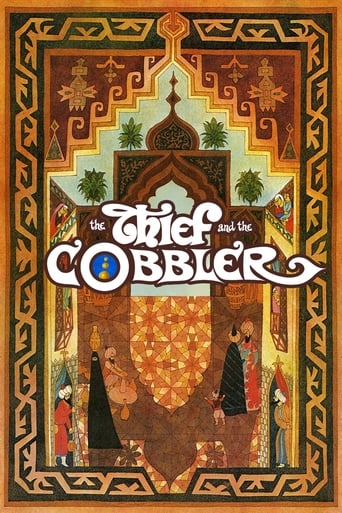
The Thief and the Cobbler
1993 · Film · 72 min
Directed by Richard Williams
AnimationFamilyFantasyRomanceAdventure
Princess Yum Yum falls in love with Tack and saves him from being executed. Later, when the protective orbs of the palace get stolen, Tack and Yum Yum set out to find them and save the kingdom.
2 positive1 neutralfrom 3 commenters
Where to watch
No streaming data for this title.


4 comments on Hacker News
I saw a "boot leg" cut of The Thief and the Cobbler about twenty years ago. Some of the animation of a huge machine, toward the end of the film, is amazing. It looks like CG but it's completely hand drawn. It's a shame he was never able to realize it as he wanted to.
Williams is also the author of the bestselling book The Animator's Survival Kit which is considered an essential text for any aspiring 2D (and even 3D) animator.
He spent decades on creating his own 2D animated film called The Thief and the Cobbler which was beset by endless problems and delays. The film was never completed in the form that Williams wanted. The fascinating story of this film can be found in this 2016 article:
13 Facts About The Thief and the Cobbler
http://mentalfloss.com/article/74031/13-beautiful-facts-about-thief-and-cobbler
Another interesting fact: Williams worked as an animator on the 1968 film Yellow Submarine featuring the voices of The Beatles. I think you can see some of the visual influence from that film (such as the exaggerated forms) in The Thief and the Cobbler too.
> why do all of those adverts on the back of the legendary Nick Park stuff?
You've gotta pay the bills and keeps the lights on while you're painstakingly crafting the next masterpiece.
IIRC ads are typically one of the places in the animation industry where you can get the highest budget per second. You can turn out acceptable-but-not-amazing work and save the big fee you got to extend your runway to work on the huge projects - or you can experiment with some crazy ideas you've been kicking around, on someone else's dime, without committing to an untried new technique for the length of an entire short or feature.
This doesn't always work out well - see Richard Williams'The Thief And The Cobbler for instance, with years of amazing animation by some of the early masters of the craft left on the cutting room floor, both before and after Williams got investment money that came with a deadline he couldn't finish that glorious mess of a film before - but it's a common pattern for animators.
There are of course many pitfalls. Once you staff up, you've got a crew that you may be loathe to break up - they work together well, they're used to your workflows. Do you lay them off, wish them luck finding the next gig, and hope you can get a bunch of them back the next time you need help on a project? Or do you come up with more stuff for them to do? There's lots of successes and failures along both of these paths.
Ex-animator from the US here.
Most Western animation has historically been done at 12fps ("on twos"); you go to 24fps for very fast motion or stuff you want to be super-smooth. This holds even in big-budget 2D theatrical features[1]. You will also find no small amount of super-stylized motion - dig up "The Dover Boys" (dir. Chuck Jones), commonly cited as the first cartoon to experiment with the smears, multiple images, and other crazy stylizations of motion. Single-frame your way through that someday; it's full of amazing semi-abstract images.
(First in the US, at least; there may have been people in the East playing with this as well, but there was very little cross-pollination at this time.)
The big difference between the Western and Eastern animation traditions, in my mind, comes from different decisions in how to best allocate "pencil mileage". You have a budget of X number of miles of lines drawn by your animators for each project; how do you spend it? Westerners generally pursued "the illusion of life", favoring really fluid and subtle motion over a huge number of drawings. This meant that very few single drawings could be very complicated. Easterners, on the other hand, gravitated towards complicated character designs. You might spend four or five times as much effort drawing a single frame. This meant that very few motions could be fluid.
Fluidity of motion × character design complexity = pencil mileage. Pencil mileage is fixed by your budget. Which one of those do you want to emphasize? You can't have both unless your budget is amazing. (This is also why animated commercials can have both; they can cost more per second than some features.)
To eyes trained in one tradition, the other one looks like crap. Why is this Eastern cartoon barely more than a slide show half the time? Why is this Western cartoon full of such simplified designs? Personally, it took me many years to learn how to appreciate Eastern animation.
(Also it is worth noting that most lovingly-animated Western games quickly converged on quickly popping into a motion as a result of a control input, with exaggerated settling into the new pose - look at Crash Bandicoot, Earthworm Jim, or Aladdin.)
I am rambling. Mostly I just wanted to mention that my experience of the Western tradition (including years of single-stepping cartoons) is largely on twos, with occasional bursts of ones.
[1] except for anything Richard Williams directed because he is kind of a total obsessive who would wander around the studio late at night and inbetween stuff onto ones that maybe should have never been on ones. See 'Raggedy Ann and Andy' for instance. Or if you want to actually see a decent movie hunt up the Recobbled Cut of 'The Thief and the Cobbler' because RA&A is pretty much 80 minutes of pure nightmare fuel.