 Hacker Cinema
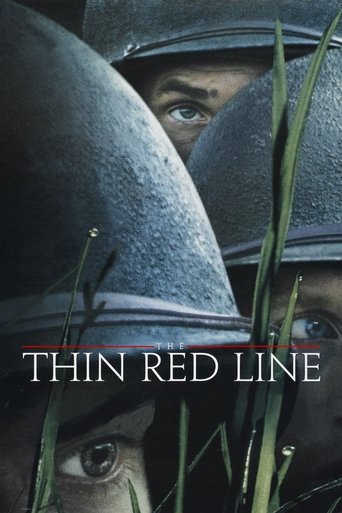
The Thin Red Line
1998 · Film · 171 min
Directed by Terrence Malick
The story of a group of men, an Army Rifle company called C-for-Charlie, who change, suffer, and ultimately make essential discoveries about themselves during the fierce World War II battle of Guadalcanal. It follows their journey, from the surprise of an unopposed landing, through the bloody and exhausting battles that follow, to the ultimate departure of those who survived.
14 positive1 negative1 mixed9 neutralfrom 25 commenters
Where to watch
No streaming data for this title.
29 comments on Hacker News
Interesting - I got something completely different out of The Thin Red Line. To me it was fascinating to see how different people processed the war and their different struggles, whether philosophical (Private Witt), with relationships back home (Cpt Staros), or PTSD. It was a little scattered as it bounced between so many soldiers but the central theme seemed to centre around Pvt Witt and Sgt Welsh - the actual battle was almost secondary. IMO there’s no snobbery - though Malick is maybe a little self indulgent - and I enjoyed movies like Saving Private Ryan or even Fury just as much.
I wanted to appreciate Malick's films out of a sense of intellectual snobbery, but it was too difficult for me. And I think most people who love his films appreciate them in a snobbish way; they really try to convince themselves that it is great cinema.
The Thin Red Line had some good moments, but it clearly came together in the editing room--but in the end, it came together only somewhat and weakly. He had hours of scattered footage (famously, a couple of major characters/actors had 90% of their planned screening time reduced in the final release), and in the editing room, he was trying to make sense of it, but unsuccessfully. What somebody interpreted as genius, I saw as disorganization, poor planning, and imprecise editing.
Well, someone may say, when talking about The Thin Red Line, that's what war is: confusing, boring most of the time, very violent in bursts. But that is akin to saying that life is mostly about eating and using the bathroom and doing pedestrian stuff and cleaning counters. But most of us, and not because we are simpletons, don't go to movies to see actors doing chores. It might be for others, but not for me.
He is definitely a director's director. The people who study cinema like him, people who become young directors and cinematographers like him, college professors teaching cinematography like him, but is he definitely not for the general audience.
I completely understand why your average moviegoer (is there such a group of people any more?) would walk out of his movies.
When Thin Red Line came out (1998) I saw it a few times in the theaters, then Saving Private Ryan came out about the same year, and I remember having interesting debates with my friends about which one was a "better" war movie. It was this perfect A/B study. They found Thin Red Line completely boring and terrible: no main hero, one who is sort of the main character dies senselessly in the end (well he sacrificed himself, but it wasn't with any sense of bravado or anything). And my point was, that's kind how war is: there are no heroes and people die senselessly and often stupidly, and there is a lot of boredom and sitting around waiting, too.
> This kind of earnestness stood out in an age of relentless irony and snark.
That's why I like him. And to be fair, I am the first one to enjoy relentless irony and snark, but on a deeper level I realize it's also unhealthy and often is an escape from something terrible or a way of distancing from what's happening, so when something more honest and authentic some about, I pay attention.
Or dive at the deep end and watch Knight of Cups or A Hidden Life. You will either like it or not, frankly I don't think it matters what you'll see first, I love all of his movies even though I didn't understand Thin Red Line when I was 20. But Knight of Cups hit me hard when I was 36.
Badlands and Days of Heaven are definitely his most conventional films and thus good starting points. Badlands especially is a great film, Days of Heaven is a bit uneven in terms of plot and pacing, but the cinematography is beautiful.
Then you have The Thin Red Line and The New World, which to me feel like a transitional period between the more conventional films and The Tree of Life, which is the first film that is characterized through and through by Malick's extremely divisive style. I personally love The Thin Red Line, but I can see why it's not for everyone. (I would skip The New World.) All later films have a very recognizable style, for which I think The Tree of Life is the best starting point.
Long story short: I'd start with Badlands, then watch The Thin Red Line, then The Tree of Life. If you like the last one, watch any of his later films.
I should give Malick another shot. I love film, but only first tried him when I was much younger (Thin Red Line) and don’t think I really got it.
Never tried Tree of Life or any of his more recent stuff.
Got any recommendations in the first 2-3 of his you’d suggest?
I actually walked out of it. I was not alone, several others did before me.
I saw it without knowing what it was about, it was a summer evening, I was alone and just decided to see a movie as I passed the theatre.
When I came home and learned it was the same director as the Thin Red Line, I was blown away. Same director of both the best and the worst movie I have seen.
There have been other war films with uncannily twinkly star studded cast lists.
The Longest Day (1962) claims Sean Conery, John Wayne, Clint Eastwood, Henry Fonda, and Robert Mitchum amongst it's cast members.
A Bridge Too Far (1977) Includes Anthony Hopkins, Robert Redford, Sean Connery, James Caan, Gene Hackman, Ryan O'Neil and Lawrence Olivier amongst it's ensemble.
A Thin Red Line is notable for the number of high profile actors whose parts got whittled down to almost nothing in the editing room.
That article was so poorly written, I struggled to get through it, save for my interest in Malick. What a half baked analysis of Thin Red Line. There's just so much more going on in that movie than the author gives credit for.
> His movies may be "artsy" but he had a big influence on cinema
Of course, that's why all the movie directors and actors and people who are into film like him. But take a person off the street and put in front of a Malick movie and don't be surprised if they walk out. Someone in the sibling threads said that much.
But yeah, I watched The Thin Red Line in the cinema twice when it came out, but also acknowledge that I am probably in the minority.
I watched Tree of Life in the cinema. I was spellbound. It spoke directly to me, no mental processing of a story, I was tuned to this film. I didn't feel its time. As the film ended a girl behind me said to her friends 'this was the biggest piece of shit I have ever seen'. I understood her and it was a perfectly fine opinion. She didn't 'get it', but it didn't have to do with taste or intelligence or anything like this. She was just not able to receive it - as if it was a signal sent she could not process.
Our wedding rings have these words from the film engraved: 'unless you love, your life will flash by'. We married late - our kids were already almost at school. The love in the words is about the love of your family, just like in the film.
And why the Thin Red Line is perfect - just view the "Swing Scene" as a work of religious art: https://www.youtube.com/watch?v=s40YpEsVkxk The inner monologue of Ben Chaplin's private Bell about what the role of love is when you encounter war, asking 'Who lit this flame in us' is a visual prayer.
(And yes, this is Miranda Otto, aka Eowyn)
This book is particularly great about discussing the process of filmmaking, which in Malick's case often seems to involve a ton of experimentation through editing in order to shape a film after photography had finished.
(Some of this editing work notably led to major actors having their roles cut from films. Adrien Brody, for example, apparently believed that he was going to have the lead role in _The Thin Red Line_ but ended up entirely cut.)
For those interested, Richard Brody's book about Godard and Carrie Rickey's book about Agnes Varda are similarly detailed about the specifics of their filmmaking work!
I don't know if I would call The Thin Red Line "beautiful" but I think it's a great (anti-)war movie.
Like the first line says, he is probably the least known famous director. That is, he is not an activist and not flashy, doesn't make a lot of movies, and the general public simply doesn't know about him. But all the other movie directors and famous actors know him and kind of idolize him.
When Thin Red Line came out in 1998 he hadn't done a movie since 1978 (Days of Heaven) and yet he snagged all the famous actors to play in it: Sean Penn, Jim Caviezel (though he wasn't as famous then), George Clooney, Jared Leto, Nick Nolte, John Travolta and others. It's like they were tripping over themselves to be in his film.
But I can't fault the general public for not knowing him either. His movies are more "artsy" so he is like like an American version of Andrey Tarkovsky -- you have to really be in the mood for his movies, like watching Stalker or Mirror by Tarkovsky.
Days of Heaven and The Thin Red Line are simply the most beautiful films ever made.
- The Thin Red Line.
The narative structure is hard to get the first time you watch the movie, but once you get it, it can change the way you see (the/our) nature.
- The Secret of NIMH.
Saw it the first time at 4 or 5 and was in awe, but it tooks several more years to understand it fully.
- The Truman Show.
It's basically my life.
- Akira.
No particular reason, except it's the first Manga which gets international recognition and propulsed the industry in the grown-up domain.
Totally in agreement. The Thin Red Line is possibly my favorite film of all time, while I hated The Tree of Life; except for that awesome creation segment. And I also loved A Hidden Life.
The Thin Red Line is one of my top films, and I walked out of The Tree of Life. Only afterwards did I realize they were directed by the same guy. And then this spring I saw A Hidden Life. I thought it was absolutely fantastic. I plan to rewatch The Tree of Life to see if I like it better than first time. Perhaps I was not in the mood for that type of movie that particular evening.
I recommend "The Thin Red Line (1998)" as a reference movie that is American, but not funded and appreciated by the military complex.
> It is steeped in symbolism, deep metaphysics and calm, meditative, photography. All attributes that have been essentially banned from the fast food production/consumption chain that has conditioned audiences.
Whoa... this is a bold claim. I can think of western films that use techniques like this: 2001: A Space Odyssey, Thin Red Line, Breathless, anything by Bergman, and The Royal Tenenbaums, for example, and many more that employ some of those traits. Additionally, implicit in the suggestion that not having those things somehow makes it "fast food production" (and thus of low quality), is rather unfair to the many western and non-western artists who have honed they're storytelling craft in a variety of styles. I love Tarkovsky and Solaris remains one of my favorite films, but I also like suspense films like Alien or action movies like Enter the Dragon, and many others which are frenetic, scary, fun or exciting.
I once saw Tree of Life, totally on a whim, no knowledge at all, bought a ticket when passing the cinema during an evening walk.
I left the movie in the middle. I thought it so bad, but fascinatingly bad. Well at home I found out it was directed by same director as The Thin Red Line, one of my favorite movies. Since then I have been puzzled, I really should give Tree of Life another chance.
Cool. I hadn't known the exact provenance of that. There's also "thin blue line" meaning police force[0] (separating decent folk from criminals and chaos) as opposed to a military force[1] which is a red line.
I would add that red lines are topical with Brexit[2] negotiations in the media, lines beyond which this British government is unwilling to step.
[0] Movie https://en.wikipedia.org/wiki/The_Thin_Blue_Line_(1988_film) and TV show https://en.wikipedia.org/wiki/The_Thin_Blue_Line_(TV_series)
[1] https://en.wikipedia.org/wiki/The_Thin_Red_Line_(1998_film) – one of the best films about war ever in my opinion
[2] https://www.theguardian.com/commentisfree/2017/dec/05/theresa-may-brexit-red-lines-reckless-hostage-dup-promises-cant-keep
Well said. I've always been a Kubrick fan, and a fan of off-the-beat films. For some odd reason I just never watched 2001 b/c I usually wait until I get inspired or "feel in the vibe" to watch things like that. I finally did about a year ago and I was so happy I waited until the time seemed right. Its like The Thin Red Line - only movie I ever walked out of the theater on (I was about 16 or 17). Fast forward about 10 years and upon rewatch I fell in love with it.
Look up the documentary "thin red line" on YouTube
Days of Heaven is my favorite film, I recommend it to anyone with an appreciation for visual storytelling. Those 95 or so minutes are the perfect balance between conventional storytelling a lá Badlands and the disjointed, introspective narrative of The Thin Red Line and onwards.
A bunch of exceptional films in that list.. you have good taste.
So, you acknowledge that there is a default, and that the films you mention challenge that default. I think everyone can agree on this.
Why are films like 'the thin red line' or 'full metal jacket' so powerful. The only pro-american-military film which I can remember having such a deep impact on me was 'black hawk down', and I think we all know the story behind that one.. I would argue that they tell a truth, and in the face of 60 years (give or take) of holywood military propaganda. And what does it matter that a dozen critical films come out over a thirty year period when, lets say 50 films a year come out pro-military.
Breaking it down your essential argument is - there is no propaganda because people like the propaganda. Question you should be asking is, who created that default?
Full Metal Jacket.
• Three Kings.
• In The Valley of Elah.
Good Morning Vietnam.
A Few Good Men.
Platoon.
• Jarhead.
Casualties Of War.
• The Men Who Stare At Goats.
The Deer Hunter.
The Thin Red Line.
• Syriana.
• The Green Zone.
• Stop Loss.
Also, • HBO's "Generation Kill".
(•'d relatively recent movies)
I don't think "The Hurt Locker" was particularly critical of the military and didn't count it. Also not counting documentaries like "Restrepo".
I hereby dispute the idea that the DOD has made it impossible for big-budget Hollywood movies to criticize the US military, and suggest instead that the bias Hollywood in favor of the military is responding to customer preferences and not leading it. Given what I presume to be America's default position of "supporting our troops", I'm struck by how many films Hollywood produce that challenge that default.
Remember also that Hollywood confronts at least two vectors of consumer preference in marketing films: first, Americans (in the large) have a (typical) diffuse nationalistic home-team support for our overseas adventures, and, more importantly, there's a less-political less-issue-oriented reverence expected for the sacrifices made by the young people we send into combat which is especially intense during times when large numbers of people are serving in combat zones. In other words, it's especially tricky to criticize the military during active conflicts.
Also, Three Kings is a fantastic movie.
I agree that there's a lot of terrible stuff being produced, and you can go to any indie film festival and see movies with great scripts. But when you drop below the A list and look at the marginal, non-blockbuster movies, do you really need a good script to make money? Do producers and directors need a good writer? Is a good script or a good writer an asset to them at all?
To put it another way, what is a "good" script from the point of view of the movie industry, and how many people actually want to write one, and would be willing to put their real name on it?
If you look outside the blockbusters, and even at many blockbusters themselves, most scripts aren't that good. I know a few people who watch a lot of terrible movies who are kind of allergic to quality, or at least allergic to the aspiration to quality. They are tolerant of crap and want their movies to be tolerant, too. A friend of mine is a huge fan of horror and action movies, and the only movie he has ever walked out of was "The Thin Red Line." Why did that movie offend him, out of all the movies he's seen? It wasn't because it was bad. (He and I saw "Deuce Bigalo: European Gigolo" in the theater.) It offended him because it insulted his taste. It aspired to be better than the movies he liked. That's what I'm guessing, anyway.
So if you're in the movie industry and trying to get a non-A-list movie made, you have to think about who's going to go see it. Writing a "good" script by your own standards may be a mistake. Maybe writing a "good" script only proves you don't understand the business and won't be an asset to the people who can help you. Maybe showing some hustle, some talent at getting noticed, and some crass instincts is necessary, not to draw attention to your good writing -- nobody gives a shit about your writing -- but because hustle, self-promotion, and crassness is how you prove you can succeed in the industry and help them make money in the future.
I saw this all the time when I worked at a movie theater 12 years ago.
Vampires and Blade (1998) Mighty Joe Young and some other ape movie. Two horror movies with bats. Saving Private Ryan and The Thin Red Line.
It happens over and over again. A semi-biggish movie and another that gets forgotten.