 Hacker Cinema
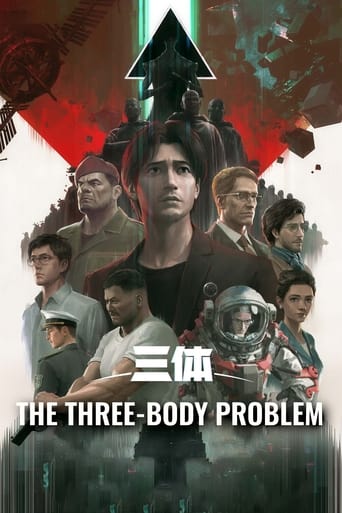
The Three-Body Problem
三体
2022 · TV series · 35 min episodes · 1 season
MysteryWarScience FictionFantasyAnimation
A science-fiction drama adapted from the novel of the same name by the famous science fiction writer Liu Cixin. “Three-Body Problem” tells the story of nanomaterials scientist Wang Miao and criminal police Shi Qiang who jointly unveiled the mystery of the “Three-Body Problem” world of an extraterrestrial civilization..
5 positive6 neutralfrom 11 commenters
Where to watch
No streaming data for this title.
11 comments on Hacker News
I highly recommend everyone read a science fiction novella called Full-Spectrum Barrage Jamming, especially if you are interested in China-US relations.
Its author is Liu Cixin, whose other work The Three-Body Problem won the Hugo Award and was adapted into a TV series by Netflix. His thinking carries a heavy shadow of Mao Zedong's strategic philosophy. This novella is very intriguing—it is set during a time in the past when the gap between China and the US was immense, and people were trying to imagine how China could win if a war broke out. I forgot the exact details, but the general concept is to force a technological regression through electronic warfare, knocking out all smart devices. By doing this, both China and the US are dragged down to the exact same technological baseline, allowing China to win the war.
Similarly, when facing the nuclear threat from the former Soviet Union, Mao’s idea was to abandon Chinese territory and launch a counter-offensive directly into Soviet land instead. Their underlying logic is similar: if the gap between us is too vast, we don't follow the traditional route of trying to catch up; instead, we find a way to drag your absolute advantage down to our level.
He has written many novels, and I can say with full responsibility that they are incredibly revealing when it comes to understanding the behavior and mindset of the Chinese people.
Adrian Tchaikovsky is really good at these alien ecosystems kind of thing (his Children of * range being quite good). This was a terrific short story. One thing I am curious about is whether there is a different kind of science fiction out there. The driving thread through all of modern English sci-fi is "we shouldn't go out there and do anything; we are the bad that ruins a delicate thing". That's a cool story but somewhat overly tropey at this point I think. This short story, the Avatar series, they have this ecological moralizing. AT is creative enough that the novel ideas (single species life-cycle planet) carry the tale even though the moral thread is the same as the Avatar movie: corporations destroy ecosystems they don't understand in the resource pursuit.
I enjoy the "what if we're the baddies" just as much as anyone else. But are there big stories with these exciting concepts where we aren't the baddies in the Anglosphere?
A thing I enjoy about other cultures is seeing what is unusually different about them. In the Three Body Problem, spoilers to follow for the series, humanity aren't The Bad Guys With Agency. We aren't even The Big Bad or The Big Good. We're sort of just other participants in this universe. The dual vector foil is employed by someone else, the guys who want space back from the pocket dimension to reboot the universe are just someone else, everything is someone else. We are bit part players in this play.
This goes on even to a few movies. The Wandering Earth movie (somewhat different from the short story) has this part at the end (obvious spoilers to follow) where the heroes accomplish the task and reboot their Earth Engine after conquering all odds - only for the camera to zoom out and show numerous other teams also having done the same. This wasn't the only struggle won. Cool alternative tale where it isn't so much One Team Saves The World or One Team Ruins The World.
> No physics expert but isn't this unpredictable (based on what I saw in series) ?
A three-body orbital problem is an example of a chaotic system, meaning a system extraordinarily sensitive to initial conditions. So no, not unpredictable in the classical sense, because you can always get the same result for the same initial conditions, but it's a system very sensitive to initial settings.
> Amd this does seem predictable, I saw this for almost a minute
The fact that it remains calculable indefinitely isn't evidence that it's predictable in advance -- consider the solar system, which technically is also a chaotic system (as is any orbital system with more than two bodies).
For example, when we spot a new asteroid, we can make calculations about its future path, but those are just estimates of future behavior. Such estimates have a time horizon, after which we can no longer offer reliable assurances about its future path.
You mentioned the TV series. The story is pretty realistic about what a civilization would face if trapped in a three-solar-body system, because the system would have a time horizon past which predictions would become less and less reliable.
I especially like the Three Body Problem series because, unlike most sci-fi, it includes accurate science -- at least in places.
In addition to the experiential gap between theatre and film, we have productions which translate from one to the other. Each is a distinct market.
A subset of the Chinese TV version of "Three-Body Problem" consists of video gameplay "footage". The lack of human actors is compensated by over the top footage of cataclysms, which could never be filmed. It's mostly additive to the storyline with human actors.
AI can create new media markets with different cost structures. These will necessarily subtract some attention-minutes from existing film audiences. But it should also lower production costs for artistic filmmakers focused on portrayal of human actors for human audiences.
This is incredible work, thanks for sharing. That said, does anyone know what kind of technology they’re gesturing to? Maybe I’m really stuck in the present, but short of tangible holograms I’m not sure how we’d make tactile computing devices.
The keyboard is tactile, and I’ve long dreamed of augmenting Alexa by covering my house in purpose-specific buttons, but that seems like a short road. Even the most advanced HCI device I’ve ever seen proposed by a consumer company—Meta’s Orion wristbands that read hand movements by measuring the electrical signals in your wrist—aren’t tangible in the slightest.
What am I missing? Can any fellow futurists point me in the right direction? I don’t need “doable today” or even “the technology is worked out”, but ideally I’m looking for something more doable than tangible holograms. See https://xkcd.com/678/
EDIT; the VR suits from the Three Body Problem books come to mind, using tiny actuators and temperature controls (thermal actuators?) to simulate touch. I could see that in a glove for sure, and that’s probably the most futuristic tactility gets at this point, but I doubt it’ll ever see fully-body usage, both for technical feasibility and user convenience reasons. There’s a reason the TV show replaced them with brain-modulating headsets… I guess that’s really the end dream.
What is a tangible hologram (or any interface, really) other than an illusion, at the end of the day?
Three Body Problem now has 30 episode Chinese adapatation on Youtube, and Netflix is coming out with a 'simplified' 8 episode version.
You can find the ship going through the Panama canal scene on YT, worth the watch. Not really a spoiler since it has no affect on the plot. (that second sentence was the spoiler.)
edit: just looked and its gone now. nvm.
The Three Body Problem is a work of fiction, much like those war movies.
Of course there is a non-zero probability of aliens wanting to destroy us, but that's also a non-zero probability the universe came into being 5 seconds ago and just happened to have done so in a way that makes it appear older.
This sounded like a weird comparison to me. I got curious so did some math.
Brazil area = 3300000 sq mi = 9.2e13 sqft. A film 1mm thick of this area would be 9.2e13 sqft x 0.003 ft = 2.76e11 cuft.
Great wall of China, average of 33 ft tall and 20 feet wide, with a length of 13,170 mi (69,537,600 ft) is a volume of 4.6e10 cuft.
According to this a 1mm film the size of brazil would be an order of magnitude more volume than the great wall of china.
Using silicon’s density of 2.32 g/cm3, at a volume of 2.76e11 cuft (7.82e15 cm3) gives us 1.8e16 g, or 1.98e10 tons.
The falcon heavy launch capacity to geostationary transfer orbit is 26.7 tons. However, L1 is much further altitude (1.5 million km) than GTO (42,164 km @ apogee). (But we’ll just use GTO capacity since the only other listed capacity for the falcon heavy is for mars transfer orbit and I couldn’t find an altitude for that from earth.) 1.98e10 tons would require almost three quarters of a billion falcon heavy launches. If we did 100 launches per day, this would take 20,000 years.
Maybe there’s some solid silicon asteroid out there, but even if that were the case, we’d have to lift up the machinery and fuel to move it in space. Vesta, one of the largest known asteroids with a mean diameter of 326 mi, if a sphere would have a volume of 1.8e7 cumi = 2.65e18 cuft. So by volume we could flatten that out with enough to spare, but you’re dealing with maybe a lot of undesirable content.
I’m bored now so Ill let someone else calculate how much fuel it would require to move Vesta the required distance, or guess at how much of it is useful and what it would take to convert it to the necessary structure.
But my guess is that in any case, “huge undertaking” is underselling it. Sounds like pure fantasy to me. Actually sounds remarkably similar to the scale of the problem humanity is faced with in The Three Body Problem trilogy. (I’m half way through The Dark Forest now, guess I should go back to that!)
Oof, that's sad..
I really liked RbW but didn't want to get too invested because it felt like it wouldn't even get a second season. Then the second season was released, got me really invested, and now this, booh!
At least the second season of Foundation is still being filmed, looking forward to that and hopefully that will last past two seasons.
The Three-Body Problem is getting a TV show on Netflix, heard good things about the books, maybe the show can live up to them.
While the film version was cancelled, apparently a TV series is in the works:
A TV adaptation of Chinese sci-fi novel The Three-Body Problem is in development https://www.theverge.com/2019/6/21/18700675/chinese-science-fiction-three-body-problem-tv-series-cixin-liu
My recommendations from books I read this year:
Bad Blood : Man, this book really does read like a Hollywood movie screenplay. The rise and fall of Theranos, documented through interviews with hundreds of ex-employees by the very author who came up with the first expose of Theranos. Truly shows the flaws in the "fake it before you make it" mindset and how we glorify "geniuses".
Shoe Dog : Biography of the founder of Nike. Really liked how it's not just a book glorifying the story of Nike, but tells the tale of how much effort, balance and even pure luck went into making the company the household name it is today.
Master Algorithm : It's a book about the different fields of Machine learning (from Bayesian to Genetic evolution algos) and talks about the pros and cons of each and how these can play together to create a "master algorithm" for learning. It's a good primer for people entering the field and while it's not a DIY, it shows the scope of the problem of learning as a whole.
Three Body Problem: Finally, after years of people telling me to read this (on HN and off), I read the trilogy (Remembrance of Earth's Past), and I must say, the series does live up to the hype. Not only is it fast paced and deeply philosophical, but it's presented in a format very accessible to casual readers as well (unlike many hard sci-fi books which seem to revel in complexity). If I had to describe this series in a single line, it's "What would happen if China was the country that made first contact with an alien race?"