 Hacker Cinema
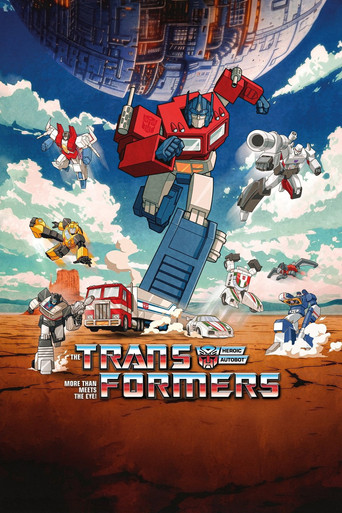
The Transformers
1984 · TV series · 22 min episodes · 4 seasons
AnimationKidsActionAdventureScience FictionFantasy
The Transformers is the first animated television series in the Transformers franchise. The series depicts a war among giant robots that can transform into vehicles and other objects.
1 positive11 negative13 neutralfrom 25 commenters
Where to watch
No streaming data for this title.
27 comments on Hacker News
Thanks. Working in the industry for over thirty years has paid off :-)
I'm much too old for the Transformers TV series, that flew straight past me I'm afraid. I was eight when the original Dr Who series started!
See also the theme tune to the first Terminator film, which has a really strange signature, and the theme tune to the Transformers cartoon from the 80s, which has a weird break in the middle of it: https://youtu.be/4Lk1d1PbHYY
TaleSpin was inspired by old adventure movies. The whole tiki-bar culture, scruffy cargo pilot thing was a vibe back then.
Transformers has a much weirder cycle. They were a collection of different transforming toy lines from Japan that U.S. companies wanted to sell to children here. They divvied them up based on criteria: road vehicles largely became good guys, weapons and planes largely became bad guys. They wrote some comics around a concept of a giant war, made some animated films as a sort of pilot, and went to town.
Jetfire (IIRC) is actually a Macross figure.
Gundam is Gundam. I think that's just a Japanese series that is also popular in the U.S.
The opposite can argued too.
That children who don't use tablets have shorter attention spans and worst social skills. The "natural is better" argument is not research based. Society has long preached that things like reading books is great for kids but it's entirely unnatural just like tablets.
Generally research in this area has been extremely biased against electronics. You also have to control for the type of activities they are doing on the tablet.
For example the mental stimulation when playing an educational Daniel Tiger game is completely different than watching a toy sales driven TV show like Transformers. Both can be done on a tablet though.
YuGiOh and Transformers were largely toy commercials, but you lump Dragonball Z into the same class? It practically indoctrinated half a generation into fitness and physical self improvement, I still sometimes hear Bruce Falconers score at the gym.
I feel there is a substantial divide between a narrative adventure story by a Japanese manga artist crafted as a parody retelling of Journey to the West and followed by his eccentricities (Frieza was an alien and power ranger parody, Cell was a bishonen parody, there was tons of messaging in the core narrative about passing the torch, etc) and a product like Transformers designed by a corporate committee of Hasbro from day one meant to sell toys. Sure, the further into Dragonball you got the more commoditized and derivative it became, but at least the original Dragonball show is a worthy classic.
There absolutely is a class below all those shows, where there is absolutely no narrative development and every episode is designed and manufactured for self contained entertainment with no greater depth. A lot of Hanna Barbara cartoons fall into that class, Scooby Doo absolutely - where every episode is designed to be disposable and ultimately meaningless, just meant to distract.
In a related note, I have come to realize the different levels of quality in children's television:
- Public television shows (PBS) stuff is so lovingly created and charming. You can really tell they had experts and creatives work side by side to craft positive stories. Even if it's not particularly exciting.
- Super-smart and creative shows (like the first couple seasons of Spongebob, or Gravity Falls). Great shows on their own merit, super funny and creative. But they are an art first and not necessarily focused on development. Good at clueing kids in on structuring jokes or references, not much else.
- Bland and harmless. Shows that drive a story or characters, but not necessarily lovingly made or particularly funny. I have found most of the Netflix/Amazon/Hulu stuff falls in here.
- Colorful garbage. It's a lights and noise show, with huge focus on licensing. Cartoons of my era are particularly susceptible to this (Dragonball Z, Yu Gi Oh, Transformers, etc).
Right? Let's see...
- GI Joe
- Transformers
- He-Man
- She-Ra
- Might Max
- Power Rangers
- Bionicle
- Ninjago
- Care Bears
- Street Sharks
- Teenage Mutant Ninja Turtles
Those are just off the top of my head. TV shows (and in some instances movies) that existed to sell toys.
Then again, thinking about the kids' tv shows that only really existed to sell the toys (eg, Transformers) it's not that surprising.
> My generation grew up with TV shows like The Transformers that got kids to beg their parents for toys.
But the addiction component wasn't built-in the way it is now. Everyone remembers "Saturday morning cartoons with cereal" because there was a set time and place for that event. After the episode ended, it didn't auto-play the next episode, or recommend 5 highly similar shows based on your "viewing history".
Consider that "bingeing" is a commonly accepted term when it refers to consuming an entire season of a show in one sitting and companies like Netflix churn out TV shows with a focus on this "bingeability", because that's their differentiator compared to regular TV.
> Tell me you weren’t 100% addicted to a television show when you were a kid (He-Man, GI Joe, Transformers...), oh holy one.
But that was only once a day after school for 1 hour or so. Not constantly everytime I felt bored.
Meaning clearly I’m a terrible parent SMH.
Also I am exaggerating.. the kids enjoy the television programming they experience on the YouTube and I would prefer if there were fewer errors.
Tell me you weren’t 100% addicted to a television show when you were a kid (He-Man, GI Joe, Transformers...), oh holy one.
I recently re-watched some episodes of Transformers and GI Joe that I LOVED as a little twerp. Total garbage writing and animation, which makes me think anyone can make children's shows with some colorful animation and catchy words/songs. This Chu Chu looks like I'm waiting for the acid to kick in.
I have most of the symptoms described by the OP, including a severe difficulty focusing on movies/books.
For me, it's basically that my mind wonders if I'm not very interested. It's my mind's default mode of operation that I think about everything related to the thing I just thought about. Comes in very handy when programming, but is kind of annoying when trying to get through some mediocre material.
Something worth noting is that my focusability seems directly based on how interested I am, not how action-packed something is. For example I have no problems watching the 1981 German classic Das Boot, where people just sit in a submarine for 3 hours. However something that is popularly belived to be made for ADHD people like The Transformers is excruciating for me even though there's so much going on visually every second.
Stimulants like Adderall make me even more focused on things I could focus on already sober, but also make me even less focused on things I don't care about. So basically just intensifying my natural tendendices, as opposed to changing them.
^ this is just as bad. At least a lot of the youtube videos I watch are often sponsored by e.g. squarespace which is neutral enough. But those are unblockable ads, basically.
...just like a lot of cartoons were back when we were growing up, Transformers and He-Man and even Star Wars were all advertisements for toys (although in Star Wars' case the toys came after the movie. Still made them several times what the movies made them though).
No such thing as free content.
Funny you mention that. Growing up, I remember watching the Transformers cartoon, and begging for the toys. Years later, I watched a retrospective program on the series, where they noted that The first episode was just a long form advert, and was so popular, they ordered a series, of toy commercials.
So nothing is totally new here, except that the average youtuber seems to have no ethicical qualms about pushing any product, while networks did, and still do, qualify their advertisers.
Im not sure how it is today but when I grew up in Finland in the 80s all the most popular tv-series for kids where in English only. Of the top of my head: The Transformers, Inspector Gadget, M.A.S.K., He-Man, G.I. Joe, My Little Pony, Care bears, Smurfs, Postman pat, DJ Kat show, and then non-cartoon shows like like MacGyver, Knight Rider, Airwolf, Quantum Leap, Rescue 911, etc.
We also watched some some non-English tv shows like the Swedish "Bjornes magasin" and the Finnish "Pikku Kakkonen". But these shows where not as cool and not as plentiful as those English tv shows.
Well, from my memories most of the cars in the cartoon Transformers had little in comparison to real-life cars. I viewed them as more generic truck, generic sports car, and the like. Sure, some of them matched fairly well to real cars but for the most part they did not. Plus I guess it depends on how many American style cars made it into foreign markets.
I agree that if one lived in a country that didn't have deserts with small mountains it might be difficult to relate, but there are many areas of the world that appear much the same as the American southwest. Especially in the generic way it was portrayed in the show. Although, there's a point in there about the style of housing as I'm sure that varies quite a bit.
In the end, since it was a toy line intended to enter the American market, you are probably more correct in that than I am.
The modern movies don't count because what you describe is Michael Bay, not Transformers. The themes you describe in the movies is similar themes in just about every movie Michael Bay directed. A large number of the vehicles are GM cars, due to money I'm sure, but I would say the lineup of vehicles is more diverse than how you describe them in the cartoons.
As for your last bit, if you are stating that in lines of marketing to sell toys, I agree. If it is propaganda to benefit government something or other programs, I fail to see how you've supported that thought even though that seems to be what you are trying to say.
Am I misunderstanding?
Well outside of the first generation of transformers being made up of largely common cars you'd see on American roads and American military equipment (not a lot of Mercedes, Opels, Peugeots in the mix) and taking place in what appeared to be the American South West, desert with small mountains and valleys (with nearby American style suburbs the human characters lived in)....they changed this later, with a larger variety of settings. The Animated movie felt like it took place in somewhere, Europe.
Yeah Bumblebee was a VW Bug and Jazz was a Porsche, but there really weren't any other European cars in the show and both of those cars were pretty common in the U.S. Most importantly, Optimus Prime was very clearly an American style semi-truck rather than a British Lorry or Euro style truck.
I guess I wasn't clear though. Those shows really felt like they were at least reinforcing the prevailing propaganda, at a kids level. Part of this was no doubt marketing savvy rather than Government control, but it really made the propaganda machine pervasive, from young to old, top to bottom.
The modern movies are very much an extension of this. The Autobots are allied with Americans, operating out of a base provided by Americans. There's the occasional Aussie or Brit, but by and large it's all American. The cars are all GM cars. It feels natural because it's just an updating of what the Transformers were already doing.
It was brilliant. It tapped into so many threads floating around during the 80s and just pulled them together. High tech robots that fought evil and turned into blue collar American trucks! Bad ASS.
Well, like I said, I get the GIJoe bit. And I agree for the most part, I just don't necessarily agree with the government propaganda part. Using nationalism and patriotism as a means to sell toys? Sure.
I can't agree with the Transformers as much. I don't recall anything specifically stating they were in America other than suggestions in the dialogue. With redubbing the show could have been placed just about anywhere only limited because of the appearance of the main human characters. I believe there was a British version as well. I could agree that maybe the Reagan administration co-opted Transformers for their own use (much like they did with the Star Wars name but I doubt Lucas was a government propagandist) but you seem to be suggesting that the Transformers exists for the benefit of Reagan's Star Wars program. That's the bit I'm curious about because I just don't see that. It seems too conspiracy theory to me. My reasoning is that Transformers was a part Japanese effort and originally based off existing Japanese toys. It was essentially a Japanese company entering the US market. To say they were propaganda for the benefit of the US government is a stretch to me.
I agree with the stereotypes, but I would say they were more of the typical good vs evil stereotypes. Just because they matched the good vs evil actors of the day doesn't necessarily mean they were created with that in mind. That seems some form of bias to me.
The reason the Autobots didn't have energy issues like the Decepticons was because they weren't attempting to conquer. They only required what was needed to survive. The Decepticons were gathering resources to destroy the Autobots on the planet, conquer said planet, and then return to Cybertron to finish the war. Works for me. I think it was the major plot point in several episodes.
I disagree with your final statement. There are many modern examples of more-or-less the same themes of good vs evil with similar stereotypes, archetypes, and plots. It's just a lack of interest or failure in connecting them to modern events.
I just don't buy the propaganda for government benefit in the Saturday morning cartoons from my childhood. Now, propaganda for me to want the toys they were selling? Sure enough, and it works.
The 80s really were weird. Especially growing up in an Evangelical household. Reagan and all the almost flawless propaganda that accompanied his administration, the Japanese electronics boom, the endless stream of 80s style propaganda action movies, the huge surge in religious upswelling at that moment against the godless communists, the space program, Star Wars (the military program and the movies), endless cartoons reinforcing these values and ideas down at a child's level (G.I. Joe, Transformers, Gobots, etc.) the emergence of video games, hair bands, the endless parade of spy movies, and then spy movies where video games played a prominent role. It's pretty remarkable how many popular franchises were started and established in the 80s that are still wildly popular today and the thousands more that have vanished. I get a sense that it far surpassed the decade prior or after in that respect.
It was a really special kind of holistic life-pastiche that I don't think really existed before or sense. The closest I can think of is the late 50s early 60s as being quite so cohoesive and holistic.
I experienced it as a child growing up, so my take on the 80s is from that angle, but when I walk around the toy section at my local store these days, it's like a pale shadow of the vibrancy from that time -- most of the really popular toys are still more or less the ones that came into popularity when I was a kid. It seems like most of the big franchises from the 90s (the last time I really had awareness of the toy section) have died off or been replaced.
My wife is South Korean, and when she grew up, her country was just emerging from a long dictatorship. The popular media was heavily controlled and given their neighbor, was almost a more intense version of what we had in the 80s. In fact, I'm frequently surprised at how much of our 1980s American culture was wholesale imported into hers, but not our 1970s or 1990s culture.
Glad you found the appetite angle interesting thenomad.
Whilst licensing popular IPs is one way to reliably bring in an audience, I wouldn't say it's a long term solution for healthy, diverse culture. Reusing older source material is certainly popular right now though, Sherlock Holmes is a strong example of that. Furthermore, older material can be reused in creative ways (e.g. Sample-based music, reimaginings of universes such as Luhrmann's Romeo and Juliet, etc...).
I also think you make a good point about 'a Joss Whedon fan wants "stuff like Buffy"'. I think this can go beyond what someone is used to when people begin to build their identity around what they consume. There is an unwritten but obvious way that a group latches onto certain media, even in scenes that supposedly promote individualism such as geek culture. Even if culture should be identity agnostic, it frequently is not.
I should point out that although I don't always find time for the new, I know that I'd be better off if I did. Perhaps 'find time' is the key phrase, I feel so busy with/addicted to my current cultural consumption that I don't make room for finding something new. The one exception for me is YouTube, I'll happily take time browsing YouTube seeing where it takes me. Perhaps that's the one exception due to the habits ingrained in me throughout the 90s through copious TV consumption, I'm at ease that I'll not always hit the jackpot of an interesting video.
What I really would like to see is greater cultural diversity, despite my actions to the contrary. As a film maker I apologise that you'll have to deal with these issues!
Perhaps short, ambitious content could help? When I was a kid I had a Transformers video I used to watch a lot, one of the episodes was 'Call Of The Primitives'. I really enjoyed that episode, the story seemed to flow really well. When I was older I read a complaint about that episode that they had tried to fit in too much, that it was a film-like storyline in a single 20 minute episode, it struck me that maybe that's part of what I liked about the story flow, it had the ambition to throw in quite a few memorable moments in a short time frame. I don't know if there's a lesson in that, but perhaps there is.
What else do you think might help?
I was homeschooled in a conservative (although not full-on-fundamentalist) Christian household the whole way, K-12. No TV, etc... although with my family it was only partially due to Christian conservatism and almost more due to ivory tower intellectualism (an odd mix, I know... I wasn't allowed to listen to rock music, but we listened to either classical music or liberal NPR instead, not Rush Limbaugh). I've never seen an episode of Transformers. Most "Wasn't the 90s great?" memes I can't really relate to.
I learned a hell of a lot, though, because I was allowed and encouraged to.
By the time I was 12, most of my social group (a fun, tight-knit youth group at church) was not made up of homeschoolers, so I adjusted pretty well socially. In college most people were surprised if I mentioned I was homeschooled.
I definitely knew several families of downright weird kids like the ones the author described... they were generally a minority though. (I homeschooled in a relatively large metropolitan area, so that perhaps helped). The majority of homeschooled kids, at least in my area, were not obviously socially awkward, although they were almost all trained by rote to be morally conservative.
The truest line in the article is the first one: "To a very great degree, school is a place where children learn to be stupid." - John Holt
I'd also add that school is a place where we learn how to treat other people like dirt. If I ever homeschooled my kids it would be because I thought it gave them a distinct chance to be a nicer, more decent human being.
The 80s were particularly notorious for toy-based animation.
Transformers is the most famous example. Characters would be killed off and replaced to boost toy sales.
Still, there's a difference between a show where you make the toys and then get the nastiest animation done to create a 22-minute advertisement; vs making a halfway decent show and flogging some merch on the side.
In other media, one might compare the original Star Wars trilogy with episodes I-III.
I learned most of my early english from TV. I grew up in the Netherlands, speaking Frisian at home and Dutch at school. At the time dutch tv did not offer much programming aimed at children, the more interesting cartoons to be found on cable tv were on english language channels. I would tape Transformers episodes and watch them over and over.
Later on I started consuming other media (video games + video game magazines, american comics), so that by the time they started teaching english to me at school I was already relatively fluent.
Could make the same sort of point about music, movies and TV these days. What is the artistic merit of Desperate Housewives, The Transformers, and Britney Spears? Hell, much of that is sold on titillation alone. Sounds like artless porn to me.
"Tried to watch GI Joe and Transformers a couple years back and could barely last an episode."
On the other hand, the Chuck Jones and Tex Avery cartoons have held up quite well, probably because the creators were doing them for themselves as well as younger kids.
Saturday morning cartoons are the big one for me.
My mom took the approach of just reading out loud whatever she read, so I grew up with Lord of the Rings and other good solid books. I personally read Madliene L'engle's books in 3rd and 4th grade then skipped directly up the ladder to Dune (making me the only 9 year old I've ever met that managed to make it through Dune Messiah (and man did I ever manage to miss the subtext and analogy and etc)) .
But cartoons, man I loved em all. Tried to watch GI Joe and Transformers a couple years back and could barely last an episode.