 Hacker Cinema
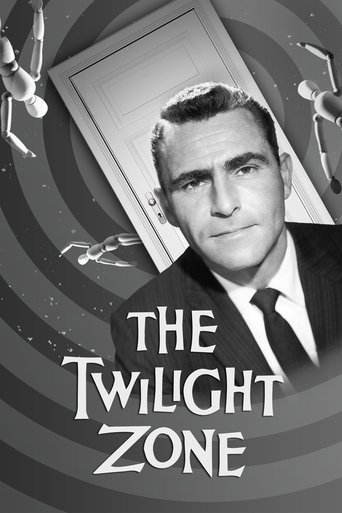
The Twilight Zone
1959 · TV series · 25 min episodes · 5 seasons
Created by Rod Serling
Science FictionFantasyMysteryDrama
An anthology series containing drama, psychological thriller, fantasy, science fiction, suspense, and/or horror, often concluding with a macabre or unexpected twist.
32 positive1 negative1 mixed110 neutralfrom 144 commenters
Where to watch
No streaming data for this title.
159 comments on Hacker News
That's TV water torture (I gave up TV) even for the visionary Twilight Zone and Alfred Hitchcock Presents series.
How about Groundhog Day the movie? That's the premise. You live the same day over and over again until you "awaken"
There was an earlier HN post about this[0] no replies. It links to an article at Huffington Post. [1]
My own take (at pastebin) [2]
[0] https://news.ycombinator.com/item?id=1364702
[1] https://www.huffpost.com/entry/the-groundhog-day-buddhis_b_162950
[2] https://pastebin.com/raw/kfGNp1ey
https://pastebin.com/kfGNp1ey
This title evokes memories of The Twilight Zone's To Serve Man episode.
I guess this just shows how divided the world is right now (in a lot of ways), but for me this sounds like one of the creepier episodes of Black Mirror or Twilight Zone.
"They live" was a cult classic, and great fun if you were a Roddy Piper fan.
Other entertaining films =3
"The Great Dictator" (Charlie Chaplin, 1940)
https://archive.org/details/the-great-dictator-disc-01-title-2
"Day the Earth Stood Still" (1951)
https://archive.org/details/day-the-earth-stood-still-1951
"Invasion Of The Body Snatchers" (1956)
https://archive.org/details/invasionofthebodysnatchers1956_201911/
"The Man in the White Suit" (1951)
https://archive.org/details/the-man-in-the-white-suit_202105
"The Twilight Zone" (1959)
https://archive.org/details/the-twilight-zone-1959-s-01-e-00-original-pilot/The+Twilight+Zone+1959+S01E12+What+You+Need.mp4
https://archive.org/details/the-twilight-zone-1959-s-01-e-00-original-pilot/The+Twilight+Zone+1959+S01E25+People+Are+Alike+All+Over.mp4
https://archive.org/details/the-twilight-zone-1959-s-03-e-15-a-quality-of-mercy/The+Twilight+Zone+1959+S03E24+To+Serve+Man.mp4
https://archive.org/details/the-twilight-zone-1959-s-03-e-15-a-quality-of-mercy/The+Twilight+Zone+1959+S03E28+The+Little+People.mp4
So I love watching 50s-70s television shows: honeymooners, I love lucy, twilight zone, alfred hitchcock, Mission Impossible, Columbo. (recent MeTV lineup).
I'm a millennial. It occurred to just the other day, the language they use, they say "dough" a lot. They need dough. Where's the dough. Any criminal is always involved with gambling and gangs and they need dough! And the normal working people storylines are pinned to their lack-of-dough situations.
I remember the internet very fondly too. There's always an age of innocence but it just takes time to realize everyone just really needs and wants dough. And that's what happens.
Ever see the old Twilight Zone episode with the 6-year-old kid who wishes you into the cornfield if you don't do what he says?
https://en.wikipedia.org/wiki/It%27s_a_Good_Life_(The_Twilight_Zone)
That's his authority.
I fear it's going to take more than just one other president.
Now we've all see what one bad POTUS can do to the world, and I don't know if/how/why the world would trulyove past that.
It reminds me of the Twilight Zone episode "The Shelter" [0].
[0] https://en.wikipedia.org/wiki/The_Shelter_(The_Twilight_Zone)
> getting stuck in the walls
I remember the early Simpsons video game. Sometimes, due to some bug in it (probably a sign error), you could go through the walls and see the rendered scenery from the other side. It was like you went backstage in a play. It would have made a great Twilight Zone episode!
I seem to remember that it was The X-Files that first pioneered the “every episode is a mini-movie” and it showed in the production at the time compared to other stuff.
Could be mis-remembering though, when I think about early anthologies like Twilight Zone or Freddy’s Nightmares.
Reminds me of the Twilight Zone episode where the aliens visit Earth and someone on Earth snags a book from them with the title "To Serve Man." The rest of the book is written in the alien language. Everyone is excited because they think it means "we are here to serve you to make your lives better." At the end of the episode someone figures out the book is a recipe book about how to cook humans. If you look around the table and don't know who the mark is it's probably you.
Someone should turn that comment into a Twilight Zone episode...
We wake up tomorrow to a world where universities never existed.
No cultivation of Copernicus, Newton, Einstein...
So we're stuck mostly with 1000 year old technology.
Let's not assume things about age. I'm old enough to remember holding the stupid rabbit ears. Never liked the Andy Griffith show though. I've also spent plenty of nights sitting a fire with a bunch of nomads in the middle of nowhere.
It's not fundamentally different from media today. Audiobooks, Twilight Zone, Black Mirror, Disney movies, true crime media, etc. People don't choose these for lack of alternatives. They're activities people like (excepting the parents forced to watch Frozen for the thousandth time).
Strong oral storytelling cultures also have many, many stories available to them. It's not as tedious as syndicated TV was. Two examples of collections that survive to the modern day are the Jewish bible (old testament) and the Christian New Testament, each of which has dozens of stories you're likely familiar with no matter your religious background. They're not communicated solely through everyone sitting down around a campfire, and not every recitation is in the formal verbiage of the source material. Often recitation is associated with a calendar (e.g. the sermon schedules ministers follow in modern churches, or performed only at particular seasonal festivals). Different recitations are often performed in new ways to adjust things to the audience (e.g. referencing recent events) or with slight changes to keep things fresh. So on and so forth. It's a much richer world than you may be aware of.
Pretty sure I saw this episode of the twilight zone. No, actually I think it was Sapphire & Steel.
What is this, that episode of The Twilight Zone called "to serve man"?
Hard to not recall a Twilight Zone and even a Night Gallery episode where those cruel to machines were just basically cruel people generally.
>An unreliable computer treated as a god by a pre-information-age society sounds like a Star Trek episode. star trek, and twilight zone too
Surprised nobody has pointed out that this was and episode of the Twilight Zone [0], if you substitute "pre-information-age" with "post-information-age".
0. https://en.wikipedia.org/wiki/The_Old_Man_in_the_Cave
> All of this means that face-to-face, we will probably talk a lot less about divisive political topics than we would do online.
I see your point — I think more than a couple Twilight Zone episodes that Serling penned explored the "monsters" that are within us.
But I disagree. Because I think when you are face-to-face you're more likely to see nuance in your option and others. "I hate gays!" you say. But then you find yourself chatting with your neighbor and his husband and have been thankful for them, on several occasions, for helping you get your car started in the winter, or whatever.
"Black people scare me!" But then you have to admit that the two black families that go to your church are not threatening at all....
I think they meant eternal life much more in the “I have no mouth, and I must scream” sense.
Much has been said and written about the cruelty of immortality, since the myth of Sisyphus and probably before.
“The Mortal Immortal” is a story about prolonging lifespan but not healthspan, and also not emotional fulfilment in life — https://en.wikipedia.org/wiki/The_Mortal_Immortal. There are also TV shows (“Altered Carbon”, “Black Mirror” USS Callister and other episodes, “Twilight Zone”) and video games (“Nobody Wants to Die”) about it.
What your parent comment speaks about (the vanity of endless life) is particularly explored in Bernard Williams’s “The Makropulos Affair”. Endless life could mean no regard for quality of life and endless trivial pursuits.
When did it promise that it would? I feel like people reject these stories not because they're counterproductive, but because they frighten them. We feel so personally and viciously attacked by modern narratives because they question everyday concepts and routines we're all comfortable with.
I'm reminded of growing up watching episodes of Twilight Zone and Star Trek that yes, were kitschy stories, but instilled lifelong lessons about independence in their audience. Black Mirror isn't my favorite show but it seems to resemble the same "near future cautionary tale" archetype that has remained popular for centuries.
With the caveat that this is only possible with very lossy compression:
1. You land a software job which is "perfect" on almost every traditional indicator. Amazing office and amenities, incredible compensation and benefits, and no hard demands on your time... except to meekly endure some brief pain, for no particular reason, every day.
2. However it seems that neither the team nor yourself really accomplish anything, you gain no sense of social belonging, and you are literally a (very brief) punching-bag for your manager.
3. You "should" be happy, but you aren't. What's the point of it all? What are your values, and what is your worth? You start to struggle with depression. Eventually you can't take it anymore. You quit. Maybe you heal.
It's sort of like a Twilight Zone episode: You get (almost) everything you (believe that you) will be happy with, yet somehow the result is a subtle form of hell.
It's also riffed on in Treehouse of Horror on the Simpsons, but I am sad to say that episode now happened closer to the Twilight Zone episode than to today. We crossed that bridge in 2018.
Perspective is strange. I suspect we're not far from a time when a show such as the Brady Bunch will be as bizarre to the modern mind as the most severe Twilight Zone episode was in its time.
So "The Monsters Are Due on Maple Street" episode from the original "The Twilight Zone".
Flesh eating squirrels sounds like a story from the TV show The Twilight Zone.
I got The Twilight Zone: Evergreen episode flashback while reading this.
Some haunting episodes of "The Twilight Zone".
I remember seeing the episode "Walking Distance" for the first time as a Freshman just in college. I was away from home, away from all my friends. I was coming to realize, with a kind of horror, that the door behind me, my childhood, had truly shut. I wasn't sure at all that I would like this new adult world.
Gathered in the "commons" room of the dorm, watching that "Twilight Zone" episode, I just sat in the back of the dark room and cried. But his final message, that there are merry-go-rounds in the adult world if you know to look for them stuck with me.
Also blown away when I saw the episode, "The Lonely". If you know the episode, you know how it ends.
"All you're leaving behind Corry, is loneliness."
"I must remember to keep that in mind."
Long distance pretty quickly adopted digital transmission. Unless you made calls in the 70s there's a pretty good chance you were just using digital calls which is why they were so clear.
If you go watch an old TV show with a long distance phone call (Comes up on MASH, for example, and the Twilight zone). You'll see people screaming into the phones. That was a pretty normal way to be heard as whispers simply couldn't be heard. Sending out a really strong vocal signal made it easier to hear that over the noise and pops.
I clipped it years ago but found it again here with google:
https://sites.google.com/site/cultoddities/home/carrie/carrie-1976/carrie-76-press/stephen-king-american-film-interview
Aaaand... there's actually a much more relevant set of quotes about The Shining, like:
There's a lot to like about it. But it's a great big beautiful Cadillac with no motor inside. You can sit in it, you can enjoy the smell of the leather upholstery -- the only thing you can't do is drive it anywhere. So I would do everything different. The real problem is that Kubrick set out to make a horror picture with no apparent understanding of the genre. Everything about it screams that from the beginning to the end, from plot decisions to that final scene -- which has been used before on "The Twilight Zone."
There's no way to see this and not include this neat little Twilight Zone episode.
https://www.youtube.com/watch?v=29sd4IneEm4&pp=ygUZaSBvZiBuZXd0b24gdHdpbGlnaHQgem9uZQ%3D%3D
The Twilight Zone episode, “I of Newton 666”, from 1985. Great ending.
https://www.youtube.com/watch?v=U0ZRKSoN7Vg
Robby is prolific!
https://www.imdb.com/name/nm1119475/
For example:
Star Wars: Phantom Menace
Gremlins
Mork and Mindy
Columbo
Lost In Space (not Robot)
The Addams Family
The Twilight Zone
"Witness Mr. Henry Bemis, a charter member in the fraternity of dreamers. A bookish little man whose passion is the printed page, but who is conspired against by a bank president and a wife and a world full of tongue-cluckers and the unrelenting hands of a clock. But in just a moment, Mr. Bemis will enter a world without bank presidents or wives or clocks or anything else. He'll have a world all to himself... without anyone."
-Twilight Zone Episode: Time Enough at Last-
A book doesn’t, and Foundation makes excellent use of every inch of the novel as a medium to explore itself, but the commenter above was specifically referring to what made the book difficult to adapt into a television series. And while Malick et all can def do “rumination on a theme” as a feature film, an ongoing tv series requires the audience to invest and keep coming back week after week, episode after episode.
Generally that takes the form of characters who experience things — ideally growing or changing in response, although many genres and formats don’t require that part. It’s unnecessary since part of the medium of television, unlike the novel, is people putting on a show to entertain you which is different from reading, an inherently more-individual experience. Part of what TV is selling is a group of people to hang out with every week. Generally.
Which is not to say always — shows like Twilight Zone and Tales from the Crypt proved the anthology format has a wide audience. But they had the advantage of a brand new paradigm each week, which creates a relationship with the show itself (but even TZ allowed the audience Serling).
Foundation def be done as anthology style episodes with some crossovers/overlap, but again practical realities make it difficult to guarantee narratively-necessary access to actors due to contract and scheduling factors, and you have the issue of both too big for standard structure and “not big enough” for a true anthology at its core. Not saying it couldn’t work it’d just be more difficult, which is not a quality that makes studios likely to invest.
Correct. I don't believe in killing people before they do anything wrong. I really can't believe people think that it is fine to kill innocent people because they may turn bad. There is also the possibility that you cause Hitler (see the Twilight Zone episode "Cradle of Darkness").
How life plays things out...
I was told earlier today that my best friend in this world has died. We haven't talked for the past 4-5 days (we usually catch up on the weekends - but this past weekend he had a packed concert-going-schedule - we live in different countries so I couldn't join).
What sucks the most is that we use(d) Signal, and we have autodestruct every 2 days so apart from some really old emails, I got nothing left from him, and our frequent "correspondence".
I am using the "Henry Bemis" moniker because he was making fun of me and my reading and I was making fun of him and his frequent cinema-going (and we both loved THAT episode of the Twilight Zone - Time enough at last)(great episode btw!!)
And now I got into HN and I saw the black banner on top and I thought "WTF is going on today with the deaths!" and my stomach got a bit tighter.
It sucks when people we love die. It's what Keanu said to Colbert "those who love us will miss us".
My friend also "..would like to live five lives in the course of one life", but alas, he managed to live half of it.
Farewell to those who fade/reincarnate/cross the river Styx/go to hell/go to paradise.. we will miss them.
I don't maintain a blog, so I'll be keeping this bookmarked. Apologies for the 'spam', I wanted to get this out of my system.
Anyway, sorry to hear Lynn Conway has died, looked technology just lost a great contributor.
Well, you have a point, but the separation is hardly as stark as all that. Both film and television have works that definitely qualify as Science Fiction, and some are even original rather than adaptations from books.
A few examples: 2001: A Space Odyssey, Fantastic Voyage, Moon, much of Twilight Zone and Outer Limits, Prospect, etc.
And for that matter there is plenty of SciFi in print as well, and it isn't all novelizations of movies and TV shows.
There is certainly more room for exposition in a novel (a fact which plenty of authors have abused over the decades, and plenty of directors have abdicated responsibility for by tacking on lengthy voiceover or on-screen text introductions), which often allows for more complete worldbuilding to explore whatever contrafactual premise the story is built around, but it is possible on-screen as well, as long as you don't rely solely on the dialog to convey it. For that matter, books shouldn't rely solely on the dialog for that purpose either.
Of course, on-screen dramatic works aren't the only ones that face the problem of conveying a setting in few words. Novellas, novelettes, and short stories have similar constraints to various degrees.
SSID: LibraryBox@http-10.20.30.40
I actually have a "MonsterOTG" portable WAP. https://www.youtube.com/watch?v=THnT-rWFnE8 ...their pitch was "put your kids movies on an SD card and they can navigate to them from their iPad (on a road-trip)"... or have all the media on one SD-card and not have to have them on all your phones (like a proto-NAS, kindof).
I used it actually while on a trip to "fake" being a web-server. eg: `scp index.html 10.1.10.1:/media/files/public` (or whatever) and then I could have my phone navigate to it. Chromebook => "OTG-Wifi" && Phone => "OTG-Wifi". Chrombook.push(); Phone.fetch(...);
I couldn't connect directly from phone to chromebook, but if they were both on the same (captive) wifi, I could actually have the phone navigate to the server running on the chromebook via that little device as a "wifi mediator" (even while in the middle of nowhere with no internet for 50 miles around). I had some episodes of Twilight Zone that I'd ripped and could connect to it while on a flight. You could take the SD-Card out of your camera and fetch pictures over to the macbook-without-sd-card situation, then clear the card and take more pics (or keep them on and just be guaranteed that you have a backup).
There's really some non-pirate use cases of things like that, and the overall concept is pretty cool! Got me thinking of something like a neighborhood "Captive SSID", like a LAN that you opt in to vs the WAN that's always connected. It's really instructive to think through for yourself personally: if you were on the moon, and all you had was a wifi access point that held SD-Cards
One of the first twilight zone tv episodes, maybe even the first one, featured that pronunciation also.
Has Toner (or someone with like-minded views) filled in the blanks between "GPT-4" and "Terminator Judgement Day" in a believable way? I've read what Yudkowsky writes but it all sounds so fantastical that it's, at least to me, more like an episode of The Twilight Zone or The X-Files than something resembling reality. Is Toner really in the "nuke the datacenters" camp? If so, was her placement on the board not a mistake from the beginning?
Black Mirror ought to use this to parody the classic Twilight Zone episode of the post-war guy trying to find his eyeglasses so he could read. That was subtle horror, but reckoning with the fact that a private company could own the whole of your perception is an appropriately unsettling topic for the 21st century.
As the current AAA games are as playable as mediocre movies, and the movies themselves are nothing but soulless remakes, I'd prefer to get some public domain comic books from https://comicbookplus.com and get some stories from Ditko, the non-superhero based ones, but the ones from mistery/scifi themes, kinda like a comic version of The Twilight Zone.
On proper gaming, most AAA games are lacking against Slashem, IF, csokoban and casual and libre games like Trigger Rally where the playability it's just there, even if the graphics are two decades behind.
Sounds like an episode of "Black Mirror". If they load this chat service into a robot, we will be chillingly close to the Twilight Zone's episode of "Uncle Simon".
https://en.wikipedia.org/wiki/Uncle_Simon
I vaguely recall there was a Twilight Zone episode that might have used “Klondike” - anybody happen to know which one? I think they picked up the phone, the operator was either already on the line, or they might’ve dialed zero, then requested the number they wanted to call. I just remember it wasn’t completely numeric.
I always had wondered what was going on with that phone number, and I think these comments have pretty much solved the larger mystery, now I’d just like to re-watch that scene again with this new (to me) context.
I see those sets constantly and always annoy the wife commenting on them.
It was in the Twilight Zone episode "Where is Everybody?" https://www.youtube.com/watch?v=Khvo6TH-DXc
I remember watching it more recently and when he runs down the alley I wondered if he was going to buy that almanac.
Think they are in the process of tearing down the WB one (christmas vacation, bewitched, partridge family, wandavision, etc) to make room for sound stages.
The universal one is unique if you know what to look for. It pops up in a lot of older TV shows. It is kind of neat to see it in twilight zone before they built some of it out.
There are quite a large number of vids on youtube where people go inside the buildings. Most end up being storage for stuff or setup areas for different productions.
The real question is, "how many Twilight Zone episodes away from ubiquitous quantum computing are we?" (is joke)
Units definitely matter but anything outside of our day to day experience is difficult to communicate widely. I think most people don't know more than Jupiter is actually really far away and really really big compared to the Earth. 7 AU means nothing to my brain just like 655 million miles. It's a computed unit based on mean distance from the center of the Earth to the center of the Sun; I also have no idea how far we are from the Sun because my brain just experiences a hot circle in the sky. The only reason these things seem to make sense is because we have seen really vague maps of the Solar System. Other falsely but widely-accepted measures include using state sizes to describe other regions. People readily accept it despite never having been to said state or potentially any other state ... or even across their own state.
I think these are accepted because of a false confidence in understanding (think Dunning-Kruger) based on the fact that we have some information.
Personal anecdote: A friend flew from the East coast to Arizona and asked if we could just drive to the other side of the state to see the Grand Canyon in the evening. I had to explain that it's 6 hours one-way despite being in the same state. Had I instead said "Arizona is the size of 22 Connecticuts," the idea of how long it would take to get there would still not make any sense.
PS: I said "vague map of the Solar System" because generally nothing is always the correct scale. Either the planetary distances are the correct scale from each other or the planets are the correct scale from each other for pragmatic reasons. Sometimes, none of those things are scaled properly. Some animations attempt to show things correctly but that's still difficult to comprehend because of the non-linear velocities required to keep the attention of the viewer.
To be honest I think this is almost a trick question, because you're combining two very different things (speed of light and performance of computers), and people are not very good at combining these sort of contexts intuitively (i.e. you need to do the calculations).
The other day I was watching The Twilight Zone, and one episode involves a crew "655 million miles" from Earth. I know what miles are, I know the rough layout and scale of the solar system, galaxy, and universe, but I had no idea how far away that actually is because it mixes these two units from very different contexts and intuitively it just doesn't make sense to me; is it still in the solar system? No idea. Converting it to AU showed it's about 7 AU, which put it in the appropriate context: a bit beyond Jupiter.
__void says: "a post-apocalyptic recipe book...":
That would be "To Serve Man":
https://en.wikipedia.org/wiki/To_Serve_Man
You can view that "Twilight Zone" episode at:
https://www.youtube.com/watch?v=wJjvg-Gq1LE
Most of these are all plots of successful movies or TV shows.
* Creative person is having trouble creating. Creative person meets a muse...
Xanadu, the movie.
* Weird things happen, but it turns out they're not real.
About half of Twilight Zone episodes.
* An AI gets loose on the Net, but the author doesn't have a clear concept of what it means for software to be "loose on the Net."
Terminator
* Technology and/or modern life turn out to be soulless.
"The Office"
"The Lorax"
This one goes all the way back to "The Machine Stops".
* Bad person is told they'll get the reward that they "deserve," which ends up being something bad.
Several Twilight Zone episodes.
* Person is floating in a formless void; in the end, they're born.
"2001"
* Person uses time travel to achieve some particular result, but in the end something unexpected happens that thwarts their plan.
That one really has been done to death in SF.
* A mysteriously-named Event is about to happen ("Today was the day Jimmy would have to report for The Procedure"), but the nature of the Event isn't revealed until the end of the story, when it turns out to involve death or other unpleasantness. [Several classic sf stories use this approach, which is one reason we're tired of seeing it. Another reason is that we can usually guess the twist well ahead of time, which makes the mysteriousness annoying.]
This is the plot of the New Testament.
* In the future, an official government permit is required in order to do some particular ordinary thing, but the specific thing a permit is required for isn't (usually) revealed until the end of the story.
That was a 1950s thing, and seems to have died out.
* Someone calls technical support; wacky hijinx ensue. Someone calls technical support for a magical item.
"Oh My Goddess" anime
There's a "Twilight Zone" episode where the power goes out on an entire block -- all except one man's house. He can't explain it; and eventually the neighbors come to the conclusion it's an alien invasion and the aliens have spared him because he's their covert helper.
The surprise twist is that two aliens did in fact take out the power on the block -- all but one house -- gloating over how easy it was to get the humans to turn on each other. "The monsters are coming to Maple Street," Rod Serling says at the end.
"Or maybe, they're already here."
There's a Twilight Zone episode with a similar premise (and nasty if foreseeable twist)
https://en.wikipedia.org/wiki/The_Silence_(The_Twilight_Zone)
"2010: The Year We Make Contact" is a much more accessible movie that holds up pretty well. It also feels like a payoff after investing so much time being confused/bored by 2001.
I was 11 when "Logan's Run" came out. Yes it's kinda loaded with 70's sex tropes for the first act, but it's also equal parts goofy and a really good film.
The original "The Day The Earth Stood Still" holds up.
"A Boy and His Dog" is a bit crude here and there, but might resonate with a 12yo.
"Quatermass and the Pit" (aka "Five Million Years to Earth") is both intense and fairly tame.
A lot of old TV series hold up - Twilight Zone, Outer Limits, UFO, Space 1999, Star Trek TOS, etc all have some excellent episodes.
I absolutely love "Dark City" and "12 Monkeys" but I'm not sure they'd have held my interest at 12.
Doctor Who, both old and new are excellent. Though I'm partial to the Tom Baker era.
The Stargate franchise is pretty good.
"Moon" (2009) is a bit cerebral but a good SF story.
It wasn’t a crowd-winner, but I particularly enjoyed that episode of The Twilight Zone
So funny to see this pop up in this discussion. This is quite possibly my favorite Twilight Zone episode, and it had a similar impact on me upon seeing it (although that wasn't until ~2005 as I was working my way through the series in college).
Thanks for the memories.
Related but far off-topic, in regards to differences in experiencing passing time: the "The Twilight Zone" episode "An Occurrence at Owl Creek Bridge," based on Ambrose Bierce's 1890 story of the same name. My heart almost stopped when I saw it on TV when it was broadcast as Episode 22 of the fifth season of "The Twilight Zone" on February 28, 1964. I was 15.
Watch it here: https://vimeo.com/542564090
>ARE YOU LIVING IN A COMPUTER SIMULATION? — Nick Bostrom, 1961
https://www.simulation-argument.com/simulation.pdf
I think that was a Twilight Zone episode?
This was a good write up as it contained criteria and points for "defining life", it was nice to have a refresher on the meaning of "entropic" life as well.
I've often thought if complex extraterrestrial beings were discovered they may not "look" much different than anything found on earth, since the spectrum is so vast on this planet (bacteria, plants, mammals, cephalopods, etc.) - considering the universal confines of physics and locomotion. Isn't there something special about crab/spider anatomy as well and it being very "evolutionarily stable" or something? Cannot recall any papers or information on specifics here at the moment.
Meanwhile, I always laugh watching old Twilight Zone episodes and how they have regular humans playing aliens - they don't even bother to differentiate them as a species (likely because of available technology) but think this can work well in a way.
edit word
Hopefully diamonds will be like gold in that Twilight Zone episode.
Diamonds were worthless until De Beers paid a marketing agency to make the public think they are valuable.
Most definitely. Just reminded me of it is all... I feel like nearly every life lesson can be learned through various Twilight Zone episodes.
https://www.youtube.com/watch?v=tGguhrEMR_U
I am reminded of an excellent Twilight Zone episode: https://www.youtube.com/watch?v=oPOoEQ2vx7w
This thread reminds me of a Twilight Zone episode.
https://en.wikipedia.org/wiki/The_Rip_Van_Winkle_Caper
> We can’t know what heaven is like at all so it’s likely that whatever we think of as heaven is actually much more applicable to some kind of hell.
Your comment reminds me of the Twilight Zone episode "A Nice Place to Visit". Henry Valentine's eternal punishment is to always get what he wants. At first he thinks he's gone to heaven, it takes him a month of always getting everything he wants to realise he's actually been damned to hell.
The opening of Apocalypse Now would look like dog shit at > 24fps.
For a good comparison, watch the few Twilight Zone episodes (the original from the 60s) from season 2 that were shot on videotape, as opposed to film for the rest of the series. They look downright weird.
In my case I've got the complete collection from The Twilight Zone and Star Trek:TNG among the movies. Everything else it's just a rehash from these scripts.
> Wasn't there a old Twilight Zone episode about that eventuality?
Indeed: https://en.wikipedia.org/wiki/Time_Enough_at_Last
Adapted from this short story: https://gutenberg.org/files/32633/32633-h/32633-h.htm
You’d love the “Time Enough at Last” episode of The Twilight Zone if you’ve never seen it. Maybe don’t Google it, though!
Reminds me of that Twilight Zone episode - all the books in the world and no time to read them.
I'd have to look up who wrote what episodes although it looks like Beaumont wrote some classic ones.
The Twilight Zone was always something of a mixed bag but, because it was episodic, from the distance of time we can easily pick and choose and skim the cream.
Possibly they just got the rights to air the film, but didn't actually get ownership. I'd imagine when the language was written up, the assumption was made that Twilight Zone would only take the form of over-the-air TV broadcast.
For those looking for a legal way to view episodes of the original series, they are currently on Paramount+ (as well as being available for purchase in the usual ways).
Paramount+ contains every episode except season 5, episode 22 An Occurrence at Owl Creek Bridge: https://en.wikipedia.org/wiki/An_Occurrence_at_Owl_Creek_Bridge_(film)
> An Occurrence at Owl Creek Bridge (French: La Rivière du hibou, lit. 'The Owl River') is a 1961 French short film, almost without dialogue. It was based on the 1891 American short story of the same name by American Civil War soldier, wit, and writer Ambrose Bierce. It was directed by Robert Enrico and produced by Marcel Ichac and Paul de Roubaix with music by Henri Lanoë. It won awards at the Cannes Film Festival and the Academy Awards. The film was later screened on American television as episode 22 of the fifth season of The Twilight Zone on 28 February 1964.
The whole series of movies (well, the pre-2000 iterations) was recently free to watch on YouTube. They're all cheesy but the original one holds up reasonably well.
Feels like a movie-length version of a classic Twilight Zone episode, which makes sense, considering Rod Serling wrote the first draft of the film's script.
There's a good twilight zone episode where some alien kids come to earth to go camping. They get discovered, hunted to their death by humans and in their last move they activate a distress beacon. The closing shot is a alien craft dwarfing earth.
The Navy pilots report being jammed by the silver tic tac's, so one day there may be an escalation.
Or it could all be lens flare.
The Simpsons episode was spoofing The Twilight Zone.
One day I would appreciate to know where that perfect C++ world of yours exist in real world.
I guess I need to catch up with some Twilight Zone episodes.
They ran a TV show in the 80s about science fiction, and that aired The Twilight Zone.
[All french geeks now in their 40s took that show right in their face] #love
Twilight Zone season 3 episode 10 titled "The Midnight Sun"
He reminds me of the character in the Twilight Zone episode “Time Enough At Last”
https://m.youtube.com/watch?v=oLoNGRVeC7Y
Burgess Meredith is a bookworm and is bothered by everyone (including his wife) interrupting his reading. After a nuclear detonation, he seems to be the only one who survived because he was hiding in a basement, reading, during the explosions. After discovering the devastation and his aloneness, he is about to kill himself when he notices the ruins of the Public Library.
This is his best possible outcome: lifetimes of books to read and no one to interrupt him while doing it. He is overwhelmed with joy.
But I won’t give away the ending.
He reminds me of the character in the Twilight Zone episode “Time Enough At Last”
https://m.youtube.com/watch?v=oLoNGRVeC7Y
* I don't work (retired)
* I was in the mood for a Twilight Zone episode
* I wasn't in the mood for that when I scheduled my recordings.
I normally only watch news bulletins live. I don't have a feed of $EVERYTHING; I have Freesat and a bunch of basic Sky channels, with catchup services such as iPlayer. I cancelled Netflix.
I'd subscribe to a service that offered $EVERYTHING, but it doesn't exist.
Maybe not an entire TV show, but it could make a good episode of a series like Twilight Zone or The Outer Limits, if it didn't happen already.
Like a lot of SCP material, really.
You are, of course, correct. In fact, the article even states that explicitly. My comment was a [too?] subtle snarky reference to a famous 1963 episode of the Twilight Zone starring Shatner, in which there was "a man on the wing!". "Nightmare at 20,000 ft" https://www.youtube.com/watch?v=fXHKDb0CNjA
> "Shatner has a fear of flying"
I immediately thought of the Twilight Zone [1]
[1] https://www.imdb.com/title/tt0734600/
Or a Twilight Zone episode.
Any fantasy movie in a futuristic setting (even one that's technically in the past, like Star Wars) would be widely considered science fiction. Granted, that is a common definition of science fiction.
But science fiction can also be something like The Twilight Zone: a genre that explores "what-if" scenarios. A genre that takes some fictional premise and attempts to explore the consequences logically. An example premise could be, how might modern society have evolved if the Greek gods were real? A sci-fi story would try to approach that question in a scientific and logical way. Star Trek often followed this pattern. Star Wars doesn't.
A weakness of defining sci-fi by a futuristic setting is that you can change the genre with only superficial changes to the story. Other major genres - comedy, horror, mystery, romance, action - are defined by the feeling or thought process they try to evoke. But take Star Wars and replace the planets with kingdoms, the Jedi with wizards, and the force with.. well, that's fine as it is.. and you can create a story with the exact same plot points but without a futuristic setting. There's no actual science in Star Wars; only a futuristic setting.
Setting doesn't feel like it should be the feature that defines a genre. You should be able to have a comedy, horror or mystery take place in a futuristic setting and a sci-fi that takes place in the present (and we often do, eg, The Handmaid's Tale).
I'll note that there aren't many movies that stick to just sci-fi; most incorporate a lot of action (like The Matrix). This is probably because filmmakers feel 2+ hours of science fiction would be boring. The movie The Martian heavily cut from the science of the book and focused on the action (while the book had little action and a lot of science). You see a strong sci-fi focus more often in literature and TV.
There is also another Twilight Zone episode where common words gradually change meaning and the hero slowly lose his ability to communicate and has to fake understanding. Pretty scary one.
https://en.wikipedia.org/wiki/Wordplay_(The_Twilight_Zone)
Nice reference. Gonna have to binge some Twilight Zone now. I can't find the exact quote from Highlander (TV series, not the movie) where Duncan has a friend, the "best swordsman in Europe", but he says something like, "don't ever be the best... God forbid you lose your nerve but they keep coming." Found the episode at least [0].
[0] https://highlander.fandom.com/wiki/Courage
I also think many classic TV shows are effectively TV plays - such as Star Trek, the Twilight Zone, etc.
I know it's a parody of Outer Limits and the Twilight Zone, but it always made me think of the "Lost room" (https://www.imdb.com/title/tt0830361/)
Technically gold isn't impossible to manufacture as there are scientists and labs fully capable of making it, but it costs more energy to make than its value... For now... Let's remember that episode of the Twilight Zone when the gold thief goes into the future only to find out gold is manufactured and worthless.
Gold lasts forever, it doesn't tarnish, rust, or corrode, that much is true. But it still could be stolen, or potentially damaged (like a big house fire). I suppose bitcoin could be stolen or lost as well though, but as it's not actually physical it should be easier to protect.
Gold is beautiful so that's an excellent point as well. It can be turned into jewelry and such.
Bitcoin isn't really the opposite though in every regard. It may not be physical but it's very difficult to "mine" and it gets harder every year. Plus there will come a day when it can no longer be mined at all, making it even more rare than gold, and impossible to produce more of.
That first picture looks so much like a colorized shot from an original Twilight Zone episode. The flight suits (military surplus, and sort of timeless), the (foam and plaster?) rocky background, the big mysterious artifact (that happens to be really cheap and easy for a prop department to source), and no other items lying around to easily date the picture...
"Serve mankind"?
Has he not seen the classic Twilight Zone episode?
OK, that's probably fine for AI. But if we ever encounter a non-AI not from Earth intelligence, don't reuse that prayer for them. Come up with a different one, with better phrasing. Let's not ask for that classic Twilight Zone episode to come true.
Yeah, agree with the general sentiment of the post, but I think it does not go nearly far enough.
The TV Series rating link: call me old or highbrow but I really thought Rod Serling's "The Twilight Zone" should be in the top 10. Nope, not even in the top 146.
The U.S. "The Office" makes the top 146 (#13) but not the U.K. version.
Fawlty Towers? Nowhere.
Etc.
Years ago, and it might have stolen the story from somewhere else, there was a Twilight Zone/Outer Limits/Tales from the Darkside type show and in one episode space explorers are visiting the remains of a charred planet ~2,000 light years away. They learn the star that went supernovae and that it is the star the three wise men followed to Bethlehem.
I never followed through: had the idea to make my own "TV channel" at home with various ripped DVD movies, television. Maybe "Twilight Zone" on Friday night at 9:00 PM followed by an old horror film. It would be always "serving" in real time, unable to be paused or queued up. You "tuned in" if there was something you wanted to watch. No binge-watching: wait until next Friday for the next episode.
This was my idea for raising my kids with "TV" but not TV if you know what I mean. No crap, no commercials.
Would still be fun to do. And now I am inspired to try a "radio station". You know there is a ton of "old time radio" on archive.org. CBS Radio Mystery Hour on Saturday night? (Wouldn't want to compete with Twilight Zone's Friday night spot.)
This would be great for the Twilight Zone radio broadcasts, as non-native English speakers as me understand better the TV series because of the context and live action.
> Heck, you can buy pretty much any movie from Amazon digitally.
Not really, I pay for Amazon prime, tho in Germany, as such the content is very limited and often only exists dubbed, granted: They've been getting better with this.
But delivery of certain shows sometimes is days and weeks late compared to US release, streaming quality has also been spotty for me with no real way to fix anything.
I also have shared access to Netflix, but once again: It's German Netflix, as such it does not have the same offerings as what's current in the US, for example no second season of Twilight Zone.
With Netflix I could use a VPN to get access to the US version, but finding a free VPN with enough bandwidth to stream Full HD content is easier said than done and finding a good paid one seems like quite a bothersome task.
Meanwhile, none of that matters with the warez scene, which also covers everything, not just specific IP. Meaning that I don't run the risk missing out on something interesting or a new season due to not having properly kept up with the news or checked dozens of different services.
No weird issues with streaming, just a handy *.mkv file, add whatever language subtitles I want/need because unlike the entertainment industry, the warez scene actually has been extremely good and consistent about setting and keeping standards [0]
[0] https://en.wikipedia.org/wiki/Standard_(warez)
Yeah- it's not a pleasant thought. It's like some horrible episode of twilight zone made just for developers.
Everyone seems to want to control social media platforms these days, it just gets dressed up differently depending on how the reporting party feelings about you, after which a journalist will tack on a headline finishing with "... (And That's a Good Thing)" in a way which will never not remind me of a certain Twilight Zone episode.
Are we in an alternate reality where 67 year olds immediately drop dead? Is this an episode of Twilight Zone?
Not true. Movies were of course shot on film, which has way higher resolution than DVD.
Even old TV shows look better than ever, as long as they were scanned from film. Look at the original Star Trek or Twilight Zone on Blu-Ray.
A lot of his power comes from the insulation he receives from those around him. Generally this reliance leads increasingly to paranoia and in large part this is why we're seeing these crazy headlines. See Peter Falk in "The Mirror" episode of the Twilight Zone.
Oh, that's what that Twilight Zone episode was named after... Neat.
Friend, the extremists who have taken over the narrative and soul of the Democratic party are not talking about antitrust. They are talking about remaking the US in the image of a demented ideology NONE OF THEM have ever lived under or have any experience managing in any imaginable way. They are in love with an ideology that has laid waste to entire nations across nearly every continent on this planet.
As a Classical Liberal/Libertarian myself I find these people to be absolutely repugnant. They are selling the masses on ideas that will cause incredible damage. I mean, Bernie himself is on video during a debate talking about creating, if I remember correctly, 40 million government jobs. We know EXACTLY how something like that would end, because it has been done in many nations at different scales. The short answer is: Not well at all.
This discussion isn't a matter of opinion, this is a matter of historical fact across nations and time. Nobody who pushes these ideologies can name a single nation on any continent in the last hundred years that has experienced good outcomes from their adoption. And by this I mean, to include raising people out of poverty and generating economic growth at a minimum.
These conversations are like the people who promote coffee enemas to cure cancer, or the flat-earth-ers. Lot's of passion and even followers, but not one of them can back up what they are saying with any semblance of a reality that approaches confirmation of their promises in any way that would not caused them to be laughed out of the room.
The fact that a society like that of the US doesn't laugh these people right out of the political sphere is of great concern. It means, at a minimum, that our educational system is severely damaged. No educated society would elevate these ideas.
Most developing nations in the world aspire to be like the United States of America, and here we have a bunch of politicians and their followers wanting the US to be like most failed nations of the world. This is a bad episode of The Twilight Zone, to say the least.
The one thing that that picture of HPPD does not adequately explain is time. In my opinion you should think of the (distorted) square as a superposition of the total time spent, not a snapshot.
Another thing to mention for (some?) people with some sort of psychoactive or hallucinatory experience is that "real" things can complicate matters. An example: If you wear glasses with coloured reflections and are not used to it, then it can compound your paranoia about the other things that are "not real" that you are seeing. A similar thing about streetlights: Foggy or misty nights already do funny things to the lights and you can overexaggerate this effect by confusing real and not real things.
One should be careful about these things. In my case I had these kind of experiences at university and without psychoactive substances. Doing abstract mathematics certainly can complicate matters, but it is not a prerequisite. Also, crazy people may be crazy, but often their fears are logical in the sense that you can't really disprove them. I mean, how do you really prove to someone that they were not kidnapped by aliens? In the end you just need to show the value of Occam's Razor in your own life.
I think the best case scenario is maybe analogous to eventually writing an interesting movie (I think the Twilight Zone was inspired by such experiences) and NOT getting to some super hyper special plane of existence. I do also think that the creative cycle has both a logical and an illogical component. The latter is like training the model, where you cycle through senseless things with funny connections until the logical part takes over and makes it concrete. It's like the difference between "OMG what is this weird static electricity thing OMG it's so weird" (which is a fair observation) and going to "So, what we can say about electricity is that x, y and z. And this is how to build a circuit."
This parallels the Twilight Zone Episode "The Silence"[0] which itself has roots in Chekhov's "The Bet"
[0] https://en.wikipedia.org/wiki/The_Silence_(The_Twilight_Zone)
I'm certainly not the only one to think of this.
I know of Twilight Zone episodes to have used that. Specifically one I can think of is the Dachau Nazi "doctor" comes back to relive his glory days, and is forced by the ghosts who still live there to forcefully feel their pain for the rest of his life. It's supernatural, but still the same idea.
There were also episodes of Outer Limits that did similar, but with a machine that forced them to live with the crime they committed.
I believe Black Mirror also did some of this as well.
I believe that was a novel by Richard Matheson, author of Twilight Zone episodes, I am Legend, The Incredible Shrinking Man etc.
https://en.m.wikipedia.org/wiki/Richard_Matheson
I'd imagine something actually revolutionarily useful would probably have controversial assumption breaking conventions that people would be very skeptical of along with some novel concepts and definitions most wouldn't see any value or sense in.
If this were to actually happen, I think most people would discount it as gibberish because it would appear to be wrong things based on inventiveness and misunderstanding. Which if someone with a fields medal published you take seriously but if it's someone who works retail and is talking about aliens, you're probably going to ignore.
There's a twilight zone episode about that where someone travels back in time to prevent things but isn't taken seriously and can't stop disasters.
This reminds me of a Twilight Zone episode[0] where a longtime professor, now considered obsolete by the younger Dean, is forced to retire and becomes suicidally depressed... until he's visited by ghosts of former students. Donald Pleasance stars as the professor.
[0] https://en.wikipedia.org/wiki/The_Changing_of_the_Guard_(The_Twilight_Zone)
This concept was explored in a "Twilight Zone" episode:
https://www.imdb.com/title/tt0734611/
Oh dear God. Reading into the indictments, it seems that a lot of the kids never had a clue that they were complicit in the schemes:
>... and it was like, the kids though, and it was funny 'cause the kids will call me and say, "Maybe I should do that again. I did pretty well and if I took it again, I'll do better even" Right? And they just have no idea that they didn't even get the score that they thought they got.
Can you even imagine what those people are going through?
One day you are a USC/Harvard/Stanford grad. The next day you are a fraud. And not only that, you are revealed to the entire world to be dumb as a box of rocks, just totally naked and shamed. And you had no clue. Your closest family members spent tens of thousands of dollars fooling you, committing very serious crimes on your behalf, and all the while, lying to you about your intelligence and work ethic.
For those people, it must feel like The Truman Show or an episode of The Twilight Zone. It's totally unreal.
There's a Twilight Zone episode (Season 2, Episode 16) where a bank clerk can suddenly hear his every coworker's thoughts.
After he causes a $200k loan to get denied because he realizes the recipient would gamble it, he reads the mind of his old reliable co-worker Smithers, who is thinking about how he'll steal cash from the bank and escape to Bermuda.
The fact was that Smithers did have the thoughts, but they were fantasy, and not actual planning. By lowering the boom on him, the clerk gets himself fired.
In your instant case, maybe you were meant to find these documents. Maybe your employer got the quote but will end up deciding that the intangibles from outsourcing don't make up for the reduced expenses.
I wouldn't advise anything unethical, but the mindreader in the episode ends up blackmailing his adulterous boss, getting promoted, and getting the girl he was always too shy to get. Perhaps the question you should be asking is "how can I selectively divulge this information to get what I want?"
Yeah, there's a Twilight Zone episode about a used car salesman... Bit of a caricature but makes it clear how that profession was perceived a few decades before CarMax, Carfax, or the proliferation of consumer warranties.
https://en.m.wikipedia.org/wiki/The_Whole_Truth_(The_Twilight_Zone)
That said I've recently driven reputable brands that have weird problems dealer mechanics can't even figure out. You can have bad cars with strange problems even today.
Reminds me of the Twilight Zone episode in a gentlemen's club where a member bets one annoying member can't go a year without speaking.
Guess I won't spoiler it but the guy has to make a pretty big decision in order to complete the bet - here - https://en.wikipedia.org/wiki/The_Silence_(The_Twilight_Zone)
Okay please tell me this is a Markov chain bot being trained on scripts from unaired Twilight Zone episodes.
>television is a real time medium
Arguably that's less the case than it used to be insofar as you can get your hands on many older TV shows if you want to.
That said, TV--and, especially, historic network TV--is a lot more rooted in its time and place than a lot of writing is. It's partly for technical reasons as you say. The production values of a lot of older shows are going to be a distraction even if the content were otherwise modern. But TV shows also tend to reflect (to an arguably greater degree than the typical film) the period in which they were made. Not just the look but a lot of the sensibilities.
I'd wager than there are very few TV shows dating to the 1970s and before that are really watchable today whereas there are plenty of films going back to almost the beginning of "talkies." (There are some good silent films too but obviously those have to be approached with a somewhat different mindset.)
There are some exceptions. For example, episodes of The Twilight Zone or a series like MAS*H can still be appreciated, but for the most part, no. (ADDED: For example, All in the Family was a groundbreaking show when it aired. But, although I haven't seen an episode in years, I'm willing to bet it would come across as very much a period piece today.)
Every day I fight the urge to tell people to get out of the elevator. The doors open, and 5 people are staring into their phones. It is like being in an episode of The Twilight Zone. I dare not speak ill of peoples fondle slabs.
This was a Twilight Zone episode.
I remember watching the Twilight Zone episode about the man with the bomb shelter whose neighbors laughed at him until the air raid sirens went off, then almost killed him. I think it applies to a lot of people in a lot of situations. When times are easy, the vast majority of people go along and get along, but it is in very difficult circumstances where you find out who your friends are. There are a lot of people in the world who would become very selfish in difficult circumstances, but that doesn't prove that _everyone_ would do so. It is truly amazing to see those few who would go through anything and be loyal to ideals.
Well, Hari Seldon - a recording of him at least - is a constant presence. There are lots of episodic tv series with varying cast. For example, Twilight Zone, Black Glass, etc. I'm sure all of the ages treated in the series can be fleshed out in sufficient detail to make for entertaining tv. As another example, Tolkiens original lore is not exactly ... visual ... but it gained lots of artist output in the decades between the publication of the series and Jackson's movies. Jackson's movies own cinematically almost as much to the artistic output by cadres of fantasy artists as much as to Tolkiens original work.
Not really. I'm not giving away which of these happens in which episode and a lot of the technology is recurring throughout the different stories. In most episodes the general idea of how the tech works is given away fairly early on and the real plot points are more about how it affects the characters.
In fact the parental controls idea is literally this: http://j.aufbix.org/plif/archive/wc161.gif and I'm pretty sure the soldier one was taken from an episode of Outer Limits or Twilight Zone.
Idea for a Black Mirror episode (from the past):
In the future, people of the internet are unable to write about new technology without resorting to increasingly tiresome, lazy and spurious references to a popular British Twilight Zone remake.
"Star Trek" as an abstract concept across franchises has always been a few things. It's always been about interesting, and generally likable, characters and a backdrop setting of extensive space exploration, a galaxy full of many civilizations and so forth. That's a comparatively small but still important part of Star Trek. Star Trek has always been a kind of anthology project similar to The Outer Limits or The Twilight Zone, except it has used a constant cast of characters and setting, which makes it easier to get to moments that have more significant impact on the viewer. You already know and are invested in the characters, and their different traits can be used to help tell the story. This is both the weakness and strength of Star Trek, leading to some of its worst but also some of its best stories, stories that show what literary SciFi is capable of achieving. TOS episodes like The City on the Edge of Forever, TNG episodes like The Inner Light or Chain of Command, DS9 episodes like Far Beyond the Stars, etc.
Additionally, Star Trek has always had a strong set of progressive values (peace, reconcilliation, cooperation, honesty, etc.) and has used its story telling to further those values. It put a black woman and a Russian man on the bridge of the Enterprise during the height of the civil rights fight and the height of the Cold War. It's pushed progressive causes for decades, even when it was risky to do so within the confines of the television studio system. There was an episode of TNG that tackled issues of homosexuality and gender identity in the '90s, for example, and of course there's that famous interracial kiss on the original series.
The new Trek seems to be substantially in the same vein here, though it's still a bit early to make a definitive call. The diversity of the cast is very nice to see, and the mixture of "episodic anthology show" and long-running plot is pretty well done and keeping with the tradition of Trek going back even to the original show. It'll take more episodes to see how good the show is ultimately, but so far it's doing pretty well.
When I was about 10, I saw Night of the Living Dead and it fully cemented my love of horror movies. I had watched Tales of the Crypt, Are You Afraid of the Dark, Twilight Zone, and similar, but NOTLD was incredible. Terrifying, creepy, realistic... it gave me nightmares and shook me to my core.
Most people who aren't into the genre think that horror is all Jason-style slasher flicks. Horror is so much more than that. If you want to try something that I recommend, The Void was just released on Netflix, which is genuinely scary in a non-slasher way (although it has a lot of that too).
RIP George A. Romero
There's evidence that civilization is becoming more distributed -- increasing specialization in the trades, more joint publishing and shared Nobels in the sciences, chat replacing e-mail, social media replacing correspondence, increasing trade share of GDP, etc. To the extent it's part of this process, and to the extent such a world is more capable, more peaceful... it's a good thing.
I personally hate it.
Incidentally - and not accusing you of it - but the fear of expressing negativity here is another issue, which reminds me quite a lot of the Twilight Zone episode, "It's a Good Life".[1] I rather prefer Bram Cohen's approach: "Focus on the negative. It's what needs fixing."[2]
[1] http://www.imdb.com/title/tt0734580/
[2] https://twitter.com/bramcohen/status/248845743081807872
Cultural connoisseurs will also no doubt be aware that Johnny Bravo covered that episode the Twilight Zone too, except instead of Gremlins, it was Clowns....
https://youtu.be/W-oEQIiKx_U
> The Shatner reference is to one of the strangest Twilight Zone episodes, Nightmare at 20,000 Feet,
I don't know that earned a title for one of the strangest. There were lots of great episodes in the series, it would be hard to argue any of them were other than very strange.
[Edited to address astrodust's comment.]
Perhaps a relevant bit of trivia. William Shatner was on the tv series. John Lithgow remade the same scene for the twilight zone movie. i was never much of a fan of 3rd rock from the sun, but they did have this adorable little (20 second) callback: https://www.youtube.com/watch?v=gTNOihQnqVQ
It might be a bit off-topic, but this is the idea behind one of the most popular episodes of the Twilight Zone.[0]
[0] - https://youtu.be/6g7vz6c2fog
It got the dichotomy right - the solution for horrible things like PTSD also turned out to be justifying continuation of a horrific crime in its own right. The balance of how technology is amoral and how we use it as a society and for what agendas is illustrated in one of the better ways in this specific episode. The problem I had with the episode is similar to my complaint with all of season 3 - unnecessarily slow pacing and repetition. I'm not seeing the artistic reasons for repeating the same tired gestures in, say, the first episode unless they're more sentimental kind of episodes like San Junipero.
The morality lessons that the Twilight Zone oftentimes preached are manifested more as debates in Black Mirror with season 3, which I think is a lot tougher to write successfully. What is a bit of a letdown is that the debates are mostly contemporary (PTSD wasn't even a term when the Twilight Zone was airing) and will date this specific episode heavily. Meanwhile, most of what I watched in the Twilight Zone is still very relevant from even a thought experiment perspective.
I think I developed a lot more critical thinking watching Twilight Zone episodes as a child than anything I had to read in school.
It definitely was: https://en.wikipedia.org/wiki/The_Little_People_(The_Twilight_Zone)
In fact, a lot of the Treehouse of Horror skits are remakes of Twilight Zone episodes: http://twilightzone.wikia.com/wiki/Television_series_with_references_to_The_Twilight_Zone
It's all fun and games until some old soldier figures out there is no functional exit and tragically kills a caretaker.
It'd make a hell of a Twilight Zone episode! Old war buddies walk around with a notebook, counting their steps, methodically constructing a map, just for fun. When they realize there's only one exit, they argue back and forth about which one of them is senile... They bring in a couple more octogenarians to check their work. The ragtag group stakes out the one exit, they see young people coming and going freely... etc. Maybe it should be a comedy?
1 of those shows is still on TV. Sopranos ended all the way back in 2007.
Anyway, from a business standpoint only having 2 or 3 good shows mean people get out of the habit. Fox fed viewers from Simpsons into American Dad and Family guy, but when most channels are filled with junk people got out of the habit. When The walking Dead has a bad season there is nothing keeping people tuning into AMC.
Think filler B TV like Roseanne or Home Improvement the kind of show where the mass of humanity don't just turn them off even if nobody is lining up for a new episode.
PS: It's also all the same formulas and if you like it that's great for you. But, we are missing a lot of the off the wall TV like the twilight zone or MST3k.
It's just an announcement - it's way too early to tell how the series is going to turn out. That being said, I would be surprised if the reboot becomes a cultural landmark like TOS. I just hope it's at least good, compelling television. At best I hope it captures the genius of good Star Trek: exploring new ideas, concepts, and perspectives, with clever & humane writing, capable acting, and good special effects.
I hope it's not too heavy on the action/drama, like _The Walking Dead_ or _Game of Thrones_. These are both excellent series that are highly entertaining to watch. But they make me _feel_ first and _think_ second.
Good Star Trek episodes are like puzzles. You're thinking "what the heck is going on?", "what strange phenomena is this?", etc. The best ones draw you in and then delight you with the reveal. They almost have a Twilight Zone quality to them.
The best way to increase usage of their video streaming would be to make the interface suck less.
Finding shows and videos is a pain in the ass, and it's very difficult to find shows and there's no way to find shows or movies that I've previously watched, even if I didn't finish them.
I've been working my way through all of the Twilight Zone episodes, and even after completely watching seasons 1, 2, 3, and half of season 5, it still doesn't show up as suggested for me or anything. I have to search for it every single night, and the shows don't even show up in the top results, I have to scroll half way down the page to find it.
And then a lot of shows are missing a random season or two. The Twilight Zone is missing season 4, for example.
I only use it because I already have prime and don't watch enough to pay for Netflix. If I had to pay, I'd use something else.
maybe an episode of The Twilight Zone? "Submitted for your approval, a world where pseudoscience has taken over..."
Reminds me of the first episode of the Twilight Zone:
https://en.wikipedia.org/wiki/Where_Is_Everybody%3F
Twilight Zone is an interesting case, because while it's still quite watchable today, it's very obviously a different style than anything on modern television. Watching Twilight Zone episodes feels like watching a video tape of a stage production. The acting is much broader, the sets are more suggestive than realistic. It's clear that they had good writers and performers, but they were still finding their feet in a totally new medium.
Breaking Bad is a high bar and Charlies Angels was always pretty low-brow fluff but I agree with your basic point. There were some good shows (Twilight Zone for example). But the list of shows from that era that are truly enjoyable today is pretty thin in a way that isn't true for movies. While a show like Breaking Bad isn't to everyone's taste--and arguably doesn't work without time shifting and even maybe the Internet--anyone who tries to argue that there's nothing good on TV any longer basically doesn't know what they're talking about.
I recommend Black Mirror as well, but I would suggest skipping the first episode. Like the twilight zone, each episode is independent so it doesn't matter what order you watch them and the first one is... unpleasant (and in my opinion not as well done as the others).
If you enjoyed this, I'd really think you'd enjoy the first episode of 'The Twilight Zone', called 'Where is Everybody?'
It's on YouTube! Enjoy! :)
Twilight Zone episode "Time Enough at Last"
Did any one get any stranger followers before or after the twitter warning/password reset?
Not sure if this is a coincidence but i got a follower at 3am today then the twitter warning. the follower is legit but i can't make a connection/context as to why they would follow me. After i did a pswd reset i get another follower who i known for years in business but now wonder if these coincidences are related. this all reminds me of that twilight zone episode on Maple St where the aliens fiddle with the lights and the whole town goes paranoid bonkers :-)
Oh I know, I was just riffing off a Mitch Hedberg line:
One time, this guy handed me a picture of him, he said,"Here's a picture of me when I was younger." Every picture is of you when you were younger. "Here's a picture of me when I'm older." "You son-of-a-bitch! How'd you pull that off? Lemme see that camera... what's it look like? "
I like it because it reminds me of an old Twilight Zone episode.
Probably a lot of people do. Is a common attitude between hackers to take the world as a place to learn from, and to tinker with. I did a few things too, but then I got hired to design programs that would prevent people from doing what I was doing. And I became (for a while) a white hat hacker.
This attitude is a blessing... and a curse. And scare the shit out of the people that take safety in the use of brute force and the law. As a side bar, once I saw an episode of "The Twilight Zone" were the state would test kids at a young age (around 10) to calculate their IQ, and if it was high, then they would be deem a danger to society and be legally killed on the spot, and the ashes sent to the parents with a note on the death sentence of their unlawful son. Awful, I know, but I don't think we are that far.
Also loved them all, with episode 2 ("15 Million Merits") my favorite. It was almost like a modern update of THX-1138, and as good or better than any classic 'Twilight Zone' or 'Outer Limits'.
For the Twilight Zone fans, there is an episode (Queen of the Nile) where an immortal Egyptian princess is alive, in the modern day. She lives off of male souls to continue her immortality. She mentions to one of her victims that she's 38. If she's immortal, why choose 38 to live forever? She explains she chose it because any younger, and others consider you too inexperienced to take seriously; any older and you lose attractiveness/health. Perfect age? Maybe. Granted, this is a tv show from 1964. Food for thought.
"If we discovered that space aliens were planning to attack, and we needed a massive build-up to counter the space alien threat, and inflation and budget deficits took secondary place to that, this slump would be over in 18 months," Krugman says, referencing an episode of The Twilight Zone in which an alien threat was manufactured to bring about world peace.
Wow, it's like he was in his own Twilight Zone episode. You think the FBI is watching you and everyone tells you they aren't. In that situation I think I'd believe the people around me and think that I was crazy.
Even though it was unfinished, Moveable Feast is one of my favorite books of all time. Definitely worth reading if you haven't yet.
Yes, the parents in A Clockwork Orange! Or pretty much everyone in the "It's a Good Life" episode of Twilight Zone:
http://en.wikipedia.org/wiki/Its_a_Good_Life_(The_Twilight_Zone)
That episode also made it into the Twilight Zone movie directed by John Landis.
See you next Wednesday!
>I remember reading a science fiction story...
That story was "To See The Invisible Man" [1] by Robert Silverberg. There's apparently an adaptation in an episode of The Twilight Zone.
[1] http://en.wikipedia.org/wiki/To_See_the_Invisible_Man
Randall Munroe should've watched a Twilight Zone episode called "A nice place to visit" before drawing this comic.
Interesting stuff. I know it's just a small step, but it makes you wonder if maybe good ole Ray Kurzweil is onto something with his talk about achieving immortality.
Which leads to some interesting questions... if there was a drug available that would let you live to be hundreds or thousands of years old, barring accident, would you take it? What would be the effect on society if death were all but eliminated? Would our population quickly overrun the limits of Earth's resources?
Thinking about this almost feels like an episode of The Twilight Zone.
There's a famous Twilight Zone episode about a time-traveling assassin who kills baby Adolf Hitler. The episode concludes that nothing really changes, as another child growing up in that environment becomes just as bad as an adult.
I'm not sure if I believe it, but it's an interesting argument. There almost certainly would have been people in most of those positions, though perhaps not with the same quirks.
What the hell do you think I'm doing all this work for?
If someday I find myself retired but without any French cafés to visit, it'll be like the end of a Twilight Zone episode.
This is an emergency! I need to go to France and bail out the croissant economy!
Reminds me of that twilight episode where a plant manager began replacing workers with robots, up to and including his assistant manager. At the end, the company that owned the plant replaced the plant manager himself with a robot. It poignantly ends with the plant manager and the assistant he had fired drinking together in a bar and discussing how people need the dignity of work. A perfect "poetic justice" Twilight Zone "lesson of the week".
Replacing toll workers with automated systems may save money, and may be inevitable, and trust me, I have quite a fascination with robots, but still, I am sorry for those hapless humans in their way.
This reminds me of a Twilight Zone episode.