 Hacker Cinema
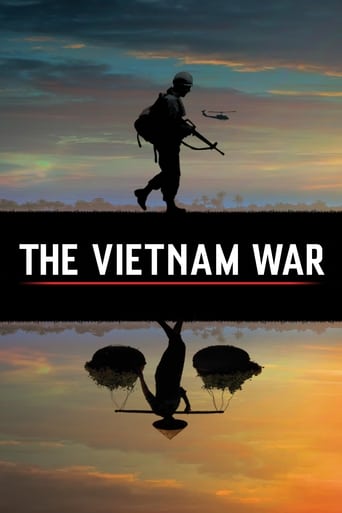
The Vietnam War
2017 · TV series · documentary · 1 season
An immersive 360-degree narrative telling the epic story of the Vietnam War as it has never before been told on film. Featuring testimony from nearly 80 witnesses, including many Americans who fought in the war and others who opposed it, as well as Vietnamese combatants and civilians from both the winning and losing sides.
31 positive2 negative7 neutralfrom 40 commenters
Where to watch
No streaming data for this title.
45 comments on Hacker News
I’m watching the excellent Ken Burns documentary “The Vietnam War” right now, and this is a subject that is briefly touched on. The US was collecting such a vast amount of data and metrics during their war, quantifying everything, that they simply could not process it all. They didn’t have the minds or the manpower to make sense of it all.
Chiming in a second time to throw in just about every Ken Burns and Rick Burns episodic docs on PBS -— they have so much depth that it’s crazy. “The Vietnam War” is like 18 hours long. This is a bit hyperbolic and reductive but if you want to understand why an older person in your life is the way they are, pick a Burns documentary set during their formative adult years and so many puzzles get solved haha.
I’m terrified to see Ken Burns’ “The Internet” in 20 years lol
https://www.metacritic.com/tv/the-vietnam-war
https://www.metacritic.com/movie/what-is-a-woman
Ken Burns's documentaries on America's National Parks, The Civil War, The Vietnam War, and The War
Herzog's "Lo and Behold"
The World at War - BBC documentary series about WWII. Shows humanity simultaneously at it's best and worst.
The Vietnam War - Ken Burns documentary series. Very balanced and sobering take on the Vietnam war, events leading to the Vietnam war, and unrest in the US during that period.
The Fog of War - Errol Morris doc about Robert McNamara.
The Salt of the Earth - Doc about photographer Sebastião Salgado
Alone in the Wilderness - Dick Proenneke films himself building and living in a remote cabin in Alaska
Also can't go wrong with Adam Curtis.
Strongly recommend Ken Burns' Vietnam War documentary to all who haven't seen it, covering this and other tragic incidents:
https://www.pbs.org/kenburns/the-vietnam-war/
I think there's so much content that even with a very low hit rate, there's more than enough to entertain yourself to death. For example, the 18 hour Vietnam War documentary by Ken Burns is itself enough to burn a month or so of TV time.
The Vietnam War by Ken Burns.
Hands down on of the best documentaries I watched. It's not a one-sided American centric thing. Does a good job of remaining objective.
Wow. I love Ken Burns. Did not know he did Ali as well. The Vietnam War, The Roosevelts and Prohibition by him are among my favorite documentaries.
>When the US supported South Vietnam, it's not that they condoned everything south vietnam did, but had to make a tactical choice between lesser evils.
But why get involved at all? The US didn't have to do anything.
Most of the reason the U.S. gets involved in anything has to do with geopolitics. If there are human rights issues or "freedom" issues then this is just a bonus for justification purposes.
I highly recommend the Ken Burns documentary "The Vietnam War". I'm old enough to remember all the propaganda we were fed, it is just amazing how much we were lied to.
The NY Times and Washington Post also refused to publish the My Lai massacre before an unknown at the time freelance journalist Seymour Hersh broke the story in the western press more than a year after. There are also a great visuals of the massacre in the Ken Burns documentary Vietnam War.
https://en.wikipedia.org/wiki/Mỹ_Lai_massacre#Media_coverage
Two major national news press outlets — The New York Times and The Washington Post, received some tips with partial information but did not act on them.
Ridenhour called Seymour Hersh on 22 October 1969. The freelance investigative journalist conducted an independent inquiry, and published to break the wall of silence that was surrounding the Mỹ Lai massacre. Hersh initially tried to sell the story to Life and Look magazines; both turned it down. Hersh went to the small, Washington-based Dispatch News Service, which sent it to fifty major American newspapers; thirty accepted it for publication.[157] New York Times reporter Henry Kamm investigated further and found several survivors of the Mỹ Lai massacre in Sou
A good watch in regard to this is 'The Weight of Memory' (https://www.imdb.com/title/tt5734330/) episode from 'The Vietnam War' documentary.(https://www.imdb.com/title/tt1877514)
Ken Burns Vietnam War documentary, exemplifies really well how limited commitment to fight a war, will result in similar situation as in Korea (to a degree, I guess), Vietnam, almost in Iraq, and now in Afghanistan.
I think that video is part of a bigger documentary series by PBS[1]. I learned so much about the modern US history and how even to this day the Vietnam war continues to exert its influence in the US in many different ways.
[1] https://www.pbs.org/kenburns/the-vietnam-war
Some great visuals and imagery of the bombing of the Vietnamese can be found in the Ken Burns documentary series:
https://en.wikipedia.org/wiki/The_Vietnam_War_(TV_series)
Note: the imagery can be graphic and those afraid of seeing genocidal scenes and babies bombed should be warned.
> The fragility of American imperialism and its fear in being portrayed in any negative light knows no limits.
This is 100% unarguably, demonstrably false. Americans write books critical about American imperialism (https://www.amazon.com/Imperial-Cruise-Secret-History-Empire-ebook/dp/B002P8N0UC/), we make (and fund with public broadcasting money!) documentaries that criticize both the effectiveness and wisdom of our own military efforts (https://www.pbs.org/kenburns/the-vietnam-war/). Most US media has been very critical of recent military efforts. These are just a few examples.
Is the US perfect? No. Are there examples of it the US behaving in a way that makes its citizens less than proud? Yes. But there is a wide gulf between the US and the CCP and what one can get away with saying and doing in the US vs. what one can say or do under CCP control.
Ken Burns' Vietnam. Understanding the conflict in Indo-China is to understand America
Recently felt shook by the American Masters: Keith Haring episode. Died way too young. And that creative energy of Downtown NYC 1981 is just a memory now ;)
https://www.pbs.org/wnet/americanmasters/keith-haring-documentary/16014/
> How is it an example of "shining at its best"
Shining at its best, in terms of making a product that just sells well without the state taking much efforts at it. Like in case of WW2, they just made movies which glorify US's contribution at the expense of others, the product sold well because it was well made. So their role got pushed in the minds of people even outside US.
> How about this one? https://en.wikipedia.org/wiki/Youth_(2017_film)
I read the synopsis, it doesn't seem like anything critical of their role in the war or need for it or their defeat. It talks about how they won bravery medals there and then it seems like a drama around love/work life.
Watch the Vietnam War documentary by Ken Burns/PBS, that's the sort of media I am talking about.
Although I agree with the sentiment that US has a lot of soft power influence, I would argue that most of it is just US capitalism shining at its best. I think the best example of this is WW2 related content like movies. In France public perception of who won them World War 2 changed from Soviet Union in 1940s to US in 2000s. [1]
One major difference in US soft power is, they don't censor media critical of them to an extent even close to what CCP does. Look at the commentary on the pointless Vietnam War originating from US in their media, try to find something similar on PRC's pointless war in Vietnam which they lost.
[1] https://www.les-crises.fr/wp-content/uploads/2014/06/sondage-nation-contribue-defaite-nazis.jpg
I wish people would stop comparing US coronavirus deaths to the Vietnam war. The comparison is intended to increase the perceived gravity of coronavirus pandemic - "Remember that war 50 years ago which had massive cultural & social impact? This is just as big!" - but implying the Vietnam war's impact was based on American bodycount is just wrong at best and appalling at worst.
The Vietnam war had such an impact because the US military went on such an insane spree of war crimes and civilian massacres that America permanently lost its standing as a moral authority gained in WW2. Two million Vietnamese civilians paid the ultimate price for America's geopolitical theorizing, and the disaster was prolonged for an entire decade because the country was too proud to admit it was in over its head. McNamara and then Nixon knew the war was unwinnable, but the US could not appear defeated. And so the atrocities continued. Many in the US realized all of this and became permanently disillusioned with their country.
Apologies for the off-topic rant but this comparison has been making its way through a lot of circles that really should know better. If you find yourself wishing you knew more about this topic, I recommend the Ken Burns documentary The Vietnam War or the book Kill Everything that Moves.
I was young enough in the 70s not to get all of the subtlety, but I think we really are more divided now than back then. Current politics is vicious in a way now that I don't recall back then.
In any case, to get a taste of what things were like then, watch Ken Burns' excellent documentary on the Vietnam War (currently on Netflix?).
Loved the Vietnam series too. Have watched it a couple of times on Netflix.
I'm 40 yo European so I knew close to nothing about the Vietnam war other than what I had seen in some movies. Very in depth and emotionally powerful. It also seemed pretty objective to me as a complete outsider.
Think you got mixed up a bit there.
Ken Burns Vietnam documentary series was about Vietnam (1960s - 1975 ?), not the Korean War (1950 - 1953), no?
The 320,000 South Korean troops who rotated through the Vietnam War over 10+ year period were great troops according to many US veterans who were there.
And also I do not agree with the broad generalization that South Vietnamese troops were hopeless.
I was watching the Ken Burns documentary on the Vietnam War and I recall one of white vet (from the marines I think) remembered something to the tune of "it didn't matter what color your skin was, we were all the same out there" meanwhile some of the black vets had clear memories of racism in the ranks and how they dealt with it. One guy said he told people "say what you want to say about me, but say it from where I can't hear you" and another said he recalled a black soldier blowing up his white officer's house (or room, can't remember the exact terminology).
As a black guy from a military family (though I wasn't in the military myself) my folks for the most part told me they tended to deal with racism quickly and quietly by pulling someone off to the side and either explaining what was wrong to them or fighting them (I have uncles that did one or the other). I think that is kind of how you have to deal with it as well as a lot of other problems in the military because of social pressures towards cohesion. I say this to say that maybe you didn't see it as much when you served because you never did anything to warrant a stern conversation or confrontation yourself and your fellow soldiers or sailors nipped it in the bud before it became a problem within ranks. But that's just my speculating because, again, I've never been in the military, but my uncles, cousins, and great grandfather were and talked about their experiences.
So many Ken Burns documentaries come to mind but I think the National Parks one is my favorite. The Vietnam War, his latest work, was excellent too.
"Lo and Behold" by Herzog depressed the hell out of me. It gives me the impression that society is being torn apart by the independence that technology enables.
Farenheit 9/11.
Michal Pollan's Cooked series.
Riding Solo to the Top of the World (2006) https://www.imdb.com/title/tt0903013/
The Atomic Cafe (1982) https://www.imdb.com/title/tt0083590/
At Sea (2007) https://www.imdb.com/title/tt1829648/
The Vietnam War (2017) https://www.imdb.com/title/tt1877514/
Lessons of Darkness (1992) https://www.imdb.com/title/tt0104706/
Tim's Vermeer (2013) https://www.imdb.com/title/tt3089388/
Weiner (2016) https://www.imdb.com/title/tt5278596/
Jodorowsky's Dune (2013) https://www.imdb.com/title/tt1935156/
Los Angeles Plays Itself (2003) https://www.imdb.com/title/tt0379357/
The Art of Japanese Life (2017) https://www.imdb.com/title/tt7002974/
The Great Happiness Space: Tale of an Osaka Love Thief (2006) https://www.imdb.com/title/tt0493420/
The Triumph of the Nerds: The Rise of Accidental Empires (1996) https://www.imdb.com/title/tt0115398/
The Jinx: The Life and Deaths of Robert Durst (2015) https://www.imdb.com/title/tt4299972/
The Vietnam War: A film by Ken Burns & Lynn Novick
I watch it on Netflix. It is an even handed look of the war from both sides. It was so good. Be prepared to get angry and to cry.
> "as politicians concern themselves more so with existential power struggle"
I've been watching The Vietnam War documentary. Nothing angers me more than hearing Presidentsspeak about "re-election" in the same sentences as they speak about mass casualty campaigns as if it's one of the primary strategic considerations of a war that kills hundreds of thousands.
Politicians who have insulated themselves from the effects of the economy, the same way they insulate themselves from the effects of war, will be forever out of touch and therefore incapable of properly representing their people.
Was it the Abrams Doctrine, I think, that described the purpose of Total War being that decision makers think twice because its their children, their constituencies, their local, State, and Federal economies that pay the price of war? Maybe the same concept needs to exist for education, healthcare, and climate change. Not that Total War exists anymore...
It wasn't crazy but if you go by the Ken Burns documentary series it was also wrong. America abandoned its principles to support French colonialism, ironically for fear that France would otherwise ally with the Soviets and thus pushed the Viet Minh firmly into the communist camp. The Viet Minh were Vietnamese nationalists first and foremost and showed no appetite for exporting communism post the Vietnam war.
The Vietnam War, by Ken Burns?
Watched that episode with the South Vietnam veteran recalling that episode where he was left for dead (literally, by his own allies AND adversaries), crawled through the jungle for 3 days and only then felt the pain and smelled the nasty odor of the rotting flesh.
People in general are able of amazing deeds under the threat of death.
Unfortunately it's why we are able to wage war. Was watching a documentary on the Vietnam war the other day and one guy was describing how he felt like an automaton that was focusing only on survival, which kept him from going insane, while another guy was describing how he felt no pain from his bullet injuries while trying to stay alive alone in the jungle for 3 days, only feeling pain after he was rescued.
But yeah, this coach is a hero for sure, I'm so glad they made it out.
I'm sorry but this is a serious (and arguably offensive) falsehood.
I'm sorry, but I will show you to be mistaken below.
But the notion that US forces would just designate an area where everyone including civilians are to be killed is an outright and offensive lie.
Then you should have an issue with the Ken Burns documentary. I think I got the terminology wrong; "free fire zone" means something else. However, the practice I am referring -- that of designating everyone in a certain place as an enemy, then killing everyone within -- did happen.
https://en.wikipedia.org/wiki/My_Lai_Massacre
From Ken Burn's "The Vietnam War" Part 5 narration: (00:44:43,393 --> 00:44:47,428)
In the summer of 1967, Tiger Force was sent to the fertile Song Ve Valley. The entire population had already been herded from their homes and crowded into a refugee camp. But some had come back to resume the farming they had always done. The valley had officially been declared a free-fire zone, and Tiger Force's officers took that literally. "There are no friendlies," one lieutenant told his men. "Shoot anything that moves." Over a seven-month period, they killed scores of unarmed civilians. Among their victims were two blind brothers; an elderly Buddhist monk; women, children, and old people hiding in underground shelters; and three farmers trying to plant rice. All were reported as "enemy... killed in action."
I know it's a popular series, and I haven't gotten my dad's response to it because he hasn't watched it, but many war veterans and South Vietnamese military members say it's not a very balanced documentary.
https://www.mercurynews.com/2017/09/29/veterans-angry-disappointed-following-pbs-vietnam-war-documentary/
https://www.military.com/off-duty/television/2017/10/02/veterans-angry-disappointed-pbs-vietnam-war-documentary.html
I'd also like to recommend the Ken Burns "The Vietnam War," which can be found on PBS. It is amazingly well done and the depth of it is beyond most documentaries. For example, there is one episode (1.5+ hours) that covers a six month period from 1967 to '68.
I was a small child during the war (10 in '68) and (to be truthful) only somewhat remember watching the coverage on TV. My mother said I used to ask her if I was going to have to go fight there and that I didn't want to. Thankfully, I didn't. The war ended in '75. I had just turned 17.
Strangely, the My Lai massacre is not covered until a later episode. They slotted it in the time line where it was first reported --not when it actually happened. But be patient, they do get to it eventually.
The sobering part about the series is that it absolutely captures the stupidity, futility, and mismanagement of the war over such a long period of time. The huge waste on both sides. The scale of it was staggering.
Myself, I am always drawn to the jungle patrols and the combat portions, which are fierce, terrifying and totally engulfing. I can see why certain people are drawn to war. It's the ultimate video game. Everything is on the line. You have no idea what the enemy will do and (really, in the end) no idea what you will do when faced with that visceral terror and excitement. What a rush it must be! And how horrible too. I am in inveterate coward. I don't believe I would have gone if called, but my 17 year old self is someone I don't really know anymore.
Anyway, the series is great and I highly recommend it.
I understand that no one likes being painted as the bad guy, but this is a very odd claim: "Americans movies will certainly never paint America as the bad guy, despite the fact that millions have died at the receiving end of American weapons. In fact, I can't recall any media where America is painted as the bad guy."
I'm not American but this suggests you have experienced very little of the variety of American movies or general media? There are not only plenty of American movies and media critical of America and American policy but there is a long history of such. Without going back too far in history, the media presentation of the Vietnam war, for example, may be something of a cliché but it's a valid example.
Ive slowly lost faith in the mainstream news over the last few years, and so have subsequently tuned it out.
It started when I noticed that the news barely covered the US bombings of hospitals and funerals overseas. There was very little coverage of the US supported war in Yemen where thousands of innocent civilians were being killed.
At some point CNN went crazy over MH370 and gave an uneventful search for the plane wall to wall coverage while US weapons killed people overseas.
I had to go to The Intercept to learn about drone killings in any real detail.
And then I remember in particular when Bernie Sanders had just had his largest rally yet, the PBS newshour failed to mention it while devoting 8 minutes to Donald Trumps twitter comments.
So when the media that hated Trump (a position I am not criticizing) started talking about allegations of Russian interference with the elections, I waited for the evidence. But after a couple of months of anonymous officials making this claim and that claim but no hard evidence in the matter, I tuned it out.
I’ve since stopped following mainstream news, so if they’ve come up with genuine evidence by now then I’m just out of the loop. It’s fair to say I’m uninformed here but I do recall that for some time at the beginning, no evidence was presented.
Lately I use my time to educate myself in other ways. I’m 10 hours in to PBS’s 18 hour documentary on the Vietnam war. I’ve never learned so much about that conflict. I’ve been watching some John Pilger documentaries on YouTube, and trying to understand why people all over the world still live in destitute poverty even in the outskirts of wealthy cities. I’m trying to understand my libertarian friends who say that broad social programs are unfair, while I see images of people with nothing dying from poisoned water or preventable disease. But I’m also trying to understand why socialism was unfair (John Pilgers documentary about Japan was enlightening there). I’m trying to find a way to care for the poor and give them more power without giving power to despotic governments that will siphon aid money into their personal accounts (as in the IMF funded nuclear power plant in the Philippines that was never finished, but poor local tax payers are still paying off). I’m also working on a week long robotics course to teach to some university students in Africa, and the associated robot I built as a teaching aid. I leave in less than a month and it’s been a busy time.
So when I see news that sounds like baseless claims about “The Russians” on channels that don’t cover the murder of children but do feast on images of a bare ocean where a missing airliner hasn’t been found, I just tune it out.
My life has improved since I stopped using Facebook and removed the normal political feeds from my reddit. I’ve been political my whole life and to this day I focus heavily on politics, but the information I want is scarcely carried on those normal news feeds.
This doesn't address the rest of your comment, but I have a theory about the presence of Vietnam War books on this list. Ken Burns and co. released their multi-part series on the Vietnam War this year: http://www.pbs.org/kenburns/the-vietnam-war/episodes/ That has likely contributed to an uptick in general interest in the subject.
There are also some pretty frank interviews in Ken Burns and Lynn Novak’s Vietnam War documentary in which the subjects discuss “fragging” unpopular officers. Though maybe the quote was referring just to recent cases.
Edit: Whoops, missed the “elite” part of that quote.
For a well-documented summary of the Vietnam War, I recommend Ken Burns's PBS documentary which came out a few weeks ago [1] It is a total of 18 hours of video but very well worth it.
To me, it is striking how history has repeated itself with the Iraq and Afghanistan wars. A war with: (1) no clear goal or victory criteria, (2) endless spending and major profiteering by the war industrial-complex and (3) low levels of support from the American people. It was very sad to, very clearly, draw the parallels between the two wars as the documentary progressed.
[1] http://www.pbs.org/kenburns/the-vietnam-war/watch/
I have relatives that served in Vietnam (drafted, most served in the enlisted ranks), and worked with several other Vietnam veterans (all retired officers, all were career military, and nearly all had been commissioned before the Vietnam War had started).
I, perhaps oddly, do not know how my relatives feel about the war or the Ken Burns documentary. Most flat out refuse to talk about those years. Perhaps that's not so odd, given the times and situations they faced both abroad and on coming home.
The folks I worked with, on the other hand, were pretty uniformly proud of the job they and their men did. They did not all agree with the politics surrounding the war, both in recent years as well as at the time, but being professionals, they did as they were ordered. Several of them, now professors of U.S. History, thought the Ken Burns' documentary was very well done, and reflected reality in a way that Hollywood never did or desired to. A couple of those professors include the Burns' documentary as part of their courses' curriculum.
I don't know if any of that helps with your curiosity.
The recent Vietnam War PBS documentary covers the Mayday protest as one of many different protests as public opinion turned against American involvement against the war. Whether the tide turned because the protests were leading or trailing public opinion is probably arguable. There were also signficant organized violent counter protesters in favor of the war/against the antiwar protesters. A bit of the info in the documentary is covered in The Fog of War but it's pretty interesting for the similarities to today. Also, there was a Vietnam vets against the war protest in DC immediately preceding the Mayday protest that the administration specifically did not oppose with police/national guard in order to not generate positive press/sympathy for the antiwar effort.
My first thought is nothing changes.
In the recent PBS Vietnam War documentary they show film footage of the US military tiger teams waterboarding an elderly Vietnamese villager (episode 8/9?). And on the other side the North Vietnamese tortured all the American POW's, and we heard from Hal Kushner directly and learned about what they did to McCain and others who survived to bear witness. But we expect more from our side, we don't expect to be the "baddies".
When we call it a war (on terror), we expand the limits on what some will justify. Having a war on an idea means there's essentially no end in sight.
I don't think you should watch Burns' documentaries or any documentaries as history, but as works of art.
And Burns' Vietnam War is a great work of art. And you have to appreciate that he is making a film for an audience and naturally, he will cater a significant part of it to that audience.
There is no such thing as a completely unbiased documentary or history book or political text. They are all made by biased people.
But I think Burns' gave every major side and every major viewpoint a voice in his documentary. And that's all we can ask.
I think his film was as objective and fair as anyone, or any american, can be. But you have to be cognizant of the fact that it is an american documentary by american filmmakers for an american audience.
I agree with what you wrote.
Burns has said he makes films, not documentaries. PBS shouldn't have relied on him to do a Vietnam "film", but I guess he still brings in the ratings.
A good documentary on the Vietnam war would have every Republican and Democrat denouncing it and calling the director a traitor. That would never happen with a Burns film. Bill Moyers would have been a better choice.
Sidenote: "Kill Chain" (book) by Andrew Cockburn also has some Vietnam War era stories...that also relate to the current "war on terror".
As a permanent resident with a pending citizenship application (who came on the visa mentioned at the end of this article), I find this incredibly alarming.
I have nothing to hide, despise terrorism and the fanatics that commit it, and wish no harm on others with different social, political, or religious views. But I'm familiar enough with history to know how badly this can end. "Papers please" had consequences, especially for groups targeted for political reasons.
Just last night I was browsing Wikipedia articles on various Presidential/political assassinations after watching an episode of the PBS Vietnam War documentary that is currently being aired. Earlier this week I tried to sign up for Snapchat and discovered an active account based out of Saudi Arabia that someone had set up using my email address (via an unverified email address I assume - thanks SnapChat). I can't read arabic so have no idea what was being shared on that platform from "my" account but based upon the images it looked critical of America.
It's not much of a leap to imagine being accused of various things based upon your browsing history or social media, especially if actions like this (http://www.npr.org/sections/thetwo-way/2017/08/15/543782396/doj-demands-files-on-anti-trump-activists-and-a-web-hosting-company-resists) become more common.
The rational part of my brain keeps screaming "This is America, it can't happen here, especially if you have nothing to hide" but I also find it difficult to ignore the historical and current warning signs.