 Hacker Cinema
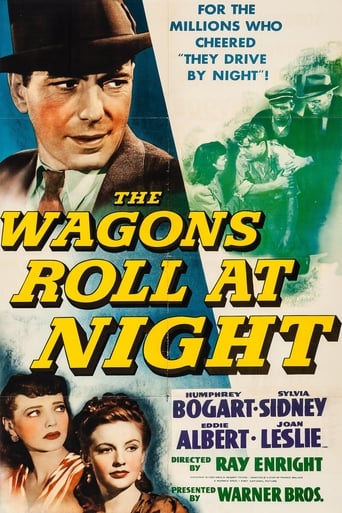
The Wagons Roll at Night
1941 · Film · 84 min
Directed by Ray Enright
An escaped circus lion provides the impetus for the meeting of carnival owner Nick Coster and Matt Varney, a small-town man who suddenly becomes a lion tamer when he manages to subdue the big cat. While acclimating to carnival life, Matt begins a romance with Nick's sister, Mary, causing tension between Matt and Nick. The latter must also juggle his stormy relationship with glamorous circus star Flo Lorraine.
1 neutralfrom 1 commenter
Where to watch
No streaming data for this title.





1 comment on Hacker News
During the "golden age" of Hollywood in the 30s-40s, the studios would crank out one movie per week. Stars would often appear in 3 movies per year. Today, stars shoot a film every 3 years or so. E.g. take a look here:
https://en.wikipedia.org/wiki/List_of_RKO_Pictures_films#1940
In 1940, RKO released 55 films, of which they produced 39. That's basically a film per week. And these were feature films.
For the individual stars, take a look at Humphrey Bogart, who starred in 3 films in 1941: The Maltese Falcon, The Wagons Roll at Night, High Sierra. I don't think there was a year in the 40s up to the mod 50s when Bogart didn't star in at least 2 releases per year. In 1951 he was in The African Queen, Sirocco, and The Enforcer.
Today, take a major studio, say Paramount Pictures. It released 11 films in all of 2018.
What happened was JAWS created the 'blockbuster' phenomena, in which the studios made huge money on a small number of very expensive films with huge marketing budgets compared to previous eras. That totally changed the dynamic. It also made actor pay shoot up.
But it has nothing to do with the cost of the prints -- just strategy of whether you want to make a small number of films with tons of marketing spend like in the post JAWS era or a large number of cheaper to produce films with small marketing budgets like the pre-JAWS era.
In many ways, what is happening with TV and Netflix is akin to a return to the studio model but for episodes, where Netflix seems to be able to crank out a large number of relatively cheap but decent quality episodes, and this of course corresponds to lower actor pay per episode.