 Hacker Cinema
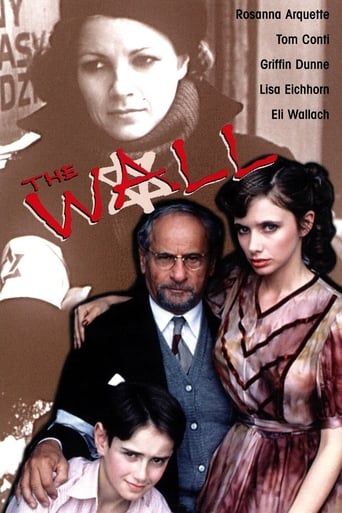
The Wall
1982 · Film · 135 min
Directed by Robert Markowitz
A dramatic re-enactment of the Warsaw Ghetto Jewish uprising in April 1943 were 650 armed members of the Jewish Fighting Organization of Poland held off a 3,000 strong Nazi force in which only a handful of Jews survived. Tom Conti plays Dolek Berson, a Jewish smuggler who joins the resistance movement and is aided on the Aryan side of the wall by a former teacher named Regina Kowalski played by Rachel Roberts in her final role.
3 positive2 negative7 neutralfrom 12 commenters
Where to watch
No streaming data for this title.
12 comments on Hacker News
I'd say celebrities and creatives in general are often big offenders here too. Lots of actors/athletes/musicians acting like being good at what they do means they're also qualified to talk about science and engineering. And a lot of reviewers, documentary creators and specialist writers that decide to wade into discussions about topics they have no knowledge of/cover something they're new to, only to look ridiculously out of touch as a result.
See the Nostalgia Critic review of the Wall. Or the Alex Meyers review of Obsession.
> I'm not sure what you mean by separating review from criticism. Can you expand on that?
Let's start with applying both to "Eraserhead":
A critical approach might have a thesis on how it links with Lynch's interest in Buddhism and how those concepts surface in the film, how different events and characters in the film can be read through that lens and how the resolution of the film makes sense in a Buddhist context. Absolutely none of this tells you whether the person who watched the film was enraptured by it from the first scene or whether they got through it out of academic obligation and immediately bitched about it on social media afterwards. Criticism has a thesis about a work and defends it, which doesn't usually involve how enjoyable the work is.
A review of "Eraserhead" would tell you about the experience of watching it, whether the person writing the review thought it was a well-constructed and engaging film, and maybe some thoughts on how much sense they made of it, but the analysis wouldn't be the focus. Thumbs up, thumbs down, that's the meat.
It's entirely possible to mix the two realms, but there's a difference in focus and intent. The better YouTube channels (Folding Ideas) mix the two quite deftly, in fact, but I'd put Folding Ideas in the realm of criticism more than reviewing because he does tend to have a thesis and defends it in addition to saying how much he enjoyed (or, more often, didn't) the films he talks about.
For example, in his video about The Nostalgia Critic's review of Pink Floyd's movie The Wall (that is, his video about another person's review of a band's movie made from their rock opera album) his thesis is that the person behind The Nostalgia Critic character is creatively stalled and fundamentally lazy. He defends this thesis while lambasting the video he's talking about, but the thesis is centered. That's criticism.
The discussion is new to me.
I started analysing the audio because someone sent me a link to the film (The Wall) on youtube and asked me about the signalling. Once I'd decoded the telephone number, I tried googling it, to see if someone else had already figured out what it was (a US local number? the number to a US operator? the number a US operator called to talk to a UK operator? the number a UK operator dialled to get a London number?), but nothing came up. There's quite a bit of good discussion about that in the comments here.
A week or two later, I tried googling 'Pink Floyd Telephone Call', and found that the audio actually comes from the album, i.e. it's not just in the film, and a bit more information about how it was made, and put that in the addendum.
You should try a concept album.
https://en.wikipedia.org/wiki/Concept_album
They're like a movie; they have a story to tell. Try Pink Floyd - The Wall.
The wall is best enjoyed by watching the movie.
Once you’ve done that then you can enjoy listening to the music by itself.
There's a reason that men succeed at suicide a lot more frequently than women. Help is often not an option.
In his excellent review [1] of Nostalgia Critic's idiotic, embarrassing and awful review of The Wall, Dan Olson points out that much of the part of the film that Doug makes fun of is specifically the main character being told to hide/suppress emotion and struggling with that and failing.
In other words, the "satire"'s primary take is basically that men showing feelings is being strictly something to be mocked.
[1] https://www.youtube.com/watch?v=rokAtlFGa7Y
The first thing to realize is that there are 4 main phases of Pink Floyd, and can be considered different bands:
1) the Syd Barrett era. They were a psychedelic pop / experimental band, led by charismatic singer / songwriter / guitarist Syd Barrett. They had 1 album (Piper at the Gates of Dawn), and several singles. I like this era a lot. Try listening to Arnold Layne, Lucifer Sam, See Emily Play...
2) Middle period - after Syd went nuts, they brought in Dave Gilmour to replace him. Everyone tried their hand at writing songs, and it took some time to get their footing. This is a more introspective, laid back period, and when they did those sound track albums people are talking about. They were in the top 40, but not really stars yet. The culmination of this era was the movie Live at Pompeii.
3) Roger Waters era - bass player Waters wrote an entire album of songs about madness and alienation, this was Dark Side of the Moon, their most popular album, which propelled Pink Floyd to the top of the charts. Waters had developed into a genius song writer, but with each successive album, became more domineering and difficult to work with. These albums tended to be ambitious concept albums, dark and disturbing, in contrast to the laid back vibe of the previous era. The last 2 Waters albums, The Wall and Final Cut were essentially Waters solo albums, and at the end, half the band had departed.
3) Dave Gilmour era - Waters went solo, and expected the band to end, but Gilmour decided to bring back the 2 ousted members of the band, and continue as Pink Floyd. This period isn't very interesting IMO.
So my personal tastes: I find The Wall and most of the Waters-era albums kind of overpowering and negative. I prefer the Barrett stuff, as well as Live at Pompeii. YMMV...
> This argument is far from original; lambasting public schools for tormenting their inmates and ruining the country is one of Britain’s oldest traditions.
Pink Floyd's The Wall, anyone?
> The author also makes good use of his own [1970's] memories at Radley College. The school was trapped in the past, both the 1940s and 1950s—playground games were an endless fight against the Germans
No different from 1970's Czechoslovakia playgrounds.
We're talking only 30 years after a big, devastating war; it held a lot of cultural influence.
If we look at television and film related to WWII:
https://en.wikipedia.org/wiki/List_of_war_films_and_TV_specials_set_between_1914_and_1945#World_War_II_(1939%E2%80%931945)
still plenty of action into the 2000's.
Indeed, though I do recommend watching that old western on BluRay. Someone who knows how to nail it with film actually does capture way more than they even expected back then.
There is a fine art there to be appreciated. This is why Spielberg still shoots film. He has a mastery that continues to have value. He may find all of that blunted in the digital realm. Can't blame him.
I think we will eventually find the art in high resolution digital comes down to things other than perfection. Sometimes too much of a good thing is too much.
On another thread, I mentioned Pink Floyd, "The Wall" and how it has been reissued on CD and a remastered gold version that is insane good.
Actually, it is too good. The average person may well appreciate the production values from the earlier work more, despite its considerable distance from perfection.
The trouble on all these discussions centers in on what people like as opposed to perfection. Those two are not always the same, and "better" has that subjective component to it always.
Many digital movie productions I see have subtle aspects to them one can find distracting or that break the immersion a movie is supposed to deliver. Not breaking that is Cinematography. I remain unconvinced everyone really understands that.
That's where the art is.
This is not to say advances in tech are bad or to be discouraged. Neither is true.
However, value perception of said tech may vary considerably from expectations.
On your last point, we actually lose the pixel art, and often the discussion goes to other things. Fine, but it's not always bad to see the pixels.
With gaming, extreme realism, or just extreme quality, can break some of the escape and fantasy, abstraction inherent in the entertainment form. There is definitely room for both and an active retro culture and indie scene taking liberally from retro in order to see that art continue.
The are also some economies with analog means. I'm on a chip project right now that can offer up great analog display. (Truth is, it will do a 4k on analog, no sweat, if one wants to do that)
Some of that is lost on digital devices. The thing is, generating the analog is at least an order more lean, while being able to offer comparable quality. Barrier to entry is low. That is also high value.
Raising that bar is good in many cases, but not all. So I find myself dealing with many subtle timing matters, artifacts of A to D conversion all a non issue on actual analog displays. I will end up with a lean device that can do HDTV signals nicely, while still maxing out an old TV, which does way more than most expect, and do so sans an awful lot of hassles.
As a "do it myself" kind of person, I do not always see the benefit of complex, resource intensive signals, compression, etc... as a good, or the better thing. And there are IP concerns too, all near completely absent from analog means and methods.
So then, "better" takes on some new depth when on is making or building from first principles. In the end, the system will deliver a great display for a fraction of the effort required to employ a fully digital path.
That's tech I know down to the core, can trust and control in any way desired. Does exactly what I want. High value as far as I am concerned. Timeless too. Works on anything ever made.
I just got a media player that refuses to interface with my other goodies. HDCP in play. It's hooked up via analog component, and delivers the great experience it is supposed to. Funny how that mess can all work.
In all fairness, most pop music is pretty vacuous. The Wall annotations are pretty good, a nice mix of references from the movie and personal anecdotes of the band members, e.g. http://rock.genius.com/Pink-floyd-nobody-home-lyrics
The classroom video clip from The Wall movie when this song plays.
I just ran a little experiment, because I'm out of practice on that sort of thing and too lazy to use anything but Pandora and Rhapsody anymore.
Google searching for 'pink floyd the wall' and clicking the three most obvious links in order gets you a well seeded torrent file. None of the links on the page obviously lead you to somewhere to pay to stream/download the album legally (although there is an iTunes link for the movie at the bottom).
Pirates are still winning on convenience, let alone cost.