 Hacker Cinema
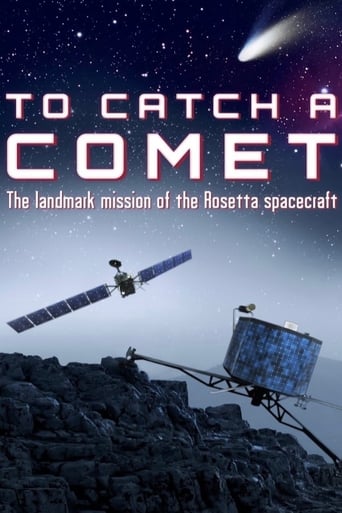
To Catch a Comet
2014 · Film · documentary
Directed by Rory Griffin
On November the 11th, billions of miles from Earth, a spacecraft orbiter and lander will do what no other has dared to attempt: land on the volatile surface of a comet as it flies round the sun at 41,000 mph. If successful, it could help peer into our past and unlock secrets from our very origins. The stakes couldn't be higher.
1 positivefrom 1 commenter
Where to watch
No streaming data for this title.





1 comment on Hacker News
I watched this documentary called "To catch a comet" about the Rosette/Philae mission to comet Churyumov–Gerasimenko. The achievement of getting to the comet and landing Philae, like many other achievements in space, is really phenomenal. So many things could've gone wrong, but the fact that the worst was Philae bouncing and getting stuck in a dark place (and not being able to perform fully) is a huge success beset by an issue of a smaller magnitude.
The description of the documentary says [1]:
> Unable to carry enough fuel owing to weight restrictions, the Rosetta scientists devised a delicate cat and mouse trajectory to reach their distant destination. In the ten years Rosetta had been in space she flew around the Earth three times, Mars once and the asteroid belt twice, to gain the momentum she needed to reach her destination. In the months before landing, the team navigated Rosetta safely to a world never before observed at such distances or accuracy. Rosetta orbited the comet before releasing Philae onto the surface.
Quoting from the article of this thread:
> “We were beginning to think that Philae would remain lost forever. It is incredible we have captured this at the final hour.”
This brings a much better ending for the people who worked on the mission for more than 30 years. [1] We tend to anthropomorphize things like spacecrafts, landers, rovers and many other inanimate objects. I think for the team (and many others following this news), this photo would be like being able to see a dear friend one last time, say goodbye in their minds and have some kind of closure.
The Wikipedia article, and especially the section titled "Landing and surface operations" [2], is also quite interesting to read.
[1]: http://www.pbs.org/program/catch-comet/
[2]: https://en.wikipedia.org/wiki/Philae_(spacecraft)#Landing_and_surface_operations