 Hacker Cinema
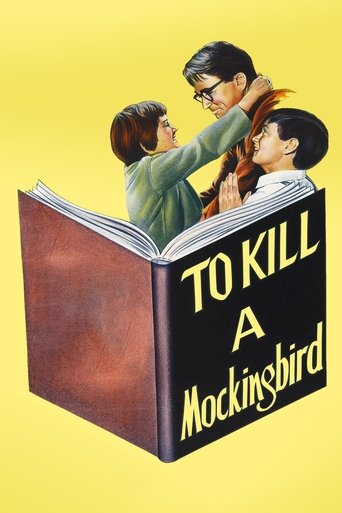
To Kill a Mockingbird
1962 · Film · 129 min
Directed by Robert Mulligan
Scout Finch, 6, and her older brother Jem live in sleepy Maycomb, Alabama, spending much of their time with their friend Dill and spying on their reclusive and mysterious neighbor, Boo Radley. When Atticus, their widowed father and a respected lawyer, defends a black man named Tom Robinson against fabricated rape charges, the trial and tangent events expose the children to evils of racism and stereotyping.
6 positive2 negative15 neutralfrom 23 commenters
Where to watch
No streaming data for this title.





23 comments on Hacker News
“ In 1992, an Alabama editorial called for the death of Atticus, saying that as liberal as Atticus was, he still worked within a system of institutionalized racism and sexism and should not be revered. […] Critics of Atticus maintain he is morally ambiguous and does not use his legal skills to challenge the racist status quo
[…]
despite the novel's thematic focus on racial injustice, its black characters are not fully examined.[79] In its use of racial epithets, stereotyped depictions of superstitious blacks, and Calpurnia, who to some critics is an updated version of the "contented slave" motif and to others simply unexplored, the book is viewed as marginalizing black characters.[130][131] One writer asserts that the use of Scout's narration serves as a convenient mechanism for readers to be innocent and detached from the racial conflict. Scout's voice "functions as the not-me which allows the rest of us—black and white, male and female—to find our relative position in society".[79] A teaching guide for the novel published by The English Journal cautions, "what seems wonderful or powerful to one group of students may seem degrading to another".[132] A Canadian language arts consultant found that the novel resonated well with white students, but that black students found it "demoralizing".[133] With racism told from a white perspective with a focus on white courage and morality, some have labeled the novel as having a "white savior complex",[134] a criticism also leveled at the film adaptation with its white savior narrative.[135] Another criticism, articulated by Michael Lind, is that the novel indulges in classist stereotyping and demonization of poor rural "white trash".
- https://en.wikipedia.org/wiki/To_Kill_a_Mockingbird
Most overrated book since “night” by elie Wiesel
Interesting that the runners-up were much more conventional choices, Pride and Prejudice and To Kill a Mockingbird.
I've never read Mockingbird; I gotta say that it doesn't sound like a fun read. I really admire Jane Austen, though I find her books a bit of a slog even now. (I really hated them when compelled to read them in high school, though with the aid of some film adaptations I have a much better understanding of what those books are about.)
Hunger Games does nail a sweet spot of Young Adult fiction: compelling, easy to read, but not completely dimwitted.
The first Harry Potter book might have been a good choice, but it's really a juvenile rather than YA, and that narrows the audience somewhat as a "favorite book". Later Harry Potter books are more appealing to older readers, but no single one of them quite captures the lightning of the first one.
A simple search for books is an interesting problem because some it makes sense to find based on title alone, while it doesn't make sense for other books.
Take To Kill A Mockingbird as an example... No matter what (English) edition of the book you read, you're likely reading the exact same content, even the exact same words, as any other English edition. There might be a different preface near the front or different blurbs on the back cover or a different number of words per page, but the actual story is word-for-word the same. A simple title lookup makes sense here in most cases.
Compare that to something like The Iliad, where the English versions are all translations and can vary greatly from translator to translator. While all telling ultimately the same story, a bad translation doesn't begin to compare to an elegantly beautiful translation, so you almost certainly don't want to treat all editions of The Iliad the same.
Translations aren't the only times that you wouldn't want to treat all editions of a title the same. Some books have undergone abridgments, revisions, or corrections, so the content won't be word-for-word the same between editions, but might or might not be close enough that it's worth considering them the same. Some books have heavily annotated editions, so while not changing the underlying content that all the editions are based on, the reading experience is quite different.
I could go on with differences, but I hope it's clear that there _are_ differences between books and movies when it comes to variations/releases. For books, I think the lookup issue is closer to how it is for board games. Board games, like books, have many editions and translations and often get updated/revised between editions. Sometimes the updates change the gameplay significantly, and other times they don't. Boardgamegeek.com is one of the best (if not _the_ best) catalogs of board games that there is, and it has regular discussions/arguments about whether a new edition of a game is different enough that it deserves its own page or if it should just be relegated to be an easy-to-ignore note in the Versions section of the previous version's page. I think a letterboxd-like lookup for books would have similar regularly-occurring debates, and, like with board games, ultimately have to be fairly hand-curated.
> Thanks again for continuing this conversation! I'm enjoying it. Also, can you recommend me a book or two to read on this subject? Thanks in advance.
Hey sorry for my late reply, I really didn't mean to waste your time, I just got super busy and spun a bit responding. Honestly I haven't read as much as I'd like to after discovering the internet around 1995, so this is mostly what I've picked up online.
To me, wokeism is fundamentally about stuff we can't unsee. It's like being friends with someone in an abusive relationship, where the other partner takes us aside and tells us that if we knew what they knew about our friend's behavior, we might not want to be friends with them anymore. The more we learn, the more that America's origin story becomes a twisted fable of revisionist history, written by the winners to cover centuries of oppression and violence. These stand out to me:
https://en.wikipedia.org/wiki/Tulsa_race_massacre
https://en.wikipedia.org/wiki/Thomas_Jefferson_and_slavery
https://en.wikipedia.org/wiki/Brooks_(1781_ship)#/media/File:Slaveshipposter.jpg
I went to South Carolina a few years ago and stood on a small plantation cotton field they keep preserved for tours. It was suffocatingly hot, felt like 100% humidity under intense sun, and not even the hottest time of the year. I just imagined people forced to pick cotton all day, every day, their entire lives. It was soul-crushing.
Then the tour guide called the Civil War the Northern War of Aggression and my eyebrows raised. Reality shifted and I suddenly saw the feelings from that time still running strong today.
Maybe I can relate my experience better through pop culture references..
I grew up on movies like To Kill a Mockingbird, The Color Purple, Do the Right Thing, Glory, Schindler's List and Amistad, to name a few. I never read Black Like Me and never saw Soul Man. I think I may start with these, regardless of if they aged well, to get an impression of where my head is at now vs then.
This search brought back a memory, that in Short Circuit (one of my all-time favorite movies), I didn't know that Fisher Stevens wore brownface to play Indian engineer Ben Jabituya until maybe the 2000s:
https://ew.com/movies/short-circuit-fisher-stevens-regrets-playing-indian-role/
This just goes to show how ignorant people were (including myself) as recently as a couple of decades ago. I think that the makeup in Soul Man is forgiveable because it's explicit and the subject of the film, much like Dustin Hoffman dressing as a woman in Tootsie. Whereas Short Circuit did it for convenience, without considering that it might be offensive.
I also grew up playing with the toy car with the rebel flag on it from the Dukes of Hazzard, completely oblivious to any racist connotations.
And sexual harrassment was so prevelant that we had never even heard of it until Anita Hill vs Clarance Thomas in 1991 before he was appointed to the Supreme Court. I remember that we were really appalled by that, because it was so obvious that he was guilty of the harrassment, even if that didn't bar him from being appointed. This was just after the Rodney King beating and LA riots, but a few years before the OJ Simpson case if I remember right. Racial tensions were running high, but also there was a feeling that minorities were being kept from positions of power, so there was a lot of cognitive dissonance. There was no Me Too movement and we didn't have a words like cancel culture yet. I didn't feel at the time that he should have been appointed, because he gave me creepster vibes. I think his decisions in the time since have shown that he is very, let's just say tempted by financial favors.
> This is sort of like the concept of "original sin", isn't it? The notion that certain people have a debt that is so big that it is impossible to ever be paid back, and so they must forever remain burdened with the guilt of the sin that their ancestors committed. The scale can never be zeroed. The guilt can never go away. The transgression can never be forgiven, because the effects linger down to our day.
Ya that's a good point, I hadn't considered that. It reminds me of how young people in post-WWI Germany felt that it was impossible to pay back the war debt that their elders faced when they lost the war. So they felt oppressed by who they viewed as Jewish elites in banking, eventually using them as scapegoats and starting WWII against the countries whose loans they were defaulting on.
Which has eerie similarities with the dissilusioned feelings of young men in America today, who due to wealth inequality can't earn the level of income needed to provide for a spouse or family, as they watch women and minorities rise without them. Blaming liberal and Hollywood elites, as well as immigrants, for bruising their egos instead of the real culprit, late-stage capitalist patriarchy.
I think what we're talking about is: how can the rights of individuals be upheld when our debts to previous generations are so high that we'd lose ourselves in an attempt to pay them back?
I guess my only counter to that is, if winners and losers resulted from the inequities of previous generations, leading to the vast wealth inequality we see today, then what would healing look like? Letting it go without making ammends, or going too far with violence as a result, both seem extreme.
I feel that affirmative action and taxing the wealthy are two solid approaches. But I don't feel that either have been tried to a degree nearly approaching reparations. Because if they had, then Congress might be 50% women, we wouldn't have such a large national debt or high poverty rate, etc.
> In the case of the LA fires, and for the additional reasons you've given, I agree, DEI was not to blame and is being used as a scapegoat. I wonder, if the fire chief were instead a straight white male, and if there was no firefighter that "looked like you" but instead, was capable of saving your life, would people still have blamed DEI, or would they instead shift their focus towards the "real problems" that you mentioned? Perhaps if these people weren't in these highly visible positions to begin with, DEI would not have been undermined as it was.
Ya, DEI probably wouldn't have been blamed had the people involved in the response fit prejudiced notions of what they should look like.
It seems that we both agree that DEI wasn't the cause of the fires. But maybe we should ask if putting such priority on DEI is undermining the cause of reaching equality. With so much political manipulation happening these days, it makes for an attractive scapegoat for those wishing to distract us from the real issues.
I don't know the answer, or if DEI should be put on hold temporarily. What I do know is that with controversial issues like gun control, we can find ourselves on hold indefinitely. So I am suspicious of calls to halt DEI when the problem of discrimination in hiring still exists. It feels too opportunistic IMHO.
> preface: I would like to think that everyone on the board has in mind the good of the entire company, and that the men don't just have in mind the considerations of men, and that the woman is not the only advocate for all the women of the company.
> Given the above, what injustice is there? Assuming that everyone earned their seat on the board fairly, without nepotism, sabotage, or shady backroom deals, why do you consider there to be an injustice happening here?
> The only way I can see there being an inherent injustice in a board room like this is if my initial assumptions aren't true, and that the men aren't advocating for the concerns of the women. But that would be to assume the worst of people. That sort of thinking is racist and sexist. That leads to tribal thinking, where people think that people from other demographics are similarly only looking out for "their own group".
Ya good point about the dangers of tribalism, since that is the single greatest threat facing the US today. We've grown so divided and provincial that we can't seem to work together, and that's undermining our credibility in the eyes of the world.
And I agree that people don't just work towards their own best interest, and that assuming they do is putting them in a box.
What concerns me though is that some people only respond to authority, not what society deems common decency. So without a law in place, they will return to discriminatory practices.
Trump just issued an executive order revoking Lyndon B. Johnson’s Executive Order 11246, promoting affirmative action in federal contracting:
https://www.washingtonpost.com/politics/2025/01/23/trump-revoked-equal-employment-opportunity-order/
Even though this move claims to encourage merit-based hiring, it will undoubtedly have the opposite effect. Because authoritarian-minded people will no longer be forced to practice nondescrimination. So they will hire candidates who appear to fit their own projections and stereotypes, causing them to overlook similarly-qualified candidates from other demographics.
When the laws aren't there, companies have a track record of accepting a certain level of human cost if it raises profits. Seatbelt laws, pollution laws, etc reflect the need for those regulations.
Now, we can argue whether the free market would take care of discrimination on its own. But in these times of little or no antitrust enforcement, often workers have few alternative employment options, so are at the mercy of employers. I'm not seeing politicans in favor of deregulation also calling for antitrust enforcement, so they are having their cake and eating it too, making this argument suspect.
-
Continues ->
Well adding to the above list of what could be considered stand out movies, these below are some I really enjoyed / admired -- in no particular order.
Dark City
Ice Planet (2001)
The Green Mile
Mortadelo & Filemon: The Big Adventure
Flodder 3
Gettin' Square
Midnight Run
The Accountant
Slipstream (2005)
To Kill a Mockingbird
North by Northwest
In the Heat of the Night
What the Deaf Man Heard
The Simple Life of Noah Dearborn
Short film - Forklift Driver Klaus – The First Day on the Job
The only graph in that article that shows a strong trend supporting the thesis is the first one - essentially, "movies that are remakes or sequels to previous movies". It goes from 25% in the 1980s to ~80% today.
But doesn't that follow sort of naturally? Filmmaking took off as an industry not that long ago - roughly in the 1960s. Of course you didn't have too many remakes of old movies back when you just didn't have that many movies to begin with. And cinematic universes - often centered around superhero action - started popping up only in the 1980s. Before that, it wasn't easy to make a sequel to "Gone with the Wind" or "To Kill a Mockingbird". It was a literary problem, not a matter of corporate consolidation.
And it's dictated to a large extent by audience preferences. We like sequels, prequels, and remakes of the films we remember from our childhood. The same goes for video games; it's a lot harder to sell a brand new idea than it is to market Fallout 5 or Dragon Age IV. It's not the studios doing it to us, it's what we want to play.
I don't know. I don't find the thesis particularly compelling. On the flip side: it used to be that everyone was watching the same TV shows at once, because you only had so much choice. Now, you have far more variety than you used to (albeit the average quality has probably gone down). The same goes for music - sure, "top 100" lists are still dominated by studio-produced albums, but what percentage of people is listening to "top 100" when we all get personalized streams?
> The writing for new shows is predicable and boring.
To YOU because you are probably a middle-aged man who is not supposed to have time to watch everything so that all the tropes are familiar to you. Watch less media, focus on other things.
> Actors are featureless blobs that all look the same.
I think there is more variability than there has even been in the history of media and they have been quite direct about fixing this. What are you even taking about?
> Movies and shows seem to be eye-rollingly preachy and talk down to audiences.
The notion that movies and shows in the 2020s are "preachy" or condescending is not a unique feature of our times. The medium has always been used to shape the society.
For instance, "To Kill a Mockingbird" (1962) engaged with racism, "All in the Family" (1971–1979) tackled subjects like racism and homophobia, and "Philadelphia" (1993) addressed HIV/AIDS and homosexuality.
Many narratives from the past feel less preachy today, not because they were less pointed in their messages, but because society has largely absorbed their perspectives into mainstream thought.
It is hard to overstate how much Godard changed cinema, even in America. If you don’t believe me check for yourself. Open the best picture nominees between 55’-65’ and watch their trailers. Films like Marty/On the waterfront/12 angry men/To kill a mockingbird/The Caine Mutiny/Sweet smell of success is what movies were like in the late 50s.
The acting/writing was pompous, actors talked like reciting Shakespear. The movies were about heros of impeccable character doing heroic things and there always was a happy ending. Movie shots followed strict guidelines and the creative head of the movie was the producer while the director was akin to a contractor, someone hired to film the scenes.
Starting in the mid 60s there was a radical shift, topping the nominations we have films like Five Easy Pieces, The French Connection, The Godfather, One Flew Over the Cuckoo’s Nest, The Deer Hunter, Dog Day Afternoon, Taxi Driver etc. Actors would act and behave like normal everyday people facing everyday problems. The new Archetype is the Anti-Hero, someone with flaws/vices in their character, someone that viewers can relate to. We see the rise of the director as the auteur, the creative master of a film. Every known filmaking rule is being tested to it’s limits and broken by young experimenting directors.
The catalyst for this change was the French New Wave, a group of young filmmakers tired of the old style of cinema wanting to do films about their own life and experiences. The poster boy for the New Wave was Jean-Luc Godard starting this revolution with his 1960 film Breathless.
I also saw Blade Runner in its original theatrical release, and it's still the version I prefer. In this case I think the studio heads did Scott a backhand favor by ending the film as they did.
Spoilers:
If, as depicted in the original release, Deckard is human and Rachael is a replicant, then the movie is a true love story. The message of a true love story is that the Other is as deserving of love and dignity as I am. It's the message of Romeo and Juliet, Frankenstein and To Kill a Mockingbird, to name three offhand.
Whether your allotted lifespan is four years or threescore and ten, if you understand that you don't know how much time you really have, then you are entitled to the full measure of decent regard and respect the melancholy of that understanding earns. Batty bought that respect for Deckard and Rachael's sake. Thus the original ending is moving, and completes the film's overall themes.
If Deckard is also a replicant, as subsequent versions try to establish more and more explicitly, then of course he's going to want to be with Rachael. It's a no-brainer, it's no sacrifice, and there's no moral revolution of the characters. In which case I don't really know what the movie is supposed to be about. Boy robot meets girl robot, boy robot loses girl robot, boy robot gets girl robot? Boring. Definitionally cliché.
I suppose the realization of it is supposed to be some kind of shocking twist, but to me it simply empties the film of meaning.
As a first comment here, I'd point out that defining women independently from solely their role as mothers is judging them on character rather than identity, so you should support such a thing if that's your rallying cry.
But also, on MLK and postmodernism: postmodernism dates back to the 1940s, To Kill a Mockingbird is postmodern. MLK's Letter From a Birmingham Jail is very clearly postmodern (e.g. when he says "But I am sorry that your statement did not express a similar concern for the conditions that brought the demonstrations into being.", he's alluding to a failure to consider the viewpoint of the oppressed in the situation).
That letter is also very modern-leftist. Kimberle Crenshaw coined the term "intersectionality" in 1989 and elaborated on it in 1991, saying "When feminism does not explicitly oppose racism, and when anti-racism does not incorporate oppposition to patriarchy race and gender politics often end up being antagonistic to each other, and both interests lose". The letter from a Birmingham jail includes another famous line from MLK: " Injustice anywhere is a threat to justice everywhere. We are caught in an inescapable network of mutuality, tied in a single garment of destiny. Whatever affects one directly affects all indirectly". To me, those express similar sentiments: that oppression exists in many forms in many places, and it is unwise to pretend that oppression that fails to inconvenience me is therefore unworthy of my attention.
And of course he says later on "there is a type of constructive nonviolent tension that is necessary for growth. Just as Socrates felt that it was necessary to create a tension in the mind so that individuals could rise from the bondage of myths and half-truths to the unfettered realm of creative analysis and objective appraisal, we must see the need of having nonviolent gadflies to create the kind of tension in society that will help men to rise from the dark depths of prejudice and racism to the majestic heights of understanding and brotherhood. " which to me describes the people often criticized as "modern far leftists", those people who create the tension and discomfort in society are, in MLK's view, doing us, collectively, a great service.
I'd recommend you read the whole letter[0]. If you're so willing to lionize MLK, but disagree with so much of what he preached, I implore you to consider why exactly that is.
[0]: https://www.csuchico.edu/iege/_assets/documents/susi-letter-from-birmingham-jail.pdf
Say what you will about the Hays Code, but I would hardly consider Gone With the Wind, The Great Dictator, Casablanca, It's a Wonderful Life, Sunset Boulevard, The Ten Commandments, The Bridge on the River Kwai, Ben-Hur, Spartacus, Psycho, West Side Story, Lawrence of Arabia, To Kill a Mockingbird, Paths of Glory, It's a Mad, Mad, Mad, Mad World, Mary Poppins, The Sound of Music, or, you know, Citizen Kane to be especially "crappy" movies.
> Altering a poem is a whole different animal than editing a book or a movie, for instance.
I don’t know about that. George Lucas has managed to butcher his own movies after the fact, and newer audiences would never know.
Hundreds of thousands of people still believe that “Go Set a Watchman” is a new book as opposed to the first draft of “To Kill a Mockingbird.”
Thing you haven't mentioned is that with no oversight, no transparency no counter, no clear your name, the tyranny which wants to ruin your life doesn't need to build a CSAM scanner to do it. A tip-off to the police, a falsified claim from an "eye witness", an "accident" putting your name on the wrong report to get the machinery rolling and it will, as you say, roll by itself. See what actually did happen to Sir Cliff Richard[1] where "a complaint to the police" got his house raided and his name dragged through the media and despite not being arrested, not being charged, case being dropped, him suing the media and winning, suing the police and winning and the media apologising, he says his reputation will never be completely cleared - and it probably never will be, and it didn't require any specific tech.
"The System" didn't need to wait patiently for a big tech company to build a complicated system with dastardly moustache-twirling weaknesses before it could affect Sir Cliff, anymore than Big Brother in 1984 needed to wait for Winston to be seen taking action on the telescreen in his house before the system crushed him. If "The System" wanted to accuse you, it could accuse your car of having been seen on a nearby road at the time, your likeness being seen on CCTV, and if you get rid of licence plate recognition scanners and CCTV then it would be "an anonymous witness" seeing you in the area at the time or "overhearing you discussing" something.
> "Most people don't understand how life destroying a false accusation is"
Citation needed? Because we were forced to read 1984 and To Kill a Mockingbird in school and I'm pretty sure a lot of other people were as well; we've seen cult TV series like The Prisoner and The Fugitive focusing on the lives of the trapped trying to escape "the system". Blockbuster films have been made about the power of "The State" chasing people such as Enemy of the State with Will Smith. Films in the pattern "wrongly accused must fight to clear his name" and "stalwart good guy fights the system gone bad" are practically genres on their own - The Fugitive as a film with Harrison Ford, Who Framed Roger Rabbit, Captain America: The Winter Soldier, The Shawshank Redemption, and specifically about someone falseley accused by a child, The Hunt with Mads Mikkelsen which is in the IMDB Top 250 films.
Are you also, for example, complaining about the system where doctors and social workers are mandatory reporters if they have any evidence or suspicion of children being abused? That's a "their word against yours" system which pervades the nation, has no oversight, has no objective criteria, no explanaiton of the workings of the brain behind it, relies on humans when we know for certain that there are doctors who make mistakes and errors of judgement and at least some who would look the other way for money.
At least with the tech company CSAM scanners we can potentially have a society wide discussion about how they work in detail, whether that's reasonable, who could and should oversee them and how, what kinds of data cloud companies are obliged to know about their customers and what is reasonable for them to not know, etc. But even in tech circles we can't actually have those discussions, most of the attempts to discuss the details of how it works are drowned out by people who haven't a clue what Apple announced, misunderstand massive parts of it, conflate two or three different systems, don't seem to understand that other tech companies already do this with much less careful design, and cry tyranny and blame China.
Hypothetically, iMessage or any chat system could be built end to end encrypted, any cloud file sync or file storage could be. One end of the spectrum is that they should be. If that's your position then "the system" will probably work around you, that's the "opt out of modern life" position of the "return to the woods" lifestyle. You can't unmake billions of cheap ubiquitous cameras, you can't unopen Pandora's box, and you probably can't stop people emotionally reacting strongly to topics of child protection. If your reaction to that is "not listening, no no no" then it doesn't seem likely to sway "the system" very much at all.
> "CSAM is a dastardly and effective way to establish a totalitarian rule by fear of life in jail, nothing more.
America has effectively incarcerated a lot of people into for-profit prisons without needing this. China has effectively added a lot of population control by rule of fear without needing this. You don't need a high-tech murder-detector to make people fear being thrown in jail for murder.
[1] https://en.wikipedia.org/wiki/Cliff_Richard#Property_search,_investigation_and_BBC_litigation
I’ve been watching these movies recently simply because they are so popular — I feel obligated to see them. I was bored by my neighbor totoro. But kikis delivery service absolutely blew me away and I would call it one of the best movies ever made. It astounded me. The story is perfectly paced and the characters mesh with each other, the setting and the story absolutely perfectly. It’s extremely beautiful visually. It should be mandatory viewing in the way that to kill a mockingbird is mandatory reading.
In my background I taught high school English for a few years, and while I wasn't that great at it, I will always remember when a student's eyes lit up when something clicked in their heads. When a joke Shakespeare made finally made sense, or when the magic of poetry moved them to tears, or when they found themselves surprised to relate to Scout in "To Kill a Mockingbird" by Harper Lee. In that sense, being a manager is also about being a mentor. Helping an engineer fix a bug, resolve an interpersonal conflict, improve their mental well-being, help them level up their careers... all of that is rewarding. Helpful. Making things better. And that's just awesome. Who wouldn't want to do that?
While I have been extremely privileged in my life, I have also suffered through some personal tragedies and lived with things I wouldn't wish on my worst enemies, and those were things that were and are beyond my control. So in many ways, I crave control over my life and my destiny, and that's something I'll never have if I'm on the receiving end of a to-do list. The higher up I go in an organization, the more control I have over my destiny. I can choose which projects I want to work on, and I can delegate the things I don't. (In reality, I often find myself taking the projects that others do not want to do, but since it's my choice to do so, I still satisfy my objective.)
I am not interested in micromanagement. I do not rule by iron fist. I believe that I cannot make you do anything you do not want to do. I operate by consensus and collaboration, by radical candor, and by building trust with my teams so that when I ask them to do something, they want to do it because they trust that I have their best interests at heart, and that I'm not going to screw them over. In many ways, this is the reward for me.
I've been a loner my entire life. I don't have many friends. The friends that I do have all moved away over the years, and so now my social life is almost entirely online. But having a team that I can talk to at work, that trust me and believe in me and whom I can trust and believe in, that root for me and my success just as much as I root for them and theirs... That fills a lot of that void in my life, and it helps a lot in my quality of life. You don't need to be a manager to have this, but it helps. Most engineers operate in very small silos, but as a Director-level, I get to interact with a larger team of dozens of people per day. It helps.
In many ways, the reasons I wanted to go into management have to do with filling the voids in my own life: my feeling of lack of control, my lack of great social skills and close friends, my imposter syndrome, my desire to make a difference in the world, my disabilities and my weaknesses.
A computer will exactly what I ask it to do, without question and without deviation, for better or for worse. It doesn't talk back, it doesn't get excited when a problem is solved, it doesn't invite me to its weddings or birthday parties, it doesn't want to talk about the latest Bridgerton/The Expanse episode, it doesn't do anything except execute on its own code.
But a human? That's a whole different ballgame. Humans are challenging and frustrating, addicting and rewarding. And I hope that at the end of the day, when my employees sign off and go spend time with their friends and family, that they've contributed something to themselves or to the world around them. Kind of cheesy, but it's how I feel on my good days.
Hope that helps.
I don't know any culture that banned books independent of their content that people didn't regret in the future.
A few months ago I was reading about schools banning the book "To Kill a Mockingbird" because it contains basically the "n" word. I'm not american, and and havent read that book. I watched the movie, through, and it seemed to me to be a very anti racism message.
I think instead of banning, schools should work provide context to kids and teens that read this books, of how society was when they where written, so people don't forget the past, but are able to make better decisions to the future.
approved by the Joint Chiefs of Staff, rejected by president Kennedy
in 1962, the same year the film "To Kill a Mockingbird" appeared... contrast
If you're familiar with the black and white movie "To kill a mockingbird" the dad/lawyer wore a seersucker suit. Its hard to explain verbally, its like silk-thin corduroy. And how to explain corduroy fabric to someone not a child of the 70s.. um...
Lets just stick with seersucker is like 3-d silk but its actually very fine cotton. Its about as thin of a fabric as you can make that's not translucent.
Also traditional "real" seersucker suits were unlined although "fake" modern seersucker suits are lined.
Fitting a seersucker suit is non-trivial if done right because too tight and you'll roast and too baggy looks bad but there's this magic size where you get maximal cooling while still looking awesome. Being a cotton its so "fun" to deal with the shrinkage.
Its also not fun for the tailor/mfgr because they put a lot of work into faking thickness in the lapels. Here you are wearing something lighter than a polo shirt in total, but the lapels will be cut to appear 1/8 inch thick. Again, this was "real" seersucker and modern "fake" seersucker might be pretty warm without air conditioning.
It feels like wearing summer weight pajamas, its actually very comfortable while being stylish.
Also digital video/photo algorithms famously don't work well with the higher contrast seersucker colors.
Website overloaded... here's a cache.
http://webcache.googleusercontent.com/search?q=cache%3Ahttps%3A%2F%2Fweb.law.duke.edu%2Fcspd%2Fpublicdomainday%2F2017%2Fpre-1976
"What books would be entering the public domain if we had the pre-1978 copyright laws?"
Harper Lee, To Kill a Mockingbird John Updike, Rabbit, Run Joy Adamson, Born Free: A Lioness of Two Worlds William L. Shirer, The Rise and Fall of the Third Reich: A History of Nazi Germany Friedrich A. Hayek, The Constitution of Liberty Daniel Bell, The End of Ideology: On the Exhaustion of Political Ideas in the Fifties Arthur M. Schlesinger, Jr., The Politics of Upheaval: The Age of Roosevelt Dr. Seuss, Green Eggs and Ham and One Fish Two Fish Red Fish Blue Fish Scott O’Dell, Island of the Blue Dolphins John Barth, The Sot-Weed Factor Jean-Paul Sartre, Critique de la raison dialectique
"Consider the films and television shows from 1960 that would have become available this year."
The Time Machine Psycho Spartacus Exodus The Apartment Inherit the Wind The Magnificent Seven Ocean’s 11 The Alamo The Andy Griffith Show (first episodes) The Flintstones (first episodes)
Also listed: songs from 1960 (e.g. Elvis's "It's Now or Never"), and copyrighted scientific research from 1960 still behind paywalls (e.g. 1960 papers on the structure of hemoglobin and myoglobin).
It was a stereotypes-based joke. It's like pushing a boulder rolling downhill as it passes by. You're not so much using your own power as adding just a little to the destructive power that is already there. In this case, the stereotype is "all Chinese people own a house/condo in Vancouver", which is an abuse of the conditional probability that a property is owned by a Chinese person given that it is in Vancouver (and also clearly impossible, due to there being somewhat fewer than a billion residences in Vancouver). Imputed property ownership is not a derogatory stereotype, so I don't feel particularly bad about perpetuating it.
I was forced to read _To Kill a Mockingbird_. As a result of the forced consumption and interminable in-class literary dissection, I don't have a very high opinion of it, and only a vague recollection of the plot. Nothing could make me hate a book quite like English class.
But that's actual fact of having a national literary canon shoved down our throats, and we're looking at non-factual stereotypes here. As an American, you would have had no chance at all at answering the question, because Americans don't know where anything is outside the borders of the U.S., unless there is a war happening there, and then we can correctly identify the continent it is on about 80% of the time. To the stereotypical American, Vancouver might be barely recognizable as a city somewhere in Washington state, just as Montreal is in Vermont, Toronto is in Ohio, Windsor is a suburb of Detroit, and Ottawa is an illusion maintained by the Canadian military to distract its enemies from the real capital in Toronto.
The movie Canadian Bacon is based almost entirely on this national stereotype, and the Canadian national stereotype.
Storytelling uses any avenue possible to express the story.
Shamans dance around a fire, play-actors get on stage, Film directors use CGI , actors, puppets, sets, and so on.
A writer writes. A good writer uses all of the tricks available to them that their language provides and is capable of doing so in a consistent manner to create their own written voice.
'To Kill a Mockingbird' was both well-written and a good story; the social impact it created reflects that.
I've read plenty of works that are either exclusively well-written, or exclusively a good story. It's not rare.
To Kill A Mockingbird is still one of my all time favorite books and movies. Sad news.
Has anyone read the newly released book? Thoughts?
Are you kidding me? Hemingway is seen by a lot of people as the master of writing concise prose. Aesthetically, he's got something beautiful going: he eliminates unnecessary statements. His six-word short inspired me as a high-school sophomore: I took up writing haiku to learn how to capture that incredibly tense feeling that Hemingway inspired. On the Hemingway-versus-Faulkner debate (Faulkner once insulted Hemingway by saying he used "commonplace" words; Hemingway responded by saying that Faulkner was too pretentious to reach somebody emotionally), I side more with Hemingway, though I think that Joyce beats both of them hands-down.
[tl;dr]
Of course there are other forms of beauty. Do you not read the statements I've made? Reread what I said in response to you, regarding Harry Potter versus Narnia. I'm pretty sure I said specifically that I liked Harry Potter more, and considered it a more valuable story, despite its not being as well-written as Narnia. I think that some people were masters of aesthetic, but never learned how to tell a good story: for that reason, I dislike Steinbeck quite a lot. I think the opposite can be the case.
My statement, as I've already clarified, was made against the use of the phrase "literature" alone. I use the word "literature" to describe writing that has aesthetic merit. When I read It, I call it a damn good story. I would not call It literary because Steven King is not a literary writer. He is literate, but not literary. He is a good writer who excels in substance and falters in style. I'm over-describing this, I think, but that's because my more concise explanation seemingly had no effect.
Another example: I think Isaac Asimov wrote damn good stories. I think that he was a master of logic, and that he wrote some of the best intellectual fiction I've ever read. I don't call his writing literature. I call it fiction. If somebody said in front of me that Asimove was a cornerstone of literature, I'd tell them that I disagreed, and explained why. I think he's a valuable part of the history of fiction. I think he's a masterful storyteller. If I were to make a list of writers to recommend to others, or even to history, I'd ditch both Hemingway and Faulkner and put Asimov on instead, though I'd admit that's not a popular opinion. However, I would not call him literature.
Whether something touches you or not doesn't make something literature. It doesn't make art, either. There's an art to being capable of drawing emotions, and that is an art that makes some writers memorable. However, you can draw emotion without any finesse whatsoever: witness Nick Sparks and his movie adaptations. People openly weep at The Notebook. That doesn't make it a well-crafted movie. I wouldn't call it an important movie in terms of cinema, in the same way that I'd say the novel is not an important piece of literature. If somebody asked me how to write a tearjerker, though, I'd point them there before I'd point them to Citizen Kane or Ulysses, though I'd probably point them to something like To Kill A Mockingbird first. (It should be noted that To Kill A Mockingbird is expertly written, tells a compelling story, and manages to draw tears all at once. These three things require separate skills and Harper Lee had all of them. Do you understand what I'm trying to say yet?)
[/tl;dr]
You can't ignore the connotations and meanings of the words that you choose. (Well, you can, and clearly you are, but you shouldn't.) There is a difference between being able to tell a story and being able to craft a good sentence. There's a difference between both and being able to draw emotion. The three are not linked immutably, though many good writers absolutely could do all three.
I'm not ignoring beauty. I'm not stuck in a mindset. I'm just particular about the words I use. Call it the mark of a writer. I posted, I will say yet again, because I thought it was worth a side discussion on what constitutes literature. I will say yet again that I liked Steve Yegge's post. It was an article that was worth reading. That doesn't make it well-written. That doesn't make it literature. It makes it, plain and simple, a good article. I don't object to people who like it because of that; I object to people who use the very specific term "literature" to describe the more general idea of "good writing."