 Hacker Cinema
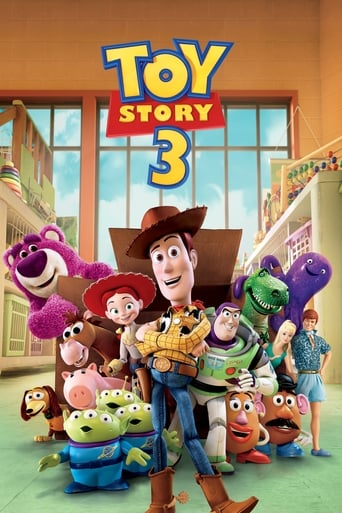
Toy Story 3
2010 · Film · 103 min
Part of Toy Story Collection
Directed by Lee Unkrich
Woody, Buzz, and the rest of Andy's toys haven't been played with in years. With Andy about to go to college, the gang find themselves accidentally left at a nefarious day care center. The toys must band together to escape and return home to Andy.
23 positive6 negative1 mixed13 neutralfrom 43 commenters
Where to watch
No streaming data for this title.
50 comments on Hacker News
I wholeheartedly disagree. Pixar does not have a monopoly on attention to detail. They're flush with cash and their leadership has decent taste.
There are so many creators putting in intense work, and doing it on low budgets. You can't claim these folks don't have attention to detail. Check out A24, low and mid and low budget films, or independent films and you'll see a wide assortment of highly meticulous storytellers.
Pixar, on the other hand, isn't low or mid budget:
Toy Story - $30 Million A Bug’s Life - $120 Million Toy Story 2 - $90 Million Monsters, Inc. - $115 Million Finding Nemo - $94 Million The Incredibles - $92 Million Cars - $120 Million Ratatouille - $150 Million WALL-E - $180 Million Up - $175 Million Toy Story 3 - $200 Million Cars 2 - $200 Million Brave - $185 Million Monsters University - $200 Million Inside Out - $175 Million The Good Dinosaur - $200 Million Finding Dory - $200 Million Cars 3 - $175 Million Coco - $175 Million Incredibles 2 - $200 Million Toy Story 4 - $200 Million Onward - $175 Million Soul - $150 Million Luca - Unknown but probably around $150 Million Turning Red - $175 Million Lightyear - $200 Million For that amount of money, they had better pay attention to detail.
Miyazaki is doing way more with much less.
Voices of a Distant Star was one person -- Shinkai. That's the kind of thing we'll see more and more of. Small creators reaching audiences and building studios. Gooseworx, psychicpebbles, Vivienne Medrano. That's the algorithm of tomorrow.
AI, as a tool, makes this more possible. One of the first people to do it successfully was Joel Haver, and he's just the first of many to come.
Pixar badly lost its edge by getting complacent.
Somewhere after cars, 3D animation competition started breaking past pixar’s moat that no one else could make a 3D movie look quite as good, and somewhere after Toy Story 3, it became clear that competition had broken past pixar’s moat that no one could tell equally compelling narrative stories. Since then, Disney’s in-house team, Dreamworks, and other major productions have soundly eaten their lunch.
Pixar needs to return to its bread and butter story-telling, trying to focus on being a toy-peddler has ruined them.
I saw Toy Story 3 with a group of longtime friends when it came out in the summer between high school and college. Definitely some wet eyes in the group during those final scenes. I don't think I could have chosen a more appropriate time for that movie if I tried.
IMO, Toy Story 3 was a perfect movie for the people who saw Toy Story 1 as a child and were now young adults, having recently left home and moved away. The heart of that movie is in the parents having to let Andy go. They tell the story through the Toys, but flip it over to the parents in a few small scenes.
I've never been so compelled to call my parents than after watching Toy Story 3.
After 2006 they were still knocking out an extremely high rate of absolutely impressive films:
Wall-E -- if you don't love this film you are possibly dead inside. It's not only absolutely beautiful and emotionally communicative, it's a deeply clever pastiche.
Up, as observed below.
Toy Story 3 came out after Up. And it is a work of acutely well-observed cinema. A staggeringly good film that should have won the Best Picture Oscar. [0]
Brave (2012) is critically neglected, too -- that is a beautiful, subtle, yes quite elusive film, despite what the article says.
And then there are films I have not seen yet but I am told are clever, inventive and beautiful -- Coco, Inside Out, Soul.
They are by any measure still a masterpiece factory. This article is lazy, toxic and cynical.
[0] edit: when I say this, I say it in the sense that surely everyone knows now that E.T. the Extra-Terrestrial should have won Best Picture, not Gandhi. Even Richard Attenborough thought this.
It used to be that Pixar films regularly got past $1B in revenue.
Most Pixar films don't actually get anywhere close to $1 billion; they tend to reach the $500-600m range worldwide. Only a handful of Pixar's films have breached the $1b threshold: Finding Dory, Toy Story 3 and 4, and Incredibles 2.
Turning Red earned $20m in countries like Poland, the UAE, and Vietnam...i.e., tiny markets, and only for 2 weeks, due to COVID. It was not released theatrically in major markets, but based on comparables to pre-COVID releases, if it had been released theatrically in major markets, it would be looking at over $600m in box office revenue, and online viewership numbers suggest it might have made close to a billion at the box office.
Soul, likewise, was primarily a Disney+ release (it wasn't released theatrically in the U.S.), and $120m in box office gross for a 2020 release is...amazing...considering that 99% of theaters were closed that year.
Onward was released right before the Spring 2022 COVID outbreak, and would have done much better if theaters hadn't closed 2 weeks after it released (though probably not much more than $4xx million worldwide based on tracking, so still underperforming but not a flop).
Lightyear was objectively bad. The story was too convoluted for children, too simplistic for adults, the characters were generic and forgettable, and nothing in the movie suggested it had anything to do with Buzz Lightyear as it was presented in Toy Story except for the name "Lightyear." Preview audiences were so confused about the movie's relationship to Toy Story that Disney had to add a blurb at the beginning claiming that this was Andy's favorite movie (but in the original Toy Story, Buzz Lightyear was an animated show with a movie, a la South Park, not a standalone movie). Lightyear should have been planned, produced, and released as a Disney+ film.
Yup. Even if you only look within a relatively small category of films one per year can miss a bunch. For example, consider the category of animated feature length films released after 2000 in the US, and pick one per year by picking the winner of the Academy Award for Best Animated Feature.
In 2001 you'd miss Monsters, Inc. because of Shrek.
In 2002 you'd miss Lilo & Stitch because of Spirited Away.
In 2004 you'd miss Shrek 2 because of The Incredibles.
In 2005 you'd miss Howl's Moving Castle and Corpse Bride because of Wallace & Gromit: The Curse of the Were-Rabbit.
In 2008, no Kung Fu Panda because of WALL-E.
In 2009, no Coraline or Fantastic Mr. Fox because of Up.
In 2010 you'd miss How to Train Your Dragon because of Toy Story 3.
In 2011 no Kung Fu Panda 2 because of Rango.
In 2012 no Frankenweenie, ParaNorman, The Pirates! Band of Misfits, or Wreck-it Ralph because of Brave.
In 2014 no How to Train Your Dragon 2 because of Big Hero 6.
2015 no Shaun the Sheep Movie because of Inside Out.
2016 you miss Kubo and the Two Strings and Moana because of Zootopia.
2019 No How to Train Your Dragon: The Hidden World because of Toy Story 4.
2021 you'd miss Raya and the Last Dragon and Luca because of Encanto.
Most of the winners are good...but if you just put all the above mentioned films in a pool and asked most people to pick their top 14, most would have a lot of films on their list that were not among the winners of the aforementioned years.
It's a thing in the nicer parts of India too, but I agree. I remember going to NYC when it was quite hot and seeing Toy Story 3. The cinema was so cold, each seat had a huge AC blasting on it at an arctic temperature. I'm not sure what the intention is. It does seem to me, as you say, that the greatest desire of americans is to live in the southern hemisphere, whether unconsciously or consciously. My guess? Americans have a strong erotic lust for both power and the subversion of nature, so it is almost sexually arousing to demonstrate enough power, even unnecessarily, to totally reverse the seasons. See also: guns, massive cars with 10 cup holders, huge interstate roads with 5 lanes in each direction, extremely consumer-engineered foods, etc.
>transformed from these simple ideas into great films (lots of iteration, lots of early prototyping and feedback, etc.)
I don't doubt there's lots of feedback on details, but I have doubts about how much story arcs might change, or how "rough" the originating ideas are, especially after realizing that "Toy Story 3" is just (imho a lessor version of) "The Brave Little Toaster" as fed through the "Pixar Process".
It's toys instead of appliances, an attic instead of a cabin, being repurposed at a daycare instead of a repair shop, and an incinerator instead of a compactor, but the pixar process didn't change the overall story at all.
(The idea was originally Lasseter's, but to oversimplify, he basically lost the rights and others ended up making TBLT, while he eventually got to do TS3.)
Maybe other movies saw more changes going through the process, but the only example we have to actually compare didn't.
They might be the best action movies, but I don't consider them the best Bond movies, bc they're so different than every other Bond movie. They're a different genre all together.
It's not that I don't like them, or even like them any less in general; I just have a hard time considering them to be Bond movies at all. They're so serious, even when being sarcastic and dry. They're not fun, and not something I probably would have been excited to binge watch as a kid, as the other ones are/were. I try hard to convince myself this is just temporal bias, but I'm less convinced the more I think about it.
And I still can't wrap my head around the fact that Goldeneye and Casino were directed by the same person.
I say this as someone who has 4 different actors in my top 5 Bond movie list, and none are Craig. So probably not a popular opinion- but also as someone who's never read any of the books, but seen every movie multiple times.
Then again, I also consider Brave Little Toaster to be a better version of Toy Story 3, for almost opposite reasons, while I still consider TS3 to be objectively the best Pixar-formula movie made. (Unless counting the first 10 mins of Up as it's own entity.)
That's great! I'll be sharing that site with my homestay family, who have kids aged 6 and 9. On Monday this week I asked the older one to read a Wikipedia list of Disney films and Dreamworks Animation movies and here's the list she made, which you can compare with the ones on your site:
Alice in Wonderland; Toy Story 3; Incredibles; Pinocchio; Lion King; The Tale of Despereaux; Winnie the Pooh; Maleficent; Cinderella; Frozen; Frozen II; Moana; The Santa Clause; Coco; Pirates of the Caribbean; The Princess and the Frog; Brave 2012; Beauty and the Beast; Born in China; The Boss Baby; Abominable; Trolls World Tour; Gift of the Night Fury; Shrek (all); The Grinch; Book of Dragons; Kung Fu Panda; Puss in Boots; Dawn of the Dragon Racers; Marooned ; Prince of Egypt; Peter Rabbit; Aladdin 1992; Aladdin 2019; Shark Tale; Wallace and Gromit; Chicken Run; Bee Movie; Turbo 2013; Home 2015; Captain Underpants; Tangled 2010; Harry Potter; Despicable Me; Despicable Me 2; Minions; The Secret Life of Pets; The Little Ghost; Waking Sleeping Beauty; Cleopatra in Space; My Neighbour Totoro
Monster's University was not the first Pixar movie to use global illumination, but it was the first Pixar movie that used path tracing (combined with rasterization for the primary visibility). Earlier movies such as Up and Toy Story 3 used Point Based Global Illumination.
Interestingly, of the Toy Story series, Toy Story 3[1] is considered by many to be the best of them (and one of the best Pixar movies overall as well). Sequels can be done well, even if they often aren't.
1: Just thinking about the ending now is making me tear up a little. I think the older you are, the more aspects of your life it will likely relate to.
Not really, neither Up nor Toy Story 3 did it for me as movies (a very unpopular opinion I know). I choke up watching a movie or TV show from time to time, maybe more than I'd like to admit, but I don't share the popular opinion about those two movies.
Toy Story 3 for me since the summer I saw it for the first time was the summer before my freshman year of college and consequently moving out.
I had some tears that time. Occasionally movies make me feel emotion, but not quite to tearing level.
I'm not sure how I would classify Toy Story 3 under any recycled "kids movie" plots. The ending (the real ending, not the climax, as described in the article) is one of the most poignant moments in film I can recall. Similarly, Wall-E does a good job illustrating the human need for companionship. And the need for purpose within our lives. And at the very shallowest and most obvious level, over-consumption. Pixar often makes very "smart" animated movies, and they generally work at quite a few levels, in my opinion.
> Especially considering as kids movies they cannot explore adult topics and will always be fairly limited in scope.
I disagree. I've seen many masterful "childrens" movies that have done masterful jobs at exploring adult concepts, as long as by "adult" you don't just mean sexuality. While childrens' movies may be constrained on some axis, they are often freer on others. Additionally, there is the chance to speak to people that wouldn't normally go to a movie about some of these adult messages, or to reach them when they aren't expecting it and are less cynical. Who goes to see an animated film about a family of super heroes to see a touching rendition of mid-life crisis?
Their movies are great as a computer person and moviegoer, since each usually contains at least one "wow, that must be really hard with computers" moment. Like the fur simulation in Monsters, Inc. or the crowd physics(ish) simulation in WALL-E, or Merida's hair as you mention. Not to mention the incredible render quality progression from Toy Story to Toy Story 3.
I recommend.
https://en.wikipedia.org/wiki/Animal_Farm
https://en.wikipedia.org/wiki/Propaganda_%28book%29
Btw in Lost why did sayd was nice guy in the beginning and died as an evil torturer ? And why does every action series and movies, event toy story 3 promotes torture ?
> I agree (for now), but i'm not sure this would be a bad thing. You might not be able to make Transformers 3, but you could make most (all?) of Hitchcock's movies.
In addition to "Transformers 3", we also might not have:
WALL-E: $180 million
Toy Story 3: $200 million
Up: $175 million
How to Train Your Dragon: $165 million
Could these same stories be told more cheaply? Sure...but I think they would have just been good stories then, not masterpieces.
Playings devil's advocate: There are many ways to incentivise even complex, large scale investment absent copyright. From project finance to Kickstarter, it is well beyond self-evident. On the flip-side, the cost of supressing academic and sciendific knowledge through academic publishers dwarfs whatever entertainment value might come from their library (~12 films)[1]. I think your comments on this are too simplistic.
________
[1] Toy Story, Toy Story 2, Toy Story 3; Monsters, Inc.; Finding Nemo; The Incredibles; Ratatouille; WALL-E; Brave; A Bug's Life; Cars, Cars 2
Although not an Apple fan, I can relate to their purchasing behaviour through an analogy of my own:
I am a massive Pixar fan. I think almost everything they touch turns to gold and I haven't seen a Pixar movie that I dont' like (to be fair, the last new release I saw was Toy Story 3). When I saw the ad for WALL-E, I thought it sounded like a stupid idea for a movie, but I still forked out the $10 to go see it at the cinema. This decision was purely on their past record, nothing to do with my perception of WALL-E. Sure enough, I loved it.
Perhaps this is a similar way Apple fans make decisions.
While I will grant that Tim Burton can be clever I have never seen anything of his that carries the same emotional weight of Pixar's best works. Toy Story 3 was an amazing success and pulled off being a very emotional film while being a comedy/adventure. I know many people who cried or nearly cried toward the end who are parents with kids leaving their childhood behind. The first several minutes of UP are amazingly melancholy. The "dance" in space from Wall-E is downright beautiful and Wall-E's devotion to the girl robot when she is broken is rather heartwarming.
Incidentally according to BoxOffice Mojo Wall-E made 521 Million dollars.
Inception was hardly a 'risky' movie, plenty of explosions, cool visuals, and a simple but slightly ambiguous plot. Think of the way 'total recall' ends, is this just the vacation he had paid for? If you think about it they are fairly similar movies, and fairly well liked. If anything, I think suggests that a good movie can also have mass appeal.
WALL-E lacks dialog for 1/2 the movie, but because Pixar could test it out ahead of time they knew it was worth making vary early in the process. Pixar's string of hits has a lot to do with constant refinement and feedback. Saying Hollywood needs to put out more Toy Story 3's is not a terrible thing when their done well. There is something to be said for the old script + 6 weeks of frantic shooting + cutting room floor style of movies, but it's a style that showed up when film was expensive and budgets where tight.
> Pixar didn't enjoy iPhone-like profitability.
Personally, I'd say Pixar seems to be the Apple of the movie industry. A few products, done right, and hugely profitable:
> As of February 2012, its films have made over $7 billion worldwide, with its $602 million average gross by far the highest of any studio in the industry. In addition all the films produced by Pixar are among the fifty highest grossing animated films of all time, with Finding Nemo (#26), Up (#43) and Toy Story 3 (#7) all in the top 50 list of highest-grossing films of all time. - http://en.wikipedia.org/wiki/Pixar
> My point is that (1) no, they really can't product another iPhone-like hit (that's a once-a-generation thing)
They've already put out three in a generation - iPod, iPhone, and iPad. Lumping those three distinct systems into one is intellectually dishonest.
I agree. I only posted to comment on the idea that somehow kids these days have gotten worse compared to older generations. The original post mis-attributes the kids getting bored to shorter attention spans, rather than lower quality films.
Take for example
Snow White and the Seven Dwarves (1937): 84 minutes Bambi (1942) runtime: 70 minutes Toy Story 3 (2010): 103 minutes
The "kids these days" myth has existed since the dawn of language. People grow up and do not understand they have changed, not the children.
http://en.wikipedia.org/wiki/List_of_Disney_theatrical_feature_films
http://www.disneymovieslist.com/disney-movies.asp
> Do people think companies really behave this way?
An interesting anecdote from the Steve Jobs biography:
Finding Nemo had just been released to critical acclaim and Pixar were in renegotiation talks about their deal with Disney.
(Disney's) Michael Eisner had one powerful trump card. Even if Pixar didn't renew, Disney had the right to make sequels of Toy Story and the other movies Pixar had made, and it owned all the characters from Woody to Nemo. Eisner was already planning -- or threatening -- to have Disney's own animation studio do a Toy Story 3, which Pixar had declined to do.
The threat had teeth not because Pixar would lose control of some of their characters, but because Disney's animation studio had been releasing flop after flop. After ten years of The Lion King, Beauty and the Beast, and Aladdin, there were ten years of rubbish. As a company, Disney had been creatively brain-dead for a decade.
(Pixar's) John Lasseter was aghast at the prospect of breaking up with Disney. "I was worried about my children, what they would do with the characters we'd created," he recalled. "It's like you have these dear children and you have to give them up to be adopted by convicted child molesters."
Effectively, Disney's negotiation tactic was "re-sign with us, or else we'll spin up a shitty division to make shitty sequels of your movies!"
http://en.wikipedia.org/wiki/Circle_7_Animation
http://en.wikipedia.org/wiki/Toy_Story_3#Production
I worked at Pixar from 2000-2010 and I can tell you that a really good director definitely earns his/her salary. A good director can mean the difference between a bad, overbudget film and an on-budget success. You're going to have a lot harder time cutting costs than you might think too. Salaries dominate the budget of films like Avatar and Toy Story 3 and the kind of talent it takes to make those films can't currently be had for less. Maybe you don't care if films like that disappear from the market but you should at least acknowledge that is what will happen if DVD and ticket sales continue to slide. None of the alternatives currently on the table compare.
I'm a big fan of Netflix but that means that Netflix grosses less in one month than it costs to make one movie like Toy Story 3.
If you think Netflix selection is bad, try the Hulu movie selection. If you want movies from the 1930s-1950s, they've got you covered. I have not yet found even one movie they have that is of the calibre of Toy Story 3, which Netflix has right now through Starz. I believe Hulu is pursuing a strategy whereby they can say with a straight face that they've got "thousands of movies", but they really hardly have any.
We've been trying Hulu Plus with a free month trial and we will not be signing up. It's pathetic next to Netflix and it plays commercials. If you aren't an 18-24 year old preferably-male, Hulu is barren, and frankly you've got poor coverage even then.
Toy Story 3 is in there twice, with ratings 34 and 143.
On another note, it's amazing seeing all the movies in here which aren't available in Canada.
I remember seeing it in the theater w/ family and my (then) four year-old niece saying "this movie is really sad". The first 20 minutes are about how the old man lost his best friend and wife and is left all alone.
It wasn't sad in the same sense that Toy Story 3 was sad, because I don't think little kids can really relate to Toy Story 3 story like adults can. Kids could realize, at least on some level, the loss felt by the old guy in Up.
That's not really true. Toy Story 3 was the highest-grossing film of 2010... so there has to be a segment that would be interested in live-action movies. :)
Basically, Top Gear is popular because it isn't all those other car shows. It's mainstream by popularity, but it's not mainstream in terms of typical car enthusiasts.
You hear this every year. And it's still true. Hollywood is wall-to-wall sequels, IP translations (games, comics, tv shows, etc. to movies), remakes, and the remake's newer cousin the "reboot".
Yet even so good films are still being made. The Social Network, True Grit (a remake even!), Toy Story 3 (a sequel!), The Fighter, Black Swan, How to Train Your Dragon, and Inception were all great films from 2010 (I haven't seen The King's Speech or 127 Hours yet but I hear those were good too). If this is what the system pumps out while it's horribly broken, I'm ok with more of the same.
There's always going to be a ready supply of churned out pap in any medium. Just go to a bookstore and look at all the crap that they keep pumping out. But that doesn't necessarily stop truly excellent works being published as well. Some of my most loved books have been published in the last several years. And with the internet it's easier than ever to sift through the dross to find the gems.
>But according to the graph, Toy Story 3 was the least polarizing movie of 2010 and that seems like a prime example of a movie "safely" manufactured for an existing fanbase.
I think this is likely due to that fact that Toy Story 3 was superior to Toy Story 2, leaving people pleasantly surprised.
(It is actually unexpectedly complex. The first scene features the toys calmly discussing and preparing for their own deaths. It's quite stark.)
> The key, we think, is to look for movies that some love and some hate, which is the likely profile of a bad movie that's "safely" manufactured for an existing fanbase.
But according to the graph, Toy Story 3 was the least polarizing movie of 2010 and that seems like a prime example of a movie "safely" manufactured for an existing fanbase.
I really worried they'd lost the plot after Wall-e and Up! (The 2 worst releases imho). So Toy Story 3 was great to see.
Story outlines usually sound rubbish IMHO. So I'll give cars 2 the benefit of the doubt. Glad there's a new movie with characters my kids love in it.
Wall-e and Up! catered mainly to parents/intellectuals so it's nice to see some good fun movies in the pipeline.
That concern would be valid if Toy Story 3 wasn't the 2nd best Pixar movie ever (in my opinion, a hair behind Ratatouille)
<b>but the films that make the most money are rarely bad. The highest grossing films of the last three years have been Avatar, The Dark Knight, and Toy Story 3</b>
Which, even if praised by whoring critics, are all quite bad , formulaic, shit.
They aren't gonna be near (random selection of quality stuff): Citizen Kane, On the Waterfront, Arsenic and Old Lace, Apocalypse Now, 2001: A Space Odyssey, Vertigo et al in any cinephiles list...
A lot of bad sequels make orders of magnitude more money than critically acclaimed films, but the films that make the most money are rarely bad. The highest grossing films of the last three years have been Avatar, The Dark Knight, and Toy Story 3, which were all critical darlings to various degrees. People really want great movies but are willing to settle for mediocre ones that have some of the things they're looking for (e.g., exceptional visuals, or characters in which they're already invested).
This is an article bashing Ebert and siding with contrarian "intellectual" film critic Armond White. Here's what Armond White wrote of Toy Story 3:
"But Toy Story 3 is so besotted with brand names and product-placement that it stops being about the innocent pleasures of imagination—the usefulness of toys—and strictly celebrates consumerism."
Let's pick apart his argument. I'm guessing that for White a movie in which children grapple with adolescence and sentimental value over their childhood belongings is celebrating consumerism. In my book celebrating consumerism would be a movie about a child not being able to decide what new toy to buy at Toys R' Us. Consumerism, at its worst, is about companies convincing you that your old stuff isn't good anymore and to forget it and to buy the new stuff. Toy Story is about just the opposite. But you wouldn't think that right away for the seductive allure of agreeing that a popular movie "celebrates consumerism."
My point is that Armond White takes big words, in the tradition of French literary and film criticism, drops them in to troll and get attention, and then sheepishly backs off when you try to scrutinize what he says. This is the same school that brought you "the author is dead" and "writing precedes speech." There's nothing for White to defend here. His way of doing criticism is a house of cards.
Hey, "Scott Pilgrim" isn't actually out yet; let's not herald it as a year-saving success yet, no matter how good the trailers look.
Besides, correct me if I'm wrong, but whereas Toy Story 3 has broad appeal, Scott Pilgrim looks more like something destined to be a cult classic. A lot of "bad movie years" generate a fair crop of movies with cult appeal, we still call them bad movie years by most standards.
I can't speak for true film buffs--I like the "mindless" Hollywood junk... but only when it's not mindless and not junk, if you get my drift. This year has been absolutely terrible. Months of mediocrity punctuated by the occasional standout. Other than Inception and Toy Story 3, there haven't been any great blockbusters. Oh yeah, How to Train Your Dragon. Almost everything else has been a wait-for-DVD. If that.
Of course opinions are subjective. So let's agree to disagree. :-)
I beg to differ. Some really, really bad movies this year, but there are some real gems.
1) How to Train Your Dragon (it's just magical for some weird reason)
2) Inception (finally something new)
3) Toy Story 3 (don't need to explain)
A year with Toy Story 3 and Scott Pilgrim (directed by Edgar Wright) can’t be bad.
Hollywood has always produced those movies that make me queasy – over the top visuals, artificial sound, mindless story. The solution to the problem is to just not watch them.
Do you mind if I side-track a little and ask people's opinion of 3D in general?
I've seen two movies in 3D in the past year - Avatar and Toy Story 3. While Avatar was fun, and Toy Story 3 exception, I didn't feel that the 3D really added much to the experience. In particular, the colour for Toy Story 3 seemed dimmer than normal. I also where glasses, so I sometimes had reflections obscuring the picture.
I understand that 3D is being hyped as the next big thing to get after a big flatscreen TV, so I'd be interested to hear what people here think of it.
My advice for haters of 3D: try seeing Toy Story 3 in 3D. It was made for 3D and it doesn't use any of the usual cheap tricks associated with 3D (aka the cliche throwing things at the audience). It mostly just seemed to really enhance the depth of the picture and make it slightly more immersive. I agree that 3D is still mostly a gimmick now, but I think it will eventually be used mostly as a way to make the viewer feel like they're actually there, rather than for the spectacle. Think of it this way: we didn't need color movies, but they tend to look nicer (unless of course you just prefer that old timey look).
Having just come out of this movie a few hours ago, I feel confident in saying that this is the most completely stupid, half-ass analysis Toy Story 3 you're likely to read.
While you could reasonable make some political and economic analogies about the conditions at Sunnydale, Andy's toys relationship to Andy isn't a feudal master slave relationship, it's a family relationship. The most WTF part is claiming that Bonnies house is a "mixed economy". It's not. It's another family. A new version of what the toys had years ago with Andy.
I think it may be Pixars influence... Up! and Wall-e were both pretty adult intellectual movies (yawn).
Hopefully Toy Story 3 has something for the kids as well (Haven't seen it yet).
I haven't seen the movie, but given the history of Pixar and Toy Story, I think there's a good chance Toy Story 3 will be good: http://news.ycombinator.com/item?id=1334660
Have you seen Toy Story 2? It is actually a decent movie. It was originally slated to be a typical Disney direct-to-video sequel. But the Pixar guys didn't want to do substandard work, so they worked hard on the preproduction and managed to convince the Disney execs that it was worthy of a theatrical release.
Four years later, the story repeats itself: Disney's five-movie partnership with Pixar ends and Disney owns all the movie characters, so they decide to make a direct-to-video Toy Story 3 with their in-house studios. Then Eisner leaves, Disney buys Pixar, the Pixar guys are put in charge of Disney Animation Studios, and Toy Story 3 gets shelved so that it can be redone from scratch as a theatrical release by Pixar. Given the history, I expect that it, too, will be a decent film.