 Hacker Cinema
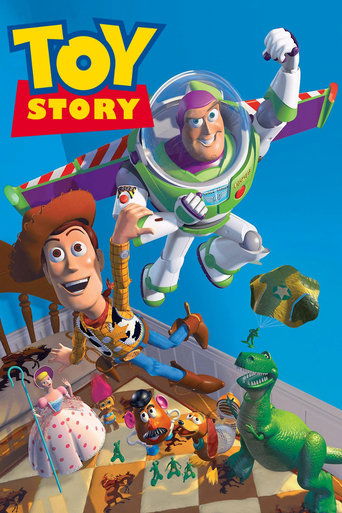
Toy Story
1995 · Film · 81 min
Part of Toy Story Collection
Directed by John Lasseter
FamilyComedyAnimationAdventure
Led by Woody, Andy's toys live happily in his room until Andy's birthday brings Buzz Lightyear onto the scene. Afraid of losing his place in Andy's heart, Woody plots against Buzz. But when circumstances separate Buzz and Woody from their owner, the duo eventually learns to put aside their differences.
40 positive9 negative150 neutralfrom 199 commenters
Where to watch
No streaming data for this title.
217 comments on Hacker News
Rents are just amounts beyond what's needed to cause the thing to exist. At the point of copying something, it already exists.
So payments for the right to do so aren't payments required to bring anything new into existence at that point, save for the legal fiction.
Now you might argue that the future copy-licencing rents are necessary to bring the _original_ creation into being. But that doesn't make them _not rents_.
But I would say that's the second assumption you're baking in here.
As in, we live in a world where e.g. the movie Toy Story exists. Now, certainly Toy Story does provide some good or value to the world. But I don't think you can assume such things provide more value than e.g. open science, free transformation of works, etc.
I get that people enjoy our current IP culture but saying certain things wouldn't exist in an IP-free world is just an argument from consequences that doesn't even really compare consequences between the two.
There have been a few movies that each revolutionised CGI in their own way. The Last Starfighter, flight of the navigator, tron, jurassic park, toy story, Terminator 2
Nintendo does family-friendly games. Which have their place.
However if for example movie industry had its crisis, and someone were to point out how Pixar is doing great, and latest Toy Story is a big hit (it is btw), I'd say "And what if I want to watch anything that is not a family-friendly movie?".
Could Nintendo ever make Baldur's Gate 3? Not in a million years. Doesn't fall into children-friendly bucket and so would completely run against Nintendo brand image.
As schools are off and Toy Story 5 is just around the corner, we started binge-watching Toy Story from 1 to 4. While watching, suddenly this idea popped up: what if a GitHub repo came alive just like the toys? I started writing with something basic and enhanced it using Gemini Flash. Hope you’ll like it.
That show is basically a national treasure in Germany today, so you'll find lots of references to it.
There also used to be a more ecology-centered show with a similar idea, Löwenzahn. It had the gimmick that after the end credits, the main character would directly address the viewers and tell them to turn the TV off NOW.
I'd at expect at least the same from that Toy Story movie.
Did you forget Pixar? Jobs transformed the company with his extremely bold bet on Toy Story. They were doomed to obscurity without this big bet and now all children's movies are made this way.
All complicated commercial art (movies, series, games, music, designed spaces...) has its budget as a key constraint of what is built. You don't get a new season of an anime that looks 4 times better because of a random genius: Someone evaluates the money it will make, and somehow decides that increasing the animation budget will be worthwhile. It was the same when it was animated by hand, with huge cameras and cels, than in modern digital-first animation, and whether it's using plain hand-ish drawn 2d, or using 3d models for some shots. The art is tied to the budget, and maybe the next season the budget is 2/3rds of what it was before, and the technical quality drops (see One Punch Man, Blue Lock and such)
So when an artist looks at AI, it's unlikely to be as a tool that will build a whole piece: Insufficient control, and currently nowhere near good enough to do more than occupy space, like a little painting in a hallway or in a hotel room. But it is something that can be used to better spend the budget in places where it'll be more impactful for the quality of the piece. Not unlike how CGI is often used today in places where it wouldn't have been 20 years ago, and it's aiming to be invisible. Not because the shot was impossible, but because it's cheaper.
Treating AI in art as a moral thing will end up being like the people being against synthesizers in the 80s: It's a viable creative choice for some things, but ultimately not a good expectation for industry direction. Ultimately the vast majority of art is commercial, and we'll see shortcuts being taken for budgetary reasons. Nobody is manually animating every detail of every mesh in a game like this was Toy Story. And even though doing that would produce more work for artists, it wouldn't make better games, really. And we'd sure have far fewer of them.
Well, is Pixar’s Toy Story a work of art? Or what about Julia set renderings, where people make choices about the colors? ;)
Tongue-in-cheek aside, I do think I agree with you in that (1) art, as perceived by us human meatbags, is art because of the human element of it (if not in creation, then in perception), and that (2) AI absent explicit steering trends towards a rather bland medium.
But there’s art in everything from the blurry, out of focus, disposable film cameras, to a 5-year-old’s crayon scribble scrabbles, to the neon glitter themes we used to copy-paste over our geocities and xanga pages, and as frustrating as it is to our own sensibilities, an AI prompt “draw a pink elephant” isn’t all that different.
"She advised film-makers to focus on character and emotion[...] So evident is Pixar’s formula that it has inspired an internet meme: “What if toys had feelings? What if fish had feelings? WHAT IF FEELINGS HAD FEELINGS?” [...] Film franchises tap into nostalgia, too. “Toy Story 5” will be watched by more than a few adults who saw “Toy Story” as youngsters 31 years ago."
Reminds me very much of Roger Scruton's diagnosis that our popular culture is defined by kitsch (which in turn is defined by sentimentality), echoing Wilde that the big problem of the latter is that it wants to have an emotion without paying for it, gratification on the cheap.
And I think animation is particularly ripe for nostalgia, just like gaming because effectively it never ages. The Scrubs reboot is an interesting case because just watching the first episode I think you can actually see Scruton's point, there's something immediately off about seeing the same jokes and characters played out by people well into their 50s in a painfully way too HD recreated set.
Few franchises that span generations?
The entire current zeitgeist of popular media is about zombifying your parent's IP. It's Nintendo's entire business in fact. Sure, usually they are doing good work with that IP, but they are the outlier in the industry. Everyone else is shitting out remakes of what your daddy played that don't even understand the original material, or like Halo, remakes of what your daddy played which was already a mediocre remake.
Halo 1 came out the month after 9/11. It's old enough to have graduated college and started a family. It will be resold soon.
Jurassic Park was dug up out of the grave to crap out several more movies. Star Wars is inflating a couple good plot lines into an entire Universe of "Content". Even reality shows are made up of people who were contestants on older reality shows. Pixar is making yet another Toy Story.
Aliens is still going, long after it's reanimated corpse was overplayed.
One of the premier television series, that just finished, was all about nostalgia for living in the 80s, with some silly plot tacked on that apparently even the writers didn't care about.
Even our propaganda, like Top Gun, is basically the same script as an 80s movie with minimal changes.
It feels like the entire media ecosystem is designed around reselling content to my parent's generation before they finally kick the bucket or satisfying the nostalgia of that generation's early children. Even the President's administration bitches about things like the 90s USDA food pyramid that only affected that 13ish year segment of the population and was deprecated, twice, since then. Our authoritarianism is nostalgia based, for the time that generation was children, and things were "Simple" and "Good", because they were children and got to live the lives of kids.
Is that true though? Most quality animated features included quality animation. The visuals of the beautifully hand painted early Disney movies were part of the art form. Toy story looks basic to us now but it being the first totally computer animated movie and the visual style that came with that was part of it. Movies are a visual medium, so I guess saying that the visual part of the movie doesn't matter much to you is like saying that the words a writer uses doesn't matter much to your enjoyment of a book.
Pixar was bought by Disney years after it was already a movie powerhouse. Toy Story was released in 1995; Disney acquired Pixar in 2006.
I think you're ill-informed. The Pixar movies were re-rendered completely. They did not take a 35mm negative, or an old file, to transfer it. Pixar has the ability to load the Toy Story project files, and use the current version of RenderMan to make a new final version. It's completely unique among the industry.
Same vein https://open.substack.com/pub/animationobsessive/p/the-toy-story-you-remember?r=3fcpe&utm_medium=ios
Pixar films were setup with the idea of being put on film so the DVD digital transfers color is all wrong.
In some cases, the artifacts of the medium can be desirable -- especially when consuming media that was created with those artifacts in mind.
Take a look at pixel art on CRTs vs LCDs [0] and Toy Story on film vs. digital [1].
[0]: https://wackoid.com/game/10-pictures-that-show-why-crt-tvs-are-better-for-gaming/
[1]: https://animationobsessive.substack.com/p/the-toy-story-you-remember
> is also dependent on the film printer
The printers deffo make a difference to colour, but I came from VFX world where we put a macbeth chart in for each shot so we could adjust the colour afterwards. (https://en.wikipedia.org/wiki/ColorChecker) We'd have a whole team working on making sure that colour was accurate.
The scanners we used (northlight) were calibrated a lot so my understanding is that if you scanned the same film twice it was meant to be pixel perfect (We did rescans for various reasons and it supposedly matched up enough to do effects work. but that might have been proxies, ie low resolution scans that were done for speed)
Also the printers should, if they are good match it properly, thats what you're paying them for. I know that we did have a person that calibrated film projectors for colour, but I never asked them _how_ they did it.
For toy story its a bit harder because you are digitising a whole finished movie, you don't have the colour chart in every shot to keep the colour consistent. I know for adverts the telecine people did loads of fiddling to make the colour consistent, but I assumed that was because the spirit 4k was a bit shit.
I never dealt with actual finished prints, because the colourist/DI people sent the finished graded off to someone like Deluxe to print out
Hmmm. I saw the first three toy story; the fourth one I never saw, even though people said it is not bad, but to me Toy Story was over with the third one.
Now, while I liked the first three, the first one always has a special place, because at the time it was really quite new-ish. Fully computer animated movies were quite rare. Pixar did several short videos before Toy Story, and I think there were some other movies too, give or take, but Toy Story kind of changed everything past that. Unfortunately many other computer-generated movies are absolute garbage nowadays. The big movie makers want money and don't care about anything else, so they ruin the interest of people who are not super-young anymore, because let's face it: older people are less likely to watch the latest marvel 3D animated zero-story movie that is a clone of prior clones.
It would be nice if AI, despite it also sucking to no ends, could allow us to produce 3D movies with little effort. I have a fantasy game world my local pen and paper RPG group built. Would be interesting to feed it a ton of data (we have generated all that already over decades) and come up with an interesting movie that relates the story of a part of this. This is just one example of many more. Quality-wise I still like Toy Story - I find it historically important, and it was also good at the respective time (all first three actually, although the storylines got progressively weaker; I did like Ken and Barbie though, but too much of the story seemed to go into wanting to milk out more money selling toys rather than telling a story. Tim Allen as Buzz Lightyear was always great though.)
It certainly should be possible but idk if its actually implemented; at the very least you should be able to implement it as a filter plugin for ffmpeg.
Some of the more advanced CRT shaders actually attempt to mathematically model how the video gets distorted by the CRT and even the component video. If the effects of converting to film are so well-understood that Pixar can adapt their film for the process then it out to be able to post-process the video in a way that reproduces those artifacts.
I don't think its possible for it ever to be exactly the same since the display technology of a monitor is fundamentally different from a film projector(or a CRT) but it should be possible to get it good enough that its indistinguishable from an photo of the film being displayed on a modern monitor (ie the colors aren't completely different like in the comparisons in the article.
BTW TFA didn't mention this but about 15 years ago they rerendered toy story and toy story 2 for a new theatrical run when those gimmicky 3d glasses were popular. If that's the version thats being distributed today on Disney plus and bluray (IDK but i feel like it probably is) then that could potentially be a more significant factor in ruining the color balance than not having been converted to film.
There is a solution for Toy Story specifically -- the Laserdisc version. If I'm not mistaken, the laserdisc was digitized from the 35mm print.
Toy Story is the only Pixar movie ever released on Laserdisc (along with all their shorts, in the same box set). Disney also released a lot of their 90s animation on Laserdisc.
So if you're a true cinephile, seek out the Laserdisc versions.
(Cough) Abstraction and separation of concerns.
In Toy Story's case, the digital master should have had "correct" colors, and the tweaking done in the transfer to film step. It's the responsibility of the transfer process to make sure that the colors are right.
Now, counter arguments could be that the animators needed to work with awareness of how film changes things; or that animators (in the hand-painted era) always had to adjust colors slightly.
---
I think the real issue is that Disney should know enough to tweak the colors of the digital releases to match what the artists intended.
This topic is fascinating to me. The Toy Story film workflow is a perfect illustration of intentional compensation: artists pushed greens in the digital master because 35 mm film would darken and desaturate them. The aim was never neon greens on screen, it was colour calibration for a later step. Only later, when digital masters were reused without the film stage, did those compensating choices start to look like creative ones.
I run into this same failure mode often. We introduce purposeful scaffolding in the workflow that isn’t meant to stand alone, but exists solely to ensure the final output behaves as intended. Months later, someone is pitching how we should “lean into the bold saturated greens,” not realising the topic only exists because we specifically wanted neutral greens in the final output. The scaffold becomes the building.
In our work this kind of nuance isn’t optional, it is the project. If we lose track of which decisions are compensations and which are targets, outcomes drift badly and quietly, and everything built after is optimised for the wrong goal.
I’d genuinely value advice on preventing this. Is there a good name or framework for this pattern? Something concise that distinguishes a process artefact from product intent, and helps teams course-correct early without sounding like a semantics debate?
> "Even so, it’s a little disquieting to think that Toy Story, the film that built our current world, is barely available in the form that wowed audiences of the ‘90s."
Load it up in DaVinci Resolve, knock the saturation and green curve down a bit, and boom, it looks like the film print.
Or you could slap a film-look LUT on, but you don't need to go that far.
I find a lot of the stuff I remember from decades ago looks worse now. Toy Story in particular I watched when I got a projector after I'd seen Toy Story 4 and it looked bad, almost to the point I wish I hadn't tarnished my memory of it. Similar things have happened with N64 games that I cherished when I was little.
I don't buy that it's a real degradation due to different presentation methods. I'm sorry, but no matter what film stock you lovingly transfer Toy Story to, it's never going to look like it does in your memory. Same with CRTs. Sure, it's a different look, but my memory still looks better.
It's like our memories get automatically upgraded when we see newer stuff. It's jarring to go back and realise it didn't actually look like that in the 90s. I think this is just the unfortunate truth of CGI. So far it hasn't reached the point of producing something timeless. I can watch a real film from the 80s and it will look just as "good" as one from today. Of course the colours will be different depending on the transfer, but what are we hoping for? To get the exact colours the director saw in his mind's eye? That kind of thing has never really interested me.
This is an interesting take when you look at the gas station Toy Story example and consider the night sky. In the digital version the stars are very washed out but in the film version the sky is dark and it's easy to appreciate the stars. Perhaps it's unrealistic when you realize the setting is beneath a gas station canopy with fluorescent lights, but that detail, along with some of the very distinct coloring, stuck out to me.
I'm not sure if I'm just young enough to be on the other side of this despite seeing all three of those Disney movies as a millennial kid (Lion King and Aladdin were VHS mainstays in my house, and I remember seeing Mulan in theaters), but I honestly don't find the film grain to look better at all and think all three of those bottom images are much more appealing. For the Toy Story ones, I think I'm mostly indifferent; I can see why some people might prefer the upper film images but don't really think I'd notice which one I was watching. I'd definitely think I'd notice the difference in the 2D animation though and would find the film grain extremely distracting.
"toy story film scan" on Kagi led me to a reddit page that may or may not contain links that might help you, but don't dawdle those links may not work forever.
Another one that's been hard to find is the 4k matrix original color grading release. Ping me if you have it! (Not the 1080p release)
in a computer graphics course i took, we looked through how popular film stories were tied to the technical achievements of that era. for example, toy story was an story born from the new found ability to render plastics effectively. similarly, the sora video seems to showcase a particular set of slow moving scenes (or when fast, disappearing into fluid water and clouds) which seem characteristic of this technology at the current moment in time
I think the author meant "mostly 2D animation" when they say "hand-drawn", in contrast to the fully 3D rendered movies such as Toy Story. They mentioned Suzume as a hand-drawn movie, even though it was a mix of 2D animation and 3D CG.
https://area.autodesk.jp/case/animation/suzume-no-tojimari/
Except American movies(and entertainment in general) haven't been good for about 10 years now, it's all slop based on established IP from 20-30 years ago.
When I was a kid growing up in the post communist 90-00s, we were going nearly weekly to the cinema to watch the latest American movies: Blade, Shrek, Toy Story, The Matrix trilogy, LotR trilogy, American Pie, Batman trilogy, Pirates of the Caribbean trilogy, Fast & Furious, X-Men, Spider-Man, Star Wars, Scary Movie, Rush Hour, etc
We couldn't get enough of US entertainment, while now everyone here avoids the new US releases like the plague since it's only cash grabs injected with $CURRENT_DAY identity politics, diversity box ticking based on focus group testing, resulting in sterile, predictable, zero-humor, zero-edge, zero-creativity slop that's not even worth pirating.
Americans have no idea how much soft power they lost worldwide by forcing their identity politics and ideologies in entertainment. Japanese anime and Koran movies and TV shows now run rings around the US entertainment industry.
There’s Toy Story 1-4 on there and Star Wars Force awakens, but for popular films it doesn’t have the incredibles, no Star Trek (perhaps include ii), few/no bond films (Casino Royale?), few Miyazakis (Nausicaa, Mononoke), not many Tarantinos (hateful 8), not too many Burtons (Batman 2, Big Fish, Sleepy Hollow). Is there any Indiana Jones? Could include Starship Troopers.
I have "Battle Royal" on CD so:
- I hate Fortnite for trivialising killing
- CD is damaged in one place, boo...
I also have "Matrix" and "Pulp Fiction" on DVD etc. but imagine this: you login to Netflix or HBO and there is no "Matrix" or PF to watch ! HOW idiotic and dumb by platforms owners... Maybe it is limited to other streaming platform because of ownership or something but putting it somewhere online is basic SANITY ! But no, _they_ do limit accesibility... I can't grasp that...
On top of that so many older films are not available ! Eg. where is Toy Story number 1 ?? I saw somewhere 2 or 3 but skipped becouse you need to keep order ;)
And when I log to streaming platform I have max 2 weeks or less of material to watch and then just thing to rewatch. But they want _monthly_ subscriptions ! Are they intentionally suicide their own platforms ??
So DVD is best thing after CD ;)
People would go watch original movies in theaters every weekend when tickets were $6 a pop. Now a night at the movies for a family can run into the hundreds of dollars. The cost of a disappointing showing is simply too high. The audience will only pay for Fast & Furious part 27 and Toy Story 16, and so that's what we are stuck with.
Just saying "Pixar movies" was probably not a great example. They can be deliberately location ambiguous (Monsters Inc., Toy Story - though it's clearly _somewhere_ in America, The Incredibles - a generic "metropolis"/50's futuristic city, lightyear, Elemental) or very specifically somewhere (cars - mashup of Route 66 towns, Finding Nemo - Sydney when on land, Ratatouille - Paris, etc...)
It makes sense to "translate" locale cultural indicators in say Wall·E which was very location agnostic but not so much for say Turning red which is very culturally specific.
Now that's a subject that can put a brain to work.
What is that movie/series/book all about? What does it mean? etc
The battery is a play on earlier Duracell ads. The bunny is also there. Which themselves play on the idea of the rabbit hole. It also interweaves with Toy Story from the same time period in a weird way.
It's funny how movies from the same rough period seem to be all similar underneath. Doesn't matter the studio, the director, the concept. All of it can be tied together.
It reminds me of the idea of the Gustav Gun. A giant slow ballistic trajectory launcher of projectiles on pre-laid railroads that can shoot stuff across the sea.
If the neighbor kid (Sidney "Sid" Phillips) from toy story appeared in a modern movie of a similar budge (not even inflation adjusted) people would comment about the bad CGI.
Toy Story was a good idea because attempts at depicting humans with CGI at the time had a very plastic look.
Because the thread was discussing CG becoming a commodity and Toy Story was the first thing that popped into mind for 90s CG; I have a vague recollection that it was the first feature-length full-CG film.
I only checked its production budget while writing my comment.
"The Terminator" and the first two "Toy Story" films are 'foreign, art-house shit'. Who knew?
I wholeheartedly disagree. Pixar does not have a monopoly on attention to detail. They're flush with cash and their leadership has decent taste.
There are so many creators putting in intense work, and doing it on low budgets. You can't claim these folks don't have attention to detail. Check out A24, low and mid and low budget films, or independent films and you'll see a wide assortment of highly meticulous storytellers.
Pixar, on the other hand, isn't low or mid budget:
Toy Story - $30 Million A Bug’s Life - $120 Million Toy Story 2 - $90 Million Monsters, Inc. - $115 Million Finding Nemo - $94 Million The Incredibles - $92 Million Cars - $120 Million Ratatouille - $150 Million WALL-E - $180 Million Up - $175 Million Toy Story 3 - $200 Million Cars 2 - $200 Million Brave - $185 Million Monsters University - $200 Million Inside Out - $175 Million The Good Dinosaur - $200 Million Finding Dory - $200 Million Cars 3 - $175 Million Coco - $175 Million Incredibles 2 - $200 Million Toy Story 4 - $200 Million Onward - $175 Million Soul - $150 Million Luca - Unknown but probably around $150 Million Turning Red - $175 Million Lightyear - $200 Million For that amount of money, they had better pay attention to detail.
Miyazaki is doing way more with much less.
Voices of a Distant Star was one person -- Shinkai. That's the kind of thing we'll see more and more of. Small creators reaching audiences and building studios. Gooseworx, psychicpebbles, Vivienne Medrano. That's the algorithm of tomorrow.
AI, as a tool, makes this more possible. One of the first people to do it successfully was Joel Haver, and he's just the first of many to come.
Photographs are machine output too and are famously subject to copyright. The movie Toy Story is also machine output, but I'm confident Disney is enforcing copyright on that.
The opinion that AI output isn't copyrightable derives from the opinion of the US Copyright Office, which argues that AI output is more like commissioning an artist than like taking a picture. And since the artist isn't human they can't claim copyright for their work.
It's not at all obvious to me that the same argument would hold for the output of AI training. Never mind that the above argument about AI output is just the opinion of some US agency and hasn't been tested in court anywhere in the world.
This is just some guy's top 50 favorite movies. And if you'd gone just one year further, to 1995, you'd have gotten Heat, Braveheart, Casino, 12 Monkeys, The Usual Suspects, and Toy Story. The Basketball Diaries doesn't hold up, at all, but Apollo 13 was great.
(I will stick up for Heat, but my god, the shoulder pads).
Steve Jobs left Apple and founded NeXT in late 1985 with the intent of developing a 3M computer: 1 MB of memory, 1 million pixels and 1 million instructions per second; or powerful enough to run wet lab simulations.
Jobs bought Pixar in 1986 when they developed their own computer systems. Luxo Jr. was shown at SIGGRAPH that same year, one part advertisement for their computer, and one part fun hobby project because some of the Pixar guys aspired to one day do a fully computer animated full length feature film of their own. This worked out very very well for them. Eventually, but they also stopped developing the Pixar Computer System in 1990 in part because Jobs was losing a lot of money propping up both NeXT and Pixar.
Development of NeXTSTEP began in 1986 under Avie Tevanian based upon the Mach kernel he had co-developed at Carnegie Mellon which was developed with the intention to replace the kernel in BSD, which at this point I believe is still just BSD and years away from fragmentation. NeXTSTEP 0.8 was previewed in October 1988 and all the core pieces were there: the Mach kernel, BSD, DriverKit, AppKit, FoundationKit, Objective-C runtime, and the NeXTSTEP GUI. 1.0 came in 1989.
IRIX 3.0 was released in 1987 debuting the 4Sight window manager which isn’t too similar to what was released in NeXTSTEP but does use NeWS and IRIS GL, however it was based on System V UNIX. It’s not until Pixar started making movies, I think actually starting with Toy Story, that they bought Silicon Graphics workstations. For Toy Story, the render farm also started off using SGI but eventually moved to Sun computers.
So if anything, IRIX and NeXTSTEP are probably a decent example of convergent evolution given they were both (at least initially) in the business of making high end graphical workstations and neither needed to reinvent the wheel for their target market.
Yawn, there are literally 10 different apps and wannabe startups that do video generation and AI videos have already flooded social media. This doesn't look any better than what is and has been already available to the masses. OpenAI announced this ages ago and never did give people access, now competitors have already captured the AI generated video for social media slop market.
We have yet to see any kind of AI created movie, like Toy Story was for computer 3D animation.
OpenAI isn't a player in the video AI game, but certainly has bagged most of the money for it already (somehow).
Not sure why you're downvoted. This is one of the most objectively true things said here. CGI was pretty crappy for at least the first few decades of its existence. Even aspects of the animation in Toy Story really show that film's age. I remember realizing that in the early 2000's. Most people either forgot or didn't even experience the early days of CGI and would consider much of it to be nightmare fuel today.
AI is pretty clearly advancing orders of magnitude faster than CGI has. Just because it sucks now doesn't mean it's going to suck in another 5 years.
>> A theme in the Toy Story movies was collectors vs. kids, and the toys always seemed to prefer being with the kids.
I suspect my Barbies would have preferred to be with a collector and keep all their limbs and eyes and hair. #Barbicide
A theme in the Toy Story movies was collectors vs. kids, and the toys always seemed to prefer being with the kids.
I think you made the right decision.
This is sort of incorrect. The BSD daemon was originally drawn by Phil Foglio. As seen here https://www.mckusick.com/beastie/jpg/foglio.jpg
Lasseter did a later (more current and iconic) revision.
https://en.wikipedia.org/wiki/BSD_Daemon?wprov=sfti1
Also John did more than just direct Toy Story.
Lasseter was one of the founders of Pixar , directed several movies, took over the chief creative officer role for both Pixar and Walt Disney Animation, before eventually leaving after several allegations of sexual impropriety. He’s now heading up Skydance Animation for Larry Elissons son, and has a contractual liability clause for any further impropriety.
One of the big “never meet your heroes” examples, along with the other Pixar co-founder, Ed Catmull who was behind the industry wide wage fixing scandal. On the flip side he also invented so many technologies that are key to computer graphics today, including the alpha channel.
Somehow Steve jobs, famously abrasive, was the least problematic of the founders.
The BSD logo was originally drawn by John Lassetter, who would later write and direct Toy Story and a couple of other successful movies.
https://www.jacobelder.com/2024/01/17/director-of-toy-story-also-drew-bsd-daemon.html
Previous discussion:
https://news.ycombinator.com/item?id=39030991
EDIT: While the John Lassetter version became most popular he did not draw the original. Thanks to dagmx for pointing that out and the additional background info in their comment. Also there is a Wikipedia article about the BSD daemon with even more details about the history of the logo.
https://en.m.wikipedia.org/wiki/BSD_Daemon
The movies visible in the photos in the article, and their runtimes in minutes, are:
94 The Good Dinosaur 92 Trolls 98 Wall-E 88 The Lion King 103 Moana 81 Toy Story 91 Trolls World Tour 95 Inside Out 103 Frozen II 95 A Bug's Life > We have two boys, and the eldest is permitted a 30-minute TV session in the morning and another in the evening.
So...if one of them wants to watch The Lion King or Toy Story they have to split it over at least 3 viewing sessions split over at least 2 days? And for anything else on that list they need to split it over at least 4 viewing sessions?
That seems overly restrictive. Yes, limiting kid's TV time is probably a good idea, but would it really hurt to have some flexibility so that they can finish a movie in one session? Maybe let them bank sessions, so they can say skip morning TV for 3 days, and apply that time to the 4th day's evening to get a slot for a whole movie.
This reminds me of the scene in Toy Story where Buzz Lightyear starts speaking Spanish instead of English. There are two official Spanish dialect dubs of the movie, where he speaks the same language but has a different accent. https://www.youtube.com/watch?v=bDZcycnhni0
I once bought a far larger supercomputer. It was 1/8 (roughly) of ASCI Blue Mountain. 72 racks. Commissioned in 1998 as #1 or #2 on the TOP500, officially decommissioned in 2004, purchased my 1/8 for $7k in ~2005.
Moving 72 racks was NOT easy. After paying substantial storage fees, I rented a 1500sf warehouse after selling off a few of them and they filled it up. Took a while to get 220V/30A service in there to run just one of them for testing purposes. Installing IRIX was 10x worse than any other OS. Imagine 8 CD's and you had to put them each in 2x during the process. Luckily somebody listed a set on eBay. SGI was either already defunct or just very unfriendly to second hand owners like myself.
The racks ran SGI Origin 2000s with CRAYlink interlinks. Sold 'em off 1-8 at a time, mainly to render farms. Toy Story had been made on similar hardware. The original NFL broadcasts with that magic yellow first down line were synthesized with similar hardware. One customer did the opening credits for a movie with one of my units.
I remember still having half of them around when Bitcoin first came out. It never occurred to me to try to mine with them, though I suspect if I'd been able to provide sufficient electrical service for the remainder, Satoshi and I would've been neck-and-neck for number of bitcoins in our respective wallets.
The whole exercise was probably worthwhile. I learned a lot, even if it does feel like seven lifetimes ago.
It reminds me of CGI in the 90's. Everyone was so astounded over the quality of jurassic park and toy story, the rate of improvements was mindboggling. Predictions were made that in a few years, actors and movie studios would be obsolete. But in the meantime, audiences started to notice artifacts that were not apparent to the untrained eye - CGI was actually ugly! And here we are 30 years later - actors are still on sets.
That's the other thing to keep in mind, seeing things in perspective for the time; these movies were literally groundbreaking, like Wizard of Oz' transition to color film (compare with e.g. Avatar which popularised 3D film), Jurassic Park's use of CGI blended with models and live actors, the unfortunately one-off Who Framed Roger Rabbit, Toy Story's full CGI film that revolutionised animated filmmaking (arguably for the worst since it eventually came at the cost of "traditional" western cartoons).
It feels like it's getting harder to do something new.
Are any of these things true at scale? The two I can remember -- CGI and 3D rendered movies, were all lauded by audiences and critics as well as the industry when they emerged. The two films which brought CGI to mainstream audiences were Jurassic Park and Terminator 2, both critical hits. Toy Story was also huge with critics and no one claimed it wasn't 'real' animation.
I think you are just making things up because they make a good argument.
This assumes that commercial models won't continue to grow in scope, continuing to utilize resources that are beyond the reach of mere mortals. You could use 3D rendering as an analogy - today you could easily render Toy Story on a desktop PC, but the goalposts have shifted, and rendering a current Pixar film on a shoestring budget is just as unfeasible as it was in 1995.
"The Director of 'Toy Story'" is a pretty understated way to refer to John Lasseter [0], who effectively headed up all the Pixar projects (on the creative side) from the beginning of the company, and directed 5 of their films.
[0] https://en.wikipedia.org/wiki/John_Lasseter
I would be careful about Hollywood loss numbers. Disney is in it for the merch. That said, I wonder how those movies stack up to older greats like Cars, Toy Story, or Monsters Inc. They are only true failures if they fail to sell toys. Which considering I’ve never seen merch for any of these movies on the street tells me they probably have failed.
I expect this to be a something-burger but not even close to a Napster-level extinction event for AI. With gen AI, the use is not a surrogate for the copyrighted work (a replicated image of Toy Story is not like you're getting the whole film for free).
However, there is money involved so... I predict a small bump in the road of sorts
From 2011... The 2011 Guide to Making People Feel Old - Using Movie Release Dates - https://xkcd.com/891/
Age 26 - Did you realize that Toy Story Came Out Over Fifteen Years ago?
Age 27 - Did you realize that Lion King Came Out Over Fifteen Years ago?
...
Age 33, 34, 35 - Did you realize that The Little Mermaid Came Out Closer to the moon landing than the present day?
Many adults of a certain age will have very happy childhood memories of watching classic disney movies such as jungle book, cinderella, toy story, Lion King. Most creative companies would love to have the kind of love that disneys back catalog has. Alas this love does mean the easy ability to sell plastic toys for every film.
Rotten tomatoes scores aren't an average of a bunch of vectors, they're an aggregation of binary data points. Each individual review is distilled down to "good" (100%) or "rotten" (0%), then they're all averaged up.
A better way to view the critic score is, "X% of film critics think this film is worth watching."
And the audience score is: "Y% of moviegoers who leave movie reviews on Rotten Tomatoes think this film is worth watching."
This is why Toy Story can get 99% (it's a crowd pleaser), and why daring, impactful films can sometimes get lower scores (they can be polarizing).
But also, only a few years after Wolf3D we got Toy Story in 1995, the first major CGI full feature film. Six years later in 2001 we got The Spirits Within, the first attempted full-feature photorealistic film (it hasn't aged well and it bankrupted the company at a cost of $137 million at the time). And now we live in an age where realtime graphics look better than pre-rendered CGI films from 20 years ago... which also includes Lord of the Rings come to think of it.
> Even if Meta released this under Apache 2.0, there's the sticky question of the training data licenses.
You need to pay Disney royalties out of every paycheck because you watched Toy Story and Star Wars. These movies updated your own neural weights.
Right. But take, for example, Warner Bros. Discovery.
$40 billion in revenue yearly, $50+ billion in debt needing servicing, annual gross profit $13 billion, Market cap $32 billion. They aren't exactly the world's healthiest company.
What's the plan? "World-class" Cost-cutting and price hikes, everywhere. Even if it's multiple 95%-finished movies (Scoob! Holiday Haunt, Batgirl), send them to the shredder for the tax write-off if their success is uncertain. Taking risks or releasing anything that possibly won't be a hit, is not affordable at the moment.
What about Disney? Disney+ is losing $4 billion every year, and now has a lawsuit ongoing about whether the projections of profitability were ever reasonable. And it has also become apparent to investors that the content deluge and the expectations it set has caused massive damage to Marvel, as well as Pixar's Box Office profits. Pixar's Elemental, for example, just had the second-worst box office opening after the original Toy Story... except that Toy Story opened with 28 years less inflation, and on a Wednesday. The good news for Disney is that Elemental has had quite a recovery, even if it almost certainly won't break-even.
Now you've got this quibble with the Writer's Guild; at the same time that making new content to prop up streaming numbers has never been under more scrutiny, and the pocketbook has not been such a concern in years. You can afford to take a break - heck, you might have even been considering taking a break anyway; and by taking a break you can theoretically win a better deal with the Writers to save even more money in the future.
"Simulation" doesn't necessarily entail stimulating interactivity and a pleasing aesthetic. As of writing, I don't know if there's a better term than "game" for what this is. (Maybe we can coin a new term, like "game-lite" -- somewhat akin to what "rogue-lite" is to the "rogue" genre).
See "walking simulators":
https://en.wikipedia.org/wiki/What_Remains_of_Edith_Finch
https://en.wikipedia.org/wiki/The_Stanley_Parable
https://en.wikipedia.org/wiki/Thirty_Flights_of_Loving
Plenty argue that these aren't games either (usual complaints involve lack of problem(s) to resolve, and no win-lose dynamic); but, then, what are these? The closest category I can think of would be "computer-animated film", but... these are interactive, and you can navigate and look in any direction you want, which yields a very different experience than watching a film like "Toy Story".
Right, I meant to suggest there might be some "culture" bleed. Another commenter suggested it had more to do with key Pixar figures leaving for Disney, at which point Disney's own offerings improved and Pixar's suffered.
I'm not very good at articulating "feelings" so bear with me: Early Pixar movies (to me) are timeless, positive, almost fairy-tale like. They're centrist, middle-of-the-road films that don't offend or validate anyone, just faithfully follow the Hero's Journey as they try to resolve some issue in the ideal world where we're all in this together. Toy Story is the best example-- literally every single toy could not be more different, but the entire point of the movie is about all of them finding ways to leverage their differences to advance the journey for all of them, not exploiting their shortcomings to hold everyone else back. Finding Nemo, Monsters Inc, The Incredibles, all are the same pattern. Pixar's money printer used to be endless asset-swaps of "Diversity: The Movie" (the secret to Sesame Street as well), and it was a beautiful thing before the concept was perverted by the same children who grew up watching these movies.
I don't have kids' show equivalents to name from AppleTV, but I do get the same feeling ("Diversity: The Show") from their regular shows. Ted Lasso is the obvious frontrunner. For All Mankind, Invasion, Foundation (caveat: I was really high when I watched this one). All of these beautifully weave together the themes of diversity and unity into a shared journey.
> Is there an overproduction of artist hopefuls compared to the movies being made?
Yes.
Hollywood in the general sense is also an industry packed to the brim with ego and wishful thinking. Nobody wants to rock the boat because, heaven forbid, an artist may never be allowed to live their dream working on the next Avatar or the next Toy Story for crossing the wrong person.
For better or worse, most young artists I've known are wishful thinkers. They each had a dream of working on the next Jurassic Park or the next equivalent to 2001 A Space Odyssey, or the next Frozen or whatever. Although the software industry is filled with aspirations of working at The Google or Meta, unlike programmers, artists in entertainment are willing to work for peanuts because they can't have their grand vision shattered.
The fantasy of being important is what fuels the entertainment industry. It's numerically infeasible for every artist to work on The Next Big Hit, but everyone is required to believe they can in order for there to be enough fresh artists to be chewed up and spat out.
I'm so glad I left animation and became a programmer. The worst coworkers in software pale in comparison to the giant throbbing dicks that exist everywhere in the entertainment industry. I can refuse to work weekends or, even more drastic, quit my job when the deal gets bad, and it's unlikely to permanently damage my career if it even does at all. My career isn't founded on a combination of free work and brown-nosing.
> this is one of the places I feel generative AI can do a lot of good.
I seriously think that studios aren't far from having their lunch totally eaten by small groups of individuals using various forms of AI. No doubt that GPT has been used in Hollywood already, but VFX and animation are stuck in the past in many ways. These studios are afraid to experiment, which is why they resort to using old school methods that are outclassed by individuals with deepfake tech.
de Boer claims that the trailer for Brave belies the fact that it was stuck in development hell, so much that includes content not in the movie --- but everything in that trailer is in the movie, so much so that the "mountain" Merida is seen climbing was critiqued for being Yosemite geology rather than Scottish.
I'm baffled by the claim that Ratatouille is intentionally hard to love. I think it's a telling statement. de Boer's schtick is, of course, contrarianism for its own sake (it's why so much of his writing ends up here, despite the fact that his writing beat almost never overlaps HN). It's as if he assumes that anything he likes must be an outsider pick. In the world I inhabit, Ratatouille is universally beloved, with a higher gross box office than the allegedly crowd-pleasing Cars movies or any of the Toy Story films.
The whole paragraph really comes across as a parody of the Rick and Morty copypasta, but I don't think that was deliberate.
Dark? Separation anxiety? What age are we talking here?
"When I was a child, I spake as a child, I understood as a child, I thought as a child: but when I became a man, I put away childish things."
Look at all the "adult" men today, especially in America for some reason, whose desks are littered with action figures and whose offices contain a shrine to comic book superheros and Star Wars/Trek that would put the Sistine Chapel to shame. (Or women who seem to live in some alternate universe about their biological clocks, indulging infantile behaviors and attitudes, perhaps only to realize sometime in middle age the consequences, if not the cause, of their predicament.)
These are people who do not take their lives seriously. Someone clearly never told them that they're not 10 years old anymore.
One of the most valuable lessons you can teach a child is the ability to suffer. All who live suffer, and developing the correct attitude and orientation toward suffering is important lest you become soft and weak. Those who don't learn, those who flee from the suffering that the pursuit of the good often entails, suffer all the more and become depressed, miserable, and mediocre. A story in which the main character loses his toys can be a very mild, age-appropriate, narrative way of presenting the subject matter of sacrifice or loss. Growing up means parting ways with childish ways for the sake of something greater: adulthood. We do the same thing with pets. The death of a pet fish is a way of introducing a child to the reality of death in a way that's appropriate for the child's level of maturity. Maturation can be unpleasant, even painful, as the childhood attitudes and attachments and their familiarity are loosened. Film can also be cathartic in this respect.
(This is not an endorsement of Pixar or Toy Story, btw, only a general response to an apparent presupposition. Call it a rant, if you want. I vaguely remember watching the first Toy Story on TV, but I do not recall the ending and have only a vague recollection of the plot. For all I know, Toy Story may enable unhealthy dispositions.)
Do they? They are from Japan, not Hollywood. Very different business culture. And while they are successful and beloved, compared to Pixar they only made small money. They only have one movie who made comparable money to a Pixar movies, which was Spirited Away in 2002/2003, and it "only" made as much as Toy Story in 1995, and a bit more than "A Bug's Life" in 1998.
So even if investors in Hollywood knew about Ghibli around that time, they probably didn't consider it as a relevant investment.
I'll just come out and say it. I absolutely loved Toy Story 4.
I watched TS1 and 2 as a kid, and I remeber loving it and rewatching dozens of time. Then TS3 came out, with Andy going to college, around the same time I was going to college.
Toy Story 4 was an absolutely stunning movie, both in terms of photography, and underlying message. In my opinion, it is about growing up, finding out who you are, and letting go. They ended the franchise in the best way possible.
Sure, they have not been a masterpiece factory for almost two decades now. However they were certainly a masterpiece factory at one point, that point being the first decade of the studio's life.
During that time they were certainly a masterpiece factory. From 1995 with their first film Toy Story, to 2004 with the release of The Incredibles, that resulted in consistently great films for 9 years. Their record held for 11 years until Cars was released in 2006.
I believe no other studio has had similar performance. I remember around early 2000's news of Hollywood studios in panic because investors started asking other studios why it was considered business as usual, a given, that for every successful film a studio released there would be flops too. So like VC investing, the pay off for the eventual success had to be enough to offset those films that flopped and lost money.
But then came Pixar and suddenly a studio proved you didn't have to have flops, every film they made in their first decade was a resounding success. They blew the conventional logic of Hollywood economics out of the window.
This article sort of paints a picture of how outstanding their success was at the time: https://www.theguardian.com/film/2004/nov/12/3
So I guess I disagree with the title, Pixar was most certainly a masterpiece factory in its first decade.
Reading deBoer's article I can't say I agree or disagree about the recent state of Pixar, I grew up with Pixar films and their first decade coincided with my childhood and early teenage years, so when I think to myself "yeah Pixar's recent work doesn't touch that early magic" I can't really tell is that my bias coming through?
Maybe I am overthinking this a bit.
I mean, Pixar made it big with Toy Story, literally focusing on kids toys coming to life. I don’t really feel that talking dogs is any more pandering. Especially since it follows the general Pixar formula of taking something a child can relate to (toys, superheroes, monsters under the bed, etc), add in some heavy themes related to that (loss, insecurities, fear), add in some humor/lighter elements, and finish it off with a feel-good ending showing that if you continue to try and work together, you’ll always succeed.
They’ve always “pandered”, it’s in the job description. They do make movies for children after all. They just used to make movies with enough depth that adults could enjoy them too.
Yeah, it kinda blew my mind how people I knew insisted the whole movie was great.
It's like, sure, it's OK if you like dogs flying in airplanes, but the first few minutes of the movie is the only thing that has any staying power. I'm pretty sure most people at this point who haven't watched the movie in a long time don't even remember what the rest of it was about. In contrast, I haven't seen Toy Story in 15+ years, and I can still describe to you roughly what happens act for act. Granted, I watched Toy Story as a young boy, so I'm biased.
As much as I think Wall-E was an excellent film, I consider The Incredibles to be Pixar's peak. It was a great story with a perfect balance of humor, child characters actually in peril, subtle mature themes (infidelity, "you didn't save my life; you ruined my death"), well stylized humanoid character models, a father character who isn't a deadbeat, a theme around having to hide who you are, etc. Lots of great stuff in there. Wall-E might have had a grander message and an artsier vision, but The Incredibles IMO has way more rewatch value.
Monsters Inc. was pretty great, too! For me, Pixar failed to make another film that came even close to Monsters or The Incredibles.
> You can look at all the Disney movies for kids: all men are stupid, liars, stealer, and when you hit them it’s funny. On the opposite the feminine is often perfect, manage it all on the first try.
A few counterexamples: Tangled, Wreck-It Ralph, Zootopia, Raya and the Last Dragon, Toy Story, Monsters Inc, Finding Nemo, The Incredibles, Ratatoullie, Up, The Good Dinosaur, Onward, Soul, and Luca.
Almost all of their best movies have had heavy involvement in the writing / directing role by a couple of key players and most of those individuals have either graduated to a producer role or have moved on from Pixar.
Toy Story, Monsters Inc., Up, Inside Out, and Soul were all written and/or Directed by Pete Doctor.
Finding Nemo, Finding Dory, and Wall-E were written and directed by Andrew Stanton.
There are multiple writing and directing credits on all of their films, but these two have writing and directing credits on almost all of the great original ones.
One thing I have noticed is some of the more recent Pixar movies don't feel like Pixar movies at all. They feel like Disney movies: Lot's of musical numbers, a lot more slap stick and silly, more cheap laughs. Have to wonder if Disney has been asserting too much influence on the company.
I'm sure Disney was disappointed in Lightyear's performance given its marketing push and brand appeal, but I don't think you're listing the movies that are central to Disney's strategy anymore. Ever since COVID, Disney has pretty much banished Pixar to Disney+, not as "premium" releases that cost extra, but just included day one on the service. If they had theater runs, they were limited or international-only. That includes such films as Soul, Luca and Turning Red, whereas Encanto from their other animation company (Walt Disney Animation Studios) got a wide and successful theatrical run. Turning Red's box office returns are irrelevant because of this. However, due in part to people going back to theaters and (largely) to the film's brand recognition, Lightyear became the first Pixar film since 2019 to be given a real theatrical release. And the main reason it bombed was, I believe, because everyone and most importantly families had gotten used to being able to watch those movies on Disney+ for a lot cheaper. Even if that one waited two months to come to the service.
As for Strange World, it was widely observed that Disney didn't give it any marketing push and a majority of people weren't even aware of its existence. To me, the main reason is that Disney doesn't bother to hype up movies that they don't really believe in. Strange World was one such film, a WDAS movie that isn't a fairytale or a musical (and isn't safe from the kind of conservative hate campaigns that Disney tends to avoid). Disney has a long history of letting their studios make films outside of the cookie cutter but release them with little fanfare. They can now easily be written off as Disney+ fodder.
Disney absolutely still relies on their animation studios for blockbusters, but they've noticed which formula works best for each. Pixar is never as successful as when it does sequels. WDAS routinely hits the 1 billion mark when it makes new additions to their fairytale canon, or bombastic musicals (see Encanto's massive success). It's no surprise then that they're now pushing WDAS, a notoriously sequel-adverse studio, into making a third Frozen and a second Zootopia, and that a _fifth_ Toy Story is suddenly in the works at Pixar alongside... Inside Out 2. Any other project is bound to get buried in the release schedule or dumped on Disney+.
So what kind of movies are core to Disney's strategy? Star Wars is on a kind of hiatus and lives on Disney+. We have Marvel of course, which isn't in the healthiest state but still produces frequent hits. Avatar is now a big one. Any animated movie that fits their preferred formula. And of course, the depressing string of live-action remakes which, if they're all quickly forgotten, often hit the 1 billion mark, and I've no doubt that their lifeless Little Mermaid clone will do the same. I think Disney is now suffering from the same "we grew too big, too quick" realization as every other tech and entertainment giant, and they're definitely reeling from a few recent failures, but I wouldn't use Strange World or Turning Red as the poster children of their troubles; they never bet much on those anyway.
Unfortunately, when Disney makes the most bland and forgettable nostalgia bait, they still make the "movies people want to see".
> I think you’re still assuming that practicals could do it all and somehow CG is solely at fault for things you don’t like.
I'm really not. Of course sequences like dinosaurs running, or films like Avatar and LOTR couldn't be done without CGI. There's a reason these films weren't possible before CGI; the technology simply didn't exist to bring the author's vision to life.
> In fact, when Jurassic Park came out: the CG elements were the hero’s in the news.
Of course. Animatronics were nothing new, while CG of that level and scale was practically unheard of. I would still argue that those films elevated practical effects to another level, which should be equally lauded as the CG work.
> It’s ridiculous to say animation isn’t a form of film making.
That's not what I'm saying. I don't look down on it, and enjoy many animated feature films. What it is, though, is different to traditional film making, which puts it in a different category of entertainment. The production doesn't involve a physical set, live actors, cameras, makeup artists, and dozens of humans dedicated to capturing live performances. Instead it involves voice actors who mostly work in isolation, an animation director who mostly works with artists, and large teams of designers, animators, editors and technicians who bring the characters to life.
> It’s possibly the most pure form of film making. You craft every single detail, and make every single choice along the way.
Are you implying that traditional filmmakers don't? How is that constructive?
> Are you seriously going to say that Toy Story isn’t film making? Or The Lion King? The little Mermaid?
Like I said, not in the traditional sense.
My point is that once CGI becomes indistinguishable from reality, and most/all scenes are entirely created by computers, is it a live action movie, or an animation at that point? The line is already blurry today with movies like Avatar, but I still enjoy watching movies that make practical effects a priority, over those that liberally use it in every scene.
The milestones (from the source code):
//<10 seconds 'A single frame of a film': 100ms, 'It would take light to go around the Earth': 133ms, 'A blink of an eye': 400ms, 'The time it takes light to reach Earth from the moon': 1255ms, 'The fastest Formula 1 pit stop': 1820ms, 'The fastest 1/4 mile drag race time': 3580ms, 'The fastest Rubik\'s cube solve': 4221ms, 'The fastest 40-yard time at the NFL Combine': 4240ms, 'The fastest 1 liter beer chug': 4370ms, 'A skippable Youtube ad': 5000ms, 'A full bull ride': 8000ms, 'The fastest 100m sprint': 9580ms, //10 Seconds 'The Wright Brothers first flight': 12000ms, 'The fastest 200m sprint': 19190ms, 'The fastest 50m freestyle swim lap': 21300ms, 'The Westminster Kennel Club dog agility record': 28440ms, 'A typical television ad': 30000ms, 'The fastest NASCAR lap at Daytona': 40364ms, 'The fastest 400m sprint': 43030ms, 'The fastest NASCAR lap at Talladega': 44270ms, 'The fastest 100m freestyle swim lap': 47050ms, //1 Minute '"Just a minute"': 60000ms, 'The fastest Formula 1 lap at Monaco': 74260ms, 'The fastest Formula 1 lap at Monza': 81046ms, 'The fastest 800m sprint': 100910ms, 'The fastest 200m freestyle swim lap': 102960ms, 'The fastest Kentucky Derby time': 119400ms, 'An NHL penalty box time for slashing, tripping, or holding': 120000ms, 'How long it takes to drive across the Golden Gate Bridge (without traffic)': 135000ms, 'The duration of the "Millenium Force" roller coaster': 140000ms, 'The longest Super Bowl national anthem': 156000ms, 'One round of a boxing match': 180000ms, 'The average song length on Spotify': 183000ms, 'The fastest 1,500m run': 206000ms, 'The song "Never Gonna Give You Up" by Rick Astley': 215000ms, 'The fastest 400m freestyle swim lap': 220140ms, 'The fastest 1 mile run': 223130ms, 'The duration of the "Steel Dragon" roller coaster': 240000ms, 'The duration of "The Beast" roller coaster': 250000ms, 'The song "4:33" by John Cage': 273000ms, 'The longest sky diving freefall': 276000ms, 'The Any% speedrun of Super Mario Bros for NES': 294948ms, //5 Minutes 'An NHL penalty box time for fighting': 300000ms, 'The average duration of a typical sky dive': 330000ms, 'The average time for a drive-thru order': 356800ms, 'The time it takes Jeff Bezos to make $1 million': 402000ms, 'The fastest race car lap around the Nurburgring': 403300ms, 'The time it takes light to reach Earth from the sun': 500000ms, 'The time it takes a rocket ship to reach outer space': 510000ms, 'A typical marching band show': 515000ms, //10 Minutes 'The length of the first space walk': 600000ms, 'The longest a human has held their breath (non-oxygen assisted)': 695000ms, 'The average duration of popular Youtube videos': 702000ms, 'The time it takes an average human to walk 1km': 710000ms, 'The fastest 5K run': 757350ms, 'The average time to bake a pizza': 810000ms, '1% of the entire day': 864000ms, //15 Minutes 'A typical commute in the United States': 960000ms, 'The fastest superbike lap of the Isle of Man TT': 1002778ms, "MLK's \"I Have A Dream\" Speech": 1020000ms, 'An average baseball inning': 1200000ms, 'The song "2112" by Rush': 1233000ms, 'The first angels to appear in the movie "Angels in the Outfield" (1994)': 1275000ms, 'An episode of The Office, Seinfeld, or Rick & Morty': 1320000ms, 'The time it takes to drive the entire Chesapeake Bay Bridge Tunnel': 1380000ms, 'The song "Octavarium" by Dream Theater': 1440000ms, 'A typical Super Bowl halftime show': 1500000ms, 'The fastest 10K run': 1584000ms, 'It takes for Bobby Boucher to get his first game snap in the movie "The Waterboy" (1998)': 1719000ms, //30 Minutes 'The average time to bake a cake': 1950000ms, 'The time it takes until the launch in the movie Apollo 13 (1995)': 2081000ms, 'It takes WALL-E to arrive at the Axiom in the movie "WALL-E" (2008)': 2164000ms, 'The shortest war in history (Anglo-Zanzibar War)': 2280000ms, 'It takes Harry Potter to arrive at Hogwarts in "Harry Potter and the Sorcerer\'s Stone" (2001)': 2381000ms, 'The album "Thriller" by Michael Jackson': 2539000ms, 'The album "Dark Side of the Moon" by Pink Floyd': 2589000ms, 'An episode of Breaking Bad, House, or Firefly': 2640000ms, 'The boot camp sequence in the movie "Full Metal Jacket" (1987)': 2730000ms, 'The album "Abbey Road" by The Beatles': 2823000ms, 'It takes Simba to become an adult in the movie "The Lion King" (1994)': 2849000ms, '10% of a typical work day in the United States': 2880000ms, 'The album "Kid A" by Radiohead': 2996000ms, 'The time limit for the essay portion of the SATs': 3000000ms, 'The time it takes a standard ice cube to melt at room temperature': 3150000ms, '0.01% of an entire year': 3155692ms, 'The album "Fearless" by Taylor Swift': 3221000ms, 'The time it takes for the basketball game to start in the movie "Space Jam"': 3222000ms, 'An episode of Game of Thrones, True Detective, or The Sopranos': 3300000ms, 'It takes Harry and Lloyd arrive in Aspen in the movie "Dumb and Dumber" (1994)': 3394000ms, 'The album "Jagged Little Pill" by Alanis Morissette': 3443000ms, 'The fastest half-marathon': 3451000ms, //1 Hour 'An episode of Top Gear': 3600000ms, 'The inception of Robert Fischer begins in the movie "Inception" (2010)': 3847000ms, 'Riding the longest subway line in NYC from Queens to Inwood': 3900000ms, 'The time it takes Jeff Bezos to make $10 million': 4017600ms, 'It takes before Sean Connery says "Welcome to the Rock" in the movie "The Rock" (1996)': 4022000ms, 'A flight from Syracuse to New York City': 4140000ms, '5% of the entire day': 4320000ms, 'The album "Goodbye Yellow Brick Road" by Elton John': 4580000ms, 'The album "Scenes From A Memory" by Dream Theater': 4626000ms, 'The movie "Primer" (2004)': 4740000ms, 'It takes to fully charge a Tesla (at 440V)': 4788000ms, 'The ferry duration from Long Island, NY to New London, CT': 4800000ms, 'The movie "Toy Story" (1995)': 4860000ms, 'A drive from Syracuse, NY to Rochester, NY (87.5 miles)': 4920000ms, 'The movie "The Lion King" (1994)': 5280000ms, 'The longest State of the Union address': 5280000, //Duplicate time... //1.5 Hours 'The movie "Mony Python and the Holy Grail" (1975)': 5460000ms, 'The movie "Monsters, Inc." (2001)': 5520000ms, 'An average duration of a soccer game': 5700000ms, 'The movie "Reservoir Dogs" (1992)': 5940000ms, 'The longest Innaugural address': 6300000ms, 'A drive from Orlando, FL to Tampa, FL (84.6 miles)': 6660000ms, 'An SR-71 flight from New York City to London': 6896400ms, 'The movie "Alien" (1979)': 7020000ms, //2 Hours //'25% of a typical work day in the United States': 7200000ms, 'The average duration of an NCAA basketball game': 7200000ms, 'The movie "Star Wars: A New Hope" (1977)': 7260000ms, 'The fastest marathon time ever ran': 7299000ms, 'The time it takes to listen to every studio album by Nirvana': 7667000ms, 'The movie "Dogma" (1999)': 7680000ms, 'The average duration of an NBA basketball game': 7860000ms, 'The movie "The Matrix" (1999)': 8160000ms, 'The movie "Fight Club" (1999)': 8340000ms, 'The movie "The Shawshank Redemption" (1994)': 8520000ms, 'The movie "Forrest Gump" (1994)': 8520000ms, 'A drive from New York City to Philadelphia (94.6 miles)': 8520000ms, '10% of the entire day': 8640000ms, 'The movie "Inception" (2010)': 8880000ms, 'The movie "Avengers: Infinity War" (2018)': 8940000ms, 'The movie "Pulp Fiction" (1994)': 9240000ms, 'It takes Voyager 1 to travel 100,000 miles': 9360000ms, 'The movie "Avatar" (2009)': 9720000ms, 'The average duration of an NHL hockey game': 9750000ms, 'The movie "Saving Private Ryan" (1998)': 10140000ms, 'The movie "The Godfather" (1972)': 10500000ms, 'The movie "Lord of the Rings: The Fellowship of the Ring" (2001)': 10680000ms, //3 Hours 'The average duration of an NFL football game': 10800000ms, 'The total time limit of the SATs': 10800000ms, 'The movie "Avengers: Endgame" (2019)': 10860000ms, 'The average duration of an MLB baseball game': 11280000ms, 'The time it takes for a standard ice cube to freeze in a freezer': 11700000ms, 'The movie "Titanic" (1997)': 12600000ms, 'A drive from Boston to New York City (215.9 miles)': 13560000ms, 'Alex Honnold\'s free solo climb of El Capitan': 14160000ms, //4 Hours 'Half of a typical work day in the United States': 14400000ms, 'The flight time from New York City to Los Angeles': 19800000ms, 'The time limit of one session of the Bar exam': 21600000ms, 'It takes Voyager 1 to travel 250,000 miles': 23400000ms, 'The fastest swimmer to cross the English Channel': 24900000ms, //>8 Hours 'A full typical work day in the United States': 28800000ms, '0.1% of an entire year': 31536000ms, 'The time it takes Jeff Bezos to make $100 million': 40173000ms, 'The time it takes to assemble a car': 57600000ms, '1% of an entire year': 315360000ms, 'It takes for the Lōʻihi volcano to rise above the surface of the ocean becoming a new Hawaiian island': Number.MAX_SAFE_INTEGER //285,616 years
You're right. That's what I found in the Wikipedia article[^1]:
> The film required 800,000 machine hours and 114,240 frames of animation in total, divided between 1,561 shots that totaled over 77 minutes.
This comes out to 24 FPS. The article talks of 140k frames, but it looks like they didn't use all of them for the final movie.
[^1]: https://en.wikipedia.org/wiki/Toy_Story
I think you underestimate the exponential scale of what's happening and how the training data can make and dictate digital worlds to then use to train itself again to then be directed and prompted by humans again and then rinse repeat except we also train an AI to be the human who directs and prompts but throw in a random seed but also still take in some human interaction and use that to build whole visual worlds. Flat or in Unreal Nanite 3D. Characters and places. Normal light and light we haven't seen... Train again. Use the previous human AI but now the human prompts create a set of human AIs to feed back into that and then that is put out into a space to make a set of paintings as controls that are painted by robots and those are scanned in intense detail by cameras that also pick up near IR and UV and those are used as a training set to seed the new environments which is then told to make me an episode of Duckman from a half remembered drunk memory voice memo and the output is better than the original show probably ever was.
Then turn that AI loose and let the internet use it to make Duckman episodes but people figure out how to tweak the prompts to make Toy Story at scale but also use it to train their own AIs.
We have reliable secure GPU multi tenancy now. Next year we'll start seeing AI designed silicon photonics creeping in. All this GPU training is now pretty accessible to be passed all over the internet and back securely and streaming.
No one has any clue what's coming in a very short few months. Well, we have a few ideas... but it's going to be surprising. These systems build systems to build more systems there and back again. The only constraint being energy availability and attention.
The powers that be captured all of human experience for a couple decades to seed this project. So off we go I guess! This moves so much faster than copyright law. This is our new world. The compression of information contained inside of models is something that existing bureaucratic systems cannot hope to regulate. I'm pretty sure no one that can is even slightly interested in regulating it anyway.
Our new way of life is gonna be pretty weird. I think some fun new media will come out of it though. Which is pretty cool. Also you know... Utopia or Oblivion.
Nice to hear this story.
I teach in an animation program. We tell our students over and over that animation is not like the movies: re-=shoots, pick-up shots, multiple take etc are simply not possible. That is why the bloopers reel in Toy Story was so ironic.
Pixar wasn't founded by Jobs, it was spun out of ILM. Alvy Ray Smith and Ed Catmull both worked at ILM and were responsible for some of the ground-breaking digital effects in movies in the early 80s, including the Genesis Device simulation in The Wrath of Khan. They also built the PIXAR computer for rendering.
Catmull brought in John Lasseter to make animated shorts. Lucas had no interest in producing "cartoons," so once he had usable hardware, he spun out the ILM digital graphics group and as Pixar with investment capital from Steve Jobs. Lucas then hired more digital graphics artists who were more interested in supporting special effects using the rendering tools that had already been developed.
Steve had an interesting relationship with Pixar. He was somewhat hands on as chairman of the board, but still had a lot of the aggro tendencies that everyone knew from his first stint at Apple. Sometimes he would go "street bully," including a heated argument over the use of a whiteboard with Alvy Ray Smith, an actual founder of Pixar, that resulted in Smith's departure.
That said, Steve provided the financing and executive deal-making that resulted in Toy Story and the subsequent string of the best animated feature films ever made.
Not sure what the "last few years" mean to you. Personally I got to see Pixar's movies in the cinema all the way back since Toy Story. They certainly had an incredible run for about 15 years. Up is the last "Pixar classic" in my view.
However in recent years they actually did have a couple of truly wonderful titles. Luca and Soul are pretty good, and Coco is really one of the best Pixar movies. So perhaps not all hope is lost.
Even inside of Big Media you can see the relative commercial success or failure of a movie like Toy Story compared to a disinterested one like Top Gun
My wish/dream has been that realistic tech is so mature they're no longer spectacles. I felt "tentpole" movies were getting there before Marvel kicked off. Instead the focus is either on story or stylization. I love that in Turning Red they billowing smoke will dissipate into clumping bubbles and they adopted a lot of anime styles into 3d. Effects like smoke, water, and fire are the easiest to focus on. 2d animation has done a lot of this for decades; Malificent's dragon breath, Genie's smoke, Akira's effects.
I think CG sequels, especially as far apart as Toy Story 1 and 4 (24 years!), are a unique thing. It has to be familiar and consistent with previous movies that used older tech, but they can't make a new movie using 24 year old tech, either.
I was curious, since I have been watching the "100 Films To See before You Die" and so many older films seem to clock in under 90 minutes (to be sure there are plenty of exceptions).
Just a handful of films under 90 minutes:
"Toy Story", "High Noon", "Rashomon", "This is Spinal Tap", "Frankenstein" (and "Bride of"), "Umberto D", "My Neighbor Totoro", "Run Lola Run", "Duel", "Rope"...
Maybe I was too young to know any better, but I loved the 90s movies - from T2 all the way to matrix including 5th element.
> but I believe that after Terminator 2 and Jurassic park there was garbage for a few years
But lion king, toy story, pulp fiction, shawshank redemption, fargo, forrest gump, etc were released soon after jurassic park. Garbage isn't the word I'd use to describe these movies.
I've never read Chomsky (*).
Ironically, the same double-standard we apply tech billionaires vs Saudis/Waltons, etc, also exists when it comes to campaign funding. The same people who decry money in politics, are overjoyed when their candidate is outraises the opposition.
(*) In part because I don't want to be that guy that's always quoting Chomsky :-) "The last Toy Story movie was clearly nothing more than manufactured consent!"
I distinctly remember feeling like 1995 was absolutely amazing year for cinema.
Toy story, Braveheart, Apollo 13, Usual Suspects, Heat, Casino, Seven, Clueless, 12 Monkeys, Babe, Get Shorty, Leaving Las Vegas, etc.
A great time to be going to the Cinema.
Could you imagine if Disney decided to open source one of their 3D films? How much fun would that be to play with?
It would be like when Doom was open sourced (I pick Doom because it's one of the first major video games that I can remember being open sourced, and the creative results have been vast)
I'd like to see Toy Story 1 re-rendered using the Toy Story 4 models (assuming Disney also made those available). Imagine all the technical challenges you'd face to do that: Write code to convert the models, sets, skeletons, animations. Upscale/create new textures, etc.
> He had a valid point: Kids movies can be better.
Evidenced by the fact that in the same year (1995) Toy Story also came out.
A number of good movies that year:
* https://en.wikipedia.org/wiki/1995_in_film
Sure, kids do enjoy them but Pixar movies aren't kids's movies, far from it. Have you seen Wall-E? That's a thinly veiled social critic and it's getting more relevant everyday. Toy Story has a darker side, considering Sid's troubled mental health. You only to take a _little_ distance from the stories being told to realize what they're really about. Without being "deep", they're layered movies. They can be re-watched many times with renewed enjoyment and they age well.
Plus, the constant technical excellence exhibited by every Pixar movie puts them in a league well above all the crap produced by Disney.
I don't know how great this lunch was. It doesn't take a Pixar legend to say "let's make a movie about toys coming to life." Even I could do that. What it takes a Pixar legend to do is to take that idea and create Toy Story on time and on budget.
Pure Harberger taxes aren't a perfect fit for copyright--7 initial years free* is what one fan of the original paper proposed--but I can't see how, compared to existing copyright law, they encourage dishonesty, get messy, or require new industry (a sufficiently large IP company might shift some spending from lawyers to valuation and risk assessment).
> A competitor to Disney could wait until they announce a new movie and then forcibly buy up enough rights to make the movie illegal to release.
In a de novo work like Toy Story, or a fully licensed work like Wreck-It Ralph, Disney owns the rights and knows their value when they announce the upcoming film. The problem only occurs in cases like Lion King, where an existing folk story gets Disneyfied, with no compensation, and often no credit, to the cultural originator of the story.
I'm ok with Disney needing to pay extra money while their competitors pay extra taxes, in cases like this.
* https://ristret.com/s/ftmbkg/harberger_taxation_has_elegant
The tell is the author had to resort to using the Buzz Lightyear movie as an example of rehabbing a villain.
I think they dramatically misread Toy Story, which is disqualifying given the subject of their thesis. Biased and lazy, a twofer.
You don't need perfect separation to get a good stereo effect.
My son bought a pack of red-blue 3d glasses and we were looking at anaglyphic images online and enjoying them even though the images weren't perfectly clean.
In 3-d movies (Toy Story 3d) there are places where an isolated really bright object shows through cross channels and there some double imaging but it doesn't break the 3d.
These work for most people
https://en.wikipedia.org/wiki/Magic_Eye
and the channels aren't separated at all, your brain are doing it all out of desperation for closure. (Blood in the Gutter!)
What was considered full definition for digital work on a film in 1998?
Toy Story was less than modern HD, yet you can pay extra to stream it in 4K from Apple! Not sure how that works!
I love these histories of technology. The people and the times are fascinating. I never watched Toy Story growing up. I was in high school and it seemed like a child’s movie so I wasn’t interested in it. Now, 25+ years later, I have daughter who is of the age (2.5) to understand it. Recently we did a marathon watching all movies over a couple days. It’s shocking to see how the animation improves over the years but even more astonishing is how good the original one was for being made back in 1995. I can only imagine how magical it felt back then. As the article points out, algorithms and raw computation is necessary, but not sufficient, for success. Creativity and artistry are required to truly be great.
> Toy Story is probably the most interesting because it doesn't really fit in any major format.
What? It’s clearly Hero’s Journey. I haven't broken the beats down by time, but I’d bet its a reasonable approximation of the Save the Cat ideal times for each part of the plot, as well. The main unusual thing is that it has basically two intertwined Hero’s Journey's, but even that (and the twin protagonists each being antagonist-mentor shapeshifters to each other with, at least initially, diametrically opposed world views) is a not-uncommon paired-lead setup.
> There's a lot of little highs and lows
That's a fairly typical 2nd act pattern, which makes the arrival of the intense crisis more jarring.
> as opposed to the usual where it's all ascends to one really big high (e.g. Guardians of the Galaxy).
That's also a common, especially action-movie, pattern, where the idea is for the central crisis to be an expected payoff. But its not so overwhelming as to be “the usual”.
> Buzz and Woody are both protagonists, antagonists, and mentors to each other, except the story is told through Woody's perspective
Mentor-antagonist (or antagonist-mentor) shapeshifters are a common hero’s journey variation, though.
I'd argue that Toy Story, like most Disney movies, is Hero's Journey at its core.
I'm enjoying story analysis a lot now. I've gone beyond watching movies and reading books to know the plot. My hobby now is finding all the possible plots based on the introduced characters and situations.
What makes it fun is that multiple people have invented a lot of rules around what a good story should be. Aristotle has written what's closest to the Newton Laws. It's badass that Newton's Laws still hold up with astrophysics and it's badass that something someone wrote in ancient Greece still holds up in the modern era of cinema. It's flawed, but it says things straight, instead of lots of maybes, so it's easy to prove true or false.
Megamind is an interesting beginner's analysis. It's very formulaic but doesn't look anything like that. It's subtle too, his cloak changes color according to his progress as a character.
Toy Story is probably the most interesting because it doesn't really fit in any major format. It's a Comedy, there's a misunderstanding, and things go from high to low to high again where enemies are friends. But that's about it. There's a lot of little highs and lows, as opposed to the usual where it's all ascends to one really big high (e.g. Guardians of the Galaxy). In Toy Story, he's about to get home, then things get worse. He makes another plan, it fails. It just gets progressively worse. There's no fixed mentor character too. Buzz and Woody are both protagonists, antagonists, and mentors to each other, except the story is told through Woody's perspective. The most interesting part is that they hatched a formula from it that works, which is used in all other Toy Story movies and a little in other movies. It seems they didn't follow the classical literature analysis and made up their own formulas and it works.
Little known fact, Pixar makes new Toy story movies just so Debian can name their versions.
> How do you differentiate between these two things?
That's a contrived example because none of those lines could be protected by copyright, patents, etc. A better example might be if you started selling a 30 minute movie that was just the first 15 minutes of Toy Story spliced together with the last 15 minutes of Shrek. I'm not a lawyer, but I'm pretty sure that would qualify as a derivative work, meaning you're potentially infringing on someone's rights (unless they've given you permission/a license).
And to be clear, none of these problems are new. People have been fighting over copyright and it's philosophy in court for a very long time. The only thing that's different here is that it seems some people think it's ok to ignore copyright if you use Copilot as a proxy for the infringement.
> As an aside, your understanding of how the model works here is completely wrong. Like, just absolutely fundamentally completely wrong.
Of course I don't, it's a neural network. You don't know either. That example I posted could be exactly what it's doing, or not even close.
(although for the record, I wasn't trying to explain how copilot works in that comment. It was a hypothetical "AI" for the sake of discussion, not that it matters. My point about it being copyright infringement is the same even if that hypothetical implementation is wrong)
I don't think this is anywhere near as obvious as you make out. Film is an odd example, given that the films that lay claim to being great works of art (e.g, Koyaanisqatsi, Wild Strawberries, The Battle of Algiers) are rarely the most popular and highest-grossing films (e.g., Transformers, Avengers, Toy Story). We usually mean something by 'greatness' quite different from 'popular'.
Even if we just focus on popularity (i.e., first-order preference satisfaction), money is a very rough proxy for it:
1. Lots of profitable activities, once you price-in their externalised social costs, are net negative. Given the scale of the climate and ecological crisis, that is very far from a marginal phenomenon. Ecological economists like Herman Daly argue that once ecological costs are included in the national accounts, we are running a GDP loss.
2. Some commodities are instrumentally necessary but intrinsically negative. Many people acknowledge that social media is a net negative, but use it anyway because it helps build their profile and career. Market dynamics often transform intrinsically positive activities into merely instrumentally necessary activities, e.g., the marketisation of academia means researchers spend their whole career optimising for maximum articles and grants, not great work.
3. Market demand reflects the stratified incomes of people around the world. Markets are therefore heavily skewed in favour of the interests of the rich.
4. Market exchanges which are mutually beneficial for the transacting parties often have unintended effects in the aggregate, sometimes negative, e.g., no one wants Facebook to be a monopoly, and no individual makes it so, but it is the aggregate consequence of people joining Facebook.
The most objective measure of "greatness" we have is money, which comes from people who think something is great and are willing to pay for it.
Sometimes this works well: for example, pretty much everybody thinks Toy Story is a great movie, and Lasseter and Pixar were rewarded handsomely for it. Sometimes it doesn't work so well: for example, Wall Street thinks money is great, so they spend a lot of time and energy figuring out ways to extract more money from people.
I actually knew that, but somehow thought they took it off the market when they pivot into movies.
So I guess I expected last copy to be sold around Toy Story 1.
People forget that Pixar is a 3D rendering technology company first and only secondly a film studio. When most people out there hear Pixar, they think Toy Story and Finding Nemo, not even knowing about the technology they developed that makes those movies possible.
Ubuntu at least does it in alphabetical order of the first letter of the codename. Eg, the release after Ubuntu 20.04 Focal was Ubuntu 20.10 Groovy. This means that hearing the Ubuntu codename "Bionic" provides some information: it was 4 releases before Focal.
But Debian codenames are arbitrarily based on characters from the movie Toy Story, so there's no relation to the Debian release.
To fix this, I propose for future releases the Debian codename naming scheme be replaced with numbers written out in words. Eg.
Debian 14 (fourteen)
Debian 13 (thirteen)
Debian 12 (twelve)
Debian 11 (bullseye)
Debian 10 (buster)
Debian 9 (stretch)
Debian 8 (jessie)
This retains the ability to easily search for eg, "Debian Thirteen", while making it much easier to remember earlier codenames as time goes on.
Also unlike Ubuntu's alphabetical naming scheme, the number approach doesn't have any overflow issues (which isn't as big of an issue anyway because Debian's provides new releases every 2 years instead of 6 monthly).
IMO thieves need be jailed.
But if there will be some place where, for some fee, you can watch all that old movies... Fuck, for years I'm looking for Toy Story (1) to learn what are that Debian names ! But no... 2, 3 but no 1. Ice age 1 ? Rambo ? THX 1138 ? <- everyone need to see how leftists are naive and what they planning for human genetic modifications.
Interesting movies on Netflix and HBOGO ends in like... 2 days of watching ? Why the fuck i need to pay for a whole month ????
Movie/music industry is double stupid: they do not know how to sell what they already have (century+ amount of movies/recordings) and they create such brain-dead organizations like RIAA and many, many others.
Toy Story was rendered at 1536 × 922 pixels, 48 bits per pixel.
https://stack.com.au/film-tv/movie-review/toy-story-4k-ultra-hd-review/#:~:text=When%20Toy%20Story%20was%20made,4K%20at%204096%20x%202160.
I've always wished Pixar would do what Id software did, releasing an Open Source version of some small portion of their movies for analysis, like this Moana scene.
Because the question on my mind is, given the improvements in rendering, there's some year in which we can now render in real time, what took a long time for Pixar to render.
So, what is it? I believe I read that creating the 3D version of Toy Story ran at 24 fps, averaged across the entire film. So, basically, we already crossed the threshold for Toy Story. (But maybe that was only if you have a rendering farm?)
So, where are we at? Could we render a plausible Toy Story in real time now? Bug's Life? Monsters Inc?
Others have noticed this too— some examples:
https://www.reddit.com/r/FanTheories/comments/1qmtoi/sid_from_toy_story_wasnt_actually_a_bad_kid_he/
https://matthewdicks.com/film/2018-5-23-sid-from-toy-story-was-a-completely-normal-person/
Why are you bothered by a child’s opinion on children’s movies? You’ll likely never meet the kid, and one’s sense of taste at that age is hardly definitive.
For someone that young, visuals tend to take precedent over story. I, for one, am glad to see a younger generation appreciate 2D animation (which still looks acceptable in Space Jam) over 3D (which looks dated in Toy Story).
Awful film. I was listening to the radio the other day and they had a 10 year old on saying Toy Story was cringe and he preferred Space Jam. I've never been so appalled just listening to radio.
What do you expect to understand exactly? In the first one he progressively sucks the drama out of a myth by taking the concept of eternity seriously. The second one is about being in possession of something that you can't have. The third one is a joke about a man talking to a dog about his family problems. The last one is about two approaches to take when there's nothing you can do, not that it makes a difference.
Do i understand these stories? I don't know. They're interesting. I just read them tonight though. Maybe in a year i will have forgotten them, or maybe i'll bump into them in my thoughts every so often, be reminded of them, draw parallels between them and other things.
Each story has one thing following another in a logical progression that i'm sure you can discern, so what more understanding are you asking for? I could tell you all about the movie Toy Story, but do i understand it? I don't know. It's interesting, and i bump into it every so often in my thoughts and all that.
If i understood it, i guess i wouldn't ever need to think of it again. Which reminds me of Twin Peaks, which i definitely don't understand.
As a massive Disney fan, the parks would be very different! Almost all new rides in the parks are based on Pixar / Marvel / Fox properties.
Firstly Pixar - The Pixar brand pretty much turned around the failing 'California Adventure' after the 'Pixar Pier' conversion. Toy Story alone has more rides than any other movie with Midway Mania, Slinky Dog Dash, RC Racer, Toy Soldiers Parachutes and Slinky Dog Zig-Zag Spin. The French pavilion in Epcot is getting Remy’s Ratatouille Adventure (which is already in Paris). There would be no crush coaster, no Radiator Springs Racers...
Disney probably wouldn't have entire areas of their park dedicated to Pandora and Star Wars, both of which were after the aquisitions of Fox (Avatar) and Lucasfilm (Star wars). Both Florida and California have Guardians of the Galaxy rides enabled by the acquisition of Marvel, and are planning more Marvel based attractions.
Bob Iger realised that just licencing these properties wasn't good enough - only ownership of the brand can protect Disney's long term interests ('What if pixar decides just to stop making Toy Story? Or refuses to licence their next hot property? Or gets acquired by our competitor?').
I like to remind people the brilliant CGI work in Jurassic Park and Toy Story was contemporary to the cheeseball CGI in made for TV movies. People can guess what's made on a computer in Toy Story, but they never knew the well-done stuff trying to be realistic was done in part or in whole on computers.
The late '90s were especially big here because computers and tools were getting so cheap. The same tech that let big space battles happen in Deep Space 9 and Babylon 5 also made stuff that...did not age so well.
Programmable graphics pipelines were originally done at Pixar with Renderman, and used in Hollywood movies like Toy Story, definitly not a game related community.
Yes the games industry demand for better hardware has driven mainstream computing to adopt them.
And naturally we got shader Assembly, followed up by C dialects like Cg and 3DLabs initial GLSL implementation.
C++ on the GPUs happened thanks to CUDA and C++AMP.
Even Vulkan would keep being a bare bones C API if it wasn't for NVidia's initial use of C++ on their samples SDK.
Hardly any programming language innovation being done by gaming companies, with exception of snowflakes like Naughty Dog.
He said:
> Debian releases
Not Debian itself.
From "A Brief History of Debian, Chapter 3 - Debian Releases" [0]:
> This was the first Debian release with a code name. It was taken, like all others so far, from a character in one of the Toy Story movies...
"Bo" was the first version of Debian that I played with. I switched to Debian "full-time" shortly after "Hamm" came about.
[0]: https://www.debian.org/doc/manuals/project-history/ch-releases.en.html
Did you know that Debian releases are named after characters from the Toy Story films? I began using it with Debian 4 (Etch) in 2007. It was named after Etch A Sketch[1], one of Andy's toys. The latest release, Debian 10 (Buster), is named after Andy's pet puppy[2].
The name Debian itself is a portmanteau of the names Ian Murdock (the creator of Debian) and Debra Lynn (his then-girlfriend, later ex-wife). As a result, this name has been called a curiously personal name for such a community-oriented project.[3]
I was using Fedora and Ubuntu in 2007 when a member of a local Linux User Group (LUG) introduced me to Debian. Its simplicity and elegance, its vast package repository, and its stability and robustness made me an ardent user of this distribution pretty quickly. Thirteen years later, I still use Debian on my laptops, Linode servers, and virtual machines. I run my personal website[4] on Debian too. I have got so used to "apt-get install" and the large number of tools available in the Debian repositories that I keep a Debian VM or a remote shell handy when I am working on a non-Debian system. Over these years, I have gradually moved from GNOME 2 to GNOME 3 and then to Xfce 4. It really helps that Debian provides an installation CD with Xfce as the default[5]. In case anyone is interested, I have documented and shared my Debian setup notes on GitHub[6].
[1]: https://pixar.fandom.com/wiki/Etch_A_Sketch
[2]: https://pixar.fandom.com/wiki/Buster
[3]: https://archive.org/download/lud098mag/LU%26D098%20-%20Android%20Tablet%20Super-Test.pdf
[4]: https://susam.in/
[5]: https://cdimage.debian.org/debian-cd/current/amd64/iso-cd/#indexlist
[6]: https://github.com/susam/dotfiles/blob/master/docs/debian-setup.md
1. The dangers of microplastics to humans and other mammals are better understood. Some groups are pushing to ban using washers on any clothes made with synthetics in cities that recirculate waste water
2. Disney has bought one or 2 studio competitor(s) with little pushback from regulators. The second Toy-Story trilogy is about to conclude, and it features (a rebooted) Antman, setting up phase 5 of the larger Disney Cinematic Universe. You will only be able to watch an independent movie on 2 days of the year at your nearest cinema
3. Starlink has <5% market share in North America, mostly used in the sparsely populated areas with little infrastructure - the coasts/metros are awash with cheaper 5G/5G+
4. A recession early in the decade decimates the startup scene claiming some marquee names.Venture Capital is much more prudent in the aftermath, with fewer IPOs. The exuberance of the 201x's is long forgotten, well-paying tech jobs will suddenly evaporate. Out of this conflagration, some companies will emerge that will have prominence at the end of the decade
Me thinks there's a bit of selection bias here.
If you're fortunate enough to hit product market fit without too much struggle ... and then can scale it as a regular company - good on you.
But I suggest in the early years, it's really not like that for most founders as they pivot and strife.
In the scale years, I suggest it probably could be more like that for most company employees and leadership. And FYI I think most companies are like this i.e. more or less 9-to-5, even very well known corps.
I also think this might have very much to do with the nature of the technology and the inherent competitiveness/barriers in the category: in companies wherein there's a significant number of talented individuals needed to focus - crunching happens.
For example: Pixar films. Apparently people work pretty long and hard to make production work. It involves a lot of specific talent, working together with ambiguous timelines and schedules, last minute creative changes.
Spotify seems to be the kind of company perhaps wherein the work can be spread out fairly efficiently thereby enabling not only 9-5 hours, but perhaps more importantly: no need for A+ Valley Top Talent. I know Ottawa very well and there isn't remotely enough raw, high end A+ talent and specialisation of skills to make something like the iPhone.
Spotify can be built with a large number of 'smart people' (which Ottawa has aplenty), but I'm doubtful there will ever be an iPhone or 'Toy Story' come out of Ottawa either (though I would desperately like to be wrong).
Imagine a highly efficient compressor watching Toy Story in 4k definition. If it was really intelligent, then it could abstract the 3D-models, motion, physics, lightning, and textures, and store the movie (or something imperceivably like it) in a highly compressed representation. Or even write down just the script and direct a movie so similar that it can't be distinguished from the original.
CG movies are created in 3D, they use 3D modeling software. There's nothing to "convert" to 3D unless they lose the original models and have to retrace them or something. Which apparently is a quite common occurrence, according to some articles on the 2D to 3D conversion of Toy Story and Shrek. So collateral damage from capitalism is the main explanation for old movies.
For new movies, where there is proper data, the 3D camera for each scene still requires more than "zero human labor"; you have to specify the inter-ocular distance, convergence plane, and tweak the scene a little for cinematic effect or 3D weirdness. And since there are thousands of shots, and the work is fairly tedious, it makes little sense to work on it in parallel with 2D during production when shots might just be cut entirely. So you end up with a bias towards 2D or 3D during the creation process.
Dreamsworks apparently has a made-for-3D animated movie division (https://animatedviews.com/2007/dreamworks-goes-3d/), where presumably they are flattened to 2D in post. Reviews of their movies (https://www.3dor2d.com/reviews/how-train-dragon-hidden-world-3d-3-d-movie-review) unsurprisingly say "great use of 3D". Since that's the goal of the division I'd expect them to continue doing 3D-first movies.
In contrast Pixar so far has stuck to a more 2D style. In this interview (https://www.youtube.com/watch?v=HepIGDJK98s) their stereo guy says they do 3D in post. The 3D in their movies is described as "well done but a minor aspect" (https://www.3dor2d.com/reviews/Toy-Story-4-3D-3-D-Movie-Review). In the interview the guy basically says that he could use more 3D but he's more concerned with keeping the director happy so he doesn't. Pixar is now focusing on originals so maybe one of their next films will be 3D oriented. But they're making tons of money anyway so who knows if the right director will come along.
This is completely nonsensical.
Toy Story? Cars? Inside Out? Up? Coco?
None of these follow that template. Sure, some like a Bugs Life and Rattatouille follow this, but in quirky ways. All conventional narrative structure involves an external incident. That sets up the central conflict of the narrative.
Disney movies like Big Hero 6, Moana or Frozen are more likely to follow it, though again, there’s a lot more craft in the story and surrounding context than the base structure suggests.
"Pixar movies have become crappy sequels made to sell toys."
Not really. Most of what they do isn't sequels, and the ones they do are great. I saw Toy Story in the cinema and loved it. My daughter just saw Toy Story 4 in the cinema and loved it. So...financially successful, and people love the movies - not sure how this is a good example, to be honest (unless the metric is "I don't like it", of course...).
Children of Men, The Incredibles, Inception, Toy Story, Lala Land. Just a few off the top of my head.
I'm not sure what genres you like but I cannot imagine you haven't enjoyed a significant number of movies over the past two decades.
A movie targeted at kids and teenagers needs to appeal to parents to do well. They're the ones paying, and often have to watch it themselves. My parents (apparently) refused to take me to the Care Bares movie because they knew it'd be terrible. They were perfectly happy to go see Toy Story.
The more modern superhero or cartoony 3D movies are often designed to appeal to a fairly broad audience.
IF I may assume, majority of the people commenting here are 25+. I am sorry but movie theaters are not targeting you as primary audience. Why? You are an adult, you are likely to enjoy somewhere with alcohol/adult-food, in adult-only setting and somewhere you can get better value for your 'hard earned' money. Sure, you MAY catch that marvel flick but how many times do you really anticipate really watching a movie at cinema during the year?
See, with marvel and superhero movies and with chick flicks and raunchy over-the-top comedies, who are they targeting? You? Give me a break!
They are targeting the youth! The ones 16-22, you know the ones who are mostly students and have awkward social lives to begin with and the ones who are likely to religiously follow the movies, later buy the related merchandise and talk about it for long time in their gatherings.
And for kids below 16, there is a healthy stream of cartoon movies that Pixar, Disney and the like keep doling out to the masses -- case in point, the next Toy Story or Pets movie.
Because for that age group (22 and under), cinema is the biggest bang for the buck AND the cheapest night-out with friends (spend around 10 dollars for movie ticket followed by cheap pizza slice and can of cold drink before heading home).
Pixar has a house style, with procedural textures, written in Renderman. Everybody else mostly takes pictures of real world stuff and uses those as textures. Pixar's approach has the advantage that the camera can get very close to a surface without the texture going blocky. "A Bug's Life" and "Toy Story" use this heavily. Wouldn't help in making an Avengers movie.
Here's where that procedural texture approach started: "Road to Point Reyes".[1] First "photorealistic" render, 1983. Today, that's not even an acceptable game asset.
[1] https://lucasmuseum.org/works/detail/asset_id/1292
Why are you asking about Pixar movies in a thread about ray-tracing? Most of them were not ray-traced. For example Toy Story was not ray traced. Monsters University was the first one.
Modern techniques seem to be more about ease-of-use for the artists rather than getting things to run faster.
Physically based rendering is mostly about ensuring that your models look the same across many different lighting conditions. IIRC, something like Toy Story "cheated" by having the artists change the lighting settings between scenes.
While Wreak it Ralph is the famous Pixar Movie for using a singular "uber-shader" that worked in all situations across the movie.
https://disney-animation.s3.amazonaws.com/library/s2012_pbs_disney_brdf_notes_v2.pdf
The "Principled" BSDF was mostly about making things easier to control for the artist. IE: Making settings between 0 and 1, arbitrarily. And other such "user interface" issues.
-------------
Because the "cheating" way to get things to run at runtime the easiest is to encode it to H264, and then hit the playback button. :-)
One thing I learned is how a lot of video-game models have baked-in shadows (especially 2d perspective games like fighting games). The sun is assumed to be coming from a certain direction. So any shadows created by the sun are "baked into" the texture itself, and no need to calculate it during runtime.
Other shadows remain dynamic (Ex: a lamp in the background may still cast a dynamic, runtime shadow). And the combination is enough to trick most people into thinking they have fully dynamic lightning.
It's funny you should mention Toy Story. Pixar's John Lasseter is well known to be a friend of Miyazaki. Studio Ghibli even released a DVD of the home movie visit to America titled Thank You, Mr. Lasseter.
http://www.nausicaa.net/miyazaki/lasseter/
I remember seeing once that Pixar had a life size Cat-bus from Miyazaki's Totoro installed in their studios.
The original home movie DVD release of Spirited Away was also introduced by Lasster.
Huh, and all this time I thought Spirited Away was the first one—which would also fit with the massive difference in style from the earlier films.
It means, though, that their flirtations with CGI go back full two decades to right after the first Toy Story.
That should be a new goal post: can it render a pixar film in real-time. e.g. Do we have a Toy Story capable card yet?
(Note: I know offline rendering and real-time raster rendering we use in GPU's are completely different methods. But there is a point where the raster trickery can catch up and match the offline stuff.)
Disney's streaming can afford to be less valuable. It's just additional revenue. Netflix's total revenue for 2017 was 11.69 Billion. Disney's revenue was $45 billion. Estimated are that once they combine with Fox, it will have revenue of close to $75 billion.
Another thing that makes Disney's content more compelling is that it's "evergreen" kids can watch the same shows over and over again. They will watch the first Toy Story movie just as excitedly as the last Pixar movie.
Its way more complicated than that.
In the old days, artists would change the scenes to match the technology. If human skin couldn't be rendered well, you just showed off plastic and metals. Or, they'd make a "cartoony style" and hope that the audience would get used to the plastic barbie-looking skin.
Or in the case of Toy Story: you just make a story revolve around plastic toys. Plastic looks good, remember, in 90s CGI. As long as actually humans are rare, the movie will look "realistic".
But you can't just keep making movies about Toys with plastic-like skin. And improving the algorithms to have realistic skin requires harder calculations such as "subsurface scattering".
Today, artists want to show off more materials, and they also want all those materials to be more believable. Pixar is insane with their details: they spent two years on creating the "Hank the Octopus" in "Finding Dory". And it shows: good reflections off the skin highlight the wetness of the Octopus, Hank walks and moves very much like a real octopus, etc. etc.
-----------------
In short: there are some materials which don't require much processor time. You probably can get away with a toy-story like plastic look and feel with 10 samples per pixel (talking 90s era here, where things were still relatively flat and primitive).
But if you want to create a CGI Grand Moff Tarkin in an otherwise live-action movie (Star Wars: Rogue One)... you'll need to do better than that. These scenes will naturally require 100s or 10,000 even samples before the human eye is tricked.
> But if the consumer can't tell the difference, does it matter?
The consumer gets used to it. The CG effects in Toy Story 1 look dated, and if you were to watch the Incredibles and the Incredibles 2 back to back, you would also notice immediately. Or compare the movie "Gravity" to "Babylon 5".
Plus I've not even mentioned hair, fur and volumetrics. A staple in pretty much any feature film FX, they were completely absent in the real time ray tracing demos. Hair and fur are commonly not ray traced as triangles but use custom intersection routines. Those are an extra layer of complexity on top. I don't know yet how Nvidia's own API for the RTX card looks like, but Microsoft DXR and Apple's Metal ray tracing both are restricted to triangle geometry only.
What you see as sequelitis, others see as brand new stories, using the guise of existing characters and settings to bring in an audience. Or in other words, what artists have been doing for centuries. Shakespeare was notorious for it...and yet is regarded as the best playwright in history.
What matters is what's underneath the surface. Winter Solder, examined the role of covert operations, the military-industrial complex, and nationalism. Civil War was about the motivations for regulation, patriotism, and even terrorism. Black Panther examined the role of fathers and environment on the black community. Antman satirized the situation of released convicts and the drives of divorced fathers. Spiderman Homecoming took a dive into the lives and drives of teenagers, showing how teenage conflicts were just as meaningful (to teenagers) as the Avengers and Captain America stuff was to adults. Infinity War examined the extremes of authoritarianism and conservationism and the costs of all-out conflict. Wreck-It Ralph was about chasing the American Dream. Each Toy Story movie has examined a different phase of its characters lives over the course of decades, and has explored the topics of inclusion, purpose, death, family, and commercialism.
You say rut? I say that we are in a glorious age of movies...as long as you can look beneath the surface to what the movies are really about.
I agree with this. Disney is the real threat imo. Their IP seems really sticky and unbeatable. Netflix is basically in a race to establish beloved IP before Disney gets into the fray because the basic stories all these films/shows tell are not really all that different, but people way pay through the nose to get Star Wars / Toy Story etc.
Man, I don't know why you're in hyperbolic attack mode, I'm sorry if I said something that irritated you. I'd love to have a peaceful technical conversation about how to do it, rather than a try to prove me wrong on every point fight. You're probably right, it's probably possible to render Toy Story in real time. I sincerely hope you have happy holidays.
It is a fact that the texture filtering Toy Story used is more computationally intensive than the "high quality" anisotropic mip mapping you get by default on a GPU. I did speculate getting PRman level texturing, filtering and anti-aliasing, combined with memory constraints, could compromise the ability to render Toy Story in real time. You disagree. That's fine, I could be wrong. But, if you don't mind, I'll wait to change my until after someone actually demonstrates it.
I've built render farms too, and renderers as well. My personal experience was that texture caching was a large factor in deciding the network layout, the hardware purchases, the software system supporting the render farm, and the software architecture of the renderer itself. You can tell me whatever you want, and keep saying I'm wrong, but it won't change my experience, all that means is that you might not have seen everything yet.
> If you were rendering in real time, there would be no reason to unload textures from GPU memory and then put the textures back into GPU memory, so this isn't relevant.
It is completely relevant, if you can't fit the textures into memory in the first place, which is precisely what was happening in my studio around the same time Toy Story was produced, and what I would speculate was also happening during production of Toy Story.
But, I don't know about Toy Story specifically, since I didn't work on it. I believe the production tree was smaller than 16GB, so perhaps it's entirely possible the entire thing could fit on a modern GPU. Still, this would mean that a good chunk of the software, the antialiased frame buffer, all animation and geometry data, all texture data -- all assets for the film -- would have to fit on the GPU in an accessible (potentially uncompressed) state. I'm somewhat skeptical, but since you're suggesting a theoretical re-write the entire pipeline & renderer, then yes, it definitely might be possible.
> I'm not sure why you suddenly focused on modern GPU rendering for film.
I was just making a side note that memory is still (and always has been) the GPU rendering bottleneck for film assets. Threads can't evolve? I'm not allowed to discuss anything else besides the first point ever?
I think my side note is relevant because an implicit meta-question in this conversation is: what year's film assets are renderable in real time on the GPU, regardless of whether Toy Story is?
The GPU memory limits are, IMO, becoming less of a bottleneck over time. Rendering today's film assets is becoming more possible on a GPU, not less, so I think if Toy Story couldn't be real-timed today today, it will happen pretty soon.
> You mention ray tracing, are you assuming ray tracing? Why? Toy Story wasn't ray traced.
I actually said that in my first post.
> I said you could roll your own, didn't I? If you don't roll your own, you most definitely are locked in
The point is that this is not something that is so computationally intensive that it would prevent it from running in real time, even when matching the filtering quality of PRman.
> > Render farm nodes are typically built with memory to CPU core ratios that match as the main priority. >That doesn't contradict what I said, at all.
You said that render farms focus on texture caching, and I'm telling you that is not true. I've built large render farms and the topic never comes up. Textures aren't nearly the focal point you are making them out to be.
> I doubt that was true for Toy Story, and it was not true for the films I worked on circa Toy Story. Textures usage was "out of core" at the time.
If you were rendering in real time, there would be no reason to unload textures from GPU memory and then put the textures back into GPU memory, so this isn't relevant. Film is rendered one frame at a time, however if the Reyes architecture were running in real time, the same workflow used for 2 hour frames would not be practical, nor does it weigh on whether real time would be possible here.
> You certainly can load textures on demand on a GPU, you just don't get any performance gain over a CPU when you do that.
That assumes that GPUs' only advantage is due to memory bandwidth, which isn't true, though that is irrelevant here, since there are plenty of GPUs with much more memory than the computers used to render Toy Story.
> Aside from Toy Story era assets, in-core GPU textures are not possible with today's film texture & geometry sizes. Film frames with good filtering can easily access terabytes of texture. > GPU core memory size & bandwidth is the single main determinant of whether studios can use GPUs for rendering today. Getting large (film sized, not game sized) amounts of geometry & textures onto a GPU is the main problem.
I'm not sure why you suddenly focused on modern GPU rendering for film. This thread was about whether Toy Story could be rendered in real time on modern GPUs, not modern film assets.
> This only makes sense if you are locked in to some texture filtering algorithm already, which isn't true.
I said you could roll your own, didn't I? If you don't roll your own, you most definitely are locked in. All GPU libraries (OpenGL, CUDA, OpenCL, DirectX, Vulkan) only come with a limited set, none of which match the filtering quality that Renderman & other film renderers have.
If you do roll your own, your performance is going to suffer, and not by a little.
> I'm acutely aware of how much does or does not go into textures. Modern shaders can account for as much as half of rendering time, with tracing of rays accounting for the other half.
That ratio depends entirely on what you're doing. It's meaningless. That said, Pixar people have said 10:1 in the past (Toy Story time frame) for shading:rasterizing. You mention ray tracing, are you assuming ray tracing? Why? Toy Story wasn't ray traced.
> Render farm nodes are typically built with memory to CPU core ratios that match as the main priority.
That doesn't contradict what I said, at all.
> The textures would also stay in memory for multiple frames,
I doubt that was true for Toy Story, and it was not true for the films I worked on circa Toy Story. Textures usage was "out of core" at the time.
Texture & MIP tiles were loaded & purged on-demand into a RAM cache during a frame of render. Each renderfarm node also had a local disk cache for textures, to minimize network traffic. The amount of texture used during the render of the frame often (and I believe usually) exceeded the amount of RAM in our renderfarm nodes. You certainly can load textures on demand on a GPU, you just don't get any performance gain over a CPU when you do that.
Aside from Toy Story era assets, in-core GPU textures are not possible with today's film texture & geometry sizes. Film frames with good filtering can easily access terabytes of texture.
GPU core memory size & bandwidth is the single main determinant of whether studios can use GPUs for rendering today. Getting large (film sized, not game sized) amounts of geometry & textures onto a GPU is the main problem.
Kingdom Hearts 3 features an area based on Toy Story, so we can actually draw a direct comparison between the original movie and modern real-time rendering.
Digital Foundry compared them here: https://www.youtube.com/watch?v=tkDadVrBr1Y
You are correct. Toy Story 1 and 2 were resurrected around 2010 for 3D re-rendering. It took a team of 4 or 5 working for the better part of a year, IIRC.
A 3D movie like Toy Story isn't like a Maya file; it's hundreds of thousands of files in a gigantic filesystem, and many pieces of complicated software working together just to compose them and generate a mere description of the scene, let alone make an image out of it. Getting the software to a place where it could reproduce an image at all was a feat.
And the end result, if everything goes well, is just the same image rendered again from two angles instead of one. The images would not magically look like modern graphics, because for that, an artist would have to re-model the characters to be higher resolution (and then re-animate them to be up to snuff), re-surface them, re-light them... basically re-make the whole movie. Not a button push. :)
One thing about 3-D animated movies is that can be rerendered later on with improved rendering tech without being reshot.
Disney should go ahead and rerelease Toy Story with its latest rendering tech (at maybe 8k), to show these kinds of rendering improvements.
Thanks, that makes sense, the family is the center of love. Good background and perspective. I still think for the sake of storytelling there's a lot to be gained by the inclusion of romantic interests. There was just Hector. Look at wall-e and eve, the couple in Up, Ratatouille, Toy Story; most Pixar movies before they became part of Disney?
> Someone who can't tolerate the "stress" of being hugged is never going to be able to pull together Toy Story. As someone who worked in Hollywood, you cannot be farther from the truth.
Movies are not produced by aliens. They are done by people like you and I. Similar to people who work at Uber, or Google, or Goldman Sachs. Or at your employer. There isnt a "hollywood" type.
The 2000s were definitely Pixar's golden age. They made great films before then (e.g. Toy Story), and they've made great films since then (e.g. Inside Out), but the 2000s were an incredible run of very original stories executed impeccably.
> conclusion is that there is something definitely wrong with the way some movies are rated. I'm not sure if there exists a fix for that, apart from us, the "normal" viewers, just starting to ignore reviews and movie-critics and then watching movies with no preconceptions.
That seems like a big takeaway from one false negative. And I agree on Booty Call, I've long put it as one of my funniest movies from the 90's. That's said I didn't watch it in the theater and if the wife and I had gone I'm not sure she would have called it a good 30-40 bucks.
There are probably 3 issues here, critic blind spots (because the median critic is probably over 40 and has some cultural lenses that are hard to shake), the lack of information you can convey with one bit of data (which is an overall goodness bit not a "funniness" bit for comedies), and perhaps the sample size (this movie has only 12 reviews on RT and half are from no-names, more reviews might not change this score though it matters for some others).
FWIW Roger Ebert loved Booty Call and gave it 3 stars so, going beyond the one bit of fresh/rotten, it can lead you to critics that like movies you do and you can follow those personally.
And RT does pretty good at giving you good movies in general - their best comedies of the 90's rightly include Toy Story 1 & 2, Groundhog Day and The Player all of which are purchase worthy.
I should have clarified: there's no sampling bias. These are incredibly popular movies. Here are some movies not on Netflix streaming that I've wanted to watch this year: Gladiator. Star Wars IV. Shawshank Redemption. The Wizard of Oz. When Harry Met Sally. The Princess Bride. All Star Trek movies. Goodfellas. Lord of the Rings. Gone with the Wind. All Godfather movies. Monty Python and the Holy Grail. Airplane. American Graffiti. The Usual Suspects. All Jim Carrey movies except a bad one (the Grinch) and one I've never heard of (the Number 23). Toy Story. There's Something About Mary. All Austin Powers movies.
The last time I tried searching for a good movie to watch on Netflix streaming, I gave up after 10 minutes. I'd think of one movie after another after another. Nothing was there. All it could suggest was "related titles," as if that's what I would want.
I prefer the title on the article's page - How Pixar Lost Its Way - and enjoyed this observation:
> “Who would want to see a movie about a little boy who plays with dolls?,” Michael Eisner, then the CEO of Disney, obtusely asked when told of plans for the Pixar debut. (Disney was to co-finance it.) But the film’s creative premise is precisely—and crucially—the reverse: Toy Story is a movie about dolls who want to be played with by a little boy.
As long as we're sharing anecdotes, I've been watching Pixar movies since I was quite young - Toy Story was the first movie I saw in the theaters, at the age of four - and I have consistently loved them. Toy Story was my favorite movie for years as a child.
There are some mildly scary or tense scenes in many Pixar movies but I think children are more receptive to that kind of experience than you think they are. There is definitely a question of age appropriateness / maturity that you would want to think about before showing one to a very young child, but that's the responsibility of you as the adult, not Pixar. Kids movies aren't one size fits all. And it certainly doesn't feel like a valid criticism of the quality of the storytelling to say that some children are scared by them; tension and investment in the outcome by the viewer are hallmarks of good storytelling, not bad.
There's some model reuse. Pixar does it as a joke; the truck from Pizza Planet in Toy Story shows up in other movies. It's a minor business, like clip art. What can be a low-resolution detail in one application may need much higher detail in another, depending on how the camera moves.
i think it might have turned out better if they had lost the movie - Toy Story I and III have really good plots, but the screenplay of Toy Story II isn't that stellar; is it possible that they would have changed the story of II if it had been lost? (Mr. Potato head might have said that they lost the movie on purpose)
Yep. I bought a 13" (512GB, 16GB) the instant the Store would let me.
Maybe I don't qualify as a 'Pro', but I work in IT, I regularly have more things open than comfortably fit across the Cmd-Tab HUD, I reboot about once a month, I open close sleep move charge monitor on, off, edit podcasts, blaaaah blah, and I do all of that today on my mid-2011 MBA.
And it's fine. So fine I almost don't need to update, really, I just want to. Oh, and that screen. I want the screen. Oh and the battery life! Ten hours. Yo mamma!
So this thing, this is going to be a screaming powerhorse compared to what I'm using. The ports? I'll get used to it. I'd prefer someone push us towards The Future. Can I run six hundred VMs on it while I'm rendering the next Toy Story movie from seat 4A on my flight to Caracas? Nope! But I wonder, who is doing that?
This is a fine update that should last me until whatever they release in 2021. Which is ridiculous, when you think about it.
Obrigado! We found a few kids shows - Palavra Cantada has a great channel on there, and there are a few Turma da Monica episodes.
But not films like Toy Story.
This is mostly covered in the article, but anyway:
I see a few overlapping effects here:
1) Aggregators like Tomatometer rank based on broad appeal. That's why Toy Story is one of the highest scored of all time (if you don't like Toy Story, you're dead inside), and Fight Club can be beloved to many but still not A grade.
2) Audiences are slowly getting tired of cynical reboots. Sure, I understand the harsh reality that means Hollywood has to play as risk averse as possible, and that recycling beloved IP has slightly-better-than break even results on average, but you can't expect movie watchers to gush over story retreads.
3) Yes, the loudest and most obnoxious voices on the internet are also the ones who will go to the most trouble to tank your reviews. This is not specific to movies. The fact that men are doing this for Ghostbusters does not reveal an inherent misogyny overall, just that said mysoginistic neckbeards are more likely to invest their time in trolling the internet (the 4chan effect).
I have no trouble with an all female lead cast. I just wish they didn't waste all that potential on such a crappy regurgitation.
I actually think the games/virtual environments that avoid attempting to recreate reality will be more immersive initially. Being in a cartoon world would probably avoid distractions about something not looking "realistic" because as long as it seems consistent to the world you're in, I'm guessing it'd be very immersive. If I'm in a Toy Story world (or watching the movie), I'm not really bothered that the physics of how a character moves doesn't seem to match any reasonable muscle structure because I have no expectation that it should.
I'm surprised that Cars holds ~75% on Metacritic and Rotten Tomatos, while Inside Out and Toy Story and others have >95%.
I see Cars as a film that appeals to children primarily, while the others are "family" movies in the best sense.
It always seemed to me that Cars was intended to be a more child-oriented movie, but I don't know that it should suffer for that critically.
Maybe it w as hoped to be a film on the same level as those others, but I can't imagine anybody read the script and thought it would be.
You really do get incredible insight into how they work up and tear down ideas in a setting that is both art and technology. Also fun to hear about lessons learned from iconic films such as toy story, finding nemo, and inside out.
What they mean is that it was rendered in a way in which it took 1 minute to render 1 minute of footage.
Instead of a typical movie rendering which can take a long time for just a single frame. Like toy story "Our original toy story frames were averaging four hours, which is 240 minutes" - https://www.quora.com/How-much-faster-would-it-be-to-render-Toy-Story-in-2011-compared-to-how-long-it-took-in-1995
Even simpler methods exist.
Realize that framing your daughters behavior by giving her babies, princesses, dolls, makeup, clothes and similar to play with, while your boy gets the newest action games, puzzles, balls, competitive and brain engaging fun, will definitely influence her future career choices.
When you take your daughter to look at some princess movies, or some toy story thingy, while you watch star wars and star trek with your son, long into the night, think of what kind of framing is done.
Of course, even if you try to keep all the options open. Someone from her school might make your daughter do "girls only" activities. Or maybe she'll be forbidden from accessing the Star Wars room at Legoland because she's a girl. Whole world is against your little girl becoming like a man. She needs babies so she knows she has to be a mother. She needs kitchen games so she knows she has to cook. She needs to play with dolls, to groom them, to dress them, so that she eventually does the same for herself. She needs to be pretty, and by pretty we mean makeup.
If someone is naive enough to believe that boys and girls have innately different interests, then so be it.
But girls ain't "gurls" because they don't like technology.
Wow has made over 10 Billion which is far more than any one movie. Grand Theft Auto V made 1 billion in 3 days.
Moving up the timeline is meaningless toy story was 20 years old so the point is game year x ~= movie x - y. Means games in y = in ~20 years top games = today's movies assuming steady exponential growth. Which probably does not hold long term, but if today’s movies are ‘acceptable’ then that’s all you need.
I disagree on both counts.
Even looking at The Witcher 3 running at its highest settings, the human characters are not photo-realistic. The game itself doesn't look like something that was captured on a camera; the output includes blur filters that look impressive but unrealistic (Toy Story isn't a good measuring stick, since it's not trying to be photo-realistic; something like the 2007 Beowulf movie would be a better comparison against live-action).
The biggest games aren't as profitable as movies today. Right now, there's about 35MM consoles capable of playing The Witcher 3 (PS4 and X1). Avengers: Age of Ultron passed $1 billion this summer. For TW3 to match its sales numbers, they'd have to sell roughly 16.7MM copies at $60. Almost half the number of console owners would have to buy this game at full-price for it's revenue number to be the same (yes, the PC market will have an impact, but that's harder to measure, but that market tends to be smaller than the consoles).
Firefly is great, albeit short.
I was forced to watch Buffy, but while the first season makes you cringe, it is pretty good. Not as stellar as people claim, but really good. I think Joss Whedans masterpiece wasn't Buffy, it was Toy Story. But do watch the musical episode "Once More, With Feeling"!
Babylon 5, of course, if you can tolerate the (even for the time) bad CGI.
I've just watched DS9 from beginning to end, something I had wanted to do for 15 years now. Hasn't aged well, and I hadn't seen it in English before. Avery Brooks' overpronunciation is painful, but it is the best Star Trek series by far.
Friends was something I've enjoyed as a teen, and later as an adult. It was a totally different experience as an adult. I think that's worth a lot, to have a depth that appeals differently to you in different stages of your life.
Modern Family was way better than expected.
ALF is a bit painful to watch nowadays, it also hasn't aged well.
Golden Girls are probably still great, The Cosby Show definitely is!
Boston Legal is fun, fun, fun! Hey, why shouldn't Nantucket be allowed to habe its own nuclear weapons? But do watch all the newer Star Trek series before BL, so you can appreciate the ST heavy cast.
Dallas! Oh my. Incredible how old Victoria Principal is today.
ER was great, but I haven't seen much of the last seasons. I also liked Chicago Hope, but it clearly lost.
The 2004 Battlestar Galactica. Probably the most modern TV series of its time, great themes and issues, pretty current, fantastic buildup to the big finale and then... disappointment.
Game of Thrones, if only for the shock value ;-)
And at last, the Tv series I've probably enjoyed most in the last few years: the first two seasons of Veronica Mars. But make sure you can stomach it, the season finales are sickeningly evil (especially season 2).
What about Toy Story, Incredibles, Cars, Up... Oh wait they completely invalidate your point, I get why you left them out.
Or are you saying the sexism bias came in after the acquisition? So it's a Disney thing? Ignoring the fact that they are a company based around a massive Princess franchise, you are wondering why they like to manufacture princesses?
Did you forget the two male leads in Frozen? (Kristof and Olaf).
Do you point out the sexism in almost every facet of life to your kids? Or does this dilemma just hit you at disney movies? If your children are daughters, do you explain to them they should expect less from the world, because historic statistics show they are going to get less? Or if they are sons, do you explain how they will get more simply by being male?
That really spends on the movie. I don't feel like Ratatouille is really a kids movie nor is The Incredibles. I'd even argue Toy Story and Toy Story 2 are pretty adult. I could certainly relate to Woody's feeling scared of the shiny new hire (TS1) or his being lured to probably the wrong job (TS2). Up seems like an adult movie with stuff added for kids vs the opposite. So did Wall.E IMO. Lots of parents found Saving Nemo very close to their hearts (not a parent so not one of my favs).
Cars, on the other hand ......
Do you view films like Toy Story, Star Wars and E.T. as junk?
This is full of interesting bits, but on the whole it's vary wrong. There was a lot of reasons why Toy Story looked fine even @480p.
Motion blur helps make lower frame rates seem more 'real' as does rock steady FPS. Monitors are also all or nothing with when it comes to frame rates. So a 59FPS video game on a 60FPS monitor is basicly jumping between 60FPS and 30FPS when it misses a frame drop below 30 and it get's even worse.
Also, movies tend to avoid things that seem odd, like wheels seeming to move backwords when low frame rates mix with fast rotating objects.
Since there is an aisle of Minecraft related merchandise in my local Target, I think the future cash will come from that. The Cars franchise has been worth billions in merchandise for Pixar/Disney. Regarding CARS "In the five years since its 2006 release, "Cars" has generated global retail sales approaching $10 billion, according to Disney. That ranks the Pixar film alongside such cinematic merchandising standouts as "Star Wars," "Spider-Man" and "Harry Potter," as well as its own paean to playthings, "Toy Story," according to researcher NPD." http://articles.latimes.com/2011/jun/21/business/la-fi-ct-cars2-20110621
In my house of kids (10,7,4,1) Minecraft is more popular than Lego, and it is a point of interest shared by many kids. I have been instructed several times that a Minecraft related gift would be good for a kids birthday party. Since the kids provide the design, entertainment, etc like Lego, I think this has a long long way to go.
My kids are still playing on the Xbox, and have not learned about mods or anything else yet. I am sure it will come soon.
Toys is a different film from Toy Story.
That all the stories occur in the same universe is a given. Oddly, The Pixar Theory gives no reference (much less credit) to the long-running proliferation of Pixar characters appearing in other Pixar movies. This includes characters from future movies, like Wall-E seen in Toy Story. The Pixar Theory, in its long-history view, fails to address proof most of the movies occur within a narrow timeframe, via facts like Heimlich (from A Bug's Life) appearing in Toy Story 2, and the Pizza Planet truck appearing in every movie (partial exception for Brave, where it appears as a carved-wood toy alongside a bas-relief of Sully).
The Pixar Theory takes a vague notion and just, as noted "post hoc, ergo proter hoc", creates an elaborate and baseless theory to justify it a la most conspiracy theories. Alas, there is a great deal of facts available to both destroy the theory as presented, and at the same time prove the "one Pixar universe" premise to far more comprehensive and compelling effect. Instead of a few vapid paragraphs, the website should be a collection of the dozens (hundreds?) of images tying all the stories together.
The worst of it was that most of the fitting wasn't necessary. There is no need for there to be a link between Up and Toy Story - both stories can exist in the same universe, as there is nothing contradictory.
In fact, the author of the page doesn't seem to want all the films to be in the same universe. S/he could more accurately be described as trying to reduce the number of "magical" artifacts necessary to explain all of the things in the films that don't exist in real life. So we have the discovery of magic in Brave, and the creation of unlimited energy / strong AI in The Incredibles, and everything else flows from that. Of course trying to tie everything to just these two root causes ironically makes them all less believable than the suspension of disbelief for each individual act of "magic".
Their movies are great as a computer person and moviegoer, since each usually contains at least one "wow, that must be really hard with computers" moment. Like the fur simulation in Monsters, Inc. or the crowd physics(ish) simulation in WALL-E, or Merida's hair as you mention. Not to mention the incredible render quality progression from Toy Story to Toy Story 3.
HB does have a very iconic style, but that style was deliberately chosen to make it easier to get away with low-quality animation techniques [1][2]. The HB shop needed to run on a shoe-string budget, and they had to cut corners wherever they could.
Now, it works because of the HB cartoons' light-hearted style and premises, but would seem tacky and ridiculous for a film or episode attempting something grander (i.e. a feature film like The Little Mermaid or Toy Story).
[1] For example, many HB characters don't have necks, or have extremely thick necklaces or collars where a neck would normally be. This allows you to swap out head and face animations with much greater freedom, and makes it harder to detect camera errors when the head and the body don't quite line up correctly. Is that bad? Not necessarily, but if you rely on too many of these tricks you end up painting yourself into a corner.
[2] Also, some HB characters don't even walk correctly. Their torsos and upper bodies stay perfectly motionless while their legs flail about beneath them. It looks cute and storybook-like in certain applications, but completely ridiculous in most others.
Wasn't this Toy Story 1? Well, I'll watch this Catmull's talk.
Still, Pixar Story is a great documentary really, and if you have the chance read the book as well.
THIS
Pixar was the success coming from the genius and hard work of three people:
- Ed Catmull for all the tech
- Steve Jobs for the money, the vision through a dark maze and negotiating the first deal with Disney (Toy Story). Yes, he had second guesses, yes, Pixar almost became a division of Philips, etc
- John Lasseter. CalArts. Kicked out of Disney for believing computers were the future, 'hanged in there' at Pixar, as an 'Interface Designer', responsible for giving the human touch to Pixar movies, even the first ones (Luxo Jr, Adventures of Andre and Wally B - pre Pixar) probably helped Steve Jobs 'see the light' on Pixar
Playings devil's advocate: There are many ways to incentivise even complex, large scale investment absent copyright. From project finance to Kickstarter, it is well beyond self-evident. On the flip-side, the cost of supressing academic and sciendific knowledge through academic publishers dwarfs whatever entertainment value might come from their library (~12 films)[1]. I think your comments on this are too simplistic.
________
[1] Toy Story, Toy Story 2, Toy Story 3; Monsters, Inc.; Finding Nemo; The Incredibles; Ratatouille; WALL-E; Brave; A Bug's Life; Cars, Cars 2
It's hard to imagine a film the quality of Toy Story being made for fun, but I frankly find it just as hard to imagine a world powered completely by open source software, from the OS on our computer through the network stack, to the databases, web servers, and programming languages that run them all. Yet we live in that world, and the closed-source software that you assert is the only way to make a profit is somehow being written as a thin layer of film atop an ocean of free, open source software.
I'm not sure how it has escaped the world's attention that you didn't approve these thousands of man-years of work, but it's clearly an oversight that must be corrected immediately. Let's have you tell everyone it doesn't make sense and get this communist nonsense shut down immediately—it's not philosophically viable!
Well, I was thinking of a specific anecdote about how one of the Disney execs kept insisting that Woody in Toy Story had to be "meaner" and "more edgy" to the point that the project was almost scrapped because it wasn't working.
But in general, the recent Disney animated movies haven't been all that great, and a lot of what they do is just straight-to-dvd stuff to make some quick money on their existing properties.
I remember reading that but if Jobs hadn't have taken a risk and continued ploughing nearly all of his money into Pixar it wouldn't be around today. I think I read that he put nearly all of his money into it, to the stage he didn't have much left, and at that point Toy Story came along.
I think the article you are referring to was about the actual movie making process. If Jobs had access to that side of things he would have exercised control over it and people like Lasseter wouldn't have been able to create the work they did.
If that were true, there would be other movies like Toy Story, but "open".
Right. Can you imagine a film with the quality of Toy Story being produced just for fun? Not a chance. ThAt film took thousands of man-years to make. The whole open source everything movement is just communist nonsense that typically comes from people who have never had to make a payroll. Rails for example was the open source result of a profit-creating piece of software: Basecamp. The profits enabled the open source not the other way around. When I can feed my family, I'll contribute to open source, but who pays open source developers? Usually they're being subsidized by closed source work. For example, in my current day job, I'm building software for a startup. That pays the bills so I can afford to dabble in open source for fun. The idea if give everything away is just silly. Who is going to pay for the computer you're usin to develop on? Who pays the electric bills? Certainly not te little open source fairy godmother.
The tech of 1999 is certainly underestimated today
Still, in 1999 I had a PII 333MHz and 10GB HD (and Windows 98, sigh)
But reading about the history of Pixar, the difficulties (in the first Toy Story) involved the workflow of creating a full-feature film (apart from all the other problems they had)
So I'm guessing, since Toy Story 2 was their 3rd feature film, things were still a bit raw (especially given their fast pace)
I think Pixar is similar to Apple, who Alex addressed:
Apple is a technology company thanks to some of its lines of business (hardware, software), but is not a technology company in all of its lines of business (music, movies, books).
i.e. Pixar is a technology company thanks to some of its lines of business (e.g. RenderMan), but is not a technology company in all of its lines of business (e.g. Toy Story).
It wasn't so much that. The issue was that Bioware promised something completely different than what was delivered. It was like being given a trailer for Inception, then finding out the movie you were actually seeing was Toy Story. It's still a great movie, but it wasn't what I paid to see. The game itself is a fantastic game - I'd give it a 9/10. But buying one product and being given another is just shady business.
They're riding a hit. I know this borders on heresy here, but the iPhone/iPad ecosystem is really just one very good product that hit an amazingly lucrative sweet spot in an emerging market. They're printing money with it because they got there first and best (c.f. Microsoft), not because their "leadership team" is reliably able to produce hit after hit.
Even Jobs only really got one money-printing-quality hit like this in his career. Most of "his" other stuff was great, sure, but mixed with equally great competitors (Pixar -- Toy Story was huge, but so was Titanic) or never managed to break into the market due to bad timing or market conditions (Mac OS).
Seriously: if all that Apple can do with that $100B is produce a top flight movie studio or a distant-second competitor to an established monopoly, it's not enough. They should give the cash back instead.
Thanks for your thoughtful posts on this topic. I can only agree when you say that "copyright is a key part of many forms of commercial activity whose nature is not changed by the Internet and whose deep-seated roots require the continuation of copyright" - however, it seems this begs the question whether society wouldn't be as likeable without those forms of commerce, and with others in their place?
I think you're right that in a world of weaker IP, Pixar wouldn't have happened, for want of capital. However, Toy Story might still have happened - perhaps it would have taken a few years more, until the cost of making it would have dropped enough to make it worthwhile investing in even though you'd only get a few weeks of box-office revenue?
Perhaps, also, many movies would be closer to "Dogville" (shot on a bare film set) than to "The Wolfman" (last year's remake, costing ~150M dollars). But, as Boldrine and Levine argue in their book "Against Intellectual Monopoly", maybe actors would compensate for their lower income by making more films per year (they look to the adult film industry to back up this suggestion, arguing that that is a reasonable model for a world of weak copyright). That is, creative output would not necessarily drop.
> ... whose livelihood in the economy as currently structured depends on it.
Your careful wording here tells me that we don't really disagree: certainly a reform that brings weaker copyright laws would cause a lot of pain to many established trades. With a well-designed transitional period though, I suspect that in the long term they would adapt, rather than simply cease to be creative.
WRT marginal quality, I don't think that word of mouth buzz from great quality can be ignored - one of the ways to build a massive (and massively profitable) franchise like the Dark Knight/The Matrix/Toy Story is by making a really, really good movie.
It's getting a lot harder to "con" people into making a movie a blockbuster via advertising.
WRT marginal quality, I don't think that word of mouth buzz from great quality can be ignored - one of the ways to build a massive (and massively profitable) franchise like the Dark Knight/The Matrix/Toy Story is by making a really, really good movie.
I don't besmirch LEGO for doing what is an entirely rational for them: design products whose pieces, like puzzle pieces, don't have much versatility outside the context of that playset, leading children to tire of them quickly and want a new set.
Of course, LEGO still sells the general-purpose sets with instruction books to show you how to construct dozens of different buildings/vehicles/etc. My son prefers those, but every kid is different.
The No Girls Allowed theme is pretty easy to explain: mass-market films of the type that will have product tie-ins are almost universally aimed at boys, and LEGO is simply downstream from that trend.
There are toys that give kids' imaginations some exercise, and there are those that, like video games and Harry Potter LEGO sets, don't deliver quite the same workout. It's up to you to cultivate in your child a healthy appetite for the former.
EDIT: I would add that the Toy Story movies do a good job of echoing the nostalgia that adults feel for those older, simpler toys. My son and my affection for those movies has in some way conditioned us to stretch our imaginations and breathe new life into old toys.
His example outside of software[1] is not the best either. Movies do have "versions", they are called cuts; an example of multiple published cuts for a movie is Blade Runner.
[1]> Every single release of a movie, whether it is The Jurassic Park and its sequels or The Matrix and its sequels or Steve Jobs’s own Toy Story and its sequels never had "versions".
Cars and Cars 2 suffer from some of the same problems that Shrek 2 & 3 suffered from: creating a self-consistent universe based on adult puns based on characters of modern society.Unless it is done with restraint and real skill it soon behinds to feel insincere and contrived (see Sharks Tail, Chicken Run).
Toy Story & Shrek did something far cleverer. Shrek especially is smart, sophisticated humour for smart, sophisticated kids. The references are all from children's literature and culture. Kids know the references and are able to understand the clever puns.
Shreks 2&3 are dumb adult humour forced into the Shrek world. Many of the puns are above children's heads and are not sophisticated enough for the adult audience. Adding plot-lines about lawyers, unions etc just confuse small kids and leave adults slightly cringing.
Pixar and Dreamworks are at their best when they choose their target audience and focus on it. Toy Story & Nemo are for smart young kids; Ratatouille & The Incredibles are for smart older kids. Then enough is added for the rest of the family: everyone gets a clever joke every few minutes; the stories are understandable by all. Wall-E and Up are very adult in the big story (but full of great fun in the small story) I thought they were wonderful but I do understand your point (although they are I no way 'awful'—even if you are 5).
I'm not convinced that Pixar have mad a bad film yet. Cars grows on me the more I see it (and believe me if you have kids you end up seeing these films any times). Nemo (by far the funniest film Pixar have made) still makes me laugh despite having seen it 20+ times.
{I'm told that Cars 2 is relentless: too fast and too complicated for young kids, but as I haven't seen it I can't judge. The fact that I haven't seen it says something: I normally see every Pixar film the week it comes out.}
The problem that Pixar has had is that we have had to judge Pixar by Pixar standards as until recently no-one was making anything as good. This has now changed. Wonderfully for us Pixar now has serious competition. Dreamworks has made a number of films that are as good as Pixar's. Some of them are as good as Pixar's best: How to Train Your Dragon, Megamind, Kung Fu Panda. Walt Disney Animation Studios is back on form with Tangled (Monsters v Aliens wasn't bad either).
How to Train Your Dragon & Tangled are thankfully free of transfer-modern-society-into-cartoon-world puns. Instead you are given a detailed, self-consistent world that complements the story (rather than being the story). This is a very good thing—something I hope that Pixar will move back towards (although I don't hold out much hope for Monsters Inc 2).
The technology race in video games is as utterly retarded as it is in the movie industry. There's as much room for Clerks and the Blair Witch Project as there is for Toy Story and Avatar.
Also, a word of caution: be very careful about laying it all on the line in a single film. I mean, Carpathia had better be darned good. You've referenced Pixar, so for better or for worse, people hearing your pitch are going to be expecting Toy Story. And all of the baggage that comes with it: top-notch animation, brilliant writing, creative direction, tier-one voice acting, etc. If Carpathia is anything more than a standard deviation below typical Pixar fare, you're in a dicey situation.
Bear in mind that even Pixar didn't launch with Toy Story. The company was founded in 1979, and Toy Story debuted in 1995. In those intervening 16 years, the company did a lot of white-label work in the B2B space, for such clients as George Lucas, PepsiCo, and Disney. It also produced a few short films and interstitials. All of this was part of a slow, steady ramp-up to its first feature-length production. And that production, Toy Story, was as much a triumph of writing and voice talent as it was a triumph of animation technology.
If you've got a great piece of tech on your hands, consider the B2B (or B2-prosumer) space before diving into the deep end. There are a lot of young, hungry filmmakers and mini-studios out there right now who would kill for the chance to do Pixar-quality animation on a decidedly less-than-Pixar budget. You could make some nice coin, and help build your industry credibility and reputation, by providing animation services to these entities. Ditto advertising agencies. Just food for thought.
Finally, I apologize for sounding dickish in these comments. I'm just trying to be constructive, but firm. What you're doing sounds very cool, and I'm rooting for you. I just want to make sure you've got the best pitch (and plan) you can. Betting the farm on a single feature is an incredibly risky strategy. Conversely, if your tech is really solid and groundbreaking, there's no reason why you can't turn a tidy profit with it as you move up the storytelling learning curve.
The tech/work behind Avatar is far more expensive then Toy Story. There are plenty of poor quality animation that pop up in films by major studios. And there are a number of quality cg animation by students for example http://vimeo.com/1470875 Avatar is really an edge case, majority of the shows on Hulu don't cost that much. For example: http://philipbloom.net/2010/04/10/house-season-finale-shot-entirely-with-canon-5dmkii/
The finale of a popular show was shot using the Canon 5Dmkii. A camera many amateurs are using to capture their content. There are some stories that are best told with the big tech and budget of major studios, but like I mentioned, in most cases, the cost of promotion and over paying for hyped talent is keeping everything they do very expensive.
It's sad that "Toy Story 2" didn't make the cut. I think it's a stronger movie than the original with a better villain, a bit of Shakespearean mistaken identity, new characters that you care about, and foreshadowing for the final movie (Stinky Pete asks "Is Andy going to take you to college?" and claims they'll all end up in a landfill.) The climatic scene at the Airport is almost as good as the "Bird Rescue" scene in "A Bug's Life" (which I contend is one of the best action scenes in any animated movie).
In fact, the only thing I don't like about it is how easy Woody gives up on Andy. Woody is, in my opinion, Andy's surrogate father and probably should have come up with "Come with me to Andy's House" much sooner.
(With all this obsession about Pixar movies, can anyone tell I have a three-year old?)
Early animated movies mostly did well, and resonated with people, because of excellent voice acting from recognizable actors. (Think Toy Story.) Up's gambit is to show that well-orchestrated music and animation can surpass that. It isn't technically superior, but it is far more important.
Exactly, you "turn the JPEG quality down a touch". That's a problem for two reasons. One, you're reducing the file quality (which may not create visible problems initially, but - I promise you - will cause all sorts of ugliness to appear if you post-process the frame several times over, as is par for the course in professional film and video production). Also, you're shooting JPEG, not RAW, meaning you're comparing apples to oranges. Try that test again using a file format comparable to what D-Cinema uses. Again, 3-5 frames is on the high end, and WAY short of the sustained 24 fps needed to compete with film.
Keep in mind that a 400' film load (a standard measure) gives you 11 minutes of shooting at 24fps. Every time you stop the camera to swap magazines, you cause a break in the shooting. Producers want to decrease the number of interruptions like this, not increase them. One of the (many) things video needs to offer to be competitive is equal or greater time between reloads. With digital, memory capacity isn't the only limit on run time. The reality of cameras shutting down due to overheating (a non-issue with film, but something I've experienced with Canon 5Ds) also needs to be accounted for. And again, this is all about beating established industry benchmarks. On a high-end shoot, your camera package is actually one of your smaller costs. Saving a few bucks here is bad economics when it leads to delays that put your crew into overtime.
Regarding "Toy Story". That's a CG film. At the time it was made, per-frame rendering times for (a) the source images (b) the up-sampling and (c) the film-out were all measured in minutes, hours, and sometimes days - not fractions of seconds. Because the production wasn't having to contend with anything happening in real time, they could afford to take the extra time to create those initial frames using ridiculously high bit rates and no compression whatsoever. In other words, they were free from the two primary sources of trouble that lead to visual artifacts in upresed images. And since the entire film was created in-computer, there was no post-processing whatsoever. That is to say, the upsampled files were first generation copies of (exceedingly clean) master images.
It's worth remember in that the massive render farms used to deliver all this are exactly that - massive. As in, they need their own air-conditioned warehouses. That kind of hardware support isn't even feasible for studio shooting, let alone location work. So sure, you COULD master at 1k and go up, but only under incredibly controlled conditions that result in bills averaging $1 million per finished minute.
Shooting action live then heavily processing your material in post is a completly different ballgame. Personally, I'm thrilled that video solutions are coming to market that can (finally) rival film, which is a colossal pain in the ass, and the source of some pretty major creative constraints. Still, the competition had some cons that were (a) major and (b) non-obvious to non-professionals. So I wanted to help mey understand why the change from film to digital hadn't occurred with the same speed and thoroughness as it did in the still-photography world.
Keep in mind that even 'burst mode' on a high-end DSLR only runs at 3-5 frames per second (not 30), and still requires a few seconds between bursts to process and write to disk.
No.
My 4 year old consumer level Nikon D80 will hit 3FPS. Yes, that's with a buffer, but in practice if I turn the JPEG quality down a touch, it'll run for a long time at that rate while pushing out 10MP files. I've no idea what it'd do at even 2K resolution but it'd be fast.
I forget exactly which SLR is the fastest at present but 10+FPS is very doable in a device costing a few thousand on 10-15MP files, far below the price level of a RED One.
Also....
Film not only shoots at 24 frames per second (or more), but the final picture has to play on a screen that is literally two stories high. The scale is unforgiving. Things that would fly on television get suddenly ugly - especially if you're only starting with 1080 lines of resolution.
Toy Story 1 was rendered at 1536x830 and upsampled to 2048x1108 in post production. You really don't need as much resolution as you think.
Yeah, if you read "The Pixar Touch" you get a good picture of what Jobs hoped to achieve with Pixar (focusing on selling the hardware to consumers). His main contribution was money. I think it was only after Toy Story did he truly "get" how good the computer animated films could be.
It's funny because in the book they describe the brief period where Pixar was owned by George Lucas, and he too did not have faith in computer animated films.
Polarization is a measure of the assertiveness of an artist.. the degree to which they have executed an opinionated concept for a specific audience.
A niche film should be as highly opinionated as possible, with the objective of both catering to your chosen market and excluding all others intentionally.
For example, the musical act Prodigy do not do TV performances. This is a mainstream marketing method that does not appeal to their audience. By avoiding it, they increase their appeal to their true fans, while ignoring uninterested listeners. Likewise, the singer Adele does not perform at music festivals for the same reason.
The ideal niche product would repel exactly half the critics and attract the other half. This would create a core of hardcore evangelists, a bigger group of fans, a big group of uninterested bystanders and a small group of haters. The haters and bystanders can mostly be ignored, making marketing super-efficient.
Lack of polarization is a measure of beauty and popularity. Beauty is a measure of average-ness and normality. The most beautiful person in a given society is the one that looks the most an average of all the people. The most popular movie is the one that everyone can relate to.. the most profoundly average.
Case in point.. the Shawshank Redemption. This is a movie that is consistently voted one of the best ever made, but it's highly rated because of its familiarity. It's a near flawless execution of common mythologies that everyone can relate to: fall from grace, redemption, justice, freedom and so on.
Toy Story is another example. Pixar's entire methodology is to distill the world's archetypes and mythologies down into the "perfect" movie with every "i" dotted and every "t" crossed. The result is profoundly familiar, yet kept fresh with just enough plot twists and humour to keep it interesting.
Niche movies are just popular movies for specific groups instead of a general audience. Polarization is a measure of how effectively they achieved the goal.
I think it's fair to say that the Toy Story movies (and possibly Pixar movies in general) is an exception to the Polarizing Sequels trend, similar to the Batman franchise. I'd be curious to see a filter that lets you select films by studio and/or distributor.
I've greatly enjoyed some 3-D movies. My impression is that the current systems do better when the dynamic range in value isn't very strong. "Cloudy With A Chance Of Meatballs" tried to do all sorts of transmitted light effects that are tempting but don't quite work. Other films, like Avatar, Tangled, Tron, and the 3-d conversions of Toy Story 1+2 and work a lot better.
Last weekend I was playing with some 3-D glasses, black paper and colored pencils, trying to draw stereoscopic images by hand. The first thing I realized is that you've really got to get conventional perspective right... It has to tell a consistent story or your brain is going to really rebel.
All the Toy Story films have 100% Top Critics ratings, in fact.
I agree 100% - I use it to decide which movies to see in my area. I end up seeing a wide spectrum of types of movies (e.g. from Toy Story to Let the Right One In), but they are mostly all very good.
Debian release names are taken from characters in the Toy Story movie series.
Wow, okay, that never struck me!
(Debian 7 will be called "Wheezy", in case there are folks who don't want to click thru to read a single word..)
Paying $5-10 extra per person for 3D is overrated, especially for movies that aren't shot explicitly for 3D. Animated films like Toy Story and Despicable Me are ideal, and possibly worth an extra few dollars. Alice in Wonderland was not.
The novelty has worn off - it's a premium experience for some films, and a detractor for others.
the abolishment of Intellectual Property won't make the world any more chaotic or unfair
Unfortunately, this is not true. Yes, it all begins with an idea but that idea takes tangible form at some point and it takes money, work, and ingenuity to give it that tangible form. And, while our minds can freely conceive away at the idea stage, it takes a lot more than that to execute. When we do, we create value. If the law does not protect that value for its creator, everybody suffers.
Take a fictional animated character. Pixar's Toy Story characters all no doubt had limited value as mere abstractions when first proposed but today have enormous value after having appeared in several hit movies, having been made larger-than-life by imaginative scripting, and having been powered by mega-marketing dollars into vivid images that millions of people can identify and relate to.
Someone can and will profit from the value embodied by those animated characters.
If it were not for the protections of copyright law, the creators of those characters would be robbed of the value of what they have created. The thousands of hours of work they put into developing the story lines, into shaping the animations, and into the countless other tasks that took years to accomplish would ultimately be diluted or wasted at any time that any knock-off artist decided to take those same characters and exploit them commercially as his own. And, without copyright protection, any person would be free to do so. He could not only distribute unauthorized versions of the movies themselves but he could also make his own movies (or books, commercials, or whatever) based on those exact same characters.
Copyright law blocks such efforts and gives he owner of the copyright the exclusive right to exploit the creations he has made, both as embodied in existing works and as used in future derivative works.
Without copyright, every fictional creation would be up for grabs by anybody without any accountability to the original creator. This would apply to books as well. Anybody could do a Harry Potter book and seek to exploit the value built up by the author of that character. Conceivably, there could even be thousands of books about that character, to the point where the value of the original was so diluted as to be destroyed. No one could control the quality because no one has any rights to the intangible property represented by that character. It is all shared. Everybody owns it and nobody does. This means, of course, that no matter how much time, effort, money, and ingenuity that someone invested to make something valuable in a work of fiction, that value could be taken or destroyed by anybody who had a mind to want to try to capitalize on it.
I think such a system would be deeply unfair to creators of such works. It took a lot for them to give their ideas value. That value should be protected and not be exposed to misappropriation or destruction just because it is now easy to make copies of tangible embodiments of their creative efforts.
I will grant that this is not all one-sided. IP rights have been abused, and often badly so. The ludicrous extensions of copyright terms for the benefit of Disney are but one of a host of examples.
But the world would be more chaotic and more unfair if those who create intangible value have no way under law to protect that value for themselves. IP protections give them that ability. To abolish such protections would have many and varied consequences, most of them bad for those who take great ideas and give them great implementations.
The Wired article claims that the average render time is seven hours per frame: http://www.wired.com/magazine/2010/05/process_pixar/all/1
Assuming a single machine (which is obviously not true, but I can't find any details about the size of the render farm), that'd mean the entire film would take something like two hundred and thirty seven years to render.
Also, note that the WSJ article you linked to is talking about Toy Story 3D which is a re-rendering of the original film in stereoscopic 3D.
With all respect to Mr. Swartz, I find it hard to fit the world of Toy Story, broadly speaking, into a widely-stretched political framework, although it is a thoughtful and fun read. Here's how I differ in my read of TS3.
Swartz starts by connecting the dynamic between Andy and Woody & company to feudalism, which is tempting at first glance (because loyalty is at play), but upon closer scrutiny there is no economic exchange or significant obligations to the "loyalty" apart from merely being present as a toy. Instead of the toy-master arrangement being one of servitude, indentured labor, or military obligation, the duty of the toy is in fact inverted from any such duty: they simply have to "be," which doesn't require any work. The toys' purpose is pure: to love and to be loved. The relationship forces us to ponder how we relate to the non-human things around us: our iPods, the planet, animals--how we form relationships with objects, and what consequences arise, both within our minds and out in the physical world, from our regard (or disregard) for those objects. That there is an unconditional dominance of the toys by humans is granted, and, in the conceit of the films (with the exception of the moment with Cid in TS1), immutable.
Sunnyside Daycare, however, IS rife with political undercurrent (as it relates a power dynamic unto itself among the toys), but I disagree that it is being presented as a "libertarian paradise" (if such a thing can even be said to be possible). The reason, of course, is that there is a thinly veiled communitarian, possibly communist sense of mutual obligation: that is, the massage and sewing shops are exactly presented as examples of the ways in which the toys in this community are meant to "help" each other--self interest is ostensibly not at play, not among the toys anyway. In any event, we see the system quickly unveil itself as a totalitarian police state, with Lotso at the top, and we see quickly how his oppression becomes untenable for Woody & company after they attempt to exercise their option to leave. What ensues is a classic depiction of imprisonment (creatively, in my opinion, the movie's low), along with an interesting interlude that comically reexamines the sexual power inversion that Barbie enacts over Ken to trump his military authority.
Bonnie's house doesn't in any substantive way represent a "mixed economy" but instead represents a reincarnation of purpose for the toys once they've exhausted their use to Andy. Bonnie is, simply put, a younger Andy, and along with that represents a new abundance of love and time that will reinvigorate the toys with a sense of purpose and belonging. The moment at the end of the movie is the very profound recognition, via the transference of toys, that youth, and with that life, is fleeting. Andy recognizes that the joyous youth within himself hasn't died, but has merely been passed on to the very capable Bonnie. With that there is a third layer of meaning, that many have picked up on, that relates to the paternalistic relationships present both within the movie and its audience.
With the advent (some would say inevitable advent) of consumerism, we have become a more materialistic society, and we imbue meaning to more objects in our lives than ever before. Toy Story forces us to examine how we distribute our own sense of self worth, and, in many ways, pieces of our own identity among the various artifacts strewn about our houses. Perhaps there is even a subtle critique of this materialistic culture hidden somewhere in the Toy Story franchise--do we think twice before we swap in our iPhones anymore for a new model? Has society forced us to discard our regard of what we own in hopes that we constantly sell on eBay, REown, and repeat? There's rife economic and sociological commentary here: we all feel it. The political interlude, in my opinion, while funny, isn't nearly as interesting as its relentless focusing and refocusing on what we consider garbage, and why.
My initial thought was that this was a serious waste of adspend for Pixar - but when I think about it a little deeper, I see two possibilities that make it worthwhile.
1. Things like this TechCrunch post which serve as "promotionbait" because it's the first ever Trending Topic ad, offering additional ROI on top of this.
2. The possibility Twitter cut Pixar a large deal on this in exchange for the ad offering some real adnetwork validity/proof of large, successful customers (which will see huge box office #s, although how they correlate to this will be hard to measure).
It's really a strange play in general because Toy Story will undoubtedly become a trending topic once the movie is about to release, so I have considerable doubts that Pixar made this move for any significant dollar amount.
I'm sure he thinks he could have done better than Sculley, and it's almost certain he would have. But to cite his oft-cited speech:
I didn't see it then, but it turned out that getting fired from Apple was the best thing that could have ever happened to me. The heaviness of being successful was replaced by the lightness of being a beginner again, less sure about everything. It freed me to enter one of the most creative periods of my life.
During the next five years, I started a company named NeXT, another company named Pixar, and fell in love with an amazing woman who would become my wife. Pixar went on to create the worlds first computer animated feature film, Toy Story, and is now the most successful animation studio in the world. In a remarkable turn of events, Apple bought NeXT, I returned to Apple, and the technology we developed at NeXT is at the heart of Apple's current renaissance. And Laurene and I have a wonderful family together.
I'm pretty sure none of this would have happened if I hadn't been fired from Apple. It was awful tasting medicine, but I guess the patient needed it.
-----
An addendum: I wonder how many decisions Jobs made after returning to Apple would have happened if he'd never been fired. Would he have still embraced Microsoft? Would the radically colorful design of the iMacs have happened any earlier, or at all? Would they have switched to Intel? What about the iPod, which was probably the most significant way Apple could introduce non-Mac users to Apple design, making the value proposition of a Mac credible? I wonder if his time away from Apple hadn't made him more sensitive to the importance of media besides software.
Not necessarily...here's what Steve Jobs had to say about it (http://news.stanford.edu/news/2005/june15/jobs-061505.html):
"I didn't see it then, but it turned out that getting fired from Apple was the best thing that could have ever happened to me. The heaviness of being successful was replaced by the lightness of being a beginner again, less sure about everything. It freed me to enter one of the most creative periods of my life.
During the next five years, I started a company named NeXT, another company named Pixar, and fell in love with an amazing woman who would become my wife. Pixar went on to create the worlds first computer animated feature film, Toy Story, and is now the most successful animation studio in the world. In a remarkable turn of events, Apple bought NeXT, I returned to Apple, and the technology we developed at NeXT is at the heart of Apple's current renaissance. And Laurene and I have a wonderful family together."
I think that can be said about most stories with a non-tragic hero.
Except that it's relatively unique to the animation field.
The thing is, Pixar's process is more story focussed than other studios, A typical Pixar film usually has a 4 year production cycle in which the first two of those are spent primarily on writing and rewriting the story to get the "feel" right. Even then, they have no problem with changing the story at the 11th hour.
Case in point - WALL-E's ending was originally very different with WALL-E originally saving EVE from the trash compactors (essentially larger versions of WALL-E for irony). After the film was complete and was screened in Portland, Andrew Stanton changed the ending to what it is today. The story flows better.
Compare that to something like Dreamworks or Blue Sky Studios. Dreamworks focusses on making films which are more technically proficient and aimed at children (Kung Fu Panda was astounding from a technical standpoint) and something like Horton Hears a Who or Ice Age are heavily stylised films.
Dreamworks are more focussed on the business side, rather than the entertainment side of the process.
I first saw Toy Story as a child. Looking back on it as an adult, I remembered that I had a pretty good grasp on the plot and characters as a kid, so I was assuming it had been a simplistic film. When I watched it again, I saw lots of things I didn't notice as a kid.
That's Lasseter's influence as one of the Pixar co-founders. This style has permeated throughout the whole studio. Creativity comes first at Pixar. Ironically, he was actually fired from Disney in the 80's for trying to introduce 3D to their production pipeline and Disney ended up buying Pixar for billions...
They've built up a pretty solid momentum now, and it would take a series of bombs (like Disney after the mid-90s) to shake it.
Funnily enough that's a result of Katzenberg leaving Disney after a disagreement with Michael Eisner (then CEO of Disney) and he ended up co-founding Dreamworks.
(Though I'm kind of on the fence about Cars.)
Yeah, each of the studios has those little outliers. Monsters vs Aliens has very many adult jokes in it that children just wont get. If you haven't yet seen it, go see it.
For example: This is a quote from one of the US Military Advisors says to the President in a secret strategic meeting to deal with a giant alien robot.
"We need our top scientific minds on this project... Get India on the phone!"
I absolutely laughed my ass off at that joke and I'm sure most people didn't "get it".
I don't know, I disagree with a couple of these points.
Here is the basic recipe for a Pixar film. The main character has to "grow" throughout the film while facing what are essentially adult problems - using animation as the vehicle for story telling.
I think that can be said about most stories with a non-tragic hero.
Dreamworks animations are aimed directly at children because of this influence, the stories are often not as complex and the jokes are simpler.
Of the several PDI/Dreamworks films I've seen, I would say they are at the same complexity level as Pixar's stories. These stories usually have a couple of layers of depth to them, and you only need to follow the obvious one to get the main points. In my opinion, the Dreamworks films are not articulated as well (in both plot and characterizations) as the Pixar films and actually end up feeling more convoluted.
I first saw Toy Story as a child. Looking back on it as an adult, I remembered that I had a pretty good grasp on the plot and characters as a kid, so I was assuming it had been a simplistic film. When I watched it again, I saw lots of things I didn't notice as a kid.
Their marketing teams absolutely blitz the public and this is probably why Shrek 2 is still the highest grossing animated film of all time, even though several films from both studios are better.
Definitely.
Now if the NY Times really wants to make an article about Pixar's future success, they should perhaps write about how the next few films after UP won't be directed by Pixar's main stable of directors (Stanton, Lasseter, Bird and Docter) instead seeing a generational change with new directors handling old franchises.
True. One thing Pixar has going for them is that they haven't made any movies even close to bad. I would say that they haven't even made any movies that aren't great. (Though I'm kind of on the fence about Cars.) They've built up a pretty solid momentum now, and it would take a series of bombs (like Disney after the mid-90s) to shake it.
The people getting upset about Up not being as marketable as past Pixar films will have to get over it. If you're going to get great creative types together and have them make stuff, you have to give them freedom – otherwise you end up like PDI/Dreamworks. In summary: http://farm4.static.flickr.com/3472/3398960470_05527c04b1_b.jpg