 Hacker Cinema
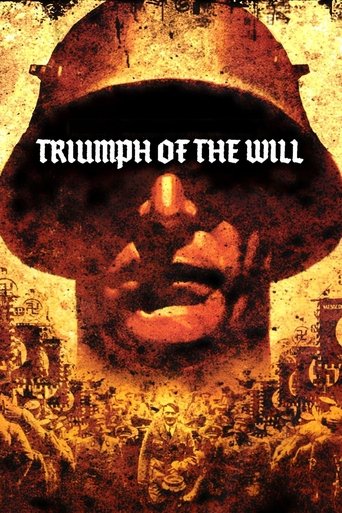
Triumph of the Will
Triumph des Willens
1935 · Film · documentary · 114 min
Directed by Leni Riefenstahl
A showcase of German chancellor and Nazi Party leader Adolf Hitler at the 1934 Nuremberg Rally.
2 positive10 negative1 mixed11 neutralfrom 24 commenters
Where to watch
No streaming data for this title.
Videos commenters linked
From YouTube links in the comments below. Most are clips and trailers; “Full” means the uploader says so.




24 comments on Hacker News
If only he had embedded a short parody of Triumph of the Will, a decidedly seductive film IMO (YMMV).
I can't help thinking there's a huge opportunity for discussing this side of AI in a more principled way. When something (i.e. AI) is this viscerally annoying, it's tempting to slip into this style of discussion, I get it. But it's......hard to read even when you agree and smile along the way.
"The brief bio read: A little girl with blue eyes and blonde hair leads her friends on a healthy eating mission, culminating in the creation of a neighborhood farmer’s market. Okay. Sort of Triumph of the Will: Bedtime Story for Kids and Adults." (for context, Triumph of the Will is the name of a famous Nazi Germany-produced propaganda documentary)
To flesh it out a bit more with examples, to make it clear it's not cherry-picking:
- "What generative models are being used? What kinds of prompts are generating these texts? I don’t know. I’m not a virgin. As I said, I have a child." (virgin really is a complete non-sequitor here, unless the idea is only virgins use ChatGPT?)
- "But I did want to read about my nice Nazi Youth friend and her farmer’s market journey"
- "More importantly, what is a bedtime story for kids and adults? I am an adult. A bedtime story for an adult is just a real book. I read real books. Or at least, I used to? Basically, did Kindle think I was stupid now?"
I disagree with the statement. I don't think enforcement of political correctness would have had any impact because his words hardly mattered to begin with. Events were everything. If it wasn't Hitler it'd probably have been someone else, and that someone probably would have some famous quotes to their name. His words boil down to:
1. Patriotism. Germany is great, Germans are great.
2. Socialism (calling each other comrades, talking about how awesome the working class/"labour" is, calling for an end to class differences).
3. Generic vibes. The Nazi party is great, the future is bright, we are powerful, etc.
... expressed in a muddled and often incoherent way. (and in his book, hatred of the jews, but that doesn't get featured in their propaganda films).
The only obvious thing in the Triumph of the Will excerpts that would be red flags by today's standards are the open and explicit glorification of dictatorship. And for some people the socialism, but in the 1930s people didn't know what we know now about how that works out.
Now come up with a speech code that can forbid those things yet not also ban either of the two main American political parties.
> The most fundamental part of my position is that I find it hard to believe that the average german citizen, in a calm and rational state of mind, would have decided World War 2 was in their individual self-interest.
Hitler didn't literally say in his speeches "Let's start another world war", did he? And by the time he got into power and did start it, it was too late, speeches didn't matter anymore.
But let's put that to one side. Remember that in Germany in the 1920s and 30s democracy was brand new and very weak. From the perspective of people who had been used to monarchy it was absolute bedlam. Political parties were engaging in open street warfare, the government was run by fragile coalitions made up of lots of tiny parties that constantly bickered and collapsed, there was hyperinflation and then France and Belgium actually invaded Germany to seize the factories when it proved unable to pay the war reparations. Then things recovered briefly before the Depression hit. The constitution meanwhile allowed the president to suspend the whole democratic process and rule as a dictator in an "emergency" which wasn't defined. Hitler used this, but he wasn't the first, Hindenburg used it before him so normalizing the procedure. It was absolutely nothing like today's relatively rich and stable western democracies. Times were desperate.
So for the average working class German this whole experiment with democracy would have looked SNAFU. The economy was hosed, Germany was being oppressed by the victors of WW1, they feel like shit because they lost, the government wasn't working and there's no national pride anywhere (something very important to most workers who aren't very mobile at this time), and the democratic process was barely working. In steps a guy who very clearly (a) has a lot of energy, (b) promises to fix everything if given the power to just get rid of this stupid voting system and (c) is a patriot and socialist. He may not be articulate but so what, fancy men with fancy words had plenty of chances but haven't fixed anything. If you don't believe much in democracy to begin with because your experience of it has been bad, why wouldn't you elect a strongman who says the right things? That's how you'd pick your politicians anyway. They didn't know he'd start a world war and then lose it.
"what about the stories that were improved by military influence?"
This is the best thing I have read this week thus far, and will probably haunt me for the rest of my week.
When I was looking at "Triumph of the Will" with film classes I taught, there was a certain beauty in that horror. The story it tells is definitely less unsettling than the reality it presents.
A hypothetical question: imagine a filmmaker, who had studied a lot of obviously copyrighted movies by famous renowned directors. This means he has trained his neural network using their copyrighted licensed content. Does he breach copyright when he composes and films a scene? Are visual quotes copyright theft? Homages? Did George Lucas infringe copyright when he was borrowing compositions from "Triumph of the will"?
Einstein's Brain
"English filmmaker Kevin Hull crossed America in search of the truth about the stolen brains, together with the Japanese scientist Kenji Sugimoto, who has been studying Einstein for over thirty years."
https://www.idfa.nl/en/film/35af3499-a6ce-498f-a5ae-cbba455e0449/relics-einsteins-brain
The only issue is good luck finding a legitimate copy anywhere.
https://youtube.com/watch?v=xM4m-Z0nAio
Edit:
Triumph of the Will
https://www.rogerebert.com/reviews/great-movie-triumph-of-the-will-1935
(Goes better with the commentary by Anthony Santoro)
General Idi Amin Dada - A Self Portrait
https://www.criterion.com/current/posts/5609-general-idi-amin-dada-a-self-portrait-a-tyrant-for-our-times
> There are a few other articles of Nazi belief: for example, that acting ("the will") is better than thinking (a sign of weaker races).
Perhaps this explains the otherwise strange title of the film "Triumph of the Will".
Interesting info here, if these points are true. However, initiating political violence by punching people seems counterproductive. Punching is an act carried out at an individual level, so unless you need to engage in self-defense against a specific individual who is actively physically attacking you, you're the aggressor.
Hitler was also a voracious reader with a private library of some 2000 books. Surprisingly, Schopenhauer appears to have been Hitler's favorite reading rather than those books of Nietzsche which proclaim the right of the amoral Superman to impose his will on all, or the repulsive racist theories of Alfred Rosenberg and Houston Stuart Chamberlain which surface in Mein Kamph.
Maybe it was Schopenhauer's notion of the noumenal will being the prime mover that gave Hitler the notion that anything could be achieved if only it was willed strongly enough, hence the title of the infamous Nazi propaganda movie, Triumph Of The Will. Hitler was found to have developed a system of annotating passages with a system of colored pencils. Presumably there was a lot of angry red.
I wanted to let you know I'm upvoting you, not for the useful links you have provided, but because I also love DIN, to an unreasonable degree, like the kind of feeling that makes someone otherwise totally rational marry a pokemon.
When I was about 20, after the Berlin wall came down, I rode my bike round berlin, then all round east then west Germany for three months, sleeping rough in the forest most of the time, and I think the font, on road signs everywhere, soaked into me as linked to that summer.
But you know what really creeps me about this font. It has a history dating back to the start of the 20th century as letterforms for hand painted signs, but Deutsche Industrienorm 1451 was created in 1936, the year of the of the Berlin Olympics, concentration camps had been open for three years, Triumph of the Will was released the year before. If you've never seen 'Triumph of the Will' it's an experience, I'd never understood how the fascists had managed to appeal to enough people to actually win an election, but in that film you see how they presented themselves to the people of Germany at the time and it was sophisticated. There's a moment in the film in which hilter interacts with an unemployed labourer, and in that interaction he imbues this guy with a sense of purpose, hitler has told him he is a soldier - a soldier with a shovel, it's nonsense, but it is carefully crafted nonsense. It seems to me that DIN is part of this carefully crafted propaganda, a tool to help project an vision of Nazi Germany as rational, orderly, scientific, rigorous and correct. And it does the job, like the unemployed labourer, I respond to it exactly the way goebbels would want me to.
I know I can use a Roman road without endorsing the invasion of Gaul, but there's still a horror there millennia later.
The Triumph of the Will comes to mind. Political propaganda films can be effective ways to change the world for the worse.
Many documentaries end up effecting permanent changes that may only be noticeable to people who live in a certain place or work in a certain industry. The Cove and Blackfish had a pretty direct effect on how SeaWorld treats its animals, but that doesn't quite rise to the level of "changing the world" as most would see it.
The following part from [0] seems relevant a bit too:
In the 1970s, I met Leni Riefenstahl and asked her about her films that glorified the Nazis.
Using revolutionary camera and lighting techniques, she produced a documentary form that mesmerised Germans; it was her 'Triumph of the Will' that reputedly cast Hitler's spell. I asked her about propaganda in societies that imagined themselves superior. She replied that the "messages" in her films were dependent not on "orders from above" but on a "submissive void" in the German population. "Did that include the liberal, educated bourgeoisie?" I asked.
"Everyone," she replied, "and of course the intelligentsia."
[0] http://johnpilger.com/articles/the-return-of-george-orwell-and-big-brothers-war-on-palestine-ukraine-and-truth
Something that occurred to me last night: "politics" comes from the greek polis (city).
I agree on the spectrum[1] of shared trust.
As for the state/non-state status of loosely connected cities, consider the case of my own: in the thirteenth century it got a charter of freedom from the bishop who previously administered it as property of the diocese, and in the fourteenth century its self-administration was formalised to the point of reporting directly[2] to the Holy Roman Emperor.
As modern wags have said the HRE was none of the three, I believe that means that a free city was much more on the state[3] end of the spectrum.
For an example of how recent nationalism is, Triumph of the Will has a scene[4] where a Nazi repeatedly calls out "where are you from, comrade?" and is answered by another Nazi proudly saying "I'm from X" (where X ranges over locations around the country), which I take to imply that in the 1930s, part of what Hitler had been selling was the notion of a Deutschland that was superior to the sum of its regional[5] affiliations.
[1] Pedantically, my usage of granfalloon is consistent with Vonnegut's, as he explicitly uses "Hoosiers" (a demonym for the state of Indiana) as an example of a granfalloon, so if regional identities already count then national ones certainly do. (End of Pedantry)
[2] https://en.wikipedia.org/wiki/Free_imperial_city
[3] During its quarrels in this period with neighbouring Ducs and Freiherren, my city deployed its own military, both building and sacking castles, in pursuit of its own foreign policy.
[4] anticipating the Starship Troopers movie's "I'm doing my part" commercials.
[5] I don't know where you're from, but although in our day I think the idea of a german nation (especially post-reunification) is very strong, regional dialects remain more actively differentiated than in, say, france.
> "Deepfakes can be used for many of the things we already know," [co-director of the Nixon film Francesca] Panetta says, "but also to create kind of alternative histories or have the potential to kind of rewrite history as well."
Movies, from Hollywood and elsewhere, have been convincing people of rewritten histories since their inception. How well known is the story of the real Spartacus compared to the Hollywood Spartacus? How many people's vision of the antebellum US South came from Gone With The Wind rather than from historical documents and interviews with former slaves and slave-owners? Birth of a Nation inspired the revival of a terrorist organization that lasted decades; Triumph of the Will painted the Nazis' rise as a matter of noble heroism triumphing over cowardice. Last week I argued with some epistemologically incompetent person who wanted me to watch an anti-vaccine movie about Gardasil, apparently unaware that YouTube videos are not really a publication venue used by medical researchers.
So, what should we do about it? Well, the Soviets had an answer: since movies were so powerful, people would be carefully vetted before they got access to the equipment needed to make them, and if someone made a movie with harmful contents anyway, they would go to GULAG. Is that the solution we want?
> I think the opposite thing is true, and that most Americans generally assume that any major motion picture or television show is copyrighted no matter when it was produced.
You're probably right for everything produced since the second World War, but I doubt people think that e.g. Triumph of the Will is under copyright. I think people have a vague notion of "historical" vs. "contemporary" that starts right around the end of WWII.
"Triumph of the Will and the Cinematic Language of Propaganda"
https://www.youtube.com/watch?v=jJ1Qm1Z_D7w
The propaganda was incredibly successful. To this day "Triumph of the Will" continues to be used as a reference point for the mental construct of the Nazi regime. The modern understanding of the Nazis is deeply informed by a propaganda film produced by the Nazis for the explicit purpose of creating that mental construct. "Triumph of the Will"'s endless lines of soldiers marching in formation is exactly the image they wanted you to think of when you thought of them.
The article is not trying to make a new intellectual contribution to the existent thinking on the subject. It's to serve as an introduction for the benefit of people who may lean far too much in the direction of taking our democracy for granted–as a God-given right that can never disappear. I would guess that the Times felt like such an introduction could be useful, given the current political climate.
It's an easy and compelling introduction, rather than a rigorous intellectual treatise, in order to increase the probability that people will actually read it and thereby have something added to their perspective.
For instance, for those (such as myself) who are unaware of the Dostoevsky quote, it may be useful to see it: "There is no more ceaseless or tormenting care for man, as long as he remains free, than to find someone to bow down to as soon as possible." It may not be strictly true. But it is useful to consider that such a perspective on human behavior is, perhaps, not to be immediately dismissed as useless and ridiculous.
The way the article writer describes The Triumph of the Will is accurate (I've seen it a couple times); most people haven't seen it, or even heard of it. The reference to the "collective ecstasy" well-depicted in the film does, after all, reveal a human phenomenon that goes beyond Nazis and which it would be good for more people to understand, as a warning.
The Athenian process for protecting their democracy against populism is useful to think about, because we, in taking democracy for granted, tend not to see any risk that such a system would be useful for addressing: "When one of the citizens was becoming a bit too popular — too much of a charmer — Athenians would vote him out of the city for ten years by inscribing his name on bits of pottery. It was not punishment for something the charmer may have done, but a pre-emptive measure against what he might do if left unchecked. Athenians knew that they were too vulnerable and too flawed to resist political seduction (their complicated affair with Alcibiades gave them ample proof of that), and promptly denied themselves the pleasure. Man-made as it is, democracy is fragile and of a weak constitution — better not to put it to the test."
Again, it's useful to present such ideas to people who may not have been exposed to them before. I had already known these details about Athens. But a year ago, I hadn't, even though I studied and loved Plato in college. And I'm 62 now.
1935's Triumph of the Will is a documentary. It documents the 1934 Nuremberg Rally of the Nazi Party. It is also pro-Nazi Party propaganda. A film can be a documentary and advocate for a certain agenda. These dual-purpose films existed long before the late 1980s.
I believe that most documentaries do advocate something. Documentarians adhering to Wikipedia-like NPOV rules of presentation are rarer than other sorts.
The Great Dictator is one of the few films with obvious value beyond entertainment, because it's a vaccine against Triumph of the Will. Triumph of the Will is a skillfully made propaganda film, and if you have no awareness of how it works then it would be easy to leave with positive feelings about the Nazis, even if only subconsciously. But once you've seen The Great Dictator it becomes a joke. E.g. the low camera angles don't make Hitler look powerful, they just remind you of the extending chair scene. His exaggerated gestures no longer project confidence, and instead make you think of slapstick routines.
John Cleese's silly walk had the same effect on the goose-stepping scenes. It's art that makes people more rational, by transforming emotional manipulation tricks into comedy. It's beneficial even if you don't agree with all of the politics of it (e.g. Chaplin's call for open borders).
> Casablanca is widely remembered as one of the greatest films of all time, coming in at #2 on the AFI’s top 100 list ...
1. CITIZEN KANE (1941) 2. CASABLANCA (1942) 3. THE GODFATHER (1972) 4. GONE WITH THE WIND (1939) 5. LAWRENCE OF ARABIA (1962)
I just don't enjoy CITIZEN KANE anymore. It's like a film school movie. I watched it maybe 10-15 times when I was younger and I just don't enjoy it anymore. Like so what? GONE WITH THE WIND is the pinnacle of Lost Cause propaganda. I enjoyed when I didn't understand it. (I'm sure glad I didn't watch Triumph of the Will when I didn't understand it.) I damn sure don't enjoy GONE WITH THE WIND now that I understand it.
But I can watch CASABLANCA, THE GODFATHER and LAWRENCE OF ARABIA over and over. And this was a good article telling me things I didn't appreciate and still I can go back and watch CASABLANCA again.
While I in no way condone censorship or dictatorship I can remember a few pieces.
Triumph of the Will is still looked at as a millstone in cinema, and the soviets produced very memorable sculptural works such as The Motherland Calls to name two. Both regimes also had some of the most memorable (propoganda) posters ever made, that are still awesome visual works to this day (even though the content they communicate is abominable).
I'm sure there's lots of examples, but in the documentary world, The Thin Blue Line was about a man wrongfully accused of murder on death row, who was retried and released as a direct result of the movie.
Also, I think Triumph of the Will played a huge part in helping Hitler come to power. And in the US, The Birth of a Nation helped the KKK explode in popularity. These aren't particularly uplifting examples, but I think it's clear that a popular movie can have a huge effect on the political landscape.
"They Live" is a fun movie, and like Marxism, it certainly taps inot the vague, nearly universal "everything is wrong" vibe that affects nearly everyone but especially young adults. Other examples: The Matrix. Philip Dick and Stanislaw Lem (perhaps the most underrated SF author ever) made careers out of this emotion. For a modern incarnation on Netflix, check out Black Mirror, particular "15 Million Merits"[1]. Powerful stuff.
When I step back and look at the world, for all of our terrible mistakes, we (the western capitalist states) really are the good guys, because personally and politically, overwhelmingly, we really do despise the despots, and the racists, and the needless violence and barbarism that rises to power in too many places in the world. More than once we've spilled blood and spent money not to benefit ourselves, but to stop something evil from happening to others. And no, this doesn't excuse the fact that we've spilled even more blood for our own selfish ends, be they resources or the assertion of misguided idealism.
Consumerism, unlike unjust war, is a trickier beast to slay. Why? Because it's good in one important way! Consumption really does drive an economy, which is good for people's bellies, and well-fed people are pretty happy (watch Triumph of the Will[2] and notice how often Riefenstahl shows food and people eating). The urge to consume, and all the messaging that goes into it, are manipulative, but it manipulates us into wealth. (Heaven help us all when even the elite can't ignore the externalities of this approach, particularly WRT climate!) We will soon see if virtual goods can thread this needle.
>Once we’ve put on the glasses, what do we do? Where are the aliens, and how do we start killing them?
As anti-authoritarian as I am, I still can't get behind killing anyone. Maybe it's naive, but I really believe in non-violent (not passive) resistance. Ghandi, MLK, Aung Yung Suu Kyi - they show us the remarkable power of patience, love, and unyielding persistence.
[1] https://en.wikipedia.org/wiki/Fifteen_Million_Merits
[2] https://www.youtube.com/watch?v=GHs2coAzLJ8
If you don't understand that Triumph of the Will and the yellow bumper ribbons are the exact same thing, you're not understanding propaganda.
Uh huh. Glorifying Hitler and the Nazis in a government comissioned film is "the exact same thing" as privately expressing support for our volunteer military in a hard situation. They're "identical", even!
Do you ever stop and think about the claims you're making? Are pink ribbons propaganda? How about the Jesus fish? The Darwin fish? A "make love not war" bumper sticker? How is private viewpoint A propaganda, while private viewpoint !A isn't? If you want to call every politically clever expression of a viewpoint "propaganda", you've robbed the term of its important, useful meaning.
If you don't understand that Triumph of the Will and the yellow bumper ribbons are the exact same thing, you're not understanding propaganda.
It's always more difficult to examine something you're inside (yellow ribbons) than something you're outside (Nazi war movies). But they're identical. And in fact the modern PR industry was founded to sell World War I to the American public.