 Hacker Cinema
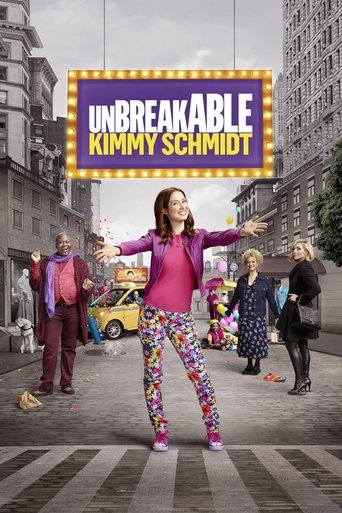
Unbreakable Kimmy Schmidt
2015 · TV series · 4 seasons
Created by Tina Fey, Robert Carlock
When a woman is rescued from a doomsday cult and lands in New York City, she must navigate a world she didn't think even existed anymore.
5 positive2 neutralfrom 7 commenters
Where to watch
No streaming data for this title.



7 comments on Hacker News
Seriously?
The Crown, Stranger Things, Unbelievable, Russian Doll (wow, just wow), Orange Is The New Black, Narcos, Narcos: Mexico, GLOW, Daredevil, Jessica Jones, Ozark, Nobody Wants This, Altered Carbon, Dirk Gently, Mindhunters, The Queen's Gambit, Unbreakable Kimmy Schmidt.
And that's just what I can remember off the top of my head. And that's my taste, there's more not to my taste like Squid Game, Wednesday, Bridgerton, etc. And not including the films, documentaries, shorts, etc. they done like Love, Death and Robots.
Which is why I think that of Netflix's experiment here the Unbreakable Kimmy Schmidt "finale movie" was possibly the height of the art form. The obviously bad choices are always an excuse for more jokes and more punchlines and opportunities for surprise guest cameos from the show's previous seasons (and weird closure of multiple seasons of strange guest characters). The show's previous seasons already engendered enough of a feel of "anything can happen" that made most playthroughs, even "bad" ones, fun, and especially yielded a strong reason to see the entire play graph to catch all the endings and all the cameos and all the jokes.
It actually had answers for "Why would you want to do that?" and in ways that fans of the show's previous seasons would expect. From my experience, many of the other CYOA properties that Netflix attempted didn't have that multiple seasons of loyalty to wild "anything can happen" jokes and reasons to explore the interactivity in depth, but the UKS CYOA certainly had a lot of charm and fun.
(Aside: one of my favorite gags was the UKS CYOA's gag Netflix Skip Intro button.)
>WRT Netflix, their stated strategy was that their access to data was going to allow them to create superior content
I would argue that Netflix has and does do this except for a different definition of superior. They aren't really trying to make a single show with broad market appeal. An algorithm isn't going to help with that anyway. What an algorithm can do is find niches to serve. Netflix has done a good job of creating these smaller shows that have an intense appeal to a small number of people. Gather enough of those shows together and eventually you have everyone covered. It is basically just targeted advertising except with TV shows.
HBO might have GOT that everyone watches, but Netflix has Black Mirror, BoJack Horseman, GLOW, You, The Crown, Russian Doll, Narcos, Maniac, Ozark, One Day At A Time, Big Mouth, Unbreakable Kimmy Schmidt, and numerous other shows that have received critical acclaim and everyone probably watches at least one of those.
There's some really good research in this article and then some really poorly researched topics and it seems like the entire thing was written with an agenda to please an anti-millenial audience. Specifically, an agenda to prove that millenials are given way more than previous generations (especially boomers) with really poor research and a really shaky narrative.
This one part shows it pretty clearly:
>n the television show “Thirtysomething,” which aired from 1987 to 1991, the all-white cast of characters seemed to be economically emancipated from their parents, who rarely factored into the story lines. Today’s series about 30-somethings portray a decade that seems far less adult, at least by traditional standards. (Think “Unbreakable Kimmy Schmidt” or “New Girl.”)
Mad Men didn't even have an audience when it aired (<2 million viewers most episodes), and airs on a network that likely won't exist in 5-6 years (or at least won't be producing new content), so it's not super clear to me what your point is about those shows as evidence of how a network grows. The way a network grows is by producing content people want to watch, whether that's disposable content made to last a minute or content made to last the test of time. HBO isn't growing because people are subscribing to watch Sopranos re-runs.
Past reporting suggests churn in most subscription content services is very low, so your Netflix cancellation may be unusual. I'd also add that exclusive content is one part of the story, but there's also a lot of licensed content that's very good on Netflix as on other services.
But for what it is worth, I would rank the following Netflix originals to be "top tier" within their genre -- some of these genres lend themselves more to rewatching than others, and some are closer to my taste than others, some held up in quality through their run more than others, so in a sense I am ranking shows based on their peak quality --
Orange is the New Black; Bloodline; Stranger Things; The Crown; Gilmore Girls AYITL; The OA; A Series of Unfortunate Events; Mindhunter; The Haunting of Hill House; Unbreakable Kimmy Schmidt; Master of None; Love; Lady Dynamite; Santa Clarita Diet; GLOW; American Vandal; Maniac; Bojack Horseman; F is for Family; Disenchantment; Hilda; Dark; The Rain; Elite; Chef's Table; Making a Murderer; Shot in the Dark; Wormwood; Wild Wild Country; Salt Fat Acid Heat; Queer Eye; The Curious Creations of Christine McConnell; My Next Guest Needs No Introduction; Lilyhammer; Terrace House; Alias Grace; The End of the Fucking World; Collateral; Wanderlust; Longmire; Black Mirror; Comedians in Cars Getting Coffee.
In addition to these, the following shows are Netflix originals in my region, indicating that although someone else initially funded them, Netflix bought them for exclusive distribution here, and also meet the above requirements:
Babylon Berlin; Bodyguard; Casé; Crashing; Cuckoo; Derry Girls; The Great British Baking Show; Happy!; Happy Valley; The Investigator; Peaky Blinders; River.
I have pretty broad taste in TV and watch a lot of TV while I am programming or running data analysis, so maybe the breadth of stuff I include here is surprising to most. But to the extent your post is a useful anecdote about how Netflix has no great shows, I'm responding to your challenge to "Name one show" that would meet that criteria.
(These are TV shows only, not films. I haven't really liked many Netflix original films although there are a few I would say are great, like Okja and Roma)
It's probably not quite as rosy as you state here, I'm afraid.
Let's look at a 380,000 viewer show. It's very unlikely that ever single one of those viewers paid for Netflix for a solid year just to get access to that show (which will have all its episodes released at once).
So let's assume it has significant cult appeal, meaning a full 25% of its viewers are primarily subscribed for that show and things like it. (I'd say that's likely to be very high, based on my experience in the narrative video world, but let's be optimistic.) And let's say, based on subscribing for that show and forgetting to cancel for a couple of months (or subsequently being retained by another 380k viewer show), that Netflix gets 3 months' worth of revenue from them.
So that's 380k/4 = 95,000 * $7.99 * 3 = $2.28m revenue attributable to that show.
Of the shows you mention:
Marco Polo cost $90m to produce for the entire season.
Black Mirror doesn't have figures online, but it'll be around $3m per episode if it's similar to other BBC shows. So that's $18m.
Unbreakable Kimmy Schmidt doesn't have figures available, but based on Tina Fey's fees for other shows and general knowledge of how much TV costs, I'll guess at about $3m an episode. (Might be cheaper if they're being clever about it, so could be as low as $2m) So that's $39m.
So, assuming that Netflix are just getting revenue from retained subscribers, and they get the figures above, we're looking at losses of:
$88m for Marco Polo.
$16m for Black Mirror.
$37m for Unbreakable Kimmy Schmidt.
Obviously the situation is far more complex than that - they'll be financing with coproduction deals, they're looking for growth rather than revenue, they also acquire a lot of content cheaply (very, very cheaply in some cases) through licensing - but it's certainly not rosy enough that they'll be happy with 380k viewers for shows they're making.
Modern Family, 30 Rock, Parks and Recreation, The Middle, Raising Hope, How I Met Your Mother, and Unbreakable Kimmy Schmidt were all fairly recent examples of decent modern sitcoms (and wow that list is bigger than I thought it'd be), and for the most part, generally centered around middle class families/people. Some are a bit more outlandish and over-the-top at times, but that can also be their appeal.
By modern, I also mean they follow a continuing story arc episode-to-episode, so while you could watch any episode in isolation, you get a lot more if you know backstory and the characters. They're also all "single camera" shows (no laugh track) which IMHO is a much better style, and allows them to be more creative, have a continuing story, and frankly, be funnier than the (pause for laughter) lines in a show like Big Bang Theory.