 Hacker Cinema
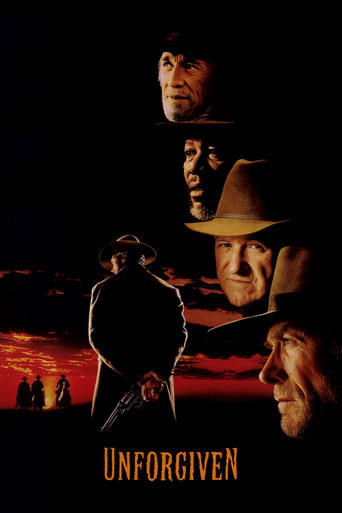
Unforgiven
1992 · Film · 130 min
Directed by Clint Eastwood
William Munny is a retired, once-ruthless killer turned gentle widower and hog farmer. To help support his two motherless children, he accepts one last bounty-hunter mission to find the men who brutalized a prostitute. Joined by his former partner and a cocky greenhorn, he takes on a corrupt sheriff.
10 positive2 neutralfrom 12 commenters
Where to watch
No streaming data for this title.
13 comments on Hacker News
I'd actually put one in for Clint Eastwood.
Although most popular knowledge about him revolves around his earlier acting career (Westerns, Dirty Harry), you'll notice a distinct change in many of his films once he started directing.
* Play Misty for Me
* Breezy
* Unforgiven
* A Perfect World
* The Bridges of Madison County
* Midnight in the Garden of Good and Evil
* Mystic River
* Million Dollar Baby
* Changeling
* Gran Torino
* American Sniper
* Sully
* The Mule
People frequently do not understand the statistics underlying real world dynamics, embrace oversimplified world models, and going against that has them discouraged? That is one strong re-expression of the satanic attitude.
From cinematography, two big examples "that may have people leave the theater, then":
-- in Clint Eastwood's Unforgiven, the Sheriff (Gene Hackman) re-telling the story of English Bob:
> You see, the night that Corky walked into the Blue Bottle, and before he knows what's happening, Bob here takes a shot at him! And he misses, 'cause he's so damn drunk. Now that bullet whizzing by panicked old Corky, and he did the wrong thing. He went for his gun in such a hurry that he shot his own damn toe off. Meantime Bob here, he's aiming real good, and he squeezes off another, but he misses, because he's still so damn drunk, and he hits this thousand-dollar mirror up over the bar. And now, the Duck of Death is as good as dead. Because Corky does it right. He aims real careful, no hurry... [...] BAM! That Walker Colt blew up in his hand, which was a failing common to that model. You see, if Corky had had two guns instead of just a big dick, he would have been there right to the end to defend himself. [...] Well, old Bob wasn't gonna wait for Corky to grow a new hand. No, he just walked over there real slow - 'cause he was drunk - and shot him right through the liver
-- the scene in Vince Gilligan's El Camino, in which a bunch of gunners is so hijacked by the unpreparedness to the havoc that most bullets end on the scenery.
Not documentaries, but statistically relevant like the ten "black" in sequence at the roulette, frequent as the wheel is having well over a thousand spins.
Not to dogpile too much here, but I think 1992's Unforgiven directed by and staring Clint Eastwood does the best here when it comes to my feeling about this comment:
https://www.youtube.com/watch?v=vTjBR0jicAo
Bill Munny: It's a hell of a thing, killing a man. You take away all he's got, and all he's ever gonna have.
Schofield Kid: Yeah. Well I guess they had it coming.
Bill Munny: We all have it coming, kid.
The acting here is much better than these simple lines as well as the lead up to them.
Suffice to say, talking about dealing death over property online is a lot easier than living with it.
Absolutely bonkers that Hackman quit acting more than 20 years ago [0] — "Welcome to Mooseport (2004)" was his last film. But his body of work in my mind feels as timelessly relevant and fresh as Clint Eastwood's and Bill Murray's. Maybe because I love rewatching Unforgiven and Crimson Tide. I haven't even seen French Connection, which earned him his first Oscar. RIP to this legend.
[0] https://www.imdb.com/name/nm0000432/
For convenience, I asked ChatGPT to create this table, which summarizes how many times each movie has been mentioned in this conversation so far. It got a few counts wrong (as usual), but it still gives a good sense of the frequency. I hope it can be useful to someone:
| Movie | Number of Mentions | |-------------------------------------------|---------------------| | The Matrix | 9 | | Lord of the Rings Trilogy | 8 | | Pulp Fiction | 8 | | Alien | 7 | | Fight Club | 7 | | Ghostbusters | 6 | | Die Hard | 5 | | Back to the Future | 5 | | Inception | 5 | | Star Wars Trilogy (original) | 5 | | Groundhog Day | 5 | | Terminator 1 & 2 | 5 | | Jurassic Park | 4 | | The Thing | 4 | | The Fifth Element | 4 | | Monty Python and the Holy Grail | 4 | | Ghost in the Shell | 4 | | Interstellar | 4 | | Casablanca | 3 | | Office Space | 3 | | Shawshank Redemption | 3 | | The Godfather Trilogy | 3 | | The Blues Brothers | 3 | | Blade Runner | 3 | | Mad Max: Fury Road | 3 | | Unforgiven | 3 | | Total Recall (1990) | 3 | | The Crow | 3 | | The Princess Bride | 3 | | Akira | 3 | | The Big Lebowski | 3 | | Guardians of the Galaxy | 3 | | American Psycho | 3 | | Indiana Jones Trilogy | 3 | | Kiki’s Delivery Service | 2 | | Ratatouille | 2 | | A Clockwork Orange | 2 | | Mission Impossible (various) | 2 | | Casino Royale | 2 | | Skyfall | 2 | | Ferris Bueller's Day Off | 2 | | Star Trek: The Wrath of Khan | 2 | | Apocalypse Now | 2 | | The Shining | 2 | | Groundhog Day | 2 | | Donnie Darko | 2 | | Dune (2021) | 2 | | Gladiator | 2 | | Predator | 2 | | Seven/Se7en | 2 | | The Dark Knight | 2 | | Snatch | 2 | | Prometheus | 2 | | Schindler’s List | 2 | | The Wolf of Wall Street | 2 | | Dr. Strangelove | 2 | | Silence of the Lambs | 2 | | Kill Bill | 2 | | Real Genius | 2 | | Top Secret! | 2 | | Tenet | 2 | | Tinker Tailor Soldier Spy | 2 | | The Adjustment Bureau | 2 | | The Expanse | 2 | | Pulp Fiction | 2 |
I always hated westerns, until I saw the outlaw Josey Wales, and later Unforgiven. The rest were just so formulaic and juvenile (especially the early Clint Eastwood spaghetti westerns).
Treasure of the Sierra Madre was good, though. The only bogart movie I ever liked.
Kubrick’s results were all over the map. He made maybe three great films:
Dr. Strangelove
Full Metal Jacket
A Clockwork Orange
A bunch of not bad films:
2001
Lolita
Barry Lyndon
The Shining
Spartacus
One real turd of a film:
Eyes Wide Shut
And a bunch of forgettable filler:
All the other films he made.
Compare this to the Anti-Kubrick, Clint Eastwood, who made:
Unforgiven
Mystic River
Million Dollar Baby
Letters From Iwo Jima
Gran Torino
And a bunch of okay films:
Pretty much everything else
And it’s pretty obvious that you don’t need to be an abusive taskmaster like Kubrick to make great art.
I just did a quick search on Walmart.com for DVDs <= $6 and found plenty of mediocrity but also:
- Shawshank Redemption - Despicable Me 1 & 2 (for $5 total) - Scream 1-3 (again $5 total) - Beverly Hills Cop 1-3 (same) - Tombstone - Unforgiven - ET - A Star is Born (2018) - Sleepless in Seattle - The Thing (1982) - Seabiscuit - Once Upon a Time in Hollywood - Titanic
I would say any of these movies is better than 95% of the movies available for streaming on Netflix (conservatively).
I’m not necessarily disagreeing with your list, even though some of those are mediocre at best, but yeah I did mean per year, and limited to Hollywood (Parasite for instance not counting). And no, ok, I will also straight up disagree with the second Knives out Movie which I thought was absolute trash. A perfect example of poor storytelling and the form over substance of modern cinema.
But just taking say 1992 you have Last of the Mohicans, The Unforgiven, My Cousin Vinny, Malcolm X, Bad Lieutenant, Scent of a Woman, Reservoir Dogs, Dracula, Chaplin.
And then a bunch of fun schlomp like Arizona Dream, Basic Instinct, Sister Act, Army of Darkness, Home Alone 2, Buffy the Vampire Slayer, The Mighty Ducks, Wayne’s World.
These are all undoubtedly great movies.
And then another huge bunch of watchable stuff easily comparable to some of your mentions like Watcher or High Life.
And 1992 is not an outlier.
In 1993 you have Jurrasic Park, Groundhog Day, Whats Eating Gilbert Grape, Scindlers List, Meanace 2 Society, Alive, Dazed and Confused, Falling Down, In The Name of The Father, True Romance, Demolition Man, Carlitos Way, The Secret Garden, Philadelphia, A Perfect Workd, Cool Runnings, Short Cuts.
In 1991 Silence of The Lambs, Ternimator 2, JFK, Point Break, Thelma and Louise, Boyz in the Hood, The Doors, My Own Private Idaho, Barton Fink, The Fisher King, Naked Lunch.
In 1990 Goodfellas, Hunt for Red October, Total Recall, Edward Scissorhands, Home Alone, Godfather 3, Dances with Wolves, Tremors, Back to the Future 3, Awakenings, The Witches, Wild at Heart, Jacobs Ladder, Nikita, Slacker, Millers Crossing.
And the quality difference is massive too, not just somewhat better. Like just Millers Crossing is miles better than anything that has been made in the last 5 years, and I’m picking at random.
In 1994 Shawshank Redemption, Pulp Fiction, Forrest Gump, The Lion King, Speed, Ace Ventura, Dumb and Dumber, Stargate, Natural Born Killers, The Crow, Clercs, Maverick, Ed Wood, In the Mouth of Madness, Interview With The Vampire.
I could go on.
And this is not even talking about how the 80s is a better decade for cinema, or how the 70s is the peak of the power of the author with far more experimental, artistic, and substantial productions.
Has quality declined? Yes. Massively. Humongously. Stupendously.
A securities fraud lawsuit against a company because the work environment is toxic reminds me of the movie Unforgiven. For those unaware, the movie starts with a cowboy disfiguring a prostitute with a knife because she laughed at him. After the incident, the guy who manages the brothel is financially compensated since he had invested money in bringing the prostitute to his place of business, money which he will presumably be unable to recover now that the woman has been disfigured. No compensation is ordered for the disfigured woman (another cowboy does try to compensate her out of guilt), instead, the perpetrator is flogged, and that's supposed to be enough for the woman.
There's a real gap in our understanding of capitalism and crime if it's easier to compensate shareholders of a toxic company than it is to compensate the direct victims of that toxic behavior. If a toxic culture would suppress stock prices, it seems that the same culture would suppress career advancement, physical health and general mental well being. The problem seems to be that an employee must not only prove criminality but also particularized harm, whereas the standard for a successful securities fraud lawsuit seems to be lower.
Any comprehensive study of the genre must include movies directed by John Ford; and movies starring John Wayne. There will be much overlap in these two sets. Wayne was not a versatile actor, but any study of The American Western without significant attention to him would be incomplete. "Stagecoach" and "The Searchers" are good examples of their early and later collaborations, respectively. Howard Hawks' "Rio Bravo". Anthony Mann's westerns starring James Stewart. More recent suggestions would include Lawrence Kasdan's "Silverado" and Clint Eastwood's "Unforgiven".
I think he's going about his goals incorrectly. We wants to elevate games to a critically and mainstream accepted Art, so he creates a game that declares itself Art. Such an approach will have immense push-back from the 'main stream' (game) industry and even more from the general public. It actually does not matter what industry we're talking about - an industry that has not mainstream publicly accepted expressions of itself as High Art worthy of the equivalent of an Oscar/Emmy/Hugo/Literary-Nobel expression of the human condition will have virtually no chance of convincing the public one of their own has broken through into this level of communication.
Think about what Clint Eastwood did with "The Unforgiven": before that film, the Western was considered a tired, spent, comical film genre. I remember reading pre-release critics saying Clint had wasted his time on that over used genre: "what could he possibly say that has not already been said 1,000 times?" they wrote...
What did Clint do? He started the film as a more-or-less classically serious western. However, as the film progresses, it acknowledges itself through the presence of dime store outlaw novellas causing kids to idolize the criminal aspects of the western experience. Then our heroes go about demonstrating the fallacy of this attitude, and the film ends with the audience being spoon fed the horror this idolization creates.
I suggest Mr. Blow and others attempting to elevate games to High Art need to begin with the traditionally insipid game style so popular today. (I can say this as a former 15 veteran of the games industry. I left specifically because of all the "pretentious" reasons Jonathan cites.) As the game's traditional fight-puzzle-fight mechanics play out, the character becomes exposed to the game engine simulation itself, and the gamer becomes exposed to the existential dilemma of wanting to continue their suspended disbelief while the game itself taunts them with the fact they are playing a game. Through such a careful balance of crossed signal communications, the gamer is left to question their own existence and the potential of our world merely being a simulation for the amusement and enrichment of others - at their expense.
No, Matrix fans/critics, I'm not saying "make the Matrix". What I'm pointing out is how "The Unforgiven" elevated itself by acknowledging the disjoint between the fiction and the reality, and spoon fed that to the film viewer. Sure, many a western and plain film fan missed Clint's higher message. Such is the diverse nature of how Art communicates. Much of what is considered "Art" today is simply artfully ambiguous. Jonathan can not afford such ambitiousness if he wants to achieve his goal.
Jonathan's goal of elevating games needs to include all the insipid game cliches to draw the traditional fan in, and then pull the floor out from under them, leaving them literally afraid to continue the game because it risks wreaking their appreciation for game playing thereafter. It's not a success to simply engage. It's not a success to merely cause consideration and wonder. Jonathan Blow's goal is to end games as they are today and reboot the entire industry, reborn as the 21st century's equivalent to the 20th century Film.
P.S.
Since I've heard about Aeris being killed by Sepiroth before, I went ahead and watched it on YouTube, and I wasn't impressed. It must have been because I didn't play the game. If that scene affected you at all (if it looked like anything but cheesy crap animated with expressionless plastic dolls) it was because you were prepped by playing the game to experience that scene in a particular way. You can watch a clip of "La Strada" or "Midnight Cowboy" or "Unforgiven" or "Casablanca" out of context and at least get a sense of the emotional dynamics of the characters. That's the strength of movies. The strength of games is the immersion and feeling of personal involvement with the characters, personal involvement driven by your own actions, choices, and sacrifices. I may have felt like Ratso Rizzo was my friend, but I never picked up a john to get money for a bus ticket for us to leave town together. I may have shared Rick Blaine's feelings as he put Victor and Ilsa on the plane to Lisbon, but I didn't decide to do that. It just happened to me.
Games will always be second-rate next to movies when it comes to presenting scripted drama, but they don't have to feel that way. Aeris and Sepiroth is proof of that, I guess. Gameplay allows games to affect us in ways that movies can't and enables different and stronger emotional contexts for experiencing games as art. The art of games is in the gameplay. Detaching from gameplay is just a crutch, like filming a stage production, copying another art form because we don't understand the new one well enough yet.