 Hacker Cinema
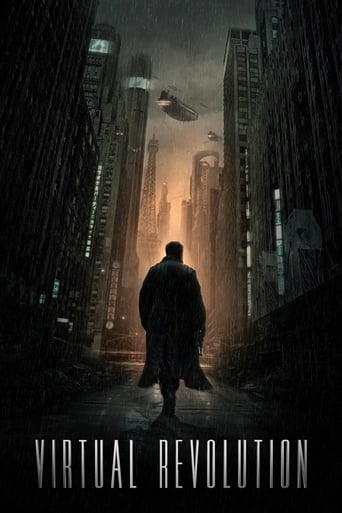
Virtual Revolution
2016 · Film · 92 min
Directed by Guy-Roger Duvert
Paris 2047. Most of the population spend all their time online, connected into virtual worlds, and don't care anymore about reality. A shadow agent, Nash, working for one of the multinational companies behind these virtual worlds, is tracking down terrorists who threaten the system...
1 neutralfrom 1 commenter
Where to watch
No streaming data for this title.



3 comments on Hacker News
I do know SOME do not want Citizens to travel https://voxeu.org/article/trade-and-travel-time-epidemics in general dreaming to pushing people to a scenario like the recent french movie Virtual Revolution. Personally I do not want to travel with public means AT ALL.
I do want to being able to move with MY means because public (private) transports have lowered their quality and reliability below the acceptability threshold. I'm tired of airlines shrinking seats, trains more and more designed to be human meat carriers and so on. I'm tired of crappy crapware platforms designed to left even vector employees powerless seeing a crappy screen and so on.
I do favor punishing the management of such companies hard enough their ancestors do not even dream imitating their choices.
A small question: how many time you do not lock your screen in the office while going to the bathroom, to eat something, ... ? How many time while doing casual things you need to switch an instant to something else, quickly entering credentials etc?
Now you are in a café, you'll unlikely left a laptop on the table, but you might have an impromptu need to just look at something, perhaps not even entering credentials per se, but still showing something, even by accidents. MANY information have leaked that way. Many innocuous information per se led to discovering of something else valuable to attackers.
You can be perfectly aware 99% of the time, there is still a 1%. Not only: what's work for you? Recently I see a trend, a cohort of people who start working much in time terms and produce far less in substantial terms, they seem to have lost smartness, like what I've seen in SK/Japan where they toxic work culture create an incredible level of inefficiency masked as commitment and hard work, the hard part is the only true ones, the outcome is bad. In the western sauce is even worse: people start to be less and less effective without caring. Managers start to organize toward inefficiency and less smart behaviors encouraging them.
Work is a serious thing and should be done seriously witch does not means at all being available 24/7/365 for 99% of jobs, but being effective, concentrated, with all you need in hands, for a defined timeframe. Such timeframe can be fixed or flexible following targets, current needs etc. But nothing more and nothing less than that. Stereotypical laptop/craphone nomadic smart worker is the antithesis of that. Is the elogium of people who prefer living in a fiction snapping fingers and shrugging "ops, I spilled my drink" with the same involvement of "ops, I've just crushed a plain onto an NPP"... Pushing such model is obviously harmful. Is the tentative of creating a legion of stereotypical Ford model workers all easy to source and substitute, all cheap, all unable to see the big picture, all living on their sofa or in the metaverse (see virtual revolution movie from few years ago [1], for instance) such model gives the maximum easiness to the ruling class but also the worst overall outcome, the result is something that can't last longer and just live disasters behind for generations.
If we really want to progress, to work less, with less fatigue, with more free time we need the exact opposite.
[1] https://en.wikipedia.org/wiki/Virtual_Revolution
Very, very nice, but to be more clear: it's not just Chrome.
The modern web is the surveillance web because the modern web is "an endpoint" for users (witch means a new mainframe dumb terminal, at a far higher price and complexity than the old ones) and someone else service, typically run on giants cloud datacenters.
To avoid that, and still have the modern level of life PLUS MANY MORE, we already have had a solution: the desktop computing. The first one on record the modern way AFAIK was the Xerox Star Office System, but even the older NLS (1968!!!) have networking, videoconferencing and screen sharing. YES, you read correctly. Dates are not wrong.
So what? So it's a real mess because since Xerox except for LispM and Plan 9 we do not have developed desktop computing anymore, so the old model might still be rediscovered, at least it still exists, but on actual iron, very badly designed even if far more powerful in mere horsepower terms, and with essentially no modern software. The last living vestige is Emacs, witch is VERY good but not enough evolved for actual end-users, so we need:
- public universities, paid enough by the government and government only, with a very effective separation from the private sector, to create a new old classic research not for short term business but for the society;
- enough years to write a modern desktop, which means around a decade because it's not just a matter of code, it's a matter to learn how classic systems works and design a new one, a thing most today devs do not know and have issue imaging, than time to develop it, to spread it etc.
The other option? Well... A small Canadian TV series (Continuum) recently gives a nice idea, perhaps mixed with a small French movie (Virtual Revolution) to see a more realistic one. Be prepared to a future where you will have to eat only if some IT giants gives food to you. Be prepared to live to work instead of working to live because yes, I'm not joking nor exaggerating, it's just a matter of observing the world today.