 Hacker Cinema
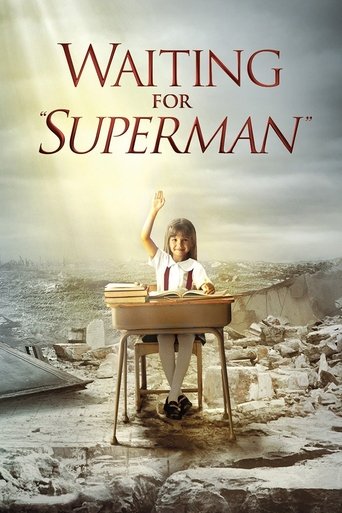
Waiting for "Superman"
2010 · Film · documentary · 111 min
Directed by Davis Guggenheim
Gripping, heartbreaking, and ultimately hopeful, Waiting for Superman is an impassioned indictment of the American school system from An Inconvenient Truth director Davis Guggenheim.
27 positive8 negative12 neutralfrom 47 commenters
Where to watch
No streaming data for this title.
57 comments on Hacker News
You are right, scaffolding seems like a better descriptor.
> It sounds like you're pointing to something more nefarious.
Well the structure itself is quite nefarious in a way. You have to constantly fight against it to progress and don't really have a choice at the beginning, which often leads to learned helplessness and PTSD in the dropouts. As a teacher you also have to constantly fight against this because any shortfall of effort on your part leaves your students behind in one of those pitfalls, and its largely dependent on the students ability to overcome the torture. You generally aren't given sufficient resources to do this because there's no way out; only through. This is why the structure is nefarious and at the root of the problem.
The unlearning process after learning to competence is imperfect and induces what amounts to self-torture sessions. The imposition of psychological stress (torture) actually lowers the ability for rational thought, and may permanently warp people at vulnerable stages of their lives. Children tend to have a period where they try on various personas after which their identity crystallizes which they carry forward. Adopting learned helplessness at this point makes them a resource drain on everyone. You see these effects in the youth today where they can't even read in many cases.
The sequences in math for example rely on a undisclosed change in grading criteria resulting from this path, a gimmick if you will. There is the sequence, Algebra->Geometry->Trigonometry. Algebra is graded based on correct process, whereas Trig is graded based on correct process and correct answer. When the process differs between classes because the process taught was a flawed version, and you pass Geometry, you can't go back. Its outside the scope of the Trig teacher to reteach two classes prior, and they'll just say: "If you are having trouble with this material you should choose a career that doesn't require this", and leave it up to them. This was actually pushed for adoption by the NEA in the 90s, where they were going to strike if the administration didn't cave.
There are similar structures used in weed-out classes in college as well. Physics used to use a non-standard significant figure calculation when the questions were related by a property of causality (1st answer is used for the 2nd, and the 2nd for 3rd, 2 tests, you can only get 1 question wrong on one test to pass. It must be either of the last two on either test). Using a correct method to reduce propagation of error would cause you to fail, and the right answer was passed around to only the professor's favorites, hence very similar to gnosticism where the only the experts determine who may receive the secret knowledge.
An excellent teacher that constantly bucks the norm will naturally sidestep many of the pitfalls, but an average teacher who is overburdened from lack of resources, and ground down who has sunk to the lowest common denominator of work production won't provide a bridge over the pitfall and these things happen through simple lack of action as a consequence of the adopted structure.
When people speak of nefarious and maliciousness there's often an assumed intent, and in a way negligence can be intent but while some could argue these type of plans conform to this based on things our nation's enemies have said, its probably equally if not more a result of degradation and corruption from within as a result of the flaws inherent in centralized systems.
The history about how this came about is particularly muddied. To give some context, Sputnik in the 1960s shocked the US, and they wrote a blank check for Academia towards more engineers and math alumni. It was a problem you can't fix though using money, and when that was noticed the hiring standards which were quite high in the 1960s, were lowered. Whether the lower standards caused this, or subversives snuck in as an attack on the next generation, no one will know. The effect though is by 1978 there is a marked difference in the academic material published prior and after with lower quality resources being available after which conform to the mentioned flawed pedagogy.
The proposed alternative is to go back to the classical pedagogical approach. Use real systems, teach the process of reducing those systems to first principles (in guided fashion), creating models, and then predicting the future behavior of those systems, identifying the limitations. Some professors still do this, but they are in such a minority that you may only see on or two in a local geography (driving range/county) across all areas of study.
> Sounds compelling but it strikes me more as a limitation of demand for good math teachers.
I've known quite a lot of extremely intelligent people who have been hobbled because they couldn't get through the education, the few that have are often unable to apply the knowledge outside a very limited scope. Its a bit of a chicken egg problem, you need the chicken first.
The hiring standards were never raised back up and remain low, and the materials used to teach those have degraded, there is also no incentive towards improvement of teachers. Basic performance metrics are eschewed from collection. You see this particularly in colleges where they may collect pass rates but won't differentiate a person who has taken the class in the past from a new student.
There are also other incentives which are covered quite plainly in the documentary "Waiting for Superman" in the Lemon walk. If you don't fire your lowest performers, and they are effectively guaranteed wages without the appropriate level of work, they end up driving the higher performers out through social coercion, harassment, and corruption. The higher performers make the lower performers look bad.
> but is afraid to anger the union, so anything short of actual violence by a teacher against a student won’t have any consequences
Everyone should watch the fantastic documentary "Waiting for Superman" (https://www.imdb.com/title/tt1566648/) that highlighted just how problematic the teacher's unions have become and how much of an impediment to education they are.
Even in cases of gross negligence (showing up to school drunk, completely failing to teach, etc) bad teachers just get bounced to another school. Teachers who physically assault or sexually abuse a student might remain on the payroll for years while the bureaucracy slowly reviews their case.
The unions have also prevented any form of incentivizing teachers to perform well or rewarding good teachers. In fact, the union leaders prevented the teachers from even voting on changes (that the majority of teachers wanted) that would have allowed good teachers to be rewarded and bad teachers to be removed from the classroom.
There are a lot of problems with education in America, but the teachers unions have to be right at the very top of the list.
There's a rebuttal documentary called "The Inconvenient Truth Behind Waiting for Superman". Apparently the factual accuracy of "Waiting for Superman" left something to be desired. Maybe I'll watch them both.
Check out the documentary, "Waiting for 'Superman'".
I agree that many prisons need reform. Many times they are a cess pool of abuse and inhumane treatment, drug running, and criminal enterprise training, with many prisoners and staff participating. But as I'm reading this I ask myself why don't they just fire the guards. And then I thought well there is probably a union. And yes of course I then read there is. Puzzle solved. Unions many times overtime create an unworkable unreformable bureaucracy that prevents reform. Particularly in governmental and semi-governmental organizations in which unions become political machines which control whi gets elected as their counterparties on the next contract negotiations, successfully gaming the negotiations and guaranteeing their survival. See public schools - watch the movie Waiting for Superman https://m.imdb.com/title/tt1566648/
> But this is an issue with any identification problem, there are false positives and false negatives. If we have a bunch of laws mistakes will be made.
So be cautious when adding yet another imperfect system onto all of the rest. Especially one with such disparate weightings attached to it.
> It seems to be pretty confused about how kids get their political opinions.
It's not confused. Most children get their political opinions based on:
A) Whether or not they felt they had supportive parents.
B) What they think their parent's political opinions are.
It is thus up to parents to both be supportive of their children, and to affirmatively communicate to their children what their political opinions are. If this happens much more than 70% of children will mimic their parents' politics.
> This is part of skin-in-the-game, right?
It's not your skin in the game, it's your children's skin in the game. Some persons do indeed see people as cliques and tribes, which have interests in lock-step, and believe it is just to have them vote in sync. But I believe that most people are more nuanced.
> For instance how will you form an opinion about whether schools are well run?
You made the mistake of triggering one of my hobby-horses. :D
The way I do this is by knowing what policies helped and hindered me, my spouse, and our siblings while going through school. And then reading the policies promulgated by those running for office (especially of the local school board), and of the school proposals submitted to the voting population as initiatives or referendums. And reading criticisms by teachers, parents, students, other politicians, etcetera. And then weighing all of this data to determine what I think is best, for students like me, my spouse, and our siblings.
Let's say that all of your kids are still in primary school. How are you, as a parent, supposed to form an opinion about whether the secondary schools are well run? How are you supposed to form an opinion based solely on your own kids? Kids are not identical. My wife thrived in a particular pre-school, while her brother later said he thought it wasn't good for him. The schooling choices you make for the eldest of your kids may turn out to be bad decisions for your younger kids. Now factor in that your kids are only a tiny proportion of the school-attending population.
I, at least, have spent a couple of decades researching these schooling subjects. I've watched documentaries on it (specifically Waiting for Superman, and Hoop Dreams). I've seen the movies Stand and Deliver and The Prime of Miss Jean Brodie. I know a bit about the differences between schooling in Scotland, England, Australia, and my home country the USA. I've read Miraca Gross's books on gifted education. I've read John Taylor Gatto's critiques of the education system for regular kids. You're telling me that with all of my knowledge my political power should be much less than your own?
You gain knowledge I cannot by dint of having your kids in the system. I have knowledge that you do not by dint of having gone through a system, as well as having done my own research. Let us both have an equal vote. If you don't like how I vote you can always home school your kids, or send them to a private school (or "public" as they call them in England).
Yes, your past experience sounds sad.
But, with regard to public education systems in the US:
- it's definitely true that some people 'attempt to blame low quality of a system on individuals'
- it's not generally true that this leads to firing (of teachers)
If you want to know more about some of the problems, you might enjoy the documentary 'Waiting for "Superman"': https://en.wikipedia.org/wiki/Waiting_for_%22Superman%22
For those interested in some of the challenges facing schools and the attempts to improve them, I found this documentary very interesting: Waiting for Superman. https://www.rottentomatoes.com/m/waiting_for_superman
And on school choice see Milton Friedman: https://youtu.be/SEZnis9-9Gc
Not only that, but he is paying for documentaries that attack the public school system, yet paint him and other pro-charter 'thought leaders' in a positive light:
"'Waiting for Superman' is a new documentary film that is being lauded as a path-breaking exposé of the problems with public schools in this country, and as a vehicle to pretend that some hard-working, school “reform” experts, have the solutions.
[...]
But the movie is remarkable for the “facts” it doesn’t show: how public money has been handed over to corporations and banks, resulting in public schools closing, students being jammed into overcrowded classrooms, with no equipment, books, or sometimes, not even toilet paper. It doesn’t show how so-called top leaders in education summits are primarily CEOs and charter school operators, as well as Wall Street “Investment” bankers and representatives from foundations pushing the agendas of billionaires like Bill Gates and Eli Broad." [1]
Rick Ayers on DemocracyNow:
"In a way, it reminds me of the Horatio Alger stories in the nineteenth century, when there was great union agitation for raising up the working class, and these Horatio Alger stories would be these wonderful individual stories of individuals who worked hard and did what they were told and became successful, so we do not need a union movement, we just need individuals to succeed under capitalism. And these stories about individuals making it out of the ghetto and the very moving examples of the scholarship student who gets out are put forward precisely to avoid any talk about real problems of poverty, real problems of access, real problems all the students are facing in a place like Harlem."
[1] https://the-spark.net/np879404.html
[2] https://www.democracynow.org/2010/10/1/waiting_for_superman_critics_say_much
Thanks for the insights. Yeah you raise good points I hadn't considered. I admit I know very little, what I know is based on what people have told me (few friends living in the US) and watching the documentaries "Waiting for Superman", "College Conspiracy", and "Stupid in America".
Super Size Me was a turning point where the power of dishonest propaganda as "documentary" became a major force in culture.
Super Size Me while dishonest about how bad McD is in just one month, was shooting fish in a barrel.
Waiting for Superman, a charter school infomercial featuring discredited superintendent Michelle Rhee, showed the danger of the form.
Journalism should have been all the more important than before given so much misleading information and controversies on social media. Did X really say Y? Under which context? Why would A push policy B? What's A's rationale? How did the policy work? What are the trade-offs? What are the data, facts, and logic that support claim C? And of course all kinds of cover-ups by local government. Deep and comprehensive reports can shed lights in this confusing world. For instance, is the US K-12 education system really this bad? I think it is, and it is even worse than the gloomy situation depicted in the documentary Waiting for Superman? But is my frustration really founded? A former secretary of education, whose name I forgot, also claimed that the documentary was detrimental to the teacher's union and the K-12 education system. What was her angle? Why did he say so? And this is probably the least controversial topic I have in my mind.
Instead, journalism got marginalized and polarized. It's sad.
No, I'm not blaming teachers for all the disciplinary problems in school. I am blaming bad teachers for squandering time of ordinary kids -- kids like me who have a shot if pushed and educated properly.
You're lucky to have great teachers, and I just think we need more of such kind. As for bad schools, let me give you a few examples and you can check out the documentary Waiting For "Superman" to get a more grim picture.
- Did you know that teachers in some Cupertino schools asked parents to grade student homework?
- Did you know that a straight-A student who graduated high school in NYC couldn't pass the math placement exam in The City College of New York? I mean, placement test in a college, how hard could that be, right? The story was featured in NYT, IIRC, a few years ago.
- Did you know that only 48% of public school students who took the California Assessment of Student Performance and Progress (CAASPP) met or exceeded grade-level standard in 2016. And we're talking about CAASPP, a standard that is really not that high.
- Did you know that SAT is not differentiating to say the least, yet the average score of SAT math in California is merely 536. Pathetic, shall we say?
- Did you know that elite students in the Bay Area routinely completed more than 10 AP classes, yet the average students could barely understand Algebra 1?
And now let me give a few counter examples to show what good teachers can do to students:
1. All 14 students in Jaime Escalante's class passed AP Calculus I back in 1982, even though the school was in a hood. The success was so shocking that people thought the students cheated.
2. KIPP. Merely extending the school time to 6:00pm and offering classes in summer helped students stay in school and make steady progress towards entering college.
3. Schools in other countries. Take the schools in China, for instance. Teachers enforce cultures. Great scientists and philosophers and writers become household names because of them. They form research groups to continuously improve teaching materials. Better ways to teach, better problem sets, better projects, and better exams. It is widely assumed that teachers are better problem solvers than students in China. Can we assume that in the US?
By the way, a student doing well in standard test may not be a good student, but a student who does not do well in standard test is definitely not good academically. I don't really see why people keep blaming standard test for student's miserable scores. Do we really think these students could solve much harder free-form problems when they can't eve deal with much easier standard test? There is a reason that multiple-choice problems are the easiest ones in other country's college entrance exams. It suffices to say that if students in a school couldn't even pass standard tests, then the school has failed the students.
Show me a school where "the teacher is always right", it has largely been replaced with "the parent is always right".
The movie you link "Waiting for Superman" spends allot of time talking about the charter school movement which is not mentioned in your post. Arguably charter schools are an extension of "the parent is always right" motto as it is touted as giving the parent more choices. To talk about the decline of education and this movie without mentioning the role of charter schools is a disservice to the movie and the discussion.
Basically, the union puts teachers before students. Which doesn't sound too bad, until you realize they always put teachers before students. They make it impossible to fire teachers who are known to be awful, even when they've been offered incentive programs to eliminate bad teachers (they would literally be paid to fire bad teachers).
This doesn't sound too bad, until you see what happens after decades of rot. The American education system, according to anyone who's ever tried to fix it, is legally unfixable so long as the union exists. That union can block any change from happening, and they block everything that would threaten any teacher. The reason we don't hear more about this is because rich people send their kids to private schools. I'm not saying the education system is simple and eliminating this union will magically create the best education system on Earth, but I definitely believe they single-handedly share more responsibility than everything else combined, including poor funding for public schools.
While it's obviously trying to convey a message, I'd strongly recommend the documentary Waiting For Superman.
https://www.imdb.com/title/tt1566648/
Why are unions a good thing? They seem to hold students as hostages and at random.
It’s pretty gnarly. CA unfunded pension liabilities may be around $100 trillion
https://www.forbes.com/sites/christopherburnham/2018/07/30/three-cheers-for-the-los-angeles-times/
It has made CA into a nanny state. Gov. Newsom now wants to provide pre school education for the first four years. Where is the money for all this?
After school tutoring classes have become a cottage industry in affluent cities. In low income districts, schools are everything from day care to free meals. Meanwhile school funding is highest in low income districts (LAUSD is 17.xxk per student ..OUSD is 14.5k/student) and on the lower scale in affluent areas(Bay Area: 8-9k/student) as property tax and general fund gets redistributed.
Which is fine as society must bear the burden of educating all. But it seems like it’s all going for the care and feeding of union backed retired teachers. Unions have become so powerful that in LA, it’s a strike. In Fremont, teachers refusing to do more their hours...in Oakland...well. That’s a huge can of worms that no one can understand or fix. I don’t even know where to start with Oakland’s problems.
So clearly throwing money at ‘public education’ isn’t working because there isn’t a whole lot of educating going on for that money.
Interestingly there is just one school district that isn’t unionized. Clovis Unified School District. It’s near Fresno. If you google it, there is some fascinating info there. And yes, they are doing very well.
I am reminded of the 2010 documentary, “Waiting for Superman”
So I have several family members who work in under privileged schools, and what they pretty unequivocally say to this argument is that it's one of those "it's expensive to be poor" kind of things.
These kid's parents work two or three jobs, so we give them subsidized after school programs. Their housholds are food insecure, so we give them breakfast and lunch so they can focus on schooling and not their empty stomachs.
So much of this spending is just to try and bring these students closer to parity in the moment, but despite all of that, they don't get any that before they enter school in kindergarten, so they're sort of perpetually behind. It has next to nothing to do with government waste, or throwing good money after bad despite what that terrible "Waiting for Superman" movie told all the white flight parents looking for validation.
This reminds me of the documentary "Waiting for Superman". It's kind of poetic that LeBron James is making this effort.
Tenure is actually valuable at the University level .. or at least it was when professors weren't afraid of controversial research. People like Churchill, post 9/11, kept their jobs and promoted ideas that, although not everyone agreed with, at least promoted discussion and made people think.
Today, let's take an controversial issue like say: climate change. There are actually quite a few secular scientists that don't agree with a lot of the man-made climate change ideas. Al Gore would have you believe differently. Many of them even get their ideas published, but they're often criticized heavily and often pushed out of Universities, even though they have tenure.
There are also documentaries like Waiting for Superman that place every fault of child development on bad teachers and teachers unions. It's a pretty bias film and doesn't even consider other factors like bad neighborhoods, bad parents or poverty and tries to squarely place all the blame on teachers unions.
I think the most interesting thing YC could do to promote prosperity in the US is some kind of 'fellowship' for technologists with an interest in helping the impoverished to 'embed' with social service organizations and try to learn how to help them.
I don't think most people who frequent HN, no matter how well intentioned, understand the factors that cause people to be stuck in poverty, myself included. I think you would have to get close to the problem to have really useful ideas. I have ideas, but they are more like questions to be honest.
Some ideas I have thought about in the past:
* An app that helps people learn that they are in a failing school district, and helps them systematically develop a plan to get out of it. I live in St. Louis, and around the time of the This American Life episodes on the Ferguson schools, I spent a lot of time wondering how you end up sending your kids to the worst of the 550 public school districts in the state. The question in this case is: what are the characteristics of people who send their kids to bad schools, and to what extent can they help themselves if given the right tools?
* An app that helps people find others to share resources with (shared living, etc). The idea here is that poverty may be driven by the breakdown of the family, which provides first-line social insurance when working well. Kind of like match.com for poor people with kids looking to team up. The question here is: Is there some subset of improverished people who are very high-functioning, but so limited by childcare and low-wealth that they cannot lift themselves out of poverty. If so, could these people be matched and help each other by sharing resources?
* Trying to create a program that directly funnels kids from underperforming schools into computer programming and IT jobs without going to college. Perhaps to be hired by large corporations who will ultimately spring for night-school to round out their education. Here, I am thinking about a section from the book The Prize, where a bunch of Newark teachers go to insane lengths to try to get one kid with some athletic talent enough tutoring that he can achieve an ACT score of like 14 and qualify for a college scholarship. That strikes me as significantly less scalable than a program that tries to give poor kids a marketable set of skills coming out of high school. It would still be a small set of kids, but maybe larger than the number who have athletic talent (and its not clear athletic scholarships yield good outcomes anyway). The questions here: Could some non-trivial group of impoverished high school kids be funneled directly into employment with the right vocational technical skills and support from major corporations?
With all these kinds of ideas, however, I think you would have to get really close to the people you are trying to serve to have any chance of building something that would help them. And that means 'embedding' with them for a non-trivial period and really trying to figure out what will work.
None of these ideas are like startups, in the sense that I think in the best case scenario they aren't likely to scale very well. I think they are more likely to cherry pick a small number of resourceful/talented people who might otherwise have remained mired in poverty.
That's better than nothing, but my intuition is that when you get into the details of poverty that there are no highly scalable solutions. Everything is going to be messy. These stories have informed my opinions on messiness:
Netflix Rich Hill Undefeated Waiting for Superman
Audio This American Life on Ferguson Schools
Books Our Kids (Putnam) The Prize Work Hard be Nice
Articles http://www.tampabay.com/projects/2015/investigations/pinellas-failure-factories/5-schools-segregation/
Most of the educated blame seems to go towards the teacher's unions, which have always been heavily against accountability for teachers, in favor of seniority protections, so that the worst teachers can't be fired. Standardized testing, for all it's shortcomings, is equally bad for them, since it reflects on which teachers are the worst performing. Low testing scores due to poverty is a poor defense since such deviations can easily be controlled for, as is commonly done in statistics-based research.
Teacher unions constantly fighting to kill educational reform has been a recurring theme in most all reform initiatives, including Zuckerberg's.[1] There are numerous documentaries (e.g. Waiting for Superman, The Cartel, etc.) covering attempts at reform and how the one thing the unions will never allow is holding bad teachers accountable.
[1] http://www.businessinsider.com/mark-zuckerbergs-failed-100-million-donation-to-newark-public-schools-2015-9
The film "Jesus Camp" gives a few examples of fundamentalists who use home schooling as an excuse to indoctrinate their children with weird untruths or odd beliefs. (On top of the reasonable teaching of their religion).
The film "Waiting for Superman" shows how terrible US schools are, and why so many people make the reasonable choice to home-school.
It doesn't feel like people always put the child's needs first.
Jesus Camp: http://imdb.com/title/tt0486358/
Waiting for Superman: http://imdb.com/title/tt1566648/
If you've ever watched the documentary "Waiting for Superman" you'll see exactly why tenure shouldn't be allowed in public schools.
Well I'd say their first problem is that they didn't actually _implement_ any of the ideas they just spent 100 million on over paid consultants (one of the cited problems in the documentary) and didn't change a single thing. Waiting for superman talks specifically about the epidemic corruption in Newark's school system.
Well that is depressing.
They should have watched the documentary "Waiting For Superman" which talks about schools that defy the odds and produce good outcomes for the their students in places where the schools in general are a total failure. It used to be on Netflix streaming but looks like it is only available via DVD now.
http://www.hulu.com/watch/185389
http://en.wikipedia.org/wiki/Waiting_for_%22Superman%22
"poor students have a problem learning regardless of who the teacher is."
That just isn't true. Most school districts don't even get rid of the teachers who are so horrible they shouldn't be allowed near children not to mention the ones that just don't care and kick their feet up and let the kids run wild.
You should check out the documentary "Waiting for Superman". http://www.takepart.com/waiting-for-superman It is on Netflix.
There is a good documentary about schools that defy the odds in traditionally bad areas of inner cities called "Waiting for Superman"[0] one of the things they talk about is having consistently high expectations for _every_ student.
http://en.wikipedia.org/wiki/Waiting_for_%22Superman%22
This. From what I know, teaching is broken in the U.S. (and probably in many other places), and the way incentives and the balance of power is set up, what matters for most decisions on how things work is what is best for teachers, not what is best for students (the documentary Waiting for Superman shows a lot of this).
So it's not surprising to see teachers fighting back and trying to discredit KA, because success for them would mean a loss of status quo for teachers. If you get 99 things right and 1 thing wrong, those who feel threatened by you will minimize those 99 things and blow that 1 thing out of proportion.
I recommend that you watch "Waiting for Superman". It focuses on the charter school initiatives across the country and shows that maybe we should be running schools much more like businesses. When you see how poor the options are for many of these inner city kids outside of the limited charter school options - it's heartbreaking.
Just like you'll see recommended on HN, if you're going to fail, fail early and get on with something that has a chance of working. Our government funded education system is a long painful failure that established forces prevent from being scrapped and reinvented.
There is a great documentary called "Waiting For Superman" that addresses the inner city school problem and so called achievement gap. It's on NetFlix. If you haven't seen it it is worth the time.
I found the movie 'Waiting for "Superman"' http://www.waitingforsuperman.com/action/ (it's on Netflix) to be pretty enlightening on the topic of how the education system is failing kids in this country. They make the argument that even schools in well off areas are not particularly good in absolute terms though relatively they seem great.
Good point. I was approaching from a view of mostly well off Americans who get annoyed when fer'ners show up and become more successful than they are. It's completely different when you consider people who don't even know how to do academic things well being placed against extreme cram school cultures.
See: waiting for superman, the lottery, a few Frontline specials about it, and mst3k episode 816.
I looked at your blog. From my perspective, you folks are down in the weeds. Khan isn't using the optimal technique for teaching decimals? Who cares? The problem isn't that kids aren't learning optimal methods.
The problem with education in this country is that we funnel most all of our public education dollars into a system and related organizations that are only tangentially motivated to educate our children. Watch how the public school systems and teachers unions react to vouchers and charter schools and you'll see how much they care about educating kids vs protecting their turf and power base.
I've noted that those within the education system or closely aligned with it absolutely hated "Waiting for Superman". They nitpick it and try to blow up minor faults with it in a similar way to how you're going after Khan. To those of us outside of that power structure, that documentary showed how the establishment is utterly opposed to actually solving problems in education in this country if those solutions occur outside of that establishment.
I view your articles vs Khan to be in a similar vein. What Khan has done is he's added a solution to our society for our education problems that operates outside of the current public education power structure. Rather than build on what he's done and improve on it through working with Khan or doing something better -- you folks have taken the route of trying to publicly take him down in the media.
Waiting For Superman is a remarkable documentary that I would recommend to anyone who is curious about the many things that are wrong with the American education system, it honestly brought tears to my eyes at moments -- small kids who have to enlist in a lottery hoping that they are allowed to go to the good school.
Recently I saw a documentary ("Waiting for 'Superman'") about the state of education and schools in US and its biggest challenges. It was very disheartening. But it did try to discuss potential solutions. I highly recommend this to anyone who wants a better picture about what's going on.
http://www.imdb.com/title/tt1566648/
It is available on Netflix streaming.
This is the basic premise of "Waiting for Superman." It's a fairly good documentary on the failings of American public education. The majority of the film focuses on the problem of stratification and the impact it has on both lower and upper levels of the stratification.
EXACTLY. This notion that gen y is some sort of elightend urban dweller is ridiculous. Gen y is the most immature gen ever in American history. They treat college like a party, an excuse to extend childish behavior, and just throw the bill on some low interest student loans. No wonder they all rent, their credit is terrible. And then they don't get that 80k job handed to them, so they still work at Starbucks at 26yrs old with a BA in pyschology or poli sci, which they took because the classes were easy.
I agree, its all about having kids and growing up. Once your children become your priority, your school district becomes important, and every major urban center in the USA has a school system somewhere between bad and god-awful. Watch the movies Waiting For Superman and The Cartel if you want to see what a mess that situation is. I don't see it getting resolved in the next 5-10 years, which is when gen y will start having kids.
int a = 10; int b = 20; a = b;
The new values of a and b are: False!
All that example would really measure is who has had previous programming experience.
This is obviously a teaching failure.
I don't accept that there are certain things people "just don't get." Watch the documentary "Waiting for Superman," about some heroic teachers who didn't accept that either and did something about it.
A related documentary, "Waiting for Superman", is available on Netflix Watch Instantly.
I found it very well produced and informative, if not a little bias (nature of the medium) and a bit disheartening.
Have you seen "Waiting for Superman"? Is what you saw in that documentary the same in Finland?
The author ignores the power and idiocy of public unions in public education. Anyone interested in this topic should really watch the movie "Waiting for Superman".
I found the conclusion of the movie "Waiting for Superman" interesting basically the major obstacle for improving education in the US is that you can't fire bad teachers because of union contracts.
Let's start a union.
And now you have two bosses and two problems. I recommend watching "Waiting For Superman" to see how the teacher's union impedes innovation in education.
I don't want to get into the "right-wing" side of things, as that's overly political. Let's focus on the assertions of the documentary instead.
One of them suggested that tenure is very easy to get. In the article you posted, "tenure" appears exactly twice, neither time doing anything to dispel that notion. Furthermore, the byzantine and kafkaesque "due process" to eliminate bad teachers has been in the news quite a bit the last few years; I had heard of the NYC Rubber Room long before I saw Waiting For Superman.
Perhaps instead of downvoting my comment and appealing to a political agenda -- I have none, and ironically, most of my family are teachers -- it would be more instructive to discuss the actual issues at hand.
Waiting For Superman is right-wing propaganda. Here's a really good NYRB article that explains exactly how distorted that movie is. http://www.nybooks.com/articles/archives/2010/nov/11/myth-charter-schools/
Also, Finnish schools are entirely unionized. http://en.wikipedia.org/wiki/Education_in_finland Ctrl-F "union"
I just happen to have watched the documentary mentioned in the article (Waiting For Superman) a couple of nights ago. It found that children from the middle class are just as effected. The issue boils down to the pervasiveness of bad teachers in the system, and an inability to get rid of those teachers and reward/promote good teachers.
I'm a parent of two who does NOT plan on putting his kids in public school because I think they won't be served well there (plan on "home schooling"). My 5yo uses Khan Academy and it seems to be great. Finally, I basically hate most aspects of public school.
That said, I get sick of everyone piling on public school whenever something like this comes up. Public school is set to the following task: "take everyone, everywhere, all across the country, and bring them to the same level of proficiency across the board, with tightly limited funding and regardless of outside factors." Someone comes along and finds a tool that works on a teeny tiny cohort then climbs on their pedestal and declares their system better than public schools.
Personally, I think public schools are being set to an (almost?) impossible task. What the reviewer said in that article about "slow them down please" is obviously abhorrent, but the "They have a monopoly! They're monopolists!" chatter is silly, in my opinion. First of all they don't have a monopoly (for those who can afford it: private charter homeschooling etc.). Secondly, they are just trying to do their best to meet their goals with what they have. It's selfish, yes, but having students at more or less the same level of competency makes it easier for them to do the task to which they've been set.
When I was in school, the teacher would often say "Sequoia, that's a great question, but it's a bit advanced and I've got 30 other students here. I can't spend a lot of time answering advanced questions when half the class is struggling with basic concepts." That was annoying and I'm not going to send my kids to public school in part because of it, but I didn't rail against the teacher for being a selfish monopolist. S/he was just doing his/her best given the circumstances and requirements: often times public schools are doing the same.
EDIT: an article that informs my thinking here: http://www.nybooks.com/articles/archives/2010/nov/11/myth-charter-schools/?pagination=false Great article, whether you've seen Waiting for Superman (hit piece "documentary" about why public schools suck and charter schools are the answer) or not.
I liked Waiting for Superman a little better, but The Lottery is also good and touches on very similar themes. http://www.imdb.com/title/tt1515935/
These are complex questions. Which means they probably should NOT be left to a political process to decide. Parents and the students themselves (eventually) should decide.
Will some make mistakes and fail? Yep. But that's better than the entire system being hobbled, which is our current situation.
We have a tendency of trying to take over everyone's decision just because some suck at making decisions. We seem to want people to think they are like everyone else rather than experiencing consequences and learning from feedback.
I watched Waiting For Superman the other night and apparently this is the exact same problem that is preventing the public schools from getting and developing the great teachers that great teaching requires. The unions want us to think all teachers are the same and do whatever they can to stop bad teachers from being fired.
Anyone concerned about the quality of education should check out this movie.
As was said; See the movies The Lottery [1], The Cartel [2], and Waiting For "Superman" [3].
----
[1]: http://thelotteryfilm.com/
[2]: http://www.thecartelmovie.com/
[3]: http://www.waitingforsuperman.com/
Old, yes; but you are correct it's not old in the sense that it's irrelevant.
See the movies The Lottery [1], The Cartel [2], and Waiting For "Superman" [3].
When reading that interview I saw Jobs as almost prescient.
----
[1]: http://thelotteryfilm.com/
[2]: http://www.thecartelmovie.com/
[3]: http://www.waitingforsuperman.com/
Waiting for Superman has been criticized for its somewhat less-than-honest depiction of reality. Take a look at this piece from a professor of education at USF:
http://www.huffingtonpost.com/rick-ayers-/an-inconvenient-superman-_b_716420.html?view=print
Some more reading:
http://www.csmonitor.com/USA/Education/2010/0924/Waiting-for-Superman-A-simplistic-view-of-education-reform
http://latimesblogs.latimes.com/the_big_picture/2010/09/how-did-davis-guggenheim-become-the-right-wings-favorite-liberal-filmmaker-.html
http://www.villagevoice.com/2010-09-22/film/ignoring-the-inconvenient-truths-in-waiting-for-superman/
If you have seen the movie "Waiting for Superman" you'll understand why the union is taking some of the blame. They certainly make a case for it being part of the problem.
Also, would it be possible to provide some evidence for your claims about education? It might help us have a better discussion.
I remember reading an article (linked from HN I believe) that was a response to the "Waiting for Superman" movie which cited numbers showing that private schools didn't perform any better than public schools. That would suggest that either the ability to fire teachers subjectively doesn't have an impact on student performance, or that private schools don't fire enough teachers or the metrics the private schools use to fire teachers are not in line with what would improve student achievement.
It's about time this topic get the attention it needs and deserves. And I am glad to see so many people take interest. I hope this article will turn some heads. Very timely with new Waiting for Superman movie. If you don't know what I am talking about, you need to read this post.
In case you haven't noticed, charter schools have far more interest from parents than there are spots open, that's why they have lotteries to get in. In fact there is a documentary specifically about this, called simply [1] The Lottery.
Also New Jersey schools are some of the most corrupt in the nation, which there is also a documentary about called [2] The Cartel. In The Cartel they actually have a scene from one of the charter lotteries, which is one of the saddest scenes I've ever seen in a film as it literally brought tears to my eyes watching parents and kids celebrate when they were chosen, and brought to tears of anguish when they were not.
Also it would be nice if you could show us where the public school system is supposedly "functioning just fine," as I'd love to see the evidence for that. In fact, there is a movie being released this Friday called [3] Waiting for "Superman" that argues the opposite, along with former NY state educator of the year [4] John Taylor Gatto that argues in his books that the entire system should be abolished and started over from scratch. Sure, there are the very rare few teachers that are actually doing good work, but the system is flawed from the top down starting with the goals (essentially to produce factory workers with no individual thought [5,6]).
[1] http://www.imdb.com/title/tt1515935/
[2] http://www.imdb.com/title/tt1433001/
[3] http://www.waitingforsuperman.com/
[4] http://johntaylorgatto.com/
[5] http://johntaylorgatto.com/underground/index.htm
[6] http://www.amazon.com/Weapons-Mass-Instruction-Schoolteachers-Compulsory/dp/0865716692/ref=sr_1_1?s=gateway&ie=UTF8&qid=1285213876&sr=8-1
Just saw this last night in SF courtesy of the Commonwealth Club. Highly recommended.
You're shown that getting results is straightforward: get rid of poor teachers and reward good ones. One stat that was particularly interesting, from a Stanford researcher whose name I forget, was that replacing the worst 6-10% of teachers would put us on the same proficiency level as Finland.
Unfortunately, the system makes that very difficult. Many teachers are granted tenure, making them impossible to fire, and educators' compensation isn't designed to allow for performance incentives. Contracts demanded by unions are partially to blame.
Also, our education system was built for previous generations' economies. Professionals, scientists, technical workers, factory workers, and laborers were needed in different proportions than they are today. Now we have more highly skilled jobs without enough highly educated Americans to fill them. SV and schools in Redwood City and Woodside are mentioned specifically.
It examines the costs of poor education, like the staggering number of dropouts who end up in prison. Their incarceration cost could put them through private school with money left over for college.
Saying the film demonizes Weingarten is exaggerating. She doesn't look great, but there are clearly a lot of factors at work.
Waiting for Superman makes clear that the way forward is good teachers.