 Hacker Cinema
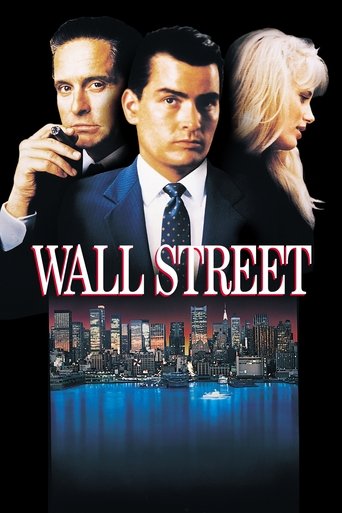
Wall Street
1987 · Film · 126 min
Part of Wall Street Collection
Directed by Oliver Stone
A young and impatient stockbroker is willing to do anything to get to the top, including trading on illegal inside information taken through a ruthless and greedy corporate raider, who takes the youth under his wing.
11 positive1 mixed64 neutralfrom 76 commenters
Where to watch
No streaming data for this title.
79 comments on Hacker News
This is not specific to Silicon Valley. It's human nature.
People take the "vibe" from a work and assume the vibe is the meaning. Look at how things like Fight Club, The Punisher, and Wall Street are viewed in the general culture.
The Great Gatsby is a famous cautionary tale of the danger and pointlessness of unchecked pursuit of wealth. It's studied widely in US high schools. When the movie came out, all over the US people held "Gatsby Parties" which were 1920s themed parties focuses on ostentatious displaces of wealth.
No matter how profound and important the message, most people won't look beyond the vibe.
> "greed is good" refers to a very specific brand of robber-baron capitalism.
It does not. It refers to the Eighties brand of corporate raiders and excess Capitalism. It's a quote from the film, "Wall Street". That whole paragraph is wrongly conflating ideas.
I've been thinking about that comment and I don't think it makes sense. When it comes down to it, PE is really just doing two things:
1. Taking advantage of a pricing inefficiency; and/or
2. Using local monopolies, inelastic demand and regulation to jack up prices.
But what powers PE is the LBO (leveraged buyout). That is, you buy csome company with borrowed money and then you borrow against the assets of that company to repay your original loan.. That... shouldn't be allowed. Obviously that company is saddled with debt and it's usually structured to explode at some future point when the buyers won't actually own it anymore. I think of it like subprime lending in a way.
Now passive funds kind of have to buy sufficiently large companies. This has been an issue with the SpaceX IPO because SpaceX is doing a small float (~5%) and NASDAQ has changed the rules to essentially force passive funds to buy SpaceX where up until now that wasn't the case unless at least 25% of the company was available to buy. It's so nakedly corrupt.
Anyway, if a LBOed company saddled with complicated debt gets re-listed it kind of has a captive market of buyers with passive funds.
So going back to (1) there is long historical precedent for pricing inefficiencies. I'm speaking about the corporate raiders of the 1980s. The movie Wall Street was about this era (well that and insider trading). Essentially ailing companies would be trading below their book value. The book value was simply the value of assets (real estate, etc) so you could buy the company, sell it for parts and make a profit. All the lost jobs be damned.
The companies that tend to get targeted for PE own real estate. This has been a competitive advantage because yet other rent-seekers can't exploit them by jacking up rents. But real estate is an easy asset to sell to pay back your LBO and you can even split the real estate into a separate company and lease it back from that company. It's just financial hocus pocus.
There are some great movies that deal with this: Wall Street, The Firm, The Big Short, Suicide Kings, Michael Clayton, among others.
One can even consider the never ending Ethics classes in college an ironic form of corruption that never teaches anything we don't already know by secondary school, but used to pad credit numbers and tuition revenue.
You may have heard of the 1987 Michael Douglas film "Wall Street"? Nothing has meaningfully changed since then.
Used in the movie Wall Street to justify insider trading too:
Bud: Lou, I got a sure thing. Anacott Steel.
Lou: No such thing, except death and taxes. Not a good company any more. No fundamentals. What's goin' on, Bud? You know something? Remember, there are no short cuts, son. Quick-buck artists come and go with every bull market. The steady players make it through the bear markets. You're a part of something here, Bud. The money you make for people creates science and research jobs. Don't sell that out.
Bud: You're right, but you gotta get to the big time first, then you can do good things.
Lou: You can't get a little bit pregnant, son.
Bud: Lou, trust me. lt's a winner. Buy it.
Lots of finance people from an earlier era ended up there from the movie Wall Street which is hilarious since it was not intended as something glorifying the sector
Well, they DID have to scrape together a few % of the purchase price </s>
Isn't this what Gordon Gecko did in the movie Wall Street? Look for asset-rich companies, buy a controlling interest of the stock (the equivalent of the PE leveraged buyout) then strip them for parts? Also, wasn't that a cautionary tale of the worst of the 80's vs. a "how to" manual?
Some viewed the Wall Street movie as a tutorial
I'm not sure what culture you are talking about that celebrates greed. Maybe you are thinking of Michael Douglas's character in the Wall Street movie, and his meme-like "Greed is good". The guy was the negative character, the movie's message was that greed is bad.
What you hear in America, at least, is a culture that celebrates hard work, and generally considers laziness a vice. Why are people willing to work hard? Because they want to succeed in life. That's what the American dream is, after all. You could try to look at it from the angle of "because they are greedy", and, in the end it comes down to dollars: people work hard because they want more of those green bills. But pretty much nobody perceives that as greed, they perceive it as the right compensation for hard work. And certainly nobody goes out there with the message "kids, be greedy; follow my lead, I was greedy in life and look how well I did in life".
What I have noticed though is that a lot of people deplore grid, just like you are doing. It's very easy to perceive that other people are greedy. But very few people perceive themselves as being greedy.
Well, duh, you could say. But here's the thing: in a culture that celebrated greed, people would be proud to call themselves greedy, and to perceive themselves as greedy. But that is just not the case.
Happy to hear counterarguments. Especially examples in popular culture where greed is glorified.
Ironic that the WSJ is saying that greed actually isn't good, while 37 years ago, Wall Street's (the movie) Gordon Gekko was saying the opposite.
There's a great scene in the movie Wall Street. Bud is an ambitious wall street trader asking his dad for money, and his dad is a working class union representative.
>Bud: It's Queens, Dad and a 5% mortgage and you rent the top room--I gotta live in Manhattan to be a player, Dad. There's no nobility in poverty anymore, y'know. One day you're going to be proud of me, you'll see...
Much of that raw, punk, diy, screw the rules mindset came from the working class. In the 90s it started to shift I think along with the offshoring of many blue collar jobs, and rise of FIRE [0] (finance, insurance, real estate) which are historically conservative industries.
Nowadays musicians are celebrated for their gross ticket sales more than their music, look at Taylor Swift's recent tour. People in my office obsessively discussed all week how much money she was making at each show. Back to your point, profit is the driver today, for better or worse. You won't get a filthy, crusty punk show anymore, but at least the venue is compliant with all current fire codes.
[0] https://fred.stlouisfed.org/series/GOFI
https://www.rogerebert.com/reviews/blackberry-movie-review-2023
> “BlackBerry” is a MoneyBro movie par excellence, right up there with “Wall Street,” “Glengarry Glen Ross,” “Boiler Room,” and “The Wolf of Wall Street.” It shares their key, defining trait: even though its main characters are either charismatic sociopaths or sheep, and the capitalist system they operate in is deeply corrupt and rewards men without morals or conscience, the story is so excitingly told, the performances so watchable, and the dialogue so quotable that it becomes the verbal equivalent of an action flick—kinetic, suspenseful, and sometimes unexpectedly beautiful and weirdly moving.
While I agree with Spielberg's realization that modifying his prior work was a mistake, there's something I would like to be able to do with movies as a consumer that I wish streaming services offered.
Hollywood seems obsessed with three things: Guns, sex and objectifying women.
While not every movie has guns, the sex and objectification is pretty much everywhere. Perfectly good movies have utterly unnecessary sex scenes that make them impossible to watch with kids. In some cases this is also uncomfortable in family gathering settings.
Two examples that come to mind (there are thousands):
Die Hard. He opens an office door, only to expose a couple having sex. Of course, the woman is fully exposed, while the guy is not.
Lucky Number Slevin. The main character walks into his apartment only to find his girlfriends on all fours on the bed having sex with a guy. Again, full sexual exploitation of the woman, of course.
The Last Kingdom (series): Once again, sex everywhere. No value whatsoever to the story. It's a great series. Unwatchable with kids and in other settings.
Battlestar Galactica (the one with James Olmos): Excellent series. Sex everywhere. No nudity that I can remember, yet scenes of oral sex and other forms of sex without showing full body nudes. Fucking unbelievably unnecessary.
Outlander (series): Might as well be labelled porn. It's a sex-fest. Humping in any way possible at any possible time and even male-to-male rape. Nothing whatsoever to add to the story, which would have been amazing without all that shit in there.
The Queens Gambit (series). Fantastic series about chess. My kids are really into chess. Fuck if we are going to watch it with them. No nudity, yet drugs and sex are featured. The character is fictitious, which means there was no need for any of it. The producers just wanted to include sex and drugs. This one can't be fixed. I am not going to watch a show with my kids that implies taking drugs can make you smarter in any way.
There are tons of movies and shows with similar problems. Movies that are excellent and yet the producers feel it is necessary to insert a stupid sex scene that adds absolutely nothing to the story and is of no value whatsoever other than to show boobs bouncing and feature women as sexual objects.
Notice I did not say anything about movies like Fifty Shades or Gray, Wall Street or Eyes Wide Shut. Those are movies where the story justifies some of what they feature. There could be an argument related to female objectification, that's about it.
I am not a puritan, by any means. I just think this is stupid, wrong, unnecessary, detrimental and destructive to women. Having a daughter changes your perspective on what's out there in popular culture. Great movies and series are being ruined all the time by inserting sex where it is unnecessary, and it is usually at the expense of women.
Getting back to the first paragraph. I wish there was a setting on streaming services to be able to watch these movies with those scenes cut out or replaced by alternative scenes shot and chosen by the creators.
In the case of Die Hard, the couple could be kissing, taking a nap, playing chess...anything. The point is they were distracted and did not react to the emergency. In the case of Slevin, the sex scene could either be completely cut out or replaced with something different.
That, to me, would be a feature very much worth having. Hollywood's obsession with sex and the objectification of women is a problem that does not seem to receive the attention it should.
It's always so baffling to see people on HN not understanding that the sole purpose of business is to make money, lots of money.
It's always so baffling to see people on HN parrot this line as if it was fact or truth, when it's far from either.
Yes, there are lots of businesses that exist only to make money. But there are millions more businesses that exist for other reasons. And, no, I'm not talking about non-profits. Kelloggs, for example, was founded to improve the nutrition of people at a health retreat.
The whole moustache-twirling moneybag-hoarding billionaire thing used to be a cartoon, because it was so misaligned with the reality of society. But in the Silicon Valley bubble, this has been turned on its head and elevated into some desirable goal, as if the only way to judge a company's value is by dollar signs. It is not.
(It wasn't even Silicon Valley that started this flip. It goes back to the 80's, as parodied by the character Gordon Gekko in the film Wall Street.)
Very nice, concise, and de-jargoned explanation of how value is “created” and “destroyed” in stock ownership.
Also, here is a relevant Gordon Gekko quote from "Wall Street":
"Money itself isn’t lost or made, it’s simply transferred –- from one perception to another."[1]
[1]: https://amontalenti.com/2011/12/16/wall-street-the-movie-25-years-later
most of crypto/segments of wallstreet are a giant scam using mathematics to make money, any pr is good for them. It is like that wall street movie quote "You got ninety percent of the American public out there with little or no net worth. I create nothing. I own. We make the rules, pal."
Consumption seems like a never-ending treadmill of its own. I'm quite the foodie, but I've made peace with the fact that there will always be more restaurants out there than I can possibly hope to dine at during my lifetime. You could say the same thing about music, art, etc.
It's like Bud Fox said in the movie "Wall Street"- "How many yachts can you water-ski behind?"
"The complaint also alleges that L. Palmer later reimbursed the client by check for the purchase cost of the options, scribbling in the check's memo line the words, "Blue Horseshoe," an apparent reference to the coded language used to convey inside information in the 1987 movie Wall Street."
How can people be so idiotic?
Someone wrote once about how Wall Street people started behaving like the slick image projected of them in movies in the 80s, namely of Michael Douglas; before that they were more like the "boring accountant" type.
Back in 2010, I was invited to a party in a building down at the south end of Manhattan. We were 4 blocks from Wall Street. It was a new building, my friend had just moved in. The building was for the "$400,000 a year working stiffs" of Wall Street, but that line is from 1987 (the movie Wall Street) and nowadays they all make a few million a year.
I was surprised by the relatively poor quality of the building. All the walls were covered with carpeting, but the carpeting was falling off in some places. Some of the light fixtures hung awkwardly slanted from their slots. The door knob (of the apartment) was very cheap and was already showing signs of wear.
Keep in mind, this was a new building, built for wealthy people.
Something feels broken about this culture, where even the rich cannot buy nice things any more.
“Money never sleeps.” - Gordon Gekko. I know people who went into finance inspired by the movie Wall Street.
Relevant comment from John Carmack a couple weeks ago:
Atlas Shrugged popped up in a trend, reminding me of the remarkable level of vitriol against it. It is obviously grinding an anti-collectivist axe, and it can fairly be called cartoonish, but if you can't see its archetypes in the world around you, you aren't paying attention.
I can easily understand people not liking the book, but the level of loathing that some show for it is odd, as if someone could go off on a rant and redline judge everyone who enjoyed the movie Wall Street as obviously terrible people.
https://twitter.com/ID_AA_Carmack/status/1478389565094256642
"Born in the USA" continues to be a staple of Republican rallies.
Michael Douglas' "Greed is Good" movie speech had a bigger cultural impact than the actual plot of the film (Wall Street, 1987), where the exploitative nature of private equity takeovers is shown, and where both Douglas and Sheen eventually land in prison for insider trading.
Your comment reminded me of this excellent post, best read with its fun accompanying illustrations, "How Money Forever Changed Us":
https://moretothat.com/how-money-forever-changed-us/
Specifically, the discussion of the "pogs" craze in elementary schools in the US in the 90s. "Basically, a nice little gambling ring was growing amongst us starry-eyed 2nd graders."
The OP would certainly read differently if he wrote, "How I won $50K in 3 days with NFTs", rather than saying how he "made" $50K.
Also the Gordon Gekko quote from "Wall Street":
"Money itself isn’t lost or made, it’s simply transferred –- from one perception to another. ... I create nothing. I own."[1]
[1]: https://amontalenti.com/2011/12/16/wall-street-the-movie-25-years-later
You might also be describing 2021-2051.
Well, except pension, which were largely gutted in the private sector by 1991 (it was the plot of the 1987 movie Wall Street).
I watch good movies many times. I keep them on a loop while studying, or working. In college, I always had an Oliver Stone film on. At the time the duality between good, and evil, was always on my mind.
I must have watched Wall Street, and Platoon, a few hundred times.
I won't even estimate how many times I have watched Hictchcock films.
And the number of times I have watched Giant, or Citizen Cane, is embarrassing.
I have old movies playing all the time. I don't actually watch them, but I find them comforting in a weird way, esoecially black, and white films. I think the old, good movies take a part of my brain away from reality? I listen to them while working,
Yes--how can I find Platoon comforting? At that point in my life, Charlie Sheen's character, and his father's, reminded me there are moral people still left. Maybe only in fantasy though?
I get what you are saying though. I have The Andy Griffith show on all the time.
(fun murky fact, I think true, fact about the Andy Griffith show. They didn't bother to copyright the episodes. For years people could sell copies of the show without copyright concerns. I think it's copy written now though.)
I'm with you up until the last part.
If people want to gamble with their money and get something out of it, that is their right.
I just wish people with money had a little shame and didn't spread this fairytale of these crypto currencies being anything other than a lottery ticket. The question 'how much is enough' from the movie Wall Street often comes to mind every time I see some rich scumbag like Chamath promoting bitcoin on TV. Haven't you got enough fucking money? Apparently not and so it goes.
thank you, I am sure you save a lot of time for a lot of people. There is an interesting conversation in the movie "wall street". Bud Fox tries to make a sale pitch to Gordon Gekko. After awhile, Gordon says: Now tell me something I don't know.
> It is not clear to me why being selfish is either antisocial or being greedy is antisocial.
Because greed leads people to harm and neglect others for gain? This is an extremely basic idea, and if it's still not clear to you, maybe you could watch a movie like Wall Street (https://www.imdb.com/title/tt0094291/) and pay close attention to the Blue Star employees, how Gordon Gekko is willing to harm them, and how little he cares about it. It's probably not the best movie to teach this, but at least it's for adults and it came to mind easily. It feels like it would take more time than I'm willing to spend to explain it.
> Almost all the better societies, more livable societies are where people are free to pursue their own self interest (aka greed or profits). The one like North Korea where government beats people to be "non-greedy" appear to be pretty violent places to live.
It would probably do you well to just completely forget about North Korea. I'm no fan of it at all, but what you wrote reads like a rough rehash of some melodramatic libertarian propaganda meme (e.g. make and extreme idea like "greed is good" by placing it in opposition to a villain).
>> which is almost never correct
> I am not seeing either any black or white. You on other hand just called a lot of people antisocial. So people who move out of California to Nevada because they dont want to pay 10% (or 16%) state tax are antisocial ? Seems pretty black and white assertion to me.
You totally are seeing things in back and white (or more precisely, pairs of radical extremes). However, I'm not really willing to spend any more effort trying to hand hold you away from that.
Also, the free association argumentation thing is obnoxious. We're talking about tax havens (and a weird assertion that they should be pride-inducing), what do state resident income tax rates have to do with that? Those are very different things.
Afaik it used to be popular in the 70s and 80s. It’s sometimes called “Corporate Raid” [0]. In the movie Wall Street, Gordon Gecko wants to buy the airline to sell it for parts.
[0] https://en.wikipedia.org/wiki/Corporate_raid#History
> such a one way street?
It's not, though - rich people get in trouble for this all the time. Bernie Madoff is going to die in prison for running a finance scam. Enough people were convicted of insider trading in the 80's that they made a movie about it - and the movie was just called "Wall Street". None of this is new.
I doubt you'd find much polling. The movies Wall Street (1987) and Other People's Money (1991) would be the next best thing for a pop culture view of the finance industry.
Movie Wall Street with Charlie Sheen and Michael Douglas.
There's this Wall Street movie made in 1970 (?) about this very kind of people.
She says the ones coming in to California "...flock here for gold and glory, ready to hustle and disrupt, hammering to hit the motherlode and laughing at the odds" while the ones leaving "...leave their families and communities behind on the chance they will, ironically, strike gold."
In other words they are the same. In both cases they're de-prioritizing more traditional values (home, family, friends, community) to pursue wealth and fortune. To put it bluntly and somewhat negatively (although I'll make a disclaimer in a sec), they're coming for greed, and they're leaving for greed. There's no contradiction.
Here's that disclaimer and a bit of a tangent: Greed has a good side, like Gordon Gekko's speech in the ancient movie Wall Street -- "Greed is good. Greed works." Basically greed is just a thing; the desire for more ___. And keep in mind that all things have dual nature dark/light just like the yin/yang symbol shows. Dark and light are not only coiled intimately around each other, but there is also a spot of the one inside the very heart of the other. It's really a brilliant piece of symbology and a good reminder about the world, that participants in fruitless and polarized political debates would do well to pay attention to. (Though nobody wants to hear there's as much evil in them as in their opponents, or that there's as much good in their opponents as themselves... especially when it's true.)
Anyway, with that in mind, you can state something like "Steve Jobs was greedy" and see what a perfect statement it is. It captures both sides. But yeah so in that case let's not fail to call out the aspects of the Silicon Valley "dream" that are inherently materialistic. Or opportunistic, might be a better word. Should we really be surprised that such a place, through its own success, begins to crowd out other uses/priorities/values including both traditional ones (home, family) and non-traditional-but-non-materialistic ones (art)?
Also what of these other towns where life is cheaper? They are filled with people who stayed put, who chose "home and family" above "gold and glory." Granted some of them had the luxury of choosing let's say "being an artist" because the town is cheap enough to do so. Others had no choice but to be pretty-much without gold or glory because of a general dearth of opportunity. But don't let either one of those things distract you: People in these places, especially people who grew up there, value the things they value. I'd imagine you'd find "home and family" are ranked as higher priorities, as well as "creativity," while "fame and fortune" would be ranked lower. Materialism and opportunism would be lower. Restlessness, shallowness all would be lower. If you could measure things like that.
So again, should we be surprised that when people steeped in the Silicon Valley go-go-get-'em environment -- either the ones who already traded "home" for "success" once in order to go there, or the ones who, like the author's friend, are doing it for the first time -- land in those other places, and end up standing out unwelcomely like the proverbial sore thumb? Try to blend in(0) and you might find less "hate." The "angry locals of Portland, Seattle, Denver, New Orleans, Kansas City, Phoenix, Austin, and elsewhere" aren't pissed because they think you're rich snobs (though those do stand out more, in part because of their disproportionate ability to influence the actual physical architecture of a place, more on that in a minute); they're mad because by virtue of your very relocations, you display a verifiable history of being at least greedy/opportunistic enough (again, in both good/bad senses) to do so in the first place, and of embracing the values the Valley/Bay is famous for, and of actively disdaining the (apparently now contrary) values these people adhere to, which are ironically the ones whose loss is being lamented in this piece.
(0) I shouldn't have said "blend in." "Blending in" sounds too much like fascism. "Harmonize" would be better. Because like people in a band, you might all be playing different instruments and parts, but you sort of have to be playing the same song, don't you.
Architecture provides a good metaphor here. An ostentatious new ultra-modern house that makes no effort whatsoever to harmonize with the surrounding architecture -- there are now plenty of those in these towns. If you say you don't like them, people will disingenuously say it's because you're an ass-backwards hick who hates modernity, but that's not the reason. It's because it's artless, jarring and tone-deaf, like someone who joins a band while it's playing and starts playing a different song.
>The Bitcoin hype cycle is driven by the mass media.
It’s much more nefarious...the boom and bust articles are essentially ordered by individuals/groups with the influence as part of the market manipulations. It’s not entirely unlike what people refer to as submarine articles, what’s lurking underneath these publishing’s are attempts to move the markets (the first wall street movie actually does a decent job of demonstrating this practice in the 80’s for the stock market).
These details will be exposed now that the SEC is beginning to target manipulations in these markets.
My Great Uncle Joe served in World War II. 4 years tromping around Europe. In his 80's, he still woke up at night, screaming. So his wife would tell us; he never spoke much about that. She lost her first husband, Fred, to the war. Society calls them "The Greatest Generation".
They couldn't have kids. But they ended up running a drive in, where the kids who worked for them became like family. They put more than one through college, and took one in when he needed a home. Decades later, those kids would call and visit them.
Well, those kids may have turned out pretty well. But, generally, I've come to think of those who came after this "Greatest Generation" as "The Selfish Generation".
Really, we're speaking of more than one generation, here. The symbolic touch phrase might come from the 1980's, written in the movie "Wall Street":
Greed is good!
To which I might respond, "Divided we fall."
For some reason, that movie never ever resonated with me, compared with other Wall Street movies like "The Big Short". What is it that people like about it?
In the movie "Wall Street" (1987) Gordon Gecko has his lackey Bud Fox follow a rival around to try and figure out what he's going to invest in, so they can undercut him.
He follows him to a private jet and finds out it's flying to mid-sized city that happens to be the corporate headquarters of a particular company. In the movie it's sort of implied that this activity is illegal.
I wonder if it actually was, and if so, why that would be different than what those hedge fund guys you reference were doing?
> tech bro... CEOs
Even in this headline, there's some pretty interesting equivocation happening between techies and CEOs overall. The article makes a decent case for why there's collective anxiety about tech companies, but neglects the question of "why only tech?"
The ~1990s had a whole string of movies with bankers and investors as villains: American Psycho, Rogue Trader, Glengarry Glen Ross, Wall Street, Boiler Room, and so on. Lately, we had had Wolf of Wallstreet and The Big Short, but in a post-2008 world where banking already has trashed the economy we're surprisingly short on bankers-as-villains films.
We got a couple of global warming films in the 2000s, and a couple more in the 2010s, but I can't think of one which makes a serious attempt to cast oil CEOs as villains - certainly not in the sense that e.g. tobacco companies have been. Avatar is probably the closest thing to "CEOs trashing the environment" that's been a hit.
Pharma companies lend themselves to human-interest tragedies, and we did get Dallas Buyer's Club. But there's no whole genre here like there used to be with "the bank takes the farm".
So there's the missing question: why tech companies specifically? The most obvious answer is just "more impressive visuals". I'm not sure we're talking about a particular anxiety of the moment, or if it's just that banks and oil companies work better on the page than on the screen.
The book was brilliantly written and really captured a time and place. The movie was just meh.
Maybe, absent a book, the movie was just mostly forgettable. There were better films involving 80s financial types like Wall Street. But we’d probably remember Bonfire as a minor film that largely wasted star power through miscasting etc. rather than a bomb.
One thing I've been struck by with movies and films like the Wolf of Wall Street, the film Wall Street, Fight Club, or even the Great Gatsby is how many people end up coming away with the exact opposite message of the movie. They end up idolizing the vapid, shallow lifestyle that the movie is critiquing, because even though the film is critiquing that it can't help but also make it glamorous. Michael Douglas has said that he has had people come up to him and tell him that Gordon Gekko inspired them to get into finance, so it's not surprising that Belfort is now inspiring a new generation.
"If you pull in $400,000 a year you aren't middle class, you're rich."
This is from the character Gordon Gecko, in the 1987 movie "Wall Street":
"Wake up, will ya, pal? If you're not inside, you're outside, okay? And I'm not talking a $400,000 a year working Wall Street stiff flying first class and being comfortable, I'm talking about liquid. Rich enough to have your own jet. Rich enough not to waste time. Fifty, a hundred million dollars, buddy. A player, or nothing. Now, you had what it took to get into my office; the real question is whether you got what it takes to stay."
https://en.wikiquote.org/wiki/Wall_Street_(1987_film)
Wealthy people live on capital. That is a traditional definition of what it means to be wealthy. If you have to work, at all, then you are not wealthy.
i am now interested in the movie i thought your uncorrected typo referred to: The Worf of Wall Street
A reminder: LLCs aren't one tax status.
You can have an LLC taxed as an S-Corp, an LLC taxed as a C-Corp, or an LLC taxed a pass through. Anyone who says an LLC is taxed in a particular way is way over simplifying to the point of confusion.
But, to over simplify on my own, Delaware is popular because it has a history of protecting shareholders over management. The movie Wall Street exists because in the 80s, companies tried to protect themselves from investors -- and Delaware stuck with shareholders firing management (not entirely, but significantly). In theory, investors may pay a bit less if you're in a state without that track record.
But, there are plenty of exchange-traded LLC securities, so it's not a bar or ban to fundraising.
The movie "Wall Street" is littered with them.
Let me tell you about the time I caught the "finance bug" after watching Wall Street film in 2007.
I had a near 99% accurate scalping system. I could not believe it. Every trade I was making was profitable. How could this be?
The system worked without a stop loss. Meaning 1% of the time the prices turned, it wiped out all the profits (limited reward) accumulated.
I published all of these details on my university homepage which has since been deleted as they won't let alumni's keep one. But I was very careful that while 99% system accuracy is achievable, it's the downside risk that makes the system pretty fucking useless.
Of course you can put a stop loss but the system ran on "limited rewards unlimited risk". There's just no holy grail out there. Even if you read Hull's options book, no matter how complex your option strategy gets, you always have to be right at the end of the day. It's pure speculation and we all know how casino's work.
So knowing this, if it sounds too good to be true, there's a very strong reason for it. Retail trading is a zero sum game. Even more suspicious when the downsides are conveniently left to "if I gave it away system won't work". I was fully transparent about the downsides when I published my trading system.
The last thing I wanted was to people without the financial literacy to naively believe that a holy grail trading system existed. They don't exist. History is filled with funds that blew up because they believed alpha generation would be a constant thing.
Even quant trades I question their success. In the long run, all trades are speculative and carry risks (except arbitrages which are automated to oblivion). No matter how sophisticated you get the risks are always unknown.
I feel your pain.
Few years ago my company switched to an open office layout. There was a temporary arrangement issue, so I had to sit in the sales section of the floor for a few weeks. I don't think I accomplished a single thing the entire time I was there. Constant phone calls, loud talking across multiple rows of desks. It was like that scene in the movie Wall Street. The guy behind me was incapable of properly using a keyboard. He would mash the keys down as if he was angry at them. Never heard such noise from squishy dome keys before. Jesus.
The greed that people talk about when they say that greed is good (by way of Wall Street, the 1987 movie) is, though.
Also, a great many uses of the word in (lazy) criticism of markets and capitalism is that too.
No director is perfect. Oliver Stone had a few duds, but he also made some excellent movies: JFK, Any Given Sunday, Platoon, Talk Radio, Wall Street...
If you have to criticize him, you could say that his recent movies have not been up to the bar he set in the '90s -- but it definitely was a very high bar.
I'm much more worried about Gordon-Levitt playing Snowden, from the trailer he looks pretty bland.
There are some gems at the glassdoor site referred to in the article.
It is true, CTO did make whole team of people redundant on New Years Eve via voicemail - maybe 'how to' book on leadership taught him redundancy procedure.
Led by a truly odious individual, this attitude is prevalent throughout the company. Senior management are relics of the 80's living off their success in the last dotcom boom (and bust), who believe the film 'Wall Street' is a training manual for management, business practices and team leadership.
These were via https://www.glassdoor.com/Reviews/Employee-Review-Powa-Technologies-RVW3877050.htm - looks like a signup would be necessary to get the full reviews.
I noticed, though, that clicking through to the full reviews page, the most recent are glowing ones from Powa's head of development and head of sales ;)
Quite right. Almost everyone is quite rich in terms of available goods and services per median income, compared to 100 years ago. Even by 50 years old standards, I am super-rich, having the ability to travel though Europe many times per year, flexible working schedule, and having, say, an on-demand driver available on call by the push of the button on my portable phone... this is insanely rich even by original Wall Street movie standards! And I am not a Wall Street trader, I am just a self-educated software engineer, coming from relatively poor family. My wife is a mathematician, also enjoying similar privileges.
So yes, I am looking forward to get even more richer in time. Like most of people. And this is way easier than it ever was before.
My favorite movies, but for no particuliar reason:
Platoon
Wall street
Three days of the condor
Chinatown
Sunset Boulevard
The Stranger(actually all of Orson Wells movies)
Any Andy Griffith episode
Bicycle thieves 1948
Niagara
Double indemnity (actually most billy wilder films)
The Misfits (last film for Marilyn and Rhett Butler--forgot his name.)
Giant
Rebal without a cause
Leaving Las Vegas
Blow out (all three)
Saturday night fever
Yes, even Urban Cowboy
One flew over the cocos nest
Deliverance
Hanna and her sisters
East of Eden
Dr. Strange love
Back to the future
Jaws
In cold blood(with Robert Blake)
In cold blood (with Eric Roberts, and forget his name)
The asphalt jungle 1948?
All about eve
The hot rock
Little Haus Big Halsey (Redford said it was his worst movie. Yes, it's masagonistic. Yes, he plays a jerk. But the movie captures the 70's I recall as a kid. The filming is great. His side kick in the movie did a great job playing a sweet, innocent, country teen.)
A lot of foreign films I have yet to see.
Back in the 80s, they were called by the term "corporate raiders". The movie Wall Street (a classic, unlike the dismal sequel) is all about them.
FT seems like the wrong place for an interview like this. Already 2 paragraphs in the author makes a cliched references the movie Wall Street and refers to Talking Heads "avant-garde pop".
But I will take any opportunity I can to read about David Byrne.
Do all men care about money? No. But are there are set of men who seemed to be consumed by money more than any set of women, oh yes.
Who works on Wall Street? Hell the movie Wall Street, Boiler Room, etc aimed at?
My first thought was: there obviously needs to be a reference to the 1987 movie "Wall Street" in there somewhere.
"Due to their large size, aircraft can also be observed physically taking off and landing at airports by scouts stationed as “tailspotters,” a role played memorably by actor Charlie Sheen in the 1987 feature film Wall Street."
Yep, I'm right.
For your first paragraph, I was trying to teach a little about probability. For the probability of rain, I mentioned that, and my mention implied the good lesson there: We can assume that there really is a probability of rain, that is, it definitely exists. Now, especially for deciding to place a bet, we could get an estimate of that probability. The 50% is a first cut estimate with some curious properties about 'total ignorance' but otherwise poor. So, how the heck to get an estimate? Likely the best practical way was by the student seeing a weather report on the news. Otherwise, for, say, the probability of rain of any day in, say, August "We might, what, class? Anyone? How might we get an estimate of that? ...?"
Or, "Billy, what company makes iPhones? Billy, you can't get the answer by teasing Sandra. Mary? Right, Apple! Okay, suppose we buy 100 shares of Apple stock today and sell it seven days from now. What is the probability we make over $1000? Assume that this probability exists and we want to estimate it. People especially good at such estimates can become among the richest in the world, fairly quickly. So, how might such an estimate be made? Information? Any ideas? Anyone remember the motorcycle, airport, and airplane in the movie 'Wall Street'? What was the role of 'information' there for an estimate of the probability that the stock of the steel company in Pennsylvania would go up a lot, soon? Anyone? Sandra?"
I was just about to post exactly this. Anyone interested in what Wall Street actually does needs to watch this movie.
I have an MBA. I have nothing against making money. But while it's possible to make money by creating something of value, it's unfortunately possible to make even more money while doing the opposite.
It's kind of absurd how closely Carl Icahn's mirrors that of the story of Gordon Gekko in Oliver Stone's movie Wall Street. What Icahn did to TWA is pretty much exactly what Gekko did (or planned to do) to Bluestar Airlines in that film. Longer period of time - but in principle, very similar.
This kind of reminds me of the original Wall Street movie, where Charlie Sheen broke into companies via their cleaning service, and then stole inside information.
I reckon that there must be a lot of writers out there thinking: "Hell, it was meant to be a cautionary tale, not a creepy government manual".
People have a habit of doing this with lots of narrative art. My favorite example is the movie Wall Street, which was apparently supposed to be a cautionary tale about what happens what the amoral will do anything to make money.
Instead, a lot of people saw it and thought, "Gee, it looks like you can make a lot of money in finance—and greed is good." Never mind that a villain makes the speech and that the quote is mangled! It's a movie telling us that it's a good idea to follow our worst instincts, so let's do it!
80's = Reaganomics
http://en.wikipedia.org/wiki/Reaganomics
"Greed is good." is a quote by the character Gordon Gecko from the movie Wall Street.
http://www.imdb.com/title/tt0094291 http://en.wikipedia.org/wiki/Gordon_Gekko
Cheating is a complex subject to speak of, especially in US. Let me share my experience with some of these cheaters.I would like to point out that I do not admire them nor I take their side, yet I am trying to understand the problem and find some reasoning behind these actions.
Everyone thinks you are stupid or evil if you cheat yet it has a deeper meaning here.We have to ask ourselves, why would someone cheat?Does it matter if it's Harvard or Stanford?No, it doesn't.The reasons are usually the same wherever you go.
The first one I can think of is Lack of Interest.The student simply doesn't give a about a certain course, and he knows he will never use it after graduation so he decides to cheat on the exam.Cheating himself?No, because he doesn't like that course at all and he will not use it in the future, so why wasting his time.No benefits, nothing coming out of this course.
An example would be the GE in the first 2 years of college.I believe it's a waste of time and money. That's why other countries don't use it.
The second one is Lack of Enthusiasm. Maybe the student doesn't like the professor or the way he teaches.Maybe he knows more than the professor.Maybe he needs something extra.Who knows...But surely this can lead to cheating as well, although this would definitely impact your future if the course is connected with your job aspirations.
The third one is No Social Life/Seeking Popularity among certain groups.Some students think that by cheating they can get in some fraternities or joining famous campus groups or getting the "girl next door" etc. A shortcut to something which they cannot obtain through other means.You don't see a movie where cheating is not cool, do you?Look at some of the commercials.Nothing negative about cheating.
Forth would be the so called "corporate mindset".They look at some billionaire stories and unethical companies that make a lot of money through schemes and cheating.I mean look at the Wall Street movies.I don't think there is one movie where characters make money by being ethical.So students think that's cool.Heck, they even drop college thinking they can become a SJ or BG.There is no other way...
I think I'll stop here but there are many more.Should we consider all of them stupid?Well, not really.The truth is the world today is not the same as the one 10-20 years ago.And yes, companies don't play fair.How can you encourage someone to be ethical when most of the top 500 companies are on the other side of the spectrum.
How can you survive as a business if most of the competition is cheating in some way?You cannot.
Let's take an example here:
Student A = Cheating/Unethical Student B = Studying/Ethical
A gets a 4.0 GPA by cheating through college.* B gets a 3.5 by playing it fair.
*Assuming Student A is not retarded or anything and he cheats when he needs to, not to the point where he couldn't bring any value to a company after graduating.
Who will get the job at a top company? Probably A because if a 4.0 is a requirement, the recruiter will completely ignore B.Can you blame the recruiter?Not really.It's impossible to ask 1000 people if they cheated or not and so on. Not fair for the hard-working student.
That's just my 2 cents.Sorry for my bad writing.
ADM's lysine fixing in the 1990s. The savings and loan debacle of the 1980s and 1990s. Hunt&Hunt's silver manipulation in the 1970s. The Towers Financial Corporation Ponzi scheme of the 1990s. Robert Emmet Brennan's First Jersey Securities pump-and-dump fraud in the mid-1990s.
Political white collar crimes from the 1970s include Watergate and Koreagate.
And as for movies: "Trading Places" was a 1980s movie ending with a foiled white collar crime attempt. "Wall Street" is a 1987 film where Gordon Gecko is convicted of multiple securities violations. "The Insider" is a 1999 film based on a 60 Minutes segment about a tobacco industry whistle blower. John Braithwaite wrote "Corporate Crime in the Pharmaceutical Industry" in 1984.
That you don't know about them doesn't mean they didn't exist or that people didn't know about it.
The title is pretty unrevealing (I mean, hey, way back when Wall Street was filmed, this concept was featured in the film). What is interesting here is that the FAA has a privacy program that allows private aircraft owners "to keep their plane movements from public view." This program is now ending. Now people will be able to track where corporate jets are going and thereby, the article suggests, get insight into M&A discussions.
"Are hollywood movies really motivating career decisions?"
You bet. When Top Gun came out, enrolment in the Navy and Air Force increased substantially. Wall Street in part fuelled the popularity in a career in finance and I'm willing to bet that Rounders was used in part to justify being a professional poker player for many people.
Also, I'm pretty sure that Blade Runner (at least subconsciously) contributed towards me going back to school and getting a masters in machine learning.
I've worked on problems that are famously profound (cancer research!) and problems that people think are stupid, trivial, and ephemeral. I've also worked for big, famous institutions, and I've worked for tiny companies.
And I caution everyone not to fall into the mental trap of overvaluing mass at the expense of momentum. When Tim Berners-Lee invented HTML, it looked kind of silly. And, actually, it has looked kind of silly ever since. But make no mistake: The invention of the web is probably a more important human advance than anything else that has happened in the last twenty years. It has probably already saved more years of human life than the last twenty years of cancer research, for example.
A lot of the problems that people think are important and profound are intractable. Intractable problems don't go away, because they don't get solved. They are around for the long haul. There's time to build institutions around them, to build popular awareness of them, to get really good at marketing them. When someone claims to be working on a Very Important Intractable Problem everyone knows they are Smart.
Whereas many world-changing practical inventions are never profound. They are always either silly or boring. They start off silly. When you first invent the mobile radio people laugh at you, because you are a ham radio geek and you carry around some big ugly boxes in a van. Then mobile radios become frivolous things carried only by the CEOs in the movie Wall Street. Then they become frivolous things carried only by hipsters. Then they become frivolous things carried only by salarymen. Then they become frivolous things carried by the young. And then... they become ubiquitous, no big deal, boring. In a handful of decades we are going to equip everyone in the world with a goddamn tricorder and society is barely going to consciously notice.
That is a technology with momentum. Yeah, nobody takes mobiles seriously. They're disposable, and they never work as well as you think they should, and they're used for frivolous purposes like having fun and raising children and reading tedious emails from your boss. But that doesn't mean they aren't important.
It's strange. Most of the movies I use aren't here already. So here's my list.
Tucker: The Man and His Dream (1988) http://www.imdb.com/title/tt0096316/
Cinderella Man (2005) http://www.imdb.com/title/tt0352248/
The Secret of My Succe$s (1987) http://www.imdb.com/title/tt0093936/
Strangely I also find, Scarface (1983) http://www.imdb.com/title/tt0086250/ and The Bucket List (2007) http://www.imdb.com/title/tt0825232/ strangely inspiring.
Pirates of Silicon Valley and The Social Network would also be on my list but they have already been mentioned.
I also keep the fraud trilogy handy.
Wall Street (1987) http://www.imdb.com/title/tt0094291/
Glengarry Glen Ross (1992) http://www.imdb.com/title/tt0104348/
Boiler Room (2000) http://www.imdb.com/title/tt0181984/
The point is that cell phones used to be a luxury item - if you recall the movie "Wall Street", they were an example of conspicuous consumption by Gordon Gekko. In the sequel (according to the trailer), the the old cell phone is comic relief.
Apart from goods with an artificially high price and limited supply (designer goods), and possibly goods which cannot be manufactured (land), the author is predicting that luxury items of today will be commodities of tomorrow.
I agree with you - this is an extremely good thing.
And Swordfish is a great movie about being a hacker... specifically the common recruiting process.
On a more serious note, I do agree with you. Some decent movies with a office environment/work theme: Boiler Room (2000), Duplicity (2009), Glengarry Glen Ross, Other People's Money (1991), Swimming with Sharks and Wall Street (1987).
I've also enjoyed the dramatized real-life stories in Rogue Trader and Barbarians at The Gate.
I wonder if Wall Street, back in the 80's, generated a lot of interest in people to work in finance. It's an interesting case since in both cases the point of the movie seems to be to make the person (the startup founder in The Social Network, the corporate raider in Wall Street) out to be the bad guy.
EDIT: Wikipedia: "It has also proven influential in inspiring people to work on Wall Street with Sheen, Douglas, and Stone commenting over the years how people still approach them and say that they became stockbrokers because of their respective characters in the film."
What made the original Wall Street movie a classic is that, despite Oliver Stone's liberalism, he created a character in Gorden Gekko who was a genuine advocate of capitalism, even if he personally represented the less attractive side of capitalism. The greed is good speech is fair and accurate, because greed is really the desire for more, and it is a motivator.
Now, 30 years later, Oliver Stone has become a marxist who loves Hugo chavez, and advocated that the US government nationalize the oil industry like chavez did, which is no small point, as it was the shrugging of capitalists in Venezuela that resulted in Chavez cracking down with violence and nationalization of the oil industry... and the flight of the best and brightest resulting in the dea spiral the country is now in....
And this new movie, im afraid, is going to be knocking down a strawman with capitalism painted on his chest. This Gekko Twitter account doesn't seem to really even be trying to channel gekko. At least compared to the original.
it's the same with Wall Street (the movie).
Everyone on Wall St (approximately) has read Liars Poker - and, while there's some artistic license being take, the observations are basically dead-on. And people are proud that they work in an industry that has such a compelling book. And they see the characters (or their company's versions) every day.
To pick other examples : 'Wall Street' is a must-see movie for everyone on the Street (though it's completely overblown). OTOH, Boiler Room (while being a decent movie) doesn't resonant much, since the vast majority of the money on Wall St is made by making tiny percentages on large amounts, rather than by ripping off small investors...
I guess that the majority of Wall St think that Liars Poker is a fairly balanced (and interesting) view of what goes on. Michael Lewis has an entertaining and insider-ish blog on Bloomberg (NI LEWIS, if you're in front of a terminal)
And here's an article he published yesterday (really targeted at the Wall St crowd) : http://www.businessweek.com/news/2010-09-13/hedge-fund-man-finds-inner-lion-in-outer-space-michael-lewis.html
Shareholders used to try to improve a company - it was quite popular in the 70's and 80's. Ever watch the movie "Wall Street?
What happened since then is that legislators and courts have become hostile to corporate raids, and have mostly made it toothless. We would have plenty of shareholder activism if it wasn't for that.
Reminds me of that cigar guy in the film Wall Street.
Wall Street is a movie starring Michael Douglas, Charlie Sheen. It is a work of Fiction.